DARWIN, C RBiblio.com
1 161 résultats
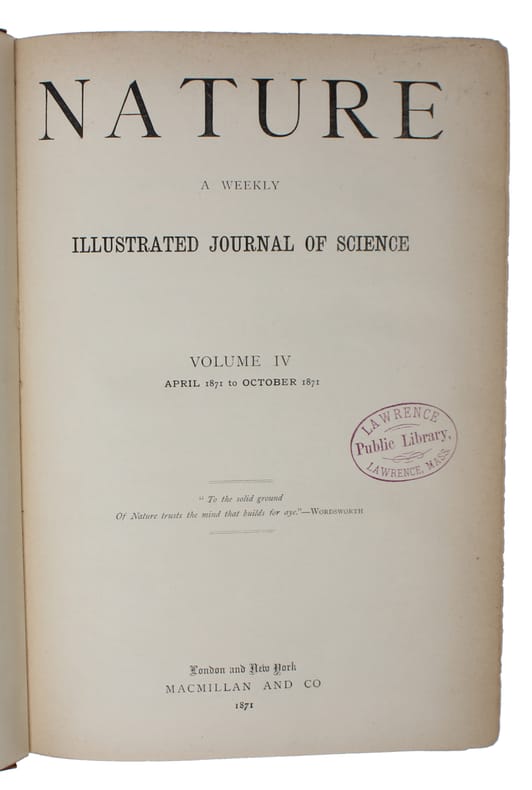
187160108London and New York Macmillan and Co. 1871. Royal8vo. In publisher's original red embossed cloth. In "Nature. A Weekly Illustrated Journal of Science" Vol. 4 April-October 1871. Stamp to title-page and p. 1 and ex-libris pasted on to pasted down front end-paper. Binding with wear and light soiling spine partly detached with a 7 cm long tear to rear hindge. Internally fine and clean. Darwin's paper: Pp.180-181. Entire volume: XII 520 pp. <br/><br/><em>First appearance of Darwin’s short notice to Henry Hoyle Howorth 1842-1923 geologist and naturalist. F1754 </em> hardcover
187160108London and New York, Macmillan and Co., 1871. Royal8vo. In publisher's original red embossed cloth. In ""Nature. A Weekly Illustrated Journal of Science"", Vol. 4, April-October 1871. Stamp to title-page and p. 1 and ex-libris pasted on to pasted down front end-paper. Binding with wear and light soiling, spine partly detached with a 7 cm long tear to rear hindge. Internally fine and clean. Darwin's paper: Pp.180-181. [Entire volume: XII, 520 pp].
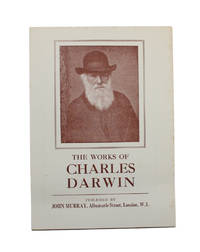
1900031933UK: John Murray 1900. Paper. Near Fine. 24mo - over 5" - 5¾" tall. C1900 A Lovely Rare Four Sided Flyer Printed by John Murray for their Works of Charles Darwin Series that was published in the early 1900s. In near fine condition. Ref 19388 <br/> <br/> John Murray unknown
18361610171437xbvkStuttgart, Hoffmann'sche Verlags-Buchhandlung, 1836-1836. XIV, (2) 1.845 (1) bandübergreifend nummerierte Seiten. - Schwarz-grau marmorierte Original-Pappeinbände der Zeit mit handschriftlichen Papier-Rückenschildern; 8vo.(ca. 20 x 15 x 10 cm; ca. 2,1 kg.).
18324893England 1832. Letter written in brown ink on a folded sheet the back leaf containing an address in manuscript with a black wax seal a dragon with a D. The stamp has been cut from the letter without affecting the text. Letter by Francis Darwin announcing the death of his mother. The letter has been addressed to Samuel Tertius Galton in Birmingham the stamp has been cut from the letter without affecting the text. There is a black wax seal a dragon with a D on the verso. <br /> <br /> The text of the letter reads: My dear Galton /It has pleased God to remove our dearest mother from this world of sin & sorrow. She appeared to be much as usual until 2 o'clock & whilst sitting in her chair by the fire complained of general uneasiness. Sophie & I assisted her to the bed & she expired at 1/4 before 3 oclock in the presence of Dr. Bent & ourselves. She had thought herself so much better lately that Mrs. Hadley & Millicent were both sent home yesterday & the day before. /I hope Violetta will not suffer from this severe shock to us all. You shall hear again in a day or two. /Believe me affectionately yours / Frans S. Darwin.<br /> <br /> Violetta Darwin was the eldest daughter of Erasmus Darwin from his second marriage to Elizabeth Chandos Pole which took place in 1781. Violetta was married to Samuel Tertius Galton and the mother of Francis Galton. It is therefore likely that the Francis of this letter was one of her four brothers. unknown
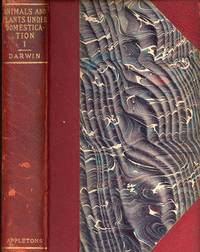
18978794New York: D. Appleton and Company 1897. 1897 Edition. Hardcover. Very good. Octavo. 5 x 8 in. xiv 473 x 495 pp. Volume one is occasionally illustrated with black & white reproductions of various animals. Very good in original half red morocco over marbled boards gilt lettering to spines still bright top edge gilt else some spots of rubbing to extremities with volume one having light cracking to leather along spine. and some discoloration to leather. A printing of the 2nd edition from 1897 considered the "authorized edition" edited by Darwin's son Francis Darwin. D. Appleton and Company hardcover
187418586Leipzig, Wilhelm Engelmann, 1874. Gr.-8°. Mit 12 (2 farb.) Tafeln, 210 Textholzschnitten u. 36 genetischen Tabellen. 1 Bl., XVI S., 1 Bl., 732 S., HLdr. d. Zt. m. goldgepr. Rückentitel.
1871013873London: Published by the author printed by Spottiswoode & Co 1871. 1st Edition. Hardcover. Very Good. Nobleman author's vanity binding of his ant-Darwin treatise with complimentary ALS from Darwin's publisher John Murray PM Gladstone Napoleon III Times publisher John Walter and 37 others bound-in. 8vo custom contemporary binding likely commissioned by the Baron himself in polished grey full leather gilt ruled covers front hinge recently repaired 137 pages of text followed by 41 ALS bound-in and in the rear 6 pages one-sided of a pasted-in newspaper review of the book from an unidentified publication. The review observes that Sir Walsh "found it necessary in drawing a parallel between astronomy and geology to allude to Darwin and Buckle Lord Ornathwaite makes their theories the subject of severe criticism." The ALS's bound-in are from peers and public figures variously complimenting Sir Walsh on his work many agreeing with the intellectual aspersions that Sir Walsh heaps on Darwin. Gladstone admits to not being particularly familiar with Darwin's work but posits nevertheless that evolutionary theory tears away at the "fabric of belief". But it is John Murray Darwin's own publisher who is shameless in criticizing the most famous author he will have published: "Although I happen to publish the works both of Buckle & Darwin I do not hesitate to myself a sceptic in the theories of both & I hope one day to see these fallacies exploded & should not be sorry to aid in this result." Most of the letters are on baronial estate or residential letterhead and bound-in chronologically from the end of 1871 through July 1872. Published by the author, printed by Spottiswoode & Co hardcover
1889feb02702<p>1889. First Norwegian Edition of Autobiography in 3 Volumes by Charles Darwin Son - Francis Darwin.<br /><br />liv og breve med et kapitel selvbiografi</p><p>Used book For more details and availability please contact me</p> Bibliothek for de tusen hjem hardcover
1888feb02667<p>1888. First French Edition of Autobiography in 2 Volumesby charles Darwin son Fancis Darwin.<br /><br />La vie et la correspondance de Charles Darwin avec un chapitre autobiographique</p><p>Used book For more details and availability please contact me</p> C. Reinwald hardcover
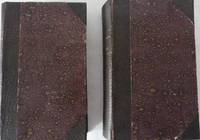
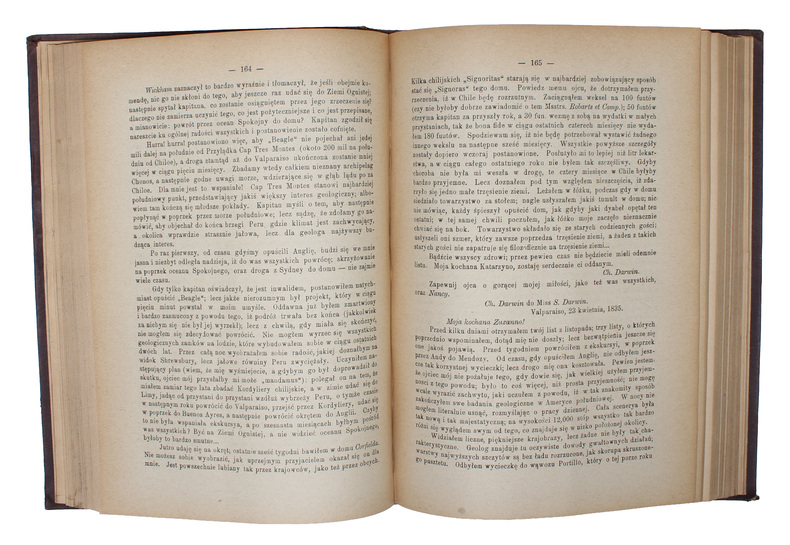
1891feb73967<p>1891: First Polish Edition of Autobiography by Charles Darwin<br /><br />Autobiografia i wybór listów. Wydane przez Syna<br /><br />Used. For more details please contact me</p> Wydawnictwo Przeglądu Tygodniowego hardcover
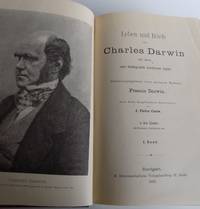
1887feb58494<p>1887:First German Edition of Autobiography in 3 Volumes bounded into one by Charles Darwin <br /><br />Used. For more details please contact me</p> E. Schweizerbartsche Verlagshandlung hardcover
189153494Warszawa Wydawnictwo Przegladu Tygodniowego 1891. 4to. In contemporary half calf with gilt lettering to spine and four raised bands. Spine with wear and top right corner 3 x 5 cm of title-page lacking not affecting text. Internally fine and clean. 4 446 2 pp. <br/><br/><em>Rare first edition of the first Polish translation of Darwin's autobiography.Freeman 1529 </em> hardcover
189153494Warszawa, Wydawnictwo Przegladu Tygodniowego, 1891. 4to. In contemporary half calf with gilt lettering to spine and four raised bands. Spine with wear and top right corner (3 x 5 cm) of title-page lacking, not affecting text. Internally fine and clean. (4), 446, (2) pp.
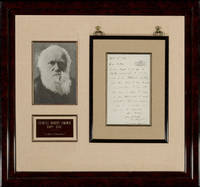
18661259011866. Signed. DARWIN Charles. Autograph letter signed. Down Beckenham Kent: Dec 17 1866. One leaf of black-edged mourning stationery measuring 4-1/2 by 7 inches penned on recto for one page; floated matted and framed with an early photographic card; entire piece measures 17 by 14 inches. $29500.Fine unpublished 1866 autograph letter written by Charles Darwin answering the questions of an anonymous correspondent concerning editions of his landmark work On the Origin of Species boldly signed by him with his full name ""Charles Darwin"" he often used ""C."" or ""Ch."" instead of his full given name. Beautifully framed with an early photographic card.The letter reads in full: ""Down Beckenham Kent Dec. 17th. Dear Sir Four editions of the Origin have appeared; that published last month is considerably added to & can be procured through any bookseller. I am glad to hear that you are interested in the subject. Dear sir yours faithfully Charles Darwin."" In November Darwin had copies of the substantially revised and augmented fourth edition of the Origin sent to Huxley and Wallace among others; their letters acknowledging receipt and praising the new edition are dated November 11 and November 19 respectively. The mourning stationery reflects the death of Darwin's sister Susan Elizabeth Darwin in October; another sister Emily Catherine Langton had died in January that year. See ""Darwin in letters 1866; Survival of the Fittest"" Darwin Correspondence Project online. Darwin Correspondence Project 5310F summary only. Very faint fold marks. Darwin's full signature bold and fine. Letters in which Darwin discusses his landmark work are particularly scarce and desirable. unknown
187932820659<p>One page. Original folds. Very good condition. Nicely framed.</p><p><strong>Darwin discusses the hereditary transmission of behavior and a vivid example of the phenomenon from the opening chapter of <em>The Expression of the Emotions in Man and Animals.</em></strong></p><p>In this letter Darwin thanks Fanny Kellogg for "communicating the curious case of an habitual gesture like that which I have described as inherited. I may add that since I wrote the action has been transmitted to another generation. Your case shall be sent to Mr. Galton who gave me the information."</p><p>In <em>The Expression of the Emotions in Man and Animals</em> 1872 Darwin had discussed the heritability of habitual gestures. There he cited at length a remarkable case related to him by his cousin Francis Galton. Galton a distinguished scientist in his own right was keenly interested in the inheritance in humans and the two men often shared findings and theories. Darwin quoted Galton in <em>The Expression of the Emotions</em> on page 33:</p><p>"A gentleman of considerable position was found by his wife to have the curious trick when he lay fast asleep on his back in bed of raising his right arm slowly in front of his face up to his forehead and then dropping it with a jerk so that the wrist fell heavily on the bridge of his nose. The trick did not occur every night but occasionally and was independent of any ascertained cause. Sometimes it was repeated incessantly for an hour or more. The gentleman's nose was prominent and its bridge often became sore from the blows which it received. At one time an awkward sore w as produced that was long in healing on account of the recurrence night after night of the blows which first caused it. His wife had to remove the button from the wrist of his night-gown as it made severe scratches and some means were attempted of tying his arm."</p><p>Galton went on "Many years after his death his son married a lady who had never heard of the family incident. She however observed precisely the same peculiarity in her husband but his nose from not being particularly prominent has never as yet suffered from the blows. The trick does not occur when he is half-asleep as for example when dozing in his arm-chair but the moment he is fast asleep it is apt to begin …" Galton further noted that the behavior had been passed down to the son's daughter. Darwin's letter offered here reveals that he learned after the publication of <em>Expression of Emotions</em> that yet another generation has acquired the remarkable habitual behavior!</p><p>This fascinating letter demonstrates the lengths to which Darwin went gathering data and telling examples for his writings. His published books reached a wide audience producing additional correspondence with yet more evidence for his theories.</p><p>The letter is also noteworthy for being signed in full "Charles Darwin" instead of the more usual abbreviated "Ch. Darwin."</p>
1869315466Down Beckenham Kent 1869. 3 pp. Bifolium of Down Bromley Kent stationery with "Bromley" crossed out and corrected to Beckenham. 1 vols. 8vo. Fine. 3 pp. Bifolium of Down Bromley Kent stationery with "Bromley" crossed out and corrected to Beckenham. 1 vols. 8vo. Unpublished.<br /> <br /> Charles Darwin 1809-1882 writes to Charles Layton London agent for Appleton about bringing out a revised and expanded second American edition of On the Origin of Species. The letter is a reply to Layton's of the day before in which he'd inquired after stereotyped plates of the English edition. In part:<br /> <br /> "The last or 5th Edit. of the Origin was printed off some months ago & it is impossible to supply stereotypes. I hope that you will inform Mr. Appleton of what I have said of the increased size of this last & 5th Edit. As 2000 copies of this Edit were printed there will not be a new Edit. for a considerable time . If Mr. Appleton will reprint this 5th Edition . I will pledge myself to endevour to persuade Mr. Murray to supply stereotype plates of my new book on the Descent of Man; but as I never before heard of such such a scheme I have no idea whether he will comply. At any rate I will please myself on the above conditions & on the terms suggested in your letter to send over the sheets as printed & stereotype casts of the woodcuts. But please remember my new book will not got to press for many months."<br /> <br /> Appleton had published the first American edition of Origin in 1860 from Murray's second English edition. In keeping with the terms of the present letter Appleton published the second American edition based on the 5th English edition in 1870 followed by the first American edition of The Descent of Man in 1871.<br /> See Darwin Correspondence Project DCP-LETT-7003 for Layton to Darwin 22 November 1869. unknown
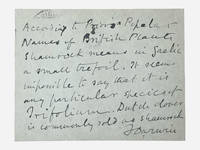
1900003924Original signed note. DARWIN Francis 1848-1925. Autograph Postcard Signed addressed to L. Cohen 14 Balham Park Road London SW. Camberley postmark 7 July 1900. 115 x 90 mm postcard with manuscript message to the correspondence side and address panel to reverse franked. Light handling wear otherwise very good. An interesting botanical note concerning the identity of the Irish shamrock. Responding to an enquiry Darwin cites Prior's Popular Names of British Plants and explains that "Shamrock means in Gaelic a small trefoil". He continues by observing that it is "impossible to say that it is any particular species of Trifolium" adding that "Dutch clover is commonly sold as shamrock". The note touches upon a long-standing botanical question namely the precise plant represented by Ireland's national emblem. Francis Darwin 1848-1925 botanist and son of Charles Darwin was a Fellow of Christ's College Cambridge and a leading authority on plant physiology. A desirable Francis Darwin autograph with scientific content relating to the identification of the shamrock. . Very Good. Soft cover. 1st Edition. 1st Printing. 1900. Original signed note paperback
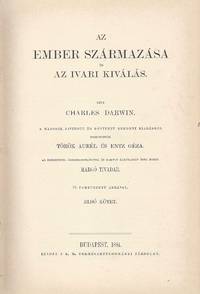
18841293Budapest: Kiadja a M. K. Természettudományi Társulat 1884. First Hungarian edition. In publisher’s red buckram with gilt title on spine and front panels blind stamped in two volumes. With bookplates and contemporary bookseller’s vignette on inner front panels. Covers are slightly rubbed at extremities. Endpapers reinforced at joints. Overall in very good condition. First Hungarian edition. In publisher’s red buckram with gilt title on spine and front panels blind stamped in two volumes. LXXI 1 1–542 2; VII 5 1–436 p. <p><br /> First Hungarian edition of Darwin’s 1871 book on human evolution and sexual selection “The Descent of Manâ€.<br /> <p><p><br /> Tivadar Margo 1816–1896 was a biologist the author of Darwin’s biography written for this edition and one of the earliest Hungarian Darwinists who wrote the first Hungarian zoological book that based on Darwin’s idea about the evolution. Margo had the chance to meet Darwin personally in 1875 he describes this meeting in the introduction of this book and also in the memorial lecture he held after the death of Darwin his fellow member of the Academy of Sciences Darwin was Honorary Fellow of the Hungarian Academy of Sciences as early as 1872.<br /> <p><p><br /> Aurél Török Géza Entz and Margo the translators and contributors of this book are among the most important figures to spreading Darwinism in Hungary.<br /> <p>. Kiadja a M. K. Természettudományi Társulat unknown
188453520Budapest Kiadja A. K. M. 1884. 8vo. In the publisher's original two embossed full red cloth bindings with gilt lettering to spine. Small vague stamp to both half-titles. Hindges loose on volume i. A fine fine and clean copy. LXXI 1 542 pp.; VII 5 436 pp. <br/><br/><em>The exceedingly rare first Hungarian translation of Darwin's The Descent of Man. "Compared with the original and with a biography by Margó Tivador" Freeman. The Hungarian public was introduced to Darwinism early on when Ferenc Jánosi reviewed The Origin of Species in the Budapesti Szemle Budapest Review a half year after it first appeared in English. Darwin's principal works were first published in Hungarian translation by the Royal Hungarian Natural Science Society Királyi Magyar Természettudományi Társulat. The Origin of Species translated by László Dapsy was published in 1873; The present work in 1884 and a few years later in 1897 the latter work was translated anew and published by László Seress. "It is characteristic of the enlightened spirit of the country in this period that Darwin received academic recognition earlier in Hungary than in England. Although Cambridge did not honor Darwin until 1879 he was elected an honorary member of The Hungarian Academy of Sciences in 1872 the same year on this occasion the renowned Hungarian zoologist Tivadar Margó visited him at Down.Historical circumstances played a major role in this quick appearance of Darwinism and its popularity in Hungary. The failure of the 1848-49 revolution and war of independence seemingly put an end to progressive political discourse signaling an ideological crisis among the intelligentsia. In this context the natural sciences with their 'eternal truths' promised a way out inasmuch as science's promised objectivity might well serve as a politically neutral expression of progressive values" Mund The Reception of Charles Darwin in Nineteenth-Century Hungarian Society."Darwin wrote in the preface to the second edition of 'the fiery ordeal through which this book has passed'. He had avoided the logical outcome of the general theory of evolution bringing man into the scheme for twelve years and in fact it had by that time been so much accepted that the clamour of the opposition was not strident. He had also been preceded in 1863 by Huxley's Man's place in nature. The book in its first edition contains two parts the descent of man itself and selection in relation to sex. The word 'evolution' occurs for the first time in any of Darwin's works on page 2 of the first volume of the first edition that is to say before its appearance in the sixth edition of The origin of species in the following year." Freeman.Freeman no. 1084. </em> hardcover
188453520Budapest, Kiadja A. K. M., 1884. 8vo. In the publisher's original two embossed full red cloth bindings with gilt lettering to spine. Small vague stamp to both half-titles. Hindges loose on volume i. A fine fine and clean copy. LXXI, (1), 542 pp."" VII, 5, 436 pp.
189242591London Harrison and Sons 1892. 4to. No wrappers as extracted from "Philosophical Transactions" 1891 Vol. 182 - Series A. Pp. 159-229. Clean and fine. <br/><br/><em>First appearance of a classic paper on the mathematics of tidal phenomena. </em> unknown
189242591(London, Harrison and Sons, 1892). 4to. No wrappers as extracted from ""Philosophical Transactions"", 1891, Vol. 182 - Series A. Pp. 159-229. Clean and fine.
187642751Leipzig: Engelmann. 1876-1879. XVI, 486 S HLdr. mit reicher floraler Rückengoldprägung und Goldschnitt.
190030140Neuwied & Leipzig, J.H. Heuser'sche Verlagsbuchhandlung, um 1900. 8°, 99 S., Bezahlung per PayPal möglich, we accept PayPal, Regalspuren am Fußschnitt, Einband ger. beschabt und ger. bestoßen und eingeschmutzt mit kl. Abrissen, altersbedingte Bräunungen, Gebr.sp., Interimsbindung