"DARWIN, CHARLES.Livre Rare Book
1 161 résultats
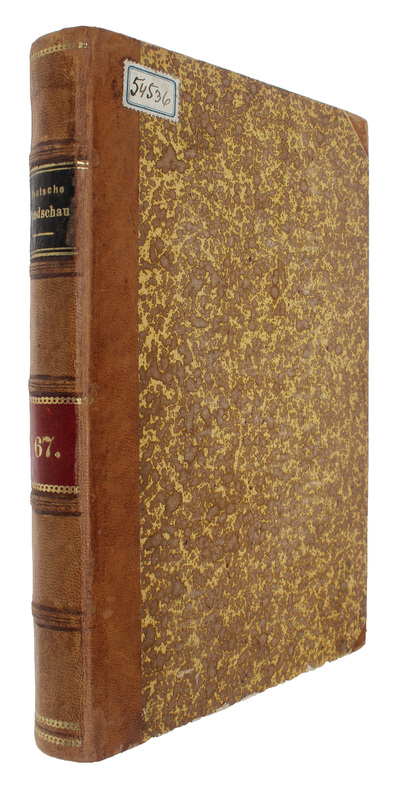
189153191Berlin, Gebrüder Paetel, 1891. Large8vo. In a nice contemporary half calf binding with 5 raised bands and gilt lettering to spine. In ""Deutsche Rundschau"", Band 67, 1891. Green leather title-label and red leather tome-label to spine, Small paper label pasted on to top left corner of front board. Two stamps to first leaf and one stamp to P. 476. Light wear to extremities, internally very fine and clean. Pp. 357-390. [Entire volume: IV, 480 pp.]
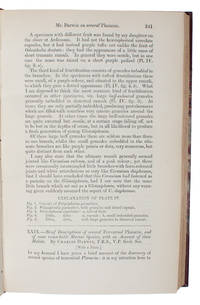
184456991London, Taylor and Francis, 1844. 8vo. In a nice later half morocco binding with five raised bands and gilt lettering to spine. Blind stamped to upper outer corner of first leaf of table of contents. In ""The Annals and Magazine of Natural History"", volume 14. A very fine and clean copy. [Darwin's paper] pp. pp. 241-251.. [Entire volume:] vii, [1] - 472 + 12 plates.
184456991London Taylor and Francis 1844. 8vo. In a nice later half morocco binding with five raised bands and gilt lettering to spine. Blind stamped to upper outer corner of first leaf of table of contents. In "The Annals and Magazine of Natural History" volume 14. A very fine and clean copy. Darwin's paper pp. pp. 241-251. Entire volume: vii 1 - 472 12 plates. <br/><br/><em>First edition of Darwin's paper on flatworms collected by him during the Beagle voyage one of the important early papers by Darwin on invertebrates originally intended for publication in The Zoology of the Voyage of HMS Beagle. This is Darwin's first publication on taxonomy: illustrated with a plate drawn by Darwin it describes a new genus and 15 new species of flatworm. Extremely rare on the market."The paper on flatworms . was Darwin's first venture into taxonomy. In it he described a new genus and 15 new species; most of the latter are still recognised as valid. He took a great deal of interest in these animals making extensive notes on their morphology and behaviour" Porter Darwin's Sciences.Previously familiar only with marine species Darwin was astounded to discover two new species of flatworm living on dry land in Brazil. He was intrigued by their close resemblance to snails and evolutionary questions may well lie behind his strong interest in them. PROVENANCE: From the collection William Pickett Harris Jr. 1897 - 1972 pencil note on p. iii. American investment banker and biologist. Following a career in banking Harris was appointed Associate Curator of the Museum of Zoology at the University of Michigan in 1928. "Harris played a highly important role in developing mammalogy and systematic collections of mammals at the University of Michigan" Hooper p. 923.Freeman 1669 </em> hardcover
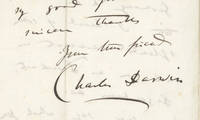
189153191Berlin Gebrüder Paetel 1891. Large8vo. In a nice contemporary half calf binding with 5 raised bands and gilt lettering to spine. In "Deutsche Rundschau" Band 67 1891. Green leather title-label and red leather tome-label to spine Small paper label pasted on to top left corner of front board. Two stamps to first leaf and one stamp to P. 476. Light wear to extremities internally very fine and clean. Pp. 357-390. Entire volume: IV 480 pp. <br/><br/><em>The Exceedingly rare first and only 19th century translation of Darwin's first published work "Letters on Geology" from 1835. The pamphlet was initially published without Darwin's consent and he was "a good deal horrified" when he learned about the publication which explains the posthumous translation. The work contains extracts from ten letters written by Darwin to John Stevens Henslow 1796-1861 during his five-year voyage on the Beagle. Henslow the charismatic and well-connected Regis Professor of Botany at Cambridge was Darwin's close friend and first mentor in natural history and responsible for obtaining for Darwin his position as ship's naturalist aboard the Beagle. Henslow had this pamphlet printed without Darwin's knowledge for distribution amongst the members of the Cambridge Philosophical Society "in consequence of the interest which has been excited by some of the Geological notices which they contain and which were read at a Meeting of the Society on the 16th of November 1835" an act which secured Darwin's reputation with the scientific community even before his return to England in October 1836. "It has always been assumed that it was issued to members of the Cambridge Philosophical Society in December 1835 and this is probably so but I have not seen a copy with a dated ownership inscription or accession stamp for that year" Freeman.The original pamphlet was reprinted in facsimile in 1960 again for private circulation in the Cambridge Philosophical Society and for friends of that Society. Only two translations has been made: The present first and a Russian from 1959 Freeman 7.Freeman No. 6. </em> hardcover
18632368-NFfM.,Hermann 1863. 4 Bl.,,274 S. Mit 20 Holzschn. im Text. Priv. Hln. d.Zt. mit Rückentitel, etw. berieben, Rücken etw. geschossen, Vorsätze etw. stockfleckig, Titel u. letzte S. gestemp., sonst innen nur ganz vereinzelt min. (finger)fleckig, insges. gut erh.
187520770Schweizerbart Stuttgart 1875 1875. Oln. 12 Bände. in gutem Zustand AZC17. HC Schweizerbart, Stuttgart 1875, unknown
1878140London: The Graphic 1878. First Edition. Very Good . 4to full page circular engraving of Charles Darwin 1809 - 1882 shortly before his death with text summarizing many of his accomplishments published by the London magazine The Graphic in 1878. An Excellent profile of the great naturalist suitable for framing. The Graphic unknown
18842502190011Theodor Thomas Leipzig 1884. Hardcover. Very Good. 6x1x9. Bound in publisher's cloth. Paper spine label. Hardcover. Gothic German text. Good binding and cover. Shelf wear. A couple markings on preliminary pages else unmarked. viii 442 1 p. ; 17 cm. <br> From the library Dr. Owen Hannaway. Hannaway was director of the Center for the History and Philosophy of Science at Johns Hopkins University. He authored numerous books and served as an editor of academic magazines in the history of science. Partial list of publications: Chemists and the Word: The Didactic Origins of Chemistry 1975; Observation Experiment and Hypothesis in Modern Physical Science 1985; The Evolution of Technology 1989; Science and the Practice of Medicine in the Nineteenth Century 1994; and The Foundations of Modern Science in the Middle Ages: Their Religious Institutional and Intellectual Contexts 1996. Theodor Thomas, Leipzig hardcover
18643456104/11/1864. <blockquote><p>Darwin's work had profound implications for the relationship between science and religion and here he opposed anyone who would seek to profess religious over scientific faith</p><p> </p><p>Scientists Darwin felt should work in the spirit of seeking ""truth"" with no preconceived notions</p><p> </p><p>The adoption of the Theory of Evolution by scientists is ""the real cream of the enjoyment to me; indeed it is to me worth far more than any medal.""</p><p> </p><p>Significantly he hopes to continue his work in science</p><p> </p><p>One of the most important Darwin letters we have carried</p></blockquote><p><img class=""alignnone wp-image-34774 size-post-window"" src=""https://cdn.raabcollection.com/wp-content/uploads/20251016172859/Darwin-2-1-1600x1200.jpg"" alt="""" width=""1600"" height=""1200"" /></p><p>Charles Darwin's ""On the Origin of Species"" was one of the most important books of all time. When it was published in 1859 there was skepticism within as well as without the scientific community about the central premise that species changed through time by a process Darwin labeled natural selection. The idea that human beings evolved from other previous species struck at the heart of the generally accepted belief that humans were different from other animals and that species were fixed or immutable. Everyone had learned the story of creation from the Bible and Darwin's ideas presented a challenge to those who looked at the question through a literal religious perspective. But Darwin hoped that scientists as well as others would be able to accommodate adopt an essentially new view and accept evolution. Yet at the same time he realized that many who had grown up in the previous scientific school would have a hard time doing so. It seemed that perhaps a new generation of scientists might have to rise before his work was generally accepted.</p><p>The Copley Medal the highest award of the Royal Society is given for “sustained outstanding achievements in any field of scienceâ€. In 1864 Darwin was nominated to receive the medal and was awarded it ""For his important researches in geology zoology and botanical physiologyâ€. Previous winners included scientists like Benjamin Franklin William Herschel Alessandro Volta Humphry Davy and Michael Faraday.</p><p>Hugh Falconer was a paleontologist and botanist who was an admirer of Darwin though not a convert to his theory of evolution. He seconded the nomination of Darwin for the medal and Darwin wrote to thank him for doing so. In his letter Darwin made some points of great importance: 1. That more and more scientists were becoming converts to his theory of evolution; 2. That he hopes to continue his work in science despite advancing age; 3. That scientists should work in the spirit of seeking truth with no preconceived notions and 4. That the support of scientists he respected like Falconer meant more than the medal to him.</p><p>Falconer was outraged by a petition that was circulating within Britain’s learned societies that attempted to limit the bounds of scientific enquiry. The petition claimed that scientific research was being “‘perverted by some…into occasion for casting doubt upon the Truth and Authenticity of the Holy Scriptures†and was specifically aimed against evolutionary theory and investigations into the antiquity of man. Falconer made clear to Darwin that he aimed to ""protest against the profession of religious against scientific faithâ€.</p><p><img class=""alignnone wp-image-34775 size-post-window"" src=""https://cdn.raabcollection.com/wp-content/uploads/20251016172938/Darwin-4-1-1600x680.jpg"" alt="""" width=""1600"" height=""680"" /></p><p><strong>Autograph letter signed</strong> four pages with the addressed envelope Down House headed stationery Kent November 4 1864 to Hugh Falconer making all the important points cited above. <em>“What a good kind friend you are. I know well that this medal must have cost you a great deal of trouble. It is a very great honor to me but I declare that the knowledge that you & a few other friends here so much interested themselves in the subject is the real cream of the enjoyment to me; indeed it is to me worth far more than any medal. So accept my true and cordial thanks. I hope that I may yet have strength to do a little more work in natural science; shaky and old though I be.â€</em></p><p><em>“I have chuckled and triumphed over your postscript about poor M. Brullé and his young pupils. About a week ago I had a nearly similar account from Germany and at the same time I heard of some splendid converts in such men as Rudolf Leuckart Carl Gegenbaur &c. You may say what you like about yourself but I look at a man who treats Natural History in the spirit with which you do exactly as good for what I believe to be the truth as a convert. Farewell my good friend with sincere thanks your true friend Charles Darwin.â€</em></p><p>In mentioning M. Brullé Darwin alludes to an amusing story told by Falconer to him in a previous letter relaying the complaint of the entomologist Gaspard Auguste Brullé that he heard of nothing but Darwin from his students.</p><p>Darwin need not have worried about his future productivity in this 1864 letter. Afterwards he wrote several more books which include “The Variation of Animals and Plants Under Domestication†1868 which explored the principles of heredity and how variations occur in domesticated species; his famous “The Descent of Man†1871 applying the theory of natural selection to human evolution and discussing sexual selection; “The Expression of the Emotions in Man and Animals†1872 examining the evolutionary origins of emotions and facial expression; and “The Formation of Vegetable Mould through the action of worms"" 1881.</p><p>Falconer replied to Darwin’s letter on November 7 and the spirit with which he treated Natural History and the reason for his support for Darwin were evidenced in that reply. Falconer explained that he believed the award of the Copley medal to Darwin was doubly important: “1. As regards due appreciation of yourself. 2d. As a determined protest against the profession of religious against scientific faithâ€.</p><p>Falconer was right to be concerned about the reaction of the religious community and its sympathizers to the theory of evolution. Darwin’s ideas provoked a harsh response from religious leaders and their allies of which this petition was one example. As examples of the criticism of evolution England’s highest-ranking Catholic official Henry Cardinal Manning denounced Darwin’s views as “a brutal philosophy – to wit there is no God and the ape is our Adam.†And Samuel Wilberforce the Anglican Archbishop of Oxford and one of the most highly respected religious leaders in 19th-century England also condemned natural selection in a now-famous speech on what he deemed the theory’s deficiencies.</p><p>This is one of the most important Darwin letters we have carried dealing as it does with support for his theory of evolution his hopes for future work in science and the role of science in seeking truth.</p><p><img class=""alignnone wp-image-25018 size-post-window"" src=""https://cdn.raabcollection.com/wp-content/uploads/20231204144051/Folder-site-11-1600x1327.jpg"" alt="""" width=""1600"" height=""1327"" /></p> unknown
1870266381870. <blockquote><p>Our first Darwin signed photograph in all these years</p></blockquote><p>Charles Darwin English naturalist whose scientific theory of evolution by natural selection became the foundation of modern biology and evolutionary studies. Darwin's explanation for the great unfolding of life through time - evolution by natural selection - transformed our understanding of the living world and focused attention on the cumulative inherited change in a population of organisms through time leading to the appearance of new forms: the process by which new species or populations of living things develop from preexisting forms through successive generations. Darwin revolutionized the understanding of the development of living things as Einstein revolutionized our understanding of the physical universe.</p><p>An attractive<strong> Carte de Visite signed</strong> <em>""Ch. Darwinâ€</em> circa late 1870s very good condition though with a few small adhesive tape marks. The photograph was taken by Elliott & Fry 56 Baker Street London and has their front and back stamps. For a century after its founding in 1863 the firm’s core business was taking and publishing photographs of the Victorian public and social artistic scientific and political luminaries. Among the notables known to have sat for a photograph by Elliott & Fry were Prime Minister William Gladstone Alfred Lord Tennyson W.S. Gilbert Rudyard Kipling Oliver Wendell Holmes Sr. Florence Nightingale and Charles Darwin.</p><p>In all our years in the field we have seen just a handful of Darwin signed photographs and have never ourselves had one. This is indeed a rarity. But the provenance is just as fascinating as finding a signed Darwin photograph with provenance is perhaps unique.</p><p>William Bateson was a British biologist who founded and named the science of genetics and whose experiments provided evidence basic to the modern understanding of heredity. He was a dedicated evolutionist and his early works on the mechanisms of biological evolution were strongly influenced by Charles Darwin though he believed that Darwin’s theory of evolution required a firmer base in heredity. Bateson also became the foremost champion of Gregor Mendel’s work on genetics. Darwin died in 1882 when Bateson was at college and though Bateson may have written Darwin such letter is unknown. Bateson and his wife did however correspond with Darwin’s family in later years as “Darwin Online†indicates.</p><p>This CDV comes with an <strong>autograph letter signed</strong> from Darwin’s granddaughter Margaret Keynes dated January 23 1929 addressed to Sir George Buckston Browne proposing an alternative date for her and her husband Dr. Geoffrey Keynes to come for lunch expressing gladness that Browne wanted <em>""the Bateson letter and the other things""</em> and acknowledging that he attended the same school as Dr. Keynes. Browne had bought Darwin's old home so lunch there would have been a homecoming of sorts for Margaret. Finding the CDV and letter together we would conjecture that this CDV was the property - one of <em>“the other thingsâ€</em> - of Margaret that she mentioned in the letter that she was glad Browne wanted and had descended in the family to her along with the Bateson letter. Thus this CDV was apparently property of the Darwin family the most important provenance imaginable.</p><p><img class=""alignnone wp-image-25018 size-post-window"" src=""https://cdn.raabcollection.com/wp-content/uploads/20231204144051/Folder-site-11-1600x1327.jpg"" alt="""" width=""1600"" height=""1327"" /></p> unknown
1900R0637-NLpz.,Thomas (um 1900). 112 S. Mit Titelportr. Illustr. Oln. im Jugendstil, min. bestoßen, schönes Expl. - Klassiker der Naturwissenschaften II.Bd [2 Warenabbildungen]
1893186231-1Stgt., Schweizerbart 1893. VI, 386 S. Mit 1 Porträt-Taf. u. 1 Handschriften-Faksimile. Original-Kartonband
18931212041Stuttgart; E. Schweizerbart'sche Verlagshandlung (E. Koch), 1893. IV; 385 Seiten; graph. Darst.; 23,5 cm; fadengeh. Orig.-Pappband.
188942682Boston: The New Ideal Publishing Company 1889. 1st printing. Modern marbled paper wrappers with printed paper title label to front wrapper. A bit of age-toning to text block. Overall VG. 3 26 - 51 3 pp. Adverts last 2 pages. 7-3/8" x 5-1/4" <br/><br/>"The publication of the series of essays on Evolution delivered under the auspices of the Brooklyn Ethical Association is undertaken in response to a general and increasing demand for a correct statement in popular form of the leading ideas inferences and tendencies involved in the acceptance of the Evolution Philosophy together with a clear statement of the main lines of evidence or proof by which the conception of Evolution is sustained. . The different phases of the subject are treated in this series in a certain natural order of succession which the student and reader will do well to follow in the perusal of the lectures." Preface. OCLC shows a bound volume of the entire series held in one copy Am Phil Soc Lib and the NUC lists this separate title as held in just one location: NYPL. The New Ideal Publishing Company unknown books
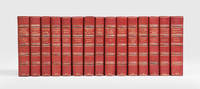
1896189921New York: D. Appleton and Company 1896-97. A finely bound set of the first collected edition The Authorized edition. This was the first serious attempt towards a uniform collection an idea that was not comprehensively achieved until the late 20th-century. There was no collected edition published during Darwin's lifetime. Together 12 works in 15 vols octavo 196 x 133 mm. Illustrated with photographic half-tone plates folding maps line drawings and diagrams. 20th-century red half morocco by Asprey spines lettered in gilt red cloth sides marbled endpapers top edges gilt the rest uncut. In fine condition. hardcover
1890126612c.1890. Highly unusual Darwinian polyptych Striking and handsomely presented photographic polyptych of major British figures of the late 19th century a number having a strong association with Charles Darwin or his "bulldog" T. H. Huxley including Frederick Temple archbishop of Canterbury Sir John Lubbock and Huxley himself. Top row: 1 Queen Victoria 1819-1901: this fine portrait was taken by the studio of William Ernest Downey described by a contemporary as "the doyen of British professional photographers". He first photographed Victoria in the early 1860s; "royal patronage undoubtedly assisted the firm which grew to be one of the premier society photographers of the late nineteenth century" Encyclopaedia of Nineteenth-Century Photography vol. I p. 436; 2 Frederick Temple 1821-1902 archbishop of Canterbury: Temple welcomed the insights that Darwin's theory of evolution offered to religion and in an essay entitled "Religion and the Doctrine of Evolution" published in The Popular Science Monthly December 1884 declared that "the doctrine of Evolution restores to the science of Nature the unity which we should expect in the creation of God"; 3 Sir Wilfrid Lawson second baronet 1829-1906 politician and temperance campaigner; 4 Ernst Haeckel 1834-1919 zoologist Darwin's leading popularizer in Germany; 5 Sir John Lubbock 1834-1913: "was the closest of CD's younger friends and frequent visitor to Down House from childhood. Lubbock suggested Westminster Abbey funeral for CD and organized letter to the Dean; served as a Pall Bearer" Freeman; 6 Frederic Farrar 1831-1903 dean of Canterbury novelist and philologist: "in 1860 he published An Essay on the Origin of Language. This work emphasizing the onomatopoeic force of primitive language and its evolutionary development interested Tennyson and intrigued Darwin who made use of it in The Descent of Man and proposed Farrar for a fellowship of the Royal Society in 1866. Years later Farrar controversially arranged for Darwin to be buried in Westminster Abbey and preached the funeral sermon" ODNB; he too was also a pall bearer at the funeral. Bottom row: 7 John Ruskin 1819-1900 "one of the great thinkers and critics of the Victorian period" NPG: "1879 CD met and made friends with in the Lake District; visited his home Brantwood Coniston" Freeman; 8 Sir Frederick Leighton 1830-1896 painter and president of the Royal Academy. Leighton and T. H. Huxley sat together on the Provisional Council of the National Trust in July 1894; 9 William Ewart and Catherine Gladstone 1809-1898 "the grand old man of British politics; leader of the Liberal Party and prime minister in four governments from 1848 to 1894" National Portrait Gallery: "1876 visited Down House Darwin's Kent home in company with Huxley. 1877-79 CD corresponded with mostly on behaviour" Freeman; 10 Lord Salisbury 1830-1903 prime minister on three separate occasions between 1885 and 1902 married to Georgina Alderson who "was on 'Personal Friends invited' list for CD's funeral" Freeman and a cousin of Darwin's wife Emma; 11 T. H. Huxley 1825-1895 known as "Darwin's Bulldog" was "a key figure in Victorian scientific life. A vigorous supporter of Darwin's theory of evolution particularly during the famous 1860 Oxford debate with Samuel Wilberforce Bishop of Oxford" NPG; 12 William Booth 1829-1912 founder of the Salvation Army. Following the publication of In Darkest England and the Way Out 1890 - "a classic in the literature of poverty" ODNB - Booth was attacked by T. H. Huxley: "In the winter of 1890-91 the 'bulldog' spirit in Huxley was briefly sidetracked into tangling in The Times with what he felt was the dangerously authoritarian structure and financially irresponsible governance of General William Booth's Salvation Army" J. Vernon Jensen Thomas Henry Huxley: Communicating for Science 1991 p. 122. Folding red grain skiver arch-top display case 360 X 135 mm unfolding to 855 mm wide each window glazed and with a gilt border liner of dark blue silk embossed with a foliate pattern. 12 original cabinet card photographs by various studios Barraud Bassano W. & D. Downey Elliott & Fry London Stereoscopic Company John Moffat of Edinburgh James Russell & Sons; all measuring approximately 140 x 105 mm 5 1/2 x 4 inches some trimmed to fit frame. A few light abrasions to case glass missing from portrait of Booth otherwise in particularly nice condition. Freeman Charles Darwin: A Companion. unknown
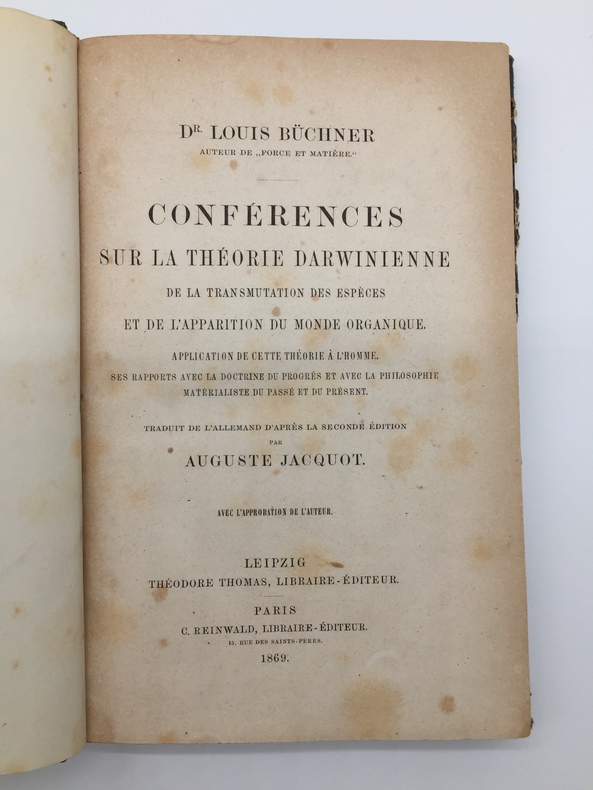
1869W60778Leipzig/ Paris, Théodore Thomas/ Reinwald 1869 xvi + 281pp., 22cm., reliure cart. (plats marbrés, dos en cuir avec titre doré), 2 cachets sur page de titre, feuilles de agrde marbrées, qqs.rousseurs, bon état
18691703Couverture rigide Théodore Thomas - C. Reinwald 1869 Leipzig-Paris 21,5x13,5 cm
1877feb02642<p>1877. First German Edition of Cross and Self Fertilisation by Charles Darwin<br />Die Wirkungen der Kreuz- und Selbst-Befruchtung im Pflanzenreich<br /><br /></p><p>Used book For more details and availability please contact me</p> E. Schweizerbartsche Verlagshandlung hardcover
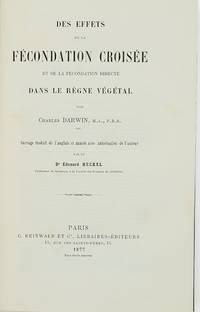
1877feb58554<p>1877: First French Edition of Cross and Self Fertilisation by Charles Darwin<br /><br />Des effets de la fécondation croisée et de la fécondation directe dans le règne végétal<br /><br />Used. For more details please contact me</p> C. Reinwald hardcover
1865266902Verlag der Daheim Expedition in Leipzig. Bielefeld Velhagen u. Klasing, 1865. 772 Seiten. mit zahlreichen Illustrationen Originalhalbleinen. 29 cm
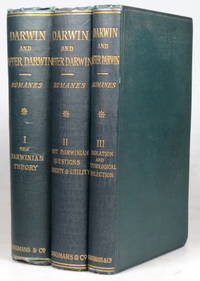
189740531London: Longmans Green and Co. 1905 1900 1897. Mixed impressions third "new" i.e. second and first printings respectively. Three volumes. Publisher's uniform dark green cloth gilt lettered to the spines contemporary monogrammed bookplate of a Frederic Weston to all three front pastedowns plus another's ownership inscription to the first half title dated 1918. Frontispiece portraits to each volume plus further illustrations in the text. A very good set. London: Longmans, Green, and Co. unknown
189232936Chicago: Open Court Publishing 1892. 12mo. xiv 2 460 pp. plus 4 pp. publ. ads. Engravd frntsp. numerous engravings text illusts. Blue cloth gilt lettrng mnr bmpng to crnrs shlfwr VG- w/ numerous contemporary clippings laid-in. First edition of this first volume in the author's exposition of evolutionary biology including sections on the major proponents of Darwin and their advances and discoveries in classification morphology embryology palaeontology natural selection and more. Open Court Publishing, hardcover
189014488London: Ward Lock 1890. The Minerva Library of famous Books edited by G T Bettany. With a critical introduction to each work by Prof. John W. Judd. Spine bumped. Cloth. Very Good. 12mo - over 6¾" - 7¾" tall. Ward Lock Hardcover
1894206565Ward Lock and Bowden Limited 1894. 12th. Hardback. Very Good/No Jacket. Ink stamped 'From Dr. Williams's Trustees' to title page gift inscription to half title light foxing to edges and a little throughout general edgewear to boards. Ward, Lock and Bowden Limited hardcover