6 067 résultats
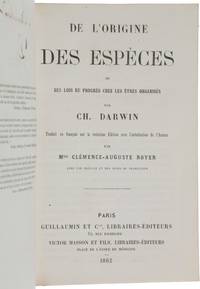
1862176464Paris: Guillaumin et Cie Victor Masson et Fils 1862. With an autograph letter signed by the woman Darwin judged "one of the cleverest" in Europe First edition in French translated and edited by the self-taught theorist feminist and author Clémence Royer 1830-1902 together with a loosely inserted autograph letter signed by her. Her lengthy preface and extensive footnotes pre-staged the rise of social Darwinism and anticipated several of the issues Darwin himself would later consider in the Descent of Man 1871. After reading Royer's edition Darwin judged her "one of the cleverest & oddest women in Europe" Darwin Correspondence Project. The French philosopher Renan went further deeming her "almost a man of genius". Although Royer had no scientific training she worked closely with the naturalist René-Édouard Claparède 1832-1871 to ensure that her translation of Darwin's biology was technically accurate. However Royer transcended the typically passive role expected of female translators and took a considerably more active engagement in the final text - a move seen at the time as a distinctly masculine one. Assuming an editorial capacity she outlined her own interpretation of Darwinian science bullishly exploring consequences that Darwin had carefully left out and adding a Lamarckian slant to his theories. In this she was among the first to publicly draw eugenicist conclusions from Darwin's work. France had been particularly resistant towards Darwinian science in part because of Lamarck's continuing grip on its biological thought. By positioning Darwin as a defender of Lamarckian inheritance Royer became a prominent albeit unsystematic champion of Darwinian ideas in France. Darwin later chose to retain Royer for the second edition indicating she claimed that she understood the thrust of his thought better than most. In the enclosed autograph letter Royer writes to Alphonse de Calonne 1818-1902 the founder of the Revue Contemporaine to arrange a meeting regarding the publication of her novel Les Jumeaux d'Hellas 1864. Together 2 items: i octavo 175 x 111 mm. Folding lithographed plate facing p. 160; ii bifolium 130 x 105 mm written across 16 lines on the first page with Royer's embossed initials at the head. Contemporary black pebble-grain calf spine lettered in gilt and ruled in blind marbled endpapers. Near-contemporary critical pencil annotation to outer margin of pp. 107 and 341. Light rubbing moderate browning and foxing to contents two central gatherings a little proud: a very good copy. Freeman 655. unknown
46407667like new. unknown
18626677Paris: Guillaumin et Cie; Victor Masson et Fils 1862. First edition. <p>First edition in French of the single most important biological work ever written and the most disputed of its early translations - rendered prefaced footnoted retitled and intellectually re-framed by Clémence-Auguste Royer 1830-1902 the self-taught philosopher whom Darwin reading the finished book in June 1862 pronounced "one of the cleverest & oddest women in Europe." Royer's sixty-four-page preface is a manifesto - anti-clerical positivist proto-eugenic - enlisting Darwin's biology for a programme he had never endorsed. Her footnotes override his hedges; her rendering of natural selection as élection naturelle drifted toward the voluntarism he abhorred; her retitling ou des Lois du Progrès chez les êtres organisés substituted Lamarckian ascent for Darwin's competitive statistics. Darwin replaced her with Moulinié in 1873 and Barbier in 1876; but French Darwinism in its first decade was shaped as much by Royer's preface as by Darwin's text and the present book is the original container of that collision.</p>. The First Edition in French in the Translation Darwin Came to Regret. <p>First edition in French of the single most important biological work ever written and the most disputed of its early translations - rendered prefaced footnoted retitled and intellectually re-framed by Clémence-Auguste Royer the self-taught philosopher economist and feminist whom Darwin reading the finished book in June 1862 pronounced "one of the cleverest & oddest women in Europe." Royer's sixty-four-page translator's preface is not a preface in any ordinary sense. It is a manifesto: an anti-clerical positivist and proto-eugenic document that enlists Darwin's biology for a social and political programme he had never endorsed and would spend the rest of his life partly repudiating. Her footnotes run through the main text sometimes clarifying often disputing and occasionally correcting Darwin from positions he did not share. Her rendering of natural selection as élection naturelle rather than the later-standard sélection naturelle was a lexical choice he quietly detested. Her substitution of his sober subtitle - or the Preservation of Favoured Races in the Struggle for Life - with her own progressivist formula - ou des Lois du Progrès chez les êtres organisés - was an ideological edit. Darwin had seen none of this before publication. By 1873 he had arranged a new translation by Jean-Jacques Moulinié; by 1876 a further one by Edmond Barbier. But the damage if that is the word was done: French Darwinism in its first decade was shaped as much by Royer's preface as by Darwin's text and the present book is the original container of that collision.</p> <br /> <br /> <p>Darwin had had difficulty finding a French translator at all. Louise Belloc the first he approached declined on the grounds that the material was too scientific. Pierre Talandier a French political exile who had offered to undertake the work withdrew when no publisher would associate with him. Royer who was already placing her own two-volume Théorie de l'Impôt with the Parisian publishing house of Guillaumin learned of the vacancy and approached Darwin with a firm publishing agreement from Guillaumin et Cie and Victor Masson et Fils already in hand. On 10 September 1861 Darwin wrote to John Murray asking that a copy of the third English edition of the Origin be sent to her at 2 Place de la Madeleine Lausanne. What he knew of her was modest and on its face reassuring: she had delivered a course of scientific lectures in Lausanne in 1859; she had paid careful attention to Lamarck; she had corresponded with republican radicals across Europe; she had written on economics and on logic. The authorisation went forward. The French title page prints avec l'autorisation de l'Auteur in small capitals as if the phrase endorsed the whole enterprise; in fact it referred only to Darwin's permission to translate the third English edition of 1861. Royer proceeded without supervision.</p> <br /> <br /> <p>She was an extraordinary figure and the absence of supervision is in retrospect the decisive error. Born in Nantes on 21 April 1830 the illegitimate daughter of Augustin-René Royer - an army captain and Bourbon legitimist - and of Joséphine-Gabrielle Audouard a Nantes seamstress she acquired her full name only when her parents married in 1837. Her earliest childhood was spent in Swiss exile her father having taken part in the 1832 rebellion to restore the Bourbon dynasty; the family returned to France on his surrender and acquittal in Orléans. She received patchy formal schooling and a year at a convent school before after her father's death in 1849 educating herself through self-study and teaching certificates. In 1854 she taught at a girls' school in Wales - acquiring the English that would later serve her for Darwin - and there encountered a religious diversity that precipitated her own drift from Catholicism. She returned to France in 1855; a year later to Lausanne where she read systematically through the municipal library. She opened a women's course in logic in 1859 followed by a forty-lesson course on the Philosophy of Nature and History in which she was already arguing a Lamarckian transformism before she had so much as heard of Darwin. She began writing for the journals of Pascal DuPrat - the French republican politician with whom she would from 1865 live openly as "wife." In 1860 her entry on tax reform took second place in the canton of Vaud's competition; her two-volume Théorie de l'Impôt was published by Guillaumin in 1862 and it was through this connection that the Origin commission reached her. Her intellectual loyalties - to Comte to the Saint-Simonians to philosophical positivism in its most anti-theological form - were formed and in print before Darwin's book arrived on her desk. She saw in it the scientific foundation her programme had been waiting for. She did not see - or more likely did not care - that Darwin's argument was narrower than the use to which she proposed to put it.</p> <br /> <br /> <p>Her preface running to sixty-four pages before Darwin's own Introduction begins is accordingly a document of French intellectual life as much as of Darwinian biography. It opens with the creedal sentence of nineteenth-century positivism: a profession of faith in revelation - not the Mosaic or the Christian but the permanent revelation of man to himself through the cumulative acquisition of scientific truths and the elimination of inherited errors. A survey of world history follows arranged as the progressive overcoming of religious superstition by reasoned knowledge with Zoroaster Moses Confucius Pythagoras Plato and the Catholic Fathers adduced as steps in a single ascending arc and Darwin's theory of descent with modification presented as the latest and most decisive revelation of this secular kind. Royer is explicit that Darwin's theory must displace the Mosaic account of creation that it renders natural theology untenable that it is fundamentally and irremediably heretical and that those who attempt to reconcile it with Christian doctrine are either dishonest or confused. In the second half of the preface she applies the theory to human society arguing that the struggle for life observed in nature should be allowed to run its course in human populations without the artificial protections of charity welfare and the preservation of the weak by the strong - the passage which more than any other has earned her the retrospective label of an early eugenicist. The argument is made with verve and in excellent French. It is also wholly absent from Darwin's own text. The reader of this French first edition meets Royer before meeting Darwin and a great many of those readers - Clemenceau Zola the circle around the Revue des Deux Mondes the young Gustave Le Bon - took their first impression of Darwinism from this entry corridor.</p> <br /> <br /> <p>Her interventions did not end at the preface. Footnotes occur throughout the main text sometimes briefly and technically more often at length and argumentatively; where Darwin hedges she is firm; where he defers to theological sensitivities she removes the deferrals. Her choice of élection naturelle was defended on philological grounds - sélection she argued carried misleading overtones of deliberate choice - but in practice the word drifted toward a voluntarist almost teleological reading that was the opposite of Darwin's blind-statistical mechanism. Her retitling - the addition of ou des Lois du Progrès chez les êtres organisés - moved the centre of the book from the preservation of favoured races under competitive pressure to a supposed lawful ascent of organised beings an inflection Darwin took pains to resist throughout his career. Behind the scenes supervision had been attempted: the Geneva zoologist Édouard Claparède whom Royer had enlisted for biological advice tried and failed to temper her commentary and wrote to Darwin with some exasperation describing the attempt as hopeless. The book that resulted runs to LXIV XXIII 712 pages - LXIV the preface XXIII the French rendering of Darwin's own Historical Sketch newly added to the third English edition of 1861 and 712 the body of the text with Royer's notes running beneath it. Lithographed as the single illustration Darwin's branching diagram from Chapter IV was reset in Paris by the firm of Delarue preserving the fourteen geological horizons and the ancestral species A through L but carrying its captions and chapter head in French. The printing itself was not done in Paris proper but at Saint-Denis by the typographical house of A. Moulin whose imprint appears at the foot of the final text page. The book was issued on 31 May 1862.</p> <br /> <br /> <p>When his copy reached Down House in early June Darwin read it with a growing and characteristic unease. In mid-June he wrote to the American botanist Asa Gray the assessment that has become the most-quoted fragment of this whole episode: the French translator he told Gray was "one of the cleverest & oddest women in Europe"-an ardent deist violently hostile to Christianity convinced that the struggle for life could be made to account for all morality politics and human nature - and about to publish he predicted a strange production on exactly those subjects. The tone is recognisable. Darwin was rarely sharp about anyone; his method of expressing disapproval was to call a colleague odd or a book strange. What the understated sentence conceals is the deeper problem: a theory he had spent twenty years writing up with methodological caution was about to enter French intellectual life attached to Royer's philosophical programme and there was in the short term nothing he could do. A month later he would regret to Armand de Quatrefages that his translator had not known more of natural history; to Hooker that Royer corrected his own expressed doubts by appending footnotes denying that any doubt was warranted at all; to Claparède private thanks for an intervention that had plainly not worked.</p> <br /> <br /> <p>He could at least wait. A second edition of Royer's translation appeared in 1866 with expanded notes a new avant-propos and - in response to corrections Darwin had by now supplied - a switch from élection to sélection naturelle flagged by a defiant footnote in which Royer conceded the popular usage but declined to concede the underlying linguistic point. A third edition further revised but published without Darwin's knowledge appeared in 1870 from the same houses; by this time Darwin had issued the fourth and fifth English editions of the Origin none of whose corrections Royer had incorporated. Worse she had added to the third edition a further preface attacking the theory of pangenesis that Darwin had propounded in his Variation of Animals and Plants under Domestication of 1868 - a theory with no direct bearing on the Origin at all. That was the breaking point. In late 1869 Darwin wrote to his Paris publisher C.-F. Reinwald and through him to the young Geneva naturalist Jean-Jacques Moulinié asking for a fresh translation. Moulinié began the work at the end of 1869 rendering first from the fifth English edition and then as Darwin's sixth edition appeared in 1872 incorporating its new chapter and additions as an appendix. The Franco-Prussian war of 1870-71 and Moulinié's own illness delayed him and he died in 1872 before his translation could be published. The book appeared in 1873 from Reinwald with a prefatory letter from Darwin dated 23 September 1872 and printed in both English and French explaining the change of translator and renouncing any royalty from the new edition. Moulinié's successor at Reinwald Edmond Barbier then produced in 1876 a second fresh translation - this time from Darwin's definitive sixth English edition of 1872 - which became and has remained the standard French Origin. Royer was not finished. A fourth edition of her translation appeared from Flammarion in 1882 the year of Darwin's death; it continued to be reprinted by that house into the 1930s thirty years after Royer's own death in Paris on 6 February 1902.</p> <br /> <br /> <p>The consequences for French intellectual life were considerable. The working French naturalists of the 1860s were slow to embrace Darwin: Quatrefages Milne-Edwards and Claude Bernard either ignored the book or engaged with it sceptically and the Académie des Sciences declined to elect Darwin a correspondant until 1878 and then only in botany. Part of this reluctance was the French scientific establishment's native attachment to a Lamarckian transformism which it preferred to defend rather than replace; part of it was the tendency of French Darwinism as refracted through Royer to be dismissable as anti-clerical propaganda dressed up as science. Paul Broca coined the neologism transformisme in 1868 to name the hypothesis in its Lamarck-to-Darwin arc and it is symptomatic that French readers through the 1870s continued to locate Darwin inside Lamarck's genealogy rather than outside it. Royer's progressivist framing made it harder for them to distinguish Darwin's argument from the older broader and less biologically rigorous evolutionism of Lamarck and of Herbert Spencer with which her preface actively confused it. Darwin writing to Gaston de Saporta in 1872 remarked wistfully that French opinion of his work had been formed in large part on the basis of a translation that was not his own. Royer for her part went from strength to strength in Paris. In 1870 she became the first woman elected to the Société d'Anthropologie de Paris a body founded and still led by Broca; she published her own major work Origine de l'homme et des sociétés the same year; and Ernest Renan in a phrase that became famous and eventually furnished the title of Joy Harvey's modern biography described her as almost a man of genius. The preface to the first French Origin is today reprinted as a standalone text in Geneviève Fraisse's Clémence Royer philosophe et femme de sciences of 1985 and discussed at length in Harvey's Almost a Man of Genius: Clémence Royer Feminism and Nineteenth-Century Science of 1997 where its status as a founding document of French social Darwinism - and more quietly of French feminist scientific writing - is now generally acknowledged.</p> <br /> <br /> <p>The book itself aside from these celebrated peculiarities of its making carries the full text of Darwin's third English edition including the Historical Sketch that Darwin had added in 1861 in response to accusations of having neglected his predecessors. It is the earliest form in which a French reader could encounter the third-edition apparatus - Lamarck Geoffroy Saint-Hilaire Erasmus Darwin Chambers Wallace and the others whom Darwin acknowledged as having anticipated one or another piece of his theory. The branching diagram of Chapter IV the only illustration survives here in the Delarue lithograph cleanly printed and unreinforced. Darwin's closing sentence - on the grandeur of the view of life with its several powers having been originally breathed by the Creator into a few forms or into one - appears in Royer's French in perceptibly softened form with the divinely breathed-in creative act rendered as an impersonal first cause. Small as the adjustment is it is characteristic of her hand.</p> <br /> <br /> <p>The provenance is French and aristocratic from an unidentified Château de Beaulieu whose library stamp - an oval in blue ink with the legend CHÂTEAU DE BEAULIEU around the circumference and the owner's initials G. T. F. in the centre - is placed at the upper margin of the half-title above an ink signature Beaulieu and a flourished calligraphic initial D. A later pencil annotation below identifies the book as the Édition originale Française. Several Châteaux de Beaulieu are candidates - in the Allier the Charente the Loir-et-Cher and the Mayenne among others - and the monogram G. T. F. has not yet been matched to a documented collector.</p> <br /> <br /> <p>References: Freeman 655. For the English first edition of 1859: PMM 344b Dibner Heralds of Science 199 Horblit 18b Garrison-Morton 220. Fraisse Clémence Royer philosophe et femme de sciences 1985 reprinting Royer's preface in full; Harvey Almost a Man of Genius: Clémence Royer Feminism and Nineteenth-Century Science 1997.</p> <br /> <br/> <br/> <br /> <p>8vo 175 × 111 mm: LXIV XXIII 25-712 pp. Folding lithographed plate by Delarue of Paris bound between pp. 160 and 161. Printed at Saint-Denis by A. Moulin. Contemporary French half red morocco over marbled paper-covered boards spine with five raised bands set off by gilt double fillets gilt-lettered CH. DARWIN and ORIGINE DES ESPÈCES in the second and third compartments small gilt ornament to the remaining compartments red-speckled endpapers edges yellowed. Library stamp of the Château de Beaulieu monogrammed G. T. F. at the head of the half-title. Joints and hinges sound and unrestored; morocco fresh and unrubbed at the bands gilt bright; corners lightly bumped; text block clean and tight with the usual scattered light foxing to preliminaries; folding plate unreinforced without tears or repairs at the folds.</p> . Guillaumin et Cie; Victor Masson et Fils unknown
1160403589.Gpaperback. Good. Access codes and supplements are not guaranteed with used items. May be an ex-library book. paperback
1167733835.Gpaperback. Good. Access codes and supplements are not guaranteed with used items. May be an ex-library book. paperback
2013692684.Gpaperback. Good. Access codes and supplements are not guaranteed with used items. May be an ex-library book. paperback
1162416114.Ghardcover. Good. Access codes and supplements are not guaranteed with used items. May be an ex-library book. hardcover
186255642Paris Guillaumin et Cie Victor Masson et Fils 1862. 8vo. Bound partly uncut with the original wrappers in a very nice later full calf pastiche binding with four raised band and richly gilt spine. Gilt boarders to boards. Small repair to upper right corner of title-page not affecting text. An exceptionally fine and clean copy. LXIV incl. half-title I-XXIII 24- 712. pp. and 1 folded plate between pp.160 a. 161. <br/><br/><em>The scarce first edition of the controversial first French translation - bound partly uncut and with the original wrappers - of Darwin's masterpiece one of the most important books ever printed. This famed translation - done by self-taught female scholar - ended up causing quite a stir and adding to the theory of evolution some for Darwin quite unforeseen interpretations. Because of this the translator Clémence Royer gained notoriety as one of the leading eugenicists of the time. Darwin was very eager to have his work published in French. It is not known exactly how he happened on Royer as the translator but as she was familiar with the works of Lamarck and Malthus immediately realized the importance of Darwin's work and also had close connections to the French publisher Guillaumin she must have seemed perfect for the job. She had a naturalist help her with the biologically technical parts and made an excellent job of the translation. There was one big problem however - she went well beyond her role as a translator and added a 60-page preface and numerous explanatory footnotes that Darwin had not seen before publication. In the preface she challenged the belief in religious revelation she discussed the application of natural selection to the human race and she presented a pure eugenic theory explaining the negative consequences of protecting the weak and the infirm. She also promoted her concept of progressive evolution which had more in common with the ideas of Lamarck than with those of Darwin. Right after having seen the translation Darwin wrote in a letter to the American botanist Asa Gray: "I received 2 or 3 days ago a French translation of the Origin by a Madelle. Royer who must be one of the cleverest & oddest women in Europe: is ardent deist & hates Christianity & declares that natural selection & the struggle for life will explain all morality nature of man politicks &c &c!!!. She makes some very curious & good hits & says she shall publish a book on these subjects & a strange production it will be."After some reflection however Darwin began having more serious doubts and about a month later he wrote to the French zoologist Armand de Quatrefages: "I wish the translator had known more of Natural History; she must be a clever but singular lady; but I never heard of her till she proposed to translate my book." He had now also read the footnotes and wrote to Joseph Hooker: "Almost everywhere in Origin when I express great doubt she appends a note explaining the difficulty or saying that there is none whatever!! It is really curious to know what conceited people there are in the world."Freeman No 655 Freeman does not mention the plate which is present here. </em> hardcover
186250871Paris Guillaumin et Cie Victor Masson et Fils 1862. 8vo. Bound uncut and with the original printed front wrapper expertly restored in a very fine later half morocco binding with four raised bands and gilt title to spine. Very light minor brownspotting to a few pages. An exceptionally nice clean and attractive copy. LXIV incl. half-title I-XXIII 24- 712. pp. and 1 folded plate between pp.160 a. 161. Fully complete. <br/><br/><em>The scarce first French edition of Darwin's masterpiece one of the most important books ever printed. The "Origin" started the greatest of all intellectual revolutions in the history of Mankind.There were some difficulties with the first French edition. Mlle Royer who Darwin described as 'one of the cleverest and oddest women in Europe' and wished 'had known more of natural history' added her own footnotes. He was not really happy until the third translation by Éduard Barbier appeared in 1876. Freeman. Freeman No 655 Freeman does not mention the plate which is present here. </em> hardcover
186252388Paris Guillaumin et Cie Victor Masson et Fils 1862. 8vo. In contemporary half calf with gilt title to spine. Very light minor brownspotting to a few pages. Previous owner's name to half title. A fine copy. LXIV incl. half-title I-XXIII 24- 712. pp. and 1 folded plate between pp.160 a. 161. Fully complete. <br/><br/><em>The scarce first French edition of Darwin's masterpiece one of the most important books ever printed. The "Origin" started the greatest of all intellectual revolutions in the history of Mankind.There were some difficulties with the first French edition. Mlle Royer who Darwin described as 'one of the cleverest and oddest women in Europe' and wished 'had known more of natural history' added her own footnotes. He was not really happy until the third translation by Éduard Barbier appeared in 1876. Freeman. Freeman No 655 Freeman does not mention the plate which is present here. </em> unknown
1247967794.Gpaperback. Good. Access codes and supplements are not guaranteed with used items. May be an ex-library book. paperback
1160394660.Gpaperback. Good. Access codes and supplements are not guaranteed with used items. May be an ex-library book. paperback
1167906268.Ghardcover. Good. Access codes and supplements are not guaranteed with used items. May be an ex-library book. hardcover
1167641329.Gpaperback. Good. Access codes and supplements are not guaranteed with used items. May be an ex-library book. paperback
B9781167641329New. unknown
1024801012.Ghardcover. Good. Access codes and supplements are not guaranteed with used items. May be an ex-library book. hardcover
0364862971.Ghardcover. Good. Access codes and supplements are not guaranteed with used items. May be an ex-library book. hardcover
0364269979.Gpaperback. Good. Access codes and supplements are not guaranteed with used items. May be an ex-library book. paperback
ria9783752478822_inpPaperback. New. New Book; Fast Shipping from UK; Not signed; Not First Edition; N/A paperback
ria9783752478839_inpHardcover. New. New Book; Fast Shipping from UK; Not signed; Not First Edition; N/A hardcover
ria9783563049969_inpPaperback. New. New Book; Fast Shipping from UK; Not signed; Not First Edition; N/A paperback
3563049963.Gpaperback. Good. Access codes and supplements are not guaranteed with used items. May be an ex-library book. paperback
2012646980.Gpaperback. Good. Access codes and supplements are not guaranteed with used items. May be an ex-library book. paperback
1010480774.Ghardcover. Good. Access codes and supplements are not guaranteed with used items. May be an ex-library book. hardcover
3752478829.Gpaperback. Good. Access codes and supplements are not guaranteed with used items. May be an ex-library book. paperback