1 492 résultats
1837099074L. Henderson 1837. First of This Edition. Half Leather. Very Good. 8 vols. with 576 colored plates - 4 vols. of text and 4 vols. of plates. Binding appears to have been done c. 1920's. All the title pages show moderate foxing. L. Henderson hardcover
80369Paris Crochard 1835-1846. 8° T.1: XXXIII 587; T.2: VIII 726 S.; T.3: IV 760 S.; T.4-1: XXII 628 S. Tabellen; T.4-2: 691S.; T.5: VIII 503 S. Falttafel; T.6: VII 559 S. 1 Falttaf.; T.7: VII 656 S.; T.8: XII 848 S. HLdr. d. Zeit Deckel berieben etwas fleckig Bd. I Rücken am Kopf eingerissen. Vorsätze mit Leimschatten.min. stockfleckig min wasserfleckig einige Blätter eselohrig. Zweite Ausgabe. - Wellcome II 423. - Nissen ZBI 1008. Die EA erschien von 1798–1805. - Georges Léopold Chrétien Frédéric Dagobert Baron de Cuvier eigentlich Jean-Léopold-Nicholas Frédéric Cuvier; 1769-1832 in Paris französischer Naturforscher und Mitbegründer der Zoologie als vergleichende Anatomie. Georges Cuvier gilt als wissenschaftlicher Begründer der Paläontologie und machte die vergleichende Anatomie zu einer Forschungsdisziplin. Er untersuchte die Anatomie verschiedener Lebewesen und verglich systematisch alle Ähnlichkeiten und Unterschiede. Diese Studien ermöglichten ihm aus der Existenz einiger Knochen die Gestalt anderer Knochen und die zugehörigen Muskeln abzuleiten. So gelang ihm schließlich die Rekonstruktion eines ganzen Tierkörpers aus nur wenigen Teilen. 010 Paris, Crochard, 1835-1846 unknown
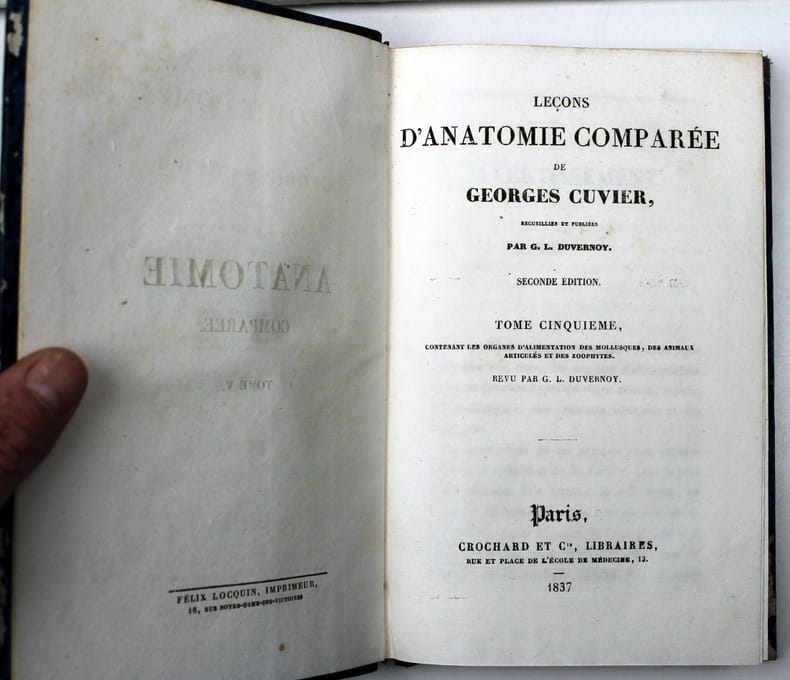
183594469Paris, Crochard, 1835-1846, in-8, 8 tomes en 9 vol, 2 tabl. depl, Demi-veau fauve de l'époque, dos lisses, ornés de filets dorés et à froid, pièces de titre et de tomaison noires, Seconde édition de cet ouvrage capital qui fut publié pour la première fois entre 1800 et 1805, en 5 volumes. Elle est ici corrigée, refondue et augmentée par Georges Louis Duvernoy, professeur au Collège de France, et par le collaborateur et élève préféré de Cuvier, Constant Duméril, qui fut le premier à enseigner l'anatomie comparée en France. Grâce à la qualité de son travail d'observation, Georges Cuvier (1769-1832) a posé les bases d'une méthode d'analyse et de comparaison à l'ensemble du règne animal et a établi l'Anatomie Comparée : cette science, nouvelle branche de l'histoire naturelle, est née grâce à la collaboration scientifique avec Geoffroy Saint-Hilaire, son ami d'alors. Sa méthode d'analyse et de comparaison à l'ensemble du règne animal le conduit à une classification reposant sur l'idée que les critères anatomiques et physiologiques des animaux sont dus à leur fonction et habitats et non l'inverse. Il décrit ainsi quatre grandes familles : les animaux vertébrés, les mollusques, les articulés et les radiaires. Cuvier est considéré comme le fondateur de la paléontologie et de l'anatomie comparée. Il a été le premier à appliquer la notion d'équilibre à la nature, en l'envisageant comme un immense réseau au sein duquel les espèces dépendaient les unes des autres. Cet esprit brillant, qui rédigea plus de 300 articles scientifiques et publia plusieurs monographies majeures, endossa plusieurs fonctions importantes : celles de professeur au Collège de France et au Muséum, de secrétaire perpétuel de l'Académie des Sciences ou encore d'inspecteur général de l'Instruction publique. Pourtant, sa croyance dans la préexistence des germes ne le disposait pas à admettre l'idée transformiste. À l'inverse, il tira avantage de sa gloire académique pour défendre la théorie créationniste : il s'opposa à Lamarck, qu'il railla jusque dans son éloge funèbre (1832), et à Geoffroy Saint-Hilaire, qu'il affronta dans le débat sur l'unité de la composition. Le tome 1 contient les généralités et les organes du mouvement des animaux vertébrés ; le tome 2, les organes du mouvement des animaux sans vertèbres, et l'ostéologie de la tête ; le tome 3, le système nerveux et les organes des sens ; le tome 4, les organes de la mastication, de l'insalivation et de la déglutition des animaux vertébrés ; le tome 5, les organes de l'alimentation des mollusques, des animaux articulés et des zoophytes ; le tome 6, la description du fluide nourricier, de ses réservoirs et des organes qui le mettent en mouvement dans les quatre types du règne animal ; le tome 7, la description des organes de l'élaboration et de dépuration du fluide nourricier, par la respiration et la sécrétion urinaire; et le tome 8, les organes de la génération et des sécrétions, avec une leçon complémentaire des organes de relations. Wellcome II, 423. Wood, 307. Couverture rigide
179838049Paris, Baudouin, An 6 (1798). 8vo. Contemp. hcalf, richly gilt back. Titlelabel with gilt lettering. Corners a bit bumped, otherwise fine. XVI,710 pp. and 14 engraved plates with many figs. A few scattered brownspots. Printed on good paper.
179838049Paris Baudouin An 6 1798. 8vo. Contemp. hcalf richly gilt back. Titlelabel with gilt lettering. Corners a bit bumped otherwise fine. XVI710 pp. and 14 engraved plates with many figs. A few scattered brownspots. Printed on good paper. <br/><br/><em>First editiuon of Cuvier's first work on comparative zoology in which he showed the affinities and similarities in the structure of present forms of animals researches which resulted in comparison with older forms and thereby giving the material for other theorists to suggest evolutionary lines and links. Cuvier is considered as the founder of modern palaeontology by this and his later published work "Recherches sur les ossemens fossiles.""Cuvier's first separate work "Tableau.1798" is based on a course of lectures he had delivered at l'Ecole du Pantheon. It wa the first general statement of his naltural classification of the aninal kingdom.He established the four great classes vertebrates molluscs articulates and radiates and classified the animals according to the anatomical structure." Milestones of Science No. 44 - Wood p. 307. </em> unknown
182918430Paris: Déterville and Crochard 1829. SECOND EDITION. With 20 full-page etched plates. Contemporary gilt green sheep-backed marbled boards. Ownership stamps of J.E. van der Dussen. A fine set. Second edition enlarged of this landmark in the history of zoology and comparative anatomy the most comprehensive biological work since Linnaeus. “Cuvier’s valuable work represented the fruits of a lifetime’s study of living and fossil animals. In his day Cuvier exerted an enormous influence on science. He played a leading part in the development of the science of palaeontology and stimulated the study of comparative anatomy†G&M. <br /> “It is in his classification of the animal kingdom into four main groups Vertebrata Mollusca Articulata and Radiata that he is so notably succeeded in giving a lead that has been followed by all his successors. . .Cuvier was the first to apply analyses and comparison to the entire animal kingdom. He also saw that this homogeneity in an individual should enable a competent naturalist to reconstruct a complete animal from any significant part of its anatomy†PMM.<br /> See PMM 276; Garrison-Morton 327; Dibner 195. Déterville and Crochard unknown
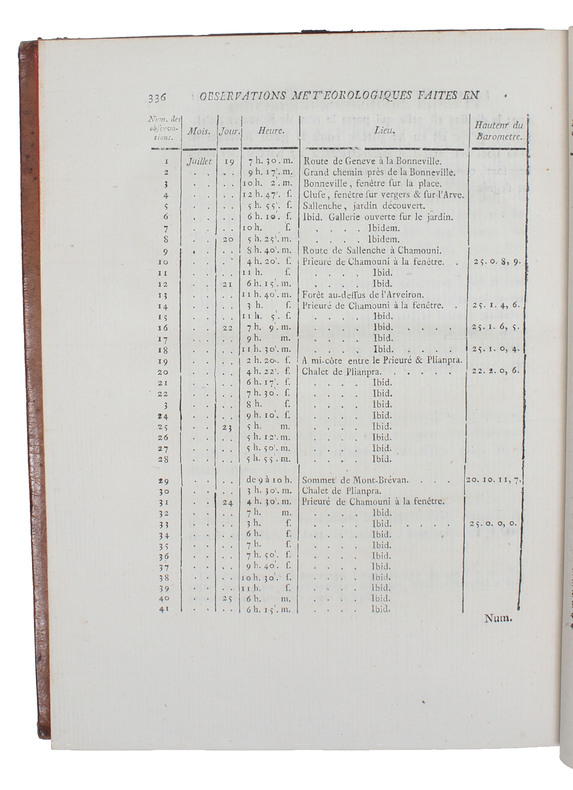
180547764Paris: De L'Imprimerie Impériale 1805. First complete French edition. Hardcover. vg- to vg. Quartos. Vol.1: xcvii 528pp 31pp. Vol.2: 460pp 84pp. Black leather over dark blue marbled paper boards. Gilt lettering and ruling on the spines. The first full French translation of compiled research from the Asiatic Society of Bengal originally published in English as the periodical journal "Asiatick Researches" from 1788- 1839. <br /> <br /> The text throughout contains a vast array of information in various realms of scientific historical philosophical religious and/or cultural topics from different authors. Volume 1 contains a total of 33 plates of copperplate engravings including 2 fold-out while volume 2 contains 11 plates plus 2 folding tables one one which a table of Persian grammatical influence on North India printed on blue-toned Arches papers measuring 22 1/4 x 28". Some of these plates contain illustrations while others contain geometric figures mathematical calculations astrological charts and samples of texts in various Asian scripts including Sanskrit Arabic and Chinese. In addition to the numbered plates there are many other un-numbered examples in-text as well as statistical tables some full page. The text throughout is accompanied by copious scholarly footnotes. Of special note is a sections of beautifully rendered plates containing images of various Hindu deities. Also includes a large fold out steel-plate engraved Hindu Zodiac with 27 images. The final section of volume one contains corrections and additions followed by tables of meteorological data also included in vol.2. <br /> <br /> This French edition notably has been revised and supplemented with various additional notes from a number of distinguished French scholars and scientists of the era including zoologist Georges Cuvier 1769 – 1832 mathematician and astronomer Jean Baptiste Joseph Delambre 1749 – 1822 naturalist Jean-Baptiste Lamarck 1744 -1829 and entomologist Guillaume-Antoine Olivier 1756-1814. <br /> <br /> Text in French.<br /> <br /> Bindings with some light rubbing and/or bumping to extremities. Light scratches to the covers. Interiors with minor sporadic foxing and/or water stains to the margins of a few pages throughout although in general the pages are surprisingly clean and vibrant. Book blocks quite tight. Bindings in very good- interiors in very good condition overall. About the society:<br /> The "The Asiatic Society of Bengal" now simply known as the Asiatic Society was founded in Calcutta in 1784 by British scholar philologist and civil civil Sir William Jones 1746-1794 in the early years of the British Raj. Its purpose as set forth was the furthering of Oriental research of all kinds as well as the collection of manuscripts and other relevant materials. It began publishing the work and research of its members all distinguished scholars in its periodical journal "Asiatick Researches". A museum set up to house and display its holdings as well as act as a hub or research was established in 1814. At first only Europeans could become members but starting in 1829 Indian were allowed to join as well. De L'Imprimerie Impériale hardcover
179844687Paris: Baudouin 1798. First edition 8vo pp. xvi 710; 14 folding engraved plates; full contemporary sheep upper cover a bit discolored gilt spine all edges red; binding rubbed lacking spine label; contemporary school prize manuscript inscription on front free endpaper; a very good copy internally about fine. "The first considerable work on zoology written by the celebrated Baron Cuvier. It has been frequently translated and formed a foundation for future editions and other treatises" Wood. Nissen 1012; Milestones of Science 44. <br/><br/> Baudouin unknown books
1822101313Paris, G. Dufour & E. d'Ocagne, 1822, in-4, [4]-VIII-428-[1] pp, 18 pl, Demi-veau blond postérieur, dos à nefs, pièce de titre cerise, tranches cailloutées, Nouvelle édition de l'Essai sur la géographie minéralogique des environs de Paris, entièrement réécrite et considérablement développée. Elle est illustrée de dix-huit planches en lithographies ou gravées en taille-douce, dont la très grande carte géognosique des environs de Paris, coloriée à la main. Cuvier et Brongniart, amis et confrère, publient ici leurs études communes sur les formations géologiques du Bassin de Paris, entreprises à partir de 1804. Ce célèbre mémoire a paru simultanément dans le Journal des Mines et dans les Annales du Muséum d'histoire naturelle en 1808, sous le titre d'Essai sur la géographie minéralogique des environs de Paris; puis il est publié en librairie en 1811, accompagné de la carte géognosique en couleurs (Paris, Baudouin). Saut de page de 2 à 5, sans manque de texte. Bel état intérieur. Petites galeries sur le plat inférieur. DSB III, 526. Ward & Carozzi n° 565. Couverture rigide
59478Paris F. G. Levrault 1828-33. Gr.8° Bd. I: XIV 422 S. 1 Bl.; Bd.II: XVII 371 S. Bd. III: 368 S.; Bd.IV: XX 379 S. 1 Bl.; Bd.V: XX 374 S. 1 Bl.; Bd. VI: XVIII 419 S. 1 Bl.; Bd. VII: XXII 399 S. 1 Bl.; Bd. VIII: XV 375 S. 1 Bl.; Bd. IX: XXIV 1 Bl. 379 S HLdr. der Zeit neu aufgebunden unter Verwendung der alten Rücken und Deckeln. Innen einige Bl. mit Rissen diese Hinterlegt asnonsten gutes Exemplar. Etwas berieben. Bibliotheksstempel a. Vorsatz. Einge wenige Bleistift anstreichungen. Nissen ZBI 1017. Leider ohne die legendären Fisch-Abbildungen.Georges Léopold Chrétien Frédéric Dagobert Baron de Cuvier 1769 -1832 französischer Naturforscher. Georges Cuvier gilt als wissenschaftlicher Begründer der Paläontologie und machte die vergleichende Anatomie zu einer Forschungsdisziplin. Er untersuchte die Anatomie verschiedener Lebewesen und verglich systematisch alle Ähnlichkeiten und Unterschiede. Diese Studien ermöglichten ihm aus der Existenz einiger Knochen die Gestalt anderer Knochen und die zugehörigen Muskeln abzuleiten. So gelang ihm schließlich die Rekonstruktion eines ganzen Tierkörpers aus nur wenigen Teilen. 010 Paris, F. G. Levrault, 1828-33 unknown
178344413Neuchatel, Samuel Fauche, 1783. 4to. Bound in fine contemp. full sprinckled calf, raised bands and richly gilt spine. Wear to head of spine. Without the 2 free endpapers. Halftitle present and with stamps. XXIV,367 pp., 2 engraved plates (1 folded). The folded plate depicts his two types of Hair-Hygrometers a. 1 engraved vignette. A fine clean and wide-margined copy.
178344413Neuchatel Samuel Fauche 1783. 4to. Bound in fine contemp. full sprinckled calf raised bands and richly gilt spine. Wear to head of spine. Without the 2 free endpapers. Halftitle present and with stamps. XXIV367 pp. 2 engraved plates 1 folded. The folded plate depicts his two types of Hair-Hygrometers a. 1 engraved vignette. A fine clean and wide-margined copy. <br/><br/><em>First edition of a fundamental work in Meteorology in which Saussure describes how to construct a hygrometer from human hair that can measure the relative humidity and discussing the principles behind it. Cuvier regarded this book as one of the greatest contributions to science of the eighteenth century."A milestone work in chemistry physics and meteorology which established hygrometry as an exact science. Primarely a geologist who explored and published on the Alps Saussure 1740-1788 was the first to prove that air expands and becomes less dense the more humidity it contains. In these Essais the work offered he describes his experiments with the hair hygrometer of his invention and his theory of the evaporation and hygrometry with their applications to meteorology. he also enunciates his theory of the evaporation of water in hydrogen carbon dioxide and other gases."Neville II p. 427 a."In his essay on the theoretical principles of hygrometry which he conceives as "the art of measuring the absolute quantity of water suspended in the air" De Saussure distinguishes three classes of methods of determining humidity which respectively utilize i observations of changes in the weight dimensions or shape of a hygroscopic body; ii observations of the capacity of the air for taking up water; and iii observations of the quantity of water condensing from the air under given conditions on a cold surface or of the degree of cold necessary to start such an condensation."Wolf "A History of Science Technology & Philosophy in the 18th Century" I p. 326 ff.Partington III 763. - Partington "Breakthroughs" 1783 M - Poggendorff II 755-56. </em> hardcover
183538516Paris, Crochard, 1835-1846, in-8, 8 tomes en 9 vol; , T.1: XXXIII, (1bl), 585, (1)pp.; T.2: VIII, 726pp.; T.3: (4), IV, 760pp.; T.4-1: XXVII, (1bl), 628, (4)pp.; T.4-2: (4), 691, (1)pp.; T.5: VIII, 503, (1bl)pp, 1tabl.; T.6: VII, (1bl), 559, (1)pp, 1tabl.; T.7: VII, (1), 656pp.; T.8: X, demi-basane verte de l'époque, dos plats ornés d'un large motif romantique doré, tranches mouchetées, Seconde édition de cet ouvrage capital qui fut publié pour la première fois entre 1800 et 1805. Elle est ici corrigée, refondue et augmentée par Georges Louis Duvernoy professeur au Collège de France et Constant Duméril qui fut le premier à enseigner l'anatomie comparée en France. Georges Cuvier (1769-1832) l'a revue lui-même. Cuvier fut le fondateur de la paléontologie des vertébrés et qu'il fut le premier à mentionner les théories des types morphologiques. Le tome 1 contient les généralités et les organes du mouvement des animaux vertébrés ; le tome 2, les organes du mouvement des animaux sans vertèbres, et l'ostéologie de la tête ; le tome 3, le système nerveux et les organes des sens ; le tome 4, les organes de la mastication, de l'insalivation et de la déglutition des animaux vertébrés ; le tome 5, les organes de l'alimentation des mollusques, des animaux articulés et des zoophytes ; le tome 6, la description du fluide nourricier, de ses réservoirs et des organes qui le mettent en mouvement dans les quatre types du règne animal ; le tome 7, la description des organes de l'élaboration et de dépuration du fluide nourricier, par la respiration et la sécrétion urinaire; et le tome 8, les organes de la génération et des sécrétions, avec une leçon complémentaire des organes de relations. Bon exemplaire en dépit de quelques rousseurs habituelles du papier de cette époque. Ex dono autographe signé de l'éditeur Victor Masson à son ami le Dr Barth Couverture rigide
183137709New York: Carvill 1831. <p>Cuvier Georges L. C. F. D. baron 1769-1832. The animal kingdom arranged in conformity with its organization. . . . Translated from the French with notes and additions by H. M'Murtrie M.D. 4 vols. 8vo. xxxii 448 2; xv 1 475 1; xx 575 1; xii 545 1pp. 20 engraved plates. New York: G. & C. & H. Carvill 1831. 220 x 133 mm. Speckled sheep ca. 1831 gilt-ruled spines slightly rubbed. Moderate foxing and browning but a fine copy.</p> . <p>First American Edition. See Dibner Heralds of Science 195 Printing and the Mind of Man 276 Garrison-Morton 327. The most influential exposition of the typological approach to animal classification representing the greatest body of zoological facts that had yet been assembled; it served as the standard zoological manual for most of Europe during the first half of the nineteenth century. Cuvier's view of animal organization led him to an early recognition of the balance of nature both with respect to the functional balance of parts in the individual and the interdependence of groups in the "network of nature." However Cuvier's adherence to the concept of species as rigid unchanging types rendered him unable to account for the immense variation within species populations. Coleman pp. 94-98. DSB. </p> . Carvill unknown books
1834deckert33736bc5G. Henderson 1834-1837. Hardcover. Good. 3/4 leather boards with marble maroon and gold title labels on spine 4 volumes of text and 4 volumes and color amazing amount of plates book showing wear about edges but all tight pages all vg G. Henderson hardcover
15903Paris, Crochard, Fortin, Masson , 1835 à 1846.
179862600Paris, Baudouin, 1798, in-8, XVI-710 pp, 14 pl, Demi-basane blonde, dos lisse et orné, pièce de titre noire, Édition originale du premier ouvrage de Cuvier, fondé sur les lectures qu'il fit à l'école du Panthéon l'an précédent. Dans sa Notice historique sur les ouvrages et la vie de M. le baron Cuvier Duvernoy écrit les "immenses services que M. Cuvier a rendus à la partie systématique de l'histoire naturelle, en introduisant dans les classifications zoologiques la méthode de l'ensemble des rapports; en distribuant dans un mot, le règne animal... M. Cuvier publia en 1798 sous le titre Tableau élémentaire de l'histoire naturelle des animaux, le premier exemple de cette distribution, telle que son génie avait conçue". Bien complet. Les feuillets liminaires (préface et explication des figures), ainsi que les planches sont reliés dans le désordre. Charnières fendillées. Nissen n° 1012. Couverture rigide
67369Paris A. Belin 1819-1829. Large folio approximately 53 x 35 cm. Five plates with explanatory text leaves. Not bound as issued. = Rare part of a magnificent publication with fine large plates of mammals from all over the world. The authors Geoffroy Saint-Hilaire 1772-1844 and Fréderic Cuvier 1769-1832 were the leading authorities in mammalogy in the first half of the 19th century and the Histoire Naturelle des Mammifères is widely regarded as their magnum opus. This section contains the Australian marsupials - a very little-known group then. It includes "Le wumbat" wombat; "Kanguroo ou macrope géant" two plates one with the red kangaroo the other with the grey kangaroo; Kanguroo ou halmature thétis" probably a "wallaroo"; and "Phalanger de Cook" Australian ring-tailed possum. All as issued without stamps annotations or other markings. All text leaves and all plates uncut and untrimmed resulting in very large margins. Due to these large margins some edges a bit frayed or with minor tears. Two plates irregularly age-toned a few text pages spotted. In all a set in very good condition. Brunet II p. 1536; Nissen ZBI 1525; Casey Wood p. 354. unknown
1817RO80000899Deterville. 1817. In-8. Relié demi-cuir. Bon état, Couv. convenable, Dos frotté, Intérieur frais. 255 pages.15 planches. Planche 1et 2 tachées.. . . . Classification Dewey : 590-Zoologie
6128P., Baudouin, An 6 (1798), un volume in 8 relié en plein veau, dos orné de fers dorés, filets dorés sur les plats, toutes tranches dorées (reliure de l'époque), (une coiffe usée, un mors fendu mais solide, manque de papier d'origine dans la marge du feuillet 679 sans atteinte au texte), 16pp., 710pp., 14 PLANCHES
90743<p>London Geo. B. Whittaker 1827 1st edition. Five Volumes. Hardback tall 8vo. 9.5 x 6 inches. In maroon full calf leather fine bindings diced and gilt paneled boards raised bands and gilt decorations to spines with twin black leather spine labels. Brown speckled page edges marbled endpapers. In very good condition. Covers rubbed some surface chips/nicks to leather on edges of boards. Spines and front of vol.5 faded. Also rear of vol.1 with some staining. Small binders label to corner of endpaper in v1. "W. Cater Launceston." Previous owners bookplates to endpapers "Rev.d Rich.D Gerveys Grylls Helston Cornwall." Some occasional minor handling marks else pages overall very clean and tight throughout. Barring some accumulated dust between top page edges. Colour plates all very clean and bright with lovely bright colouring. Else an very good set. 5 volumes: 352 513 468 498 & 391pp. Illustrated with 200 engraved plates 178 coloured and 23 in B&W. A comprehensive guide to the Animal Kingdom beginning with Man and the vertebrates. Based on the knowledge available in the late 19th century. Beautiful illustrations by Landseer.</p> London, Geo. B. Whittaker, 1827 1st edition hardcover
181720421Paris:: Chez Deterville 1817. First edition. contemporary quarter sheep gilt and marbled boards. Old stamped ownership signature on each front free endpaper; some light rubbing to the bindings. A very attractive set. 8vo. 15 engraved plates. PMM 276. Half-titles present. Chez Deterville, hardcover
18461948<p>Paris: Crochard et Cie 1846. Second expanded edition.</p><p><strong>PIONEERING ESTABLISHMENT OF THE SCIENCE OF COMPARATIVE ANATOMY.</strong></p><p>Eight volumes in 9 bindings 8 1/2 inches tall Vol. 4 is in 2 parts. Green quarter leather binding with gilt titles and compartments marbled paper covered boards patterned endpapers bookplate of NSR Maluf to each volume Vol. I i-xxxiii lithographic facsimile of letter from Cuvier 587 pp 1; Vol. II i-viii 726 pp; Vol. III 4 i-iv 760 pp; Vol. IV pt 1 i-xxvii 618 pp 4; Vol. IV pt 2 i-iv 691 pp 1; Vol. V i-viii 503 pp folding table; Vol. VI i-vii 557 pp 1 folding table; Vol. VII i-vii 1 656 pp; Vol. VIII i-xii. 848 pp. Covers corners spine ends worn light browning to pages the first blank and usually the half title of each volume have top edge corners clipped presumably to remove a signature not affecting text. Bindings tight pages unmarked very good in custom archival mylar covers. <strong>CONTENTS:</strong> Vol. I contains the principal discussion of Cuvier's famous theory of the correlation of parts- the functional relationship of each bodily organ to every other organ. Also considered are the organs of movement of vertebrate animals; Vol. II addresses the organs of movement of invertebrate animals and the osteology of the head; Vol. III considers the nervous system and sense organs; Vol. IV reviews the organs of mastication salivation and swallowing in vertebrate animals; Vol. V reviews the feeding organs of invertebrate animals; Vol. VI explores the nutritive fluid its reservoirs and the organs that set it in motion in the four types of the animal kingdom; Volume 7 the description of the organs of elaboration and purification of the nutritive fluid through respiration and urinary secretion; and Volume 8 the organs of generation and secretions the swim bladder of the fish and the organs of vocalization.</p><p><strong>GEORGES CUVIER </strong>1769 – 1832 was a French naturalist and zoologist sometimes referred to as the "founding father of paleontology". Cuvier was a major figure in natural sciences research in the early 19th century and was instrumental in establishing the fields of comparative anatomy and paleontology through his work in comparing living animals with fossils. He expanded Linnaean taxonomy by grouping classes into phyla and incorporating both fossils and living species into the classification. He laid the foundations for a method of analysis and comparison applied to the entire animal kingdom and a new branch of natural history was born thanks to his scientific collaboration with Geoffroy Saint-Hilaire. This was based on the theory that anatomical and physiological characteristics of animals are molded by their environment. He established four major families: vertebrates mollusks arthropods and radiates. He was the first to apply the concept of an ecosystem viewing it as a vast network in which species interact with one another.</p><p><strong>GARRISON-MORTON </strong>No. 311 "Cuvier played a leading part in the development of paleontology and stimulated the study of comparative anatomy. He ranks with von Baer as one of the founders of modern morphology. The posthumous second edition offered here revised and expanded by Georges Cuvier's younger brother Georges-Frédéric Cuvier to 8 vols. appeared from 1835-1846."</p> Crochard et Cie hardcover
2007Star-9788170416654Anmol Publications Pvt Ltd 2007. Hardcover. New. Anmol Publications Pvt Ltd hardcover