173 résultats
1813019666Edinburgh and London: Printed for William Blackwood John Murray and Robert Baldwin 1813. Book. Very good condition. Hardcover. 1st Edition. Octavo 8vo. 265 pages of text. Full original calf binding with one corner bumped and moderate shelfwear; hinges and spine extremities professionally mended. Ex-libris of Society of Writers to the Signet gilt stamped on both boards with a withdrawn label on the inside front cover. First and final pages of text are moderately foxed. Complete with a frontisportrait and one plate both of which are lightly browned and foxed a few pages with small creases and there is scattered soiling and minor wear throughout the text. Contemporary old pencil marginalia scattered throughout text. Height = 215mm 8 7/16 inches. First edition. Printed for William Blackwood, John Murray, and Robert Baldwin Hardcover books
1822019802Edinburgh and London: Printed for William Blackwood Edinburgh; and T. Cadell Strand London 1822. Book. Very good- condition. Hardcover. 4th Edition. Octavo 8vo. xxiv 454 pages of text. Full calf binding is rubbed with moderate shelfwear; rebacked in calf with original spine laid down. Complete with a frontisportrait and four plates all of which are lightly browned and foxed. Previous owner's engraved armorial bookplate on the inside front cover: Richard Hugh Sennett. First and final pages of text are moderately foxed. A few pages with minor creasing to the corners and a few pages with old pencil notations. Height = 216mm 8.5 inches. Fourth edition. . Printed for William Blackwood, Edinburgh; and T. Cadell, Strand, London Hardcover books
182819264[Paris] Imprimerie de C. Thuau s.d. [vers 1828] in-8 dérelié
184394472Fortin, Masson & Cie, 1843, in-8, 2 vol, [4]-351 + [4]-440 pp, Veau vert de l'époque, dos à faux nerfs et fleuronné, plaque romantique à froid sur les plats et filet d'encadrement doré, tranches marbres, Édition originale de ces deux tomes qui feront partie de l'Histoire des sciences naturelles, depuis leur origine jusqu'à nos jours, chez tous les peuples connus, en cinq volumes (Paris, Fortin & Masson, 1841-1845) : ils en forment la troisième partie, qui sera publiée en 1845 en tant que tomes IV et V. La rédaction de ces tomes est due à Magdeleine de Saint-Agy, qui indique avoir "complété" le cours de Cuvier, d'après la sténographie prise au cours des leçons au Collège de France. Ces deux volumes parus isolément se rencontrent rarement. Ces leçons de Cuvier commencèrent à la fin de l'année 1829, au moment où il réintégra sa chaire au Collège de France. Il s'agit de son tout dernier cours, qu'il laissa inachevé à sa mort. Le célèbre naturaliste, qui n'avait pas prévu d'en faire la publication, ne les avait pas non plus retranscrits dans leur totalité : confiant dans son talent d'orateur, il réalisait de "brillants discours (...) improvisés sur de simples notes et [qui] n'existent plus maintenant" (Sarah Lee, p. 226-228). Néanmoins, ses cours ont fait l'objet, dans les feuilletons du Temps, de comptes-rendus médiocres, qu'il réprouvait. Magdeleine de Saint-Agy annonce ainsi rattraper les erreurs des journaux, en prétendant avoir l'assentiment de Cuvier : "[J'écrivis] à M. le baron Cuvier. Le 10 avril 1830, il me fit l'honneur de me répondre : qu'il n'avait aucun motif personnel d'empêcher que je publiasse ses leçons; mais qu'il faudrait éviter la foule d'anachronismes et d'altérations de noms d'auteurs qui s'était glissée dans les articles des journaux; car autrement mon travail serait peu utile" (préface du rédacteur, tome Ier de l'Histoire des sciences naturelles, 1841, p. I). Dos insolé, rousseurs. Theodore Wells Pietsch. Introduction In : Cuvier's History of the Natural Sciences : Twenty lessons from the first half of the Eighteenth Century [en ligne]. Paris : Publications scientifiques du Muséum, 2018. Sarah Lee Bodwich. Mémoires du Baron Georges Cuvier publiés en anglais par Mistress Lee, et en français par M. Théodore Lacordaire sur les documens fournis par sa famille. Paris, fournier, 1833. Couverture rigide
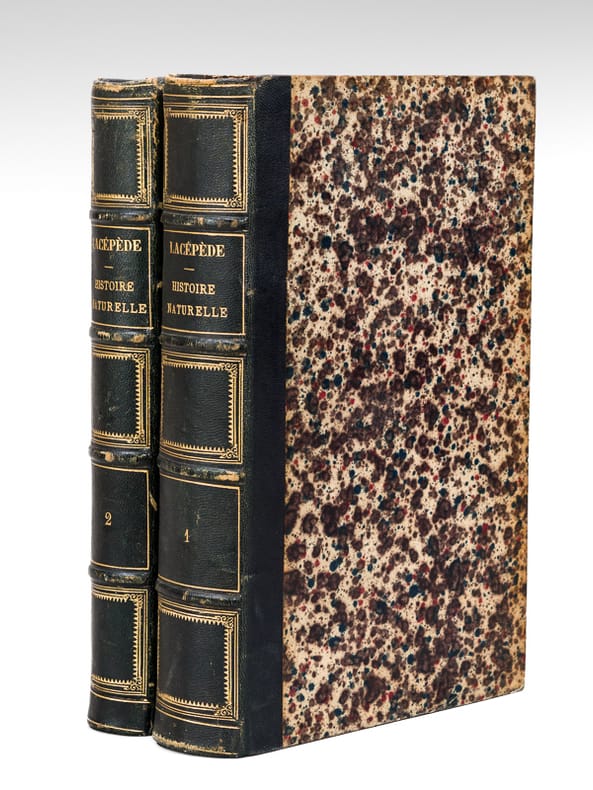
185071153Paris Furne et Cie 1850 2 In huit reliure d'éditeur en deli-chagrin vert xii-668 pp, 647 pp, texte sur deux colonnes, papier non piqué, bon état général ,ouvrage orné de 36 planches en couleurs protégées de serpentes
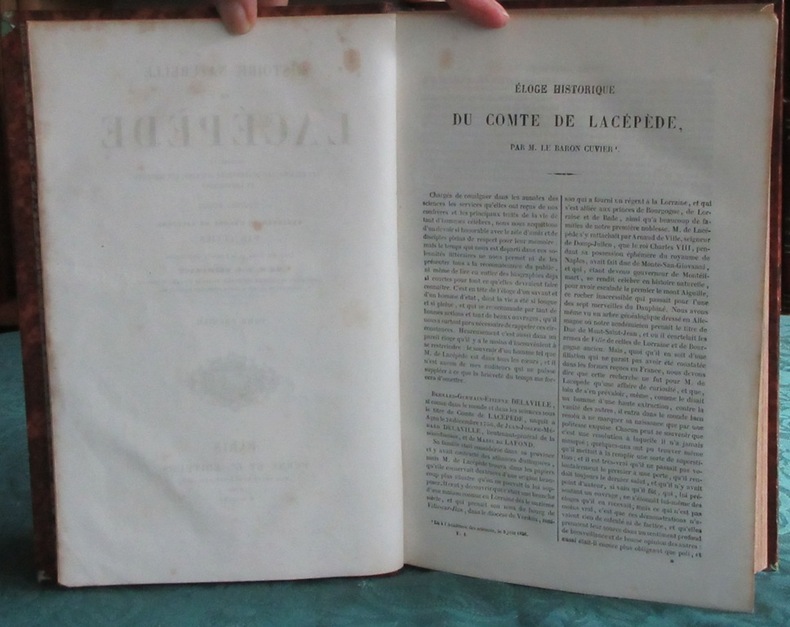
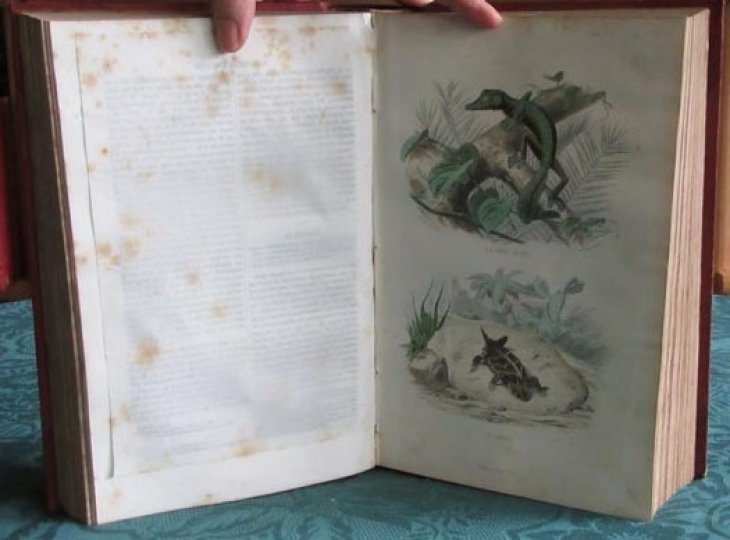
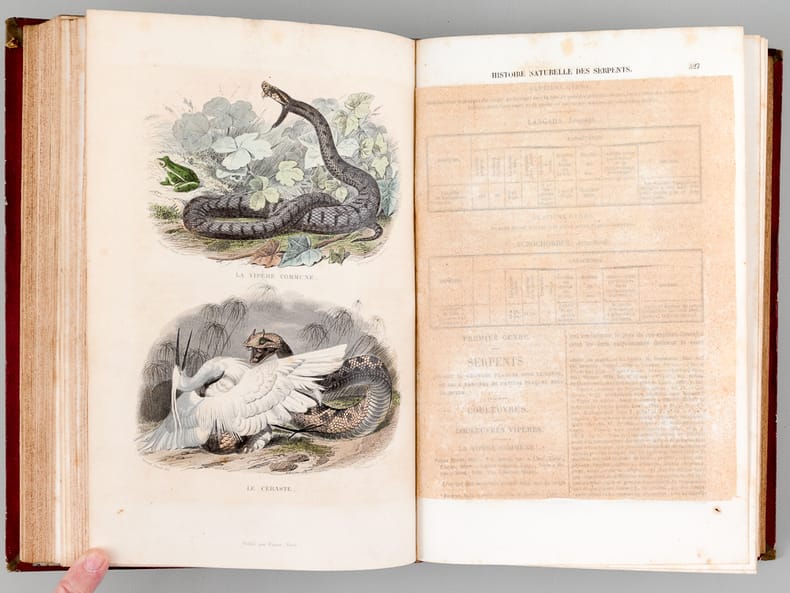
185519253Histoire Naturelle de Lacépède comprenant les Cétacés, les Quadrupèdes ovipares, les Serpents et les Poissons. 2 volumes.Nouvelle édition, précédée de l'éloge de Lacépède par Cuvier, avec des Notes et la nouvelle Classification de M. A.-G. Desmarest, Correspondant de l'Académie des Sciences, Membre de l'Académie de Médecine, Professeur de Biologie à l'École vétérinaire d'Alfort, etc.Paris, Furne, Jouvet et Cie. - 1855 - XII, 668 et 647 pages. Imprimé sur 2 colonnes. 36 planches hors-texte aquarellées par Édouard Traviès, peintre animalier, illustrateur et lithographe.Reliure demi chagrin rouge de l'époque. Dos à nerfs aux titre, auteur et caissons dorés. Rares rousseurs. Bon état. Format in-4°(27x18).Bernard-Germain de Lacépède (1756-1825) se lie d'amitié avec Buffon qui l'encourage à étudier l'histoire naturelle. Il fait paraître, en 1788-1789, son Histoire naturelle des quadrupèdes ovipares et des serpents. Il s'agit du premier ouvrage d'envergure sur les amphibiens et les reptiles destiné à un large public. L'oeuvre de Lacépède contribue à favoriser l'étude de ces animaux.
186717764Nouvelle édition, précédée de l'éloge de Lacépède par Cuvier, avec des Notes et la nouvelle classification de M. A.-G. Desmarest, Correspondant de l'Académie des Sciences, Membre de l'Académie de Médecine, Professeur de Biologie à l'École vétérinaire d'Alfort, etc.Paris, Furne, Jouvet et Cie. 1867 - XII, 668 et 648 pages. Imprimé sur 2 colonnes. 36 planches hors-texte colorées par Édouard Traviès, peintre animalier, illustrateur et lithographe.Reliure demi chagrin rouge à coins de l'époque. Plats percaline rouge. Dos à nerfs aux titre, auteur et filets dorés. Dos tachés. Des rousseurs sur les serpentes et sur les pages de texte. Quelques rousseurs sur le bord des gravures. Bon état. Format in-4°(27x17).
182712110Paris, F.G. Levrault, 1827, in-8, portrait, (4), LXXII, 321, (1bl)pp, 1pl, demi-basane noire, dos plat orné. (Rel. post.), WELLCOME, III, 425. PREMIERE EDITION. Portrait de Lacépède et fac-similé d'une de ses lettres à son éditeur. Son éloge historique est de Georges Cuvier portrait, (4), LXXII, 321,
184164147Nouvelle édition précédée de l'éloge de Lacépède par Cuvier, avec des notes et la nouvelle classification de M. A.-G. Desmarest, ornée de 36 planches en couleurs gommées par Travies, 2 vol. grand in-8 reliure demi-basane noire, dos lisse orné, Furne & Cie, Paris, 1860-1855, xii-668 ; 647 pp. avec 36 planches hors texte en couleurs
185064287Nouvelle édition précédée de l'éloge de Lacépède par Cuvier, avec des notes et la nouvelle classification de M. A.-G. Desmarest, ornée de 36 planches en couleurs gommées par Travies, 2 vol. grand in-8 reliure de l'époque demi-chagrin rouge, dos lisse orné, Furne & Cie, Paris, 1850, xii-668 ; 647 pp. avec 36 planches hors texte en couleurs
182829724Paris-Strasbourg F.-G. Levrault s.d. [1828] in-8 broché, premier et dernier feuillets détachés
182639285Baudouin Frères Paris 1826. Ouvres complétes de Buffon Complément tomes 1 & 4 only. V.g./No Jacket. Quarter leather binding Tidy copies slight edge wear to boards. Baudouin Frères, Paris hardcover
182619716Paris:: Chez Baudouin Freres 1826-1828. First edition. contemporary quarter calf and marbled boards; gilt spines; all edges marbled. Some scattered inoffensive foxing; very light use to the attractive bindings. 8vo. Chez Baudouin Freres, hardcover
1866LFA-126711755Un ouvrage de 961 pages, format 180 x 260 mm, illustré de 40 gravures sur bois tirées à part par E. Bayard, relié cartonnage, publié en 1866, Librairie L. Hachette et Cie, bon état
1817RO80000899Deterville. 1817. In-8. Relié demi-cuir. Bon état, Couv. convenable, Dos frotté, Intérieur frais. 255 pages.15 planches. Planche 1et 2 tachées.. . . . Classification Dewey : 590-Zoologie
182994471Paris, Déterville, 1829-1830, in-8, 5 vol, 20 pl, Veau olive glacé de l'époque, dos lisses ornés de fleurons dorés et à froid, roulette d'encadrement sur les plats, tranches marbrées, 20 planches gravées sur cuivre d'après Laurillard. Deuxième édition de cet ouvrage qui pose les fondements de l'anatomie comparée. Il est le fruit de tout une vie d'étude des animaux vivants et fossiles. La première édition fut publiée en 1817, chez le même éditeur. Grâce à la qualité de son travail d'observation, Cuvier (1769-1832) a posé les bases d'une méthode d'analyse et de comparaison à l'ensemble du règne animal et a établi l'Anatomie Comparée : cette science, nouvelle branche de l'histoire naturelle, est née grâce à la collaboration scientifique avec Geoffroy Saint-Hilaire, son ami d'alors. Sa méthode d'analyse et de comparaison à l'ensemble du règne animal le conduit à une classification reposant sur l'idée que les critères anatomiques et physiologiques des animaux sont dus à leur fonction et habitats et non l'inverse. Il décrit ainsi quatre grandes familles : les animaux vertébrés, les mollusques, les articulés et les radiaires. Face à Geoffroy Saint-Hilaire, qui deviendra son rival, il niera farouchement les liens que ces animaux, ainsi distingués, pourraient avoir entre eux et il s'aveuglera quant à la question de l'évolution des espèces. Ex-libris manuscrit et étiquette de la bibliothèque d'Emmanuel Gonse. Frottements, coins et coupes usés, accrocs aux coiffes. Nissen, 1013. Wood, p. 307. Couverture rigide
183629867AB3 Bände. Bruxelles, L. Hauman, 1836. 8°. Mit 24 gest. Tafeln. Halbleinenbände der Zeit.
1829GF323471829 Paris - Déterville - 1829 - 1830 - Complet en 5 volumes in8 broché de (XXXVI - 584 pages); (XV - 406 + catalogue); (XVI - 504); (XXVII - 581); (XXIV - 556) pages - Couvertures muettes roses de l'époque - toutes marges - pièces de titre papier en partie disparues - dos cassé au tome III - trous de vers à quelques pages du tome I - bon état intérieur et agréable exemplaire dans son état d'origine -
181720421Paris:: Chez Deterville 1817. First edition. contemporary quarter sheep gilt and marbled boards. Old stamped ownership signature on each front free endpaper; some light rubbing to the bindings. A very attractive set. 8vo. 15 engraved plates. PMM 276. Half-titles present. Chez Deterville, hardcover
1840354997Paris.: Fortin Masson. circa 1840. 25 loose lithograph plates with caption sheets in the publishers printed card stock slipcase. Very good a little wear to slipcase. 28.5x18.5 cm. Plates are numbered 1-25 but lacking number 19 however 11a and 11b are included for a total of 25 plates as called for on the label. Scarce. weight: 1.0 lb. 25 black and white lithograph plates with captions on facing Fortin Masson. unknown
1817elala537Paris: Deterville 1817. 1817. 4 Volumes. 8vo. pp. xxxvii 540; xviii 532; xxix 653; viii 255. with half-titles. 15 engraved plates by Pierron after Laurillard. 10 folding engraved plates from another work bound in at end. contemporary quarter sheep gilt backs spines somewhat worn several joints cracked scattered foxing. bookplate 1825 ownership entry 1834 & rubberstamp on title of A.Chambion on titles. First Edition of Cuviers most comprehensive work which embodied the whole of his previous researches on the structure of living and fossil animals and laid the foundations of modern comparative anatomy. Here Cuvier introduced his famous classification system according to which the animal kingdom is divided into four main groups vertebrata mollusca articulata insects lobsters and radiata all remaining types. "This type theory is Cuviers greatest contribution in the sphere of systematization and represents although in a somewhat modified form the basis of all subsequent animal classification." Nordenskiöld Opposing the current view that the structure of an animal determined its functions and habits Cuvier maintained that an animals structure was due to its functions and habits. Throughj the exact study of the anatomy of living and fossil species he could reconstruct extinct forms from a few surviving bones. At the end of Volume IV pp. 95-170 is an important annotated bibliography of zoological literature. Brit. Museum Cat. of Natural History I 410. Brunet II 457 incorrectly citing date 1816. Casey Wood 307. Dibner Heralds of Science 195. Nissen 1013. Nordenskiöld History of Biology pp. 339-41. Printing and the Mind of Man 276. Sparrow Milestones of Science 42 Plate 134 pp. 31-32. Waller 11796. Wellcome II 423 incomplete. cfGarrison & Morton 327. 1st Edition. Hardcover. Paris: Deterville , 1817. Hardcover
182918430Paris: Déterville and Crochard 1829. SECOND EDITION. With 20 full-page etched plates. Contemporary gilt green sheep-backed marbled boards. Ownership stamps of J.E. van der Dussen. A fine set. Second edition enlarged of this landmark in the history of zoology and comparative anatomy the most comprehensive biological work since Linnaeus. “Cuvier’s valuable work represented the fruits of a lifetime’s study of living and fossil animals. In his day Cuvier exerted an enormous influence on science. He played a leading part in the development of the science of palaeontology and stimulated the study of comparative anatomy†G&M. <br /> “It is in his classification of the animal kingdom into four main groups Vertebrata Mollusca Articulata and Radiata that he is so notably succeeded in giving a lead that has been followed by all his successors. . .Cuvier was the first to apply analyses and comparison to the entire animal kingdom. He also saw that this homogeneity in an individual should enable a competent naturalist to reconstruct a complete animal from any significant part of its anatomy†PMM.<br /> See PMM 276; Garrison-Morton 327; Dibner 195. Déterville and Crochard unknown
18173707077Paris: Deterville 1817. Some foxing to the plates. Four volumes octavo 15 engraved plates by C.-L. Laurillard a handsome set with all four half-titles in original quarter calf over mottled papered boards gilt double spine labels in red & green. <p><p>First edition of this germinal work of natural history with three volumes by Cuvier himself and the fourth an important study of insects by his friend and colleague Latreille.</p> <p>Recognised as the father of comparative anatomy Cuvier published widely throughout his lifetime but this was his most famous and influential work and contained the results of all his previous research on the structures of living and fossil animals. It was based upon his vast knowledge of zoological anatomies and in it he applied Linnæus' system of nomenclature and classification to the whole animal kingdom in the process establishing his four great classes: vertebrate molluscous articulate and radiated.</p> <p>Cuvier's work is a benchmark for many reasons not least for the third volume present here which is actually the work of Pierre André Latreille Professor of Entomology at the Paris Museum: Latreille's contribution was not only a significant contribution to his field but he had earlier been heavily involved in characterising the insects collected on the Baudin voyage to Australia and the Pacific. In the present volume Latreille sought to update the foundation work of scholars including Fabricius within Cuvier's framework; as a result Latreille included here many Australian insects including two the 'Rhipcera' and the 'Heleus' noted for the first time.</p> <p>Cuvier born in 1769 was invited by Geoffroy Saint-Hilaire to come to Paris in 1795. He took an appointment at the newly-formed Muséum nationale d'histoire naturelle where he remained until his death from cholera in 1832. He had first publicly canvassed his new quadripartite schema of the animal kingdom in an 1812 presentation to the Academy of Sciences but it was in this work that he first detailed how this proposed division worked in practice. Here each of the classes is discussed in a separate volume with volumes I II and IV by Cuvier himself; his organizations of fish families in particular 'were so soundly based that they have become orders or suborders in present classification' DSB.</p> <p>Throughout his career Cuvier held to the premise of Le Règne Animal that the four branches were fundamentally different and that any similarities between them were due entirely to common functions rather than common ancestry. He did not believe that is that there was any evolutionary adaptation a stance which put him in open conflict with his contemporaries such as Buffon Lamarck and Geoffroy. This led to the famous debate between Cuvier and Geoffroy at the Académie Royale des Sciences in Paris in 1830.</p> <p>Cuvier's towering position in the French natural sciences should be seen in the context of a very cynical view of his ambitions towards intellectual ownership of the science on Freycinet's voyage an idea explored in correspondence between Faujas de Saint Fond and Louis de Freycinet.</p> </p> . Deterville unknown
183629867AB1836. 3 Bände. Bruxelles L. Hauman 1836. 8°. Mit 24 gest. Tafeln. Halbleinenbände der Zeit. Vgl. Nissen 1013 für die erste Ausgabe. - Dritte Ausgabe erschien erstmals 1817 in Paris. - Papier durchgehend gebräunt und stockfleckig. Einbände berieben und bestossen. unknown
18461948<p>Paris: Crochard et Cie 1846. Second expanded edition.</p><p><strong>PIONEERING ESTABLISHMENT OF THE SCIENCE OF COMPARATIVE ANATOMY.</strong></p><p>Eight volumes in 9 bindings 8 1/2 inches tall Vol. 4 is in 2 parts. Green quarter leather binding with gilt titles and compartments marbled paper covered boards patterned endpapers bookplate of NSR Maluf to each volume Vol. I i-xxxiii lithographic facsimile of letter from Cuvier 587 pp 1; Vol. II i-viii 726 pp; Vol. III 4 i-iv 760 pp; Vol. IV pt 1 i-xxvii 618 pp 4; Vol. IV pt 2 i-iv 691 pp 1; Vol. V i-viii 503 pp folding table; Vol. VI i-vii 557 pp 1 folding table; Vol. VII i-vii 1 656 pp; Vol. VIII i-xii. 848 pp. Covers corners spine ends worn light browning to pages the first blank and usually the half title of each volume have top edge corners clipped presumably to remove a signature not affecting text. Bindings tight pages unmarked very good in custom archival mylar covers. <strong>CONTENTS:</strong> Vol. I contains the principal discussion of Cuvier's famous theory of the correlation of parts- the functional relationship of each bodily organ to every other organ. Also considered are the organs of movement of vertebrate animals; Vol. II addresses the organs of movement of invertebrate animals and the osteology of the head; Vol. III considers the nervous system and sense organs; Vol. IV reviews the organs of mastication salivation and swallowing in vertebrate animals; Vol. V reviews the feeding organs of invertebrate animals; Vol. VI explores the nutritive fluid its reservoirs and the organs that set it in motion in the four types of the animal kingdom; Volume 7 the description of the organs of elaboration and purification of the nutritive fluid through respiration and urinary secretion; and Volume 8 the organs of generation and secretions the swim bladder of the fish and the organs of vocalization.</p><p><strong>GEORGES CUVIER </strong>1769 – 1832 was a French naturalist and zoologist sometimes referred to as the "founding father of paleontology". Cuvier was a major figure in natural sciences research in the early 19th century and was instrumental in establishing the fields of comparative anatomy and paleontology through his work in comparing living animals with fossils. He expanded Linnaean taxonomy by grouping classes into phyla and incorporating both fossils and living species into the classification. He laid the foundations for a method of analysis and comparison applied to the entire animal kingdom and a new branch of natural history was born thanks to his scientific collaboration with Geoffroy Saint-Hilaire. This was based on the theory that anatomical and physiological characteristics of animals are molded by their environment. He established four major families: vertebrates mollusks arthropods and radiates. He was the first to apply the concept of an ecosystem viewing it as a vast network in which species interact with one another.</p><p><strong>GARRISON-MORTON </strong>No. 311 "Cuvier played a leading part in the development of paleontology and stimulated the study of comparative anatomy. He ranks with von Baer as one of the founders of modern morphology. The posthumous second edition offered here revised and expanded by Georges Cuvier's younger brother Georges-Frédéric Cuvier to 8 vols. appeared from 1835-1846."</p> Crochard et Cie hardcover