"BRUCE, JAMES.Livre Rare Book
20 127 résultats
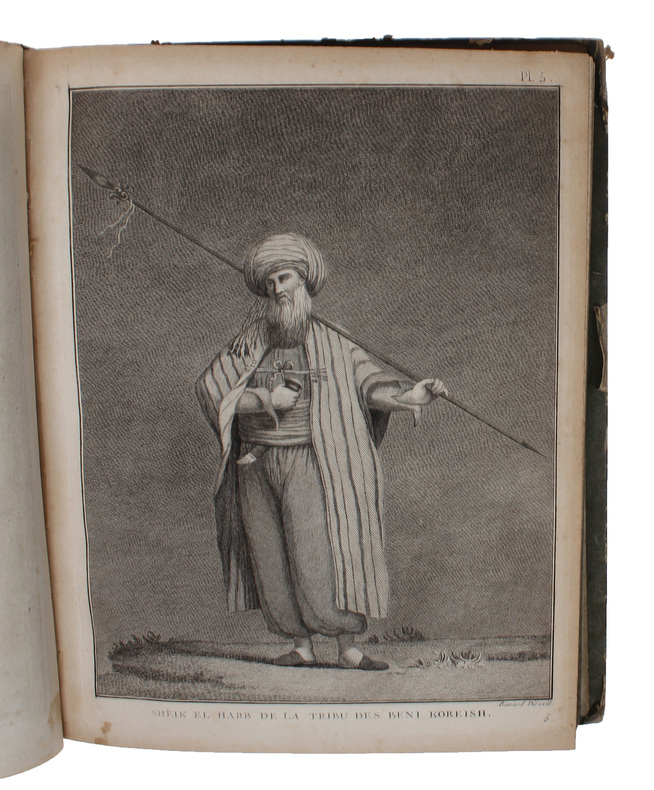
179028042Paris, 1790-92. (Atlas: Paris, chez Plassan, 1792). 8vo and 4to. Textvolumes bound uncut in 10 cont. blue boards with gilt titlelabels in red on backs. Corners a little bumped and bindings with a few scratches. Atlas-volume in 4to bound in cont. green boards, some scratches to back. With all 88 engraved plates (both numbered in relation to the corresponding textvolume and with numbering 1-88) comprising 4 large folded maps, plate 1-65 single-page, plate 70-88 double- page
Paris, 1790-92. (Atlas: Paris, chez Plassan, 1792). 8vo and 4to. Textvolumes bound uncut in 10 cont. blue boards with gilt titlelabels in red on backs. Corners a little bumped and bindings with a few scratches. Atlas-volume in 4to bound in cont. green boards, some scratches to back. With all 88 engraved plates (both numbered in relation to the corresponding textvolume and with numbering 1-88) comprising 4 large folded maps, plate 1-65 single-page, plate 70-88 double- page
Folio piccolo (mm 328x225); carte 4 non num., pagine 480 con centinaia di silografie nel testo raffiguranti le piante, carte 14 non num. di indice; frontespizio in rosso e nero con vignetta silografica con motto "Portum fortiter occupa" con l'immagine di un vascello entro cornice ornamentale e figure allegoriche, capolettera entro vignette. Mezza pelle di inizio Ottocento con piatti marezzati, titolo in oro al dorso con filetti dorati. L'autore, Castore Durante fu medico e cittadino romano (Gualdo Tadino 1529 - Viterbo 1590). Celebre opera, che, dopo la prima pubblicazione del 1585, fu ristampata in otto edizioni di grande successo, fino al 1718 in diverse lingue. La nostra edizione del 1717 è rara, sebbene presente in alcune biblioteche. L'opera riunisce più di 900 specie ordinate alfabeticamente secondo il nome volgare; il ricco apparato iconografico, di notevole fascino, probabile opera di Isabella Parasole, una delle più note artiste del tardo Rinascimento, accompagna le descrizioni dei nomi in lingua greca, latina, araba, francese, spagnola e tedesca, ed è di supporto alle descrizioni nel riconoscimento dei vegetali.<BR>Il testo è completo delle revisioni e appendici, aggiornato dell'inserimento delle descrizioni relative alle piante esotiche che dopo il 1585 entrarono a far parte dell'uso farmacologico e alimentare. Durante, intitola l'opera Herbario nuovo, intendendo soprattutto divulgare le conoscenze di materia medica tramandate dall'antichità fino al XVI secolo, basate sull'uso dei Semplici, da cui si estraggono i principi attivi dei farmaci del tempo e non solo. Bell'esemplare che presenta tracce di tarlo di varia intensità solo al margine interno senza ledere il testo, fino a pag. 150, ultima carta di indice con antico restauro, carta di rinforzo, saltuarie minime macchioline. <BR>Pritzel 2552; Nissen 569. <BR>
In-4, pp.(12) 210 (1) Legatura piena pergamena coeva con nervi, titolo manoscrittoo al dorso. Con 80 tavole incise su rame. Antiporta con figure allegoriche e una veduta dell'orto botanico di Bologna, eseguite da Francesco Curti e dal suo allievo Francesco Maria Francia. Magnifica edizione con con ricchi capilettera ornati e le incisioni assai nitidamente impresse: Bellissimo esemplare fresco e a pieni margini (un rinforzo al margine inferiore del frontespizio, due timbri del censore all'ultima carta. Zanoni fu la figura più importante della botanica bolognese ricoprendo per quarantanni la carica di sovrintendente. Figlio di uno speziale i Montecchio sin da bambino si dedicò agli studi completandoli a Bologna. Compì alcuni viaggi di esplorazione botanica in Italia, ma soprattutto ottenne piante e semi provenienti da regioni esotiche, principalmente orientali, procuratigli da viaggiatori, ed in particolare da missionari diretti all'India. E' questa la sua opera principale che cataloga le piante coltivate nell'Orto Universitario, nonché in un suo orto privato, descritte ed illustrate per le proprietà medicinali. Quest'opera godette di grande fama e considerazione, ancora molti anni dopo la morte dell'autore, tanto che Gaetano Monti, Prefetto dell'Orto, ne curò nel 1742 una seconda edizione ("Jacobi Zanonii Rariorum Stirpium Historia"), ampliata e tradotta in latino onde darle maggiore diffusione internazionale. L'importanza di Zanoni nella storia della botanica è testimoniata dal fatto che lo stesso Linneo gli rese omaggio dedicandogli il genere Zanonia, della famiglia delle Cucurbitacee.. NISSEN BBI 2193. PRITZEL 10458. .
1880WB19262Paris c. 1880. ALBUM OF ARTIFICIAL LEAVES AND FLOWERS PRE-A.I. Extraordinary album of artificial leaves and flowers. France ca 1880. 4to. Quarter gray linen and contemporary black impressed designed covers. Collation: 32pp. Cut out Flowers and Leaves of different species of flowering plants shrubs and trees some in natural green appearance but also including fantasy leaves in gilt and silver paper; and finally 2 pages for artificial flowers made in magical colors. Provenance: Ancienes Maisons J. Pezieux & Fils label on pastedown. The assembler has noted manuscript categories and numbers with stamped letters next to each specimen. <br /> <br /> <br/><br/> unknown
Ventisei volumi in 28 parti di cm. 24,5. Ritratto di Bresadola all'antiporta del primo volume ed oltre 1250 tavole a colori, ciascuna accompagnata da una carta di testo esplicativa. E' presente l'intero corpus dell'opera, in 26 volumi ed impresso tra il 1927 ed il 1933. Entro cartelle editoriali in mezza tela con titoli a piatti e dorsi, a fogli sciolti. Esemplare genuino ed in eccellente stato di conservazione. Edizione originale, rara e ricercata di quest'opera la cui validità scientifica ha coniato definizioni quali: "L'Iconographia Micologica, un pilastro che ancor oggi puntella l'incerto mondo della sistematica micologica". Oltre all'importanza si sottolineano le difficoltà che quest'impresa editoriale dovette superare per poter vedere la luce. Il Bresadola infatti rischiò di cedere i diritti di stampa ad editori stranieri, i quali si dimostravano più generosi nell'acqusito delle preziose tavole micologiche. Solo grazie al paziente lavoro di convincimento di un gruppo di studiosi, si riuscì a mantenere l'opera entro i confini italiani. Questi furono inoltre i curatori, nelle persone di: G.B. Traverso, L. Fenaroli, G. Catoni e G.B. Trener. Cfr., tra l'altro, C.A. Bauer: Giacomo Bresadola. Frammenti inediti di una vita).
118972aafZürich, bey Joh. Heinrich Lindinner (Lindner), 1715, in-8vo, (16x9 cm Blattgrösse), Gest. Frontispiz Porträt + 16 Bl. + 448 S. + 7 (von 8, das letzte als Kopie beigebunden), durchgehend fingerfleckig, 1 Bl., Original-Lederband. der Zeit, restauriert, Lederrückenschildchen neu.
175628605Nürnberg, Johann Michael Seligmann, 1756-57. 4to. Bound in one cont. hcalf. Back somewhat worn, hinges with tears so cords are seen, but not loose. Corners bumped. Titlelabel on back. (8),3-136,(6)"(4),208,(12) pp. and 100 (50+50) fine engraved botanical plates (P.L. Feuille ad viv.del - I.M. Seligmann excud) and 2 unnumbered engraved plates (1 with an Owl, 1 with a Tortoise). In all 102 plates. Printed on thick fine paper, and internally fine and clean, plates as well as text.
Nürnberg, Johann Michael Seligmann, 1756-57. 4to. Bound in one cont. hcalf. Back somewhat worn, hinges with tears so cords are seen, but not loose. Corners bumped. Titlelabel on back. (8),3-136,(6) "(4),208,(12) pp. and 100 (50+50) fine engraved botanical plates (P.L. Feuille ad viv.del - I.M. Seligmann excud) and 2 unnumbered engraved plates (1 with an Owl, 1 with a Tortoise). In all 102 plates. Printed on thick fine paper, and internally fine and clean, plates as well as text.
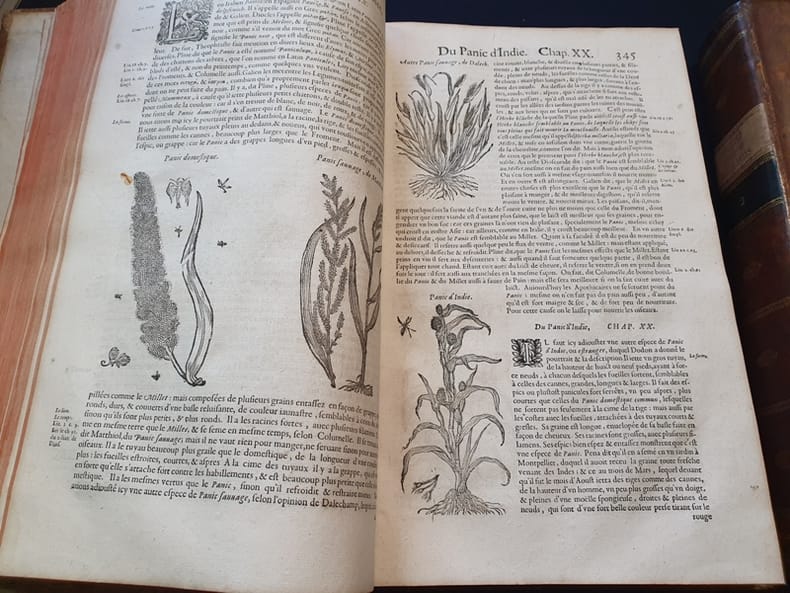
1653395ArmLyon Borde Arnaud & Rigaud 1653 2 Tomes en 2 volumes - Bien Complet des 2572 bois gravés - Complet - Demi veau légèrement postérieur , dos orné - tomaisons - Tome 1 : Page de titre gravée , dédicace , sommaire et privilèges + 960 pages pour les 9 premiers livres + tables générales en Français , Latin , Grec , Arabe , Italien , Espagnol , Allemand , Flamand , Bohémien et Anglais - Brunissures marginales de la page 932 aux tables incluses / Tome 2 : Dédicace + 114 pages contenant les 4 index des simples et des vertus des simples + sommaire des 9 livres du Tome 2 + 758 pages + tables en Français , Latin , Grec et Arabe . Nombreuses et belles lettrines - - Jacques Dalechamp ( 1513/1588) botaniste et médecin Lyonnais fit imprimer sa 1ere édition en Latin en 1586 . Il fut aidé par Jean Bauhin et Jean des Moulins . La 1ere édition française date de 1615 , la notre ( 1653) est la deuxième édition Française et comporte une quarantaine de bois gravés supplémentaires . Bel exemplaire de ce qui fut le livre botanique de référence du 17e siècle .
1653395ArmLyon Borde Arnaud & Rigaud 1653 2 Tomes en 2 volumes - Bien Complet des 2572 bois gravés - Complet - Demi veau légèrement postérieur , dos orné - tomaisons - Tome 1 : Page de titre gravée , dédicace , sommaire et privilèges + 960 pages pour les 9 premiers livres + tables générales en Français , Latin , Grec , Arabe , Italien , Espagnol , Allemand , Flamand , Bohémien et Anglais - Brunissures marginales de la page 932 aux tables incluses / Tome 2 : Dédicace + 114 pages contenant les 4 index des simples et des vertus des simples + sommaire des 9 livres du Tome 2 + 758 pages + tables en Français , Latin , Grec et Arabe . Nombreuses et belles lettrines - - Jacques Dalechamp ( 1513/1588) botaniste et médecin Lyonnais fit imprimer sa 1ere édition en Latin en 1586 . Il fut aidé par Jean Bauhin et Jean des Moulins . La 1ere édition française date de 1615 , la notre ( 1653) est la deuxième édition Française et comporte une quarantaine de bois gravés supplémentaires . Bel exemplaire de ce qui fut le livre botanique de référence du 17e siècle .
R300001380CHEZ PANCKOUCKE. NON DATE. In-4. Relié plein cuir. Etat d'usage, Coins frottés, Dos abîmé, Mouillures. 300 planches en noir et blanc. Tampon de bibliothèque. Manque page de garde. Titre sur pièce de titre rouge. Titre et caissons dorés. dos à 5 nerfs.. . . . Classification Dewey : 580-Botanique
Quattro parti in due volumi in 4° (mm 240x160); pagg. (8), 420, (110), con due ritratti dell'autore, stemma, marca editoriale al verso dell'ultima carta, capilettera istoriati silografici; pagg. 417, (107), con un ritratto dell'autore, stemma, marca editoriale al verso dell'ultima carta, capilettera istoriati silografici. Pagg. (12), 439, (9), con con un ritratto dell'autore, marca editoriale al verso dell'ultima carta, capilettera istoriati silografici; (12), 363, (9), con ritratto dell'autore, stemma, marca editoriale al verso dell'ultima carta, capilettera istoriati silografici. Ogni parte ha un frontespizio proprio. Entrambi i volumi sono rilegati in piena pergamena coeva dipinta di verde, con dorso a quattro nervi.<BR><BR>Prima rara edizione tedesca dell'opera omnia di Paracelo in dieci parti. Sono presenti le parti tre, quattro, sette e otto. Gli argomenti trattati nel primo dei due volumi sono per lo più di argomento medico: due trattati sulla peste, alcuni scritti sul tartaro, residuo calcareo che genera calcoli e altre malattie; altri opuscoli su calcoli, gotta ed errori dei medici antichi. La settima e l'ottava parte contengono invece opere di botanica e fisica: Composizione dei rimedi, caratteristiche delle erbe medicinali, proprietà dei semplici e loro preparazione, qualità mediche delle acque termali, concordanze e rimedi dei morbi. Si tratta anche di filosofia, anatomia, dei quattro elementi, della generazione degli uomini, dei frutti e delle caratteristiche degli agenti atmosferici.<BR>Philippus Aureolus Theophrastus Bombastus von Hohenheim detto Paracelsus o Paracelso (1493-1541) fu un alchimista, astrologo e medico svizzero. Autore di numerosissime opere di svariato argomento, fu una delle figure più rappresentative di tutto il Rinascimento.<BR>Buon esemplare, con leggero alone all'angolo esterno inferiore lungo tutto il primo volume; alcune fioriture nel secondo. Antico timbro di biblioteca al primo frontespizio di entrambi i volumi. Note e sottolineature manoscritte. Leggere grinze alla legatura, che presenta segni dell'uso.<BR>
17760056251776 Paris, Ruault, 1776. In-quarto (268 X 206 mm) veau porphyre, encadrement de triple filet doré sur les plats, dos à nerfs orné de roulettes, fers et fleurons dorés, pièce de titre, tranches marbrées (Reliure de l'époque) ; (1) f. blanc, frontispice, XII pages, (4) pages de table des chapitres, 206 pages, (2) pages d'approbation et privilège, (1) f. blanc. Une rousseur brune au frontispice, habiles et discrètes restaurations à la reliure.
RARE FIRST FRENCH EDITION of a 16th-century treatise in botany, where the author - Pietro Andrea Gregorio Mattioli (Matthiolus) (1501-1577), a renowned doctor and naturalist, described 100 new plants and coordinated the medical botany of his time in his Discorsi ("Commentaries") on the Materia Medica of Dioscorides. The first edition of Mattioli's work appeared in 1544 in Italian. There were several later editions in Italian and translations into Latin (Venice,1554), Czech, (Prague,1562), German (Prague, 1563) and the present lavishly illustrated French edition (Lyon,1572). 385x250mm. 138+819+22 pages (altogether 973 pages). Marbled rebound board Hardcover with brown leather ribbed gilt spine. Cover scratched and worn. Cover and spine rubbed. stained and partly peeled. Cover edges, corners, spine edges and hinges worn/peeling. Spine gilt partly faded or missing. Small hole on front whitepage. Title page repaired - text partly missing. First few pages bottom corner repaired - text partly missing on several pages. Page 108/109 slightly torn with small damage to text. Page 239/240 bottom half taped - text readable. Several pages stained due to pressed flower - text readable. Few pages slightly stained and/or age-stained - no damage to text. Text block upper edge slightly stained. Pages yellowing and slightly wavy. [SUMMARY]: This extremely rare profusely illustrated 16th-century treatise in botany has suffered some damage, but is still in good reading condition. PLEASE NOTE: This item is overweight. We may ask for extra shipping costs.
1686PHO-1723Paris, Arnould Seneuze, Daniel Horthemels, 1686-1689, 2 vol. in-4 : 16ff.-424pp. 8ff., 8ff.-416pp.-5ff., illustré de 26 planches (20+6) dont certaines dépliantes ou à double pages, gravées par Cornelis Vermeulen, d'après les dessins de P. Sevin, relié plein veau chiné (légèrement différentes), dos à nerfs orné avec titre, frottements, manques en tête et en queue du tome I, coins du tome I émoussés, dos, mors et coins du tome II réparés, tache d'encre dans les marges inférieures des pp.305-307 du tome I, pl. p. 91 du tome I colorié à la main, déchirure au titre du tome II renforcé.
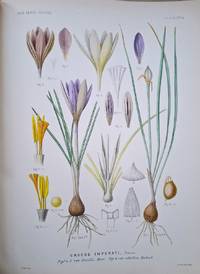
1886021464London: Dulau & Co 1886. Large thick quarto pp viii 326 xx 10 top edge gilt two double page charts and a map 4 coloured plates lettered A to D 77 coloured plates numbered 1 - 67 11 bis plates plate 17 was not published one internal hinge slightly stretched endpaper a little oxidised the half-title and the final leaf foxed the title page lightly foxed slightly age-toned internally the rear hinge a little cracked but not weak original brown beveled cloth slightly worn and rubbed the spine pulled at head and tail with rwo short tears at each a small bruise on the lower cover. The plates are very fine chromolithographs. A very attractive wood-engraved scene usually in Turkey precedes most species section; these are by the Brothers Dalziel. The book was printed by Fawcett of Driffield. With the attractive bookplate of the Scottish author and nurseryman William Cuthbertson at one time a senior partner in Dobies Nurseries. A heavy book - extra postage will be needed. "Maw was a Fellow of the Linnean Society the Society of Antiquaries and the Royal Historical Society. He became a Fellow of the Geological Society in 1864. He was a member of the RHS Scientific Committee during the 1880s and served brief terms on the Floral Committee Daffodil Committee and Library Committee. Maw made frequent plant collecting trips including to the Mediterranean and Eastern Europe. In 1871 he accompanied Sir Joseph Dalton Hooker and John Ball on a plant collecting expedition to Morocco and the Atlas Mountains and letters from Hooker to Maw give details of their preparations. A full account of the trip was published in 'Journal of a Tour in Marocco and the Atlas Mountains'. Maw wrote occasional articles for the garden press and was an accomplished artist: John Ruskin wrote of his crocus drawings that they were 'most exquisite . and quite beyond criticism'. In 1886 Maw published 'A Monograph of the Genus Crocus' the result of over ten years of collecting and research illustrated using his own watercolours. Many of the bulbs and plants he collected on his plant collecting expeditions were planted in the garden at Benthall Hall later owned by the National Trust. Correspondence between Maw and the friends and contacts who helped to collect the 67 species of Crocus detailed in his work forms a significant part of the archive. Maw retired in 1886 due to ill health and moved to live at Rangemore in Kenley Surrey changing the house name to Benthall. Frederica Mary died on 6 Feb 1894. George Maw died on the 7 Feb 1912." - British Museum. ""George Maw 1839-1912 was the industrious author and illustrator of his great 'Monograph of the Genus Crocus' 1886. A many-sided and remarkable man Maw was not a botanist by profession but a chemist and geologist a manufacturer of encaustic tiles at Broseley Staffs. His monograph the result of ten years of inquiry was the most complete work of its kind that has been published on any genus. The plates of this work are marvels of comprehensive detail and put to shame those of many more skilled draughtsmen. From a botanical point of view this work is a landmark."Blunt & Stearn". First Edition. Cloth. Good. Dulau & Co Hardcover
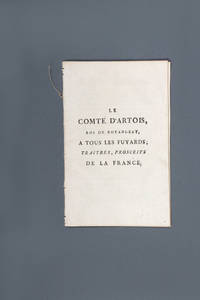
17904504805Paris 1790. Small hole to A4 affecting one word otherwise fine. Octavo 19 1 pp; disbound from a volume. <p><p>A very rare early "satire on French politics and English colonization" Ferguson. Likening those who fled the tumult of the French Revolution to the English convicts transported to Australia the author petitions them to join the future king of France in the newly established penal colony at Botany Bay: "le vaste continent des Terres Australes leur offre un pays nouveau asyle fait pour eux" "The vast continent of the Southern Lands offers them a new country a refuge made for them". The "count" continues that "c'est la Nation que vous etes dignes d'etentre c'est la Nation que je suis fait pour commander" "this is the nation that you deserve and that I am meant to command" and explains that in the Antipodes the laws are very different and virtue and vice are often upended.</p> <p>The satire evidently found an audience in Revolutionary France: a second edition was published in 1799. It appeared in the very first years of the English colonisation of Australia at a time when France had its own interests in the region and its own problems at home. La Pérouse commanding the Astrolabe and the Boussole arrived at Botany Bay on 24 January 1788 just as Arthur Phillip was moving the English settlement to Port Jackson. They spent six weeks in Australia before moving on.</p> <p>Toby R. Benis uses the pamplet to begin the introduction to his Romantic Diasporas: French Émigrés British Convicts and Jews 2009: "In 1799 a satirical pamphlet aimed at French émigrés and those inside the republic who sympathized with them appeared in England. Claiming to be produced in London the text was framed as an appeal from the Comte d'Artois Louis XVI's youngest brother calling on the 'cowards who fled France and to all those who have been banned from France-princes and valets traitors and bandits princesses and prostitutes' to join him in the British penal colony of Botany Bay: 'a new country made especially for them'. Styling d'Artois the "king of Botany Bay" the writer characterizes Australia as a de Sadian refuge for the worst elements of both Britain and the ancien regime bequeathed by the British government to the emigrant Prince and his circle to rule. A historical curiosity this document nonetheless points to a political and social dimension to exile in the Romantic period.". Romantic Diasporas focuses on how French emigrés Australian convicts and Britain's Jews embodied this state for Georgian society.</p> </p> . unknown
Due volumi in 4°, pp. 503 con numerazione continua (203 nel primo volume). Con 61 tavole colorate a mano, incise da F. Sansom da disegni dell'autore. Leg. piena pelle dell'epoca con dentelle ai bordi. Dorsi rifatti con filetti oro e titoli su tasselli. Tagli dorati. Copia in buono stato. Cfr. Brunet, II, 948; Pritzel, 2621.
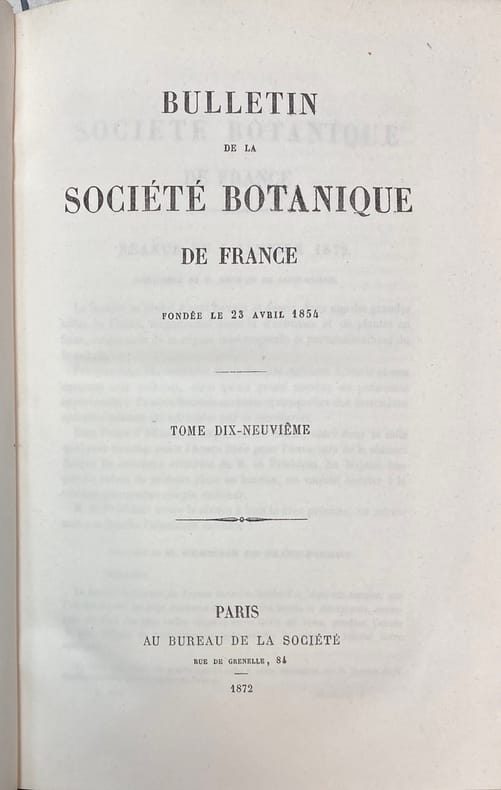
67Paris. Au bureau de la société. 1854-1907. 53 vol. in-8, dont 50 en demi-chagrin vert, dos à nerfs et 3 en demi-chagrin grenat, dos lisses passés, , et 1 vol. in-8 de table, demi-chagrin vert, dos à nerfs passé.
First edition, 2 vols., 4to (290 x 225 mm), Large paper copy, vol. I: viii, 96 hand-coloured plates with unpaginated accompanying text; Vol. II: 80 hand-coloured plates and accompanying text followed by 32 page index with an errata leaf, some light offsetting to text leaves, light spotting to endpapers, cont. calf, rubbed, rebacked, both vols., with a dark stain to base of spine, overall a clean and presentable set. Sir William Jackson Hooker (1785?1865), born and educated in Norwich, an inheritance gave him the means to travel and to devote himself to the study of natural history, particularly botany. He married Maria, the eldest daughter of the Norfolk banker Dawson Turner, in 1815, afterwards living in Halesworth for eleven years, where he established a herbarium that was renowned amongst botanists at the time. This is the rare large paper copy with all engravings hand-coloured, Hooker published more than twenty major botanical works over a period of fifty years, this being one of his scarcest works. Provenance: Bookplates of Sir Robert Harry Inglis Palgrave, grandson of Dawson Turner. Stafleu & Cowan, 2990; Nissen, Botanische Buchillustration, 925; BM (NH), p. 870; Pritzel, 4210.
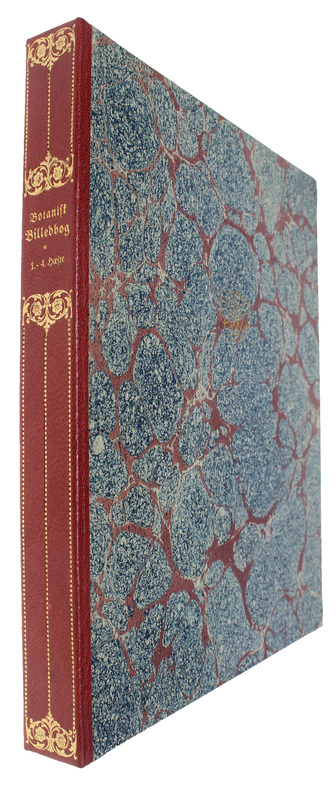
180714611Copenhagen., A.& S. Soldin, Trykt hos C.M. Cohen, 1807. 4to. All four issues in the original blank wrappers with paper title-lables to front wrappers. Each issue with a later cloth backstrip. Housed in an exquisite box with a beautifully gilt red morocco spine and marbled blue and red paper, with gilt super ex-libris to front. Some leaves brownspotted, especially in the fourth issue 48 pp + 40 finely hand-coloured plates (on two of which the engraved is mentioned: ""Fridrich sc.""). Two versions of the title-page for the fourth issue. 4to. Foreligger i de 4 originale hefter med glanspapirsomslag, shirtryg i en smuk bogæske af rød maroquin med rygforgyldning. 4 titelblade (af hefte 4 foreligger 2 versioner). På skrivepapir. 48 pp. samt 40 fint håndkolorerede plancher (på 2 plancher nævnes kobberstikkeren: Fridrich sc.). Nogle plancher brunpletted, især i 4. hefte.
18286605København, 1828-35. 3 smukke senere hldrbd.m.rygforgyldn.og skindtitler. Frisk ubeskåret eksemplar, såvel plancher som tekstsider. Med ialt 288 håndkolorerede, kobberst. blomsterplancher(efter Flora Danica og Palmstruch) samt 576 pp. beskrivende tekst. Bound in three beautiful later hcalfs w. gilt backs and leather title labels to backs. Clean and uncut copy, wich goes for both text-leaves and plates. All in all 288 handcoloured engr. plates of plants (after Flora Danica and Palmstruch) and 576 pp. of descriptive text.
Frankfurt, Sumptibus Haeredum Matthaei Meriani, 1662. Folio. In contemporary full sprinkled calf with gilt lettering and ornamentation to spine. Extremities with wear and corners bumped and with repairs. Hindges a bit weak, showing edges of cords. Missing leather on lower compartment. Lower half of half-title detached. A few pages with light brownspotting but otherwise internally fine. (20), 477, (31) pp. + 137 engraved plates depicting depicting trees, fruits, seeds, leaves ect. Including the engraved frontiespiece by Matthäus Merian engraved by Melchior Küsell.
.REGIS GRATIA AC PRIVILEGIO AD SEPTENNIUM. Basileae, (in fine): J. Oporinus 1541.[Prima edizione-Greco] (cm.30) curioso cartonato originale con frammenti di pergamena manoscritta, doppi nervi esterni. -- cc. 6 nn., pp. 291 + 1 pag. bianca. Fregi e capilettera in xilografia. La prefazione di Heronymus Gemusaeus, è in latino, tutto il testo è in greco a piena pagina e molto elegante. Prima edizione rarissima del sec. XVI della celebre opera scientifica, botanica e medica, preceduta solo dall' edizione Aldina del 1498. Il nostro esemplare non porta al frontis il nome del Camerario e la sua prefazione, ma è una variante rara con la prefazione del Gemuseo. Manca a CHOIX, DURLING e WALLER mentre ADAMS e WELLCOME hanno solo l' edizione col Camerario. Qualche lievissima ombreggiatura a poche carte in fine altrimenti esemplare molto bello nitido e marginoso. Nella sua interessante legatura originale che sia all' interno che all' esterno dei piatti conserva frammenti cartacei e membranacei manoscritti del XIV e XV secolo. L' opera, verosimilmente doveva essere ricoperta in pergamena che attualmente manca. PRITZEL 9190; BM. STC. GERMAN 856; GRAESSE VII 124; FEDERICI " SCRITTORI GRECI " p. 163 illustra le due varianti.[f30] Libro