BOCK, Hieronymus.MareMagnum

20 127 résultats
in-4, ff. (34), pp. 1200, ff. (32), preziosa legatura coeva in pelle di scrofa su assicelle in legno, dorso a nervi, piatti adorni di vari ordini di bordure a secco, tracce di fermagli. Prima edizione latina, e seconda illustrata, accresciuta di quasi 100 silografie rispetto all'edizione del 1546 fino a giungere a 568 legni. Bock è considerato uno dei padri tedeschi della botanica moderna e fu tra i primi a cercare di classificare le piante. La particolarità della sua opera è da individuarsi nel modo sistematico di descrivere le piante basato sull'osservazione a prima vista. Nel 1539 uscì la prima edizione non illustrata ma già comprensiva della classificazione delle piante in famiglie; la presente comprende 568 silografie a mezza pagina, tratte per lo più dai disegni di Kandel, Fuchs, Brunfels; mentre le aggiunte testuali di Tessier e Gessner comprendono il primo tentativo di una bibliografia botanica. Bell'esemplare, in gran parte in buono stato di conservazione, malgrado alcuni piccoli difetti abilmente restaurati (porzione del titolo in alto a destra restaurata, con alcune lettere anticamente rifatte a mano, e strappo restaurato alla pag. 203), con illustri provenienze manoscritte sulla sguardia e sul titolo: "ex Bibliotheca Fischeriana", dedica di C. A. Schmid "Collegio Carolini Professor Brunsvic 1785" a Io. Fred. Poij, Archiatra di Karolina, Principessa di Orange-Nassau (1743-1787).. Hunt 66; Nissen BBI 183; Stafleu TL2 576..
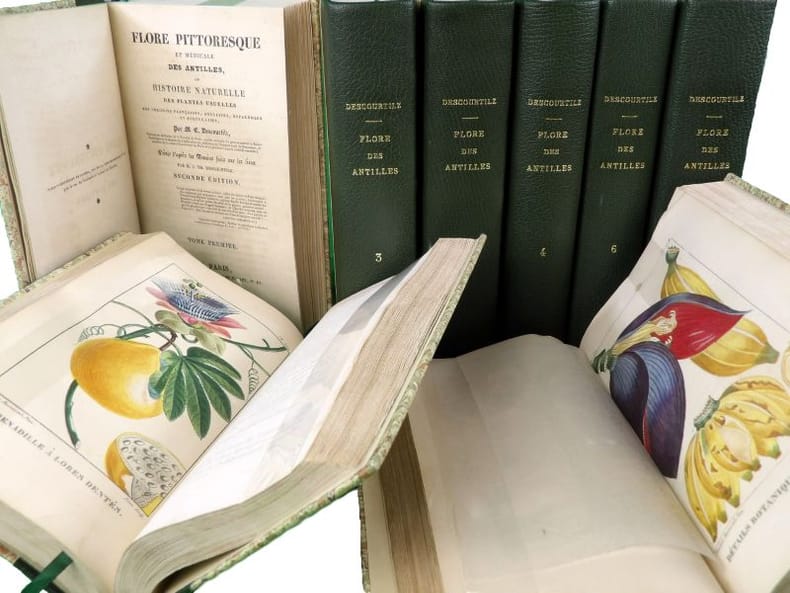
2764Paris, chez l'éditeur, chez Crosnier, chez Rousselon, 1827 - 1833. 8 Volumes, complet. In-8 - 21,7 x 12,6 cm. Reliure moderne en demi-chagrin sapin, dos lisse titré à l'or. 43pp, 296pp ; 346pp ; 370pp ; 338pp ; 292pp ; 308pp ; 344pp ; 400pp, 72pp. 1827 (tome 5), 1828 (tome 6), 1829 (tome 7 et 8), 1833 (seconde édition, tomes 1, 2 et 4). Exemplaire collationné, bien complet de ses 600 planches, finement aquarellées, protégées par des serpentes. In fine du tome 8, se trouvent les tables générales française et latine.
1590R300001385FRANCOFURTI AD MOENUM. 1590. In-4. Broché. A restaurer, Livré sans Couverture, Dos abîmé, Papier jauni. Plus de 1100 planches en noir et blanc. Tamponnée d'une bibliothèque originaire de langon (33). Dos absent. Coin supérieur droit partiellement brulé.. . . . Classification Dewey : 580-Botanique
The »Herbarius Latinus«, a most important plant incunabula, with striking Italian woodcuts. – Content: The »Herbarius Latinus« is an anonymous compilation from antiquity as well as Arabic and medieval sources. Present edition is the 2nd Italian one, at the same time the 1st of about a dozen Venetian editions of this most important Renaissance plant book. Present edition was also the first to erroneously ascribe the text to 13th ct. Spanish born physician Arnaldus de Villa Nova, whose name appears run-on with Avicenna's at the head of the preface, the printer having misunderstood the significance of the names printed beneath a woodcut that supposedly represented these two scholars and that was used as head-piece to the preface in the Vicenza 1491 edition. While the woodcut was omitted from this edition, the names were retained, and the misattribution was perpetuated throughout later editions. – Illustration: The woodcuts were printed from the woodblocks of the 1st Italian edition executed in 1491 by Leon Achates in Vicenza. They seem much more ambitious and naturalistic than those in the earlier German editions (the book was first published in Mainz in 1484), „… being finer in execution and the lines are more delicate…“ (Klebs). "A delightful example, almost Japanese in style, shows an iris at the edge of a stream, from which a graceful bird is drinking. In another picture the fern called 'capillus veneris', which is perhaps intended for the maidenhair, is represented hanging from rocks over water" (Arber, pp. 192f.)." As regards content this Italian edition also differs, as it includes plants used as medicine and sold in pharmacies and by spice merchants. – With beautifully calligraphed, partly contemporary annotations and marginalia throughout made with differently coloured ink in various languages (e.g. Hungarian), due to later cutting in parts lost.. – Condition: Cover bumped and worn, top and bottom part with faults due to worming, some parts with worm holes, moderately stained and finger-soiled throughout, leafs i2 to i4 loose, some pages with minor faults at margins or traces of old restoration, overall despite 14 leafs missing a substantial copy of this precious incunabula, gorgeously printed with wide margins. – Rarity: ISTC quotes 75 copies worldwide in institutional holdings, of which 17 imperfect like preceded. – Reference (in alphabetical order): Ahumada 7; Hain 1807*; BMC XVth, V, 524; BSB-Ink. H-104; Choulant: Graph. Inkunabeln 10; Early Herbals 11; Essling II, 1190; Goff H-69; Harvard/Walsh 2540; IGI 5677; Klebs 506. 11; Liechtenstein-Hauslab 20; Nissen BBI 2308; Pechellet 1315; Poynter 289; Proctor 5415; Pritzel 10757; Sander 612; Schullian/Sommer 237; Sajo/Soltesz 1639; Welcome 3101; Agnes Arber: Herbals, their Origin and Evolution. Cambridge et al.: Cambridge University Press, 1938.
[Botanica] HORTUS EYSTETTENSIS di Basilius Besler FACSIMILE DA COLLEZIONE IN 3 VOLUMI. Opera in tre volumi completa di Commentario Il facsimile dell¿erbario intitolato Hortus Eystettensis, è la riproduzione fedele dell¿esemplare realizzato dal botanico farmacista Basilius Besler nel 1613 e conservato a Eichstätt, in Germania. (Biblioteca Universitaria, SJ II 2892-2894). Il facsimile dell¿Hortus Eystettensis, edito a cura di Aboca Museum Edizioni, ha rispettato e mantenuto tutte le caratteristiche dell'originale, come certificato dal colophon. È un erbario figurato di straordinaria bellezza composto di 367 tavole in folio imperiale con 1084 disegni a colori di piante fiorite di provenienza europea ed esotica. L¿Hortus Eystettensis è da considerarsi il più bel florilegio del Seicento: segna il definitivo passaggio dalla tecnica xilografica a quella calcografica e apporta un rilevante contributo scientifico alla storia della botanica. Le piante, per la prima volta al centro dell¿attenzione, sono presentate seguendo la fioritura stagionale: ogni giorno il lettore ha a disposizione un fiore diverso da ammirare. VOLUME I Dedicato alla Primavera. 134 tavole calcografiche a colori, con relative pagine di testo. VOLUME II Dedicato all¿Estate 127 tavole calcografiche a colori, con altrettante pagine di testo. VOLUME III Dedicato all¿Estate (in parte), all¿Autunno e Inverno. 106 tavole calcografiche a colori, con relative pagine di testo. CARATTERISTICHE DEL FACSIMILE Anno di pubblicazione 2006 Formato cm. 43,5 x 52 Tre volumi in folio imperiale contenenti 367 tavole a colori, di misure e numero di pagine conformi all¿originale; Coperte in pergamena-simile, con decorazioni in rilievo sui piatti; Legatura eseguita artigianalmente a mano, cucitura di tipo antico, colorazione dei tagli, cordonatura, nervatura ed etichettatura sul dorso; Lingua: latino. CARATTERISTICHE TECNICHE DEL SAGGIO Anno di pubblicazione 2006 Formato cm. 28,5 x 38 Confezione brossura legata Copertina cartonata rigida con sovraccoperta Pagine 286, illustrazioni 408 Lingue: italiano, tedesco, inglese
3 vol. (2 di testo ed 1 di atlante) in-4, pp. VIII, 440; VIII, 416, 167, (privo delle 9 pp. n.n. finali contenenti un ''Indice delle Materie''); leg. coeva in pergamena titoli in oro ai dorsi, tagli marmorizz. Il terzo vol. è costituito da 65 bellissime tavole num. su doppio foglio, finem. inc. in rame dall'autore stesso; esse illustrano una grande varietà di fiori nell'insieme e nei particolari (le prime tre raffig. rispettivamente un magnifico frontesp. allegorico, semi ed attrezzi da giardinaggio, esempi di aiuole). Prima assai rara edizione di quest'opera, trionfo del Barocco nel libro botanico e di grande interesse per la storia della biologia vegetale, nella quale talvolta sono anticipate concezioni che saranno meglio chiarite da Darwin e Mendel nel secolo successivo. Il primo vol. tratta soprattutto della riproduzione delle piante e dell'impollinazione tramite gli insetti (scoperta che i testi botanici attribuiscono generalmente a Kölreuter, essendo stata per lungo tempo trascurata l'opera di Arena); il secondo vol. si occupa più specificamente dei fiori, del giardinaggio, del terreno e della coltivazione, del ''secreto per far venire dalle semenze i fiori doppi, semidoppi, di bei colori, e nuove forme...e nuovi mostri di fiori o frutti'', della semina, della piantagione; particolarmente interessanti sono i capitoli concernenti la varietà degli agrumi ed infine, nella parte quarta, viene esposto il ''Catalogo primo e secondo di tutti i generi di fiori nobili''. Esempl. assai bello. Nissen 48. Pritzel 223. De Backer-Sommervogel I, 527.4. D.B.It., IV pp. 79-81. Vendita De Belder 1987 n. 9. Mira I, 52..
In-8 p. (mm. 222 x 166), 2 volumi, p. pergam. antica (risg. rifatti) tit. oro su tassello al dorso, tagli rossi, cc.nn. 34, pp.num. 1200, cc.nn. 32, ornati da alcuni grandi capilettera figurati a vignetta; con un ritratto dell’A. (al recto della c. “d” 10) inciso a p. pagina e con l’illustrazione di 568 piante, silografate nel t., il tutto con pregevole coloritura d’epoca. "Mancano 2 carte": 1 di “Index” (c. KKk) e l’ultima di colophon (qui riprodotte su carta antica). Nel 1539 apparve la prima edizione in tedesco, senza figure, ma già comprensiva della classificazione delle piante in famiglie. Questa del 1552 è la "prima edizione latina", tradotta da David Kyber, e accresciuta di circa 100 nuove silografie rispetto alla prima edizione tedesca illustrata del 1546 che ne conteneva 477, realizzate da David Kandel. Kandel, per la maggior parte, basava le sue silografie su quelle di Fuchs e Brunfels, ma le nuove tavole sono totalmente originali ed includono anche alcune deliziose scene di genere nella raffigurazione degli alberi (sono state aggiunte figure di uomini e di animali). Hieronymus Bock (1498-1554) è considerato uno dei padri tedeschi della botanica moderna assieme a Brunfels e a Fuchs e fu tra i primi a cercare di classificare le piante che, nel suo “De Stirpium”, divide in tre libri o classi: il primo contiene le erbe selvatiche o fiori odoriferi; il secondo i trifogli e le graminacee; il terzo gli alberi e gli arbusti. Nella sua trattazione delle piante allora conosciute, i vegetali, oltrechè fedelmente raffigurati, vengono accuratamente descritti anche nel loro habitat, con l’indicazione della località, ecc. Questa prima ediz. latina contiene nella prefazione un importante contributo di Conrad Gessner (amico di Bock) in cui fa la storia completa della botanica fino ai suoi tempi, oltre a fornire una bibliografia di scrittori di botanica, considerata la prima in questo campo. L’edizione termina con un commento e la ristampa dell’"Index" di Dioscoride, fatto da Benedetto Tessier. Cfr. Pritzel,867 - Nissen,183 - Brunet,I, p. 1023 - Cat. of the Library British Museum, I, p. 182 - Biographie Universelle (1881),IV, p. 629-632. Leggerm. corto del marg. super.; nel vol. I°, prime 3 carte restaur. per piccole manc., mentre la p. 537 (per mancanza di cm. 10x7,5) è stata molto ben restaur. con sapiente trascriz. del testo su 15 righe (al verso solo su 3 righe); con qualche alone margin. più o meno lieve in entrambi i volumi. Malgrado questi difetti è un buon esemplare.
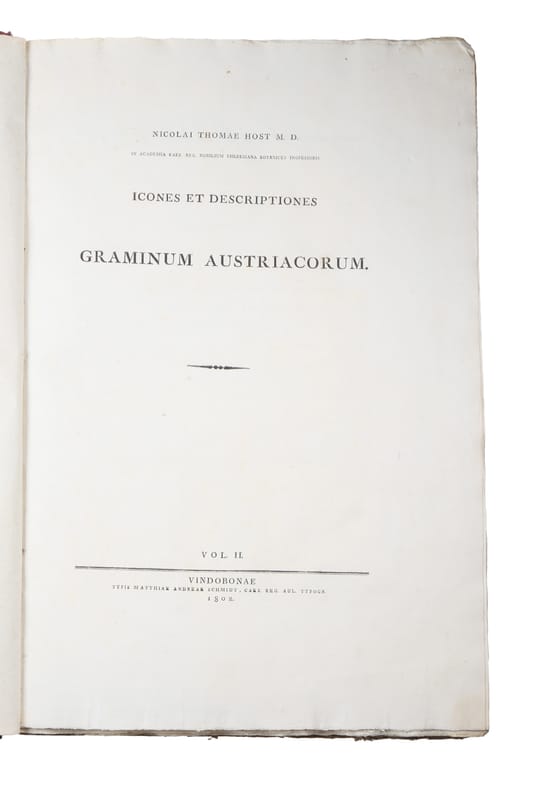
180162793Vindobonae (Vienna), Matth. Andrae Schmidt, 1801-1805. Large folio. (50x35,5 cm.) Bound in three contemporary half longgrained red morocco bindings, with gilt lettering to gilt. Corners and edges slightly rubbed, minor scratches to the marbled covers overall an excellent copy, completely uncut and very nice and clean. Text as well as plates printed on fine, thick paper. Plates with tissue-guards and in very fine original hand-colouring. (8), 74 (1), 72" (1), 66 pp. + 300 (100+100+100) hand-coloured engraved plates.
London, Whittaker & Co. 1842-1850. 4to. 4 cont. full calf. Backs with 5 raised bands, richly gilt compartments, very slight wear to backs. Gilt double line borders on covers. All edges gilt. Front hinge on Vol. 4 professionally repaired. With 260 fine hand-colored lithographed plates, all with tissue guards. (Chabot's Zinc, Skinner st.) Practically with no offsetting or foxing, clean. List of subscribers in Vol. 1., also an alphabetical index withbound. Text to all plates, pages unnumbered.
15342839<p>WITH MANUSCRIPT ANNOTATIONS IN PORTUGUESE MENTIONING BRAZIL</p><p>8vo 14.4 x 9.6 cm 180 ff. with 151 large woodcut illustrations of which 149 are of plants. Bound somewhat tightly in later vellum over boards covers gilt-ruled spine gilt with morocco title pieces a.e.g. Some marginalia cropped at time of re-binding as well as 2 pages of manuscript annotations in Portuguese. Minor tear repaired at edge of title just touching woodcut border; some minor soiling but generally a fresh copy with dark strikes of the woodcuts.</p><p>Rare second Italian-language edition first 1522 of the <em>Herbarius latinus</em> important for the dissemination of botanical/medical knowledge in popular culture and particularly for the adoption of this originally German-printed Latin work for readers in the Veneto. The second section with 96 chapters includes information on laxatives aromatics fruits seeds gums and resins salts minerals goose-grease cheese honey ivory and much more. Anderson notes that this section probably contributed to the book's success: "It was concerned with the materials of medicine that were commonly available in the shops of apothecaries and spice merchants. Through the use of the <em>Herbarius</em> the average man could easily find what drugs to use and purchase them in most towns."</p><p>According to Anderson "the <em>Herbarius</em> sold as well in Italy if not better. There its second section may have contributed to its success for it was concerned with the materials of medicine that were commonly available in the shops of apothecaries and spice merchants. Through the use of the <em>Herbarius</em> the average man could easily find what drugs to use and purchase them in most towns. The second section has 96 chapters though many of them are very brief. They deal with the following: laxatives; aromatics; fruits seeds and plants of garden and orchard; gums and resins; salts; minerals and stones; and a variety of animals and their products such as goose-grease cheese honey and ivory" Anderson <em>Illustrated History of the Herbal</em> pp. 86-7. The last chapter CLI <em>de Vino e Aceto</em> is illustrated with a woodcut showing wine barels in a cellar. According to Hunt the woodcut on the title-page showing Saints Cosmos and Damian appears here for the first time.</p><p>Our copy has 2 full page and numerious marginal early 17th c. annotations in Portuguese mentioning Brazil in one case and giving the date of 1630 in another. There are two mentions of experiments in planting and cultivating cotton and ginger "brought from Brazil"--one of them dated 1643 f. aa6 r and f. Y6 r. In 1577 the Portuguese prohibited the cultivation of ginger in Bahia due to their interests in the India trade. However Bahian colonists ignored the law and continued to grow it selling it in secret to the Dutch and the English among others. The use of lead for treating bladder ulcers is also discussed f. Y6 r. Most curious is a recipe for avoiding and curing hemorroids by "Father Manoel da Anunciação Capuchino in the year 1630". The recipe involves frying small frogs in oil without salt "until the oil stops making noise. Once they are fried take them out of the oil and put the oil in a bottle and apply this liquid with your fingers on the bone and on the hemmorhoids and they will heal quickly" f. Y6 v.</p><p> Hunt I.34; Mortimer I.228 1520 Latin; Anderson <em>Illustrated History of the Herbal</em> pp. 86-7; Schwartz <em>Sovereignty and Society in Colonial Brazil</em> esp. pp. 158-9.</p> Giovanni Andrea Vavassore hardcover
In-8 p., 7 volumi, mz. pelle coeva (abrasioni ai piatti), dorso a cordoni con fregi e tit. oro, pp. 244; (2),239; 244; 245; (2),239; (2),240; (2),128. Magnifica raccolta completa di 393 tavole (la 330 è bis) per lo più incise in rame da Dell'Acqua e con squisita coloritura di Lazzaretti, tutte dettagliatamente descritte: sono 392 tipi di piante medicinali, poste in ordine alfabetico, dalla "A" di "Abete" alla "N" di "Nigella". Come precisa l'A.: "abbiamo.. unite colla descrizione delle piante officinali, le notizie dell'uso che se ne fa in medicina, le dosi, e la maniera di prescriverle secondo i Maestri antichi e moderni..". In Appendice al 7° vol.: "Repertorio delle piante medicinali" descritte nella Flora Medica del Dottor Fisico Antonio Alberti. Italia, s.d. Dedicato a S.A.R. il Principe Eugenio, Duca di Leuchteuberg e Principe di Eichstett, ecc., pp. (2),127, con bellissima antiporta disegnata ed inc. in rame da F. Pistrucci e colorata da Lazaretti, che raffigura Esculapio Dio della medicina con Flora, divinità delle erbe, e Apollo, fecondatore della natura, su un cocchio d'oro trainato da cavalli. Nel “Repertorio” sono suddivise, secondo la materia medica, le piante descritte nella "Flora": Piante acri - Astringenti - Alessifarmache - Alteranti - Piante amare - Analetiche - Antacide - Antelmintiche - Antiscorbutiche - Antisettiche - Antispasmodiche - Antisifilitiche - Afrodisiache - Aromatiche - Balsamiche - Cardiache - Carminative - Catartiche - Corrosive - Deostruenti - Diuretiche - Emetiche - Errine - Espettoranti - Galatofore - Menagoghe - Mucillaginose - Narcotiche - Nervine - Oleose - Rinfrescative - Stimolanti - Resinose - Stomachiche - Sudorifiche. Sono quindi elencati i 4 ordini dei veleni e le piante medicinali secondo il sistema di Linneo, suddivise per classi e ordini. Al fine, l'Indice generale. Rara "edizione originale", soprattutto se completa (La II ediz. è del 1836). Cfr. Nissen,10 e Pritzel,82 che citano quest'opera in soli 6 volumi, con 360 tavole - CLIO,I,63 la cita invece in 7 volumi, con 391 tavv. L'Indice generale elenca ben 599 piante contenute nei 10 volumi della "Flora". Evidentemente queste erano le intenzioni dell'autore ma la pubblicazione si arrestò col 7° vol. Alone su 4 pp. di Indice e qualche lieve fiorit. nel t., altrimenti bell'esemplare per la qualità delle tavole (solo 8 presentano sbavature di colore).
165093TCL8LKTV6YNetherlands 1650. Framed. Drawings 48.8 x 28.9-29.2 cm. Black chalk drawings occasionally heightened with white chalk including some light brown watercolours on grey 17th-century handmade paper without watermark. In manuscript 'Martagon' in brown ink. In lower right corner in manuscript the number '3' in ink. We have not succeeded in identifying the artist of these beautiful drawings. We know no other drawing that is clearly from the same hand. Two artists are mentioned as possible candidates Govert Flinck Cleves 1615-1660 Amsterdam and Gerbrand van den Eeckhout 1621 - Amsterdam - 1674. The present drawings are probably made around the middle of the 17th century in Holland. The composition is similar to some papers in florilegia such as Theodor de Bry 1611/1612 to 1641 and later but they never show so many species and the flowers on a sheet. This study could be a sketch for a painting not necessarily a floral still life possibly a landscape. In fine condition.l Cf. Bernt Die niederländischen Maler und Zeichner des 17. Jahrhunderts vol. 4 nr. 209 München 1979; Schatborn 'Een toeschrijving aan Govert Flinck' in: Bulletin van het Rijksmuseum 22 nr. 2/3 1974 pp. 111-121. unknown
1785ST18172Turin: Michael Briolus 1785. FIRST EDITION. 410 x 270 mm. 16 1/8 x 10 5/8". Volume II with pp. 3-4 bound before pp. 1-2 but complete. Three volumes. <br/> INVENTIVE AND ELEGANT BROWN CRUSHED MOROCCO BY ANNIE BOIGE stamp-signed "A. Boige" on front pastedown and dated 1996 on rear pastedown upper covers cleverly encrusted with botanical specimens leaves or branches smooth spines with silver titling leather hinges watermarked light gray endpapers. Housed together in the original suede-lined brown cloth drop-back box suede-covered separators preventing contact between volumes. WITH engraved frontispiece portrait of the king of Sardinia in volume I engraved allegorical vignette on title pages and 92 FINE ENGRAVED PLATES ILLUSTRATING 237 BOTANICAL SPECIES. A Large Paper Copy. Cleveland Collections 557; Dunthorne 6; Sitwell "Great Flower Books" p. 67 69; Nissen BBI 18. ◆One plate with minor repair to fore-edge margin another with tiny rust hole not touching image half a dozen plates with insignificant smudges made during the printing process other trivial imperfections but A VERY FINE COPY clean fresh and wide-margined in a flawless binding.<br/> <br/> This is a major work of 18th century botany describing more than 2800 species of plants found in Italy's Piedmont region illustrating 237 previously unknown specimens and--crucially--classifying them all according to the new Linnean system becoming one of the first regional botanicals to use that taxonomy; as a bonus our copy comes in a particularly appropriate and charming binding with prominent botanical design elements. "Flora Pedemontana" was the chief work of Italian physician Carlo Allioni 1728-1804 professor of botany at the University of Turin and director of its natural history cabinet and botanical garden. The illustrations were drawn and engraved by the botanical garden's resident artist Francesco Peyroleri and his son Pietro. Our flora is also an important source of information on Alpine flowers. The modern binding is by an artisan who was proclaimed the "Grande Dame of French bookbinding" by the journal "Art & Métiers du Livre." Annie Boige trained at the Estienne School and at the Vésinet Applied Art Workshop before establishing her atelier in 1985. An art bookbinder she is noted for her monochrome color schemes and her use of beautiful leathers and vegetal materials a felicitous choice here. Michael Briolus unknown
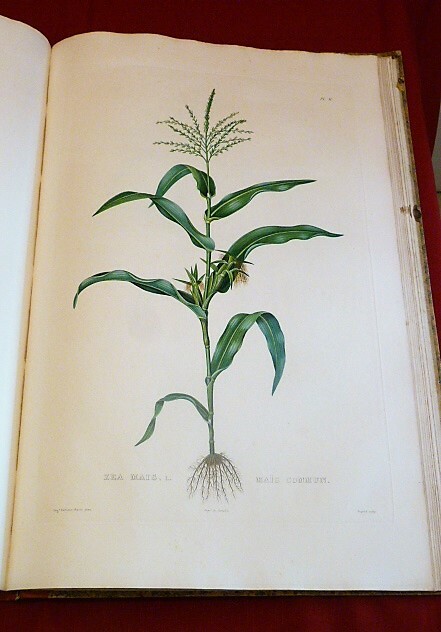
18361695Paris, Huzard, 1836. In-folio – 37x55cm. Reliure d’époque en demi-cartonnage saumon, dos lisse orné de filets dorés. Première édition, illustrée de 20 planches gravées, dont 15 imprimées en couleurs et retouchées à la main, et de 11 illustrations dans le texte, dont le portrait d'Henri-Alexandre Tessier, dédicataire de l'ouvrage. La planche V bis est gravée d’après la dernière peinture de botanique réalisée par Pierre-Joseph Redouté (1759-1840).Rare ouvrage.L'agronome Matthieu Bonafous étudia les cultures répandues dans le midi de la France : vigne, riz, soie, et maïs. Son Histoire naturelle du maïs évoque l'origine de la plante, en décrit les différentes variétés, traite de la culture, de la récolte, de l'égrenage, des nuisibles, et de leur impact sur l'économie rurale. Les illustrations mettent en valeur la diversité du maïs, les machines à égrener et les maladies dues aux insectes ou à des champignons. [Pritzel, 966. Nissen, 198. Great Flower Books, 51].
Tokio (Tokyo), 1900-08. Folio. (43x30 cm.). Bound in 2 contemp. hcalf. Covers gilt and with gilt lettering. 2 title-pages in French, 2 title-pages in Japanese and 1 colophon-leaf in Japanese in each volume. With 162 (88 + 74) fine chromolithographed plates, each with Latin nomenclatur and text in Japanese at foot. Some brownspots to the Japanese titles, plates fine and clean.
1570666651 vol. in-folio reliure de l'époque plein cuir brun, dos à 5 nerfs orné, double filet doré d'encadrement en plats, Excudebat prelum Thomæ Purfœtij [ Thomas Purfoot ], Londinis [ London ], 1570 - 1571 [ titlepage and privilege dated 1570, colophon dated 1571 ], 4 ff. (dont titre gravé), 455 pp., 7 ff. n. ch.
156138894Venegia (Venice), Vincenzo Valgrisi, 1561. Small 8vo. Contemp. full vellum. Covers a bit soiled and with remains of ink-writing on both covers. Small nicks to edges. Endpapers renewed with old paper. Old written owners name on titlepage: Antonio Cappini. 304,(32) pp. A few stains and a few scattered brownspots. Faint browning to lower margin of some leaves. Fine woodcut initials throughout.
173749368Amsterdam, Salomonem Schouten, 1737. 8vo. Contemporary full mottled calf. Light wear to top of spine. Light wear along fronthinge. Raised bands. Richly gilt compartments. Titlelabel in leather with gilt lettering. Engraved frontispiece. Titlepage in red/black. (40),372,(38) pp. and 12 folded engraved plates. Printed on good paper. Internally clean and fine.
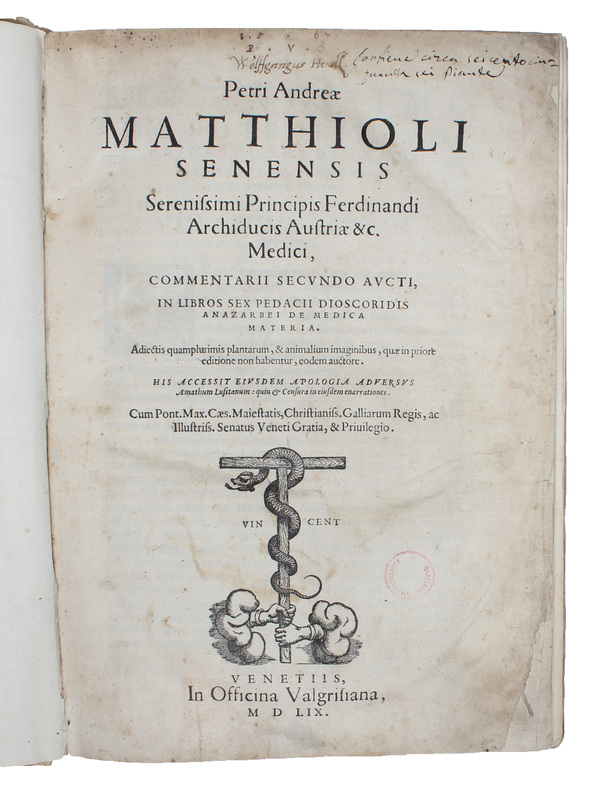
155935571Venetiis, In Officina Valgrisiana, 1559. Folio. (31,5x22,5 cm) Contemporary full Italian vellum. (100),776 pp. + Apologia (having its own title page) 46,(1) pp. Printers woodcut-device at both titles and on last leaf verso. With more than 700 fine wood-cuts in the text (of animals and plants). Light browning to title page, 2 corners repaired, no loss of text, 6 last leaves strengthened in outer margins, no loss of text. A few scattered brown spots and a few marginal notes. In general fine and clean, printed on good paper. Old name on title, Wolffgangus Hendl, 1564 P.V.Q.
180262781Stockholm, C. Delén et al., 1802-1829. Lex8vo. Bound in 10 excellent, uniform half calf bindings from ca 1900, by the great Swedish book binder G. Hedberg, in pastiche style with richly gilt spines and gilt top edges, otherwise uncut. Spines a little faded, but a beautiful set with all 720 hand-coloured engraved plates.
Venegia (Venice), Vincenzo Valgrisi, 1561. Small 8vo. Contemp. full vellum. Covers a bit soiled and with remains of ink-writing on both covers. Small nicks to edges. Endpapers renewed with old paper. Old written owners name on titlepage: Antonio Cappini. 304,(32) pp. A few stains and a few scattered brownspots. Faint browning to lower margin of some leaves. Fine woodcut initials throughout.
Amsterdam, Salomonem Schouten, 1737. 8vo. Contemporary full mottled calf. Light wear to top of spine. Light wear along fronthinge. Raised bands. Richly gilt compartments. Titlelabel in leather with gilt lettering. Engraved frontispiece. Titlepage in red/black. (40),372,(38) pp. and 12 folded engraved plates. Printed on good paper. Internally clean and fine.
Venetiis, In Officina Valgrisiana, 1559. Folio. (31,5x22,5 cm) Contemporary full Italian vellum. (100),776 pp. + Apologia (having its own title page) 46,(1) pp. Printers woodcut-device at both titles and on last leaf verso. With more than 700 fine wood-cuts in the text (of animals and plants). Light browning to title page, 2 corners repaired, no loss of text, 6 last leaves strengthened in outer margins, no loss of text. A few scattered brown spots and a few marginal notes. In general fine and clean, printed on good paper. Old name on title, Wolffgangus Hendl, 1564 P.V.Q.
Kopenhagen, Nicolaus Møller, (1761) 1766-1770. Folio. (37 x 25 cm.). Indbundet i 3 samtidige ensartede hldrbd. Rygforgyldning med blomsterstempler i rygfelterne. Forgyldt titeletiket på rygge. 2 kapitæler slidte med lidt skindtab. Lettere slidspor på rygge. Med 3 titelblade trykt i rødt og sort, hvert hefte med heftetitelblad samt indholdsfortegnelse (fra 8-10 sider) samt 537 (af 540) kobberstukne plancher- ikke kolorerede. (I første bind mangler 3 plancher: No. 112, 113 og 139). De 3 titelblade med tab af nederste venstre hjørne (kun lidt papirtab). Tekstblade og plancher rene og friske med kun ganske få mindre brunpletter.
19014624CBParis, 1901?1910. 4°. Mehr als 3100 Seiten mit 570 (davon 500 farbigen) ganzseitigen Lithographien und 820 Illustrationen im Text. Leinenbände mit roten Rückenschildchen. + Wichtig: Für unsere Kunden in der EU erfolgt der Versand alle 14 Tage verzollt ab Deutschland / Postbank-Konto in Deutschland vorhanden +, 4624CB|4624CB_2 7 Bände. [2 Warenabbildungen]