CURTIS, WilliamBiblio.com
10 003 résultats
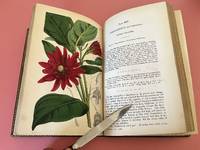
1793039192Stephen Couchman 1793. Book. Very Good. Hardcover. Royal 8vo. The Botanical Magazine which in 1801 became Curtis's Botanical Magazine is generally recognised as being the most important journal of its kind and still published today. Magnificent illustrations and beauty of production are combined with a high standard of science. This is probably the most comprehensive set ever offered either through the trade or at auction: the first 200 volumes 1793 - 1999 missing just three volumes - nos. 123 124 & 125 1897-1899. Additionally the two Companion volumes dated 1835-1836 are present plus the Dedications volume and various index volumes as documented below. In the main series a total of c. 9380 superb hand-coloured plates plus c. 125 etched or lithographic uncoloured plates plus c. 1265 colour-printed plates a total of c. 10770 plates. The majority of this collection handsomely bound in more or less matching contemporary full straight-grained green morocco extra gilt decoration to the spines all edges richly gilt marbled end papers. These volumes originally from the Library of Henry Rogers Broughton 2nd Baron Fairhaven the earlier volumes in turn from Havringland Hall Norfolk seat of the Fellows family with the Haverland armorial bookplate the later volumes with the Broughton bookplate. Volumes bound thus 1-69 71-88 97-105 108-122 127-131 156-163 the later ones bound by C. Fox W.1 of London. Otherwise vol. 70 bound in half brown Morocco also by Fox; vols. 89-96 106-107 & 126 in the publisher's green cloth; vols 132 & 133 in brown cloth to match; vols. 134-155 vols 138-146 & 148-155 with the armorial bookplate of George Walter Erskine Lodder & 164-184 in the publisher's brown cloth or brown cloth to match some with the bookplate of William Jocelyn Lewis Palmer or David Jamison. Vols. 185-200 in the original 4 parts per volume in wrappers from 1984-1994 the publication was renamed "Kew Magazine" thereafter reverting to Curtis's Botanical Magazine. Vols. 1-5 are reprints overseen by William Curtis published 1793 the first edition was published in 1787 1796 1797 1796 & 1796 respectively thereafter all first editions. Vol. 1 with an engraved frontispiece portrait of W. Curtis this was not present in the first edition and is different from that which appears in the 1828 "General Index". Vols. 132 & 133 1906 -1907 are uncoloured 120 plates: nos. 8052 -8171. At this time the Botanical Magazine was issued in coloured and uncoloured versions the latter have a different quality as the purity of the stone lithography is displayed to full advantage. Additionally: "General Indexes. the first twenty volumes." pub. 1805 contemporary half brown calf. And: "General Indexes.the first forty-two volumes." pub. 1817 contemporary half dark green morocco marbled end papers J. H. Langston. Sarsden bookplate. And: "General Indexes. the first fifty-three volumes." pub. 1828 engraved frontispiece portrait of William Curtis dated 1800 full straight-grained green morocco to match main set Haverland bookplate. And: "General index.the first hundred and seven volumes." pub 1883 publisher's red cloth. And: "Companion to the Botanical Magazine; Being a Journal". vol. I 1835 & vol. II 1836 together 30 engraved plates of which 25 partially hand-coloured; full straight-grained green morocco as above Haverland bookplate. And "Curtis's Botanical Magazine Dedications 1827-1927" 100 b/w portrait plates pub. 1931 publisher's brown cloth. Condition is generally fine to very good all bindings strong some of the earlier volumes lightly faded to the spines. Plates mostly very clean a few with a little spotting or offsetting. A few of the volumes in original paper wrappers are slightly more worn. This virtually full set of the first 200 volumes offers a rare opportunity to acquire what is undoubtedly one of the cornerstones of the botanical literature. Please note this is a large heavy set and a postal surcharge may apply. . Stephen Couchman Hardcover
67644aafParis, L.C. Desnos, 1771, gr. in-folio, Avec 116 gravures de fleurs dans un brillant coloris plus récent. 1 f. + 69 p.; 1 f. + 72 p., Maroquin rouge du XIXème siècle, dos refait.
165528459First or early editions. Various places and publishers 1655-1897 1655. See Beverly Seaton The Language of Flowers A History. University Press of Virginia 1995. A detailed description of the collection is available via pdf on our website on the catalogues page. The Language of Flowers phenomenon flourished for almost eighty years beginning in France in the early 19th century. As both potent and subtle symbols in Western culture flowers are found in religious texts poetry heraldic and emblematic literature from the classical period and early Christianity through medieval literature and the enlightenment. In the early 19th century books were written and published for the first time under titles such as Abécédaire de Flore ou Langage des Fleurs 1811 Oracles de Flore 1816 Emblemes de Flore et des Végéaux 1819 and Le Langage des Fleurs 1819. With those publications the language of flowers and its exploration of floral symbolism in communication - usually as a language of love and romance - gained acceptance and popularity. During its nascent years in France the language of flowers had a relatively limited affluent audience but once publishers saw the potential for profit and obtained the ability to print and illustrate books on a large scale they began to publish language of flowers texts in the popular formats of literary annuals gift books and almanacs. By 1830 the genre was widely available to a new world of fervent book buyers and readers in the working and middle classes. The vogue for language of flowers books was so prevalent that it became the subject of parodies and satires by among others Frederick Marryat and J. J. Grandville. Herman Melville was a devotee of symbolic flower language and referred to it in Mardi and Pierre and poems written to his wife Lizzie. The core of this collection of language of flowers titles was assembled by Doris Ann Elmore a French teacher in San Francisco and lifelong Francophile. The collection is unusual for its scope. The collection is for sale en bloc. First or early editions. Various places and publishers, 1655-1897 unknown
165528459First or early editions. Various places and publishers 1655-1897 1655. See Beverly Seaton The Language of Flowers A History. University Press of Virginia 1995. A detailed description of the collection is available via pdf on our website at www.brickrow.com on the catalogues page. The Language of Flowers phenomenon flourished for almost eighty years beginning in France in the early 19th century. As both potent and subtle symbols in Western culture flowers are found in religious texts poetry heraldic and emblematic literature from the classical period and early Christianity through medieval literature and the enlightenment. In the early 19th century books were written and published for the first time under titles such as Abécédaire de Flore ou Langage des Fleurs 1811 Oracles de Flore 1816 Emblemes de Flore et des Végéaux 1819 and Le Langage des Fleurs 1819. With those publications the language of flowers and its exploration of floral symbolism in communication - usually as a language of love and romance - gained acceptance and popularity. During its nascent years in France the language of flowers had a relatively limited affluent audience but once publishers saw the potential for profit and obtained the ability to print and illustrate books on a large scale they began to publish language of flowers texts in the popular formats of literary annuals gift books and almanacs. By 1830 the genre was widely available to a new world of fervent book buyers and readers in the working and middle classes. The vogue for language of flowers books was so prevalent that it became the subject of parodies and satires by among others Frederick Marryat and J. J. Grandville. Herman Melville was a devotee of symbolic flower language and referred to it in Mardi and Pierre and poems written to his wife Lizzie. The core of this collection of language of flowers titles was assembled by Doris Ann Elmore a French teacher in San Francisco and lifelong Francophile. The collection is unusual for its scope. The collection is for sale en bloc. <br/><br/> First or early editions. Various places and publishers, 1655-1897 unknown books
vol I TAVV. 54, II 96 (di cui 12 ripiegate), III 89 (di cui 17 ripiegate), IV 108 (di cui 14 ripiegate), V 83 (di cui 12 ripiegate), VI 100 (di cui 11 ripiegate e 1 doppia contata 2), VII 91, VIII 100 (di cui 11 ripiegate), IX 104 (di cui 13 ripiegate), X 100 (di cui 13 ripiegate) , XI 94 (di cui 17 ripiegate), XII 91, XIII 93 (di cui 13 ripiegate e 3 doppie ognuna contata 2, XIV 89, TOT 1292. Legatura in mezza pelle verde con angoli e titolo impresso in oro al dorso. In buone condizioni, non bruniti e privi di foxing.
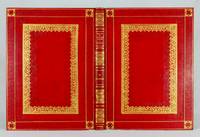
1819ST12549London: Published by Thomas McLean 1819. Second Edition. 368 x 273 mm. 14 1/2 x 10 3/4". 26 leaves of text including 3 pp. ads. Three parts in one volume. <br/> SPLENDID CONTEMPORARY ENGLISH RED STRAIGHT-GRAIN MOROCCO ELABORATELY TOOLED IN GILT AND BLIND covers with concentric filigree frames in alternating gilt and blind tooling raised bands spine panels intricately gilt with two large lozenges formed by rectangular and triangular tools surrounded by curling botanical ornaments turn-ins gilt all edges gilt. In an excellent recent matching morocco-lipped slipcase. WITH 36 VERY APPEALING ILLUSTRATIONS BEING 18 ENGRAVINGS six flowers six fruits six birds EACH IN TWO STATES monochrome and fully hand colored. Dunthorne 53-55; Sitwell "Fine Bird Books" p. 82. Text leaves with faint mottled foxing and minor browning and off-setting just a few plates with negligible faint spots or smudges otherwise A WONDERFUL COPY THE ORIGINAL SPARKLING BINDING IN AN AMAZING STATE OF PRESERVATION.<br/> <br/> This is a sumptuously bound copy of three manuals intended to teach the art of drawing to young persons written by the accomplished botanical painter who produced the renowned "Pomona Britannia." In an earlier career Brookshaw ca. 1751-1823 was a successful London cabinet-maker whose painted Neoclassical furniture attracted such titled enthusiasts as the Duke of Devonshire and the Prince of Wales but he suddenly abandoned this livelihood in the 1790s. Art historian Lucy Wood speculates that the sudden change was prompted by involvement in a financial or sexual scandal as he also parted company with his wealthy wife around this time. He spent a decade living under the name "G. Brown" teaching flower painting to refined young ladies before producing his first manual "A New Treatise of Flower Painting" which was finally issued under his real name in 1816. The three guides that make up the present volume were intended as a supplement to that work and they expand the subjects covered to fruit and birds. In the preface to this work Brookshaw observes that flower painting is a "peculiarly appropriate" accomplishment that may be obtained "without the expense of a Master a few elementary instructions and good copies being sufficient." The plates here are more highly finished than the examples in his original "Treatise" in order to "lead the young artist onward in a progressive line of improvement." Fruits and birds are added to offer a new challenge for the pupil and Brookshaw notes that while avian subjects lack the variety of botanical ones they compensate with "the inifinite number of attitudes they assume." Our elaborate and immaculately preserved binding is testament that our volume was never used as a drawing manual but was more likely enjoyed for its own merits as an attractive object. Published by Thomas McLean unknown
1917AMO-4501S.d. (1917) [pour l'éditeur J. Chevrel] 12 planches (frontispice et 11 planches) en deux états soit un ensemble de 24 planches. En feuilles. 29 x 20 ou 20,5 cm pour les feuilles 15 x 10 cm pour les cuivres (mesuré à la cuvette) - 12 planches tirées sur Japon avant la lettre avec remarque. Etat définitif. - 12 planches tirées sur Japon avant la lettre avec remarque. Etat non terminé, eau-forte pure. Le frontispice de l'état définitif est signé au crayon par l'artiste Martin Van Maele (en bas à droite). Chaque planche de l'état définitif est légendée au crayon en bas à droite. - 12 planches tirées sur vergé d'Arches avant la lettre (remarques grattées. Chaque planche, à l'exception du frontispice (ce qui est normal), est légendée à l'encre à la plume par l'artiste. Le tirage courant est sur vélin de Rives. Celui-ci, un des rares exemplaires sur Japon (quelques exemplaires seulement) avant la lettre, état définitif et eau-forte pure, avec remarque. Avec le rare tirage avant la lettre légendée sur Vergé d'Arches.
20147Leipzig, Industrie-Comptoir, 1802-1817 Relie, demi-toile rouge a l'impression doree et vignette de titre sur le dos, 260 x 330mm., pages ne sont pas numerotees, illustre de 40/60 ( 60 = total du 12 volumes ) gravures, colorees a main.With 40 (of 60) beautifully handcoloured engraved plates.
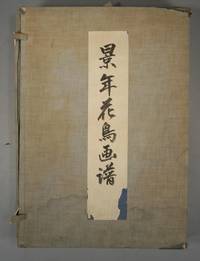
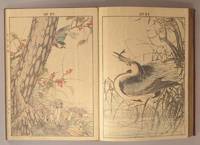
1891871711891. BIRDS & FLOWERS Imao KEINEN. KEINEN KACHO GAFU. Kyoto: Tanaka Jihei. Meiji 24-25 1891-2. 4 vols. each approx. 35.5 x 25.1 cm. Stringbound fukuro-toji Japanese style. Vol.1 Spring has 31 color woodblock prints of birds and flowers of which 7 are huge double page prints. Vol.2 Summer has 32 plates of which 8 are double page. Vol.3 Autumn has 38 prints of which 4 are double page. Vol.4 Winter has 34 plates of which 4 are double page and one is a four page spread. These original Tanaka Jihei issues which preceded the Unsodo versions have become quite scarce complete sets even more so and sets with the western number captioning the true first printing almost impossible to find. The covers are original with the titles directly printed there and the gold flecking. The summer issue has a single worm track in the margins else it and the other volumes are impeccable the printing excellent the colors subtle and lovely. The nicest set we have ever handled. All in a clasped chitsu case which itself is quite rough. 4 vols. complete as issued by Tanaka Jihei very unusual thus. unknown
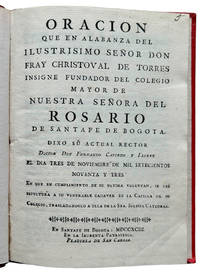
LL 705<p><strong><em>Oracion que en alabanza del ilustrismo señor Don Fray Christoval de Torres insigne fundador del Colegio Mayor de Nuestra Señora del Rosario de Santa Fe de Bogota dixo su actual rector doctor don Fernando Caycedo y Florez el dia tres de noviembre de mil setecientos noventa y tres en que en cumplimiento de su ultima voluntad se dioÌ sepultura a su venerable cadaver en la capella de su colegio transladandolo a ella de la Sta. Iglesia Catedral.</em></strong> En Santafe de Bogota: MDCCXCIII: En la Imprenta-Patriotica. Plazuela de San Carlos; 1793.</p><p>20 52 2 p.; 20 cm. 4to. Signatures: aâ´ b-d² A-Fâ´ Gâ´-G4 a1 a4 G3 versos blank.</p><p><strong>Extremely rare early Colombian imprint.</strong> In this <em>Oracion</em> the first archbishop of Bogotá from the newly established New Granada praises the founder of one of Colombia's most important universities. This is a speech in praise of Friar Cristóbal de Torres y Motones a Spanish ecclesiastic born in Burgos in 1573 and who passed away in Santafé on July 8 1654. In 1653 he founded the Colegio Mayor de Nuestra Señora del Rosario. He served as the eighth Archbishop of Santafé de Bogotá 1635-1654.</p><p>The Universidad del Rosario officially known as<em> Colegio Mayor de Nuestra Señora del Rosario</em> is a private Colombian university founded in 1653 in what was then Santa Fe now Bogotá by Dominican friar Cristóbal de Torres y Motones. The institution is known for its historical heritage and for providing a "scientific ethical and humanistic" education. It is recognized as one of the best universities in Colombia and Latin America. A year after founding the Colegio Mayor del Rosario Cristóbal de Torres died in 1654.</p><p>The Author: Fernando Caicedo y Flórez Suaita June 15 1756 – Bogotá February 17 1832 was a Colombian Catholic priest and theologian. He was the first Archbishop of Bogotá 1827-1832 in the Republic of New Granada and a hero of the Independence movement. He served as a professor and rector of Colegio Mayor de Rosario 1792-93 during which time he wrote this work. Since 1810 the Caicedo family actively participated in the fight for Independence and in 1813 Fernando Caicedo y Flórez was among the signatories of the declaration of absolute independence for Cundinamarca promoted by Antonio Nariño.</p><p>The Printing Press: <strong><em>La Patriótica</em></strong> was the printing press established by Antonio Nariño in Santafé in the New Kingdom of Granada. Nariño a creole from Bogotá made a significant mark in history as the first Neogranadine to own a printing press which operated for just one year and printed only three works one of which we offer here.</p><p>Context: Before acquiring the printing press Nariño used to gather close friends and trusted individuals in meetings to discuss various topics—perhaps news from the Old World and the nascent North American nation as well as his more private plans. These gatherings included people close to Nariño such as Zea Pedro FermÃn Vargas and other enlightened creoles.</p><p>The Printing Press in Bogotá: The first printing press was brought to Santafé by the Jesuits in 1738. Then in 1777 Viceroy Manuel Antonio Flórez invested significant resources to bring a printing press from Cádiz and arranged for Manuel Espinosa de los Monteros a renowned printer to move from Cartagena to Santafé to establish the Imprenta Real. Finally in 1793 Antonio Nariño decided to create his own press which he named La Patriótica located in the square of San Carlos Church close to the main plaza.</p><p>Nariño hired Diego Espinosa de los Monteros a former worker at the Imprenta Real along with Juan Fulgencio Tomapasca and Antonio Murcia. They were joined by two assistants Manuel MarÃa Torres and Pedro José de Vergara. At La Patriótica the following were printed: the <em>Papel Periódico de Santafé</em> by Manuel del Socorro RodrÃguez Friday April 19 1793 <em>Oración</em> by Fernando Caicedo 1793 and <em>Derechos del Hombre y del Ciudadano</em> <em>The Rights of Man and the Citizen</em> December 1793 by Antonio Nariño. This phase of Antonio Nariño's life as a publisher is fascinating because it reveals a characteristic of the enlightened society of Santafé—its interest in publications which would gain momentum in the following century.</p><p>The printing of <em>The Rights of Man and the Citizen</em> sparked a revolutionary desire among several members of the creole elite. "In 1793 at the age of 28 Antonio Nariño played a pivotal role that changed his life forever as well as that of the Neogranadine society which was beginning to embrace the ideas of independence from the Spanish crown. In his Patriotic printing press Nariño published the <em>Derechos del Hombre y del Ciudadano </em>drawn from the French Revolution a document banned for its progressive and revolutionary nature.</p><p>From that point on Nariño the son of Spanish parents and a former Viceroyalty official himself had to dedicate himself to defending his actions. Two years later he was sentenced to 30 years in prison and sent to Cádiz Spain. However after one year six months and 17 days in captivity during a moment of inattention by the guards he managed to escape and traveled through Europe spreading the ideals of Independence until 1797 when he returned to Bogotá" El Espectador.</p><p>Extremely rare.</p><p>¶ Posada E. Bib.Bogotana p. 100 # 56. esta mal: es Posada E. BibliografÃa Bogotana Bogota 1917 # 76; Palau 50660. Romero p. 195.</p><p># WorldCat U.S. Libraries: 2 copies JCB Sunny. LL 705.</p>
17934973DBLondon, W. Curtis, 1793-1798. 8°. 1- 432 S., 12 title pages, 2 pages of Index.. With 432 coloured plates. Gilt contemporary calf with red spine labels. + Wichtig: Für unsere Kunden in der EU erfolgt der Versand alle 14 Tage verzollt ab Deutschland / Postbank-Konto in Deutschland vorhanden +, 4973DB|4973DB_2 Vols. I to XII in six volumes. [2 Warenabbildungen]
19141477Imprimé pour Charles Meunier, La Maison du Livre, Paris 1914. 1 volume in-folio (370 x 280 mm) entièrement monté sur onglets, couverture muette de papier marbré gaufré, portefeuille à rabats, dos et coins de percaline bleue, pièce de titre (de l'éditeur). 10 EAUX-FORTES ORIGINALES EN COULEURS HORS-TEXTE DE LOBEL-RICHE dont un frontispice, une vignette gravée sur le titre, 10 illustrations dans le texte et nombreux ornements. Édition de luxe tirée à 30 exemplaires seulement. EXEMPLAIRE SUR JAPON IMPÉRIAL contenant 5 ÉTATS DES EAUX-FORTES dont un état sur parchemin signé à la mine de plomb (1e, 2e, 3e épreuves en états d'eau-forte, 4e état terminé sur parchemin, signé pour chacune au crayon par l'artiste, 5e état en couleurs à la poupée sur vélin blanc), une suite sur Japon de 12 petites eaux-fortes reprenant les vignettes in-texte, la gravure de titre avant la lettre et 2 très jolis DESSINS ORIGINAUX signés au crayon en noir et bistre sur le faux-titre. English description: LES BARS. Size plate or paper : 37 x 28 cm, 10 original etchings in 5 states : 1rst state (eau-forte pure), second state in black, state in black signed and printed on parchemin, in black with aquatint, and final state in color (à la poupée). cumulatively 50 plates. Also 20 pages of text with small drawings printed in red. All these drawings are reinterpreted in original etching (pointe-sèche) : 12 (tltle + 11), and printed on Japan paper. 2 ORIGINAL DRAWINGS signed on the half-title page.
1840031494United Kingdom 1840. Painting. Very Good. Unframed. Original. 24 x 29.5 Cm. A collection of 43 very fine early/mid 19th century comparatively large approximately 285 x 235 mm original watercolour studies of different species of South African Ericas each autographed with the species name. Housed in a red straight-grained morocco case with closing flap and the words "In Memoriam Madre Mia" in memory of my mother. While there is no reference to the originator of these studies they are executed in a style close to that used by Henry C. Andrews for his Monograph on the Genus Erica 1804-1812. The present watercolours do not correspond directly to those but the composition is similiar and it is possible they were executed by Andrews in connection with the publication. Notwithstanding they are highly accomplished reminiscent of the best botanical artists of the day. They are painted onto fine-textured card; this card for a number of paintings is blind embossed to the corners "Reynolds extra superfine London board" or "Bristol Paper". These papers would appear to date the paintings to the 1840's which would fit with the style of the paintings and lettering however the straight-grained morocco case might suggest an earlier date The paintings are generally in very good condition the colours fresh vibrant and unfaded a few are a little dust marked the paper lightly age-toned one or two small marks. The case is a little worn and rubbed to the edges the tap to pull out the flap is missing the paintings are very tight when all are in the case. An exceptional and important historical collection of original watercolour paintings of South African Ericas. unknown
17934973DBVols. I to XII in six volumes. London, W. Curtis, 1793-1798. 8°. 1- 432 S., 12 title pages, 2 pages of Index.. With 432 coloured plates. Gilt contemporary calf with red spine labels.
1825c2401040028xbvkNot localized or dated (3 sheets with watermark 'J. Whatman / Turkey Mill** / 1823 [resp. 1824*** and 1825]'), ca. 1823-1825. 18 sheets of paper of the period, sizes from ca. 24 x 19 cm to ca. 31 x 22 cm; the drawings within pencil-frames of ca. 18 x 13/14 cm, slightly varying; 16 of them signed 'P. J. Redouté' in the lower left corner of the frame****. - Loose in olive-grey folded carboard of the period with ink-title at frontpanel (as quoted above) and another similar title in pencil at inner rear-panel (perhaps by Redouté himself): ''Dessin / des Roses / 168 Dessin au Trait / Collection des Dessins originaux / de L'ouvrage des Roses pour l'Edition en-4°- / 168 Dessins au Trait''; Folio (ca. 32,5 x 24,5 cm).
1925868921925. BIRDS & FLOWERS Tsuchida EISHO Takeuchi SEIHO artists. EISHO HYAKUCHO GAFU. 4 vols. complete 22.7 X 33.1 cm. Kyoto Unsodo Taisho 3 3 12 14 1914 14 23 25. Profusely illustrated set of images of birds often quite surreal renderings ostensibly after design by Tsuchida Eisho the mid-19th century painter here re-interpreted by Seiho the 20th century master and subtly printed by the Unsodo. Very unusual work complete in a clasped chitsu case. Very good colors impressions condition. A brief notice can be seen at Mitchell p. 249 referencing Brown p.202. unknown books
11814Amsterdam. [Bruxelles]. À lenseigne du Coq [Auguste Poulet-Malassis]. 1866. In-8°, reliure de maroquin vert bronze à coins, dos à cinq nerfs avec fleurons et titre dorés, filets sur les plats, tranche supérieure dorée (Smeers). Frontispice de Félicien Rops tiré sur chine, protégé par une serpente portant à son verso, imprimé en rouge, un texte dAuguste Poulet-Malassis : « Explication du Frontispice ». II pages d « Avertissement de léditeur » + 163 pages. E.O. tirée à 260 exemplaires. 1/250 sur grand papier vergé de Hollande. [10 chine / 250 hollande]. Reliure unpeu frottée sur les bords, les mors, les coins et les nerfs ; seul et léger défaut les pages intérieures sont exemptes de rousseurs et sont dans un remarquable état de fraîcheur ; le frontispice est impeccable. Très rare. (Carteret, I, 127) ; (Clouzot, 28) ; (Oberlé, 844).
1891911031891. BIRDS & FLOWERS Imao KEINEN. KEINEN KACHÔ GAFU. Kyoto: Tanaka Jihei. Meiji 24-25 1891-2. 4 vols. each approx. 35.5 x 25.1 cm. Vol.1 Spring has 31 color woodblock prints of birds and flowers of which 7 are huge double page prints. Vol.2 Summer has 32 plates of which 8 are double page. Vol.3 Autumn has 38 prints of which 4 are double page. Vol.4 Winter has 34 plates of which 4 are double page and one is a four page spread. These original Tanaka Jihei issues which preceded the Unsodo versions have become quite scarce complete sets even more so and sets with the western number captioning the true first printing almost impossible to find. The original covers are worn and the 4 volumes have been placed into heavy cloth outer bindings with supplied title labels. The printings are excellent the colors much milder than the reprints subtle and lovely. Complete as issued by Tanaka Jihei very unusual. unknown
18991181571899 Paris, Pour les Cent bibliophiles, 1899, 1 volume in-quarto de 205x275 mm environ, 423 pages , XXVII pages (Pièces condamnées), (3) ff. (carton),complet du frontispice et des 6 planches hors-texte, contient la note pour le relieur ainsi que le courrier d'expédition de la Société des Cent Bibliophiles reliés in-fine. Tirage à 115 exemplaires numérotés (n°66, nominatif). Reliure signée de Carayon, demi maroquin rouge à coins, plats marbrés, gardes marbrées, couvertures et dos d'origine, grainés, conservés. Des épidermures sur le cuir, quelques feuillets très légèrement salis en leur marge (poussière), de rares feuillets brunis en fin de volume néanmoins bon état, bel exemplaire.
M163510P, Klincksieck, 1896 , 3 vos in 8 1/2 chagrin marron à coins , filets sur les plats , 432pp , 2 vols de planches montées sur onglet. Exemplaire de toute fraicheur, dos très légèrement passés. Langue: Français
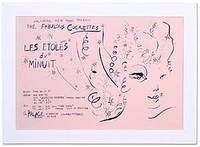
386621San Francisco: Nocturnal Dream Shows 1970. Fine. Color lithographic poster. Designed by John Flowers printed in purple and gold on light rose-colored paper. Measures approximately 17.5" x 11". Neatly tipped-in at the corner edges into a mat frame. A fine copy. A beautifully printed poster advertisement from the Cockettes legendary series of midnight shows given at the Palace Theater in North Beach San Francisco. A psychedelic drag queen troupe founded by Hibiscus George Harris the Cockettes performed outrageous parodies of show tunes and much else. Breaking many social cultural and sexual boundaries along the way they inspired the glitter rock-era of David Bowie Elton John The New York Dolls and filmmaker John Waters. A scarce survival. (Nocturnal Dream Shows) unknown
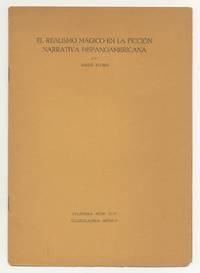
1957534842Guadalajara México: Et Cætera 1957. Softcover. Very Good. Offprint. Translated by Miguel Rodríguez Puga misspelled "Juga". Small slim quarto. 99-108pp. Stapled printed wrappers. Text in Spanish. Wrappers with tiny chips at the bottom corners and a couple of very short splits staples lightly oxidized and paper evenly toned a very good example of a relatively delicate pamphlet. From the library of noted Spanish philologist librarian and linguist Tomás Navarro Tomás with a six-line note on the first page some bracketing and underlining in the text and 27 lines in Spanish at the end all in red ink.<br /> <br /> While the practice of combining the words "magic" and "realism" had been around since the 1920s - with entire books having been written on the subject - this is the paper that popularized the term "magical realism" for the genre of Latin American fiction as we know it today. Flores who found the movement's genesis in Borges' publication of A Universal History of Infamy in 1935 first presented this paper at the Spanish 4 Group Meeting of the 69th Annual Meeting of the MLA in New York December 27-29 1954. It was published in English in the journal Hispania in May 1955 Vol. 38 No. 2. This offprint is from its Spanish-language publication in the important Guadalajara literary magazine Et Cætera Nos. 23-25 July 1957 - March 1958. This is quite likely the offprint of its first Spanish-language publication; information appears to be slight but we do find it cited next to the English-language edition in a footnote of Luis Leal's classic 1967 essay on the subject "Magical Realism in Spanish American Literature" accessed online via an English anthology published by Duke. A rare and early offprint of a pivotal essay on Latin American literature with annotations by a noted Spanish philologist and linguist. OCLC locates no copies of this Mexican offprint nor does it locate any copies of an offprint in English if one was even published. Et Cætera unknown
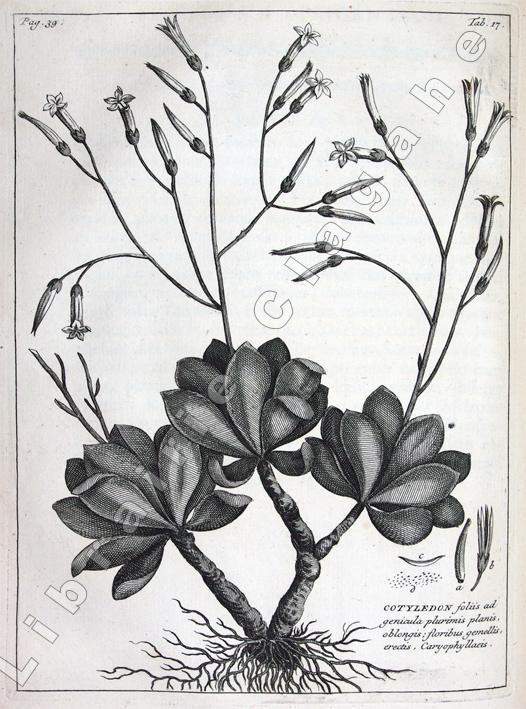
173817291Amsterdam, Henricum Boussière, 1738 ; in-4, veau marbré, dos à nerfs décoré et doré, pièce de titre grenat, roulette sur les coupes, tranches rouges (reliure de l'époque); VIII, 268pp. [i.e. 278], y compris les titres des dix parties avec vignette gravée sur cuivre répétée, (1) f. d'Index et (10) ff. de dédicaces à des personnalités différentes ; 100 planches hors-texte gravées sur cuivre.
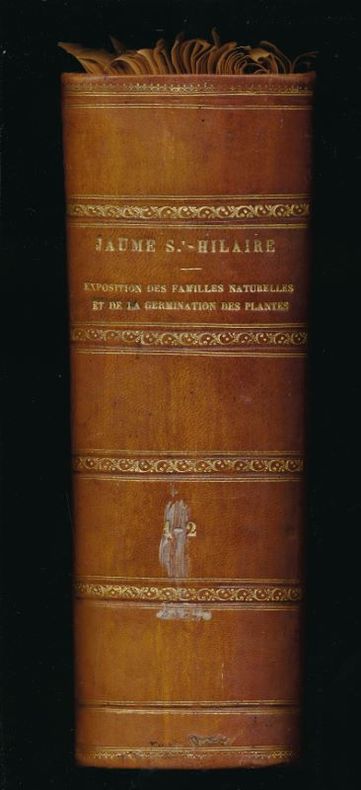
1805119040Treuttel et Wurtz Paris, Treuttel et Wurtz, 1805 - An XIII. 2 tomes reliés en un seul fort volume petit In-4 demi-basane brune, dos lisse à filets dorés. LXIII + 512 + 472 pages. 112 planches (et non 117 comme annoncé par erreur en page de titre cf. Catalogue Missouri Botanical Garden library), dessinées par l'auteur en couleurs. Sous-titre : Contenant la description de 2337 genres, et d'environ 4000 espèces, les plus utiles et les plus intéressantes. Cent dix-sept planches, dont les figures ont été dessinées par l'Auteur, représentant les caractères des Familles et les différens modes de germination des Plantes Monocotylédones et Dicotylédones. Avec, en fin d'ouvrage, une Explication des termes botaniques employés dans cet ouvrages et une table des noms français. Très bel état des planches finement aquarellées. Légers frottements à la reliure sans gravité, une tâche en dos, bel état intérieur, exemplaire grand de marge. Juste une petite déchirure sans manque à la première planche. Bel exemplaire, bien complet.
Paris, Treuttel et Wurtz, 1805 - An XIII. 2 tomes reliés en un seul fort volume petit In-4 demi-basane brune, dos lisse à filets dorés. LXIII + 512 + 472 pages. 112 planches (et non 117 comme annoncé par erreur en page de titre cf. Catalogue Missouri Botanical Garden library), dessinées par l'auteur en couleurs. Sous-titre : Contenant la description de 2337 genres, et d'environ 4000 espèces, les plus utiles et les plus intéressantes. Cent dix-sept planches, dont les figures ont été dessinées par l'Auteur, représentant les caractères des Familles et les différens modes de germination des Plantes Monocotylédones et Dicotylédones. Avec, en fin d'ouvrage, une Explication des termes botaniques employés dans cet ouvrages et une table des noms français. Très bel état des planches finement aquarellées. Légers frottements à la reliure sans gravité, une tâche en dos, bel état intérieur, exemplaire grand de marge. Juste une petite déchirure sans manque à la première planche. Bel exemplaire, bien complet.