HARRIS, MosesMareMagnum

13 151 résultats
In-folio grande (49x30), (6cc), XLI tavole a colori, 77pp, paginazione imperfetta (come in altri esemplari di questa tiratura), legatura coeva in mezza pelle con angoli, dorso restaurato a otto comparti con titolo in oro su tassello di marocchino. Edizione originale, prima tiratura, di uno dei più bei libri di entomologia mai pubblicati. Bellissima l’antiporta in bianco e nero (che mostra l’Autore con i suoi strumenti da entomologo su di uno sfondo boscoso) e 41 tavole a colori di superba qualità, raffiguranti farfalle, falene e i diversi stadi delle loro metamorfosi, assieme a piante e fiori di cui si nutrono. Il tutto con accuratezza scientifica e al contempo con la volontà di mostrare la bellezza di questo microcosmo. Ogni tavola è protetta dalle veline originali (alcune con strappetti o piccole mancanze). Questo esemplare presenta la tavola II con i margini inferiori e superiori più corti (ma quello di sotto è intonso); la pagina di fronte B2 ha il margine inferiore più corto e quello esterno appena rifilato; in mezzo sta la velina originale e la coloritura della tavola è assolutamente della stessa qualità delle altre. Essendo questo un esemplare in carta grande è quasi certo che, per qualche motivo contingente, nella bottega stessa del tipografo-editore siano stati inseriti due fogli in carta normale. Nonostante ciò, si tratta di una superba copia assolutamente genuina. Ogni tavola misura mediamente alla battuta del rame 30x23. La coloritura è splendida. Moses Harris (1730-1788) fu uno dei maggiori entomologi del suo tempo. Disegnò le sue farfalle da vivo prestando una particolare cura alla qualità dell’incisione e alla bellezza dei colori. Nissen, 190. In-folio large (49x30), (6cc), XLI colored plates, 77pp, imperfect paging (as in copies of the same issue), contemporary half calf binding with corners, eight-sections restored spine with gilt title on Moroccan label. Original edition, first issue of one of the most beautiful entomology books ever published. Beautiful black and white frontispiece (showing the author with his tools in a forest background) and 41 color plates of superb quality, depicting butterflies, moths, and the different stages of their metamorphosis, together with plants and flowers they feed on. All with scientific accuracy and at the same time with the desire to show the beauty of this microcosm. Each plate is protected by the original tissues (some with tears or small lacks). This copy presents plate II with shorter upper and lower margins (but the one below is uncut); the opposite page B2 has a shorter lower margin and the external one slightly trimmed; in the middle there is the original tissue, and the coloring of the table is absolutely of the same quality as the others. Since this is a large paper copy, it is almost certain that, for some reason, two sheets of normal paper have been inserted in the printer-publisher's shop. Despite this, it is a superb and genuine copy. Each plate measures 30x23. The coloring is splendid. Moses Harris (1730-1788) was one of the leading entomologists of his time. He drew butterflies live, paying particular attention to the quality of the engraving and the beauty of the colors. Nissen, 190.
33130-1195N.p. n.d. early 19th century. 85 sheets size 235 x 215 mm; 2 sheets size 151 x 134 mm. In contemporary cloth slipcase richly decorated with gilt rocaille decors on front and rear covers all sides with gilt rocaille in same decor slightly rubbed. Exlibris Heinrich Angst 1847-1922 founding director of the Swiss National Museum Zurich. N.p. n.d. early 19th century. A beautiful collection of brilliant drawn and colored insects painted on heavy Whatman paper. Up to seven insects are shown partly sitting on flowers or leaves. The work is of quite high quality in both drawing and coloring and can be compared with the best work of entomological book illustration. It is not possible for us to identify the artist and therefore we were unable to discover anything about place of origin. Perhaps also the painter draftsman and etcher Johann Rudolf Schellenberg 1775- 1851 from Winterthur who bore the same first name as his father Johann Rudolf Schellenberg 1740- 1806 - the famous book illustrator - can be designated as painter of these beautifully water colors. An autograph letter probably by Heinrich Angst himself is attached here in which Angst writes transl. "that he bought this present collection from Professor Alfred Ernst of Winterthur as an authentic work by J. R. Schellenberg. the Ernst family inherited the whole Schellenberg estate". J. R. Schellenberg junior's life data match the data of the heavy Whatman paper.- All leaves are brighly colored and in pristine condition. PRINTS & DRAWINGS ; ENTOMOLOGY ; N.p., n.d., hardcover
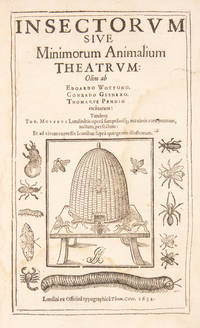
16343993<p>London: ex Officina typographica Thom. Cotes. Et venales extant apud Guiliel. Hope ad insigne Chirothechae prope regium Excambium 1634. </p><p>Price: $14000.00 </p><p>Folio: 29.4 x 19.5 cm. A6 a4 B-Z6 Aa-Dd6 Ee4 </p><p>FIRST EDITION of the "true foundation of modern entomology"Raven English Naturalists from Neckham to Ray 1947.</p><p>A very fine copy bound in contemporary vellum spine restored. The text is in excellent crisp condition with a few scattered rust spots a few lightly spotted leaves and one natural paper flaw leaf X3 with no loss. Illustrated with a decorative woodcut title vignette and over 500 individual woodcuts of insects. Very uncommon in such fine original condition.</p><p><br /></p><p>The 'Insectorvm Sive Minimorum Animalium Theatrvm' Theater of Insects the Smallest of Animals is the first substantial scientific treatise devoted exclusively to entomology and the first original treatise devoted to natural history composed in England. At its nucleus is the research of no less than Conrad Gessner who failed to complete a volume on insects for his vast and revolutionary zoological encyclopedia. Gessner's work was carried to fruition by two English naturalists Thomas Penny and his colleague Thomas Moffet with the invaluable assistance of an international network of contacts. In its final form the "Theater of Insects" brought together information from sources in Asia England Europe Africa and the Americas conducted over the course of two generations from the age of the great taxonomic researches of Aldrovandi and Gessner to the age of Bacon and the early modern scientific revolution.</p><p><br /></p><p>The book's importance is thus two-fold: first as a watershed in the study of insects and second as a record of and testament to a remarkable collaborative effort by an international group of scientists physicians artists and laymen many unknown to each other but all drawn into association as contributors to the entomological studies of Penny and Moffet.</p><p><br /></p><p>"In putting together the materials that would eventually be published as 'Theatrum Insectorum' Penny and Moffet amassed a large collection of information specimens and images of insects from contacts and correspondents with widely varying backgrounds. The members of this group ranged from some of the most learned naturalists of sixteenth-century Europe to gentlemen collectors in England to friends and travelers to foreign lands whose interest in insects led them to endure ferocious bites and filthy ditches to unnamed individuals who were paid to make observations of insects… </p><p><br /></p><p>"Moffet and Penny probably formed their friendship while Moffet was a student at Trinity College Cambridge. The materials on insects that formed the nucleus of their book were obtained by Penny during his travels in Europe from 1565 to 1569 during which time his interest in natural history was stimulated and encouraged. Penny arrived in Zurich in 1565 to meet Conrad Gessner and presented him with drawings and specimens of English plants… In exchange for these botanical materials Gessner made Penny a gift of the pictures and notes on insects that he had been gathering over the years." Neri The Insect and the Image: Visualizing Nature in Early Modern Europe 1500-1700</p><p><br /></p><p>During this time abroad Penny cultivated contacts and correspondents within Gessner's international network of naturalists among them Carolus Clusius Mathias L'Obel and Jean Bauhin and when he turned from botanical studies to work in earnest on the study of insects he drew upon these same contacts for specimens information and drawings.</p><p><br /></p><p>"Over the years Penny received several unusual flies a moth a butterfly four rare beetles and an African mantis from Clusius. Camerarius sent an unusual fly several beetles and a caterpillar. In some cases the text of the 'Theatrum' specifically notes that Penny received an image as opposed to a specimen as in the case of the rare 'horse-nose beetle' which 'Clusius sent painted from Vienna."Ibid.</p><p><br /></p><p>In England Penny acquired the notes on insects made by Edward Wotton of Oxford; among those who sent Moffet specimens and illustrations was John White the Virginian pioneer who contributed the drawing for the swallowtail butterfly Pailio glaucus L. a woodcut of which occupies three quarters of page 98 in the printed text. </p><p><br /></p><p>When Penny died Moffet finding himself in a position analogous to that in which Penny found himself when he was given Gessner's notes was tasked with completing the work. "In taking up the project of bringing Penny's unpublished research to publication Moffet was tasked with organizing and paring down what seems to have been a very large amount of material something Penny was not able to accomplish during his own lifetime."Ibid. </p><p><br /></p><p>According to Moffet Penny left his draft and other documents "in a confused heap." Moffet also tells us that they were about to be thrown away by Penny's executors when Moffet redeemed them for "a great sum of money." By 1590 Moffet had finished editing the work and was negotiating for publication in The Hague. That fell through however and Moffet was unable to find a printer in England. After Moffet's death the apothecary known as "Mr. Darnell" sold the manuscript to the physician Theodore de Mayerne who eventually published it in 1634.</p><p><br /></p><p>"The 'Theatrum insectorum' itself is a systematic treatise dealing with the habits habitat breeding and economic importance of insects beginning with bees which are accorded the most detailed treatments. The observations and illustrations… are of considerable interest. Moffet usually described the larval and adult forms separately and was aware that 'There are so many kindes of Butter-flies as there are of Cankerwormes'. He further discussed the emergence of either butterflies or 'ordinarie Flyes' now known to be parasitic wasps from similar pupae and described both the depredations wrought by locusts in Europe and their use as food. He also recorded observations of the movement of the tongue of the chameleon in feeding." DSB.</p><p>Garrison-Morton 288; Lisney pp. 4-9; Norman 1528; Raven English naturalists ch. 10; STC 17993a; Huntington Catalogue p. 297; Nissen 2852; Horn.-Schenkl. III 15547; Hagen I 553</p><p><br /></p><p><br /></p> ex Officina typographica Thom. Cotes. Et venales extant apud Guiliel. Hope, ad insigne Chirothechae, prope regium Excambium, books
176142847ABNürnberg, J. J. Fleischmann Bd. 1 u. 2 (1746 u. 1749), 1764, Bd. 3: 1755; Bd. 4: 1761. 4 Bde. + 1 sep. Tafelband. 8°. Halblederbände d. Zt. mit kl. dezenten Reparaturen an den Außengelenken u. Kapitalen. 4 Bde. + 1 sep. Tafelband. Halblederbände d. Zt. mit kl. dezenten Reparaturen an den Außengelenken u. Kapitalen.
1788193877-1Haarlem u. Amsterdam, Bohn u. Wit 1765-1788. Mit 3 kol. Frontisp., 1 gest. Porträt u. 359 kolor. Kupferstichen auf 288 Tafeln. Halblederband der Zeit
Sei opere in due tomi in folio (mm 335x210); pagg. 231, (5) con 80 tavole incise finemente in rame fuori testo a piena pag. di quadrupedi; 227, (9) e 62 tavole di uccelli nella seconda opera, testo su due colonne; pagg. 228 con bel frontespizio allegorico inc. in rame e 47 tavole fuori testo in rame a carattere ittiologico; pagg. 78, (2) con 20 tavole in rame f.t. di granchi, polpi, meduse, molluschi, stelle marine ed animali marini in genere; pagg. 200, (8), con 28 tavv. f.t.; pagg. 40, (4) e 12 tavv. f.t. Alla fine della prima opera è aggiunto, di Pietro Castelli, il "De Hyaena odorifera, zibethum gignente".<BR>Frontespizi incorniciati da belle scene allegoriche di carattere zoologico incisi da Caspar e Matteo Merian. Iniziali entro belle vignette istoriate e testatine in silografia. Piena pelle post. con dorso a nervi e titolo in oro al dorso, tagli a spruzzo. Prime edizioni di tutte le opere. <BR>Jonston (1603-1675), scienziato polacco di origine scozzese, frequentò l'università di St. Andrews dal 1622 interessandosi con maggior attenzione agli studi di ebraico e scienze naturali fino al marzo del 1625. Nei successivi quattro anni si trasferì all'estero, ma tornò in Inghilterra due volte frequentando corsi di botanica e medicina a Cambridge. Fece ulteriori viaggi nel continente stabilendosi a Leida nel 1634 dove ottenne la cattedra di medicina.<BR>Buon esemplare con lievi arrossature a poche pagine e lievi fioriture, le tavole complessivamente sono in ottimo stato. Piccola mancanza marginale a frontespizio e seconda pagg. della prima opera<BR>Ceresoli, pag. 311. "De Piscibus": Nissen, Fischbücher 82 - Dean III, 265<BR>
17463422Nürnberg, Selbstverlag, Kleemann, 1746-1761. Erste Ausgabe - Nissen, ZBI, 3466 und 3466 a-c; Junk, Rara, S. 159-162. - Die Deckel von Band 1 etwas berieben, der Rücken mit kleiner Läsur; der Rücken von Band 3 fachmännisch ersetzt. - Die Vorsätze von Band 1 gebräunt. - Der vordere Innendeckel von Band 3 mit Exlibris. - Der Titel von Band 2 im Rand beschnitten (mit geringem Buchstabenverlust). - Nur wenige Tafeln gebräunt (insbesondere in Band 3). In Band 3 wurden die Tafeln auf Trägerblätter montiert, so dass sie ausklappbar sind (diese Tafeln häufig mit Falt- und Quetschspuren). - Eines der berühmtesten und schönsten entomologischen Werke überhaupt. Verfasst wurde es von dem deutschen Naturkundler und Künstler August Johann Rösel von Rosenhof (1705-1759). Seine wissenschaftliche Bedeutung beruht insbesondere "auf den von R(oesel) und seinen Nachfolgern selbst gezeichneten und gestochenen mustergültigen Tafeln, ... sowie auf den meisterhaften biologischen Mitteilungen, die das Buch enthält und die Roesel als einen Fabre des XVIII. Jahrhunderts erscheinen lassen" (Junk, Rara, S. 161). - Nach Rösels Tod wurde der 4. Teil von seinem Mitarbeiter Christian Friedrich Carl Kleemann (1735-1789) herausgegeben und mit Ergänzungsteilen fortgeführt. Im 4. Teil auch eine Lebensbeschreibung Rösels. - Das reich illustrierte Werk enthält Abbildungen von Schmetterlingen, Nachtfaltern, Wespen und Hummeln, Mücken und Schnaken, Käfern, Wasserinsekten, Heuschrecken und Grillen, aber auch von Krebsen, Garnelen und Skorpionen. Zu allen gezeigten Arten gibt es ausführliche Beschreibungen. Angebunden in Band 4: Kleemann, Christian Friedrich Carl: Beyträge zur Natur- und Insecten-Geschichte. Als ein Anhang zu den Röselischen Insecten-Belustigungen. Teil 1. Nürnberg, Raspe 1792. 2 Bl., 16, 404 S. Mit einem gestochenen Porträt-Frontispiz und 48 altkolorierten gestochenen Tafeln. 2. Ausgabe. - Nissen, ZBI, 2201; Junk, Rara, S. 159. - Kleemann war Schüler und Mitarbeiter von Rösel und führte nach dessen Tod das Werk in gleich hoher Qualität weiter.
136295aafBasel, Bahnmaier’s Buchhandkung (G. Detloff), 1836-1842, sm. 8vo, (18.1 x 11.8 cm). Title page and index page (included in 20th part), folded blank; 136 hand-coloured lithographed plates with 136 explanatory text leaves. 34 original printed wrappers.
174657440ABNürnberg, Beim Verfasser gedruckt bei Johann Josef Fleischmann., 1746-1761. Klein-4°. Mit 3 gestochenen, kolorierten Vortiteln, einem gestochenen Porträt, 284 (davon 4 gefalteteten) kolorierten gestochenen Tafeln. Lederbände der Zeit mit 2 verschiedenfarbigen goldgeprägten Rückenschildern und reicher floraler Rückenvergoldung. 4 Bände. [3 Warenabbildungen]
2 tomes en un volume in-4, T. 1: XX-38-124 p. et 29 pl. T. 2: VI-78-27 p. et 24 pl Veau marbré de l'époque, dos à 5 nerfs orné de caissons dorés et portant une pièce de titre en maroquin rouge 1754-1755, 1754-1755, in-4, 2 tomes en un volume in-4, T. 1: XX-38-124 p. et 29 pl. T. 2: VI-78-27 p. et 24 pl, Veau marbré de l'époque, dos à 5 nerfs orné de caissons dorés et portant une pièce de titre en maroquin rouge, Seconde édition, posthume et très augmentée, du premier traité français de microscopie. La première édition fut publiée en 1718. Louis Joblot (1645-1723), prolifique inventeur de microscopes, qui ne fut jamais fabricant, débuta ses recherches en microscopie et sur les organismes microscopiques à la suite des démonstrations de Huygens et d'Hartsoeker devant l'Académie des Sciences durant l'été 1678. La publication de 1718 forme donc l'aboutissement de 36 années de travail et d'étude. La seconde édition donne la prééminence, comme le souligne le nouveau titre, aux observations d'histoire naturelle qui se trouvent en tête de l'ensemble. Elles se composent des expérimentations et de résultats d'observation de 1718 servant à réfuter la théorie de la génération spontanée où, en outre, il reprend des observations sur les protozoaires qui avaient été faites précédemment par Leeuwenhoek ; et elles sont augmentées d'observations d'entomologie (pou, puce, mouche et moucheron), et, notamment, sur les cristaux de sel. La partie qui concerne la construction des microscopes forme ici le second volume. L'auteur y décrit l'utilité de ses 18 microscopes (microscopes à liqueurs, à tiges, à canon verre nommé "Tombeaux", un microscope monté d'une seule lentille, un très petit à deux verres, un porte-loupe, un microscope à trois verres convexes des deux côtés et des microscopes dits "universels"). Elle est augmentée de la description de deux nouveaux microscopes universels à plusieurs verres et de détails sur la "proportion des verres qui entrent dans [leur] composition". L'ouvrage est illustré de 53 planches gravées sur cuivre et de très belles vignettes dont l'une montre un observateur au microscope dans son cabinet scientifique. La plupart des planches représentent d'une part les microscopes et les accessoires utilisés par Joblot et, d'autre part, les "animaux" microscopiques qu'il avait observés dans les différents liquides analysés (vinaigre et infusions) et les insectes. On peut noter sur certaines planches des détails montrant les innovations apportées au XVIIIe siècle: vis à écrou pour la mise au point, cylindre à ressort pour glisser la lame du porte-objet, etc. Très bel exemplaire, grand de marges, dans son élégante reliure d'époque portant l'ex-libris imprimé de "R. Pillault". Un accroc à la coiffe de tête. Wellcome III, 356. Nissen 2114. DSB VII, 110
17346218Paris Imprimerie Royale 1734-1742 Six volumes in-4 plein veau d'époque, dos à nerfs ornés, pièces de titre en maroquin rouge, Tome I: "Sur les Chenilles et les Papillons", [bl.], [1f.] titre, [1f.] table, 654 pages, [1f.], 50 planches hors-texte; Tome II: "Suite de l'Histoire des Chenilles et des Papillons", [bl.], [1f.] titre, xlvi pp., [1f.] table, 514 pp., [1f.], 40 pl. h-t; Tome III: "Histoire des Vers mineurs des Feuilles", [bl.], [titre], [1f.] table, xl pp., 532 pp., 47 pl. h-t; Tome IV: "Histoire des Gallinsectes", [2ff.] bl., xxxiv pp. dont titre, [1f.] table, 636 pp., 44 pl. h-t, erreur de pagination p. 321; Tome V: "Suite de l'Histoire des Mouches à 2 Ailes", [bl.], [1f.] titre, [1f.] table, xliv pp., 728 pp., 38 pl. h-t; Tome VI: "Suite de l'Histoire des Mouches à 4 Ailes", [bl.], [1f.] titre, [1f.] table, lxxx pp., 608 pp., 48 pl. h-t. Ensemble bien complet de ses 267 planches, 6 bandeaux gravés. Rousseurs éparses, mouillure en tête du tome premier. Tomes I, II, III, même reliure, Tomes IV, V,VI, reliures légèrement différentes, néanmoins bel ensemble harmonieux. On y joint: Tome VII, 1ere et 2e partie: "Histoire des Fourmis" et "Histoire des Scarabés", Paris, Chez Paul Lechevalier, 1928-1955, deux volumes in-4 brochés.
178322712Budapest, Typis Regiae Universitatis, 1783. 147 S. 16 zumeist gefalt. Kupfertafeln von Ignaz Kibler. Gr.-8°. Mod. Pp. [5 Warenabbildungen]
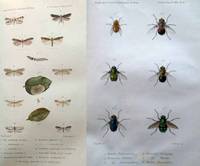
1859802881859. ENTOMOLOGY ANNALES DE LA SOCIETE ENTOMOLOGIQUE DE FRANCE INTERRUPTED RUN 1859 - 1920 BOUND VOLUMES AND ORIGINAL WRAPPERS. Societe Entomologique de France. Over 150 color plates hundreds morte monochrome/tinted plates. Offered as a lot. 24 bound volumes the rest in parts in original wrappers. Condition good to excellent. A few covers are detached or spines split in the paper issues and spines of a few of the bound volumes are chipped and backstrip is detached 1859 volume. Very few plates are flawed: a few may have partial dampstaining. Overall the color plates are delicate and vivid in excellent condition. As follows: Series 3 1859-60 2 volumes Series 4 1861-67 1869-70 9 volumes Series 5 1872-1879 8 volumes Series 6 1883-1890 8 volumes 1891-1895 1897-1899 1902-1903 1906 1909 1913-1920 LX - LXXXIX 20 volumes 1895 vol LXIV lacks part 3. Complete list available upon request. unknown
1859802881859. ENTOMOLOGY ANNALES DE LA SOCIETE ENTOMOLOGIQUE DE FRANCE INTERRUPTED RUN 1859 - 1920 BOUND VOLUMES AND ORIGINAL WRAPPERS. Societe Entomologique de France. Over 150 color plates hundreds morte monochrome/tinted plates. Offered as a lot. 24 bound volumes the rest in parts in original wrappers. Condition good to excellent. A few covers are detached or spines split in the paper issues and spines of a few of the bound volumes are chipped and backstrip is detached 1859 volume. Very few plates are flawed: a few may have partial dampstaining. Overall the color plates are delicate and vivid in excellent condition. As follows: Series 3 1859-60 2 volumes Series 4 1861-67 1869-70 9 volumes Series 5 1872-1879 8 volumes Series 6 1883-1890 8 volumes 1891-1895 1897-1899 1902-1903 1906 1909 1913-1920 LX - LXXXIX 20 volumes 1895 vol LXIV lacks part 3. Complete list available upon request. unknown books
18238215CB8 Bände. London, Printed for the Author. 1823–1840. 8°. 8 S. (Vorwort in Band I), 36 S. + 11 Bl. (Index in Band VII). Mit 771 handkolorierten Kupfertafeln von John Curtis (Tafel 205 doppelt nr.). Jede Tafel mit 2–4 S. Tect. Orig.-Leinenbände mit verg. Rückentitel und Deckelvignette.
17597836Frankfurt und Leipzig, Martin Göbhards seel. Erben, 1759. 4 Bll., 406 (recte 408) S. 18 gefalt. Kupfertafeln. Gr.-8°. Ldr. der Zeit mit Rückenschild und reicher Rückenvergoldung (Rücken mit kl. hinterlegten Einrissen oder Wurmhgängen, etw. bestoßen und beschabt).
16387548CBBonon, Ferronius, 1638. Folio. (9) Bl., 767 S., (22) Bl. Mit gest. Titelblatt und 126 Textholzschnitten. Pergamentband der Zeit. + Wichtig: Für unsere Kunden in der EU erfolgt der Versand alle 14 Tage verzollt ab Deutschland / Postbank-Konto in Deutschland vorhanden +, 7548CB|7548CB_2 [2 Warenabbildungen] Denuò Impreß.
16387548CBDenuò Impreß. Bonon, Ferronius, 1638. Folio. (9) Bl., 767 S., (22) Bl. Mit gest. Titelblatt und 126 Textholzschnitten. Pergamentband der Zeit.
1868256369Paris Deyrolle 1857/1868. cclxxvi, 140 [2],463 [1], 295, 284 S., zus. 303 Taf. (davon 292 koloriert u. 11 s/w Taf.) Gr 8° HLdr. Bde 1+2: beide Deckel lose, Rücken nur fragmentarisch vorhanden bzw.Bruchstücke lose beiliegende, Bd 3: bereits neuaufgebunden* Text und Tafeln schön und frisch*.
17830781-23Leipzig, Beigang 1783. Erster Teil, 1.-4. Stück. 4°. VIII, 58; Tit., 18; Tit., 22; 35 S. Mit insges. 16 kolor. Kupfertaf. HLdr.-Bd. im Stil der Zeit. m. goldgeprägt. Rückensch. u. marmor. Bezugspapier. In Schuber. [5 Warenabbildungen]
Vindobonae, Typis Ioannis Thomae Trattner, 1763. PRIMA rara edizione. Il libro è dedicato dall’Autore ad Ernesto Federico Duca di Sassonia. In 8vo (cm. 20,3); bella legatura coeva in mezza pelle a 5 nervi; tagli rossi; pp. (36), 420 + una carta di “errata” + una carta “Minitum Auctoris”. Bella copia. Tra le sue opere si ricordano la Flora Carniolica, e la Entomologia Carniolica, con la descrizione delle specie botaniche e degli insetti studiati durante i suoi viaggi e ordinate secondo il sistema linneano. La storia della sistematica zoologica inizia con il 1758, data di pubblicazione del Systema naturae di Carl von Lineé; 5 anni dopo fu pubblicata l’Entomologia Carniolica, il primo lavoro sulla fauna italiana. Oltre a descrivere centinaia di nuove specie, descrive per la prima volta l’accoppiamento dell’ape regina fuori dell’alveare. Axs
1953EN-50Sau Paulo Brazil: University of Sao Paulo 1953. Comprehensive two-volume reference set contains detailed descriptions and illustrations of the neotropical Culicidae- Vol. I contains Dixinae Chaoborinae and Culicinae Tribes Anaphelini Toxorhynchitini and Culicini Genus Culex only and Vol. II contains the Tribe Culicini Deinocerites Uranotaenia Mansonia Orthopodomyia Aedomyia Aedes Psorophora Haemagogus Tribe Sabethini Trichoprosopon Wyeomyia Phoniomyia Limatus and Sabethesi. Includes their bionomics classification reproductive organs breeding places habits type locality and zoogeographical distribution. Includes a brief historical outline relationship phylogenetic classification taxonomy and diagnosis of the Culicidae; a key for the Genera and index. 1110 pgs. collectively. Illustrated. Gilt lettering slightly worn on Vol. II; gilt spine and front cover crisp on Vol.I. Tiny scuff to the outer edge of Vo. II. Prior ownership stamp on front endpaper. Upper spine and corners slightly bumped. Minimal shelfwear. Scarce. First Edition. Hard Cover. Very Good. 8vo - over 7¾" - 9¾" tall. University of Sao Paulo Hardcover
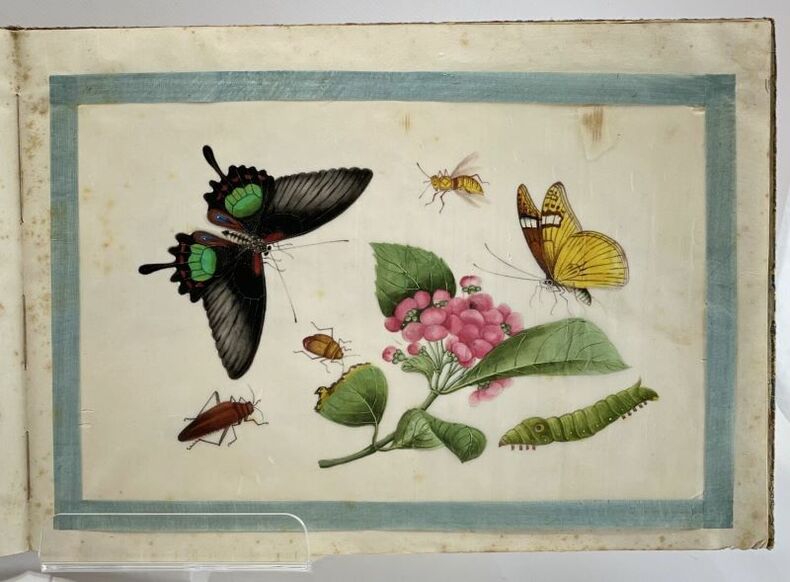
2903[ANONYME]. [Planches entomologiques].Sans date.23,5 x 33,5 cm, n.p., [6] ff. de pl., peinture sur papier de riz, encadrements en soie bleue. Relié, pleine toile, travail de tissage à motifs floraux multicolores.Album de 6 peintures originales représentant papillons, chenilles et divers insectes, à chaque fois autour d'une fleur. Le travail de couleurs est remarquable, d'une grande finesse, le papier de riz rend la sensation matte et poudrée des ailes de papillon.Quelques pâles rousseurs sur les feuillets de support, petites déchirures en marge des compositions et sur les encadrements.
2903[ANONYME]. [Planches entomologiques].Sans date.23,5 x 33,5 cm, n.p., [6] ff. de pl., peinture sur papier de riz, encadrements en soie bleue. Relié, pleine toile, travail de tissage à motifs floraux multicolores.Album de 6 peintures originales représentant papillons, chenilles et divers insectes, à chaque fois autour d'une fleur. Le travail de couleurs est remarquable, d'une grande finesse, le papier de riz rend la sensation matte et poudrée des ailes de papillon.Quelques pâles rousseurs sur les feuillets de support, petites déchirures en marge des compositions et sur les encadrements.
17748911BBBerlin und Stettin, J. Pauli, 1774-1778. Insg. 4 gestoch. Frontispiz-Porträts, 4 (wiederholte) gestoch. Titelvignetten, 1 gef. Tabelle und 163 altkolor. (20 gef.) Kupfertafeln. Kollation: Frontispiz, Titelvign., 24 (3 gef.) Taf., 2 Bll., XXXXII, 764 S. - Frontispiz, Titelvign., 50 (6 gef.) Taf., XXXII (1 Bl.), 690 S. - Frontispiz, Titelvign., 45 (6 gef.) Taf., XX (1 Bl.), 706 S. - Frontispiz, Titelvign., 44 (5 gef.) Taf., XXIV, 702 S. Lederbände der Zeit mit goldgeprägtem Rückentitel, Rückenvergoldung und ganzem Rotschnitt (Ecken bestoßen; stark berieben u. beschabt; Bd. 2-4 zum kleinen Teil wurmgängig). Alte Buntpapiervorsätze mit floralen Mustern. 4 Bände (von 11). Vorsätze jeweils mit Besitzvermerk von alter Hand (dat. 1788). Weiße Vorsätze von allen 4 Bänden und Buntpapiervorsatz von Bd. 1 mit Eckausschnitt. Altersbedingt nur gelegentlich gering gebräunt bzw. braunfleckig. Die prachtvollen, altkolorierten Tafeln g