4 951 résultats
Bln., 1914. Lex8vo. Orig. full cloth with a mounted colourphotograph on front. (4),160 pp. and many photogr.in colours.
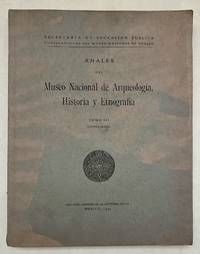
1945102474México: Talleres Graficos de la Editorial Stylo 1945. Third Edition Presumed - lists 3 years on verso of cover. Paperback. Pages clean a warm brown; tight binding; bookstore sticker on front free flyleaf; small spots of dampstaining on several pages; cover has light patches of sunning and minor wear to corners; spine slightly torn at head and foot; a very good- copy overall. Quarto in grey pictorial wraps; sewn; 253p.; 27 cm; color and black and white plates; illustrations; index. In Spanish. A veritable feast for the eyes! The last publication of the museum under this name: "Con este tomo III de la 5a epoca de Los Anales del Museo Nacional de Arqueologia Historia y Etnografia correspondiente a los anos 1936 1937 y 1938 se termina esta publicacion que sera sustuida por Los Anales del Instituto Nacional de Antropologia e Historia." --Publisher. Stunning and copious imagery photographs and illustrations from the museum's collection in 1945. Features a bibliography index and vocabulary list from the Cakchiquel language by Alfredo Barrera Vasquez. // Ethnologie Mexique Périodiques Ethnology Ethnology Mexico Periodicals Etnología México Publicaciones periódicas History Mexico Mexico Antiquities Periodicals Mexico History Periodicals Mexique Antiquités Périodiques Mexique Histoire Périodiques México Antigüedades Publicaciones periódicas México Historia Publicaciones periódicas Museo Nacional de Arqueología Historia y Etnografía México Periodicals // Heavy items. Additional shipping fees may be needed. Please inquire. Talleres Graficos de la Editorial Stylo paperback
188832597ABLeipzig, Verlag von E. A. Seemann, 1888. 4° (ca. 28 x 21 cm). VI, 340 Seiten mit zahlr. Abb. im Text u. 23 Tafeln (meist Kupfertiefdrucke); VI, 226 S. mit zahlr. Abb. im Text u. 32 Tafeln (mehrere farbig) [Kunstgewerbe-Blatt]; (6) Seiten, 728 Spalten mit Textabb. u. Anzeigen [Kunstchronik]. Halbleinenband mit Rückentitel. Schnitt u. Vorsätze gebräunt, wenige Ränder angestaubt oder leicht fingerfleckig, wirkt kaum gelesen. Einband lichtrandig, teils berieben u. leicht bestossen. Rückenkante am hinteren Deckel oben 7 cm eingerissen, Bindung stabil.
Madrid, Instituto Gonzalo Fernández de Oviedo, 1942. Folio; 103 pp., ochenta y seis de ellas con la reproducción fotográfica del manuscrito, + 424 pp., 4 hs. con la edición paleográfica. Cubiertas originales. El cronista peruano, nacido en Cuzco, de orígen mestizo y expósito, fue ordenado sacerdote y promovido al curato de Huarochiri en 1597. Se recoge aquí el contenido de gran interés antropológico del manuscrito quechua de la Biblioteca Nacional de Madrid sobre los ritos indígenas y su forma de conservarlos, la tradición oral de los hijos de Pariya Qaqa, en Waru Chiri.
Madrid, por Don Manuel Martin, 1778. 8vo.; 174 pp. Encuadernación de época en pergamino.
hardcover with dusjacket Format : 265 x 340 MM, number of pages 334, with nice photographs in color: English text fine condition !! ISBN 9789073187825. The deeper you go in understanding his art works, the more the passion becomes febrile. What a complete artist he was, everything he touched ,architecture, sculpture, drawings, reliefs, had that magic or divine inspiration called Taksu among the Balinese which gave all his work a very special dimension. The geniality of the artist is reflected in his drawings in very particular features: the purity of line, the distribution of the space, the expression of the characters or the living plants and trees which seem to vibrate with real life. Everything spans with life and magic and the observer is immediately captured by the talent and spirit behind. Whatever he made, he caught the soul of the theme, weather an action, a creature , a cloud , the mud in the rice fields or even an inanimate object such as the ?sarongs?, the traditional Balinese garment which he makes them look almost palpable ,reflecting the animist principle that everything ?has a soul or ethos?.When one observes the family shrine sculpture portraying the different generations (Il. n ?.) with his self portrait in the right bottom corner , one perceives the love he put into it , the piece shines in front of our eyes !It is full of beauty and positive energy transmitting accurately the way he felt about his family. This work could stand next to the Mona Lisa and they would be smiling in harmony. Or the young soul mask he created while watching his grand daughter which is in itself the description of beauty and youth but also the representation of the fine half Yin of the Balinese microcosm .This mask can be considered one of the most touching works by the Master. Likewise the perfect rhythm found in the dancers in the ?Dance Lesson? where harmony, movement and teaching skill are fully achieved at the same time that technical perfection thus making out of it an outstanding masterpiece. He was obviously creating in a state of trance or meditation where he became the channel for the cosmic or spiritual energy. This ability, only found in great artists allowed him to take whatever material and transform it in to a great work of art .His free spirit guided him in the adventure of creating new models for the future Balinese generations. His intention full of generosity was to satisfy the gods as well as to teach his family, friends and colleagues.Lempad ,the person, was a simple man who always wore just a ?sarong ? and ate light as holly people do. His eyes, the mirror of the soul, would spark with intelligence and wisdom until the very last day of his long life. He had a strong character but was a balanced person with firmly rooted spiritual principles who would advise his grandchildren not to move when an earthquake was under way since he believed in fate and considered that when God wanted to take one s life, he just did. Likewise his father, he was born and brought up to be an Undagi , a figure who in the Balinese culture is some how ?sacred ?and assumed as such by all the community but which does not imply to have a privileged status since the spiritual world is constantly intermingled with the daily routines . There is no vanity or ego , of course no commercial intention since the act of creating is strictly related to the spiritual world following Animist ,Hinduist and Buddhist principles. And yet, Lempad was an unusual Undagi who always kept his own personal style ,more free and universal, very modern from the conceptual and the formal point of view which he applied in many of his works except for those commanded to him for certain specific temple needs. One only has to look at the family shrines in his first house in Bedulu and the second one in Ubud to discern that pure simple line associated with Majapahait style which he combines with a surprisingly modern and original touch shown on the way volumes are combined.(See Family Shrine in Bedulu)This is also clearly shown in the Temple Gate at Pura Merajan in Pengalasan which unfinished abstraction of the classical Bhoma head reminds us of the style of the catalan architect/sculptor Gaudi, who also combined abstract figures within the architecture as in La Pedrera building in Barcelona. Gaudi could somehow be considered the equivalent of an Undagi in the western world ;the last work commissioned to him by the Estate and one of hs most important works if not the most, was actually the Christian Temple of ?La Sagrada Familia?. The Wilmana figures that surround the Gods meeting Hall in the Temple of Pura Pengastulan is another good example of Lempad s originality.He plays with the double reading concept so they become masks when they are turned upside down , as Indonesian primitive sculptors used to do. The same rule applies to the Pan and Men Brayut sculptures that flank the entrance of the Palace Sareng Kandin Delodan which are depicted with very atypical austronesian facial features. Lempad left many of his works incomplete but unlike Balinese in general who tend to leave architectural creations unfinished since for them newness is equivalent to sacredness and sometimes it take ages until they have the means to do it , Lempad ?s tendency was wholly intentional since he seem to enjoy the aesthetical look of the unfinished.Equally important if not more, was the didactic function involved since it was a subtle way to teach the art of carving to future generations (See masks, Brayut sculpture, architectural elements pgs?. )and,overall, his principles would never allow him to continue his work when the inspiration was no longer present.If we believe our informants,another possible reason in the back of Lempad s mind was that the incomplete pieces could not be requested by the palace since ,?they remained to be finished ?.Lempad s first drawings were probably sketches for atchitectural elements in temples (see ilus S39A.) and did not start to draw on proper drawing paper until he was in his middle age. The first sketch books seems to have been given to him by the German Russian artist Walter Spies who was very impressed when seeing some of his sketches.At the beginning of his drawing period, the scenes were inspired on the Ramayana and Mahabarata Hindu ?Javanese fables , classic in a sense, which slowly evolved in a more free style drawings reflecting daily life , a feature seldom seen in Balinese art with exceptional cases such as the Yeh Pulu ancient reliefs in Bedulu which he saw during his childhood and would later on become a source of inspiration. The clean line flowing with firm and precise rhythm that applies in both drawings and sculptures is one of the main characteristics that distinguishes his work.This multi talented artist had an important role in the artistic scene that took place in Ubud in the 1930s and connected with the foreign circle of artists such as Walter Spies, Rudolf Bonnet or Miguel Covarubias who saw in Lempad a sort of universality and openness that was to create the Lempad legend. Everyone went to him for exchange of information and saw in him the medium or bridge from traditional to Modern Balinese Art. Most probably, Lempad, who was very humble person in essence never thought in the idea of having a book dedicated to him since in those days and in contrast to the western world, personal success was not an objective in Balinese culture but was left aside in benefit of the community .Nevetheless ,it has been a privilege for us who love and promote art in the world, to work on the first book ever dedicated to I Gusti Nyoman Lempad , a timeless master with balinese soul but universal mind whose work ,we consider, deserves to be known as part of the World Artistic Heritage .
47401, Picton Publishing, 2014 hardcover with dusjacket Format : 265 x 340 MM, number of pages 334, with nice photographs in color: English text fine condition !! ISBN 9789073187825.
19771255858München, 1977. 53 Seiten / A4; graph. Darst.; Kt.; 29,5 cm; klammergeh. Broschur.
Madrid, 1928. Folio; 3 hs., 452 pp., 1 h. Ligera mancha lateral de humedad en las últimas diez páginas. Tirada limitada de 600 ejemplares. Cubiertas orignales.
192833021ABLeipzig, Karl W. Hiersemann, [1928]. 4°. Titelblatt, 114 Tafeln mit meist mehreren Abbildungen. Halblederband mit Rückenschildern u. marmorierten Deckelbezügen. Leicht gebräunt, Titelblatt u. Schnitt etwas stärker u. teils braunfleckig, wenige Ränder ebenfalls leicht braunfleckig. Einband lichtrandig, berieben u. teils angestaubt.
48438Genève, Editions Famot, 1979. 21 x 28, 12 volumes, ca 157 pages par volume, très nombreuses illustrations en couleurs, reliure d'édition pleine toile, dos simili-cuir noir, très bon état (sauf plat arrière du volume sur l'Inde légèrement abîmé).
51199, mercaterfonds - fondsmercator, 2018 Hardback with dust jacket, 330x255mm, 424p, 480 bw and col. illustrations.English edition FINE ISBN 9789462302037.
366pp.with ills., 27cm., edition of only 2200 copies, cloth, dustwrapper, good condition, [published on the occasion of the 60th anniversary of S.P. Tolstov], [text in Russian in Cyrillic script], OCLC 635011303, X77029
1968X77029Moskva [Moscow], Izdat. Nauka 1968 366pp.with ills., 27cm., edition of only 2200 copies, cloth, dustwrapper, good condition, [published on the occasion of the 60th anniversary of S.P. Tolstov], [text in Russian in Cyrillic script], OCLC 635011303, X77029
Venecia, Venetiis, apud Theodorum Viero, s.a. (c. 1788). Grabado al aguafuerte de 280 x 200 mm., con passepartout, enmarcado en madera dorada y con cristal. Tamaño total de la pieza: 510 x 425 mm.
Venecia, Venetiis, apud Theodorum Viero, s.a. (c. 1787). Grabado al aguafuerte de 280 x 200 mm., con passepartout, enmarcado en madera dorada y con cristal. Tamaño total de la pieza: 510 x 425 mm
4º, 29.5cm. Insges. 1073 S., zahlr. Fotos auf 194 Taf., 13 gefalt. u. teilw. farb. Karten, Fig. u. Tab. im Text. Orig.-Halbleinen. Einbände mit Altersspuren, inhaltlich in gutem Zustand. - Es erschienen noch ein 6. (=letzter) Band und 1 Supplementband, hier nicht vorhanden.
1963213689KKiev: Publishing House of the Ukranian Academy of Sciences PCP 1963. Hardcover. Very Good. 9 x 11. 94 pages many plates in very good condition. VOLUME 2 ONLY. Pages are clean and unmarked with the bulk of the book being colour plates. Text is in UKRANIAN. Some stamps throughout. Some markings on the title page. Page edges are lightly smudged and stained. Bound in red cloth on bevel boards with gilt titles. Lightly worn and bumped around the edges. VG <br/> <br/> Publishing House of the Ukranian Academy of Sciences PCP hardcover
In-4, 151p. Intéressant documents réalisé par les élèves architectes des Beaux-Arts de Paris en voyage de documentation au Cameroun. Les croquis resituent les constructions dans leur environnement et le cycle des activités quotidiennes. Abondante iconographies en noir et en couleurs. Fort peu courant.
26x14. s.pp. 4 Vols. Fotogr. Ilstr. Conserva cubiertas. Enc. Plena piel.
469406Imprimerie Officielle Tananarive 1957 - 1958 2 ouvrages reliés en en 1 volume in-4 ( 270 X 210 mm ) de 235 et 174 pages, reliure malgache demi-cuir fauve, plats imitant le raphia, dos à nerfs titré, 1ères de couvertures conservées. 33 photographies, 2 cartes, 1 dépliant dans le premier ouvrage. Bel exemplaire, rare.
PARIS, Ernest Leroux, éditeur, 1897 - E.O. - In-8 - Broché - Ouvrage illustré de 22 planches h.t dont 2 en couleurs- 176 pages - Bon exemplaire - Rare étude intéressant aussi bien l'archéologie des bijoux que l'ethnographie bretonne - envoi rapide et soiogné.
Madrid, Espasa-Calpe, 1959-1971. Cuatro tomos en 4to. mayor; 472 pp. + 479 pp. + 411 pp. + 458 pp. Ilustraciones entre el texto de de Zuloaga, Zubiaurre, Guinea, Tillac, Goiko, Garavilla, Aróstegui y otros. Texto bilingüe euskera-castellano en columnas paralelas Cubiertas originales. Papel de lomera en tomo tercero con pequeña pérdida.
Mm 190x280 Due volumi dell'opera pubblicata nell'ultima porzione dell'Ottocento dall'editore romano Perino, entrambi in uniforme legatura artigianale a mezza pelle con titoli in oro al dorso, angoli anch'essi in pelle. Primo volume (Asia, Africa, America, Oceania) pubblicato in dispense di pag. 296, 128, 32, 32; secondo volume (Europa) di 688 pagine; numerose tavole illustrate a colori fuori testo. Qualche fioritura alle carte, ma nel complesso gli esemplari risultano in ottimo stato di conservazione. SPEDIZIONE IN 24 ORE DALLA CONFERMA DELL'ORDINE.
In 16 gr, pp.(8) + 298. Con dedica autografa dell'autore alla sguardia: ...e cosi', carissimo Enrico Del Re, mio secondo maestro di tic-tac, si passa la vita, alternando al gioco...il gioco. Con 8 fot. in b/n f. t. Br. ed. ill. Testo brunito. Ediz. originale