White, Arnold [1848-1925]Biblio.com
4 889 résultats
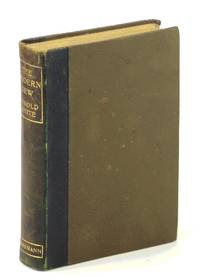
1899163H3899London: William Heinemann. Good. 1899. First Edition. Hardcover. "The circumstances under which the wealth the power and the numbers of the Jewish race domiciled in this country are likely to be indefinitely increased seem to call for more prescience and thought at the hands of our rulers than have yet been bestowed upon them. To make people think is the object of this book. Should they refuse they will wake up one morning only to discover that they have parted with the realities of national life and are dominated by cosmopolitan and materialist influences fatal to the existence of the English nation." - Introduction. Chapters include: What is a Jew; The Problem in Russia; The Jew in Austria/America/France/England/The Argentine Colonies; The Aloofness of Israel; Money Lenders; The Destitute Alien in Great Britain; Zionism; "Darkest Russia"; The Conversion of the Jews; Jewish Humour. pp xvii 301 32 ads. 7.5 x 5.3 inches. Quarter-bound in black leather and olive cloth. Gilt lettering to spine. Top edge gilt. Modest lean to spine. Binding intact. Prior owner's name dated 1899 inked atop front free endpaper. Large rectangular tanned area upon front free endpaper presumably caused by an item formerly laid-in. Average wear. Faint spots upon front board perhaps from water droplets. SINGERMAN 46.; 12mo - over 6¾" - 7¾" tall; Modern Jew Arnold White Anti-Semitism Zionism Argentina Relocation Russian Jews Usury Conversion Money Lenders Chedorim Lord Rothschild Rev. J.E. Salkinson Great Britain Immigration Jewish Question . William Heinemann hardcover
18544200Lindsay & Blakiston Philadelphia 1854 First edition. Original green cloth-covered boards gilt spine lettering still bright blind-stamped front and rear boards 9 x 5 7/8 inches 80 pp. 3 leaves of plates including frontispiece. Very good mild warp boards; modest edgewear and staining cloth; offsetting endpapers; focal mild foxing; small damp stain upper spine aspect of first few leaves; moderate pencil marginalia in a neat hand; otherwise pages clean and binding sound. A rare first edition. "Thomas Story Kirkbride July 31 1809 December 16 1883 was a physician advocate for the mentally ill and founder of the Association of Medical Superintendents of American Institutions for the Insane AMSAII a precursor to the American Psychiatric Association. In 1840 Kirkbride became superintendent of the Pennsylvania Hospital for the Insane. In 1844 Kirkbride helped to found AMSAII becoming secretary and treasurer and subsequently its president from 1862 to 1870. Kirkbride pioneered what would be known as the Kirkbride Plan to improve medical care for the insane as a standardization for buildings that housed the patients. Kirkbride's influential work On the Construction Organization and General Arrangements of Hospitals for the Insane with Some Remarks on Insanity and Its Treatment was published in 1854 and again in 1880. Kirkbride's ideas brought about mixed feelings in both patients and peers. Some in the medical community saw his theories and ideas as stubbornly clinging to ideals that hindered medical progress while others supported his ideas and saw them change the treatment philosophy for the mentally insane. In his patients he sometimes inspired fear and anger even to the point that one attempted to murder him but he also believed that the mentally ill could be treated and possibly cured and in fact Kirkbride after the death of his first wife married a former patient. Kirkbride was an advocate of building hospitals for the mentally ill in a style which he believed promoted recovery and healing. This style was used on many late 19th century hospitals including St. Elizabeths Hospital in Washington D.C. Many of these buildings designed by leading architects of the time are in ruins or decay. An estate now known as "The Village" previously Traverse City State Hospital was saved from destruction and beautifully restored." K073. 1st Edition. Hardcover. Very Good/No Jacket. Lindsay & Blakiston, Philadelphia hardcover
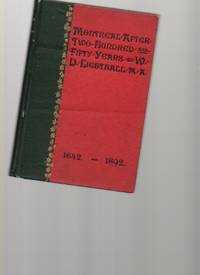
189228822Montreal: F. E. Grafton & Sons. Very Good. 1892. 1st Edition limited. Numbered and signed by the author. Large 12mo hardcover in duo-tone cloth cover: dark green spine over red buckram cloth separated by a vertical wreath of Maple leaves tight textblock pages clean bright and unfoxed the cover has a trace of rubbing at tips front hinge weak endpaper loose book plate of Frances Silcox McDowell else VG. Attractive copy in the duo tone cloth. 149pp illustrated all present including dramatic Victoria Bridge maps top edge gilt. Quite scarce; 12mo 7" - 7½" tall . F. E. Grafton & Sons hardcover
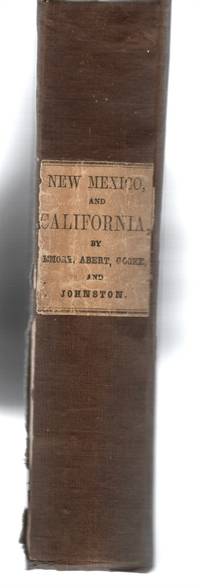
184830143Wendell and Van Benthuysen. Very Good. 1848. First Edition . Hardcover. Compact octovo hardcover 614 pages tight and square spine/binding pages clean untorn and unmarked text has a scintilla of foxing covers have light wear with intact and readable spine label else VG. Contains 67 plates including Indians flora fauna buildings full page maps etc. Two large folding maps: laid in is "Map of Territory of New Mexico" by Kearney "under instruction from Emory" 1846-47 and "Sketch of part of the march & wagon road of Lt. Colonel Cpple from Santa Fe to the Pacific Ocean 1846-47". Both are serviceable one reattached to stub with archival tape the other laid loose with no tears. Overall solid and intact. ; 8vo 8" - 9" tall . Wendell and Van Benthuysen hardcover
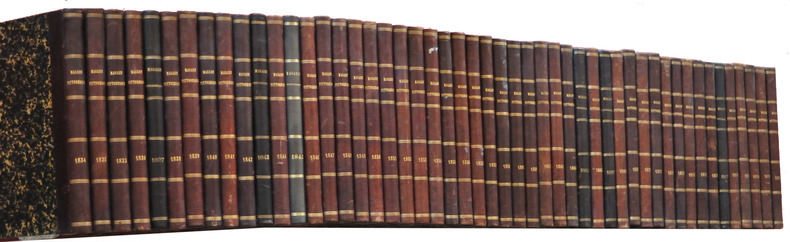
183346404463Paris, Le Magasin Pittoresque, 1833-1882 ; 50 volumes in-4, demi-basane brune, dos lisses ornés, titre et année en lettre dor. au dos, filets dorés, tranches jaspées. (Reliures de l’époque). RARISSIME COLLECTION COMPLÈTE DE LA PREMIÈRE SÉRIE EN RELIURES UNIFORMES. Edouard Charton (Sens 1807 - Versailles 1890) a commencé sa carrière de publiciste dans les revues saint-simoniennes Le Globe et Le Journal de la doctrine de Saint-Simon. Il rompt avec les Saint-Simoniens en 1831 et fonde Le Magasin Pittoresque en 1833 avec l’imprimeur saint-simonien Lachevardière sur le modèle du Penny magazine anglais. D’abord hebdomadaire, la revue devient mensuelle en 1850 puis bi-mensuelle. Le premier numéro annonce le projet : “Le Magasin pittoresque, revue illustrée bon marché, a pour ambition d’intéresser et d’instruire, tout en les distrayant, ceux qui n’ont ni les moyens financiers ni les loisirs de le faire”. Les articles sont confiés aux plus grands spécialistes, chaque livraison aborde les différents domaines du savoir : Beaux-Arts, sciences et techniques, géographie, archéologie, etc. Charton assumait seul le contenu de la revue, corrigeant chaque article avant publication. Dans cette première série aucun article n’est signé mais les collaborateurs sont connus : Darondeau, Reynaud, Souvestre, Carnot, Cazeaux, Charton, Fortoul, Aicard, V. de Joncières, Pauline Roland, R. Töpffer, Transon, Alby, Urbain, Alexandre de Saint-Chéron, Morville ou encore George Sand, Camille Flammarion ou Eugène Delacroix. Le succès de cette revue fut considérable dès les premiers numéros et suscita de nombreuses vocations, ainsi l’égyptologue François Joseph Chabas (1817-1882), un négociant en vins à Châlons-sur-Saône qui découvre l’égyptologie en 1852 dans le Pittoresque, grâce aux articles de Nestor Lhôte. Sand, Balzac ou encore Zola revendiquent cette revue didactique comme source importante de leur œuvre.Mais c’est en tant que revue illustrée que Le Magasin Pittoresque demeure inégalée, Charton considérait qu’une illustration abondante et de qualité était essentielle à son projet d’éducation populaire. Pour donner une si nombreuse illustration en maintenant un prix modique, Charton fit appel à la gravure sur bois qui avait presque disparu en France à cette époque. Les graveurs français ne pouvant fournir tant de planches à une revue hebdomadaire, il fit appel pour les premiers numéros à des graveurs anglais. Par la suite, grâce au succès de la revue, les ateliers parisiens revinrent à ce genre délaissé. Parmi les illustrateurs Grandville a donné de nombreux dessins (voir à ce sujet Renonciat Grandville p. 295) ou encore G. Doré (v. H. Leblanc Catal. de l'Oeuvre de G. Doré. p. 227)Le Magasin Pittoresque a occupé l’essentiel de la vie d’Edouard Charton. Bien que sa revue n’ait jamais abordé les questions politiques il était un Républicain fervent et fut élu dans l’Yonne à deux reprises en 1848 et 1871. Il fut aussi l’un des fondateurs de la revue d’actualité l’Illustration en 1842.Rare collection complète de cette première série en reliure uniforme de l’époque. Bel exemplaire frais, les reliures sont en bon état.
1814002659Paris, Nicolle, Mame frères, Martinet, 1814
180126901T. Cadell Et Al. Near Fine. 1801. First Edition :. Hardcover. Quarto hardcover in one-half leather over marbeled boards First Edition complete Title vii Preface cxxxii 412pp errata two pages. The frontispiece is an engraved portrait of the author. Light wear to edges spine very clean marbeled boards marbeled edges hinges strong gutters likewise notation of being Mary Bouromeo Collection on front endpaper faint stain on frontis maps In nice untorn and unworn condition else VG to NFINE. Contains 3 folding maps on heavy paper one reinforced but not torn. A cornerstone of N American exploration narrative. Mackenzie became the first European to reach the Pacific by a cross country voyage in 1793 on his second attempt the first ending in the Frozen Artic. He ended up near Bella Coola B. C. This was years ahead of Lewis and Clark. Inquiries for pics answered quickly. ; 4to 11" - 13" tall; 412pp pages . T. Cadell Et Al hardcover
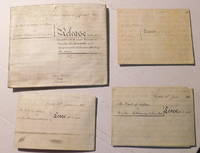
181899422Liverpool June 16 1818. 1818. Fine. - Original vellum document consisting of 2 attached sheets with scalloped top edges. An indenture 24 inches high by 30 inches wide and the assigns 22 inches high by 30 inches wide as usual folded down to 9 inches by 10-1/2 inches. 84 lines of text handsomely calligraphed over the two sheets. Within the initial "T" is the British emblem encircled by the words: "Honi soit qui mal y pense" a motto of the British chivalric Order of the Garter which translated means "Shamed be whoever thinks ill of it". The document has 2 George III embossed revenue stamps with a metal band one for three pounds and the other for one pound. There are also 2 Royal Cyphers.<p>On the rear fold of the document is a sketch of property showing several divisions including "Embleton Street 12 yards wide Dr Solomons land & Cottage". Upper Stanhope Street "20 yards wide" is on the south and Hayton Street "6 yards wide" is on the north. To the west of Solomon's land is land of Bland and another party. Further to the west is a 12 yard plot of land sold to Rowland Owen and "Release dated 23rd & 24th December 1818". This parcel appears to have the signature of Sefton over its description. Another entry on the indenture dated August 11th & 12th 1820 conveys property to Robert Rawlinson and Thomas Hesketh by the trustees of the will of Samuel Solomon. The conveyance is signed by two of Solomon's sons Abraham an oculist in Birmingham and John an amateur boxer and non-practicing lawyer. It is also signed by Ebenezer Daniell the manager of Solomon's Cordial Balm firm. Further in 1828 there is notice of "59 yards including half of Hayton Street" being conveyed to James Watts of Toxteth Park. It was later conveyed to a M J Hicks in October 1832. Both of these later conveyances are accompanied by minimal sketches. <p>The document is signed by the Earl of Sefton a party of the first part Peter Still and Alexander Strong of Lincoln's Inn parties of the second part Joseph Dawson of Liverpool party of the third part John Henderson of Toxteth party of the fourth part John Clare of Liverpool party of the fifth part. The lessees are described as "Samuel Solomon of Gilead House near Liverpool Doctor of Physic" and his Trustees "John Bird of Liverpool aforesaid Architect" and "Thomas Murrow of Liverpool".<p>In addition to the June 16 indenture there are 3 others:<p>1 A 15 inch high by 24 inch wide indenture on parchment dated June 15 1818 and titled "The Earl of Sefton to Doctor Solomon & Trustee / Lease for a year". The trustee is identified as John Bird of Liverpool Architect and it is signed by Sefton.<p>2 A 16 inch high by 23-1/2 inch wide indenture on parchment dated June 15 1818 and titled "The Earl of Sefton to Doctor Solomon & Trustee / Lease for a year". The trustee is identified as John Bird of Liverpool Architect and it is signed by Sefton.<p>3 A 17 inch high by 23 inch wide indenture on parchment dated August 17 1818 and titled "Peter Brown to Dr. Solomon and Trustee / Lease for a year". The trustee is identified as John Bird of Liverpool Architect and it is signed by Peter Brown. The indentures are folded down to approximately 8-1/4 by 6 inches.<p>Each of these 3 indentures on parchment has a George III embossed revenue stamp of one pound fifteen shillings a royal cypher the stamp of James Walker of Bermondsey parchment dealer and the British emblem within the initial "t" encircled by the words: "Honi soit qui mal y pense".<p>The 3 indentures by the Earl of Sefton are of particular interest for this reason - parliamentary elections were being held from June 17 to July 18 1818 and being an Irish peer Sefton was eligible to run for a seat. Dr. Solomon who by this time had become quite wealthy was the chief organizer of the Earl's campaign. Solomon spared no expense on his behalf in Liverpool which was famous for lively electioneering. It was to no avail as Sefton lost his election to George Canning. It seems quite possible that these leases given their dates within 2 days of the campaign served as a kind of reward for Solomon's future efforts.<p>"Doctor" Samuel Solomon c. 1768 - May 21 1819 was born in Cork and moved to Dublin influenced by his uncle Isaac Solomon who worked as a druggist there. Around 1789 he and his uncle went into business in Liverpool's dockland area. In 1796 he began marketing his "Cordial Balm of Gilead" which he claimed would cure one of ulcers of the lung kidneys and liver sexual dysfunction hypochondria female complaints etc. His claim to have been a Doctor of Medicine is suspect. Solomon became very wealthy from the sales of his expensive tincture made from a mixture of brandy and turpentine flavored with herbs as well as from real estate investments. [Liverpool], June 16, 1818. hardcover
1815IX7405Never Published 1815. HB. Quarter tan leather and green paper covered boards 8vo 164 hand numbered pages. Title page states "Bowen Adams Manuscript AD 1815." Very nice example of a cypher book an educational method of teaching both mathematics and penmanship used in Europe and early America. Contains nearly every example of colonial era mathematics needed for an educated citizen including: Reduction Decimal Fractions Federal money and conversions Interest Rule of Three Square Root Cube Root Fellowship Barter Loss & Gain Duodecimals Alligation Timber Measure Single and Double Position Discount Equation of Payments and Carpenter's Work. Contains solutions to problems as to feeding of soldiers in fortifications computing of various volumes of wine and ale measurements of land and distance and travel times. Covers show light moisture stain joints starting to crack but binding tight. Remarkably in a handmade dust jacket of rather crude brown paper with series of numbers and the same handwritten statement "Bowen Adams Manuscript 1815" on cover. Author was probably from East Medway Mass. born 1798. Dust jacket shows chipping and edge wear. Book condition VG. Pages are clean and legible. Never Published hardcover
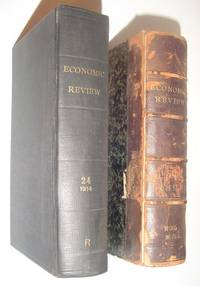
1891718a4805London: Percival & Co./Rivingtons 1891. Book. Fair. Hardcover. First Edition. 8vo - over 7¾" - 9¾" tall. The complete works of this early British learned economic journal which was published quarterly between 1881 and 1914 for the Oxford University Branch of The Christian Social Union. Includes writings by many names familiar to the modern historian of economic thought including: W.J. Ashley; W.H. Beveridge; J. Bonar; A.L. Bowley; Edwin Cannan; S.J. Chapman; A.W. Flux; L.L. Price; J.C. Stamp; R.H. Tawney; Sidney Webb; Beatrice Webb. Usual library markings. Most volumes bound in three-quarter leather with raised bands. Many later volumes bound in black buckram. Buckram volumes in good condition although all volumes bear varying degrees of external dustiness due to the partial disintegration of the leather on the leather-bound volumes which has produced considerable residue. Some leather backstrips partially loose. Gilt lettering upon all backstrips bears varying degrees of wear. Bindings generally sound. Leather volumes bear heavy external wear. Aside from the external soiling/dust a worthy working compilation of this rare and interesting journal. Total weight approximately 90 pounds. Percival & Co./Rivingtons Hardcover
1840735c9946Washington D.C.: Blair and Rives 1840. Book. Illus. by Burr David H. cartographer. Fair. Hardcover. Signed by Authors. First Edition. 8vo - over 7¾" - 9¾" tall. xi 227 pages. Index. Fold-out map. Signed and inscribed by author to renowned historian William Hickling Prescott inside front board. Upon front free endpaper a subsequent owner late 1800s has documented the provenance of this copy and documented Prescott's pencil markings to pages 23 through 27 which deal with Cortes and Mexico. Occasional light markings to contents. Prior owner's mini-bookplate inside front board. Narrow openings along both hinges. Usual library markings. Fold-out map bears several short openings and a tape repair along right edge. Front free endpaper loose but present. Prior owner's signature atop title page. Above-average external wear to brown marbled boards. WHALE 508 TPL 2369 HOWES G-389 RICKS P.112 TOURVILLE 1850 SMITH 3848 WICKERSHAM 4086. Blair and Rives Hardcover
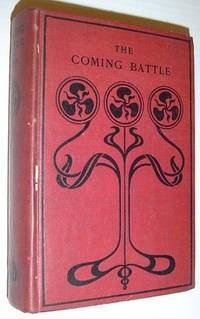
1899313a1213Chicago: W.B. Conkey Company. Good. 1899. First Edition. Hardcover. 483 pages. "In this volume the author endeavors to give an accurate history of the present National Bank System of currency including an account of the first United States Bank - both of which were borrowed from Great Britain by those statesmen who like the father of Sir Robert Peel believed that a national debt was the source of prosperity. It is believed that the facts adduced in the following pages will be productive of some good in pointing out the immense evils lurking in that system of banking - a system which has produced panics at will and which is the active abettor of the stock gamblers railroad wreckers and those industrial tyrants of modern times the enormously overcapitalized and oppressive trusts. It is sought to point out the great dangers of delegating purely government powers to these greedy monopolists by which they are enabled to organize a money trust far more tyrranical than all the other combinations now in existence; and by which they absolutely defy the authority that endowed them with corporate life." - from Introduction. Binding sound. Unmarked. Moderately worn and soiled externally. Only defects are insect damage along exterior of each hinge. Detailed photos available upon request. An ultra-rare first edition copy of this classic and vitally important work.; 12mo - over 6¾" - 7¾" tall; The Coming Battle Economics Money System united States of America Banking Federal Reserve Precursors Rothschild Rockefeller Trusts . W.B. Conkey Company hardcover
1871025478Paris: Gauthier-Villars 1871. First Edition . Original Blue Printed Wrappers. Very Good . 8 7/8" Tall. 40 Pp. Original Blue Printed Wrappers. Preserved Nicely In A Well Made Maroon Chemise And Slipcase With Morocco Spine Label Gilt. Inscribed And Signed By Pasteur " Hommage De L'autour / L. Pasteur" In Small Handwriting At Upper Right Of Front Cover. A Scarce Book In The Trade Particularly Scarce When Inscribed And Otherwise Unmarked As Here And A Very Early Inscription From Pasteur In Any Case. <br/> <br/> Gauthier-Villars unknown
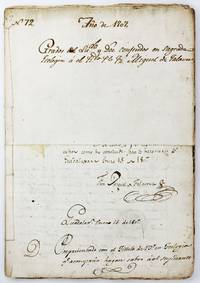
18086471Guadalajara: Apud Mariannum Valdez Tellez Giron 1808. Good. Three stitched fascicles totaling 30 manuscript leaves and fifteen printed broadsides and broadsheets completed both in manuscript and in type. Some folded. Straight vertical cuts from foot of one fascicle. Some dust soiling and toning; scattered damp staining and foxing. A few separations along folds of printed sheets. Head of some printed sheets trimmed away effecting some loss. A fascinating combination of printed and manuscript material relating to the completion of Baccalaureate requirements for degrees in divinity from the University of Guadalajara in the early 19th century. Present here are three stitched fascicles each relating to a different student that contain manuscript attestations from the candidates themselves and university professors to the individual's achievements as well as printed copies of their degrees and other official documents from the university bestowing honors upon their recipients. Each recipient was conferred a copy of their degree completed in manuscript and affixed with the printed seal of the university attesting that after four years in the study of "Sacrae Theologiae" he had achieved the rank of Baccalaurens. Then the three students Gabriel Sanchez Leñero Joaquin de Valdecañas and Miguel de Talaveras received different printed broadsheets completed to varying degrees in type and in manuscript according to their specific studies an accomplishments. In all we identify eleven different printed forms and broadsheets none of which are located by Medina or OCLC. Most bear the imprint of Mariano Valdes Tellez Giron the first printer of Guadalajara who worked alone in the city from 1793 to his death from an epileptic seizure at the end of 1807 making the present job work some of the last printing completed by this important printer. Some of the broadsheets printed on two joined leaves and folded into each fascicle have been trimmed at the head with the loss of some material including engraved illustrations. Nevertheless the present documents represent a trove of previously unrecorded early job printing from Guadalajara. Apud Mariannum Valdez Tellez Giron unknown
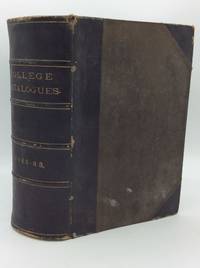
18831271969Various: Privately Printed 1883. First edition. Leather bound. Good. UNIQUE VOLUME CONTAINING TWENTY-FOUR ORIGINAL CATALOGUES FROM NORTH AMERICAN CATHOLIC COLLEGES. All catalogues are the original printings published in 1883 for the 1882-1883 school year. Catalogues in good or better condition all whole and complete with no missing majors of substantive damages. Bound in 19th century half black leather and cloth; the outer covers are slightly dampstained and soiled from having gotten wet decades ago but none of the interior catalogue pages were damaged. Several catalogues contain plates and maps of campus buildings as noted below. Old library stamp on endpaper. A fascinating source for American Catholic higher education in the 1880s. Many of the schools which were colleges then are major universities now others such as the Jesuit-run Las Vegas College founded in 1877 are long gone. The catalogues contain a wealth of information on academics student life lists of students etc. Included in the volume are St. Louis University St. Xavier College Cincinnati with one plate St. Mary's College Kansas St. Ignatius College Chicago with one plate; Marquette College Detroit College Creighton College St. Francis Institution for Boys - Osage Mission Kansas Georgetown College with one plate St. John's College Fordham with one plate Gonzaga College Washington DC Holy Cross St. Francis Xavier NYC Boston College St. Peter's College Jersey City Spring Hill College - St. Joseph's Mobile AL College of the Immaculate Conception New Orleans St. Charles College Grand Coteau LA Santa Clara College with two maps one map with small hole in center and 12 plates St. Ignatius College San Francisco Canisius College College of the Sacred Heart Prairie du Chien WI Las Vegas College and College Ste.-Marie in Montreal. Privately Printed unknown
1864734c6244New York: John Bradburn. Fair. 1864. Reprint. Hardcover. 479 pages. Translated from the French. "The object in translating this work the production of a sparkling and witty French writer De La Hodde is to show the dangerous consequences to society and government arising from the practices of secret associations. It gives a perfect illustration of the operations of these associations in bringing about the present unprincipled rebellion in the United States. French characters similar to the leading conspirators against our own government are set forth in a way that gives the reader a clear insight into the science of demagogism and lays open that nefarious class of political transactions which must tend to the ruin of any country whatever and especially to one which is governed by republican institutions. New light is shed upon the darkling work of secret societies; their demoralizing consequences to society are exposed and their deeds of subterraneous deceit and treachery brought to the contempt and detestation of all good true and loyal men." - Preface. A heavily worn former library copy with the usual markings.; 4to - over 9¾" - 12" tall; The Cradle of Rebellion: A History of the Secret Societies of France . John Bradburn hardcover
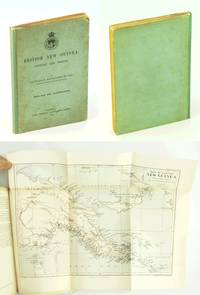
1897431j1247London: John Murray. Good. 1897. First Edition. Hardcover. "Hundreds of years ago British New Guinea was put on the map as a shaded spot marked 'Islands of the bad people.' For the last half-dozen years its character has been studied. Now we purpose to review briefly what we have been learned of the country and of the people for whom we the British have thus become responsible." - page 1. "Sir William MacGregor 1846-1919 was Lieutenant-Governor of British New Guinea from 1888 until 1898. He had to deal with many tribes of a warlike people. It was necessary at times to make punitive expeditions but by tact and perseverance he eventually brought about a state of law and order. Some of this related to the annual headhunting raid and cannibalisation of coastal tribes by the Tugeri warriors which ended in 1891." - Wikipedia. 8 100 pp. Twenty-two black and white reproductions of photos in text. Fold-out colour map. Tight and unmarked with new backstrip. No dust jacket as issued. A sound example of this rare item. 8.5" x 5.7" ; 8vo . John Murray hardcover
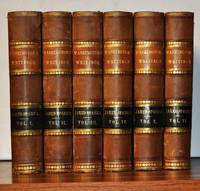
18475350002New York: Harper & Brothers Publishers 1847. Hardcover. Very Good in No Dust Jacket dust jacket. Sound bindings and hinges. Text pages slightly tanned clean. Previous owner's book plate on front pastedown. Previous owner's name on title page. Half leather binding has general light wear shallow tear at top of volume 1 spine. Extensive collection of the writings of George Washington. Each volume has engraved portrait of Washington as frontispiece. 9.5" tall. Harper & Brothers, Publishers hardcover
18905955Kutztown PA 1890. Quarter roan over marbled boards measuring 8 x 6.25 inches and comprised of 73 pages of manuscript text including a mixture of notes passed between friends on the verso of the final leaf and on the rear pastedown. Spine largely perished with boards and textblock held together by cords. Several leaves neatly excised towards rear. Containing notes from Fannie Hottenstein's courses in teacher training the present volumes offer researchers a range of study topics including the history of pedagogy and women's increasingly visible place in American education; the book also is a valuable resource for examining how educated young women were thinking through their own lives and roles -- as individuals and as a generation. <br /> <br /> Trained in one of the most educationally progressive states at the time Fannie Hottenstein was one of a generation of women who could more widely dream about and pursue more independent lives than their matriarchs. Historically Pennsylvania had been a vanguard for public and progressive education. "In his 1830 address to the state legislature Governor George Wold championed the cause of universal public education" as a scaffold for "the security and stability of the individual privileges we have inherited from our ancestors" Explore History. Before the decade was over "more than 1000 local school districts under a single statewide system of instruction" had been founded working to regularize "educational standards curriculum and instructional credentials" in tandem with the 1857 Normal School Act which founded "a network of ten state academies to prepare public school teachers" Explore History. Fannie attended one of these preparing for a career in education that would give her a new level of social and economic independence. <br /> <br /> Much of Fannie's notebook reflects the kind of rigorous work required to teach middle and high school students. Contents include for example three pages of facts on basic Botany; fifteen pages on the practice of Logic in writing and debate including an extensive section on presenting proper Opposition accompanied by text book page numbers; and five pages on pedagogical methods for helping students develop curiosity and drive it forward into productive study. There are additional fairly staid essay samples on topics such as Influence and Gentleness. Yet it is in the thirteen page essay We Girls that sparks of Fannie's individuality ambition and independence show. In it she reveals how much contact she has had with the period's literature on women's rights and suffrage; she shows her familiarity with anti-feminist arguments in opposition to women like her; and she powerfully expresses her hopes not only for her generation but the ones that follow.<br /> <br /> Fannie opens: "It is a recognized fact that the degree of civilization of every nation is marked by the social position of woman. Indeed one of the most prominent features of the progress of civilization is her gradual elevation in society and the clear perception and recognition of her rights. In the earlier ages of the world when the sphere of her influence was bounded by the narrow prejudices of the opposite sex her happiness as well as her mental improvement and social rank depended more on what was done for her at the hands of men than on what she could do for herself. All this is changed now." Fannie praises the hard-won changes women accomplished in accessing education and job training; and she touts how many opportunities are available for women to dream about and pursue. This does not mean she's unaware of the challenges that continue -- particularly from men. "We have to contend with the prejudice sometimes entertained against us that our highest destiny in life is to be a pretty piece of furniture in a handsome parlor. Men who entertain this notion we girls must always urge to get their furniture somewhere else." To those who accuse women of being too emotional and insufficiently intellectual she also has a response. "Our aim must be to develop and perfect our entire nature mental social and moral" she argues. Only by embracing both thinking and feeling as strengths can any individual -- man or women she contends -- succeed. Women are in a unique position to embrace both. <br /> <br /> A truly rich document which also includes brief notes among Fannie and her friends about their flirtations and recent purchases of accessories at the end gives insight into the development of a young woman who would go on to live what she preached. According to the US Census of 1900 Fannie remained single and lived in a boarding house working as an office stenographer. unknown
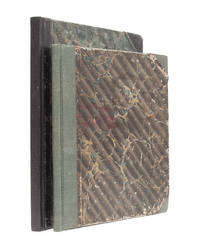
18703389United Kingdom 1870. Geography notebook of Mary Barker: Quarter black roan over marbled boards measuring 9 x 7 inches. Comprised of a calligraphic title and frontis plus 59 hand drawn-and-colored maps done by a young woman in her first three years of teacher training. Throughout Mary annotates on the margins which year and term she is in and occasionally notes that the map was drawn "From Memory"; and each map has penciled corrections and assessments. <br /> <br /> with Geography notebook of Allison Jane Gillespy: Quarter cloth over marbled boards. Calligraphic title page and 35 intricately hand drawn maps from the British Empire Europe and the Middle East. <br /> <br /> A pairing of beautiful and research-worthy notebooks documenting teacher training in the late nineteenth century as well as providing a look into how geographies changed across time and how British educators were being trained to perceive and educate the young about other parts of the world and how they connected to the British empire. With nearly 100 pages combined the notebooks offer scholars important comparative opportunities and means for better understanding the rising number of women educators and authors publishing works that engaged geography and international cultures during the Victorian era.<br /> <br /> "The Wesleyan Methodists had a school for ministers' daughters at Trinity Hall Southport.which admitted both boarders and day girls.to educate ministers daughters and train teachers" Roach. Pupil teacher programs like the one Mary Barker was enrolled in had become a popular method of producing teachers at a time when the public's access to education expanded and the demand for instructors was at a high. Such programs functioned like an apprentice system taking a senior pupil typically thirteen years old and putting her in a five year assistantship to her own instructor. Pupil teachers typically took on responsibility for teaching lower classes observing their superiors educate the more advanced students and completing their own educations. By the 1870s these programs had become standardized to ensure proper preparation for instructors Robinson. <br /> <br /> Mary's maps trace this process. As she moved from her first to her third year in this notebook the quality and care she puts into her work improves. Her handwriting and attention to detail matures. And her assessments move from Fair to Good and Very Good. Maps in the notebook include nearby locales such as Ireland Scotland and the British Isles as a whole; European nations including Sweden Norway and Prussia as well as eastern Europe and Russia. Mary also maps out "Arabia" and the "Chinese Empire" as well as "Further India" revealing a wide array of changing borders and shifting cultural attitudes. <br /> <br /> While Allison does not leave any marker of her class age or school the level of intricacy in her maps suggests she was a senior student or finished instructor. These appear to be fair copies not done from memory but prepared as examples for students or as teaching aids.<br /> <br /> Together the two provide a comparative opportunity to study the history and politics of mapping nineteenth century girls' education pedagogy and pedagogical training and geography. unknown
18703389United Kingdom 1870. Geography notebook of Mary Barker: Quarter black roan over marbled boards measuring 9 x 7 inches. Comprised of a calligraphic title and frontis plus 59 hand drawn-and-colored maps done by a young woman in her first three years of teacher training. Throughout Mary annotates on the margins which year and term she is in and occasionally notes that the map was drawn "From Memory"; and each map has penciled corrections and assessments. <br/><br/>with Geography notebook of Allison Jane Gillespy: Quarter cloth over marbled boards. Calligraphic title page and 35 intricately hand drawn maps from the British Empire Europe and the Middle East. <br/><br/>A pairing of beautiful and research-worthy notebooks documenting teacher training in the late nineteenth century as well as providing a look into how geographies changed across time and how British educators were being trained to perceive and educate the young about other parts of the world and how they connected to the British empire. With nearly 100 pages combined the notebooks offer scholars important comparative opportunities and means for better understanding the rising number of women educators and authors publishing works that engaged geography and international cultures during the Victorian era.<br/><br/>"The Wesleyan Methodists had a school for ministers' daughters at Trinity Hall Southport.which admitted both boarders and day girls.to educate ministers daughters and train teachers" Roach. Pupil teacher programs like the one Mary Barker was enrolled in had become a popular method of producing teachers at a time when the public's access to education expanded and the demand for instructors was at a high. Such programs functioned like an apprentice system taking a senior pupil typically thirteen years old and putting her in a five year assistantship to her own instructor. Pupil teachers typically took on responsibility for teaching lower classes observing their superiors educate the more advanced students and completing their own educations. By the 1870s these programs had become standardized to ensure proper preparation for instructors Robinson. <br/><br/>Mary's maps trace this process. As she moved from her first to her third year in this notebook the quality and care she puts into her work improves. Her handwriting and attention to detail matures. And her assessments move from Fair to Good and Very Good. Maps in the notebook include nearby locales such as Ireland Scotland and the British Isles as a whole; European nations including Sweden Norway and Prussia as well as eastern Europe and Russia. Mary also maps out "Arabia" and the "Chinese Empire" as well as "Further India" revealing a wide array of changing borders and shifting cultural attitudes. <br/><br/>While Allison does not leave any marker of her class age or school the level of intricacy in her maps suggests she was a senior student or finished instructor. These appear to be fair copies not done from memory but prepared as examples for students or as teaching aids.<br/><br/>Together the two provide a comparative opportunity to study the history and politics of mapping nineteenth century girls' education pedagogy and pedagogical training and geography. unknown books
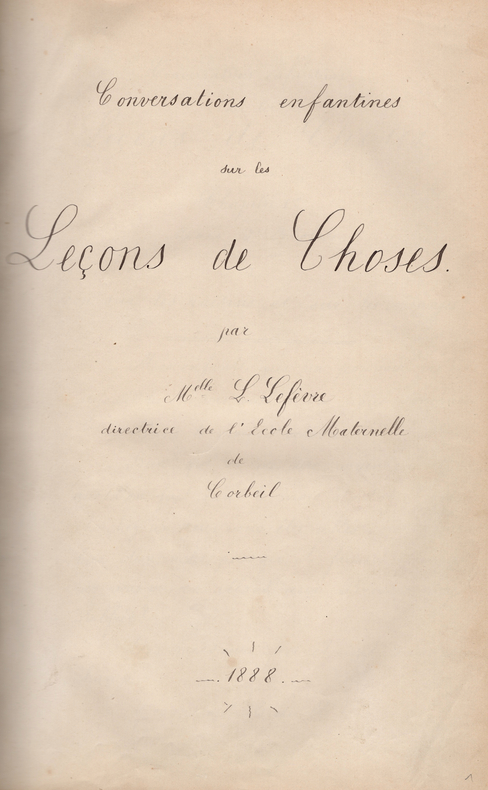
1888AMA-706S.l. [Corbeil], 1888. In 4°, demi-maroquin brun à dos lisse, tête dorée, rares rousseurs, quelques feuillets effrangés en fin de volume, et un petit manque à un feuillet (Reliure de Goy et Vilaine). [162 ff.].
1828003190Paris, Froment et Lequien, libraires, 1828
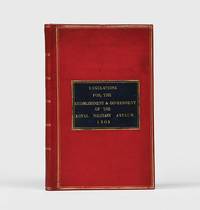
1805158331London: T. Egerton 1805. A groundbreaking school for the working class First edition of this detailed record of the founding warrant and regulations of this remarkable institution Britain's "first large-scale system for the education of working class children" Cockerill nearly 70 years before the Elementary Education Act. Instigated by the commander-in-chief Frederick duke of York the RMA offered co-educational facilities for orphans and the children of destitute enlisted men. Rare just two locations world wide British Library and Koninklijke Bibliothek. Set up in 1801 the institution was modelled on the Royal Hibernian Military School Dublin established in 1765 and at the height of the "Great War" against France 1793-1815 the RMA was caring for over 1000 boys and 500 girls in its grand purpose-built home in Chelsea now widely known as the Duke of York's Barracks and home to the Saatchi Gallery. "To govern the new Asylum the commander-in-chief formed a board of commissioners from among his most senior generals at the Horse Guards officers who had been under his command when campaigning against the revolutionary army of France in the Low Countries these included David Dundas Harry Calvert John Whitelocke and Robert Brownrigg. The RMA was intended to replace the dependence of military families on regimental depots and the charity of the officers. Alternatively destitute families of soldiers had to rely on the workhouse system which meant that families first had to travel from the regimental depot to the parish in which the father had been born. This could mean a long and arduous journey for which the Commanding Officer of the regiment in question had to provide a signed pass of safe conduct through parishes along the way to avoid being charged with vagrancy" ibid. The boys' education in reading writing and the "four rules" of arithmetic was based in Lancaster's monitorial system with older pupils relaying the lessons from one or two teachers to larger groups of younger boys. Male pupils were trained for a military career or indentured apprenticeships and the young women taught by an all female staff fitted for life in domestic service. The text sets out the terms for the acceptance of an applicant and the specific duties and remuneration of the various members of staff. The forms annexed to the volume give a diet table for pupils and for staff separate applications for boys and girls and a template for marriage birth and health certificates. In 1892 the RMA became the Duke of York's Royal Military School in 1909 moving to premises in Dover where it continues to the present day. Octavo 206 x 130 mm. Four folding specimen forms at the rear one of them double-sided. Contemporary red straight-grain morocco paired gilt rules to the spine black morocco patch label to the front board double gilt fillet panels to the boards dotted roll to the board edges scrolled roll gilt to the turn-ins finely patterned Shell marbled endpapers all edges gilt dark blue silk page marker. Spine just a touch sunned some light chafing at the extremities pale toning else very good indeed. A. W. Cockerill Duke of York's Military School history site on line. hardcover
18503448Great Britain 1850. Comprised of 88 manuscript pages of mathematical definitions tables methods and exercises in a single hand with the ownership signature of "Caroline Waters Age 16 yrs" to the front endpaper. Marbled paper vernacular binding measuring 8 x 12 inches and stitched at spine. Caroline's metric measurements and English currency reveal her to be a student somewhere in the UK. Though the commonness of her name and the absence of a specific date prevents us from locating her in genealogy records the manuscript she left behind reveals much about how and why girls of her age and class were being taught arithmetic.<br /> <br /> Caroline's elegant practiced hand suggests that she is a member of the rising middle class and the opening of the book suggests that she is a beginning to intermediate mathematician. At the top of the first page she defines Arithmetic as "the art of computing by numbers" which "has five principal sic rules for this purpose viz. Numeration Subtraction Addition Multiplication and Division." Using this definition she divides her notebook into a section for each providing a definition for that principle plus clear-cut examples of its use in both Simple and Compound formats. Numeration Subtraction and Addition are grouped together at the front; and after these sections conclude Caroline enters in Practical Questions in Compound Addition and Subtraction. These involve word problems involving the exchange of money and the calculation of wet and dry weights cloth measurements and time. She then mirrors this with Multiplication and Division before adding sections on Decimal Fractions more Practical Questions and sections on Federal Money and Simple Interest.<br /> <br /> The organization of the manuscript suggests that Caroline copied it out for continued reference where sections are easy to locate and problems clearly illustrate each of the principles. And the emphasis in sample problems on currency conversion monetary exchange and banking implies that her family in some way wanted her to be aware of these concepts.<br /> <br /> An exceptional and rich document Caroline's notebook is a rich resource for study including but not limited to the history of women's education middle class education women's domestic use of mathematics women in business paleography genealogy gender studies. unknown