42 032 résultats
19872082702114910041Nakamura City Board of Education 1987. Soft Cover. Fine. Number of pages: 99 pages Size: 26cm Nakamura City Board of Education paperback
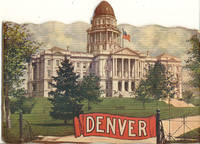
190536318Denver: The H.H. Tammen Curio Co. 1905. 1905. COLORADO. Approximately 5 1/5" x 9" with dome of state capitol rising another inch at center of booklet in color pictorial wrappers depicting the capitol building and its grounds on the front cover and depicting Denver's business section on the rear cover. 32 pp. illustrations. "A descriptive view book telling by pen and camera the story of Denver - the metropolis of the West-springing up as if by magic where less than fifty years ago roamed vast herds of buffalo and antelope disturbed only by the red man and the prairie wolf." Offers the history of Denver as well as information on and numerous pictures of various scenes in Denver to include the Union Depot its county buildings its business and residence streets various business buildings theaters hotels clubs its architecture churches schools parks etc. A two-page scene of the city of Denver at center. Very light water stains to tops and bottoms of inside corners of covers and some pages along with very light wear to extremities and spine. Very good. A nicely produced Denver item. The H.H. Tammen Curio Co., 1905. unknown
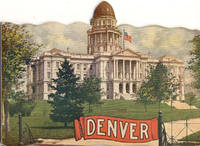
190539782Denver: The H.H. Tammen Curio Co. 1905. 1905. COLORADO. Approximately 5 1/5" x 9" with dome of state capitol rising another inch at center of booklet in color pictorial wrappers depicting the capitol building and its grounds on the front cover and depicting Denver's business section on the rear cover. 32 pp. illustrations. "A descriptive view book telling by pen and camera the story of Denver - the metropolis of the West-springing up as if by magic where less than fifty years ago roamed vast herds of buffalo and antelope disturbed only by the red man and the prairie wolf." Offers the history of Denver as well as information on and numerous pictures of various scenes in Denver to include the Union Depot its county buildings its business and residence streets various business buildings theaters hotels clubs its architecture churches schools parks etc. A two-page scene of the city of Denver at center. Light crease to front cover corner else a very good copy of a nicely produced Denver item. The H.H. Tammen Curio Co., 1905. unknown
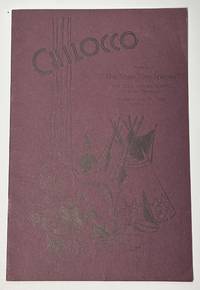
194612660Chilocco Ok: Printing Department Chilocco Agricultural School 1946. Original printed wrappers. Minimal wear. Near fine. A seemingly-unrecorded program for a patriotic "Pageant" performed by the students at the Chilocco Agricultural School in Oklahoma put on "in memory and recognition of the splendid record made by all of our men as well as women who entered the various branches of the armed forces during World War II." The program was intended to honor specifically "the 180th Infantry 45th Division which was an old Oklahoma National Guard Unit composed solely of Chilocco present and past students." The pageant consisted of five themed episodes with narration by a junior year student songs a pipe smoking ceremony "Indian Dances" other types of dances scenes depicting the flag raising on Iwo Jima and other events and so forth. The performance concluded with "The Star Spangled Banner." We could locate no other copies of this interesting program from Chilocco celebrating victory in World War II just the year after the war ended. Printing Department, Chilocco Agricultural School unknown
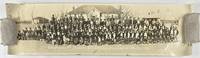
193212881Lawton Ok. 1932. Panoramic photograph 8 x 28.75 inches. Some staining along border with a few spots in the image area a few small chips and creases. Good plus. A striking panoramic photograph featuring several dozen Native American students along with some faculty at the Fort Sill Indian School in December 1932. The Fort Sill Indian School was founded in 1871 with twenty-four students and two employees. Within ten years the school had many more students and seventy-five employees to manage the facility. The present photograph emanates from the era of the Great Depression and features both male and female students from early grades to teenage years. A handful of white teachers are interspersed within the student population. The subjects of the photograph are arranged seven rows deep and are posed in front of one of the school buildings in a rather sparse rural setting.<br /> <br /> "Because the school was located near Lawton before World War II Fort Sill's student body was made up largely of Indians from western Oklahoma -- Comanche Apache Caddo Kiowa Delaware and Wichita. This changed dramatically in the postwar era however as Navajo from New Mexico and Arizona began to be admitted. Within a few years they comprised 80 percent of the student population. The influx of out-of-state Native students gradually declined and by 1970 more than two hundred of the school's three hundred pupils hailed from Oklahoma. Until the 1950s the curriculum for males consisted of vocational and agricultural training and females received instruction in homemaking. Thereafter Fort Sill emphasized more of an academic curriculum although vocational trades remained important. Students who attended Fort Sill came away from the boarding school with impressions that ranged from downright hatred of the school to enduring fondness for it. For some the strict discipline and harsh punishment meted out at the institution made it feel more like a prison than a place of learning. Being away from family and tribal communities made the experience even more alienating. Others however enjoyed their time there making lifelong friends participating in extracurricular activities and remaining Indian despite attempts by the government's educational machinery to grind it out of them" - The Encyclopedia of Oklahoma History and Culture.<br /> <br /> OCLC is silent on other examples of this photograph. unknown
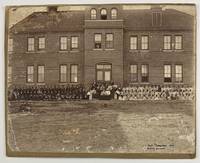
192012734Fort Thompson SD 1920. Albumen photograph 7.5 x 9.75 inches on a slightly larger plain mount manuscript title at bottom right "Fort Tompson sic S.D. Indian School." Some staining surface wear and edge wear bottom left corner a bit chipped mount worn at corners. Notations in marker and pen in verso reading "Ft. Tompson sic Indian School D OKonnor Collection" and "Dixie O'Connor Collection." Good condition. A striking group photograph featuring the students and teachers of the Fort Thompson Indian School more commonly known as the Crow Creek Tribal School in the early-20th century. The image shows about 120 students arranged in three rows split almost evenly into two groups with half the students dressed in black on the left and the other half of the students dressed in white at right. Between the students are over a dozen teachers and staff members. All of the students faculty and staff are posed in front of a large three-story brick building. The indigenous school at Fort Thompson was started in the late-1880s by Father Pierre DeSmet. The school remains open today serving the population of Crow Creek Sioux on their reservation on the east bank of the Missouri River in central South Dakota. The present photograph remains a stark visual reminder of the U.S. government's assimilationist activities among Native Americans over the past two centuries. unknown
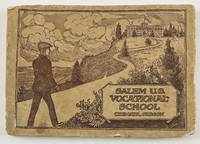
191912733Salem Or. 1919. 90pp. Oblong octavo. Original illustrated tan wrappers printed in darker tan. Moderate edge wear and minor toning to wrappers. Occasional minor foxing or thumb-soiling to text. Overall very good condition. A very rare promotional pamphlet illustrating the opportunities awaiting Native American youth at the Salem Indian Training School in Chemawa Oregon. The wrapper title is Salem U.S. Vocational School Chemawa Oregon. The Salem Indian Training School opened in early 1880 as one of the first Native American boarding schools in the country of course intended to be an instrument of assimilation for local indigenous peoples. Opened as an elementary school Salem was a fully-accredited high school by 1927. The school is still open and has been for some time known as the Chemawa Indian School named for the Chemawa band of the Kalapuya people of the Willamette Valley; its own website describes the school as "the oldest continuously operated boarding school for Native American students in the United States."<br /> <br /> The present work includes a title leaf and four pages of explanatory text about the school with the remainder of the contents comprised of full-page photographs illustrating a wide variety of subjects at the institution. The work opens with photographic portraits of four white government officials including the superintendent of the Salem school Harwood Hall. This is followed by the explanatory text describing the general area around Chemawa as well as various aspects of the school such as its academics boys and girls "industries" farm social life newspaper The Chemawa American and more. The most striking photograph is a folding "Panoramic View of Chemawa Indian School" which is present here in its entirety measuring 5.5 x 21.5 inches. Other photographs picture various landmarks around Oregon but mostly center on the school's campus and activities. These include photos of campus buildings and spaces dormitories hospital auditorium academic building girls' industrial building greenhouse prune orchard the "piggery" classrooms and other interiors sewing blacksmith shop gymnasium dormitory rooms and parlors dressmaking carpentry shop bakery "fruit room" boiler room tailor shop science lab clubs and sports teams boys' and girls' basketball boys' football track baseball Sigma Phi Delta Society and three other literary societies Mandolin and Guitar Club Boys Battalion Excelsior Literary Society group photographs of the 1918 and 1919 graduating class the latter showing twenty students holding a pennant reading "Excellence Means Labor" and more. A small card is affixed to the title leaf stating that "This booklet was printed entirely within our own shop" so very likely by Native American students whose print shop is also illustrated within. The work is very similar to another publication for the Sherman Institute in California produced around the same time.<br /> <br /> OCLC records just two copies both in Oregon at the State Library and the University of Oregon. unknown
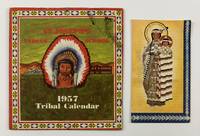
19563370Chamberlain S.D. 1956. About very good. 16pp. printed in full color. Original self wrappers stapled 5.5 x 5.25 inches. Moderate staining and soiling to outer wrappers. Some dates in July and August circled in pencil. A handsomely produced calendar issued at Christmas-time in 1956 by the Catholic authorities in charge of the St. Joseph Indian School sent to the tribal members of the school's community. The calendar opens with a message from Father Peter in which he calls the calendar an "act of friendship" for the "children of the Dakota prairies" and reminding them that the faculty and staff of the school "month after month are praying for you." Each month includes a photographic portrait of a student in various school settings including two months showing the student or students in conversation with a nun or priest. The former carries the caption: "At St. Joseph's Indian School the Sisters provide the hour of enchantment in which a child discovers that no matter how difficult the past the happiness of tomorrow can begin today. The joy in the Heart of Christ for these His little ones is best demonstrated through their constant sacrifices. Truly a sobering relic of Native American assimilation. Accompanied by a 1954 prayer card issued by the school containing the text of the Marian Year Prayer; on the last page of this prayer the school describes itself as "Home for more than 200 Poor Indian Boys and Girls. unknown
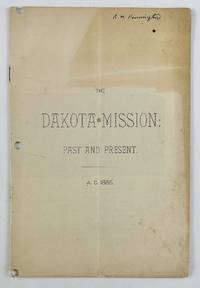
188612811Minneapolis: Tribune Job Printing Co 1886. 27pp. plus additional printed note tipped in on first leaf of text. Original printed self wrappers stapled. Three binder holes punched along spine moderate toning and dust-soiling to wrappers ownership signature in blue ink on front wrapper. Soft vertical crease throughout. A handful of blue ink underlinings to text. About very good. A scarce compilation of articles from a confederation of American religious missionary organizations working in various populations of Dakota Indians in the Midwest and Far West compiled by John P. Williamson a Presbyterian and "Missionary to the Indians" in the Dakota Territory. Williamson also served as the treasurer of the Native Missionary Society. The Dakota Mission was made up of members of the Presbyterian and Congregational orders as well as groups like the American Board the American Missionary Association the Presbyterian Board of Home Missions and the Presbyterian Board of Foreign Missions. The present work includes nine articles by members of these various groups including three by Williamson "Early Missions to the Dakota Indians in Minnesota" "Poplar Creek Mission" and "The Dakota Native Missionary Society" as well as "Sisseton Mission" by Martha Riggs Morris; "The Yankton Mission" by Nancy Hunter; "Wolf Point Mission Montana" by Rev. George W. Wood; "The Congregational Division of the Dakota Mission" by Rev. Alfred L. Riggs; "The Santee Normal School" by "One of the Teachers;" and "The Swiss Missionaries" by Rev. Samuel W. Pond. In describing their work these authors necessarily discuss various aspects of the lives and culture of Native Americans. Tribune Job Printing Co unknown
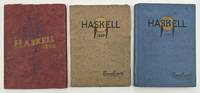
19306084Lawrence Ks: Haskell Institute 1930. Very good. Three volumes: 112; 122; 124pp. Original pictorial bindings earliest two volumes in wrappers with yapp edges the latter in blue cloth boards. Some chipping to yapp edges overall minor wear. Previous owner's signature on latter two volumes. A couple of inscriptions in latter volume. A consecutive trio of yearbooks from Haskell Institute "a United States Government Training School for Indians" still located in Lawrence Kansas and known today as Haskell Indian Nations University. The works were printed by Haskell students evidenced by the following notice printed at the front of each volume: "The contents of this book put in type and printed by apprentice students of Haskell Institute." The present annuals document the student body faculty and staff campus life and alumni information for the years 1928 through 1930. Though the student body is anything but typical the yearbooks contain information typical of traditional high school annuals including student portraits and information arranged by school class rosters and group portraits of various clubs music groups and sports teams and military groups a calendar of school events and more. The annuals also include vital information on hundreds of previous students with lists of names and addresses of the Haskell Alumni Association.<br /> <br /> These particular annuals belonged to A.A. Van Sickle evidenced by his ownership signature on the latter two volumes. Mr. Van Sickle taught religion at Haskell and is pictured along with the other religion faculty members in the 1930 annual. One of the volumes also includes a couple of inscriptions to Van Sickle from students. OCLC reports sparse holdings at just six institutions but only one location the University of Kansas holds any of these three the 1929 edition.<br /> <br /> A rare opportunity for an instant collection of Native American assimilationist yearbooks from an important government residential boarding school. Haskell Institute unknown
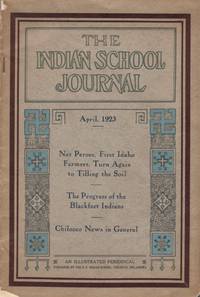
192334544Chilocco Oklahoma: Chilocco Indian Agricultural School Publisher 1923. Periodical. Good. Stapled periodical. Pages 183-206 1 page "Oklahoma" by Lydia M.D. O' Neil 1 page statement on "Chilocco." Color illustrated front cover. Contents illustrated with photograhs. A few light edge chips to the covers. Interior contents very clean. <br /> <br /> From wikipedia: Chilocco Indian School was an agricultural school for Native Americans on reserved land in north-central Oklahoma from 1884 to 1980. It was approximately 20 miles north of Ponca City Oklahoma and seven miles north of Newkirk Oklahoma near the Kansas border. The name "Chilocco" is apparently derived from a Muscogee word meaning "big deer" or horse.2 In 1912 the Oklahoma Supreme Court heard a case over an election dispute involving whisky and whether the Chilocco reservation was part of Kay County and Oklahoma or "Indian Territory".3 The U.S. Supreme Court ruled that school land was not an Indian Reservation that the school was an off-reservation entity and that the word reservation had various meanings and the area was not reserved as Indian territory.4. Chilocco Indian Agricultural School Publisher unknown
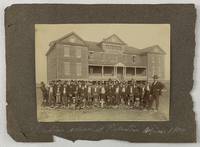
190012717Pipestone Mn 1900. Sepia-toned photograph 4.75 x 6.75 inches mounted on a gray sheet of paper manuscript caption reading "Indian school at Pipestone Minn 1900." Removed from an album. Photograph in excellent shape. Very good. A striking group photograph picturing a young teacher and fifty-five of his male Native American students posed in front of the imposing Boy's Residential Building at the Pipestone Indian Training School in 1900. The students appear to range from around five years of age to their mid-teens all dressed in similar pants white shirts and dark jackets. According to Minnesota's Carleton College: "In the 1890s the U.S. built the Pipestone Indian Training School on reserved quarry land and legal conflict soon followed. The Pipestone Indian Training School was one of many boarding schools that separated Native children from kin and land in order to assimilate them into American economy and society. These schools came about as attitudes towards the 'correct' treatment of Native people turned towards assimilation with the passage of the Dawes Severalty Act of 1887. Many Native people resisted boarding schools but the Pipestone Indian School inspired particularly active resistance for two reasons. First it was built illegally on Yankton Sioux reservation land. Second during the school's tenure management of the quarries fell largely to the white superintendent of the school instead of the Yankton people. unknown
183938798Albany: Alfred Southwick Printer 1839. First edition. Self wrappers. About very good edge worn and torn with light soiling on wrappers dampstain on top quarter of leaves and small tear to fore edge throughout. 30 pp. 8vo. Concerns school finances and the requirement that towns apportion monies for the schools. OCLC locates only 12 copies. American Imprints 57519. Alfred Southwick, Printer unknown
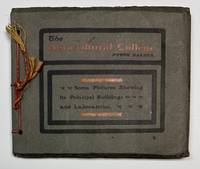
18943962Fargo 1894. About very good. 16 leaves with descriptive tissue guards. Oblong 12mo. Original grey printed wrappers string-tied. Light wear and soiling to covers. First tissue guard lacking. Internally clean. A pictorial souvenir of the Agricultural College of North Dakota which later became North Dakota State University. The school opened in January 1892 with 123 students enrolled. This booklet then showcases the progress made in the short years after the founding of the school. Images show the primary building the biology lab the chemistry lab home economics classroom the agricultural classroom with its collections of grains and seeds and more. We locate two copies in OCLC at the University of Illinois and North Dakota State University. unknown
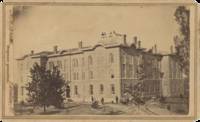
1865List3142Sandusky Ohio 1865. 2 ½ x 4 inch CDV. Normal wear; Near Fine. A photograph by Sandusky Ohio-based photographer A. C. Platt showing the new Ladies Hall at Oberlin College around 1865. Oberlin was the first college in the US to admit women initially offering them a degree from the “Ladies Department†but in 1837 allowing them to enter the regular degree program. The building pictured is the second Ladies Hall a dormitory with reading and meeting rooms built between 1861 and 1865. unknown
2082702115100113Kozan Takai Memorial Museum N.A. Soft Cover. Fine. Size: 39cm Kozan Takai Memorial Museum paperback
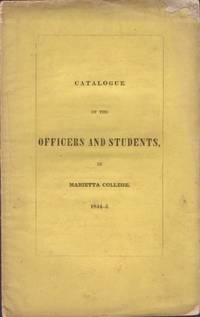
184433588Marietta: Marietta College 1844. First Edition. Wraps. Very good. Stitched wraps. 22 pages 1. Printed yellow wraps. Small chips and wear to the upper edges of the covers. Interior in good condition. Catalogue includes names of trustees overseers faculty classes course of instruction terms and more. <br /> <br /> Sabin 44569. Marietta College unknown
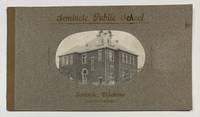
191112618Seminole Ok: News Print 1911. Very good. 42pp. Oblong thin quarto. Original printed wrappers tan paper backstrip with oval die-cut on front wrapper revealing a view of the "Seminole School Building" on the first page. Minor soiling to wrappers. Faint stain to outer margin throughout small chip to outer margin of last leaf occasional minor foxing. An unrecorded pamphlet detailing the educational opportunities at the Seminole Public School in Seminole Oklahoma just a few years after Oklahoma statehood. The work prints some opening remarks from various school officials including the President of the Board of Education W.S. Livingston and the Superintedent L.L. Sturgeon along with a Treasurer's Report. This is followed by the main thrust of the work - the rules and regulations courses of study beginning in first grade and continuing through high school a list of textbooks "adopted for the high school" curriculum plans by class and information on the school's library athletics music and "Literary Work" including a literary society for eighth graders. The text is illustrated throughout with photographs of school officials teachers the library the girls' basketball team and the boys' baseball team. We could find no record of this work in OCLC or auction history. News Print unknown
18537689Quebec: John Lovell 1853. 1st ed. 1853. 8vo. 310 pp. Original floral patterned embossed purple cloth with printed spinal paper label. Some wear at the spinal extremities and tips paper label darkened else a very good book. 1st Edition. Hardcover. Very Good. Quebec: John Lovell, 1853. 1st ed. hardcover
1889List3035California Oregon Iowa and New York 1889. Sixty-five items: sixty-two letters mainly dating from 1887 eleven letters 1888 nineteen letters and 1889 fourteen letters; and three playbills from the CMA Dramatic Club. Overall excellent. William H. Sharp 1863–deceased was born in Washington and lived in The Dalles Oregon. He attended the California Military Academy in Oakland from 1880 to 1883 and then returned to The Dalles. There he worked as a commission merchant and ran for county clerk. <br /> <br /> Offered here is a collection of letters mainly to with some from William Sharp. The letters are from friends and family—Sharp had many cousins with whom he corresponded regularly—and cover his time at the California Military Academy CMA and back in The Dalles.<br /> <br /> The CMA was founded in 1865 by Rev. David McClure and combined college preparatory education with military drills including firearm training with the aim to “give the youth of the remote West an opportunity to acquire an education such as could not otherwise be obtained.â€1 His attendance put a financial strain on the family; his mother Mary Sharp reminds him that “we have to scrach hard to keep you at school†as she scolds him for his poor performance April 8 1882. Mary Sharp also worried about conditions at the Academy:<br /> <br /> “Willie I hope you will be kind to all new comers & comfort them all you can I read of two boys being killed by ill treatment at boarding schools one they took out of a warm bed & pumped cold water on him in a cold night untill he died the other they tied a & triped him so he fell hurt his head & killed him I hope the boys do not play such tricks at your schoolâ€. November 12 1880<br /> <br /> The CMA promised not to admit any boys who were “morally bad as the institution is not designed to reform vicious boysâ€.1 However a letter from C.W. Chapman Sharp’s friend and former roommate suggests that the school’s rigorous drilling was not necessarily successful. Chapman writes from Nevada City a mining town in central California:<br /> <br /> “I’m working hard as usual; but I expect you don’t care anything about that. I’m having lots of fun too if that interests you. You don’t know one half as many girls as I go to see every evening. And they are the kind of girls that you can have fun with too. . I am making up for lost time. . I haven’t had my fingers in anybody else’s pie yet and maybe I haven’t had them in anybody’s anything else either. But that’s some more trash. . How do you fellows treat the little dears now I hope you don’t deal with them as harshly as you did when I was down there.†January 10 1883<br /> <br /> Later letters are mainly between Sharp and his wife-to-be Jennie Booth. He mentions attending a temperance meeting updates her on business which is “not overly brisk†but “good enough†October 6 1888 and describes hiring a “mongolian†cook who is “a very fair specimen of the celestial race†October 5 1887. Booth describes Oregon City on a visit there as “very picturesque†but primitive: “it has only one street that is passable the rest are so rocky that you can’t get over them with a conveyance.†August 17 1888.<br /> <br /> Around this time Sharp runs for county clerk as a Republican; a W.T. McPhire writes from Mosier:<br /> “I am glad to know you are in the field for the clerkship which as you state is a very desirable office. Now I can and will say this much although opposing you in politics that if you receive the nomination for this office against any one in my party that is not an honest sober and industrious man I will willingly do all in my power to help elect you to the office.†March 12 1888<br /> <br /> Despite this bipartisan support Sharp lost to a man named Thompson. Sharp and Booth married and lived together in The Dalles and Sharp remained in his career as a farmer and merchant.<br /> Of interest to scholars of Oregon history and of 19th-century military education.<br /> <br /> 1 “California Military Academy†Mariposa Gazette June 30 1887 4. unknown
1837037880Philadelphia: American Sunday-School Union 1837. First Edition. Leather-backed boards. Very Good. 648pp; frontispiece illustration several double-page maps many vignettes in the text. Bound in black calf and marbled boards gilt spine rules and lettering; minor scuffs to binding. Signature of Henry McGordon June 1 1851 on front free-endpaper. 6" x 3.75" American Imprints 46103. American Sunday-School Union unknown
191562581Boston: Wright & Potter Printing Co. State Printers 1915. 8vo. v 1 234 pp. Photo frontisp. numerous photo plates 1 large folding floor plan charts. Blue embossed & ribbed publisher’s cloth gilt lettering stamped front cover & spine minor shelfwear slight rubbing edgewear still a NF copy w/ presentation slip bound-in from the Board of PPIE Managers for Massachusetts. First edition of this report which highlighted the tremendous achievements by the State of Massachusetts during the Progressive era as well as their very popular tea room which was one of the best-attended attractions during the run of the World’s Fair. The Massachusetts Booth emphasized their reforms in education for vocational training and reducing poverty new educational methods improvements in Mental Health “Insanity Hospitals†Public Health reforms to improve the blind as well as dental agricultural and medical reforms. In addition there was a fine exhibit on Massachusetts road building for the early “Good Roads†campaign reforms prior to World War I. Wright & Potter Printing Co., State Printers, hardcover
187934705Unknown 1879. Ledger. Good. Ledger. Approx. 7.5" x 6". Marbled paper covered boards with black leather spine. Boards are shelf and edge worn. Leather is rubbed and chipped at the head and base of spine. A few pages have been torn out and one sheet torn in half. Old library label of "Perseverance S.S. Library" on the front paste down.<br /> <br /> Ledger consists of 106 lined pages used for recording student names classes teachers questions treasurer reports minutes of school meetings etc. No location of this Sunday School was provided in the records. unknown
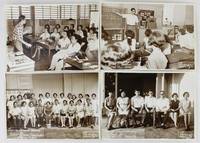
19693754Lucena City: Garcia's 1969. Very good plus. Fifteen sepia-toned photographs most 5 x 7 inches a couple slightly smaller all but one captioned in the negative. Minor wear otherwise very nice condition. A collection of fifteen photographs featuring the participants in the 1968 Division Science Workshop in the Philippine city of Lucena. The workshop appears to have concentrated on teacher training for instructors from grades 1 through 11. The present images capture the various training classes during instruction broken out by grade level with classes of Filipino men and women taught in English by two white men. Information on chalk boards can be seen in a couple of images. Six of the photographs feature group photographs featuring either the entire population of teacher-trainees or individual grade-level classes. One image features a Division Science Seminar for District Science Coordinator. An interesting assortment of photographs capturing teacher training in a notable Filipino city at the end of the 1960s. Garcia's unknown
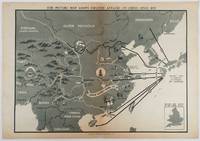
1942222849London.: Evans Brothers. September1942. Black and white pictorial map centred on China; on reverse a reproduction of Ernest Board's 1915 depiction of the marriage of William Penn and a portrait photograph of four Cypriot silk spinners and a donkey. 39.5 x 56.5cm. Few small tears mended with archival-grade washi paper lightly browned and a little friable overall in very good condition. A wartime map centred on China proper showing the historical progression of Japanese incursion across the region. Particularly topical for the year the paths of the Burma Road freshly occupied by Japan and the burgeoning Ledo Road have been marked. . [Evans Brothers]. unknown