24 936 résultats
20122092902144101012Kishin Shobo 2012. Soft Cover. Fine. Size: A5 Kishin Shobo paperback
0229QUPE6CPPamphlet. Good. ORIGINAL Prospectus for the first year at Swarthmore College. A little edgeworn and creased. Please see our photos. Scarce. $300 /year included wash room board AND books! unknown
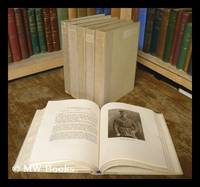
1918209506England : printed for Harrow School by Philip Lee Warner publisher to the Medici Society 1918-1921 1918. First Edition. Hardback. Very good copies bound in cloth-backed boards. Printed title labels on spines and front panels. Title labels are slightly worn in places. Top edges gilt. Spine bands and panel edges slightly dust-toned and rubbed as with age. Remains particularly well-preserved overall; tight bright clean and strong. ; 8vo 8"" - 9"" tall; 0 pages; Physical description: 6v : mounted ports ; 28 cm. Obituary notices of Old Harrovians killed in the Great War. With portraits. Subjects: World War 1914-1918 -- Registers of dead -- Death register -- Great Britain. Notes: Each volume contains 100 memorils with the exception of vol. 6 which contains 116. Each portrait has a short biography on the facing page. Editing committee: W.F. Fladgate E.M. Buttler A. Wyatt-Smith. [England] : printed for Harrow School by Philip Lee Warner, publisher to the Medici Society, 1918-1921 hardcover
18192110502151100336Not Available 1819. Soft Cover. Fine. Number of books: 1 Not Available paperback
R1278/1-2*<p>Etutes Asiatiques Vol. 1-2 PRINT Paris 1924 WL CODE R1278/1-2 SIZE 383438 pp. fully illus. 190 x 285 mm BOOK WEIGHT 3.300 Kg PACKING WEIGHT 0.200 Kg</p> paperback
1976mon0000083355The School 1976-01-01. Paperback. Acceptable. in x in x in. Ex-library book usual markings. Hardback rebound by library. Well read copy with some spine wear. Colouring of page edges due to age. The School paperback
1882ZB981331NY: Columbia University Press 1882-1915. volumes 4-36 lacks volume 10 an uninterrupted run of complete volumes bound ex library else text clean & bindings tight. - If you are reading this this item is actually physically in our stock and ready for shipment once ordered. We are not bookjackers. Buyer is responsible for any additional duties taxes or fees required by recipient's country. Photos available upon request. NY: Columbia University Press unknown
239121916 to 1919 each a ‘Charles Letts School-Boy’s Diary’. At front of diaries for 1916 and 1917 he writes: ‘C L. Harris / 120 Gladstone St / Bedford’. See Fry’s entry by Michael Billington in the Dictonary of National Biography. His brother survives as a rather shadowy figure: he was certainly alive in 1978 when Fry referred to him in the account of his family background ‘Can You Find Me / A Family History’ OUP. In that volume Fry describes his ‘brother Leslie’ as a baby ‘growing sturdily’ noting that ‘though he was later called by his first name Charles he was Leslie for many years to come’. The four years of diary entries that are present here are short and factual and rather uneventful but they have a double interest: at once casting light on the family background of one of England’s finest twentieth-century playwrights and giving a picture of the development of an average English middle-class schoolboy around the period of the First World War as he rises to position of ‘Head of School’ at Bedford. The four volumes are in fair condition aged and worn with the 1916 diary sprung from its covers at the gutter of the rear endpapers. The four volumes are uniform in embossed brown cloth described by the publisher as ‘Art Linen’ each with back loop for pencil. Each volume provides space for four days’ entries per page with numerous preliminary printed pages with the customary useful information including endpapers and other matter reflective of the conflict with maps of the Europe theatre illustrations of medals and of a ‘soldier-’ and ‘sailor-boy hero of the Great War’ the last volume carrying a ‘Message from Admiral Sir John Jellicoe to the Readers of “The Schoolboys’ Diary’. In the first three volumes Harris writes in pencil filling in the diary assiduously from 1 January 1916. In the final volume by May of 1919 the entries become intermittent and on 15 August 1919 they cease entirely. In additional to the daily record Harris also provides details of ‘Pocket Money’ personal information including ‘Size in Hats’ and memoranda dates of significant events such as ‘Promoted to Lance-Corporal in the O.T.C.’ ‘Received 1st XV colours’ and on 24 July 1919 ‘Made HEAD OF SCHOOL.’. Loosely inserted are a few postal order counterfoils and Chatham bus tickets. The entries begin in 1916 with Harris on his school holidays doing errands for his widowed mother and reading to her and entertaining his brother ‘Arthur’ i.e. Christopher Fry for example by taking him on walks to town for a haircut and helping him with his stamp collection. The monotony of school begins repeated entries in early volumes start with ‘School as usual’ and the entries reflect the rounds of sport he is captain of the ‘Wasps’ cricket team in 1916 cadet corps bible classes exams trips to London 2 January 1919: ‘Went over St Dunstans in morning with Jack / Uncle Walter took Jack girl Madeleine & myself up to the “Old Vic†to see Shakespear’s “Macbeth†2.0-5.0. Jolly fine performance though a bit tragic / Left & returned by train took 1 hr each way.’ his health recurring toothache mumps etc the weather involvement for the war effort in agriculture 11 September 1918: ‘Another dismal day all by myself. Have quite made up my mind to chuck farming if this goes on especially as when I was happily walking home at 4.30 I ran into more work & had to load wheat till 7.9.’. By 1918 the entries begin to loosen up a little. On 19 March for example: ‘Rotten wet beastly muddy miserable day with a boil on my chin about the size of an egg & a Corps Inspection 2.30 by Lieut Col Pilkington on top of that. The rest may speak for itself. Also EII beat WII by 1/4 length.’ And on 10 September; ‘G his friend Gerald often referred to & I shocked barley all the morning & then ditched until 5.30. Shocking barley is qute a decent job.’ The signing of the armistice 11 November 1918 is greeted with ‘Flags all over the town bells etc. Bands in afternoon; town packed.’ And on the following day ‘Whole Holiday for Armistice / Thanksgiving Service in Hall instead of Prayers.’ Final entry 14 August 1919: ‘Went over St Mary Redcliffe Church in morn. More wonderful even than the Cathedral. Employed myself immensely. Went on to Downs by myself in even to hear band.’ 1916 to 1919, each a ‘Charles Letts School-Boy’s Diary’. At front of diaries for 1916 and 1917 he writes: ‘C L. Harris / hardcover
21234Bedford Modern School. Nos 1-11 Feb. 1925 to July 1927: Printed by the "Bedfordshire Standard" Newspaper Co. 1913 Ltd Bedford. Nos 16 Oct. 1928 and 17 Dec. 1928: Printed by the County Press Bedford Limited. Supplement: 30 March 1926. Fourteen items all 8vo. Seven numbers 4-9 and 16 are 16pp; number 17 is 26pp; other numbers range from 8 to 12pp except for the 'B.M.S. Gazette Supplement' 30 March 1926 which has 4pp. The first five numbers on cheap newspaper stock; from the sixth number onwards the paper quality improves. Number 17 'Special Christmas Number' has lost its back cover. The other thirteen numbers are complete. A frail survival in fair overall condition on aged and worn paper. Numbers 4-11 with 'Eagle' masthead otherwise no settled layout. Becoming more professional as it proceeds with advertisements to the later numbers. Numbers 1-8 are edited by 'A. H. Harris' i.e. Fry 9-11 by W. L. Davis; 16 and 17 by B. W. R. Mooring. The usual mishmash of school news 'Holiday Camp 1928' photographs sports results and reports 'B.M.S. Regatta Victory. - The Winning Eight' stories cartoons and jokes editorial. Fry's entry in the Oxford DNB says nothing of his school years apart from the fact that he attended the school. [Bedford Modern School.] Nos 1-11 (Feb. 1925 to July 1927): Printed by the "Bedfordshire Standard" Newspaper Co. (1913), Ltd, Be unknown
22281Several of White's letters on letterheads of The Reedbeds Shoreham Nr. Sevenoaks Kent. Between 1921 and 1968. Two years after arriving in England from Australia in 1913 Franklin White entered the Slade School. His studies were interrupted by the First World War during which he worked as a draughtsman at the Admiralty. In 1919 he re-entered the Slade and was soon invited by Tonks to join the teaching staff. On his retirement in 1957 he devoted his full energies to the Samuel Palmer School of Art which he had run from his home in Shoreham since 1924 when he first held summer classes in landscape painting for his Slade students. In the 1950s the school expanded to take in residential students and despite ill-health White continued his teaching through his later years. White's work is to be found in the permanent collections of a number of major galleries in Britain and Australia including the British Museum Victoria and Albert Museum the Ashmolean and the National Gallery of Australia. The present collection of material from White's papers mainly consists of drafts and copies of letters although at least one addressed to Thelma Cazalet-Keir Item Ten below would appear to be the original letter and White admitted in Item One below to a habit of writing letters and not sending them. The draft letters contain material of biographical interest with FW discussing his home and studio business affairs teaching methods. A number of items concern the setting up of his residential school at Shoreham see Items Two and Three to 'Fleming' and Eight and Nine. In the 1920s Shoreham – previously the home of William Blake's disciple Samuel Palmer – had become something of an artistic enclave along the lines of St Ives. The collection is in good condition with light signs of age and wear. The following description is divided into fourteen parts the first nine of which describe material in FW's autograph. ONE: Autograph draft or copy of letter to 'Mr. Holland'. 15 February 1921. On Reedbeds letterhead. 2pp. 4to. FW and his wife are 'comfortably settled' in their new home 'the new “Reedbedsâ€' which dates from the fifteenth century: 'In sorting out and arranging letters accounts & papers I found no less than five written to you and never posted. Mr. Syrett would say he quite expected as much from me however my business methods are improving now that I have my place to arrange as suits me. I am getting on well with my work at the Slade School London University I like the work and it brings me in touch with the top people in the art world. I am selling work and get an occasional commission for a portrait and this summer I am taking a pupil at £4 a week and with my £225 a year from the Slade you see I am now able to do a little for myself. The Slade is a good thing for me as it brings me in contact with people and only takes up three days of the week the rest of the week I can devote to producing work for exhibitions & selling.' After a reference to 'Miss Fricker' he discusses his 'visits to the class': 'I should like it clearly understood that I cannot have outside people coming in while the class is in progress whether it is anyone connected with art the Education Board or Sevenoaks Counsellors or anyone else. We must treat the class with absolute seriousness or I cannot afford to give the time to it.' TWO: Part of autograph draft of letter to 'Fleming' originally 'Mr Syret'. 2 May 1921; on Reedbeds letterhead. 2pp. 4to. In what appears to be a response to a proposal from Fleming that FW find London artists to teach a class at Sevenoaks he writes: 'I am afraid you would not be able to get anyone of any standing to give up the time it would require to come all the way from town. I ventured it at the Slade the fee etc but although a desire for a better feeling in art should be encouraged they could not see how anyone could afford to give up the time. … The class of students would be very distasteful to me then of course I partly imagine & partly judge from the visit to Sevenoaks'. Nevertheless he gives conditions which would have to met for him to consider the engagement. THREE: Autograph draft or copy of letter to 'Dear Fleming'. 11 June 1921. On Reedbeds letterhead. 2pp. 4to. 'The days of Gold Medallists at the Slade were days long before the present Slade tradition and it goes for nothing at all in fact you might say that ithas nothing to do with the Slade and is more akin to the hard work done at South Kensington and other places.' FOUR: First part 1p. 4to of autograph draft or copy of letter to 'Mr. Syrett'. From the Reedbeds. Concerning the question of deductions 'from the sum received from the Richardsons' he writes: 'I do not believe for one moment that the vague artistic temperament cannot be businesslike in the very least. … I have now overcome the big <> difficulty a painter has to overcome to certain degrees to be able to work more rapidly. I find that I am developing a bigger interest in more pecuniary affairs.' FIVE and SIX: Autograph drafts of two letters to 'Mr Copping' i.e. the artist and FW's Shoreham neighbour Harold Copping 1863-1932. The first a short note. 10 February 1921; Redbeds. 1p. 4to. The second an autograph draft of the beginning of a letter. 17 February 1921; on Reedbeds letterhead. 1p. 4to. He invites the Coppings to supper 'so we can settle the question you wish settled … I consider it a rather small affair which all village matters must of necessity be in relation to life'. SEVEN: Autograph draft of letter to the owner of a cottage – possibly 'the new “Reedbedsâ€' mentioned in Item One – which he appears to be looking to buy or let. 2pp. 12mo. 'I have not had a definite answer from 'Mr. Dowdy' see Item Nine about the room to work in and put my things into. If this is satisfactory I shall be able to put all my goods into the room. I am sure you will find we shall take care of everything in your cottage.' EIGHT: 12mo Reedbeds letterhead carrying parts of autograph drafts of two letters. Recto dated 13 February 1922 concerning the letting of a cottage on FW's recommendation; verso undated to a prospective student stating that 'as a number of students & others have responded to my offer I am now able to run the class at a smaller fee. A number of students came on the 11.40 Tulse Hill 11.44 Bat & Ball and others on 1.20 T.H. & 1.24 B.B. and I am able to charge 5/ per lesson for this.' NINE: Remains of 12mo notebook containing five pages of autograph notes. Undated but with printed calendars for 1918 and 1919 present. Two of the pages carry accounts with 'E E Dowdy' for whom see Item Seven and a third explains that Dowdy has agreed 'to let the room Mr. White is now using as a studio for an indefinite period at the rent of five shillings a week the said room being situated next to the Church Room Shoreham Kent'. Another page carries a draft of a letter to the parent of an 'extremely promising' pupil stating that the 'number of people who wish to have lesson from me each Wednesday has so greatly increased & . the space here is limited for the number of pupils'. TEN: Typed Letter Signed to 'Thelma' i.e. the feminist and Conservative Member of Parliament Thelma Cazalet-Keir 1899-1989. 1 May 1968. 1p. 4to. An interesting letter in which FW expresses 'shock' at the 'Raspit news' her country residence being Raspit Hill in Kent: 'Raspit Hill is a name that became very dear to us … And here I would like to tell you a secret. At the end of 1963 the school nearly came to grief and Gertrude and I were left with very little to carry on the school in 1964. But in our deepest moments of despair you came along and your cheque for £400 saved the school. So you and Raspit will always glow in our memory. … Mrs. Barker delivered your letter picture and blue vase this evening May 1st. I was a student with Robin Guthrie at the Slade so that I am doubley sic pleased to possess one of Guthrie's pictures. He was a splendid draughtsman at the Slade … It will be hung where it will always remind me not of Guthrie but of you.' ELEVEN: Manuscript copy not in FW's hand of 'claims for damage to two pictures sent to Shoreham Station from Canterbury'. 1p. 8vo. 8 September 1928; Reedbeds. The second claim is for '1 picture spoilt for selling & exhibition purposes glass smashed mount soiled frame damaged valued at £10. 10 0 say £8. 8 0 This pictute has been very favourably reviewed in many papers & was of increasing value to me'. TWELVE: TLS to FW from Louis McCubbin 1890-1952 Director National Gallery of South Australia Adelaide. 11 February 1949. 1p. 8vo. Regarding a member of the Gallery's board J. C. Goodchild who 'has just left here on a visit to England and I have given him your name and address and asked him if he will be good enough to inspect your pictures'.THIRTEEN: Five printed invitations made out to FW. Two from the Provost of University College London the first to 'Dr. Pevsner's' lecture the second to 'Dr. Weinberger's' lecture; one for the UCL Union Society Foundation Week 1934; one for the UCL Charter Day Celebrations 1934; one to 'An Assembly of the College Faculties' at UCL 1934. FOURTEEN: Seven receipts addressed to FW for subscriptions to The Times 1934 and 1935. Several of White's letters on letterheads of The Reedbeds, Shoreham, Nr. Sevenoaks, Kent. Between 1921 and 1968. unknown
25164Circa 1818. Harrow School Middlesex. This item is a nice artefact of one of England’s foremost public schools. The great rival of Eton Harrow numbers among its alumni seven prime ministers including Churchill. This notebook comprises lists of boys and their positions and classes in a particular term. The paper stock watermark and handwriting all indicate that its composition is contemporaneous with the schooling of those named. It is the work of one person almost certainly one of the school’s masters and its loose and hurried nature indicate that it was intended for personal use or as an aid in future writing. There is no internal indication of author or source but the latter is established beyond all doubt by reference to R. Courtenay Welch’s ‘Harrow School Register 1801-1893’ 1894 which shows that the notebook was compiled in the last few years of the reign of George IV and certainly during the tenure of George Butler 1774-1853 headmaster from 1805 to 1829 and later Dean of Peterborough see his entry in the Oxford DNB. As Welch explains in his introduction the early part of his register is incomplete and it is likely that the present item names individuals not present there. It is 24pp with an additional 2pp of pencil calculations and a page with a simple pencil drawing of the front parts of a horse in a stitched 7 x 8 cm notebook of watermarked laid paper in dark-blue waxed card wraps. The notebook contains thirty leaves out of an original thirty-six with a few leaves loose and one stub present. All but one of the 24pp are written on the rectos. Each page carries a list of names - sometimes as many as 21 to a page sometimes only a handful under the following headings: p.1 Monitors; pp.2 and 3 Upper VI; p.6 Upper V; p.8 Under V; p.11 Upper Shell; p.14 Under Shell; p.16 IV Form 1st Rem.; p.18 IV Form 2nd Rem.; p.20 IV Form 3d Rem.; p.21 IIId Form 1st Rem; p.22 IIId Form 2nd Rem; p.23 IIId Form 3d Rem; p.24 Unplaced. P.14 will serve as an example: ‘Under Shell / Perceval Minr / Maydwell / Smith Minor / Balfour Jun / Bradford / Graham / Park Junior / Crommelin Senr / Davidson / Gregg / Mr Dundas Junr / Winter / Elliot / Sheppard / Hammet / Macham / North Minr’. Among the mass of names many are identifiable with Welch’s aid. The following individuals were unless otherwise stated entered in 1813-15: ‘R. B. Phillipps Senr / Longworth in the County of Hereford’ is identified by Welch as Robert Biddulph Phillipps ‘son of Chancellor Phillipps’entered 1811; ‘A. Clive Esq of Whitfield’ is Archer Clive d.1878 ‘son of E. B. Clive Esq. M.P.’ entered 1811-1813; ‘Ponsford’ is William Ponsford ‘son of W. Ponsford Esq. Puddicombe Devon’; on p.3 ‘Boileau Pollen’ is George Pollen Boileau-Pollen ‘son of J. P. Boileau Esq. afterwards Boileau-Pollen’; ‘Ld Ashley’ is Anthony Ashley-Cooper Lord Ashley ‘son of the 6th Earl of Shaftesbury’; ‘Goldschmidt’ is Adolphus Goldschmidt ‘Merchant’; ‘Crommelin Senr’ is George Russell Crommelin 1803-1844 the younger Crommelin being Thomas Lake Crommelin 1805-1877; ‘Count P: Lieven’ is Count Paul Lieven ‘son of Count afterwards Prince Lieven Russian Ambassador’ 1816. Circa 1818. Harrow School, Middlesex. paperback
20202081502111907334Hoo shubbansha 2020. Soft Cover. Fine. The book is in fine condition. Hoo shubbansha paperback
20222081502111906222Chinese book office 2022. Soft Cover. Fine. The book is in fine condition. Chinese book office paperback
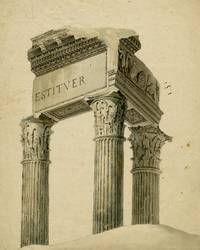
180010251800. Ink and wash in black ink with pen in black ink on watermarked C & I Honig cream laid paper 14 7/8 x 12 1/4 inches 378 x 311 mm the full sheet. In very good condition with some minor areas of light brown spotting in the right-center sheet margin. An excellent drawing with fine detail. The ruins of the Temple of Vespasian and Titus are located in the Roman Forum in Rome. The temple is a marble ruin that honors the deified emperors Vespasian and Titus. Located near the Temple of Saturn all that remain standing are three Corinthian columns that formed part of the colonnade. The temple was also dedicated to the son of Vespasiano Titus. Construction started on this temple in 79 AD. unknown
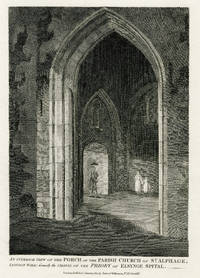
1815952London: Robert Wilkinson 1815. Etching and engraving on wove paper with an "1809" watermark 13 1/2 x 10 inches 342 x 252 mm full margins. In very good condition with some age related toning and light spots of discoloration in the lower sheet quadrant. Damaged in the Blitz and largely demolished in the 1960s what remains of St Mary Elsing includes these doorways which still stand looking back towards London Wall. The ruins include tall arches which once formed the base of the tower. There is also a low wall with an arched recess which may have been used to house a tomb. Robert Wilkinson unknown
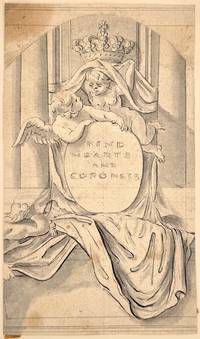
175025101750. Graphite ink and wash on cream laid paper with an extensive yet partial and illegible series of alphabetic watermarks. 7 1/4 x 4 1/2 185 x 115 mm the full sheet. With an contemporary support adhered to the top sheet edge. 19th century text in graphite added to the shield held by the putti. The image has been cropped to exclude the top portion of a recumbent figure whose legs are covered by a shroud and whose left hand remains visible in the left-center image area propped upon an pillow holding a heart. While this drawing appears to have been completed in the mid-18th century given the Neoclassical style media and paper the text "Kind Hearts and Coronets" comes from the poem Lady Clara Vere de Vere by Alfred Lord Tennyson. The poem was pubished in 1842 indicating that the pencil inscription in the image was added later. unknown
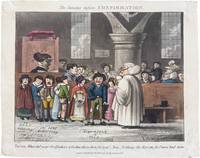
18501887London: Thomas McLean 1850. Lithograph and engraving with hand coloring in watercolor on fibrous cream wove paper 8 13/16 x 11 1/8 inches 223 x 281 mm with unevenly trimmed wide margins. In good condition with minor toning and one vertical tear at the lower-center sheet edge which extends approximately 1/8 inch into the image area. Four circular areas of adhesive on the verso at each of the four corners on the verso from a former mount. Thomas McLean unknown
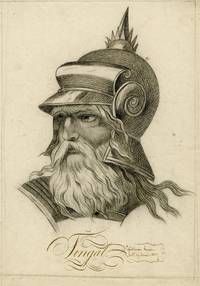
183310261833. Black chalk and graphite on lightweight cream wove paper 16 1/8 x 11 1/4 inches 410 x 286 mm the full sheet. Signed titled and dated in sepia ink in the lower-center sheet area. With horizontal folds approximately 1-inch from the sheet edge at each of the four sheets. The drawing appears to have been folded at the sheet edges to fit into a frame. "Inscribed Guillaume hameau del. 29 Janvier 1883." Finn mac Cumail or mac Umaill often anglicized Finn McCool or MacCool is a hero in Irish mythology as well as in later Scottish and Manx folklore. He is the leader of the Fianna bands of young roving hunter-warriors as well as being a seer and poet. He is said to have a magic thumb that bestows him with great wisdom. He is often depicted hunting with his hounds Bran and Sceólang and fighting with his spear and sword. Fionn MacCumhail was transformed into the character "Fingal" in James Macpherson's poem cycle Ossian 1760 which Macpherson claimed was translated out of discovered Ossianic poetry written in the Scottish Gaelic language. <br /> <br /> Fionn MacCumhail features heavily in modern Irish literature. Most notably he makes several appearances in James Joyce's Finnegans Wake 1939 and some have posited that the title taken from the street ballad "Finnegan's Wake" may also be a blend of "Finn again is awake" referring to his eventual awakening to defend Ireland. unknown
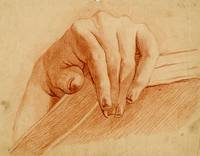
170013741700. Red chalk on cream laid paper 7 1/4 x 9 3/8 inches 182 x 236 mm the full sheet. In very good condition with minor toning and two small nicks in the top sheet edge. Some modern notations in pencil on the verso as well as one early inscription with the numeral "10" ink in the top left corner verso. A beautiful study of a dainty hand. unknown
19852110502150908384Not Available 1985. Soft Cover. Fine. Number of books: 9 Not Available paperback
19822091502133511318Japan Editor School Publishing Department 1982. Soft Cover. Fine. Number of books: 1 Japan Editor School Publishing Department paperback
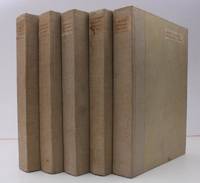
181936358For Harrow School by Philip Lee Warner 1918-1920. 5 vols. of 6 roy. 8vo. First Edition on laid paper with numerous mounted portraits toned in sepia; ivory boards oatmeal holland backs upper boards and backstrips with printed paper labels gilt tops uncut blue silk markers boards mildly dust-soiled else a very good bright clean crisp run. One of the finest and most comprehensive of the public school WWI rolls of honour. The run comprises Vol. I: 23 August 1914 to 20 March 1915; Vol. II: 31 March 1915 to 11 September 1915; Vol. III: 13 September 1915 to 3 July 1916; 5 July 1916 to 11 April 1917; Vol. V: 11 April 1917 to 10 April 1918. A crisp run tragically wanting the sixth and final volume. SCARCE IN THIS CONDITION. For Harrow School by Philip Lee Warner, hardcover
192413276Madrid: Junta Para la Ampliación de Estudios.1912-1924.- 5 Fascículos 127; 128; 198; 124; 129 pp. en un solo volumen ; 4º mayor 279 x 205 cm.; Media Piel Chagrén Puntas conservando las cubiertas originales de cada fascículo.- CONTIENE: J. PIJOAN: Miniaturas españolas en manuscritos de la Biblioteca Vaticana; JUAN M. PEREA: Frescos descubiertos en la sacristía de la iglesi a nacional de España en Roma; RAMON DE ALOS: El Cardenal de AragónFr. Nicolas Rosell; P.A. MARTIN ROBLES: Del Epistolario de Molinos; F. MARTORELL: Fragmentos inéditos de la "Ordinatio Eclesiae Valentinae"; J. SERRANO: Causas de la guerra entre el Papa Paulo IV y Felipe II; E. PACHECO Y DE LEYVA: Relaciones vaticanas de Hacienda española del siglo XVI; L. SERRANO: Alfonso XI y el Papa Clemente VI durante el cerco de Algeciras; E. PACHECO Y DE LEYVA: La intervención de Floridablanca en la redacción del Breve para la supresión de los jesuítas 1772-1773; I SERRANO: Primera negociaciones de Carlos V con la Santa Sede; L. SERRANO: El Papa Pío IV y dos embajadores de Felipe II; A. ANDRES: Proyecto de una diplomática española en el siglo XVIII. COLECCION COMPLETA MAGNIFICAMENTE ENCUADERNADA Y EN IMPECABLE ESTADO. HISTORIA DEL SIGLO DE ORO ESPAÑOL Libro en español Junta Para la Ampliación de Estudios... hardcover
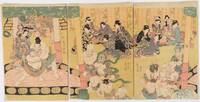
1860218670東京. Tokyo. circa1860s. Three colour woodblock prints a triptych panels loose each approx 38.5 x 25.4cms Japanese text artist's signature publisher's seal and date in the outer margin of the centre and right-hand panels and in the inner margin of the left-hand panel slivers of paper tape strengthening the top margin to the verso of each print pin-holes to the corners from previous display with loss to the lower right corners and the inner corner of the left-hand panel paper a little dusty and soiled but overall in good condition. Wonderful satirical woodblocks with muted tonings possibly from the composition for "Sumo wrestling match of Seven Lucky Gods" replacing the gods with actors as aging sumo wrestlers surrounded by onlooking geisha and fellow actors in masks and costume. <br> <br>From the collection of the late John Caiger lecturer in Asian studies ANU. . unknown
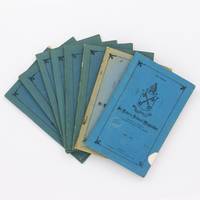
1914131663Adelaide: W.K. Thomas & Co. Printers 1914. First Edition. Paperback. Very Good. Adelaide W.K. Thomas & Co. Printers 1914 to 1919. Octavo eight issues ranging between 48 and 80 pages plus plates in some of them. Several of the plates reproduce photographs relating to Australians in the war including a folding panorama of North Beach Anzac and several snapshots taken in the field. Title-wrappers slightly worn and marked and two issues have minimal expert conservation; minor signs of age and use but overall in very good condition. Spanning the First World War this run offers powerful insights into the effects of the war on the school community. Among the usual sporting fixtures and school news are first-hand accounts of important actions sent back to Australia by 'old boys' on active service and numerous short obituaries. Recurring sections include a nominal roll of former pupils in uniform details of their awards and medals and an ever-growing roll of the wounded missing and killed. Particularly noteworthy are accounts of: 1 The Gallipoli landings from several soldiers; 2 The Battle of Cocos; 3 Light Horse actions in the Palestine; 4 Naval actions in the Persian Gulf; and 5 Trench warfare on the Western Front. The names of decorated old scholars appear regularly including Arthur Blackburn VC. <p>The ties of the Old School seem to have been strong even on the battlefield. In the obituary for Lieutenant Eric W. Talbot 10th Battalion it is noted that 'On April 24th 1915 the night before the landing he sat with Col. Price Weir who made use of his draughtsmanship to prepare the landing plans. In the attack at dawn he first had command of scouts and being allowed to choose his men he selected a team entirely of old "Saints"' Number 90 page 61. <p>The issues present in this run are Number 86 May 1914 Number 90 August 1915 Number 92 August 1916 Number 94 May 1917 Number 95 August 1917 Number 98 August 1918 Number 101 September 1919 and Number 102 December 1919. Offered with them is the 'Programme of the Annual Sports held on the School Oval on Saturday April 29th 1916' small octavo 19 pages; a little marked. 9 items. W.K. Thomas & Co., Printers paperback