95 944 résultats
19792081402109703360Saitama Prefecture Dowa Education Research Council 1979. Soft Cover. Fine. The book is in fine condition. Saitama Prefecture Dowa Education Research Council paperback
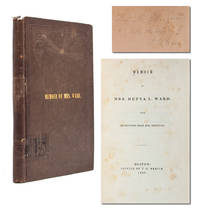
18434025Berkeley: T.R. Marvin 1843. First edition. Very Good . Original publisher's cloth binding with gilt to front board. Minor loss of cloth to crown of spine. Faint residue of removed library label to spine and front board. Peach endpapers. Light scattered foxing as is typical of the period. Inscribed on the front endpaper by Ward's husband the compiler: "Reverend Mr. Ellingwood with the respects of J.W. Ward." Bookplate on the front pastedown reveals that the recipient Rev. Ellingwood went on to donate the volume to the Theological Seminary of Bangor Maine. A scarce and important example of a published American elegiac volume produced in this case by an eminent family to mourn the loss of an educated woman. Memoirs is unrecorded by OCLC and has never appeared at auction. <br /> <br /> In their marriage James Wilson Ward and Hetta Lord Hayes Ward united two prominent Northeastern families. A senator and Congregationalist minister James descended from the founders of Plymouth and had attended Andover and Amherst. Hetta the daughter of a judge and niece of a Dartmouth president was herself a graduate of Miss Grant's Seminary Academy. The present volume released "exclusively for private circulation among the friends of the deceased" is a testament to Hetta's value not as a daughter who married well or a wife who effectively managed a house but as a companion an intellectual and an individual. In this sense it deconstructs the period's expectations of separate spheres or hierarchy between sexes. With an opening letter by Susan Hayes Hetta's mother as well as a copy of the eulogy conducted by her husband the book reveals vast details about who Hetta was as a person. Both describe her as tender and affectionate; but time and again emphasis is placed on her mind. Though Hetta was skillful with a needle as a child according to her mother "her numberless questions interested and surprised me.She acquired a fondness for poetry.She became as much interested in the in the study of the exact sciences as in the works of imagination making herself acquainted with the higher branches of Mathematics Algebra Geometry etc." James similarly eulogizes his wife. What becomes clear is that he is grieving the loss of a companion and equal. "If we have found a friend of distinguished excellence and for years rejoiced with that friend in mutual interchange and warm affections it is natural when death intervenes and separates us from the dear object of our love to contemplate their virtues.First characteristic which I would notice which she possessed in an eminent degree is an ardent love of truth.She possessed great powers of abstraction.She saw with great clearness the point of an argument and was quick to distinguish between sophistry.She loved to trace the workings of the human mind." Not satisfied simply to have their own testaments to Hetta's extraordinary mind the compilers included to the last half of the book a collection of her own poetry and prose.<br /> <br /> A scarce work in a genre underappreciated in American literature and history. Such coterie publications of intimate mourning were uncommon for the time particularly for a woman.<br /> <br /> National Cyclopedia of American Biography 148. Very Good . T.R. Marvin unknown
16993Photo Album Women Education Album from student at Wellesley College filled with 143 original silver gelatin print photographs. Chronicles a young woman's educational path from high school through college and onto her later work as a teacher. Dated 1911-1919. Photos of various sizes from 2 x 3" to 4 x 9.5". Original black cloth boards. 9 x 12". 100 pages. Many photographs of Wellesley College its campus and traditions. Photo of Lake Waban and the campus chapel. Image of a house labeled "Wellesley 1911-1912" placed in album next to photo with 3 young women with their arms full of books standing outside the same house labeled "Students". 6 women bundles in hats and coats on a snowy street: "Off for math exam". Others show young women reading books and studying outside eating meals together and enjoying campus life. Includes 5 photos of the "Senior Hoop Rolling" tradition on May Day 1912. Photos of friends lovingly labeled with nicknames such as Chub Selina Honey and Marion. Includes photos from many locations around upstate New York including the Hudson Valley and Finger Lakes regions: Frontenac Point Minnewaska Mohonk and Yankee Lake. Also photos from Digby a small town in Nova Scotia Canada. In addition to the images of Wellesley there are photos of several other academic institutions. Images of academic interiors labeled Drawing Room Mr. Wilson's Room Assembly Room Physics Lab Library and Hall at M.H.S. Group photo of a 16 boys wearing "M" shirts and 3 coaches posing with a trophy and banner reading: "OCIAA Relay Race 1912". Building labeled "Harmony Hall" next to a photo of 14 women with the caption "Inmates of H.H. 1913". 2 large group photos with women in white dresses and a banner "ETA Clionian" one labeled 1914. The ETA Clionian Sorority was active on the SUNY New Paltz campus then a state teachers' college. Later photos appear to be from when the album owner transitioned from being a student to working as a teacher. Young groups of children are photographed together with the handwritten captions "Primary" or "Intermediates". One photo shows a school production with many children on a decorated stage wearing Pilgrim costumes. Building labeled Quassaick Hall. I page detached. Very good condition. unknown books
18223447Great Britain 1822. Comprised of 78 manuscript pages of mathematical definitions tables methods and exercises in a single hand with the ownership signature of Elizabeth Young and a running date made intermittently to the footers. Blue paper vernacular binding measuring 8 x 12 inches and stitched at spine; later tape reinforcement. Elizabeth's metric measurements and English currency reveal her to be a student somewhere in the UK. Though the commonness of her name prevents us from locating her specifically in genealogy records the manuscript she left behind reveals much about her.<br/><br/>Elizabeth's notebook is composed in a meticulous cursive hand with neat headers each dated and her name to many of the footers. Section each have a definition leading into rules and from there into word problems and calculations. Each new section progresses in complexity requiring Elizabeth to conduct longer calculations and combine a variety of arithmetical methods multiplication division addition subtraction. Some of these are generic questions about distance or weight; but others urge the student to devotion even as she works in a logical field "How many Hours Minutes and Seconds elapsed since the birth of Christ which is 1808 years ago assuming 365 days to a year". Some put Elizabeth in contact with the world of commerce and supply chain "The yearly export of Brandies from France is said to amount to 25000 tons. What is the value of this quantity at 5s6p per Gallon". Still others prepare her for the maintenance and management of a household or a business "If a servant's wages be 12.12 for 52 weeks how much is that a year" or "If 1728 Elegant wine glasses were bought for £65.2s how must they be sold per dozen or per glass to gain Ten Guineas by the sale of the whole".<br/><br/>A portion of seven pages near the center of the book offers a telling anomaly. While it continues in Elizabeth's neat hand these entries from January-February 1822 list goods purchased by community members from merchants several of whom are women. If these are a part of a school exercise they do not show the marks of it. Rather they appear to be Elizabeth making real-life notations keeping track of accounts for herself or someone else. In this sense the word problems she records and practices are being applied in her own life.<br/><br/>An exceptional document Elizabeth's notebook has research possibilities including but not limited to the history of education in the UK and trans-Atlantic comparisons the history of women's education the effects of class on girls' education mathematics approaches to teaching math to girls historical measurements women in business paleography and women's and gender studies. unknown books
19102110502150402450Not Available 1910. Soft Cover. Fine. Volume: 1 Not Available paperback
19882080302106806258Not Available 1988. Soft Cover. Fine. Number of books: 14 Not Available paperback
19932110502151005039Shandong Friendship Publishing House 1993. Soft Cover. Fine. Number of books: 14 Shandong Friendship Publishing House paperback
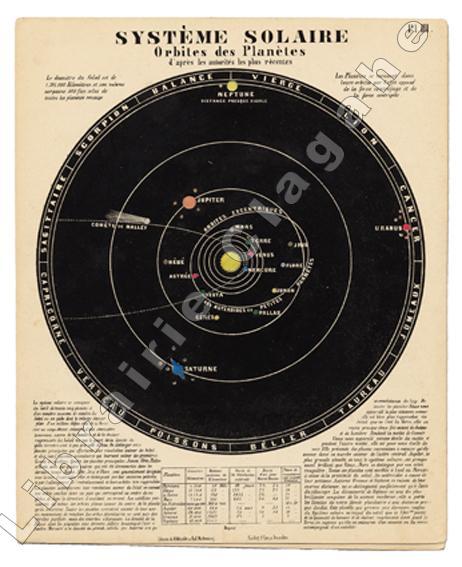
185617861Hall, Wurtemberg, librairie de W. Nitzschke ; Bruxelles, Kiessling et Comp. , s.d. [circa 1856] ; in-4 (planches 29x23,8 cm) en feuilles sous chemise cartonnée en percaline, plats à grand décor rocaille à froid et titre doré sur le premier, cordons de fermeture (chemise éditeur) ; 12 planches lithographiées en noir ou en couleurs.
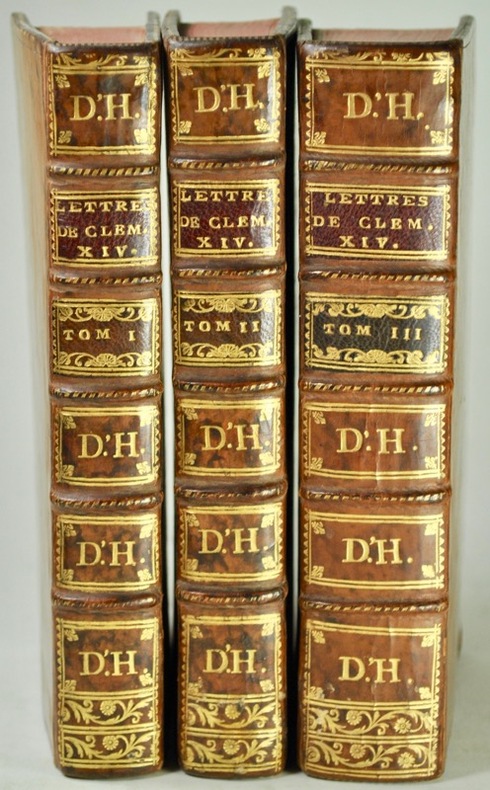
177641587Paris, Lottin le jeune, Lyon, Bruyset-Ponthus, Rouen, Bénitier, 1776-1777. 3 vol. in-12 de (2)-XXIV-439 pp., frontispice ; (4)-446-(6) pp. ; XLII-311-VIII-401-(7) pp. À la fin du 2e volume : [Béthune (Chevalier de)]. Lettre à l'éditeur des Lettres de Clément XIV, sur la crainte qu'on a que ce pontife n'en soit pas l'auteur. Paris, Boudet, 1776. In-12 de 21 pp. Par le chevalier de Béthune, d'après Barbier II, 1087. [Caraccioli (Louis-Antoine de)]. Réponse de l'éditeur des "Lettres de Clément XIV" à l'auteur de la lettre sur la crainte qu'on a que ce pontife n'en soit pas l'auteur. Paris, Boudet, 1776. In-12 de 32 pp.Ensemble 3 vol. in-12, veau marbré, dos orné à nerfs, pièces de titre et de tomaison en maroquin rouge et brun, capitales dorées D'.H. répétées à chaque caisson, tranches rouges (reliure de l'époque).
172598Paris, 1814-1822 10 pièces en un vol. in-8, demi-veau blond, dos lisse orné d'un fleuron doré, pièces de titre noires, tranches mouchetées (Boichot). Bel exemplaire.
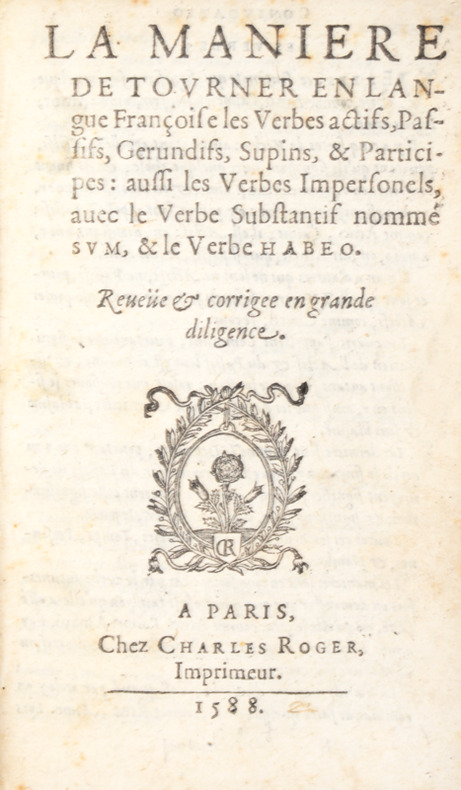
158841798Paris, Charles Roger, 1588. In-8 (10 x 15,5 cm) de 16 ff. (sign. A-B8), caractères romains et italiques, vélin souple, tranches dorées (reliure du XIXe siècle).
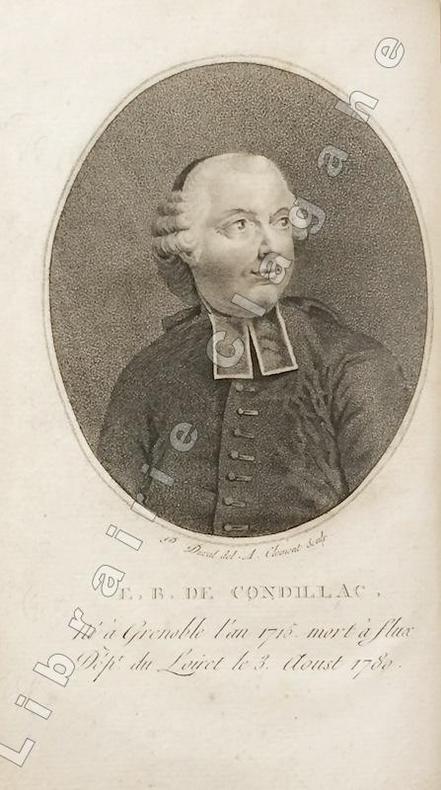
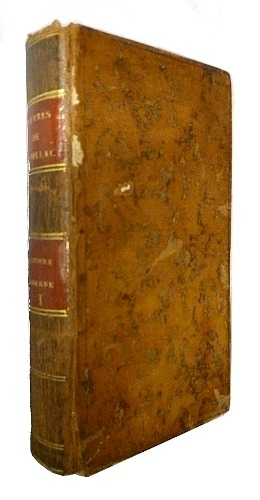
179820354Paris, imprimerie de Ch. Houel, an VI - 1798 ; 23 tomes in-8 (197 mm), veau fauve marbré, dos lisse à faux nerfs décoratifs dorés, pièce de titre marron clair, roulette sur les coupes, tranches rouges (reliure de l'époque) ; T.I : Essai sur l'origine des connaissances humaines, [4], XVI, Avertissement des Editeurs, signé Arnoux Mousnier, XII, 522 pp., [1] f. blanc, portrait ovale de Condillac gravé par A. Clément d'après P. Duval ; T.II : Traité des systèmes, [4], 406, 6 pp. ; T.III : Traité des sensations, [4], 675 pp. ; T.IV : Le commerce et le gouvernement, [4], 359 pp. (i.e. 559 pp.) ; T.V : Cours d'Etudes pour l'instruction du Prince de Parme. (1) La grammaire, [4], CL, 384, 22 pp. ; T.VI : (2) L'Art de penser, [4], 255 pp., [1 bl.], 12 pp. ; T.VII : (3) L'Art d'écrire, [4], 443, [1 bl.], 20 pp. ; T.VIII : (4) L'Art de raisonner, [4], 353, [1 bl.], 21 pp., 9 planches dépliantes ; T.IX ; X ; XI ; XII ; XIII ; XIV (5, 6, 7, 8, 9, 10) : Histoire ancienne, [4], 437, [1 bl.], 18 pp., [4], 526, 28 pp., [4], 517, [1 bl.], 24 pp., [4], 644 pp., [4], 370 pp., [4], 464 pp. ; T.XV ; XVI ; XVII ; XVIII ; XIX ; XX : Histoire Moderne, (11) [4], 604 pp., (12) [4], 410, 24 pp., (13) [4], 439 pp., (14) [4], 495 pp., (15) [4], 544 pp., (16); [4], 541, [1 bl.], 38 pp. ; T.XXI : (17) De l'étude de l'Histoire, [4], 412, 4 pp. ; T.XXII : La logique, ou les premiers développemens de l'art de penser, [4], 231 pp. ; T.XXIII : La langue des calculs, [4], 487 pp.
1766qa911Arkstée & Merkus, Bruyset frères, Changuion, Amsterdam, Dufart François, Jombert Charles-Antoine Libraire du Roi pour l'Artillerie et le Génie, Volland Relié 1766 Série complète en 20 volumes in-12 (10x17.5 cm), reliure basane marron, fenêtres de titre et auteur rouge au dos, titre et auteur dorés au dos, contient les 'cours d'étude pour l'instruction du Prince de Parme, aujourd'hui son altesse riyale l'Infant D. Ferdinand, Duc de Parme, Plaisance, Guastalle, etc. par M. l'Abbé De Condillac en 16 tomes (tome I : 'Grammaire', tome II : 'Art d'écrire', tome III : 'Art de raisonner', tome IV : 'Art de penser', tomes V à X : 'Histoire ancienne', tomes XI à XV : 'Histoire moderne', tome XVI : 'De l'étude de l'Histoire', et trois autres tomes : 'Essai sur l'origine des connaissances humaines' (deux tomes en un volume), 'Traité des animaux', 'Traité des systèmes, où l'on démèle les inconvénients et les avantages', les deux parties du 'traité des sensations à madame la comtesse de Vassé' en un volume : iv et 250 pages ; portait de l'Abbé de Condillac en frontispice du tome I ; coiffes et coins frottés (les coiffes de trois volumes sont usées de façon plus importantes), bords légèrement frottés, petits manques sur la majorité des plats, manques importants sur les plats du tome III de 'Histoire ancienne', mors usés, rousseur aux tranches, rares rousseurs à l'intérieur, bel état pour cette superbe série des oeuvres complètes de l'Abbé de Condillac. Livraison a domicile (La Poste) ou en Mondial Relay sur simple demande.
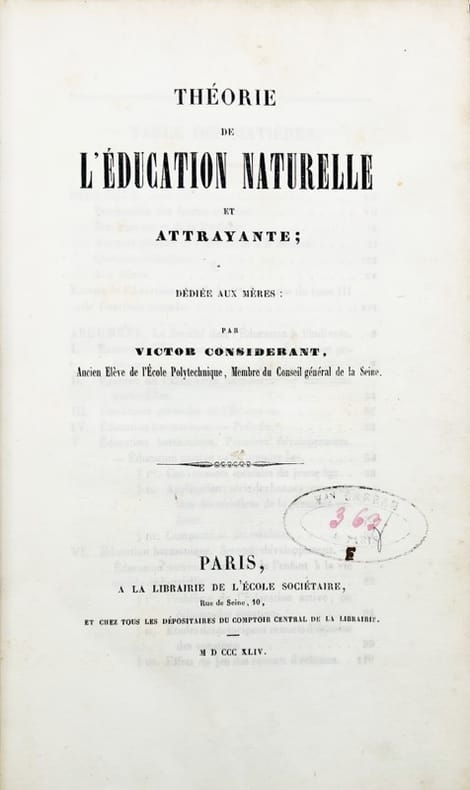
184444637Paris, Librairie de l'École sociétaire (Besançon, Imprimerie de Sainte-Agathe), 1844. In-8 de XVI-194 pp., demi-veau blond, dos lisse orné en long (reliure de l'époque signée Chabanne).
1 diplôme sur vélin préimprimé format 42 x 31,5 cm avec beau sceau de cire, signé par l'impétrant, par le directeur-fondateur de l'école Désiré Girardon, par le Président du Conseil A. Girodon, et par le secrétaire du Conseil des Fondateurs Ancel, daté de Lyon, ke 15 août 1860. Rappel du titre complet : Ecole Centrale Lyonnaise pour l'Industrie et le Commerce fondée en 1857. Diplôme de Première Classe d'Elève de l'Ecole décerné à M. Maurin Napoléon Tibulle Isidore, né le 3 juin 1839 à Naples. [ Diplôme ancien de la première promotion de l'Ecole Centrale de Lyon, attribué le 15 août 1860 ] Ce superbe diplôme est exceptionnel en ceci qu'il s'agit d'un diplôme original de la première promotion (1860) de la future "Centrale Lyon" ! Cette promotion numéro un ne comportait que 14 élèves ! C'est dire la rareté de ce beau et remarquable document, signé notamment par le directeur-fondateur Désiré Girardon. Français
177212016A Paris, De l'Imprimerie de L. Cellot, 1772. In-4 broché de 23-(1) pp., couverture muette.
180146404568À Metz, chez l’Auteur à l’hôtel de l’Intendance et chez Behmer, 1801-1802 ; 3 volumes in-12, demi-basane fauve marbrée, dos lisses ornés, pièces de t. rouges, tranches jaspées. (Relié vers 1820) 210 pp. (avec erreurs de pagination au début, les pages VI et VII numérotées 2 fois.) - 2 ff., puis pp. 211 à 381, (1 p.), 4 grandes planches dépliantes et 1 grand tableau dépliant. - 5 ff., 102 ff. (dont 1 dépliant) portant les illustrations de 407 problèmes dessinés sur damiers pour les coups de dames à la polonaise.ÉDITION ORIGINALE. Ce livre extrêmement rare, surtout complet des grandes planches et du tableau dépliant, est sans doute le manuel le plus instructif jamais composé pour expliquer le jeu de dames. L’auteur était membre de la Société des Sciences et des Arts de Metz. Dans la préface il insiste sur la valeur pédagogique du jeu des dames et sa supériorité sur d’autres jeux (cartes et dés) dans lesquels les enfants ne “peuvent que puiser le germe de l’avidité et des autres petites passions dangereuses à développer en eux”. Sous l’Ancien Régime, les dames étaient tombées en défaveur car “le bon ton aurait-il permis que des gens de qualité s’amusassent comme tout le monde ? Maintenant que nous voilà revenus vers des idées raisonnables, restituons à l’ancien jeu de dames une prééminence qu’il n’aurait jamais dû perdre...” Lallement est l’auteur de trois jeux nouveaux qu’il présente ici, “une nouveauté piquante et propre à varier les plaisirs” des joueurs. Ce sont trois nouveaux jeux de dames à cases triangulaires : égyptien, échecs et dames à 3 joueurs. Le 3e volume est un atlas de damiers montrant 407 coups de dames à la polonaise. Ces planches ont été gravées par Michaud d’après des dessins de l’auteur. L’ouvrage a paru à Metz, chez l’auteur, secrétaire de l’administration des hospices civils (note sur le titre du 3e vol.) et chez Behmer éditeur et propriétaire rue de la Paix.Gay. Bibl. jeux p. 107 - Collection Rimington - Wilson 743.La coiffe supérieure du 1er volume est abimée, épidermure sur les plats du même tome, coiffe inférieure du tome 3 élimée. Bel état intérieur.
In -4°, pp. (24), 152, (2); marca editoriale al frontespizio, testo in ebraico e latino; piena pergamena con tasselli e titolo al dorso. Testo a fronte su due colonne, in ebraico e latino. Prima edizione di queste due opere di Maimonide nella traduzione fatta dal vescovo inglese Robert Clavering: le due opere riguardano nello specifico l’educazione dei giovani e la natura e dottrina delle condanne legali. The first edition of these two Maimonides’ works, in the english translation of the Bishop Robert Clavering. M
240085Paris, imprimerie Nationale, 1791 in-4, 216 pp., 9 tableaux repliés, veau fauve, dos lisse orné aux petits fers, roulette d'encadrement sur les plats, tranches dorées, coupes guillochées, roulette intérieure (reliure de l'époque).
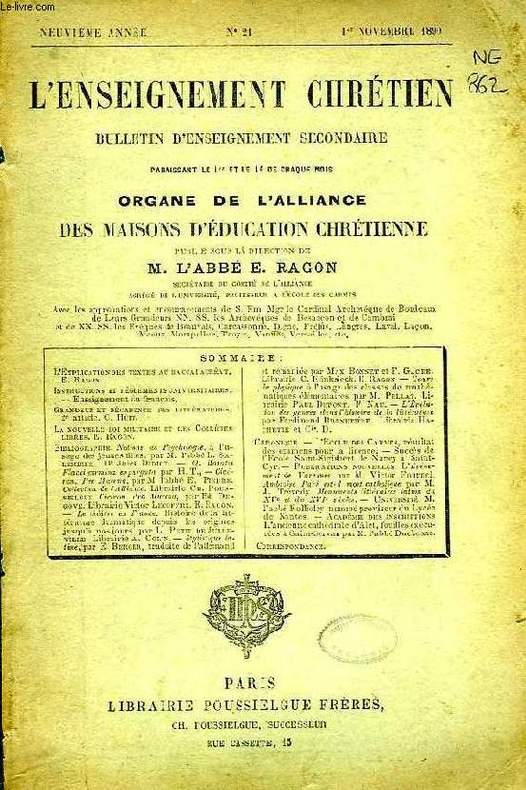
Librairie Poussielgue Frères. 1890-1961. In-8 Carré. Relié. Etat d'usage. Couv. légèrement passée. Dos satisfaisant. Intérieur acceptable. 44 volumes reliés + env. 270 fascicules brochés. Années 1938, 1940-44 fortement incomplètes (fascicules très réduits pour les années de guerre). Plusieurs numéros manquants. Etiquettes de code sur les dos. Tampons et annotations de bibliothèque sur les 1ers plats et en 1res pages. Quelques couvertures abîmées. Du n° 21, 9e année, nov. 1890, au n° 3, 75e année, déc. 1961. Avec de nombreux suppléments pour les années 1925-1932. Premières années: Organe de l'Alliance des Maisons d'Education Chrétienne, sous la dir. de l'Abbé E. Ragon. Sommaire du n° 21, nov. 1890: L'explication de textes au Baccalauréat, E. Ragon. Instructions et règlements universitaires, Enseignement du français. Grandeur et décadence des littératures, 2e article, C. Huit. La nouvelle loi militaire et les Collèges libres, E. Ragon. Bibliographie. Chronique. Correspondance. Sommaire du n° 3, déc. 1961: S.E. Mgr Blanchet, Du solide. Pierre Sage, Douceur. Louis Ruy, Le sens de la vie. Ch. guignier, Les travaux pratiques de Géographie. Education féminine, 35e Congrès de l'Union. Henri Platelle, Bulletin d'Histoire...
1961RO40189757Librairie Poussielgue Frères. 1890-1961. In-8. Relié. Etat d'usage, Couv. légèrement passée, Dos satisfaisant, Intérieur acceptable. 44 volumes reliés + env. 270 fascicules brochés. Années 1938, 1940-44 fortement incomplètes (fascicules très réduits pour les années de guerre). Plusieurs numéros manquants. Etiquettes de code sur les dos. Tampons et annotations de bibliothèque sur les 1ers plats et en 1res pages. Quelques couvertures abîmées.. . . . Classification Dewey : 370-Education
Hardcover Like New. Ships directly from publishers being a new release book . Pls. allow a minimum of 25 business days delivery time.
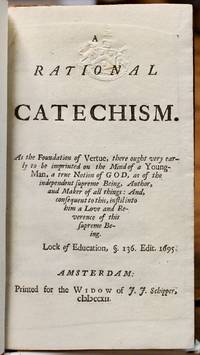
171215978<p>Amsterdam: Printed for the Widow of J.J. Schipper 1712 Second edition not so stated dedicated to the author's "dearest daughters" with a long quote from Locke's On Education on the title-page. The work is a significant distillation of the principles of toleration first published in 1687. . . Contemporary mottled calf. Gilt spine tooled in compartments yellow silk ribbon marker. . Twelvemo. Edges sprinkled red. Binding extremities slightly worn and boards a bit scratched. Front joint cracked but sound. The Macclesfield copy with the blindstamps shelf marks and the South Library bookplate. A very good copy clean copy. William Popple 1638-1708 was the nephew of Andrew Marvell and was educated under his guidance. He was a successful merchant in Hull before moving to Bordeaux where he lived from 1670 to 1688. After returning to London he met William Penn and became secretary of the Dry Club established by John Locke to debate issues of religious liberty. He also translated Locke's Letter on Toleration 1689 from the Latin. When Locke was appointed a commissioner of the Board of Trade in 1696 Popple became the board's secretary. Though this is a dialogue between a father and son the dedication to his daughters states: "I am desirous that it may be a common memorial of me unto all of you when I shall be no more I therefore make it yours also by this dedication: And for the same reason I have likewise added unto it a copy of that advice which I formerly gave him in such verse as my unpractised Muse then dictated.</p> Printed for the Widow of J.J. Schipper,
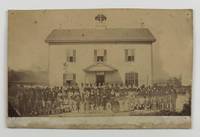
18804993N.p. but likely Live Oak FL 1880. Very good. Albumen photograph 4.5 x 7.75 inches mounted on card. Card trimmed with pinholes at corners remnants of printed caption in bottom margin slight surface soiling and spotting. Penciled annotation on verso. A stunning original photograph featuring Rev. Joseph Leroy Atwell Fish 1828-1890 and his wife and children posed amongst their African-American students at an unnamed "colored school" which was very likely the Florida Baptist Institute. The images captures Fish his wife and probably his daughters in the middle of the frame standing in front of a large two-story schoolhouse surrounded by about eighty young Black men and women in suits and dresses. Revered Fish was a graduate of Amherst College and the Newton Theological Seminary who was ordained a Baptist minister in 1856. Fish was also a teacher who helped found Florida Memorial University Florida Baptist Institute in Live Oak in 1880 where he served as first president of the institution until his death there on March 26 1890. Florida Memorial University is the only HBCU in the southern part of the state. The penciled annotation on the present photograph provides some information on the photograph but is probably ultimately misleading in one regard: "Rev. J.L.A. Fish & wife In Virginia teaching a colored school -- He married my Father & Mother Mr. & Mrs. Milan Hills Lucy M. Williams Dec. 21 1875."<br /> <br /> The latter part of this inscription is indeed true. Reverend Fish married Milan Hills and Lucy Williams on December 21 1875 in Hebron New York where he was serving as a church pastor. But the historical record does not indicate that Reverend Fish ever taught at an African-American school in Virginia if he did it was so brief that it is now lost to history. Fish's first known foray into teaching African American students was a brief six-month stint in Natchez Mississippi in 1879. Immediately thereafter Fish was appointed to the Florida Baptist Institute where he served the last decade of his life. As such it is far more likely that the inscriber here meant to say that Reverend Fish and his wife were "In FLORIDA teaching a colored school."<br /> <br /> Reverend Fish's work at the Florida Institute is covered in the Obituary Record of Graduates of Amherst College for the Academical Year ending June 27 1883: "His chief work was with the Freedmen as he brought Florida Institute out of all its troubles financial and social changed the feeling of the whites from hatred to sympathy with his work and put the school on a permanent foundation. His aim was to educate leaders for the race and the principal effort of his school was to train teachers and preachers to go out through the state and by their example to lift up and educate both intellectually and morally the colored people. His influence was felt throughout the state both through his training of teachers and preachers and through his counsels given at conventions associations and other gatherings of the colored men and in private. He is mourned by both white and black. By the whites because they knew his teachings would help the colored people without causing trouble to them. By the latter because they miss their leader teacher and friend. unknown
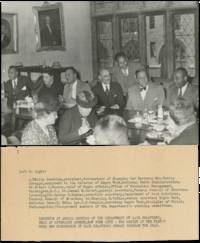
List3004United States 1964. Twenty-seven letters two typed documents totaling four pages six photographs and nine pieces of ephemera including two of Haynes’ heavily stamped passports. One of the typed documents and two of the letters belong to Olyve Jeter Haynes’ second wife. Many items affixed to loose scrapbook leaves. Near Fine. George Edmund Haynes 1800–1960 was an African American sociologist and social worker. He received a B.A. from Nashville HBCU Fiske University an M.A. from Yale and was the first African American to receive a Ph.D. from Columbia graduating in 1912. While in New York Haynes worked with the National League for the Protection of Colored Women and the Committee for Improving the Industrial Conditions of Negroes in New York and formed the Committee on Urban Conditions among Negroes with white suffragist Ruth Standish Baldwin. These three groups would merge into the National League on Urban Conditions among Negroes—shortened to the National Urban League—in 1911. He taught economics and created the sociology department at Fiske and served as director of the Division of Negro Economics under the US Secretary of Labor. He also served the Federal Council of Churches and with the Joint Committee on National Recovery which worked to ensure African Americans got their fair share of the New Deal and had a role in the formation of the State University of New York.<br /> <br /> Offered here is a collection of Haynes’ letters with several photographs and documents. The letters which are sometimes placed alongside copies of Haynes’ outgoing correspondence come from politicians and influential figures in African American higher education. Those from political figures are generally in response to Haynes sending them his thanks for their advocacy for African Americans: Herbert Hoover personally thanks him for his “fine note of friendship†in response to Haynes’ congratulations on his presidential nomination on the 1928 Republican ticket June 21 1928 Franklin D. Roosevelt’s secretary Louis Howe for his letter in appreciation of the President’s speech against lynching before the Fedral Council of Churches December 14 1933 and New York City Mayor Herbert Lehman for his letter in support of the Mayor’s mandate to desegregate CCC camps in the state April 22 1937.<br /> <br /> The letters from fellow educators are more personal and substantial. In an early letter Tuskegee president Robert Russa Moton councils Haynes on an unspecified conflict:<br /> <br /> “I can see no reason why we should not state your case before the Board. It is quite evident that Mr. Wood misunderstood you. I shall be seeing Dr. Dillard next week at which time I hope to talk over and more in detail the whole situation. . The whole thing to me is most unfortunate especially when the work in hand is so very important and there is so much need for all the forces we can summon to do the work.†July 8 1919<br /> <br /> At the time Haynes was with the Division of Negro Economics though it is not clear what misunderstanding had occurred or how it related to Tuskegee’s Board. “Dr. Dillard†is almost certainly James H. Dillard a white advocate for African American education who at the time was the director of the Negro Rural School Fund. Dillard and Haynes seem to have been personal friends as Dillard laments in a later letter that “I wonder if you and I will ever see each other again. The fates seem against it†September 24 1932.<br /> <br /> Another friend of Haynes’ Nathan B. Young writes him in 1931:<br /> <br /> “As you may have heard I am leaving the field of education in Missouri. I am casting about to find something to do. I am still young and healthy with mental powers unabated. I should like to be put into a position where I would have the leisure to ‘write up’ what I have learned by long and varied experience in the field of Negro education. . I am asking my friends to make suggestions as to the best use of the leisure immediately before me. Of course I must keep on earning in order to keep on eating for I am a poor man.†May 26 1931<br /> <br /> A newspaper clipping alongside the letter concerns Young’s unceremonious ouster from the presidency of Lincoln University an HBCU in Missouri. Young had been removed from the same post in 1927 at least in part because of his efforts to turn the school away from agricultural and industrial education and towards becoming an accredited liberal arts university.1 He returned to the post in 1929 but was fired again without a hearing in 1931; in 1933 after a few years of lecture touring Young died.<br /> <br /> Two letters from newsman Julius J. Adams concern an article that the two were writing about the founding of the National Urban League. Adams writes:<br /> <br /> “I am enclosing a copy of a memorandum supplied me by the National Urban League regarding its formation. It is of course strictly confidential but I am eager to get your version of the League’s beginning and desire to see if it coincides. . I must say that the manuscript I am working on is being held up by the printers and it is essential that I get your statement at once. I’d certainly not like to complete the work without including this particular phase of the League. What I’d probably do would be to omit or at least skirt the controversial part of the statement.†June 14 1948<br /> <br /> The attached statement which gives a brief overview of the early years and figures of the Urban League was authored by Eugene Kinckle Jones. Jones was hired as a secretary to the Committee on Urban Conditions so that Haynes could spend most of his time teaching at Fiske.2 As Jones notes in the statement “I was the first full-time employee†as Haynes “never gave full time to the organization.†It is plausible that this is the ‘controversial’ piece that Adams is worried about: Jones convinced the Committee’s board to give him a more significant role in 1916 and by 1917 became executive secretary effectively demoting Haynes who then left the League.3<br /> <br /> The photographs included in the collection date from the later era of Haynes’ career. Three are of the 1942 annual meeting of the Federal Council of Churches Department of Race Relations. The typed caption states that the subjects of the photo—besides Haynes—include labor and civil rights activist A. Philip Randolph journalist Venice Spraggs listed as “assistant to the director of Negro Work†and academic and politician Robert C. Weaver. The Race Relations commission was created in 1921 with the aim of using Christianity to aid racial relations; Haynes became secretary in 1922 and was executive secretary from 1934 to 1947. A 1948 photo shows Haynes with the Temporary Commission on the Need for a State University a New York organization that studied college admissions especially discrimination against African American and Jewish applicants. Its 1948 report which is being presented to Governor Dewey in this photograph included the recommendation to set up the SUNY system. Finally one photograph shows an event at New York City’s WLIN radio station celebrating the release of Haynes’ book Africa: Continent of the Future 1951.<br /> <br /> Later letters concern the death of Haynes’ wife Elizabeth Ross Haynes who died in 1953 with notes of condolence from figures including W.E.B. Du Bois and Adam Clayton Powell. Elizabeth Haynes a fellow social worker sociologist and Fiske graduate was a distinguished figure in her own right. One letter from “Sara†in Bronxville remembers her in some detail:<br /> <br /> “Elizabeth spent two afternoons here while in the process of revising ‘Black Boy’ and I spent a day at your house afterward. We had a child-like and easy way of picking up close communication after long intervals of separation. We never talked about Big Issues and all that — but family matters projects in hand personal expression in the arts memories; we always exchanged some disrespectful jokes about women’s organizations — both of us had felt their sticks for a long time — . I told her the first time they met I meant to get out of teaching colored students before I got helped out by the onrush of young colored teachers. She said that she was quite a lot afraid of giving up her professional work which she had under reasonable control for marriage when she felt no domestic skills and did not even want them much.†November 24 1953<br /> <br /> “Black Boy†is Elizabeth Haynes’ The Black Boy of Atlanta 1952 a biography of African American educator civil rights activist and entrepreneur Richard R. Wright.<br /> <br /> After Elizabeth Haynes’ death George Haynes married Olyve L. Jeter. Two letters are addressed to her one from NUL secretary James H. Hubert worrying about “all the lynchings and what-not†in Harlem and considering carrying a weapon June 2 1937 and one thanking her for her work with the Citizens for Eisenhower-Nixon though misspelling her name as “Alyne†November 7 1952. Also included is a review authored by Jeter of Charles A. Battle’s pamphlet “Negroes on the Island of Rhode Island†which seems to have been sent out for publication. The note to the editor states that Jeter was a staff member in the Federal Council of Churches’ Commission on Race Relations.<br /> <br /> Haynes’ career significantly impacted both Black academic sociology and employment housing and educational conditions for African Americans. Of interest to scholars of Haynes and of African American education in the early and mid century.<br /> <br /> 1 Antonio Fredrick Holland Nathan B. Young and the struggle over Black higher education Missouri University Press 2006.<br /> 2 Nancy J. Weiss The National Urban League 1910–1940 Oxford University Press 1974.<br /> 3 Edgar Allan Toppin “Haynes George Edmund†American National Biography March 27 2025 https://doi.org/10.1093/anb/9780198606697.article.1400270. unknown