12 557 résultats
19372092902141600518Arikosha 1937. Soft Cover. Fine. Volume: 1 Arikosha paperback
45179Paris.Blaise.1818.10 vols. in-8 reliés.Edition la plus complète avec des lettres inconnues.Portraits d'après Petitot,Larguilière,Mignard.Notice bibliographique des éditions connues et éditions originales. Belle édition.Qques rousseurs.Tranches marbrées.Dos à 5 nerfs avec pièces de titre et de tomaison en maroquin vert.Veau glacé blond avec ornements estampés à froid.
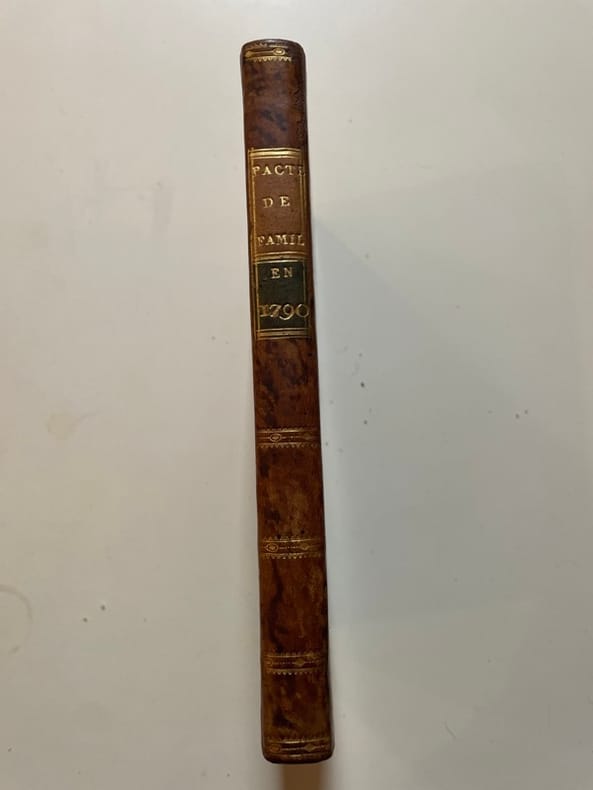
2366641790 in-8, veau fauve, dos lisse orné, tranches rouges (reliure de l'époque).
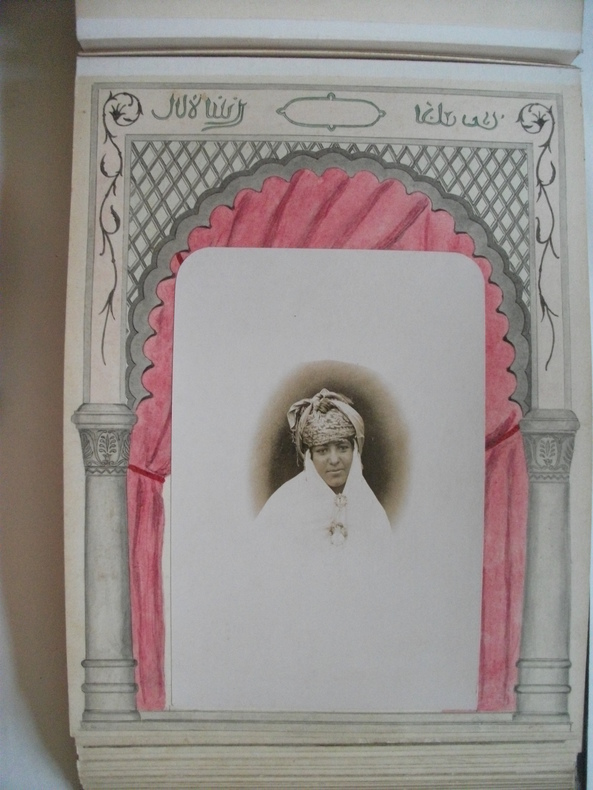
9868Album photos in 8 à l’italienne, pleine toile noire muette. Titre dessiné et peint, avec encadrement peint en grisaille. Suite de 48 photographies originales, contrecollées sur carton fort, montés sur onglets toilés. 14 grandes photos et 34 plus petites, l’ensemble avec encadrements dessinés et peints, tous différents. Très bon état. Probablement fin XIXème.
97564aaf1316-1920, dans une boîte en fer blanc avec clef (41 x 22 x 15 cm).
1772In the Savoy London: Printed by Tho. Newcomb for James Collins in the Temple-passage from Essex-street; and sold at the Kings-head and the Angel in VVestminster-Hall 1679. Hardcover. Good. Octavo. ii 116pp. A2 B4-P4 Q2. Nineteenth-century red morocco with the arms of a Barlow family on the upper cover. ESTC R236210; Wing B840. With remarks by some members of the same Barlow family regarding the author. The arms on the covers belong to this family. They do not however find any kinship with the author. <br/> <br/> In the Savoy [London]: Printed by Tho. Newcomb, for James Collins in the Temple-passage from Essex-street; and sold at the Kings hardcover
314-Eo.J. Aquarell, Feder und Pinsel in Braun über Bleistift, weiß gehöht, mit Bleistiftlinie umrandet, auf blauem Papier. 26,4:18,3 cm. Provenienz: Nachlassstempel V.P. Mohn (Lugt. Suppl. 1817a). Das Blatt zeigt eine für Mohns sonstige zeichnerische Strenge ungewöhnlich malerische Auffassung.
19000001895BELLVIEW BELLEVUE TENNESSEE. Good. 1900. On offer is an original unique circa 1900 -1908 archive of a young college aged woman Frances Harding from Bellview Bellevue Tennessee. She attended Soule College and the Memphis Conference Female Institute. The archive includes letters 23 from her family and friends and some notes 9 from college friends and school mates. Some seem to be from young men who are trying to court her; others are from her friends telling Frances not to flirt! Here is a good example "Yield not to flirtation For flirting is serious each sister will help you her brother to fight advances Don't flirt with the boys girls let the boys girls flirt with you!" Also included: 4 receipts relating to college; a Soule College Recital program; five photos four mounted on cardboard one of Miss Smiths class; and one Wedding invitation. BACKGROUND NOTES: Soule College was named for Bishop Joshua Soule of the Methodist Episcopal Church. The Rev. Thomas Madden pastor of the Murfreesboro Methodist Church organized it in 1851 and offered one to two years of college education. "The goals of the college were to provide a thorough education of the mind and heart and to impart sound and useful knowledge. Throughout the history of the school the pupils were supervised closely in all matters of a moral and religious nature." Soule College after its building was damaged closed during the Civil War but reopened soon afterwards remaining in Methodist control until 1892. Lambuth University was a liberal arts university located in Jackson Tennessee and active from 1843 to 2011. It was supported by the Memphis Annual Conference of the United Methodist Church. Lambuth's athletic teams participated in the NAIA's TranSouth and Mid-South Conferences. The university began as the Memphis Conference Female Institute in 1843 and was later renamed in honor of Walter Russell Lambuth 1854-1921 a Methodist missionary who traveled globally during his lifetime.; Manuscript; 12mo - over 6¾" - 7¾" tall; KEYWORDS: HISTORY OF FRANCES HARDING BELLVIEW BELLEVUE TENNESSEE SOULE COLLEGE MEMPHIS CONFERENCE FEMALE INSTITUTE PRE SUFFRAGE WOMEN'S STUDIES SOCIAL HISTORY GENDER STUDIES EARLY 20TH CENTURY HANDWRITTEN MANUSCRIPT AUTOGRAPHED AUTHORS AMERICANA MANUSCRIPT DOCUMENT LETTER AUTOGRAPH KEEPSAKE WRITER HAND WRITTEN DOCUMENTS SIGNED LETTERS MANUSCRIPTS HISTORICAL HOLOGRAPH WRITERS AUTOGRAPHS PERSONAL MEMOIR MEMORIAL PERSONAL HISTORY ARCHIVE DIARY DIARIES antiquité contrat vélin document manuscrit papier Antike Brief Pergament Dokument Manuskript Papier oggetto d'antiquariato atto velina documento manoscritto carta antigüedad hecho vitela documento manuscrito Papel . unknown
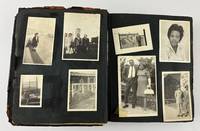
3431Various locations 1970. Good plus. 48 leaves illustrated with 260 mounted photographs most black-and-white but some in color between 1.5 x 1.5 to 8 x 10 inches and a few ephemeral items. Full brown pebbled leather photograph album screw-bound. Moderate edge wear and some chipping front joint split but holding. First leaf detached moderate wear throughout. An absorbing collection of vernacular photographs documenting multiple generations of the Piper family an African-American family from New York City. This family album captures Piper family members from babies to grandparents over the course of about forty years. Numerous images show family and friends with the men posed in fine suits and fedoras and the women in dresses and gloves. Several pictures feature African American men in military uniforms both Army and Navy including an image of a World War II soldier signed "Sincerely Kenny 1942." There are also numerous shots of the family hamming it up for the camera in various houses while in sitting rooms or at the dinner table. A couple of the larger photographs feature family groupings including a bride groom and four family members at a wedding in the 1960s or '70s. A handful of shots capture the Pipers while traveling showing them posed in remote locations outside their car or near train stations. One identifiable location they visited is the St. Joseph statue in front of the Oratory of Mount Royal in Montreal. And dozens of photographs feature subjects posed on the streets of New York.<br /> <br /> Laid into the album is a "Memorandum of Charges" for the funeral expenses of George Piper; the only ephemeral item pasted into the album is a humble typed card reading "In God's Care George R. Piper 1897-1973." This card is the last item pasted into the album. Also laid into the album is a single letter from Joseph Piper of Hollywood to James Piper of New York City dated May 15 1973 which also includes a few photographic negatives. This letter also relates to the death of George Piper. <br /> <br /> Though uncaptioned the present collection of photographs provides a deep look into an African American family from New York City encompassing the middle few decades of the 20th century. unknown
11782A Clermont, de l'imprimerie de Nicolas Jacquard, 1670, 1677, 1 pleine basane d'époque, dos à nerfs, orné, tranches jaspées, plats frottés, coins et coupes émoussées, petit manque de cuir sur 1 plat. 2 volumes in-folio de 1 ff. blanc, f.t., titre ,belle gravure en frontispice par François Picart, 10 ff.n.c., 1 tableau généalogique déliant en double pages, 2 ff.n.c., 600 pp., 8 ff.n.c., et 1 ff. blanc, f.t., titre, beau frontispice par Chatanier, 2 ff.n.c., 1 grand tableau généalogique dépliant, 2 ff.n.c., 584 pp., 4 ff.n.c., bandeaux, belles lettrines, ex-libris manuscrit des Capucins du couvent de Riez ;
1867000793IPSWICH MASSACHUSETTS MA. Good. 1867. On offer are five handwritten manuscript journals all having belonged to the Caldwell family who lived in Massachusetts one of the diaries 1870 has the name Ezra S. Vieyes written in it. A casual reading does not determine where Ezra fits in with the Caldwell family but a more detailed reading will hopefully flesh out the relationship. Two of the diaries have the name of the family scion being Abraham Caldwell of Ipswich Massachusetts. Other towns mentioned include Westminster Fitchburg Northborough and Worcester. The diaries represent the years 1867 full of entries 1870 a quarter full 1875 a half filled 1887 fully written and the 1890's. Though not all fully written and the entries suggest illiterate writers these diaries represent a true piece of Americana with a treasure trove of local historical detail and genealogical information. For the medical collector there is an interesting thread running throughout - Mr. Caldwell is quite aged and he catalogues his daily ailments certainly a medical professional may assess his health from his writings. Here are some snippets: 1867 - "February 26th Went to examination. Lizzie Rawson teach good." "March 4th Went to town meeting. Another trial of Shemp decided as it should be." "May 10th Surveyed road to town distance of about 2 ¾ miles 15 ft." "June 17th Golden wedding 75-100 people persons present." "September 13th Took Templers Degrees. Went to town to lecture. Carried B.M. Balch." "October 13th On euqaduct to town meeting for roads. Was chosen on committee." 1887 "January 9th 7 Below. Very cold. Snow flakes flying all day. Ben out very little today. Louitah Lord little more comfortable but very sick." "February 9th Sick all day. From Salem paper I see Mr. Joseph Pusfer died in Salem Oct. 19th 1886. Born July 18th 1798." "March 14th Today I hav made a grait mistak in being two positive when in fact I was rong. My mind is faking me." "June 22nd and 23rd Stage coach below belonged to Appleton farm . Boiled out sink cess pool very hard job. Had nummness in my arm and shoulder. Stage coach passed to day for Salem." "July 25th Hot and sultry. A young lady came to Mrs. Batysons. Sang for House Benefit." "August 9th Went marsh with North Harris and Negro. Went to Beverly. Stayed at Edwards over night." "August 21st Fine and pleasant. John Billy's mother and sister here. Conrad G to made round Cape Ann." "October 6th Tryed to make some wine. Caried my grapes to Capt. Wilcomb and he pressed them for me." "October 19th Finished pounding the beans then went to Georgetown. Went in to Noisas Shoe factory. Was kindly received and shown from basement up. Felt interest and enjoyed it muh." "December 14th Very warm and Pleasant. Went over to south side river to Mrs. Dolls with Edy B. Escamined his stock." "December 16th Cooler. Gave notice to Mrs. Campbell that I should want the tenement she now ocupies for my own use the first of April next." "December 19th Mrs. Smith at the Invenational House left and fell and broke both arms. Slippery this morn. Bought turkey of Perkins." The 1893-1900 journal in the lot is a handwritten financial journal which has about 100 pages of expense type entries. I believe most of the entries have to do with rentals and money collected for the rentals. This journal has the name John Caldwell written on the inside. The front cover has fallen off of this journal and some of the pages are torn. The first 20 pages have also been torn out and are not accounted for. Overall G.; Manuscript; 24mo - over 5" - 5¾" tall; HANDWRITTEN MANUSCRIPT DOCUMENT LETTER AUTOGRAPH DIARY JOURNAL LOG KEEPSAKE WRITER HAND WRITTEN DOCUMENTS SIGNED LETTERS MANUSCRIPTS HISTORICAL HOLOGRAPH WRITERS DIARIES JOURNALS LOGS AUTOGRAPHS PERSONAL MEMOIR MEMORIAL PERSONAL HISTORY AMERICANA antiquité contrat vélin document manuscrit papier Antike Brief Pergament Dokument Manuskript Papier oggetto d'antiquariato atto velina documento manoscritto carta antigüedad hecho vitela documento manuscrito Papel HISTORY MASSACHUSETTS MA FARMING ECONOMICS GENEALOGICAL . unknown
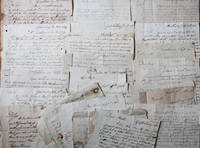
30944<p>Collection of 29 manuscript letters totaling 39 pages address panels mostly folio and quarto dating 1783-1791 to George Hale b. 1759 d. 1803 of Glastonbury Connecticut from various correspondents including Yale classmates writing to him at Glastonbury and for awhile Providence RI. Correspondents include: Jabez Peck Isaac Welles Roswell Welles "John Hiwill" Ashbell Welles his older brother Elisha Hale Nabby Kimball Zebediah Tracy Abner Moseley Nathaniel Tallcott Jr. and Elijah Killack. Together with: 7 chit receipts contemporary with these letters and later; a very worn BOSTON EVENING-POST Numb. 1567 Sept. 23 1765; and three other family items. Condition: clean but worn and torn with occasional textual loss consequent to original opening of wax seals.</p><p> George Hale was descended from Samuel Hale who landed at Watertown west of Boston in 1634 who settled in Wethersfield Connecticut in 1635 until in 1690 Glastonbury was set off as a separate parish. George's father Captain Jonathan Hale born 1718 died March 7 1776 at Jamaica Plain near Boston fought in the Revolution with the American forces. He married Elizabeth daughter of Hon. Thomas Welles and Martha Pitkin. The coupled had fourteen children of which George born July 24 159 was the ninth. He attended Yale and worked as a merchant in Providence employed in the store of Messrs. Brown & Benson. </p><p> The letters concern business domestic and social affairs and courtship.</p><p> "Glastenbury May 30th 1784</p><p> Dear Brother</p><p> I have not heard a syllable from you since you went from home except by Mr. Robbins which says you have got Quarters in Commons I am very glad… I hope you will pay a strickt attention to your Business & not spend your time in Pleasure or a Great deal of Company except so much as will be advantageous to your Business you will remember Providence is a very loose place that ill habits are very catching unless a person keeps a strickt watch over themselves.</p><p> I understood after you went from home that you had absented yourself from the Red House which I'm not a little surpriz'd at & that a great Independency appear'd in your Behaviour – a great contrast indeed in the space of six weeks … I'm very sorry to hear of it – I assure you you had no business to frequent that House so much as you have without the approbabtion of her parents but especially in absenting yourself in such a manner it is a very ungentleman like action I think it is what I never did I hope never to see it in my Brother… I don't mean to control but I think it my Indispensible dutry to advise to Gentlemanlike Behaviour. </p><p> The Sloop sails on the last day of April with 15 oxen & 20 Horses for Cargo I gave her verbal order to lay off & on Antigua & go with the Boat shore see wether a could trade or wither the English ports were open if they was to lay their course to Granada unless they was offer'd a great price there if they could not trade in the English port by all means to procure some casks of English rum att all adventure we shall look for her in about four weeks… you will write me the price current of West India goods in your first… Elisha Hale" </p><p> "Windam March 13 1785</p><p> Dear Sir</p><p> Agreeable to your request I return an answer to your letter which I received a few days since was very happy to receive an Epistle from a Gentleman of your abilities as you wrote you stiled it great happiness to add to the number of your sisters gives me reason to think you prize them as you ought. I am sure there is no greater happiness than a harmony with our friends & Acquaintance. I think your sentiments upon my friend are very just & I dare presume if you should enlarge acquaintance with her you will never regret it as she is a Lady that possesses a generous disposition you would esteem her a person of worth as to giving advice upon Love subjects I am sensible I am not capable in the Least yet I hope you will be so much master of yourself as to retain your Senses. Nancy has concluded to write you since you stile yourself a friend… Nabby Kimball" </p>
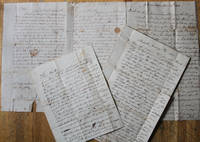
31256<p>five letters quarto and folio 11 manuscript pages some wear and staining few holes at fold intersections otherwise in very good clean and legible condition.</p><p>These letters chronicle the Forster family's movements from frontier settlements in Pennsylvania to those further west in Illinois and Indiana and as far south as Natchez Mississippi Territory seeking better economic conditions. Stephen Forster emigrates to the river town of Kaskaskia in Illinois in 1806 where he is engaged in trade and as a wheelwright. By 1810 he is Natchez Mississippi and Louisiana and is working as builder and wheelwright with a number of employees including African American slaves. He constructs buildings cotton gins sugar mills and other machinery.</p><p>Sample Quotes:</p><p>Kaskaskia September 28 1806 Stepehen Forster to his brother Chambers Forster Pittsburg Pennsylvania</p><p>"Dear Brother</p><p>I recivd your letter dated the 12 of August I am glad to hear you are well but the Remarks of Mr Foulkes Leter is not just to say that all new Countrys are disadvantages as a man Has never been out of the State of Pennsyl never seen a country that is fit for a Planter to live in they are Eternally a Slave to themselves and Stock hear we have men that has upwards of a hundred horses that never tastes corn nor hay unless the are using them however it is not worth saying much on that subject as you have your mind seteld on Sinsinnata Thomas will meet you at Cincinnati But as for my part I have no desire to Come as I can make Eighty dolrs a month hear in trade and some mony as I am nearly first hear now and it wont answer for us to lose all our trouble and Expence hear and More than that I expect to Mary Shortly to a French girl that don't Speake a word of English Shee is not welthy She is Reasonably handsom Her Caructor is preferable to any in The place very industrious and most agreable company Palizah Fortune When you wrote to me that you was going to get married you did not even write me her name –</p><p>The Receipt you set me for painting is of no account I want you to Send me eight or ten dozin of wheel irons and I will convey the mony to you as soon as possible I would not trouble you with the task But they are Not to be got hear with out more trouble than they are worth I have to pay half a dollar a set for Forging them If James Foulke gets well I want him to come to this country I have made a discovery of a silver mine and many lead mines may be found there is a cowhokia Indian to go this fall and show me one that is close to the top of the Ground if he don't come try and het him to larn you how to extrat silver from lead write what time you will be at Cincinnati … Stephen Forster"</p><p>Nippenose Bottom Septr 26th 1806 Alexander Stewart to his cousin Chambers Forster Pittsburgh</p><p>"Dear Cousin</p><p>I have returned home Like many other Prodigals And I am but poor but I think I have learned at Meadville School a Nuff to make us take care of our Money here after during Our life time. Brother Charles and My Self is farming my fathers upper Place and have Raised a very fine Crops this Summer I left Meadville Very Poor and Continue so but I still live in hope of Being Better. Charles was married last winter to Miss Lilly Crane the Daughter of George Crane Esquire. Sister Kitty was married last winter a year to John Knox and is a dowing well the Rest of the family continues in the same way they were when you left them. The Rest of the family are doing well Joseph Foulke is a Justice of the Piece & Clerk to Commiss. Of Lycoming County & making money his sister Polly lives with him William Foulke has been a Surveying out in the Jersies this four or five Years and has made money. The times were hard when I left Meadville last Spring it will take all the Property I have to bring me and my Bail out Clear the Sued me and Wraked out all the Vengeance that Ware in ther Power against we me when I was coming out of Office Whilst in Office I thought my Lot hard but Knew but little about it at that time I have been informed by Mr. Saml Torbett of Meadville who Arrived here a few days a gow that you are married to Miss Gouday a Daughter of James Gouday. … let me heare Whether you intend Gowing down the Ohio or Continue in Pittsburgh You my Dear friend I have always thought If you couldGet a good chance would do Something … I have Confined myself to privit Conserns of a Farm and have more Pleasure looking at my horses cows hoggs & Poultry feeding a Round me Then I had when I was the Publicks Servant the Sheriff of Crawford County & from all that I can learn my Successor James Quigley will have as much trouble as I had in coming out of his Office to this I add no more but I subscribe my self your zealous friend … Alexr Stewart"</p><p>"Natchez Mississpi Terr. Nov 14 1810 Stephen Forster to his brothers Chambers and Thomas Lawrenceburgh Indiana</p><p>Dear Brothers</p><p>I write wonst more to let you know that I am alive I have wrote Respectively to you but never received an answer I have heard by chance by some boat man that you wear well and still lived in lawrenceburgh and particularly by Barnet Moore who informed me that you wear doing good business which I was very happy to hear as to Thomas I could get no information of by any. Mrs. Priestley also wrote to you and wisht to know whether her brother James was with you and whether he would not come hear if you pleas can let me know I did expect to start by the first of March to old Mexico for which place iad all my letters and pas from the Spanish consol at orlians but since this late disturbance it is unsafe to go my business hear is very extensive I have the greatest carecter in macinisim of any man on this cost I have bisness steady sufficient to employ from twenty to thirty hands but it is impossible to get sober men hear and the French people wont imploy Men of disapated caracters by which means I cant make so much as I should if the would suffer them in their familys and the furnish me with black workmen I have now on hand three large dwellings two Cotton gins and one Sugar mill and after I finish them I intend to build a saw mill for myself and when I get that completed if god spares me life and health I will come and see you the business of making wheels hear is very good I could have steady imployment for two or three hands at eight dollars a peace winsor chairs is not so good I expect to make two thousand dollars this year if I keep my health and I hope this will find you all in good health and prosperity I have no news but one thing that you will be surprsid to hear that is I have left of all kinds of debautcherys I have it in my power now to mary to great advantage I have several French ladys at my command.</p><p>I have acquired the French language … Stephen Forster</p><p>Direct your letter to the care of James godberry County of Acadia twenty leagues above orlians … Parish of St James"</p><p>Meadville January the 6 1817 Chambers Forster to his wife Mary Forster Lawrenceburgh Indiana</p><p>"Dear wife I expect that you will think Long to hear from me and I hope and trust in god that these few lines will find you and the children in a better state of health than you was when I left you I have had a very disagreeable journey so far I roade before I got to Pitt one hundred miles out of my roade to see one man that had taken a list of your fathers Property and when I got thare he was dead which cept me five days Longer than I would have been gitting to Pittsburgh and when I got thare I had but one half dollar and nither Shroads nor either of the boys was at home and I could not git one cent in the place and there I was obliged to stay one hole weeak and at last met with one of my old friends from this place and I got as much from him as bore my expenses hear and I have got money hear to go on with from hear and tomorrow morning I start to harrisburgh I will right to you again I have thought the time very Long since I left home but I shall push on as fast as possible from hear until I git to my journeys end and then from that home. John and Catherine Mead sends there love and compliments to you. … Chambers Forster"</p>
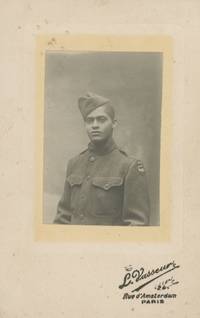
1910List1805Pennsylvania and France 1910. Five Cabinet Card Photographs and one Mounted Photograph taken at the L. Vasseur Studio in Paris. Generally fine condition one cabinet card with chips to mount. Near Fine. A small but very compelling group of images recovered from a family collection documenting an African-American family from Pennsylvania. Five of the images bear no identification one states on verso: “Mrs. Harriet Oskins / died at the age / of 112.†Most of the photographs are taken at various Pennsylvania locations including Philadelphia Allentown New Lebanon and Lehighton. We find record of an A.H. and McCleary Oskins and family listed as African-American in the Philadelphia census records from 1910. <br /> <br /> Of particular note is a photograph of an African- American serviceman and presumed family member taken at a Paris studio. It’s a particularly striking image and the first formal portrait of an African-American taken in a French studio during WWI that we have encountered. <br /> <br /> Overall a visually compelling and important group with the Paris photo of particular rarity worthy of preservation as a family collection despite the limited information on the specific subjects. unknown
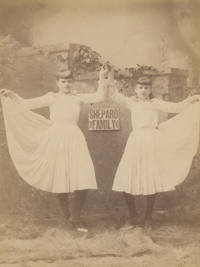
1890List1620Mostly New England: Various Photographers 1890. Cabinet cards measuring 6 ½ x 4 ¼ inches. Various settings showing the band members posed with their instruments including banjos violins trumpets drum and tubas. Varying wear but generally very good with some normal age-related fading. Very Good. Originally from Lawrenceville New York the Shepard Family Band toured throughout the Northeast in the 1880s and 1890s eventually settling in South Royalton Vermont. All members of the family were apparently musically inclined: “In addition to Minnie mother and matriarch Mary “Minnie†Shepard and her husband patriarch James Monroe Shepard all of the children were pressed into service. Daughter Laura Belle the ‘violiniste’ was getting better all the time under the instruction of a ‘competent master.’ Her fans “will be astonished at the improvement in style tone and expression.†It was said of little Lessie that ‘Among lady cornetists she has no equal.’ The darling little son of the family Master Burtie could not help but please for he was well-known to be ‘The youngest Tuba soloist in the world; only nine years of age; scarcely larger than the instrument he plays.’ He was also a ‘clever comedian singer and character artist.†The baby little Flossie “a sweet little miss of four summers’ was said to be a “wonderful mimic and impersonator…a veritable little fairy.’ Daughters Kittie and Georgia were also part of the troupe.†- Henry Sheldon Museum. A very nice collection. Various Photographers unknown
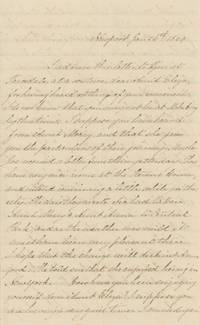
1871List3241Rhode Island Massachusetts and New York 1871. Thirty-two letters two apparently missing final pages; with fifteen pages of incomplete letter material. Excellent to Near Fine. Letters from some of the young ladies of the Hazard family primarily Gertrude Minturn 1843–1877 Anna Peace 1845–1868 and Esther Robinson 1848–d. Hazard with some from other family and friends. The family was descended from Thomas Hazard one of the founding settlers of Newport Rhode Island.1<br /> <br /> The girls were educated and often write from school; Anna and Esther attend the ‘Friends School’ in Providence which is probably the Moses Brown School and Gertrude attends Dr. Dio Lewis’s School for Young Ladies in Lexington Massachusetts. Founded by Diocletian Lewis a temperance and physical culture advocate the school incorporated his exercise system developed to condition weaker individuals. Gertrude describes a regimen of thirty minutes of walking plus an hour and a half of exercise and discusses Dr. Lewis:<br /> <br /> “Dr Lewis gives familiar lectures on any subject which the scholars propose. He is a very pleasant genial man and takes part in the games & dancing with the greatest spirit. There are about 20 scholars. Some of them board in the village but are subject to the rules of the school. This building is very large and is mostly occupied by the patients of Dr Lewis’ ‘Movement Cures’ to whom most of his time is devoted. The scholars and patients associate together. Indeed we are under very little constraint the teachers leaving our actions to be regulated by our own sense of propriety; and they seldom find occasion to reprove the scholars for misdemeanors.†November 23 1864<br /> <br /> Meanwhile Anna and Esther’s education is more on the religious side; Esther writes:<br /> <br /> “We have not been to meeting very often since we returned from our lovely visit to Newport but the first Sunday morning I did think all the time of it as I said I was going to. We were edified this morning by a sermon from Elizabeth Meader or rather a torrent of noise so that I am nearly deafened now. I don’t think I ever heard a more horrible combination of sounds from the mouth of any human being.†January 8 1865<br /> <br /> Though speaking in tongues is most strongly associated with Pentecostalism it is not unheard of in Quakerism. In his book of genealogy and reflections the girls’ father Thomas Hazard 1797–1886 connects the family’s “strong religious tendencies†to his own interest in spiritualism.2 This interest in mediumship comes up several times in the letters first in 1864 when one of the girls reports that “Pa writes us that at a circle which he attended a few days ago a clairvoyant medium described our house at Vaucluse perfectly†February 24 1864 and later when one of the girls attends a circle with their father in Philadelphia:<br /> <br /> “Yesterday morning Pa & I had a sitting with a Mrs. Robinson a trance speaking medium. The communication from mother was the most beautiful I ever heard. She spoke to us just as she used to on earth using the same expressions. It seemed as if I could almost see her – we are going again on Monday.†February 8 1867<br /> <br /> That is the pair spoke to Frances Minturn Hazard who had died in 1854.<br /> <br /> Of interest to researchers of the Hazard family and Rhode Island Quakers.<br /> <br /> 1 Caroline Elizabeth Robinson The Hazard Family of Rhode Island 1635–1894 Printed for the Author 1896.<br /> 2 Thomas R. Hazard Recollections of Olden Times Sanborn 1879 228. unknown
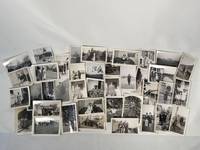
1940178121940. Photographic archive of fifty-six vernacular images dating circa 1940-1945 documents African American family life during World War II including military service higher education interstate travel and middle-class domestic stability. Taken by and of members of a single family the photographs situate Black civilian and military experience within the broader wartime transformation of American society. One subject appears in U.S. Navy uniform at a moment when more than 160000 African Americans served in the Navy during the war and the first Black officers were commissioned in March 1944 marking a transitional period in the desegregation of military leadership. Additional images record travel to Washington DC including views of the Washington Monument as well as residential streets automobiles and formal portraiture collectively presenting visual evidence of mobility aspiration and civic presence during the era of segregation.<br /> <br /> Archive consists of fifty rectangular silver gelatin prints measuring approximately 4½ x 2¾ inches and six square-format prints measuring approximately 3½ x 3½ inches. Many versos bear "Velox" brand imprint and photograph numbers. Scenes include family members posed in domestic interiors and outside homes; a man in Navy uniform also pictured beside a convertible automobile in formal attire; a young woman in cap and gown holding a diploma; snowy residential streets likely in the eastern United States; a Texas automobile license plate; and Washington DC landmarks including the Washington Monument. One verso inscription reads: "Gladys and Birdie and I spent a weekend in Baltimore Md. We spent a weekend with Gladis and her father. 1943" providing specific geographic and temporal context within the wartime period.<br /> <br /> Created during a decade defined by global conflict and domestic racial inequality the photographs record Black participation in wartime service education leisure travel and automobile culture. The presence of a Navy uniform reflects the expanding but still segregated role of African Americans in the armed forces prior to the 1948 desegregation order while images of higher education and intercity travel document social mobility within constrained legal and housing systems. Minor edge chipping and light age toning visible on some prints; images remain clear with strong contrast. Overall very good condition. Cohesive vernacular record of African American family life military engagement and mobility during the World War II home front. unknown
193864886Maine 1938. Photograph album 7 3/8 x 11 1/2 inches 44 of 48 leaves employed both sides used for either mounting photographs or describing them or both with short narratives about trips occasionally interspersed; affixed to two leaves are reproduced copies of a 1937 manuscript map executed by Erastus Haring picturing the lake hand-colored blue and identifying physical features and property owners all along its shores. The Erastus Haring family of Suffern New York vacationed at the same time at the same cabin on Sebec Lake about 40 miles northwest of Bangor for twelve summers recording their fishing adventures and other outdoor activities e.g. sailing waterboarding in the album. The majority of the photographs depict the Haring family especially sons Warren and Horace boating and catching salmon trout and bass with many "action" images and more of "stringed" fish; also captured are occasional fishing hiking or sight seeing trips to nearby spots in Maine e.g. Moosehead Lake Rangeley Lake Bar Harbor Mount Katadhin. A number of the photos focus on community life around the lake with outdoor meals neighbors in front of houses fish preparation for meals etc. The detailed captions add a great deal of context to the album; in addition to exhaustive identification of people places and dates there are manuscript full-page poems at least one attributed to Mr. Haring with content related to fishing pithy quotations related to the sport "the fellow who keeps his hook in the water catches the fish" and descriptions of the day's fishing events "with Richard it may be a long time before he catches another as large as this one". Two photographs missing two laid in loose an excellent family pictorial record of summer excursions for land-locked salmon and other species mostly on Sebec Lake northwest of Bangor. Brown faux-crocodile leather binding gilt stamped "Photographs" on upper cover tied. 11157. <br/><br/> hardcover books
17933003Cape Cod MA 1793. Folio paper stock ca. 300 x 200 mm. 24 pp. on laid paper MS entries covering every page. In contemporary "home-made" rough canvas wrappers worn some damage with loss of text and inherent soiling to text. At least 8 ff. have been excised at the end and elsewhere. Fair condition but an extraordinary survival. Preserved in a mylar L-sleeve backed with lig-free board. This crude manuscript graphically exhibits the extraordinary lengths to which colonial American students had to go in order to teach themselves. Provincial home-made textbooks such as this one almost never survive; we are unable to explain how -- or why -- this relic survived at all especially considering its lamentable condition. The manuscript was certainly owned by the Higgins family of Cape Cod who had descended from the Mayflower and who fought during the Revolutionary War see below. <br/><br/>The present ciphering book solves often complex math and word problems generally in the service of commerce. Currency is almost exclusively in British coinage but there is one reference to the conversion of British pounds into DOLLARS fol. 7v. The present manuscript bears the date "April the 17th year 1793" in a later hand! on the final page: thus the MS features a very early reference to U.S. dollars by an American student NB: on April 2 1792 the U.S. Congress created the United States dollar as the standard unit of currency. <br/><br/>Lessons herein include the Numeration Table; Addition of Money; Addition of Troy Weight; Addition of Dry Measure; Subtraction; Multiplication Table; the Golden Rule or Rule of Three and more. <br/><br/>PROVENANCE: Higgins family of Eastham / Granville / Orleans MA. Several hands have contributed to the creation of the MS. On the verso of the penultimate leaf are written the first names of several members of the Higgins family including Solomon Anna Elisa etc. These names were written below an exercise concerning the application of the Golden Rule to calculate the division of a bequest in this instance the Higgins family itself. On the recto of the final leaf is the repeated inscription of a member of the Higgins family who has resisted identification. The text on the verso of the final leaf is dated 1793 but this was clearly written by a later hand. On this page are written the names of several debtors to an unidentified individual including "Timothy Doane of Eastman" and "Solomon Higgins of Granville." More provenance research on this MS will no doubt prove rewarding. unknown books
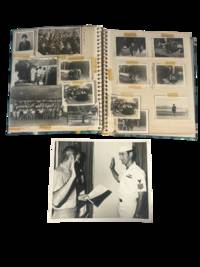
1940215981940. Japanese American family photograph album documenting daily life in Japan before and after World War II and the later integration of an American serviceman into the family during the decades following the Allied occupation. The photographs trace the lived experience of a Japanese household whose members appear across school portraits community gatherings and cultural celebrations later joined by a white American sailor serving in the United States Navy. The album therefore records a cross cultural marriage that developed during the postwar era when American military personnel remained stationed in Japan following the country's surrender in 1945. The images illustrate the social environment created by the Allied occupation and the gradual emergence of families formed through marriages between Japanese women and American servicemen relationships later enabled by immigration provisions such as the War Brides Act.The bride becomes a Japanese American<br /> <br /> Photograph album containing over 120 photographs ranging from approximately 3 × 4 inches to about 8.5 × 11 inches. Primarily black and white with later color images documenting Japanese family life and the presence of an American naval serviceman within the household. Many photographs include handwritten captions in Japanese with occasional English annotations. . Many are captioned in mainly Japanese and some in English. Early images depict traditional Japanese life including formal portraits of men in student uniforms women in traditional attire and large school or group photos. These images provide insight into pre-war and wartime Japanese society a period marked by nationalistic fervor strict societal expectations and the looming impact of World War II. One photo depicts the aftermath of Hiroshima. Many images feature Japanese cultural events outdoor excursions and group gatherings highlighting community ties. One set of photographs appears to document school festivities featuring individuals dressed in festival attire carrying decorative floats and engaging in traditional performances. Others capture serene landscapes including notable landmarks such as Mount Fuji Shinto shrines as well as Shinto shrines and temple sites. <br /> <br /> Later sections of the album introduce a white American sailor in United States Navy uniform photographed in family settings and formal military contexts including an image depicting his swearing into service. These later photographs several in color dating from approximately 1966 to the early 1970s indicate the continued connection between the Japanese family and American military service decades after the war. The album therefore spans two historical periods: wartime and immediate postwar Japan followed by the long presence of American forces in the country during the Cold War era. Together the photographs document domestic life cultural traditions and the development of an interracial Japanese American family during a period when such marriages often faced social and legal barriers in both countries. Album contains more than 120 photographs Minor handling wear and light edge wear visible on photographs and album pages consistent with long term family use. Overall condition very good. unknown
GOR002420091Hardback. Very Good. hardcover
GOR002149018Hardback. Good. hardcover
1800244358vp chiefly Paris 1800. 8vo. Half calf and boards rebacked preserving most of original spine. 8vo. Sammelband of pamphlets pertaining to the Directory Council of 500 and Napoleon's rise to power.<br /> SIGNED "C. Sneyd Edgeworth / June 1817" on the half-title of the first pamphlet. Charles Sneyd Edgeworth was Maria's half-brother; his mother Elizabeth Sneyd was Mr. Edgeworth's third wife. With a list of pamphlets in Charles's hand on the first blank.<br /> An important anti-Napoleon pamphlet "Vrai Sens du Vote National" is INSCRIBED by the author Camille Jordan "par Mr Edgeworth de la part de l'autor" partially trimmed. unknown
1800244358vp chiefly Paris 1800. 8vo. Half calf and boards rebacked preserving most of original spine. 8vo. Sammelband of pamphlets pertaining to the Directory Council of 500 and Napoleon's rise to power.<br/>SIGNED "C. Sneyd Edgeworth / June 1817" on the half-title of the first pamphlet. Charles Sneyd Edgeworth was Maria's half-brother; his mother Elizabeth Sneyd was Mr. Edgeworth's third wife. With a list of pamphlets in Charles's hand on the first blank.<br/>An important anti-Napoleon pamphlet "Vrai Sens du Vote National" is INSCRIBED by the author Camille Jordan "par Mr Edgeworth de la part de l'autor" partially trimmed. unknown books
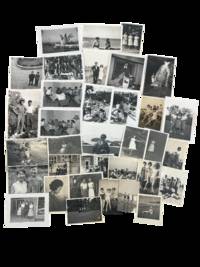
1950228011950. Japanese American Hawaii Japanese American family photograph archive early to late 1950s documenting leisure travel and everyday social life in Southern California and the Hawaiian Islands during the decade following the wartime incarceration of Japanese Americans under Executive Order 9066 and the political transformation of Hawaii from U.S. territory to statehood in 1959. The photographs record a generation of Japanese American families participating in postwar prosperity tourism and interregional mobility within communities where people of Japanese ancestry played central roles in local social and economic life. Portraits of friends and relatives gathered along beaches resort hotels and urban promenades illustrate the growing accessibility of leisure travel in the Pacific during the mid twentieth century while also reflecting the reestablishment of family networks disrupted during the war years.<br /> <br /> Archive of 34 silver gelatin photographs created during the 1950s depicting Japanese American family members and friends at beaches hotels and scenic locations across Southern California and the Hawaiian Islands. Most photographs measure approximately 3.5 x 5 inches several with inscriptions on the verso. Many photographs show groups of stylish young women and relatives wearing mid century resort clothing including swimsuits sundresses and sunglasses typical of the era's beach culture. Landscapes include rocky coastal formations of the Big Island palm lined beaches waterfalls and sweeping ocean viewpoints alongside views of hotel entrances and residential settings. Group portraits depict family members posing in coordinated outfits or bathing suits while candid images show individuals wading at the shoreline resting under umbrellas or climbing seaside rock formations. One photograph shows a group of women posed before a hotel sign reading "The Californian" while another bears the inscription "Kona Inn 7-22-1959" placing part of the series at the historic Kona Inn on the island of Hawaii a prominent gathering place for travelers during the growth of mid century Pacific tourism.<br /> <br /> The photographs collectively document Japanese American participation in the expanding culture of travel and recreation that emerged across the Pacific during the 1950s. Hawaii had long been home to one of the largest Japanese diasporic communities outside Japan and by the mid twentieth century the islands were increasingly linked to the American mainland through tourism migration and family ties. Minor edge wear and occasional creased corners; photographs generally crisp and clean. Overall very good. These images capture both the natural landscapes of Hawaii and the social environments created by Japanese American travelers and residents during the years surrounding Hawaiian statehood in 1959. unknown