Sirani, Elisabetta 1638 - Bologna - 1665 - nachAntiquariat.de

12 555 résultats
188-Wo.J. Radierung, nach G.A. Sirani (1610-1670), auf Bütten. 26,7:21,7 cm. Mit minimalem Rändchen um die Umfassungslinie. Literatur: Bartsch 8; Nagler 8, mit dem Namen des G.A. Sirani.
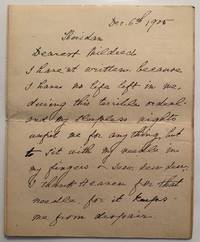
030029No Binding. Very Good. Large archival collection consisting of: 2273 letters 5636 pages plus 16 diaries and 9 banker's boxes approximately 11 linear feet of ephemeral materials all dated 1898-1990 the bulk from 1920s-1960s. The correspondence centers on Phyllis Hart Clark and her family. There are 623 letters written by Phyllis mostly retained copies and 647 incoming letters. Her husband Raymond G. Clark writes and receives 201 letters. As a couple Phyllis and Raymond receive 450 letters and their son Philip writes and receives 293 letters. The ephemera includes several thousand pieces including folders of typed and manuscript notes brochures circulars handouts pamphlets postcards telegrams etc. all dated 1930s to 1980s for further description see below. <br/> <br/> unknown
030029No Binding. Very Good. Large archival collection consisting of: 2273 letters 5636 pages plus 16 diaries and 9 banker's boxes approximately 11 linear feet of ephemeral materials all dated 1898-1990 the bulk from 1920s-1960s. The correspondence centers on Phyllis Hart Clark and her family. There are 623 letters written by Phyllis mostly retained copies and 647 incoming letters. Her husband Raymond G. Clark writes and receives 201 letters. As a couple Phyllis and Raymond receive 450 letters and their son Philip writes and receives 293 letters. The ephemera includes several thousand pieces including folders of typed and manuscript notes brochures circulars handouts pamphlets postcards telegrams etc. all dated 1930s to 1980s for further description see below. <br/> <br/> unknown books
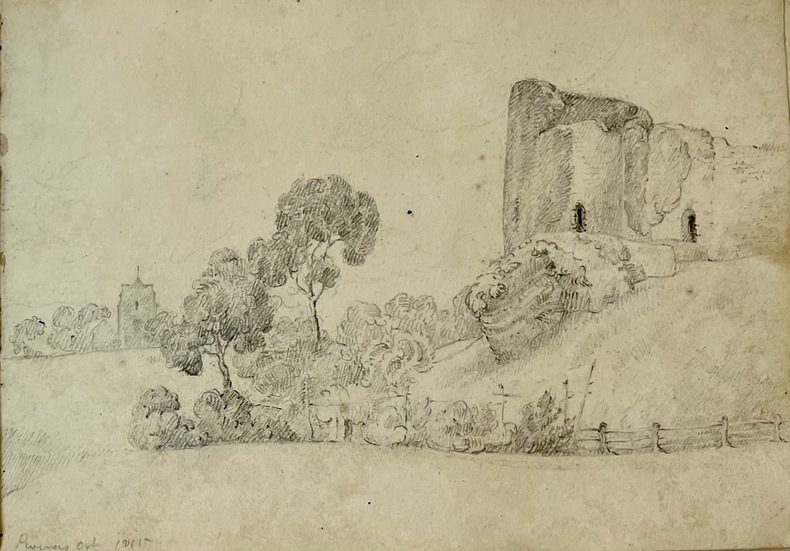
18104669s.L , s.d. [c.1810-1815]. 1810 2 carnets in-12° oblong (121 x 190 mm et 119 x 165 mm) et 1 carnet in-8° (180 x 115 mm) de : I. 49 dessins à laquarelle et croquis au crayon gris ; 1 note manuscrite détachée décrivant les conditions météorologiques sur une semaine ; filigranes J. Whatman 1810 ; II. 32 dessins et croquis au crayon gris ; inscriptions et calculs au début et à la fin du carnet au crayon gris ; III. 16 dessins et croquis au crayon gris ; 4 photos en couleur ; notes et calculs au début et à la fin du carnet ; étiquette de libraire: Made & Sold by E. William, Stationer to the Duke & Duchess of York N°11 Strand ; filigranes: W. Turner & Son, Budgen & (...) 18(..) et J. Green 1813. Soit un total de 97 dessins et croquis et 4 photos. (Quelques feuillets détachés et tarces d'arrachement, salissures et défauts d'usage). I. Demi-maroquin rouge à grain long à coins et porte-crayon dépoque, dos lisse orné de filets dorés, plats recouverts de papier vert, vestiges dun fermoir ; II. Plein maroquin rouge à grain long avec porte-crayon, dos lisse muet ; III. Demi-chagrin noir dépoque, dos muet, plats recouverts de papier marbré, dos lisse muet. (Frottements et défauts dusage).
30907Large Archive includes 2191 letters comprising 6737 manuscript and typed pages plus over 1000 pieces of paper and printed ephemera. Of the 2191 letters 1626 letters 4793 pages dated 1920-1983 are from the family of Kenneth S. Fagg and Marion Rebuschatis and their children with the remaining 565 letters 1944 pages dated 1896-1960 that of the family of Theodore Szarvas and his wife Vivian Florence Fraser and their children.<br /><br /><p><b>Description of the Fagg family section of archive:</b></p><p>1626 letters comprising 4793 manuscript and typed pages broken down as follows:</p><p><b>1920s:</b> 1920: 1 letter 7 pages; 1921: 169 letters 444 pages; 1922: 154 letters 508 pages;1923: 62 letters 186 pages;1924: 153 letters 465 pages;1925: 117 letters 387 pages;1926: 135 letters 370 pages;1927: 78 letters 201 pages;1928: 8 letters 17 pages. This part of the collection is mainly correspondence between Kenneth S. Fagg and Marion Rebuschatis both before and after they were married while they were both attending college at the University of Wisconsin and when Kenneth was attending art school in New York City and beginning his career as an artist and illustrator.</p><p><b>1930s-1980s:</b> 155 letters 448 pages. This section of the archive includes 52 letters written by Marion Fagg in 1938 to her Aunt Emma Noud her mother's sister. At this time the Faggs were living at Sunnyside Gardens L.I and Aunt Emma at Washington D.C. The correspondence seems to have been started with a hospital stay for a broken hip by Aunt Emma. Also included in this section of the correspondence collection are 43 letters written to Donald Fagg the son of Kenneth and Marion Fagg. Donald's brother Peter Fagg the noted IBM computer engineer wrote 24 of these letters between 1950-1952 with Donald's father writing 37 letters to him between 1947-1952 and his mother Marion 3 letters and his sister-in-law Janet Szarvas Fagg 1 letter also writing to him. Additionally there are other letters to Donald Fagg from Harvard University Boston University Ohio Wesleyan University the New York Psychiatric Institute and the Selective Service System. Donald Fagg committed suicide in 1957 and these letters written to him were apparently retained by the family after his death. In this section are also 4 letters written by Donald Fagg written to his two Aunts Margaret and Emma when he was a child. Peter Fagg also writes a letter to his parents and receives a letter from the Chappaqua Historical Society concerning the possible donation of paintings. There are also letters written to Ken and Marion from friends or family dating from the1960s-1970s.</p><p><b>Undated Letters:</b> 594 letters 1760 pages. Most of these undated letters do not have their mailing envelopes attached to them. There are over 500 envelopes in this collection that are not with their letters undoubtedly a good many of these letters belong to these envelopes. Kenneth S. Fagg never wrote the date on his letters until later in life thus most of these undated letters approximately 512 are written by Kenneth S. Fagg in the 1920s. The envelopes in this collection are important for helping to date the correspondence. Of course the type of stationary and the contents of the letters also help to date the letters. About 18 undated letters are written by Marion the rest of them by other correspondents.</p><p><b>Summary:</b> The bulk of the correspondence in this archive is mainly between Kenneth and Marion. The couple writes to each other and with occasional letters by family friends or fellow students and or business associates. Of the letters in the archive 1169 letters were written by Kenneth S. Fagg Marion wrote 262. The remaining letters were written by family friends or others. As might be expected the correspondence was heavy during the years the couple was courting engaged and the year they married. After they married in 1927 most correspondence was written by Kenneth while he was travelling or working out of town while Marion was still in either Washington D.C. or away at university occasionally there are letters between the parents and their children. Of the letters written by Kenneth S. Fagg a number of them 38 are illustrated with drawings sketches portraits cartoons of considerable interest and demonstrate Fagg's skill and talents as a graphic artist and designer etc. The letters give some interesting insight into the life of an artist and illustrator in New York City in the 1920s attending many art exhibitions at galleries theatrical performances plays or concerts while he was an art student.</p><p><b>Description of Szarvas section of Archive:</b></p><p>The second section of this archival collection is comprised of the correspondence of the Szarvas family Theodore "Theodore of the Ritz" Szarvas his wife Vivian Florence Fraser and their four children Theodore Jr. James H. Robert and Janet. Janet Szarvas married Peter Fagg the son of Kenneth and Marion Fagg mentioned above. It is from Janet and Peter Fagg's family that the two sections of the archive are connected and descended. This section of the archive consists of 565 letters 1944 pages dated 1896-1960.</p><p><b>Theodore Szarvas Sr.:</b> 69 letters 269 pages dated 1907-1952 written mainly to his wife with most being on the letterhead of the various hotels at which he was employed including: the Ritz Hotel Piccadilly London England 1909-1912 1914; Grand Hotel Royal Nagyszalloda Budapest Hungary 1913; Ritz-Carlton Hotel New York NY 1916-1917 1923 1927. 1931 Ritz-Carlton Hotel Atlantic City New Jersey 1927; The Midnight Sun Swedegran Restaurants Inc. New York NY 1938; Hotel Pierre New York New York undated. The letters are interesting as they show the movements and progress of Theodore as he builds his career and establishes himself in upper echelons of haute cuisine and fine dining. He worked at the Ritz in London and other places then went to Budapest returned to London then on to New York City where he worked at the Ritz-Carlton and where his name became synonymous with fine dining. He writes love letters and poetry to his wife discusses his work at various hotel restaurants he describes the political situation in London at the beginning of WWI when he was forced to leave his position at the Ritz due to his Hungarian nationality. During the early years of their marriage 1911-1913 when they lived in London Vivian took trips back to New York while her husband Theodore remained abroad.</p><p><b>Vivian Florence Fraser Szarvas:</b> 72 letters 329 pages dated 1907-1957 includes correspondence from Vivian to Theodore Szarvas before they were married 32 letters dated 1907-1909 letters during their marriage when they lived in London and she visited America twice and after they moved to America permanently. The letters show the progress of their secret courtship while they lived in New York City and later when Theodore moved to London to work at the Ritz. A couple of the later letters are to her children or a friend however the bulk of the letters are written to her husband Theodore. Sixteen of these letters are undated.</p><p><b>Millie Hartman:</b> mother of Vivian Florence Fraser Szarvas 69 letters 367 pages dated 1901-1920 this part of the collection consists of letters written by Mrs. Hartman to her daughter Vivian when she took two extended trips without her daughter accompanying her. One trip was to Hot Springs Virginia in 1901 and another a trip to Europe France Germany Switzerland in 1902. Vivian appears to have stayed home with family. Vivian was then a child of 11 to 12 years old. Other letters 1910-1914 are written to Vivian by her mother when Vivian left home to join and marry Theodore Szarvas in London still others written to Vivian by Millie when Vivian was in Budapest with her husband 1913 and still other letters are written Vivian when she returned to America from London. Millie signs the letters often simply with "Mother" or sometimes "Grandma & Mother." The letters to Vivian written when she went to London show her mother's displeasure at her daughter's decision to go away and marry Theodore a much older man.</p><p><b>James and Florence Szarvas:</b> 63 letters 190 pages dated 1927-1954 writing to his parents and siblings Florence is James Szarvas' wife while traveling abroad 1927 and 1931 as a child and later while serving in the military in WWII 1943-1945 while at Camp Upton NY Quincy MA Fort Eustis VA with Battery A 5th Battalion and later at the Antiaircraft Artillery Training Center Camp Stewart Georgia and still later at Camp Gordon Georgia and further correspondence after the war when he returned to civilian life.</p><p><b>Janet Szarvas Fagg: </b>124 letters 349 pages dated 1927-1960 of which most are written in the first half of the 1950s to her mother Vivian Szarvas signing her name and her husband Peter's name. Peter's correspondence to his parents and siblings is located within the Fagg section of this archive. Janet studied art at the National Academy of Design in New York City winning a couple of awards while a student. She illustrates a couple of her letters.</p><p><b>Robert Szarvas: </b>13 letters 37 pages dated 1949-1954 written to his parents and siblings while serving with the 601st A.C. & W. Sqd. of the Air Force at Rothwesten Germany and stateside at Moses Lake Washington.</p><p><b>Theodore Szarvas Jr.: </b>56 letters 183 pages dated 1918-1953 written while studying at M.I.T 1928-1929 while serving in WWII 1943-1945 and after the war. Thirty-six of these letters are written while young Theodore is serving in the U.S. Army with the 99th Repair Squadron 59th ADG in Guam Pearl Harbor HI Oklahoma and Texas. His letters are mainly addressed to his parents and siblings.</p><p>Other letters in this collection are written to Theodore 18 letters 27 pages and to his wife Vivian 81 letters 193 pages written by friends family or business associates. There are also 6 "certificates" or letters of recommendation for Theodore which document his rise in the restaurant world. </p><p><b> Diaries</b></p><p>6 diaries 532 pages dated 1916-1922 as follows:</p><p>Diary of Marion Rebuschatis 120 pages dated 1916 pocket diary 2 entries per page bound in leather written in ink legible hand minor wear kept while in her junior year of high school in Washington D.C.</p><p>Diary of Cora Noud Rebuschatis 187 pages dated 1916 pocket diary bound in limp leather worn written closely in ink but legible two days per page with a memorandum section at bottom of page a couple of pages of cash accounts kept in rear. Cora is the sister of Marion Rebuschatis.</p><p>Unidentified diary likely one of the Rebuschatis sisters likely Cora Noud Rebuschatis 124 pages dated 1917 pocket diary bound in leather worn.</p><p>Unidentified diary likely one of the Rebuschatis sisters not Marion 21 pages dated 1918 kept while at Camp Merritt.</p><p>Unidentified diary likely one of the Rebuschatis sisters not Marion 92 pages dated 1918-1919 stiff limp wrappers written in ink legible hand. This diary was kept while stationed at Camp Merritt during World War One. There is much description of camp life and of the soldiers arriving at Camp Merritt from the battlefront.</p><p>Diary of Emma Noud 81 pages dated 1922 stiff limp wrappers written in ink legible hand kept while on a tour of Europe during which she visited Scotland England Germany Switzerland Italy France amongst other places and writes informative entries on the cities she visits. Emma Noud is either the sister or aunt of Marion Rebuschatis.</p><p><b> Over 1000 Pieces of Miscellaneous Paper Ephemera for the Fagg and Szarvas Families as follows:</b></p><p>524 Envelopes separated from the undated letters in collection; 120 Miscellaneous Printed and Ms Paper scraps notes etc; 35 Greeting Cards; 210 Post Cards used; 41 Newspaper & Magazine clippings; 54 Family Related Paper Ephemera - U of Wisconsin related material medical bills utility bills old check stubs report cards Will of Theodore Szarvas cemetery plot papers Red Cross ID cards Foster Parent papers Unemployment Insurance papers Immigration Inspection Card for Theodore Szarvas etc.; 46 Cards wedding invitations sympathy cards calling and business cards; 12 Theater Programs; 7 Art Exhibit Catalogues; 33 Photographs; 4 Hand Drawn Illustrations by Kenneth S. Fagg.</p><p><b> Biography of Kenneth Stanley Fagg and Marion Rebuschatis</b></p><p>Kenneth Stanley Fagg was born May 29 1901 at Chicago Illinois and died 7 January 1980. He graduated from the University of Wisconsin and afterwards studied art at the Art Institute of Chicago and Art Students League in New York City and became a prolific advertising and magazine illustrator book artist painter and art director.</p><p>Fagg was the son of Peter Albert Fagg 1874-1968 and Eva Maude Ross 1869-1941 and the nephew of the Rev. John Gerardus Fagg 1860-1917 a missionary to China and a long time minister at Middle Collegiate Church in New York City. Kenneth's parents Peter and Eva married in Chicago on 20 Dec 1895. In 1910 Ken's father was a clerk at a bank his mother a homemaker. Peter Fagg was originally born in Wisconsin of Dutch immigrant parents his wife in Canada of Scottish immigrants. By the time the 1920 Census was taken Peter had moved his family to Los Angeles where he worked as a banker. However Kenneth moved back to Wisconsin for college.</p><p>Fagg was artist and editor-in-chief during high school for the New Trier Echoes a school publication. He was for a time a member of the National Guard's K Company 11th Infantry as well as a Cadet Lieut. at the Naval Training Corps in Evanston Illinois.</p><p>In 1919 Kenneth began his four years at the University of Wisconsin where he quickly established himself with the school magazine turning out dozens if not hundreds of illustrations for the Wisconsin Octopus magazine and Daily Cardinal newspaper and The Commerce Magazine there. His college graduation year book picture of 1924 stated he lived at Alhambra California. He had a very active college career at the University of Wisconsin where besides being on the varsity ski jumping team he was also a member of Delta Upsilon and served on the staff of the three different college publications as assistant art editor and as art editor for the Badger the Octopus and the Commerce Magazine. He also was involved with the Arts and Crafts Club the Display Publicity Chairman the Edwin Booth club and other activities. His senior thesis was on the novels of Honore de Balzac. It was also at college that he met his future wife Marion Rebuschatis.</p><p>Marion Rebuschatis was the daughter of Wilhelm Rebuschatis 1868- and Cora Ada Noud 1868-1918 of Washington D.C. Her father was a German Russian immigrant who found work first as a printer then as a proof reader for the Government Printing Office in D.C. Her mother was the daughter of a liquor dealer and Irish immigrant James Gray Noud and his Canadian wife Ermina Beatie. Marion took a tour of Europe in 1922 as evidenced by her passport application which shows her planning to visit England Belgium France Holland Switzerland Germany Austria and Italy. Several letters from this collection are from the time that Ken & Marion corresponded when she was in Europe. Marion eventually found work as a school teacher.</p><p>Marion was married to Kenneth Stanley Fagg on June 29 1927 at Washington. Mr. and Mrs. Fagg returned to New York City where they lived at Queens then West Point then later at Chappaqua. Marion appears to have graduated Central High School in Washington D.C. in 1917 then went to the University of Wisconsin where she graduated in 1923. Kenneth studied art at the AIC and Art Students League in NYC and thereafter worked steadily as a freelancer for advertising books and magazines.</p><p>During the 1930s he was a resident of Los Angeles and an art director for Fox Films. By the 1940s he had settled in Chappaqua New York where he remained for the rest of his life. His illustrations appeared in <i>Holiday</i> <i>Life</i> <i>Saturday Evening Post</i> and many other national magazines. He was co-creator of the world's largest geophysical relief globe hand-painted for the U.S. exhibition at the Brussels World's Fair in 1958. Fagg and wife had twin sons Donald Fagg 1928-1957 who committed suicide in 1957 at age 29 and Peter Fagg III 1928-2009 who died at Poughkeepsie as well as 3 grandchildren. Kenneth S. Fagg died in Mt. Kisco NY on Jan. 11 1980. His wife died previously in August of 1978. One researcher of Fagg states that the family kept virtually all his original artwork and thus his work did not reach the auction houses for many years.</p><p>Kenneth's son Donald Fagg's library was donated to Ohio Wesleyan Library as the "Fagg Collection." His parents donated the books after their son's death. Donald graduated from Ohio Wesleyan Union in 1949 where he was chief justice of the Campus Court and active in all three student publications and a member of Omicron Delta Kappa and Phi Beta Kappa honorary fraternities. After graduating from OWU Donald Fagg was a graduate student at Harvard University. He did field work for two years in Borneo Indonesia and helped direct the Harvard Salzburg Summer Seminary two summers. He was on the faculty of Rutgers University when he died.</p><p>Kenneth and Marion's son Peter was a fairly well-known in his field as well. Peter Fagg was born on September 26 1928 in Queens New York. He was a twin brother to Donald Fagg who was his closest friend. Peter was raised in Sunnyside Queens and Chappaqua New York and attended Horace Greeley High School. Mr. Fagg continued his education at Middlebury College M.I.T. Georgetown University and Syracuse University and earned two Master's Degrees in Engineering and Astronomy. He was also a veteran of the United States Army. Mr. Fagg married Janet M. Szarvas 1926-2010 the daughter of Theodore "Theodore of the Ritz" Szarvas and Vivian his wife. Together Peter and Janet had three children Christopher Vivian and Dawn. Peter Fagg worked his entire adult life for IBM. For a number of years Mr. Fagg was the Executive Director of Research in Fishkill New York and he also managed sites in Germany England and Japan. He was integrally involved with the development of the IBM 360/370 the first supercomputer in existence. He also had a fascination with biology and chemistry which culminated in a paper he wrote on the storage of human memory which he believes is stored in the brain's DNA not in the synapses as is commonly thought. The name of the published paper is <i>DNA as the Long Term Memory Storage Cell in the Human Brain.</i></p><p>The Fagg family Kenneth Marion Donald Peter and Peter's wife Janet Szarvas is all buried at Washington D.C.'s Oak Hill Cemetery.</p><p><b> Theodore "Theodore of the Ritz" Szarvas and Vivian Florence Fraser</b></p><p>Theodore Szarvas was born about 1874 in Budapest Hungary. He worked as the maitre d' or head waiter-manager at a number of the best hotel restaurants in the world including New York's Ritz-Carlton where he earned the sobriquet "<i>Theodore of the Ritz</i>" and which according to legend was synonymous with fine food.</p><p>Correspondence in this archive shows that Theodore worked at the Waldorf-Astoria in New York City from 1903 to 1906 and after that at the Hotel Astor in New York City in 1907 before moving to London England to work at the Ritz Hotel. A letter in the archive written by E. A. Pritchard of the Ritz Hotel states that Theodor Szarvas had been in the employ of the Ritz Hotel in London as head waiter in the restaurant from May 1st 1908 to October 25th 1912 then again from October 1st 1913 until October 17th 1914. The time between his two stays at the Ritz Hotel was spent at a fine hotel in Budapest which lured him away at 10000 Kr a year.</p><p>Theodore's time at the Ritz Hotel in London was after Cesar Ritz retired and during the period that the famed French chef Auguste Escoffier was manager. Escoffier managed the hotel and oversaw the restaurant. Escoffier and Cesar Ritz had worked together running Richard D'Oyly Carte's Savoy Hotel the most famous in London at the time. Ritz and Escoffier left the Savoy to open the Paris Ritz and later the Ritz Carlton Hotel in London which soon drew high society away from the Savoy Hotel.</p><p>After the outbreak of World War One and with England's declaration of war against the Austrian-Hungarian Empire Szarvas being Hungarian was reluctantly let go by the Ritz due to the pressure of public opinion. Pritchard's letter is apologetic and a letter of recommendation for Szarvas to be used by Szarvas in America which helped him find employment at the Ritz Carlton Hotel in New York City. The Ritz-Carlton had opened previously in 1911. An earlier letter in the collection 12 May 1908 written by Oscar Tschiersky manager of the Waldorf-Astoria in New York City tells us that Theodore had previously worked at the Waldorf from October 15th 1903 to October 24th 1906. Letters in the archive show Theodore working at a hotel in Budapest in 1913. It would appear that after he married Vivian Florence Fraser in 1910 the couple stayed in England for three years then moved to America with Theodore working briefly in Budapest then London again before losing that position when WWI broke out forcing them to move to America permanently.</p><p>Theodore Szarvas married his wife Vivian Florence Fraser 1890-1968 about the year 1910. At the time he was 35 years old his wife just 19 or 20. The couple had been secretly dating from at least October 1907 correspondence in this collection shows that Vivian at age 17 was secretly writing to Theodore a man almost twice her age. Letters in the collection demonstrate that she had a crush on him since she was 13 years old.</p><p>Vivian at first kept her correspondence to Theodore secret from her mother Millie Hartman and stepfather Otto Hartman. Vivian first met Theodore when she was thirteen and her crush on him began the day he visited her house to visit her stepfather with whom Theodore worked. The correspondence chronicles Vivian's obsession with Theodore a rather strange courtship until she finally married him.</p><p>Vivian corresponded secretly with Theodore from October 1907 until December 1909. She relates the utter horror that she feels betraying and being untruthful to her mother by sneaking around to see Theodore. Otto Hartman Vivian's stepfather appears to have been a co-worker with Theodore at the Astor Hotel and was very upset when he found out about the affair of his co-worker with his stepdaughter. Vivian's mother was also upset about the relationship and forbade her daughter to have any contact with Theodore but Vivian did not listen and kept up the relationship. However later on as it became apparent the two would marry her mother stated that she would leave her husband if he attempted to interfere with her daughter's relationship.</p><p>Theodore left for London in the spring of 1908 letters in the collection from Vivian who was in New York document the long distance relationship of the couple. There was much confusion on Vivian's part as she was in love with Theodore but all of her family parents grandparents aunts were against the relationship because of the dramatic age difference. Vivian was forbidden to have contact with him and the family felt safe once Theodore left for London however Vivian continued corresponding and the secret affair which finally came to an end in December of 1909 when Vivian's mother found out. At this time Vivian wrote to Theodore to send her money for passage to London before she is put out of the house by her mother.</p><p>Otto Hartman and his wife Millie Vivian's mother are enumerated in Manhattan on the 1900 Census and listed as being married for only three years. Vivian while given the name of Hartman was ten years old at this time. She later in life used her father's name Fraser. Her father was born in Germany Vivian in Illinois her elder sister Hope in Michigan and her oldest sister Gertrude in New York. The 1900 Census shows Vivian's mother as being born in Connecticut however other records state Canada. Otto Hartman in 1900 was listed as a German immigrant.</p><p>Millie Hartman appears in the U.S. Census for 1910 at her 1800 Clinton Avenue address in the Bronx a place where she apparently lived for the rest of her life and where Vivian and Theodore lived briefly after they came back to America from England. Otto Hartman is no longer in the household; either having died or perhaps the marriage may have ended in divorce or separation. The correspondence showed that there was considerable friction in the marriage.</p><p>Vivian and Theodore appear on the 1911 Census of England at 66A Hackford Road Lambeth London England. The couple's first child Theodore was born in England in 1910 however various records seem to indicate an earlier birth date perhaps as a way to disguise the fact that Vivian may have been pregnant when she married. The couple's second child James H. Szarvas was born 13 February 1915 and a third child Janet Szarvas was born much later in 1926. Both James and Janet were born in New York City. Later in life the Szarvas couple acted as foster parents for an Italian boy.</p><p>While living in England Vivian and her son Theodore made two trips 1911 and 1912 to America to visit her mother before finally moving to America permanently about 1913. By 1915 the Szarvas family appears on the New York State Census living at the 1800 Clinton Avenue address in the Bronx. They are living with Vivian's mother Millie Hartman who was listed as being born in Canada. Also with the family is an Austrian waiter likely an employee of Theodore who is the head waiter at this time at the Ritz.</p><p>In 1920 the Szarvas family was enumerated at New Castle Westchester County New York where Theodore was listed as a manager at a hotel. In 1921 we find Szarvas as the Maitre d' of the <i>S.S. Flotilla </i>a restaurant with a nautical theme in New York City at the corner of 56th Street and 6th Avenue a stone's throw from Broadway. The restaurant was hailed as a "most diverting development in the art of dining well."</p><p>When the 1925 New York State Census was taken the family was still on King Street at New Castle. At this time they had a Japanese butler living with them. Theodore was listed simply as a "manager." Theodore became a citizen at White Plains NY in 1925 and in 1929 the family was living in Chappaqua New York which became the family home. Earlier in a 1925 newspaper article Theodore listed as the head waiter at the Ritz-Carlton was reported to be suing William H. Kiernan a broker as the result of tips totaling $11000 being lost in Wall Street investments having gone south.</p><p>A book <i>Recipes for Cooking Forty Fathom Fish: Prepared by Theodore Szarvas Maitre D'hôtel and Louis Diat Chef de Cuisine of the Ritz-Carlton New York City</i> was published by Bay State Fishing Company in 1927. About this time society columnists were writing that Theodore was considered one of the best dressed men in the "parade of Park Avenue." His friend E. Phillips Oppenheim modeled his "suave maître d'hôtel" character after him. He was a collector of books and paintings and a boyhood friend of Ferenc Molnar during his student days in Budapest. Another writer wrote <i>"Theodor is a slender glossy-haired little man with the most beautiful clothes and manners imaginable. He prefers a pear-gray cutaway with a dark Ascot by day and an Oxford dinner jacket after dark and he knows who is who in New York's various social and financial upper brackets as well as a city editor or a bank teller". He acquired a not inconsiderable fortune in the 1920s and has a fine Westchester home with an important collection of English paintings. He later was at the Pierre. He was known as Theodore of the Ritz because of his long service as lord of the Ritz-Carlton dining rooms. It was said that he was "of a fast-vanishing school which believes that service can be a high art." His name was synonymous with "fine food" He put forth some of the most heroic adventures in cuisine in his day."</i> Theodore worked 1936 after leaving the Ritz at the Stork Club in New York City owned by Sherman Billingsley. He was also at the Hotel Pierre where he acted as director of the restaurant.</p><p>In 1930 Theodore's son also named Theodore was listed as a student at MIT. In 1935 he was living with his parents in Chappaqua but by the 1940 Census the younger Theodore was listed as living on 34th Street in NYC. He was listed as working as a salesman in advertising.</p><p>Millie Hartman Vivian's mother is found living with Theodore and Vivian in 1940 with their children Janet Robert James and James' wife Florence. In 1940 their son Theodore Jr. was living in Manhattan on Park Avenue married and working in sales with an advertising firm.</p><p>Theodore's son James Hurry Szarvas was born 13 February 1915 and died 19 February 1972. On 22 October 1943 he entered military service as a private and was released on 8 April 1946. Correspondence in the collection appears to show that James might have remained in the military serving in the Air Force as late as 1951. He had three years college and worked as a salesman. He was already married to Florence marrying her sometime before 4 June 1940 as they were listed as husband and wife on a ship manifest on a trip they took to Bermuda. They were living in Chappaqua Westchester Co. New York. She was listed as being born on 26 Nov 1914 at New York City. They were still living at Chappaqua in 1950 when they took another trip a flight to Bermuda. His brother Ted and Bob were also in the Air Force.</p><p>Theodore's daughter Janet Szarvas married Peter Fagg the son of Kenneth and Marion Fagg. They were married for fifty-seven years. Peter worked his entire adult life for IBM. For a number of years he was the Executive Director of Research in Fishkill New York and he also managed sites in Germany England and Japan. He was integrally involved with the development of the IBM 360/370 the world's first supercomputer doing a phenomenal job of managing the interdivisional international development of the dozens of new input-output devices without line authority over any of those teams. The 360 was the first family of computers designed to cover the complete range of applications from small to large both commercial and scientific. Peter Fagg headed the development of the 7010/7040 under executive Bob O. Evans the computer pioneer who helped lead the groundbreaking development of compatible computers that changed the industry. The 7040 was a historic but short-lived model of a transistor computer built in the 1960s.</p> books
31017Six photograph albums with 894 photographs with several related ephemeral items documenting the lives and travels of this Philadelphia family in the first quarter of the 20th century. The Firth family was a prominent Philadelphia family which had married into another one the Livezey's whose seat was their estate Glen Fern in Germantown. Thomas Livezey was a miller and friend of Benjamin Franklin and large property owner. The Livezey family sold much of their estate in the 19th century to the city of Philadelphia and it became Fairmount Park. The Firth Family lived in a palatial mansion on Allen's Lane before moving to the Eastern Shore of Maryland in the 1930s.1. Album documenting a month-long Hunting Trip on the Upper Yellowstone and in the mountains of Wyoming September – October 1908 by Thomas T. FirthOblong small quarto 62 photographs measuring 3 â… x 5 â…ž inches mounted on 49 black paper leaves binding worn and scuffed else very good. Photographs identified in white ink and include views of the mountains encampments game views of Cody Wyoming Cody Dam under construction party members etc.2. Photograph Album Documenting Hunting Trip to New Brunswick Canada 1913 including Images of Native American GuidesOblong quarto 55 photographs measuring 3 â… x 5 â…ž inches mounted on 49 black paper leaves bound in original flexible embossed binding images identified and dated in white ink in very good condition. Includes images of hunting camps and cabins in the woods of northern New Brunswick north of Newcastle and Miramichi game caribou moose Native American Guides etc.3. Photograph Album Documenting Motoring Trips to Maryland Virginia New Jersey Pennsylvania and Life in Germantown and the Wissahickon Valley Philadelphia 1918-1919Oblong small quarto containing 200 small snapshots mounted on 50 black paper leaves most subjects identified in white ink bound in original flexible embossed wraps string tie some chipping to edges of leaves else very good. 4. Photograph Album Documenting Family Motoring Trips to Florida New Jersey The Pocono Mountains and the Adirondacks 1919-1920Oblong small quarto containing 329 snapshots mounted on 48 black paper leaves most images identified and dated in white ink bound in original flexible paper wraps string tie missing binding worn some chipping to edges and extremities of several leaves else very good.5. Photograph Album Documenting a Hunting Trip in Northern Ontario Canada north of Opasatika Ontario and South of James Bay 1921Oblong quarto 87 photographs measuring between 2 â…› x 5 â…œ inches and 9 x 7 â… inches on 41 black paper leaves identified in white ink several related ephemeral items mounted and laid in bound in original cloth covered flexible wrappers string tie several leaves detached and chipped at edges and extremities else in very good condition.Trip taken by Thomas Firth and C. R. Firth images document the party views of Cochrane Ontario the woods Native American Guides the game shot etc. 6. Album Documenting a Trip to Florida in their boat the "Osprey" 1922 and 1923Oblong quarto containing 161 photographs mounted on 47 black paper leaves bound in original flexible embossed boards string tie missing some related ephemera laid in some chipping to edges and extremities of leaves else very good. The route to Florida went via the Dismal Swamp Canal from Norfolk to Albemarle Sound with stops in Beaufort North Carolina Cleveland Florida Captiva Boca Grande Useppa Island Sanibel Fort Myers Marco etc. and the album includes views of all these locations
1962419856Frankenforst Regensburg Lindenhof Freiburg Munster Lübberstedt Germany / Rigi-Kulma Rigi-Kaltbad Switzerland 1962. Hardcover. Very Good. Five albums ranging from quarto to folio photo albums measuring between 10.5†x 8†and 15†x 8â€. Tan flexible paper boards black leather boards with gilt page edges string tied red patterned cloth boards orange leather boards with gilt decorations and one foldout album with green three quarter cloth and marbled paper boards. Contains a total of 490 black and white sepia cyanotype or color photographs measuring between 2†x 1†and 10†x 7†with some captions written in German. Other ephemera includes newspaper clippings and 22 postcards. All albums have lightly bumped corners and spine ends with small tears thus very good with near fine or better photographs.<br /> <br /> An archive of a German family’s photo albums from 1913 to 1962 with each album focused on a different decade or theme. Most of the albums are focused on different parts of the family traveling to places around Germany and one album is specifically dedicated to a young woman’s equestrian tournaments.<br /> <br /> One of the albums is centered on a couple traveling in and around Germany from 1929 through 1932. Each picture is labeled with their destinations including Frankenforst Regensburg Lindenhof Freiburg Munster and among others. Included are pictures of landscapes rivers bridges parks churches and cemeteries with several pictures of the couple standing together smiling or embracing each other. A couple photographs feature a zeppelin flying above them out in the countryside. There are also pictures of the couple at the beach and in a garden with their children including a daughter named “Lore.†<br /> <br /> Another album is filled with photographs handwritten entries and newspaper clippings surrounding Uschi Schaemann and her horse Mario competing in various tournaments from 1958 through 1962. Uschi’s riding name was “Madness.†The album opens up with the date “Christmas Saturday December 24th by Mario and Uschi.†The newspaper clippings are often of Uschi riding Mario and sometimes include the place they won at the tournaments often coming in first through fifth place. Uschi’s written entries in the album are meant to be read as if Mario wrote it “Prayer of a horse! Always take care of me even if I am now more old. Give me always a clean camp and a wide box. Treat and care me well! Say a lot to me - and I will love you more and more.†She fills the first several pages with how grateful her horse is to be with her “Let me beg of you and God will be worth thee for beside me was created also and I am grateful that I could live a part of my horse life with you. And my last and only wish is that it always remains so and that I may be allowed up to my last breath with you.†<br /> <br /> Two of the older albums circa late 19th century and early 20th century show a family living in the country often visiting the beach with large wicker chairs. One of the two older albums contains more postcards from Rigi-Kulma and Rigi-Kaltbad in Switzerland with some pictures from the family’s vacation there. The pictures show the snowy landscape with large mountains and small settlements. There are also several pictures placed together to show a panoramic view of the countryside in both Germany and Switzerland. <br /> <br /> There is a foldable album cover with photographs affixed to loose thick papers inside. The album is titled “Lübberstedt†after a town located in Germany. The album contains photographs of the village featuring one of the larger homes the family lived in the forests around Lübberstedt and of certain family members wearing military uniforms from World War I. <br /> <br /> An extensive collection of photo albums with carefully taken and chosen images detailing five decades of a German family’s adventures and home life. hardcover
1224171992. Stockton: 1992. <br /> <br /> Two boxes large 4to 12 1/2 x 11 ins. containing 51 reproductions from original daguerreotypes ambrotypes tintypes and other formats mounted and preserved in mylar sleeves. In perfect condition contained in red cloth boxes. <br /> <br /> § Only edition of these fine reproductions of some of the rarest early material about Stockton and its founding families. This set is one of five sets made for the Cole family and copy #3 of 22 sets in all; Geraldine Cole was a direct descendant of Capt. Weber. The other four sets have been retained by the family. Loosely inserted are descriptive text leaves by Prof. Daniel Kasser and others about the importance of the collection. "It represents a rare nearly unique vision of facets from a family album. To the City of Stockton and the State of California they represent a regional treasure. Unique in and to their time many of these images qualify as national treasures." Kasser. In all a complete set of the material including the 6 supplementary leaves of text errata etc. unknown
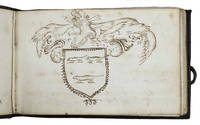
1750ABC_46340The Netherlands 1750. Oblong 8vo ca. 10.5 x 16 cm. 18th-century gold-tooled calf gold-tooled spine each board with a double-fillet frame a centrepiece and four cornerpieces gilt edges green cloth ties. Manuscript on paper written in brown and black ink in several - 17th- 18th- and 19th-century hands. With a full-page unidentified coat-of-arms showing three salamanders drawn in brown ink and a page containing 6 smaller crests of branches of the Roorda family in black ink. 1 blank 5 3 blank 20 1 blank 1 78 blank ll. Manuscript family chronicle incorporating multiple chronicles from the 17th and 18th century. The manuscript chronicles the births and deaths of four generations of the Bos Werdolen or Verdole and Roda family in Amersfoort Groningen The Hague Scheveningen IJsselstijn Tiel Deventer Kampen Zuilen and Edam. The book was probably compiled by Dirk Daniel Roda 1726-1898 a lieutenant in the infantry and later beer brewer shortly after the death of his father in 1747. It incorporates chronicles by his father Michiel Roda 1686-1747 his maternal grandfather Jacob Werdolen chronicling 1668-1686 Jacob Werdolen's father Hendrik van Werdolen a note from 1639 and a copy by Hendrik's wife Barbera Bos born 1596 of the chronicle written by her father chronicling 1577-1601.The different chronicles are interleaved with notes by Dirk Daniel Roda which supply additional biographical information. In several pages he describes the his own Roorda ancestors in the 17th century and the process by which they changed their name to Roda. Other notes chronicle the origins of the Roorda family crest of which he has drawn the known six versions. A full-page coat-of-arms containing three salamanders was possibly drawn by Barbera Bos. Although this specific crest could not be identified it probably refers to a branch other than "Bos" meaning forest or wood in her family.With the bookplate of Eltjo Aldegondus van Beresteyn 1876-1948 on the front paste-down. Also with his library label on the front board. Van Beresteyn was very interested in genealogy explaining his possession of the present family chronicle and founded the Centraal Bureau voor Genealogie CBG. A pencil inscription on the second to last leaf notes that the book was bought from H. Coffrie in 1938.Binding somewhat worn and rubbed leather on the spine somewhat cracked and with a few minor gaps paste-downs slightly browned some occasional spotting browning and soiling but overall in good condition. A fascinating family chronicle with a very interesting provenance.l For Van Beresteyn: J.A.A. Bervoets 'Beresteijn jhr. Eltjo Aldegondus van 1876-1948' in: Biografisch Woordenboek van Nederland online source. hardcover
1776168426Paris : Chez la veuve Ballard & Fils Imprimeurs-Libraires du Roi 1776. First Edition. Hardback. Full contemporary tree calf very good. Professionally and period sympathetically re-backed with raised bands and the title blocked direct in gilt; very impressively finished. Generalized wear to the board extremities. Armorial motif in gilt to the frontpanel. Remains particularly well-preserved overall; tight bright clean and strong.; 8vo 8"" - 9"" tall; 472 pages; Series; Supplement de L'Histoire Genealogique et chronologique des grands officiers de la Couronne v.2. Notes: Title vignette head and tail pieces. Subjects; France - Genealogy - Military affairs - 18th century. Large folio. Paris : Chez la veuve Ballard & Fils, Imprimeurs-Libraires du Roi hardcover
1593UC BerkeleyLick Observatory Massive Archive of the Family of Edward Singleton Holden Including Letters Photographs Family Memoir and Printed Material 1880’s-1960’s<br /> <br /> Collection includes over 800 photographs over 330 manuscript letters plus a variety of printed material and family ephemera. The letters generally are in very good condition with the exception of maybe 10% of them which apparently were nibbled on by critters with some loss of content. Despite this the majority are intact and fully legible. The photos and albums range from very good to poor condition. Perhaps 50% of the photo material received ill-suited non-archival taping which is now brittle and yellow. Many of the photos and albums are annotated. The photo albums are mostly 20th century and appear to be from Edward Holden's daughters Mabel and Mildred. <br /> <br /> Edward Singleton Holden 1846-1914 was an American astronomer fifth president of the University of California and first director of the Lick Observatory. In 1901 he became the librarian of the United States Military Academy at West Point where he remained until his death.<br /> <br /> In 1873 he became professor of mathematics at the US Naval Observatory where he made a favorable impression on Simon Newcomb. On August 28 1877 a few days after Asaph Hall discovered the moons of Mars Deimos and Phobos he claimed to have found a third satellite of Mars. Further analysis showed large mistakes in his observations. He was director of Washburn Observatory at the University of Wisconsin–Madison from 1881 to 1885. He was elected a member of the American National Academy of Sciences in 1885. He discovered a total of 22 NGC objects New General Catalogue of Nebulae and Clusters of Stars abbreviated NGC during his work at Washburn Observatory.<br /> <br /> He was the fifth president of the University of California from 1885 until 1888 and the first director of the Lick Observatory from 1888 until the end of 1897. He resigned as a result of internal dissent over his management among his subordinates. While at the Lick Observatory he was the founder of the Astronomical Society of the Pacific and its first president 1889–1891.<br /> <br /> Edward Singleton Holden was the son of Jeremiah Fenno and Sarah F Singleton Holden of St. Louis. Missouri. Edward would marry Mary Chauvenet in 1871. Mary was the daughter of William Chauvenet a professor of mathematics astronomy navigation and surveying who was instrumental in the establishment of the U.S. Naval Academy at Annapolis Maryland and later the second chancellor of Washington University in St. Louis. Together Edward and Mary would have four children including William who died at birth Mabel 1873-1961 Mildred 1875-1932 and Edward Ned 1877-1956.<br /> <br /> In 1880 Edward and Mary would separate leaving Mary to raise the three children living with her mother and their grandmother Catherine in St. Louis. Mary's father passed away in 1870. This separation unusual for the time colors many of the letters in this archive and is highlighted in Mabel's typed memoir. "Between utter loyalty to my mother whom I adored and my father whose brilliant intellect and fascination and great scholarship drew me to him while at the same time he deserted me and never asked me to be his all again.I was aghast at the life of agony in my mother's heart for she never ceased to love my father." Later prior to one of Edward's business trips to the east Mabel requests he visit "No I will not come! I am convinced that I do not ever want to see your mother again and so I cannot come to see you."<br /> <br /> This tension between Mabel and her father manifests itself in the many letters he wrote Mabel's sister Mildred. Many times Edward would ask Mildred about Mabel or request Mildred pass letters on to Mabel likely indicating an estrangement. Similarly Mildred was a conduit for her father to her little brother Ned whom Edward felt was lazy and unmotivated. <br /> <br /> Throughout the several hundred letters from Edward Singleton to Mildred we sense the sternness of a parent with parental pride of her accomplishments. He rarely lets us with fatherly advice and suggestions on how she live her life. "at any rate you will make a mistake if you run counter to what I ask you in this masterful fashion." <br /> <br /> The archive includes a number of genealogical documents with Holden emphasizing how important good social standing is. He insists in a series of letters that both Mabel and Mildred join the Massachusetts Society of Colonial Dames "recollect that membership in this society makes you at once accepted by the very people in America." 'I find Mabel is much too lax about this indispensable mark of good breeding & you must not be." The archive also contains Holden's application for membership into the California Society of the Sons of the American Revolution.<br /> <br /> Money or the lack thereof is a constant refrain in Edward's letters. He often apologizes for not providing better for his children. Holden was a prolific author and held appointments as UC Berkeley President and Director of Lick Observatory but was always complaining about money. In a February 1899 letter "I have not been idle a moment--but the pay waits until the publication. I want you to understand this--& to know that it is not my fault I have not been appointed to two good places with salaries & shall not try for any more such places. I am tired of fighting slanders 20 years old. It's a pity that the effect of them has to be felt by your girls--but so it is."<br /> <br /> In a note dated October 1901 Holden writes to Mildred "I've been appointed at West Point in chg. of library & have accepted." Holden's career was filled with controversy and disappointment. For more on his career see "Rise and Fall of Edward S. Holden" by Donald Osterbrock published in 1984 in the Journal of Astronomy.<br /> <br /> We find relatively little about Edward Singleton Holden's private life with few mentions of friends and no romantic clues. One curiosity arises from January 7 1895 when Holden writes "I shall soon go to spend a while with my old friend Mrs. Jessie Benton Fremont in Los Angeles. I'm not very well & this change is good for me." Fremont 22 years his senior was living on a widow's pension granted by Congress after her husband John C. Fremont died in 1890. <br /> <br /> Archive Includes the following:<br /> <br /> --Photo albums with 800 pictures in range from the 1880s to 1960s.<br /> --A typed manuscript 88 pages from Edward Singleton Holden's daughter Mabel detailing their relationship and his estrangement from his family the loss of her daughter and the end of her life.<br /> --18 letters and other documents all from the astronomer Edward Singleton Holden dealing with his time as a member of several committees at the US Naval Academy in the 1890s. There are several handwritten documents from him and a number of documents signed by various Naval officers and more. There is interesting content throughout.<br /> --128 handwritten and signed letters from Edward Singleton Holden to his daughter Mildred. They are from the 1890s and are all written from Mount Hamilton at the Lick Observatory at the University of California. They have good personal content and are in mostly good condition. Many of the letters are quite long.<br /> --140 letters to Edward Singleton Holden and his family. These letters are from family and some well-known people to him and his daughters from the 1890s into the 1910s. Some of the authors of the letters include:<br /> <br /> Alfred Elliott Bates<br /> Arthur Twining Hadley<br /> Carl William Ackerman<br /> Charles Doolittle Walcott<br /> Clarence Cary<br /> Fitzroy Carrington 2<br /> George Brinton McClellan Jr<br /> George Lewis Gillespie Jr<br /> George Platt Brett Sr<br /> John Shaw Billings<br /> Joseph Roswell Hawley<br /> Nicholas Murray Butler 2<br /> Peter Smith Michie USMA<br /> Rossiter Johnson 2<br /> Talcott Williams 3<br /> --Antique address book. There are many entries as well as blank pages included inside.<br /> --Signed handwritten letters to Edward Singleton Holden including sympathy cards received after his death from various people in politics and military.<br /> --Mabel Randall-MacIver Mabel Holden Autobiographical Collection: Diary notes 10 pages on legal size paper Autobiographical notes 24 pages on legal size paper Autobiographical notes 8 pages dated July 12th 1946 Autobiographical notes 111 pages dated from November 5th 1949 to July 8th 1951 Autobiographical notes 10 pages dated April 1952.<br /> --Fontainebleau Alumni Bulletin April 1952 Complete issue with an article and picture of Mabel Randall-MacIver on the front page. Partial text from the article reads: "This is only a very small part of the story of Mrs. David Randall-MacIver. Her life filled with so many interesting events from childhood to this very day would fill volumes. It is hoped that she will find some time to devote to her autobiography."<br /> --Records of Mabel Randall-MacIver: History of Edward Singleton Holden letter 11 Pages dated October 7th 1952 sent from the War Department Library U.S. Military Academy West Point N.Y. - Details of his professional educational and personal accomplishments.<br /> --Letter 1 page dated December 22nd 1958. Correspondence sent from Bryn Mawr College President's Office regarding that there are no pictures available of the memorial to Story Kirkbride given by the class of 1922.<br /> --Letter 2 pages dated May 17th 1961: Holden family genealogy details.<br /> --34 manuscript letters from Catherine Chauvenet mostly to granddaughter Mildred <br /> --Handwritten obituary of David Randell Maclver the British-born archaeologist. He is most famous for his excavations at Great Zimbabwe which provided the first solid evidence that the site as built by the Shona people. Also he was an intelligence officer for the American military during WWI and during WWII assisted the US army to preserve historical monuments in Europe.<br /> --Letters to Maclver's wife expressing condolences for her loss.<br /> --Sympathy letters written to Natalie Tuttle Martin expressing condolences for loss of Mabel/ Mildred Holden-Maclvers<br /> --Letter 2 pages dated November 1946 with 97 signatures: National Conservatory of Music and Declamation November 1946 Paris. 'The students of the Conservatory would like to thank the American Mutual Aid to Artists for all the good that has been done to them. They are deeply touched and grateful and will never forget what Americans do for them in hard times.'<br /> --3 Vintage Andrea Del Sarto Drawings #8 #58 #63<br /> --1 Vintage Michelangelo Drawing #32<br /> --1 Vintage Sandro Botticelli Drawing #52<br /> <br /> A deep dive into the family of influential scientist and writer Edward Singleton Holden. This archive has been privately held by heirs of Edward Singleton Holden and none to our knowledge have been available for scholarship. unknown
31319<p>The collection contains 126 letters 377 manuscript pages 7 manuscript essays 19 pages and one Christmas card sent to his Westall cousins by Thomas Wolfe manuscript sentiment in his hand. The collection also includes over 165 Westall – Justice family photographs from the 1880's – 1940s including carte-de-visite cabinet cards boudoir cards snapshots large format studio portraits as well as press photographs. The bulk of the images have been identified by a Westall family member in ink on the verso of the images identifying the sitters. The collection includes 60 related ephemeral items.</p><p>The correspondence comprises the courtship letters of William Harrison Westall and Emily I. "Pink" Justice. The collection also includes letters to Emily from family members and other suitors. Westall and Justice were both born in Swannanoa North Carolina but at the time of their courtship were both living in Asheville. Westall was working and Justice was a student at Asheville Female College. Westall would become the maternal uncle of the novelist Thomas Wolfe and like his older sister Julia Wolfe's mother displayed similar traits of character. He was confident assertive determined persistent and a bit obsessive. Westall faced opposition from Emily's parents in his courtship in part due to some of these traits. Emily's parents at one point sent her away to visit relatives in Tennessee and effectively banned Westall from their home shortly before their marriage. All of this only served to increase Westall's determination to succeed in his suit. Another source of friction between the young couple was the number of additional "sweethearts" and suitors interested in Emily's attentions.</p><p>William Harrison Westall was born May 16 1863 in Swannanoa Buncombe County North Carolina. He was the sixth of eleven children Henry Addison Sam Sally Julia Elizabeth Westall Wolfe1 – the mother of Thomas Wolfe American author William Harrison Lee Mary Crockett Elmer and Greely born to Martha Anne Penland and Thomas Casey Westall a farmer and builder. On both sides he was descended from pioneer families of western North Carolina. He married Emily I. Justice 1863-1942 of Buncombe County North Carolina. The couple had at least two sons. William Harrison Westall ran a successful building supply and lumber company and helped supply the raw materials during Asheville North Carolina's growth from the early 1880's through the early 20th century after the arrival of the Western North Carolina Railroad. William H. Westall even supplied materials to Biltmore in Asheville. Westall's older brother James Manassas Westall 1861-1943 was a prominent building contractor in Asheville during this period.</p><p>1. Julia Elizabeth Westall Wolfe 1860-1945 the mother of Thomas Wolfe was born on a farm in Swannanoa nine miles east of Asheville. The fourth of eleven children of Martha Anne Penland and Thomas Casey Westall a farmer and builder. She was educated at Judson College in Hendersonville she taught school for a time but stopped when she married William Oliver Wolfe on January 14 1885.</p><p>The couple resided in Asheville where their eight children were born: Leslie 1885-86; Effie Nelson Gambrell 1887-1950; Frank C. 188-1956; Mabel Wheaton 1890-1958; twins Grover Cleveland 1892-1904 and Benjamin Cleveland 1892 -1918; Frederick William 1894-1980; and Thomas Clayton 1900-1938.</p><p>In 1906 Mrs. Wolfe bought for $ 6500 a boardinghouse at 48 Spruce Street which she operated until her death. The house was called the Old Kentucky Home by its former owner it was the Dixieland of <em>Look Homeward Angel</em> and <em>Of Time and the River</em>. The house was purchased by the State of North Carolina in 1975 as a historic site it was then opened to the public as the Thomas Wolfe Memorial.</p><p>In his novels Wolfe provided a largely autobiographical account of his family's life from the turn of the century on. Julia Wolfe became the fictional Eliza Gant a small compact and persevering woman determined to keep her family together and manage fer boarding house in spite of marital discord and tragedies such as the deaths of her sons Grover and Ben. An able talker with a remarkable memory she provided her son with much raw material for his novels and short stories Her talents in business not only in running the boardinghouse but also in real estate purchases and sales eld to the family's relative affluence; thus Thomas was able to attend a private preparatory school and the University of North Carolina.</p><p>After her husband's death Mrs. Wolfe continued her business interests and was able to provide financial aid for her son then teaching at New York University and traveling in Europe. When she lost much of her capital in the Florida real estate crash of the 1920s which was followed by the great depression in Asheville she had to depend mainly on her boardinghouse for income. As he son's books became famous she in turn became noted as the real-life matriarch of the fictional Gants. From the early 1930s onward her boardinghouse drew literary pilgrims to Asheville.</p><p>A close bond existed between Julia Wolfe and her son Thomas from childhood until his death and some commentators have traced similar traits of character such as a prodigious memory ambition verbal power and determination. Their correspondence which spanned thirty years illumines one of the most moving mother-son relationships in American literary history. Always a champion of her son's writing Mrs. Wolfe became ever more so after his death. She often traveled to various parts of the country giving informal talks on his early life and influences. She was buried in the family plot at Asheville's Riverside Cemetery.</p><p>https://www.ncpedia.org/biography/wolfe-julia-elizabeth</p><p>Sample Quotes:</p><p>"Swannanoa N.C. Aug. 9th 1881 to Emily I. Justice Asheville NC</p><p>"Miss Pink</p><p>… I thought I would write you a few lines this morning … Miss Adina has been up for a week she is going home in the morning we had preaching last night at the Depot I would like to know if you ar still in the notion of going to Flatcreek campmeeting. There were a party talking of going to Black mountain this week but they gave out the idea we will all go in September I want you to go I enjoyed the picnic very much I think that I will come to Beaver dam church before very long I want you to let me know when there will be preaching Herre … T.E.W."</p><p>"Oct. 12th 1882 Asheville</p><p>Dearest Emily</p><p>It is with feelings of real pleasure that I take up my pen to write you a few lines. It is a privilege for which I feel very much under obligations to you for being so kind as to grant me. I shall take much pleasure in being able to communicate to you my secret thoughts & desires hopes & joys pleasures & expectations and in short I shall burden you with all that I could wish a <u>very dear friend</u> to know. I anticipate much pleasure from our correspondence & shall do my best to make it agreeable to you. I have long felt a deeper interest in you than you have any idea of. I anticipate with pleasure the day when I can feel assured that you <u>do</u> hold an interest in my future welfare & happiness. How much regard I have for you you do not know. It is not in my nature to express much of my real feelings. I may entertain a <u>very</u> high opinion of an individual but I am not the one to express it unequivocally. It is contrary to my nature temperament and disposition and I can no more rebel against these than swim against the cataract of Niagara. Emily you and I have long been friends in the common acceptance of the term "friend" but may I express the fond hope that our friendship may be placed on a higher nobler plane than it ever was before. May I always hope <u>we</u> may be friends in the most aesthetic sense of the term and not simply what the vulgar unthinking world terms friends. <u>We</u> will know each other; <u>We</u> will understand each other even if the outside world considers us as merely acquaintances. I have my faith in life to carve out myself' I have to attain success by my own efforts; My bark drifts lonely on the the turbid waters of life's rapid deeprolling currents with only me to send up heartfelt wishes for its success in the perilous voyage of life with only me to shed a silent heart rendering tear should it meet its destruction amidst the shoals & breakers which ever surround weak mortals in this voyage. I say "only me" because in the seeming friends of earth can be placed but little reliance. May I hope that in this ocean of life I may have one in whom I can place the utmost confidence in whose faith I can have the most unbounded reliance to whom I can turn when clouds overcast my path & all seems dark & dreary when the world casts a frowning glance upon me and hear her sympathizing voice in accents gentle and sweet bid me look upward and onward … Darling I love you! Why need I seek to hide it longer … Remember our promise to each other not to show our letters to any one. Be sure & keep it I will. . H"</p><p>"Bakersville N.C. Dec. 27th 82</p><p>Dearest Pink</p><p>I don't know that you care much about hearing from me but I want to hear from you and although I may be in Asheville before very long don't want you to forget me entirely while I am away… I left A Thursday morning took dinner with my sister in Marion and started home that afternoon. Something was going on nearly every night – when I was here before but have not enjoyed it much this time. Skated a little one or two days ago and went to a party last night and had the exquisite pleasure once more of running against a sewing machine agent – "It was said" as the legends go that those awful fellows were so thick here once that a tree fell on a windy day and killed <u>fourteen</u>. That thinned them out a good deal but enough are left to be in the way of <u>organ agents</u>. I sold one organ the day before leaving Asheville and Prof Folk who is working with me sold one …</p><p>Father is going to build a printing office soon and has made arrangements to publish a Free Will Baptist paper for the Free Will Baptist association in connection with the one he already publishes … Bradley S. Worthen"</p><p>'Asheville N.C. March 16thm 1883</p><p>Miss Pink</p><p>There will be an entertainment or a show in the Opera Hall at the Court House to night and if the weather is favorably sic and you would like to go; I would be pleased to accompany you there. And if you can go I will call by for you at seven o'clock … Wm. H. Westall"</p><p>"Asheville N.C. Aug. 1st 1883</p><p>Miss Pink</p><p>Dearest One you may be <u>greatly</u> surprised by getting this letter and it <u>will not</u> be anything <u>very</u> strange if you <u>should</u> be surprised. Your refusing to kiss me good night has <u>caused me</u> to <u>suffer greatly</u>.</p><p>Oh! I am feeling so <u>badly</u> I <u>can not</u> sleep a <u>wink</u> to night and as the clock strikes one my mind is like a ship on a stormy sea tossing reeling and blown about by a wind of disappointment; I <u>say</u> disappointment because it was a <u>great</u> disappointment to me in bidding you good-night <u>without</u> <u>a kiss</u> as I have had a kiss nearly <u>every time</u> of late when parting with Miss Pink.</p><p>I am one <u>who honestly truthfully</u> and <u>candidly</u> love you and you have said that you <u>loved me</u>; told me <u>not once nor twice but a great many times</u> that you<u> surely</u> loved me and <u>no one else</u> and that I was the <u>only</u> one that you <u>ever did</u> love well I believed that you did think and do think yet a great deal of me and perhaps did about <u>half-way</u> love me but <u>refusing</u> to <u>kiss me</u> when there was no excuse at all: twelve o'clock at night; when there was no one about; is very plain proof <u>that you do not think so much of me</u>.</p><p>I do not know why it is that I have fallen so <u>deeply</u> in love with you when you as it seems to me <u>can not</u> love me. You are waring a ring as an "engagement ring" and <u>then</u> you refuse to kiss me; one who you claim to be engaged to and one who you say that you love <u>what is the matter</u></p><p>Now Miss Pink: I <u>truly</u> and <u>honestly</u> love you God being my judge and it makes me feel very bad to think that you do not care so much for me.</p><p>May you prove to me that you do think a great-deal of me and I hope you will <u>never</u> refuse to kiss me again on an occasion like tonight when there was no excuse <u>only that you did not want to</u>. Wy did you <u>ever </u>kiss me Was it because I <u>asked</u> and <u>insisted</u> on it Or was it because you was kissing one who you loved</p><p>People sometimes kiss others who they <u>do not love</u> but I do not believe that <u>any</u> young lady ought <u>ever</u> to kiss a young man who she <u>does not love</u> but a young lady kissing a young man who she <u>truly loves</u> I don't think there is <u>anything</u> wrong in it.</p><p>I never heard of a young lady <u>refusing</u> to kiss one she loves when there was no excuse for not doing so and you refusing to kiss me under the circumstances tonight <u>puzzles</u> me <u>very much</u> and I would like to have the <u>puzzle</u> unraveled.</p><p>I am sure there would not be any<u> harm</u> in you kissing me; even if you <u>do not</u> love me for I can assure you that <u>no one</u> will ever know it by me telling them and as far as <u>anything</u> else is concerned you need <u>never </u>have any fear if I <u>know</u> myself.</p><p>I of course will come again tomorrow night as I agreed and if you should not get this letter before then perhaps I will not mention this subject or anything in regard to you refusing to kiss me but whenever you do get this letter answer me either by letter or personal conversation. For I want a reconing sic soon in regard to your manners towards me for the last two or three weeks you <u>never</u> refused to kiss me since you first kiss me until of late so there seems to be <u>something</u> rong sic <u>somewhere</u> and I would like to <u>know</u> where it is and <u>what it is</u>.</p><p>Please excuse this letter for I am feeling so very badly that it is <u>nearly utterly</u> impossible for me to write anything in a systematic or in a grammatical style.</p><p>I will still add a few more lines; saying I <u>can not</u> believe that you know how <u>much</u> I <u>love you</u> or you would not treat me as you have. If it was possible for me to <u>express</u> <u>by words</u> <u>how much</u> I love you I would <u>gladly</u> do so but there is not <u>words in the</u> English language by which I could express my love for you.</p><p>Ever since I had the <u>pleasure</u> of meeting you there has been a <u>fire</u> of <u>love</u> kindled in my <u>heart</u> and it has been burning <u>slowly continuously</u> and <u>warmly</u> <u>ever</u> since and all that is lacking to make it an <u>unceasing</u> and <u>everlasting</u> <u>flame</u> to burn <u>forever</u> is a little breeze of love from your heart; and may you <u>soon</u> send<u> that</u> breeze of <u>true love</u> so that it may ease my <u>aching heart</u>.</p><p>Hoping that you may explain how you feel in regard to what I have said I will close by saying be careful to never let any one get their fingers on this letter. The clock has struck two in the morning and I to bed must go. … W. H. Westall"</p><p>"Asheville N.C. Sept. 29th 1883</p><p><u>Dearest One </u>-</p><p>I thought I would write you a few lines as I am going to Morganton this evening and perhaps will not get back until Tuesday next. I would so much like to have you go with me but I suppose you would not like to go so far alone with me; as you are so much afraid of people talking about you going trips with me alone; and as we would be gone three or four days. But I <u>certainly</u> would like to have you go with me as I shall not enjoy the trip without your company.</p><p>I hope you will enjoy yourself Sunday if I am so far away from you.</p><p>It is like pulling eye teeth to me to be absent from you <u>just one</u> Sunday if I am with you <u>so much</u> during the week.</p><p>I don't wish you any harm but I do wish it would go as hard with you to spend one Sunday without being with me. as it <u>dose</u> sic go hard with me; In other words I wish you <u>loved</u> me as I do you and then you would take it very hard to spend one Sunday without being with me.</p><p>You may think you do love me as much or more than I do you but I think you are mistaken though it may be so but I think it hardly possible. If I should not get back Tuesday I will write you and let you know about it … W. H.W."</p><p>"Asheville N.C. January 3d 1884</p><p><u>Loved One</u>:-</p><p>May I ask you to neither get offended nor vexed at the insanity shown in my frequent letters. I have a <u>reason</u> for writing <u>this</u> one as well as for <u>all </u>I have written you.</p><p>The object of this letter is to tell you my dream of last night. It was about you of course; and as all of my daily thoughts are of you so are my dreams. I will just state the particulars of the dream for if I should try to teel it all it would take a great deal of paper and sometime to tell it …</p><p>First; I thought you came to see me purposely to explain to me for the way you had treated me while I was sick; I thought you explained everything satisfactory; but I told you that in all our court-ship I never had been led to believe you truly loved me I doubted your sincerity; I thought you then looked me in the face tears came into your eyes rolled down your sweet cheeks and that you throwed your arms around my neck kissed me and said: "God being my judge I love you truly and I am yours until death shall part us; love me else I die."</p><p>O! darling; though it was a dream you cannot imagine the inexpressible ease of mind and of heart there was when in that dream I saw the tears gushing from your eyes something I never saw since I have known you and when I thought you whispered in my ear "I love thee truly; love me else I die. O Dear; I can see your lovely form in my imagination before me now just as I saw you in the dream. The sadest thing of the dream is it has added greatly to my misery and suffering; The dream was to me: "Misery of Hell changed to the Happiness of Heaven" When I woke and found it all a dream the happiness of the moment vanished.</p><p>O if I could only be convinced in reality that you loved me in truth as strongly as I was in the dream then I would be more satisfied than I am.</p><p>I am always saying that I am rendered so unhappy by my unbelief of your love. You say you love me and I believe you do but what I am crying about is you do not love me as I do you; your love affections for me is not strong enough. I have no doubt but what you think you could not love me more; you have said so any way; I think you are just mistaken. You know people sometimes are mistaken in some things. I hope I am in thinking that you do not love me as you ought to.</p><p>Dear! It has been nearly a long week since I saw you you think if I care any thing at all for you I would come to see you at any time I want to without an invitation that is a mistake I have two or three reasons for demanding an invitation; I have already given you my reasons for not "calling" in so long a time – you are going to school; you say you have to study your lessons; how do I know whether you have any time apart from your books I am not much to impose on any one if I know it and especially on the one I love.</p><p>Darling we have been engaged for some time and there should not be any doubts in either of us of our love and sincerity if we ever expect to march up to the matrimonial altar together. … Wm. H. W."</p><p>"Asheville N. C. February 29th 1884</p><p>Miss Pink Dear:</p><p>I am not dead but liveth and don't expect to die while I see others living. I imagine I see you to night mourning and weeping because I am not by your side; Then again I imagine I see you sitting around the fireside in the family room or upstairs singing songs of praises enjoying yourself just as well or better than if I were with thee. You asked me the other night "if I would come again Friday night" and I answered "I would"; this is Friday night and I have just returned from your house did not get disappointed seeing you but I imagine you are ready to dispute me when I say I have seen you tonight nevertheless it is so I did not get disappointed in seeing you I saw you at a short distance in a lighted room in the second story of a house' now the reason why I had the great pleasure of seeing you and you not me was there was no light in the window for me.</p><p>You remember I have said to you that when you were expecting me at any rate when I thought you were if there should be no light in the window for me if when I get in sight of your house and do not see a light in the south window I then suppose you are either not expecting me or you don't care whether I come or not it always makes me feel as if my presents are not desirous on your part: can you blame me I guess you do but Oh Dear do not if you please. You know my nature very well and instead of blaming me for my faults you should try to improve them that is if you truly love me and expect to some day be joined in matrimony with me. You of course did not expect me to night or you would have had a "light in the window" or you did not want me; you know it is very hard for me to think you don't enjoy my company but still I am forced to think some thing what do you suppose it is It is this I have been going to see you too often; staying too long when I do go; nearly every time I have been at your house at night you have at a very late hour begged me to go home as you are not allowed to stay up very late bed time.</p><p>I hope you will excuse one who loves you dearly and I will try to do better in the future. I cannot blame you for telling me your bed time I cannot blame you for asking me to go home when I am imposing on you when you are wanting to close your eyes in sleep. Why I did not come tonight was I did not think you were expecting me; and I do not want to go any where not being expected; though I can not see why you did not expect me … Wm. H. Westall …"</p><p>"Asheville N.C. March 26th 1884</p><p>Dear Pink</p><p>I feel tonight as if I could write you a long letter and it is my duty to do so yet I can not write very much <u>not in the right mood</u>.</p><p>I feel very mean for acting as I did last night <u>being so provoking</u> as I was you said you hoped I would not always be so I hope so too and I promis you <u>now</u> that I will never do anything in the future which would cause you any unpleasant feelings.</p><p>I fear you are feeling badly over the way I acted and treated you last night so I write these few lines to let you know that I have repented making a resolution to <u>never</u> do so again; never to do say or act in any way which would not please you.</p><p>I know I am a perfect fool some times and you must not get any ways offended at me I would feel a great deal better to night if I thought everything was right.</p><p>Some day I hope you will understand me <u>to know my heart</u> then I know you will love me as I do you. Fearing that I left you last night feeling very unpleasant I make the promis never to do so again knowing that I am a sinful wretch I will close. … W. H. Westall …"</p><p>"Grafton N.M. 6/7 1884</p><p>Miss Justice</p><p>… As you say fishing and hunting are very pleasant but I prefer to take mine with out the broken arm… If you could have seen me coming into town. I fear you would not have felt proud of your correspondent. I had a young deer tied behind my saddle and two big turkeys in front of me my clothing was considerably the worse for acquaintance with rocks and bushes blood and deer hair. A very dusty face covered with a months growth of beard was shaded by a wide slouch hat. I carried a ten pound repeating rifle large six shooters and butcher knife and wore two cartridge belts one for the rifle the other for the revolvers. In fact I presented so disreputable an appearance that when I caught the first glimpse of myself in a mirror I instinctively reached for my revolver to defend myself.</p><p>We planted our first man in Grafton today a cowboy who undertook to <u>lay out</u> one of our Grafton boys who is only about 20 years old and got left. The fight occurred in a horse corral after dark so the shooting was all guess work both emptied their six shooters one bullet grazed Charlie's temple and another passed through his shirt burning the skin a little. Mr. Cowboy got two through the body and one horse was killed. The fellow said before he died that Charlie was a "<u>good one</u>" and not at all to blame. Charlie has not been arrested and I don't suppose he will be he is known to be quiet and peaceable while the other fellow styled himself a <u>bad man</u> from Texas and refused to give his name even after he knew he was dying. The men he was with called him <u>yaller</u> because he had very light hair and rode a yellow horse. They went off and left him for the boys in town to care for and when told he was dead sent back word to bury him in a blanket. We buried him without ceremony in a rough pine box but I suppose he will sleep as soundly as if laid in a silver mounted casket and a two hours sermon preached over him he was well cared for while he lived but Charlie who followed him to the grave wore the only solemn face I saw there… Jas B. Taylor"</p><p>Asheville N.C. Sept. 27 1884</p><p>"Miss Pink</p><p>I am compelled to go this evening to the city of Hickory N.C. will start in about an hour; Will return next Monday or Tuesday Very sorry to go and be absent from you even so short a time. Would be glad to have you go with me but circumstances won't allow it this time. Please don't forget me until I return and thine shall be the prases world without end. William Harrison W"</p><p>Asheville N.C. March 18th 1885</p><p>Miss Pink Justice Dear Friend</p><p>Your long looked for letter just to hand; I had just about come to the conclusion that you did not care enough to write to me I have been <u>weeping</u> <u>wailing</u> and <u>pawing</u> the earth since you left after hearing what I have of your departure from the Asheville Depot; I have been made to understand that you caught a <u>beau</u> the morning you left A – and that your <u>beau</u> laughed at you being so badly struck with him. The beau was a Mr. Tom Ray whom you met at the Depot introduced to you by your brother It was said that before the train left Mr. Ray had forgotten your name and spoke of you as "<u>that fast girl</u>" he told a friend of his that you had told your brother to ask him to sit with you in the train to Parrottsville said you was badly <u>mashed</u>; I think if all this is so you were badly <u>mashed</u>; it seems very strange that as soon as you get out of my eyesight you will act in any such manner. I can hardly believe this; still at some times I cannot help from thinking but what it must be so I am feeling very badly over it still I am not going to die and you must not think so I am compelled to believe you love me a little if you give me entirely up. I am both sorry and glad that you are not contented with your new home and if you want to come back I will come after you ar any time you will meet me at Parrottsville; could I come down some Sunday leaving Asheville Sunday morning and come backwith you in the evening the same day if so I would rather do that than visiting your Aunts as it is so far from the Depot If I could go and return the same day it would be much better then I would not loose any time please let me know how it is; I will be so glad to see you back in Asheville once again if you don't think so very much of me I have not been contented at any time since you left I walked all over Asheville Sunday had no where to go no place to lay my head I was a miserable boy; I would not spend another such Sunday for the whole world. I wish you could love me so that you would be perfectly contented with me so that you would be perfectly contented with me so that you would never think of traying to catch another beau it seems as though you wanted to travel the world over to see if you could find some one who is better handsomer and more of a "big bug" than I it may be when you travel over the world more you will come to the conclusion that I am about as good a boy as you could ever find. I have become a little wreckless since you left me still I will never cease to love you it matters not where you go or how long you stay. Suppose I should go away for my health to be gone six months and should ask a young lady to sit with me in the train and make her think I was badly mashed on her how would you like it I don't get guess you would like it very much so it is with me but I can't help myself; I have had two teeth filled and I still love you. … Wm. H. Westall …"</p><p>"Asheville N.C. March 26th 1885</p><p>Miss Pink Justice My Dearest One</p><p>Yours just to hand conveying to me the sad and shiking sic fact that you had not as yet received a line from me since you left Asheville. Dear after waiting a long weary and toilsome week I received a long and interesting letter from you which I answered by return mail. I have now been looking for an answer and instead I get a letter giving me a raking for not writing to you… I cannot blame you for feeling sad and lonesome if you think very much of me but I am surprised at you not coming home if you are so lonesome and sad.</p><p>I wrote you in my other letter that if you were not pleased and home sick and wished to return home I would come after you anytime. It hurts me to think you are not enjoying yourself… I will not advise you to come home if you don't want to; as badly as I want to see you for if you could gain your health as you once had it it would be the best thing you could do and you and I would be the more happier. If the place is such as you describe I don't think you will improve very much … William H. Westall"</p><p>"Asheville N.C. April 3d 1885</p><p>Dear Pink</p><p>Yours just to hand and I cannot tell you how very glad I am to hear from you after waiting so long for a letter I had just about come to the conclusion that you had met with someone who you could think more of than I and had given up the idea of writing again.</p><p>I was very much surprised at you putting off coming home so long; as you seemed to be so anxious and home sick; I expected that you would write me to come at once for you instead of putting it off three long weeks but I suppose you are very well contented now; judging from the way you write; you say for me not to tell your people about you coming home that they don't want you to come; and that you are not pleasing them now that it is I that you are trying to please; well; I am very glad to hear you say that; but I have one thing to say it is this; If you are contented in Tenn and you think by you staying there is summer it will be the meanes of you regaining your health I would advise you to stay Don't come back to A – just to please me I would rather you would stay if it is your pleasure to do so and you get well by so doing still I will be glad when you by so doing; still I will be glad when you are in A again where I can see you when ever I want to you did not say whether or not you were or not you were getting better; I suppose you are or you would have been complaining. I don't want you to come back and then say it was I that brought you otherwise you would have remained in Tenn and improved your health. If you think it best for you to stay I would advise you to stay. I have stood your absence one long month and have to stand it three week longer …</p><p>I have gotten so I can view every thing in a reasonable manner and I don't my feelings to cause me to advise you any other way than what would be best for you. … It occurred to me that I would not like to spend any time in Tenn if it is such a lonesome place as you say it is; therefore I thought when you got ready to come home. I would arrange it so that I could start on the train here in the morning and return with you in the afternoon the same day getting to Asheville at sun down; so I selected Sunday for the day so it would not interfere with my business. I suppose I can go to Bridge Port and back in the same day making the connections with trains you know more about that than I as you have gone over it.</p><p>You seem to think that I surely have by this time caught another sweet heart … it seems to me if you cared very much for me and thought I would likely get another sweet heart after you left A you would not have gone and after having gone it seems to me as though you would not put off coming home but would take up the cross and come at once. … W. H. W."</p><p>"Asheville N.C. July 21st 1885</p><p>Miss Pink Justice Dear Friend</p><p>I have just returned home from the Div. room and read your letter of inquiry. I am surprised at you not knowing why I have not been down.</p><p>As you know last Wednesday night when I was at your house your Mother ordered you to bed at half past nine o'clock which was only to let me understand that I was not welcome there; <u>so where I am not welcome I shall not go</u>.</p><p>I suppose your mother is mad with me on account of me telling what I did about your uncle; If I should have<u> made</u> and told what I did and could not prove it there would be some reason in her getting mad but all of what I told came from a <u>true source</u> and can be proved besides other smutty things.</p><p>If your Mother or any one else gets mad with me for telling what I have told will just have to get mad I can not help it and I don't care while I can not blame you with anything I can and will say that I have been at your present home for the last time unless it be under circumstances which I don't expect to look for now.</p><p>I am grieved to think of how things terminated and am very sorry but it can not be helped now.</p><p>I would be very glad to see you and have a long talk with you but if I can not see you without coming to your present home I will never see you; while now tears flow down my cheeks I have made up my mind not to place my self in a position where I would likely be insulted.</p><p>I can not find fault with you you can not help your surroundings or responsible for what your kind people do I once enjoyed life but I can not say that I do now for about two months I have not been satisfied with things in general there will have to be a great change.</p><p>If you can not meet me somewhere else than at your present home I don't know when you will get to see me surrounding circumstances are such.</p><p>I heard of your thinking of going off and am glad you did not go; There are a great many things I want to ask you but I will wait until I see you … Wm. H. W. …"</p><p>"Asheville N.C. November 18th 1885</p><p>Miss Pink Dearest One</p><p>I write you a few lines to night but have nothing strange or special to say only that I am feeling so blue and lonesome that I can not content myself anywhere or at anything. I have tried to read but am so blue I can not interest myself reading any thing; so I concluded I would spend a few minutes writing you a short letter.</p><p>You have of late several times complained of me not writing "good" letters as I once did. <u>Now</u>: if I could always feel as I do to night when writing to you you never again would complain of me not writing you "good" letters for if I should be lost to final words with which to do it. If I were now by your side I could show you better than I could tell you any way.</p><p>I have been as you know very unsettled in my mind and feelings for some little time but to night I feel as though "<u>all is well</u>" and settled as <u>far as I know or am concerned</u>.</p><p>For the last year we have had troubles and differences of many kinds: my hopes tonight are that all <u>such</u> is past and gone to come no more and for the future I hope that our troubles if any will be "<u>little ones</u>"</p><p>It has not been very long ago since when troubled I looked forward and hoped for the day to arrive when I would have forgotten you: when all feelings of love would have gone and vanquished my troubled and unsettled mind <u>but O now</u> <u>what a wide difference what a almost sudden change has come</u> I now look forward to the day when we will be happy with each other I hope you and I will never again do anything or act so as to offend the other.</p><p>I wish I could have seen you to night I would not be feeling so <u>blue</u> I am going the "<u>appointed time sure</u>" sure <u>Friday night</u> look for me and try to be glad to see the one you <u>so much</u> -------- </p><p>Don't <u>mourn</u> or <u>grieve</u> but be <u>merry over all things smile brightly</u> smile on me as you never did before and the praises shall be yours forever.</p><p>I would write more but for the lack of time will have to close <u>excuse pencil writing</u> and believe me I beg you to be the same <u>True Will</u>"</p><p>'Asheville N.C. January 15th 1886</p><p>Darling Pink</p><p>In obedience to your command and my desire I write you a few lines. While I write the south wind is<u> hissing</u> and <u>howling furiously</u> and threatening stormy weather; I am afraid we will have very disagreeable weather for quite a while yet. I will not be very surprised to see a deep snow on the ground tomorrow morning when I awake from my slumbering.</p><p>I had quite a nice time last evening at the party I enjoyed myself as much as I could have<u> you not being there with me</u>. I am very sorry circumstances were such that you could not go for I am sure you too would have had a good time. If you did miss this time you shall not miss all we will have a "<u>good time</u>" "one of these days" if nothing happens and you don't lose all hopes and confidence in me. While we have had so many "<u>ups</u>" and "<u>downs</u>" I can not help but think that things will be adjusted some day soon and all then will be peace and happiness <u>I hope so any way.</u></p><p>While I know you are talked to by your parents about me which tends to make you mistrust me and after <u>so long a time</u> try to separate us I can not help but think it will take more than <u>human influence</u> to part us Those who have tried to separate us <u>shall repent</u>. I can not help but believe you have a feeling t''ward me that will <u>never never die</u>. Our <u>court-ship</u> has been quite a long one. We have had a hard time we have a great many times come near unto separating but now I don't believe there is anything that will separate us but death.</p><p>The best we make of this life it is a hard one let us try and do better in the future – trying to make each other more happier and then we will be as inseparable as the <u>Trinity</u>. I will not get to see you before Sunday after noon at which time I am going to see you if I am run out of Doubleday Town … W. H. Westall"</p><p>'Asheville N.C. January 26th 1886</p><p>Darling Pink</p><p>… I am nearly <u>dead</u> to see you and it is nearly death to me to wait until Sunday next before seeing you again. One week from you seems as a year to me. I heard that one of your old <u>sweet-hearts"</u> has been down to see you but hope there is no truth in the report still I can not help being a little uneasy.</p><p>Can't you come up town one evening this week so that I may get one "<u>peep</u>" at you before Sunday</p><p>Do come and come around to see me I will be <u>more</u> than glad to see you. Dear Do try and make me think that you Love me; if you do don't be afraid to let people know it. Don't you think I am crazy If you do you are not much mistaken. I am so busy this evening and so tired that I can not think of any thing to write. … W.H.W."</p><p>"Asheville N.C. Jan. 30th 1886</p><p>Dear Pink</p><p>Your letter received this morning was very glad to hear from you but very sorry to have you accuse me of Lieing sic you may get mad with me and abuse me in any way you can but to accuse me of "<u>bare face</u>" <u>Lieing</u> sic is a death blow to me; I would rather have you accuse me of anything else than <u>Lieing </u>sic I wrote you that I had heard that one of your old <u>Sweet-hearts</u> had been down to see you; I <u>did hear it</u> and I told you nothing else but the truth when I told you about but had I known that you would "<u>give me the Lie</u>" about it I would not have mentioned it at all I don't believe I ever wrote you a letter without having something to quarrel about and should I live one hundred years I don't think it would be any better; you or I one always mad; <u>Hell on earth and Hell hereafter.</u> I would have come down last night but did not get your letter until this morning. I am feeling very badly this morning but can not help iyt. I will go down tomorrow after non and we will fight it out satisfactory no doubt.</p><p>I did not go to see Rush last night or any one else I am not "bad off" enough to go to see any one. Your abused Darling W.H.W."</p>
30897<p>Archive consisting of 940 letters 2359 pages of correspondence both manuscript and typescript approximately 76 items of related family ephemera in good clean legible condition.</p><p> Extensivecollection of correspondence pertaining to these three inter-married families who emigrated west from New York State to the mid-west and then on to Colorado in the 1860s. Lafayette W. Nichols was a pioneer in the lumber and building supply industry in Denver. He ran a business dealing in lumber and mill work in the 1870s which helped build the city. He later was an investor in real estate and mining. Much of his correspondence concerns his investments and the "Silver Question" which was of concern to Coloradans in the 1890s. He married Mary Plumb their daughter Josephine married William A. Norris. </p><p> Norris was formerly a lawyer from Kansas who ran into trouble there. Norris later became a cattle broker. He was president of the Cornucopia Cattle Company of Fort Morgan Colorado brokering and selling dairy cattle primarily Holstein and Guernsey cattle but also short horns. He traveled extensively throughout Colorado and surrounding states in the course of his business as far east as Wisconsin and as far west as Oregon buying and selling cattle often by the train car-load. His letters are written primarily on the letterheads of hotels from towns and cities small medium and large in Colorado. His letters form a collection in themselves on the hotels of Colorado in the early 20th century. Norris also was president of The Better Roads Association. Based in Fort Morgan dedicated to improving roads in the state; its motto was: "Everybody for Better Roads Better Roads for Everybody." He was also market manager of the Morgan County Dairymen's Association also based in Fort Morgan.</p><p> Norris seems to have been a troubled man. He worked very hard was constantly on the road but he seems to have perennially struggled economically. Norris and his wife appear to have lived apart much of the time Josephine remained in Denver and Norris was often either in Fort Morgan or traveling. His letters to his wife sometimes several a day describe his travels business and efforts to improve their economic situation. </p><p><b>Nichols & Norris Families</b></p><p> Lafayette W. Nichols 1828-1925 was born 3 September 1928 at Randolph Cattaraugus New York; died 18 May 1925 at Denver Colorado; he was the son of Daniel Franklin Nichols 1800-1883 and Lydia Bishop 1793-1859. He was living at Dutch Creek Iowa by 1856 and is enumerated there on the 1860 Census where he is listed as a farmer and enumerated only four families from his future wife's family Mary Plumb and her father F. M. Plumb. He married Mary Plumb on 17 October 1860 at Dutch Creek Iowa. Lafayette W. Nichols was considered one of Colorado's lumber pioneers he moved to Colorado in the 1860s. Mr. Nichols entered the Denver lumber business in 1872 he ran a dealership in sash doors blinds lumber lath and shingles located at the corner of Larimer and 20th Streets Denver Colorado however by 1880 Nichols was listed as a retired lumber merchant and his wife Mary was keeping house. His address was then 12 Nichols Block Denver. In 1900 he was still residing at Denver and listed with no occupation. When the 1910 Census was taken Lafayette was listed in the gold and silver mining business as an employer. In 1920 he was listed without an occupation again. He died in 1925. </p><p> Mary Plumb was born 15 July 1836 Trumbull Co. Ohiodaughter of Francis Merrill Plumb 1806-1899 and his wife Laura Mary Hyde 1810-1854. She is found in 1850 living with her parents and siblings at Kinsman Trumbull Co. Ohio. When her parents moved to Dutch Creek Iowa she moved along with them as per the 1860 Census where she worked as a teacher. She met and married her husband in 1860 at Dutch Creek. By 1880 she was living with her husband Lafayette and their daughter Josephine in Denver where she lived for the rest of her life. Mary died on 28 December 1931. </p><p> In 1910 Mary was listed as a practitioner of Christian Science on her own account. At one point she practiced clay modeling and one of her pieces was put into marble and exhibited at the World's Fair in Chicago. She and her husband had one child a daughter Josephine M. Nichols.</p><p> Josephine M. Nichols was born in June 1868 at Washington Iowa and died in 1950 in Denver Colorado. She is found enumerated in 1880 at Denver where she was living with her parents. Josephine was listed as a teacher at a university in Denver in 1910. She married William A. Norris in 1911. In 1917 Josephine is found as the President of The College of Speech Arts at Denver. In 1920 although married she lived at home with her parents and was still listed as a teacher. Despite their marital and economic problems Josephine and her husband never divorced. By 1930 she was listed with no occupation presumably caring for her mother who lived with Josephine and her husband. By 1940 after the death of her mother in 1931 she appears to have taken a job again as a teacher at a private school. Josephine lived in Denver until her death in 1950.</p><p> William A. Norris 1862-1954 was the 8th of 15 children born to Andrew Jackson Norris 1825-1893 and Euphany Lewis 1830-1911 of Concord Kentucky. Norris is found living at Concord in 1870 and 1880. On 5 April 1889 Norris was admitted to practice law and is found in Salina Kansas as an attorney where he was elected to the office of County Attorney. In 1897 Norris was accused with at least six counts of accepting money for conducting his official acts. The story made the front page of <i>The Salina Daily Union</i> on 2 September 1898. Norris declared his innocence and hired an attorney and a famous detective Sylvia Marshal to secure evidence of his innocence. He denied all the accusations. The case was investigated and went to the Kansas State Supreme Court. Norris was found guilty and disbarred in 1899 and removed from the office of County Attorney. Norris' guilt was due to a practice of many years by country attorneys of accepting a fee of $250 for cases dismissed while apparently illegal all those years it was never prosecuted but when he was prosecuted and was found guilty Norris was the County Attorney. While not given a jail sentence he was disbarred and lost his job as County Attorney. In 1908 an attempt was made by attorneys to have him reinstated as per <i>The Lindsborg News- Record</i>Lindsborg KS 4 Dec 1908 but it was not successful Norris left Kansas for Colorado where he met and married Josephine M. Nichols on 19 September 1911. The couple made their home in Denver. He lived with his wife at Denver for the rest of his life where he appears to have been an attorney at one point. Later in 1930 Norris was listed as a salesman of livestock and in 1940 was listed as a literary writer. He died at Denver in 1954 outliving his wife by four years.</p><p><b>References:</b></p><p>Ancestry.com compiled genealogies of the Plumb & Norris families as viewed on 8 Jan 2021.</p><p>Newspapers.com as viewed on 9 Jan 2021. Used for stories of Norris legal troubles as per editions quoted in text above.</p><p><i>The Times</i> Streator IL 22 Sept 1911 Page 1 – announcement of the marriage of Josephine M. Nichols and William Norris.</p><p><b> Francis Merrill Plumb 1806-1899</b></p><p> Francis Merrill Plumb was born 18 September 1806 at Litchfield Herkimer Co New York. He was the son of Theron Aaron Plumb 1785-1864 and Harriet Merrill Merry 1785-1835. Francis was the eldest of at least 13 children born to his parents as follows: </p><p>Francis 1806-1899; Martha 1808 -; Theron Calvin 1810-1838; Samuel 1812-1882; Mary 1813-1836; Jacob 1815-1861; Col. Ralph Oberlin 1816-1903; Calvin C. 1816-1840; Hiram Abiff 1820-1869; Edward B. 1822-1869; Harriet 1823 -: Julius Ashtabula 1827 -; & Elizabeth 1828 -. </p><p>Francis's father Theron was the son of Ebenezer Plumb Jr 1739-1821 and his wife Mary Skeel 1739-1833 who were married about 1767 at Richmond Berkshire Co Massachusetts. Francis' father is died in 1864 at Clay Washington Co. Iowa at the age of 80. Francis's mother Harriet was the daughter of Samuel Merry Sr. 1750-1827 and his wife Hannah Merrill 1747-1814 who were married about 1769 in Hartford Connecticut.</p><p> Francis Plumb married Laura M. Hyde on 19 October 1830 at Hormon Trumbull Co. Ohio. She was born 9 February 1810. She and her husband Francis had at least 15 children as follows:</p><p>Hyde Plumb 1831-1855; Ezra Nelson Plumb 1833-1911; Faucett/Fawcett Plumb 1834-1919; Mary Plumb 1836 -1931; Sarah Plumb 1838-1921; Isabelle Plumb 1839-1859; Rosa Hyde Plumb 1841-1924; Dahlia Plumb 1842-1850; John Brough Plumb 1844-1921 he worked a job as a typesetter on the "Central City Register"; Robert Porter Plumb 1846-1921; Laura Mary Plumb 1848-1926; Jennie Laura Plumb 1851-1932; and Annie Plumb 1852 -.</p><p> In the 1850 Census Francis is found with his wife and ten of his children living at Kinsman Trumbull Co. Ohio listed as a farmer. The 1855 Iowa State Census finds Plumb enumerated at Pleasant Ridge Lee Co. Iowa and in 1860 his first wife having died in 1854 Francis was now found enumerated at Dutch Creek Washington Co Iowa living with several of his children. The 1865 Illinois State Census shows Plumb then residing at Kendall Kendall Co Illinois. When the 1870 Census was taken Plumb was now found enumerated at Central City Gilpin Co. Colorado Territory and was again listed as a farmer with his son Nelson living with him and listed in the mining business. Francis moved to Central City and soon after founded a quartz grinding mill followed by a timber mill. By 1872 he relocated to Streator Illinois a town said to be virtually founded by his brother Ralph Oberlin Plumb 1816-1903.</p><p> Francis's brother Ralph Oberlin Plumb was a Representative from Illinois. He was born in Busti Chautauqua County New Yok on 29 March 1816. He attended the common schools. He engaged in mercantile pursuits and moved to Ohio. He became a member of the Ohio State House of Representatives in 1855. He studied law and was admitted to the bar in 1857 and commenced practice in Oberlin Lorain County Ohio. During the Civil War Ralph served in the Union Army as captain and quartermaster of Volunteers 1861-1865. He was brevetted lieutenant colonel. After the war he moved to Illinois in 1866 and settled in Streator where he engaged in the mining of coal and the building of railroads. He became the mayor of Streator Illinois 1882-1885 and then was elected as a Republican to the Forty-ninth and Fiftieth U.S. Congresses March 4 1885-March 3 1889. He engaged in banking until his death in Streator on 8 April 1903.</p><p> Francis M. Plumb lived a peripatetic life. we find he may have also lived or travelled to: Kinsman Ohio March 1852; Pontiac Illinois Feb. 1867; Kenosha Wisconsin Feb. 1867; Kinsman Ohio March 1867; Orangeville Ohio March 1867; Dover Plains Dutchess Co. New York May 1867; Patterson Putnam Co. New York June 1867; Denver Colorado Territory Oct. 1869; Central City Colorado Territory Nov. 1869 Jan. 1870 March 1870 Oct. 1870 Nov. 1870; Denver Colorado Territory Dec. 1870; "Plumbville on the Divide El Paso Co. Colorado Territory Jan. 1871; Denver Colorado Territory Feb. 1871; "At the Mill on the / Divide in Col. T.Y. / Sixty Miles from anywhere" March 1871; Kiowa Colorado Territory May 1871; Streator La Salle Co. Illinois Feb. 1872; Streator Illinois Sept. 1876 Jan. 1877. March 1877; and finally Joliet Illinois March 1884 where he appears to have lived until his death.</p><p> After the death of his first wife Laura on 9 November 1854 he remained a widower until he was married a second time on 15 June 1881 to Hattie Elizabeth McIntire. She was born 19 March 1830 at Fredonia Chautauqua Co New York. She had previously been married to Jones H. Whitney in 1848 and had two children with him. Mr. Whitney died shortly after the Civil War and Hattie a widow went to live in Joliet where she met and married Plumb.</p><p> Francis M. Plumb died 25 January 1899 at age 92 at his then home in Joliet Will Co. Illinois and was buried at Kinsman Presbyterian Cemetery Kinsman Trumbull Co. Ohio.</p><p> Francis' sister Mary Plumb Sutliff 1813-1836 was said to have been the first wife of Levi Sutliff 1806-1864 who was a major force in the local Underground Railroad movement died at Trumbull Co. Ohio. The Sutliffs were a pioneer family in Trumbull County coming from Connecticut. They settled in Vernon Ohio and succeeding generations were influential civic leaders through 1955. Brothers Levi active in the Underground Railroad in Trumbull County and Milton 1808-1880 Ohio Supreme Court Judge and Senator supported the Abolition movement and the Underground Railroad financially and politically. They both attended the organizational meeting of the National Anti-Slavery Society in Philadelphia in 1833. Levi's daughter Phebe T. Sutliff a scholar and the first woman president of Rockford Illinois College was instrumental in the formation of many civic organizations in Warren. She was also a candidate for Congress in 1924.</p><p><b>Sample Quotes:</b></p><p>Bear Creek Colorado Dec. 13th 1863 Julia to Mary Plumb</p><p> "My Ever Dear Mary</p><p> Your kind and most welcome letter came to hand Friday last. It found us still living on Bear Creek… I have been to see your brother once since you left he was well and if I am any judge of housekeeping he is getting along nicely … Porter is gone to the River. So the boys tell me. I have not been to Denver since I went with you… Mrs. Mowry has had no parties since the people say Mr. Mowry is drinking very hard. I presume you have heard of Mr. Dunn's death he killed himself drinking and I am afraid Mr. Mowry will go much the same way. … recd a letter from Mr R last week he was at Kearney on the fifth of this month said he had quite a hard trip of it… Wallace Milliag has returned from the new mines he says Griffith is doing well there. Wallace done well & is going back in March. Mary let us go to the new mines. What do you say … I have not seen any of the Denver boys since you left expect to go to Denver this week then perhaps I may see some of them…" </p><p> London England June 7th 1875 Ralph Plumb to L. W. Nichols Denver Colorado</p><p> "You are doubtless aware of the departure of the health seekers from Omaha about the 1st inst as I am informed by cable and you can sympathise with me in the deep interest felt for the undertaking… I make the distance from Omaha to Colorado Springs via Denver by wagon road to be about 700 miles and if Geraldine should endure the journey and improve it will take them some 40 days or say 35 days to Denver. I shall expect to have a cable from some point on the Union Pacific besides letters by every steamer… </p><p> My year of banishment has not been entirely lost even if the business which called me here shall prove a failure for I have had an excellent opportunity for observing the English people high and low rich and poor learned and ignorant and to trace in their present condition the effects of their religious and political institutions. </p><p> … I do not thus judge from any present appearance of opposition to monarchy in Great Britain. On the contrary there is a remarkable unanimity of feeling in favor of Queen Victoria and no one advocates a change. But let another come to the throne who is in any sense a king and not as the present Queen is a mere cypher and then an elements now existing here which would develop and crystalize into shapes that nothing could resist. The masses of England are now fearfully ignorant but the school master is abroad they are copying our system of schools and are making slow but sure progress towards free schools and universal education. </p><p> Another influence is also quietly at work which in due time will powerfully aid in overthrowing monarchy in England and that is the disestablishment of the church … Disestablish the church make education universal and extend the suffrage to all who are of age and the next thing will be the overthrow of Monarchy. But the English move slow they are tied to old forms and will not adopt new ideas with the rapidity of Americans in fact if a change re to come <u>only</u> because an enlightened public opinion demanded it great would be the delay. Here as elsewhere great forces are silently at work which cannot be resisted and these though but dimly seen at present are sure to assert their power. England has attained her present commanding position by employing her laborers profitably and very largely in the manufacture of steel and iron for which articles the United States has been her very best customer. It is now demonstrated by actual working that both iron and steel can be made at less cost in the United States than here even with cheap labor and cheap capital in Englands favor so that in the immediate future not only will the United States cease to be Englands customer but will become her most formidable competitor for the markets of the world not only for their articles but for many others. Now remember there are here 32000000 and where these are deprived of profitable employment either force or a concession of natural rights must be employed to keep the laboring portion quiet. Force cannot be successfully used and concession must be adopted…"</p><p> Streator Il Oct. 25 1885 Ralph Plumb to L. W. Nichols Denver Colorado</p><p> "The Rocky Mt News having an article on the much mooted silver question came duly to hand and is already in my scrapbook to which a lot of literature on that subject has found its way.</p><p> Up to this writing I cannot see that the coinage of silver should be changed in any way except to make it free as is gold coinage. Coining less than all that is mined and not wanted for the arts tends strongly to depress the market price in fact it is difficult to see why it would not go to par if coinage was not restricted. No doubt the objector would say that you would make money too plenty.</p><p> Doubtless it would seem so to the holder of bonds and securities for it would open the power of his holdings but for the great debtor masses such decrease in the power of money would work no harm but on the contrary good and as between these two classes patriotic justice demands that the latter should be served. I take no stock in the idea that silver is not wanted by the people because of its cumbersomness; a silver certificate is no more cumbersome than is a gold certificate and it will pay as many debts and buy as much property as either gold or silver itself. True it may be necessary for the government to provide storage but what of that What is government for if not for the purpose of serving the people who are or at least ought to be the masters of the government.</p><p> It is well to inquire who it is that demands the denomination of silver or the stoppage of coining it even. The whole discussion has been introduced and engineered by the monied class and no one else – True I must often with the average citizen who has heard so often that silver is driving gold from the country that he half believes it and is of course alarmed lest something terrible is about to happen but even such an easily made to see that gold never leaves the country as long as the balance of trade is in our favor as it now is -is likely to be and has been for years. No unless a light from some pinnacle higher than any Wall Street house comes to correct me I cannot aid in disturbing silver – let "the dollar of the daddies" roll from every mint without let or hindrance. It is good for our people the people are the government and the United States is able to do what ever is for the peoples good…" </p><p> House of Representatives Washington D.C. January 17 1887 Ralph Plumb to L. W. Nichols Esq. Denver Colorado</p><p> "Dear Sir</p><p> I notice in the newspapers that ex-Senator Hill contemplates establishing Smelting works in Aurora Illinois. Now if he has such a thing in mind it would be a great mistake to adopt Aurora as a location when Streator is so much better that out of pure regard for Senator Hill's interests I desire to call his attention to Streator as possessing superior advantages to any location for such a purpose in the State of Illinois.</p><p> Smelting requires fuel and the cheaper the fuel the greater the profit. Vermillion coal is unequalled for smelting purposes. It produces bot gas and coke to a degree that no other Illinois coal equals. The railroad facilities of Streator are more than double those of Aurora but I need not enlarge for you know these facts as well as I.</p><p> It may not be true that Senator Hill contemplates such a move but I would ask you to interview him and tell him what you know about Streator. I have written him to-day so that you need not inform him that you see him at my request. It would be a "ten strike" for Streator to have such an acquisition as the proposed smelting works. …" </p><p> "Streator Illinois Oct. 16th 1892 Ralph Plumb to L. W. Nichols Denver Colorado</p><p> "Returning from Iowa Dakota and Minnesota yesterday I found yours enclosing check for three hundred fifty seven $357 dollars which is endorsed on your note and pays interest until July 1892. In my absence RG Ingersoll delivered his lecture on Voltaire at the Opera House. While regretting we did not hear him we are glad a full house greeted the great agnostic and were well paid for their interest.</p><p> You ask about Bald Mountain. Lillie is still trying to get the tunnel far enough ahead to reach the gold bearing grand channel but has not found it and may never do so but with a dogged perseverance which we call faith we are persisting and have hope. The tunnel is now considerably over a mile long. I had heard of J D McCords great loss. I know how heavy a blow the death of his wife must be to him.</p><p> We have all of the excitement we need for the present. The worlds fair dedication and a McKinley meeting will take up the present week…" </p><p> Baltimore August 10th 1893 Robert Culver Real Estate and Loans to L. W. Nichols Denver</p><p> "… I have kept close watch of the reports from Colorado and see what terrible times you have been having there. If Congress does nothing to relieve the situation I will inevitably have a good deal of Colorado property back on my hands. The pressure is just beginning to tell on us here in Baltimore. But the last day or two "since the Presidents message to Congress". I have taken new courage. I believe the bulk of the party will leave him and that Congress will pass <u>some</u> kind of a free silver law. Then we shall se whether Cleveland will veto it or not. They are bound to have very exciting times in Washington for the nest month or two and I am thankful that Colorado has two such able men in the Senate." </p><p> Baltimore August 16 1893 Robert Culver Real Estate and Loans to L. W. Nichols Denver</p><p> "… I will let you have the money you asked for just as soon as it can be got out of the Boulder Bank and I will write to Dr. Bond today. I suppose he has the hardest kind of a time to keep his Bank open at all. But I presume in a very few days it will be in better shape. We are beginning to feel the pressure of the tight money market here. Not a dollar can be borrowed from the banks here now with any kind of security. We have been building a good deal this summer and have used all our spare money. I think money will get plentier very soon now as people begin to see that we are not going to the single gold standard. I am encouraged at the outlook in Congress and think all will be well…" </p><p> Baltimore December 15 1893 Robert Culver Real Estate and Loans to L. W. Nichols Denver</p><p> "… Times here are just beginning to get hard to keep soul and body together. It is a very queer state of things. Money is plenty and commands a very low rate of interest and all kinds of produce is very low in price but the poor can get no work to do to earn anything. No new enterprises are being started and Factories are constantly reducing wages and discharging their hands. All enterprise has been crushed out. I don't think we have seen the worst here yet. Colorado I believe is going to recover sooner from the crash than this Eastern country. We shall not have real good times again in my opinion until we get free coinage of silver again which I believe will be within five years. I see there are four new States likely to be admitted into the Union. Then with a western silver President we will be in shape to accomplish it. Our business here don't suffer from hard times as much as I anticipated…" </p><p> Streator Illinois Dec. 29th 1893 Ralph Plumb to L. W. Nichols Denver Colorado</p><p> "Dear Sir</p><p> … I return herewith the letter of your Balt correspondent. I hope he may prove prophet as to free coinage. There are indications of financial trouble throughout those European countries that have adopted the gold standard and are trying to rob silver of its money quality and it begins to appear to thinkers in Europe that the almost universal depression is traceable to the crucifixion of the white metal. Should this sentiment obtain and become a conviction it is probable that the back track will be taken and the great mischief be undone but as the battle now stands there is no hope for help from the other side of the Atlantic nor from those of our own financiers whose opinions are imported from Europe free of duty. As to our own country at this writing the gold bugs are on top. They have the democracy with them through ignorance and enough republicans through greed to control the situation.</p><p> The US could dictate free coinage to the whole world if determined to do so and it is in the power of a compact party of voters enough to hold the balance of power to win the fight but it must act with both wisdom and firmness. Many of the free coiners are demagogs pure and simple – none such are capable of leading on to victory. It requires a revolution among the voters – a throwing off of party allegiance – a devotion to the public good such as is borne of wide spread adversity – The required condition is now supplied and if leaders come to the front sufficiently devoid of political itch for personal preferment the work of reinstating silver can be accomplished.</p><p> But we can't "go it alone" with the balance of trade against us and nothing short of protection will insure us against the adverse balance. "Protection and Free Coinage" is an issue on which victory can be secured." </p><p> Streator Illinois January 17 1894 Ralph Plumb to Mary P. Nichols Denver</p><p> "Dear Niece</p><p> The newspapers said a Ben Hur organization had been formed in Crawfordsville Ind at which place Lew Wallace resides. At Rose's suggestion I called Gen Wallaces attention to your statue of Ben and suggested that the "Tribe of Ben Hur" purchase it if it was for sale. Enclosed I send you the General's reply. If you can forward a photo to Frank Snyder of Crawfordsville it may lead to business. I will write to Mr. Snyder telling him that a photo may possible be had…"</p><p> Accompanied by Wallace's letter to Plumb dated January 15 1894.</p><p> Baltimore April 15th 1896 Robert Culver Real Estate and Loans to L. W. Nichols Denver</p><p> "… We have not sold any stock since we sent the 2nd Draft but hope to be able to do so soon. The times continue very dull and money hard to get … I am greatly interested in the movement in the political world these days. The gold men are making frantick efforts these days. The N.Y. World today argues that if a free coinage law was passed it would so contract the currency that all kinds of property would go down so tremendously in price as to ruin everybody except the extremely rich. It makes the bold statement that it would reduce prices <u>one half</u>. Perhaps it thinks <u>none</u> of the fools are dead I cut from the news Washington letter of last evening and inclose. It shows how true it is that the silver craze is dead. You know it has been saying in every issue that the silver craze was fast dying out was in fact dead and buried. If the politicians will let the people vote on it squarely I have no fear of the result. The danger is in the silver men dividing their forces. The gold men will vote as a unit…" </p><p> Baltimore May 20 1896 Robert Culver Real Estate and Loans to L. W. Nichols Denver</p><p> "Some days ago Jack sent you by Express all of those Thunder Bute shares you left when you were here $50000 I see by the papers that people are moving out of West Creek and presume the mines there did not turn out as well as we or they hoped they would. If it is thought advisable not to expend any more money there on the Thunder Bute property the money on hand might be expended some where else so that those buying the stock might not loose perhaps after all. I shall be anxious to see how that district turns out … I have been interested in the political outlook lately. I think the cause of silver has never grown faster than it has for the last few weeks especially in East of Colorado. If the Chicago Convention would nominate a good Silver man preferably N. M. Telller it would sweep the Country like a cyclone in my opinion. Even the gold men in Maryland would have a hard time to carry the state."</p><p> Baltimore July 16th 1896 Robert Culver Real Estate and Loans to L. W. Nichols Denver</p><p> "… right in the face of the frantic efforts of all the great news papers of this city to sweep back the tide. Of course I was greatly disappointed that Teller did not get the nomination at Chicago but Bryan was my <u>second</u> choice. </p><p> I believe there is a good chance to carry even Maryland for Bryan and Silver. I have made it a point to talk with our contractors for a long time on the silver question … and now I believe <u>every one</u> will vote for Bryan & Sewall will be elected. But the gold men are rattled and will do every thing possible and there must be no let up on the part of silver men until the election is won. Our office has got to be quite a free silver headquarters as I was one of the first silver men here …" </p><p> Baltimore Sept. 22 1896 Robert Culver Real Estate and Loans to L. W. Nichols Denver</p><p> "… I found a strong silver sentiment in both Cattaraugus and Chatauqua counties. Still a large part of the farmers are so dumb as to stick to the Republican party and advocate the gold standard. Uncle Alvah however is not one of that kind and all of our neighborhood in Cold Spring are for silver. … But New York State will undoubtedly go for McKinley I think. Money is being used in the most disgraceful manner and also intimidation of employers in favor of McKinley. Bryan is however a host within himself I have heard him twice once at Jamestown N.Y. and over here in both places he created the greatest enthusiasm. It is very hard to tell what will be the outcome in this State but it is liable to go for Bryan. At the B &ORR Shops in the City the Gold Bugs have organized a financial school and the ones who are the quickest to learn the gold catechism are to retain their places and those not answering to the satisfaction of the teachers are to be discharged. But thanks to the Australian Ballot when they are in the Booths they are free men. I am not all satisfied with the populists in this campaign. They mixing things up uselessly and may be the cause of loosing the election to McKinley. One of our Baltimore papers yesterday claimed that Colorado was likely to be carried for McKinley of course I knew better. How is the mining business Is there anything being done with the Thunder Bute property. Those to whom the Stock was sold are enquiring of me and I don't know what to tell them. …" </p><p> Baltimore Nov. 27th 1896 Robert Culver Real Estate and Loans to L. W. Nichols Denver</p><p> "… not knowing exactly what to be thankful for. To say that I was disappointed in the outcome of the election is putting it very mildly although I realized the great power of the money and the Trusts and Corporations but I did not fully realize the dense ignorance of the Farmers of Iowa for instance and even of the farmers of the middle and eastern states. There is no excuse for them. They had no business to be controlled by the power of money. The Laborer in the eastern cities are wholly dependent upon their employers and then they are densely ignorant and don't know their interest. The Negroes voted almost to a man for McKinley simply because he is a republican. I don't know how it will terminate but I think in a revolution before many years. I think that a peaceful solution of the money question is now out of the question <u>unless</u> the American people are content to be ruled by a monied aristocracy and become industrial slaves. A foreign war might change the situation. Of course things may have a different outlook in 1900 but at present the future for America to me looks gloomy. … About the most disreputable performances during the last campaign has been the part the ministers and churches have played. With a few honorable exceptions. It has been very disgusting to me and exasperating beyond measure. I was thankful that Colorado came to the scratch in such fine shape and I am proud of her… When we do have cold weather there will be great suffering by the poor. The Coal Trust raised the price of coal one dollar per ton over the price they sold it for last year in all these eastern cities although they pay their laborers less than one year ago. They rob the people of one dollar or more on every ton of coal they use and give back a small proportion of it to secure their votes so as to enable them to continue robbery indefinitely." </p><p> Baltimore Oct. 10th 1898 Robert Culver Real Estate and Loans to L. W. Nichols Denver</p><p> "… About "politics" I fully agree you that we are helpless and can only lie still and see them work out their Devilish schemes. It seems almost impossible to make the average Maryland voter realize and understand the effect of the single gold standard and the contraction of our money. They <u>will not</u> use their brains and are growing more ignorant and poorer every day Maryland is really controlled by voters who cannot read or write. They hold the balance of power and <u>expect</u>and <u>are</u> paid for their votes one way and another but largely with cash. It don't take but a little money to buy a Darkeys sic vote. I am disgusted with the politics of Maryland and I am persuaded it is little better elsewhere. Not quite as much ignorance perhaps but rascality and corruption everywhere. The present administration I think is the most corrupt in the history of the Nation. There is jobbery everywhere. The welfare of the common people is not considered at all. I get discouraged and think sometimes that the Government can never be wrested from the Boodlers the Trusts & Money Sharks. Money seems to be all powerful in the Elections and they have it and use it…Have thought some of going to Cuba or Porto Rico but I think now things will be too unsettled …" </p><p><b> Collection Inventory:</b></p><p> The collection can be divided into three sections:</p><p><b>I. </b><b>Nichols- Plumb Family Letters</b></p><p>a. Letters by Lafayette W. Nichols 1850's-1860's</p><p>7 letters 21 pages</p><p>b. Letters to Lafayette W. Nichols from various correspondents 1855-1913</p><p>65 letters 168 pages</p><p>c. Letters from Ralph Plumb Streator Illinois to Lafayette W. Nichols Denver 1875-1900</p><p> 16 letters 29 pages</p><p>d. Letters from Robert Culver Baltimore to Lafayette W. Nichols Denver 1893-1898</p><p>19 letters 28 pages</p><p>e. Letters to Mary Plumb Nichols wife of L.W. Nichols 1856-1923</p><p>30 letters 113 pages</p><p>f. Plumb-Nichols-Norris miscellaneous correspondence 1860's-1905</p><p>24 letters 71 pages</p><p><b>II. </b><b>Letters to Josephine Nichols Norris</b></p><p>a. 1870's 4 letters 10 pages</p><p>b. 1902 2 letters 9 pages</p><p>c. 1903 primarily from her mother Mary P. Nichols 54 letters 192 pages</p><p>d. 1904 3 letters 8 pages</p><p>e. 1906 2 letters 2 pages</p><p>f. 1909 hereafter letters are primarily from her fiancé and later husband William A. Norris 62 letters 200 pages</p><p>g. 1910 137 letters 363 pages</p><p>h. 191 87 letters 199 pages</p><p>i. 1912 2 letters 9 pages</p><p>j. 1913 43 letters 100 pages</p><p>k. 1914 52 letters 98 pages</p><p>l. 1915 97 letters 239 pages</p><p>m. 1916 76 letters 142 pages</p><p>n. 1917 36 letters 57 pages</p><p>o. 1918 51 letters 113 pages</p><p>p. 1919 23 letters 65 pages</p><p>q. 1920 8 letters 24 pages</p><p>r. Undated letters to Josephine N. Nichols from W. A. Norris 23 letters 53 pages</p><p>s. Later letters to Josephine N. Norris 1920s-1930s 6 letters 18 pages</p><p>t. Later letters to William A. Norris 1920s-1940s 12 letters 28 pages</p><p><b>III. </b><b>Plumb-Nichols-Norris Ephemera 1856-1960</b></p><p>Approximately 76 items including: bills receipts invoices circulars promotional items viewbooks family photographs autograph book small account book deeds promissory notes botanical specimen book school ephemera et cetera.</p> books
19301207Great Britain 1930. <p>8vo. 230 x 180 mm. 9 x 7 ¼ inches. 70 pp. poems & lyrics. Illustrated with 35 original drawings 9 of which are in full color. Album bound in red cloth spine over red boards with the drawing in black in of a Bride & Groom set within a frame of tall leafy trees. </p> <br /> <p>The opening dialogue sets the tone for the entire album the story of loving family wishing there daughter and sister a very happy wedding day. The text of "A Dialogue on an Important Subject Between Two Members of the Pryke Family" reads in part:</p> <br /> <p>Joan. Mummy what is this I hear</p> <br /> <p>M. Collie's to be married dear!</p> <br /> <p>J. Goodness gracious merry me!</p> <br /> <p> When is the Event to be</p> <br /> <p>M. On the tenth of August Joan.</p> <br /> <p> She and he will be made one</p> <br /> <p>J. What's fellow want her for</p> <br /> <p>M. To darn his socks and scrub the floor;</p> <br /> <p> And Dust the room and make the bed</p> <br /> <p> And see that his is amply fed.</p> <br /> <p>Thus the album of a loving family begins with this coming of age poem with a colored drawing on the opposite page of Mother and three sisters presenting the book set on a purple pillow being held by the youngest girl. This is followed by a series of 34 other poems all by family members celebrating Collie the family and some poems of pure whimsy and folly. Each is illustrated with a pen & ink drawing rendered in pure amateur fashion fit for the nature of the album. <br /> One of the untitled poems signed by O. P. suggests that the family relished word games. The first few lines read;</p> <br /> <p>When I was at kcowledge</p> <br /> <p>It came to my nollege</p> <br /> <p>That if could scrough</p> <br /> <p>Out the time to go threw</p> <br /> <p>With my uttermost fourse</p> <br /> <p>A Very long corce</p> <br /> <p>Of spelling . . </p> <br /> <p>The page opposite shows a table with eight books including a dictionary a speller a book with the title "How to use a Vowel" and copy of "Principles of Etymology". </p> <br /> <p>A remarkable gift from Mother and sisters to the daughter getting married.</p> . unknown
1839101827<p>Different papers different sizes but all from the Engelmann family archives.</p><p>Includes:</p><p>1839. One plate for the year sheet size 31 x 24 cm.</p><p>1840. One plate for the year sheet size 555 x 36 cm.</p><p>1841. Two plates each depicting 6 months on a sheet sheet size 32 x 49 cm.</p><p>1842. One plate for the year sheet size 49 x 325 cm.</p><p>1842. a different calendar Two plates each depicting 6 months on a sheet sheet size 32 x 49 cm.</p><p>1843. Two plates each depicting 6 months on a sheet sheet size 575 x 215 cm.</p><p>1844. Two plates each depicting 6 months on a sheet sheet size 275 x 41 cm.</p><p>1844. a different calendar Two plates each depicting 6 months on a sheet sheet size 32 x 485 cm.</p><p>1848. Two plates each depicting 6 months on a sheet sheet size 47 x 17 cm.</p><p>Fine examples of early chromolithography a technique invented in France by Godefroy Engelmann who received his patent in 1837 only three years before the present calendar was printed. The patent was given to him for printing colour lithographs from four stones using just black blue yellow and red in a version of the technique perfected by French intaglio colour printers in the eighteenth century. Engelmann who had been a leading pioneer of monochrome lithography in France was now poised for showing the way forward for commercial colour printing. The success of chromolithography depends on the immensely skilful process of separating each image into its four constituent colours. These calendars clearly show the style of this new technique.</p>
30844<p>Large archive of 1507 letters 6631 manuscript pp. dated 31 October 1884 to 19 May 1964; plus over 300 pieces of ephemera related to the Babb and Conant families.</p><p>Note: A complete inventory of the collection and biographical sketches of its main correspondents can be emailed upon request.</p><p><b>Persis Loring Conant 1887-1964 and Hugh Webster Babb 1887-1971</b></p><p>Persis Loring Conant was born on 29 May 1887. She was the daughter of merchant Frederick "Pardi" Odell Conant 1857-1928 and his wife Eva "Mardi" Merrill 1852-1936of Portland Maine. Persis' father prepared for college in the public schools of Portland and under private instructors and entered Bowdoin College where he received the degree of Bachelor of Science in 1880 and Master of Arts in 1883. A distant cousin of the Conant family was James Bryant Conant 1893-1978 an American chemist a transformative President of Harvard University and the first U.S. Ambassador to West Germany.</p><p>Earlier in 1874 Frederick went to California by way of Panama stopping in Kingston Jamaica and various Mexican and Central American ports and returning overland from San Francisco. In 1879 he went to Cuba visited the important cities and returned home by way of Key West Cedar Keys Jacksonville Florida Savannah Georgia Charleston South Carolina and Washington D.C.</p><p>In 1880 Frederick entered his father's store as a clerk and engaged in business in his native city; and became a partner in 1882. He became president of the wholesale portion their grocery firm of Conant Patrick & Company as well as the president of the Conant Corporation the Atlantic Shore Railroad York Utilities Company vice president of the Fidelity Trust Company and a director of the Bath & Brunswick Light & Power Company. Mr. Conant had been a member of the Portland Common Council and Board of Aldermen and was also a director of the Maine General Hospital and a trustee of the Portland Public Library and the North Yarmouth Me. Academy; he also served as a member of the Board of Overseers of Bowdoin College from 1909 to 1928.</p><p>Persis' paternal grandparents were merchant Richard Odell Conant 1828-1894 and Emma Loring 1829-1904 of Portland Maine her maternal grandparents were Capt. Reuben Merrill 1818-1875 and Hannah Elizabeth Blanchard 1822-1876 of Yarmouth Maine.</p><p>Persis was one of at least four children the others were: Elizabeth "Bess" Merrill Conant 1886-1973; Richard Odell Conant 1888-1950 a graduate of Bowdoin College 1912; and Reginald Odell Conant 1889-1965 who married Marion Drew. </p><p>Persis and her elder sister Elizbeth attended Wellesley College. Elizabeth attended from 1905-1909 graduating with a B.A. and was the president 1915-1917 of the Western Maine Wellesley Club. Persis attended Wellesley from 1906-1910 and graduated with a B.A. A roommate of Persis at Wellesley and a correspondent in this collection was Eva Marguerite Miller of Scranton Pennsylvania. Miller attended Wellesley from 1906 to 1910 graduating with a B.A. She was a member of the Scranton College Club.</p><p>Before Persis married she vacationed at Cumberland Maine in the summer when not at school. Her family lived in Portland. </p><p>Persis married Hugh W. Babb on 19 June 1915 in Bridgeport Connecticut. Persis' correspondence with Babb begins in the summer of 1912. Hugh Webster Babb was born on 3 March 1887 in Yarmouth Maine the son of Howard Seldon Babb 1849-1909 and his wife Margaret Loring 1852-1932 of Westbrook Cumberland County Maine. A second son Paul died as an infant. Hugh's father was a farmer and also worked at a paper mill and later insurance agent. Hugh's mother was born in Yarmouth Maine. She and her elder sister were both employed in the paper mill of S.D. Warren father of the famed art collector James P. Warren.</p><p>Babb attended Westbrook Maine public schools until his last two years of high school when he transferred to Highgate School in England. It was the support of Edward Perry Warren that allowed Babb to study and live in England. While in England he appears to have been baptized at the Parish of St. Thomas Oxford in 1906. While in England Babb's father died. His mother had been living in England with Babb. After earning a B.A. degree at Oxford in 1911 he spent two years at Cambridge and later took law degrees from Cambridge and Harvard 1916. He joined the firm of Brandeis Dunbar and Nutter for two years. This firm was founded by Supreme Court Justice Louis D. Brandeis and his partner Samuel D. Warren in 1879. Brandeis left the firm then known as Brandeis Dunbar & Nutter to take his seat on the United States Supreme Court in 1916 just before Babb joined the firm or perhaps the reason the firm took on Babb due to Brandeis' departure. On his 1917 WWI registration card he was listed as an attorney living at Boston and working for Dunbar Nutter & McClennen. Paving the way for equality and diversity in the industry the firm welcomes its first three women attorneys to practice law in 1918. After a couple of years with Brandeis Dunbar and Nutter Babb became a partner in Perrin Babb and Heavens. </p><p>In 1920 Babb joined the faculty of Boston University he taught law at Boston University for 37. He became the chairman of the law department of its College of Business Administration. He left the university in 1958 and taught for five years at the University of Maine law school.</p><p>Fluent in Russian Babb translated both "The Law of the Soviet State" Andrey Yanuaryevich Vyshinsky and "Soviet Legal Philosophy" V.I. Lenin & others. He also authored five commercial law textbooks.</p><p>Persis died on 19 April 1964. Prof. Hugh W. Babb died on 1 January 1971 at Portland Maine. He was 83 years old and was buried with his wife at the Riverside Cemetery Yarmouth Cumberland County Maine.</p><p> Persis and her husband had four sons: </p><p>Richard "Dicko" Conant Babb 1918-1943 attended Harvard University where he had plans to become a writer. He was active in track and cross country. On the outbreak of World War Two he joined the Royal Canadian Air Force. He died in flying accident in England while serving as a flight sergeant pilot. One of Dicko's letters mention that he was waiting in England to be transferred to the U.S. Air Force. While in England Dicko met a British woman by the name of Priscilla Barrett. They became close. After Richard's death and after the war Pricilla wrote to Richard's mother. These letters are included in the collection.</p><p>Prof. Warren Babb 1916-1987 of the School of Music University of Seattle Washington; he was involved in the founding of the International Webern Society of which he served as treasurer in its early years. The society promoted the study of Anton Webern 1883-1945. The International Webern Society was founded in 1962. The purpose of the organization was to encourage study and performance of the music of Anton Webern an Austrian composer and conductor. Along with his mentor Arnold Schoenberg and his colleague Alban Berg Webern was in the core of those in the circle of the Second Viennese School including Ernst Krenek and Theodor W. Adorno. Webern's music was among the most radical of its milieu both in its concision and in its rigorous and resolute apprehension of twelve-tone technique. He is likely named for Edward Perry Warren a family friend see below.</p><p>Hugh W. Babb Jr. 1919-1988 of Cumberland Maine. He attended the College of Business Administration at Boston University where he was active in crew and tennis. He graduated in 1941 in Business Management. He married Janet Bornhofft and raised a family in Cumberland.</p><p>Prof. Howard Babb 1924-1978. He was Professor of English of the University of California at Irvine chair of the Department of English and Comparative Literature and charter member of the UCI faculty. One of the generation whose education was interrupted by the second World War Howard attended Bard College and Cornell University in the V-12 Program before going on active service as a naval officer. He took his B.A. at Kenyon College in 1948 and earned his M.A. 1949 and Ph.D. 1955 at Harvard University. Before coming to UCI he taught at Kenyon and The Ohio State University where he progressed from assistant instructor to associate professor and vice-chair of the English department. He published articles on such different figures as Christopher Marlowe Ben Jonson F. Scott Fitzgerald and Sherwood Anderson. However his main concern was with the novel and especially with style in the novel a topic he also published on.</p><p>One of the collection's notable correspondents is:</p><p><b>Edward Perry Warren</b> 1860-1928 known as Ned Warren was an American art collector and the author of works proposing an idealized view of homosexual relationships. He wrote 9 letters in this collection 5 to Hugh W. Babb and 4 to Babb's mother. The letters to Mrs. Babb concern an illness Hugh was suffering from when he was attending Oxford Warren was caring for him. The letters Warren wrote to Hugh concern the state of the Classics at Oxford and proposals to change them being mandatory. Warren is now best known as the former owner of the "Warren Cup" in the British Museum. Warren was born in Waltham Massachusetts one of five children born into a wealthy Boston Massachusetts family. He was the son of Samuel Denis Warren 1817-1888 who founded the Cumberland Paper Mills in Maine and Susan Cornelia Clarke 1825-1901 the daughter of Dorus Clarke. He had four siblings: Samuel Dennis Warren II 1852-1910 lawyer and businessman; Henry Clarke Warren 1854-1899 scholar of Sanskrit and Pali; Cornelia Lyman Warren 1857-1921 philanthropist; Fredrick Fiske Warren 1862-1938 political radical and utopist. Warren graduated Harvard with a B.A. in 1883. At Oxford he met archeologist John Marshall 1860–1928 with whom he formed a close and long-lasting relationship though Marshall married in 1907 much to Warren's dismay. Beginning in 1888 Warren made England his primary home. He and Marshall lived together at Lewes House a large residence in Lewes East Sussex where they became the center of a circle of like-minded men interested in art and antiquities who ate together in a dining room overlooked by Lucas Cranach's Adam and Eve—a gift of Harold W. Parsons – now in the Courtauld Institute of Art. One account said that "Warren's attempts to produce a supposedly Greek and virile way of living into his Sussex home" produced "a comic mixture of apparently monastic severity no tea or soft chairs allowed and lavish living. Warren spent much of his time in Continental Europe collecting art works many of which he donated to the Museum of Fine Arts Boston assembling for that institution the "largest collection of erotic Greek vase paintings "in the U.S. He has been described as having "a taste for pornography" and was a "pioneer" in collecting it. His published works include <i>A Defence of Uranian Love</i> in three volumes which proposes a type of same-sex relationship similar to that prevalent in Classical Greece in which an older man would act as guide and lover to a younger man. Warren's oldest brother Samuel D. Warren had left law to work managing the family's paper mills. He managed the family trust established in May 1889 with the legal assistance of Louis D. Brandeis to benefit his father's widow and five children. Edward Warren challenged the family trust in 1906 claiming that Brandeis had structured it to benefit his law partner Samuel to the detriment of the other family members. The dispute ended with Samuel's suicide in 1910. The Warren Trust case became a point of contention during the 1916 Senate hearings on the confirmation of Brandeis to the Supreme Court and it remains important for its explication of legal ethics and professional responsibility. In a printed piece of ephemera published at the death of Margaret Loring Babb Hugh W. Babb's mother she is shown working at the Warren Paper Mill with her sister. It's probable that Hugh's father also worked there as well census records state he worked in a paper mill. This same piece of ephemera states that Hugh W. Babb was able to attend school in England due to the benefit of Edward Perry Warren.</p><p>Warren's family business was the S.D. Warren Paper Mill Cumberland Paper Mills a paper mill on the Presumpscot River in Westbrook Maine. It is now owned by SAPPI Limited a South African paper concern. It is one of Westbrook's major employers. A paper mill was established on this site in the 1730s when it was a rural and fairly unpopulated area. In 1854 that small paper mill in the soon-to-be established town of Westbrook was purchased for $28000 by Samuel Dennis Warren known as S.D. Warren. The mill was named Grant Warren and Company. In that year the mill was only running two paper machines and had a production output of about 3000 pounds of paper per day. Nine years later in 1863 an additional machine was added to the mill and the production increased to 11000 pounds per day. In 1854 paper was made by beating down rags and using the pulp from the rags. In 1867 after the mill changed its name to S.D. Warren Paper Mill Company Warren decided to add wood fibers with rags fibers for paper. It was the first mill in the United States to do so. The mill became the largest in the world. By 1880 the mill produced 35000 pounds of paper per day. Warren died in 1888 and was succeeded by his son also Samuel Dennis Warren who managed the business until his death in 1910. The mill continued to grow through the 20th century employing close to 3000 Westbrook residents.</p><p> The majority of the correspondence in this collection is either written by or to Persis Loring Conant Babb her husband Hugh Webster Babb Persis' parents Mr. and Mrs. Frederick Odell Conant Persis' sister Elizabeth "Bess" Conant as well as Persis and Hugh's children Howard Hugh Jr. Richard & Warren and Hugh W. Babb's parents Mr. and Mrs. Howard S. Babb. </p><p> There are also letters by friends of Persis including her college roommate Eva M. Miller a friend Ethelynde Sylvester Smith the well-known singer other friends and relatives. There are many letters during the time when Persis and her sister and girlfriends were all attending Wellesley College and soon after graduating. There are letters of Hugh W. Babb when he was in college And letters by Robert Hale another suitor of Persis when he was in college. There are also letters of Hugh and Persis' son Richard written when he was serving in the Canadian Air Force during World War Two.</p><p><b>Sample Quotations:</b></p><p><i>"Sunday Oct 1 '05</i></p><p><i>My dear Persis</i></p><p><i>'Sadie' Sally we are going to call her is in here writing on our one table so I am sitting on my couch.</i></p><p><i>Hattie went off to call with her mother on some one in Cambridge right after chapel this morning so I have been alone…</i></p><p><i>I went to chapel this morning or rather the regular Sunday Service with two girls at our table. One is from Somerville Mass. another 120 miles west of Chicago. The choir composed of about 30 girls marched in the first thing singing sort of Episcopal like just like choir boys and marched out after it. A Mr. hall preached the sermon 'God is Love.' Today is Flower Sunday. Always the 1st Sun is…</i></p><p><i>The chapel was jammed all the college girls and some Dana hall and parents. I saw Jennie Milliken when I was coming out of church. She is in Dana Hall.</i></p><p><i>Last night was Christian Association reception and of course we all went. Mabel Waldron took me. Hattie Louise & myself went up to Stone for our girls. I met Mabel's roommate Clara Williams the leader of the Glee Club…</i></p><p><i>…Then I was introduced to Gertrude Owen and I think she is about the most beautiful girl I ever saw. I noticed it at once and afterwards Hattie said she was considered the prettiest girl in college. She is in the choir walks with Miss Williams…</i></p><p><i>After we had been introduced to about a thousand people I was introduced to Pres. Hazard and she asked if I was any relation of Miss Conant at Walnut Hill School. I said I supposed we were descended from the same ancestor and then she said she was much loved here. I also met three people in the Christian Ass. Or something secretary & pres. Or somebody like that who were standing in line with her. Then we had punch and then Pres. Hazard addressed everybody from the stairs in the hall then the man who preached today most of the girls though he made them feel homesick. Then the Pres. Of Christian Ass. & Pres of student government and then the girls sang and gave the Wellesley cheer and cheered the Pres. And all those who spoke. It sounded great. They did it all together so well. The singing of 'Where oh where are the grand old seniors' etc. in a slow sort of way made me feel sort of weepy in fact all the singing but I didn't. Hat wept a few tears after she got home and her mother was here too. Then we came home…</i></p><p><i>Well I must say good night…Love to all of you…Bess"</i></p><p><i>"2 Oct 1905 629 Washington St. Sunday</i></p><p><i>My dearest Schwester</i></p><p><i>I thought I would write you today and tell you my doings the past week or what I didn't tell in my last letter.</i></p><p><i>Thursday Friday and Sat. morning there was cheering in College Hall after chapel. We all hustled up to the third floor as fast as we could go and waited our turn to cheer. Thurs. it was the Senior Officers Fri the Junior Officers and Sat. Sophomore Officers which had been elected the afternoon before. Gladys Doton is Vice Pres of the Junior Class. Isn't that fine Each class gives its own cheer and then says what they are cheering for 3 times as 'Senior Class Officers' or the girl's name.</i></p><p><i>Friday afternoon Miss Hill gave all the Freshmen a talk in the barn on the gymnastics and sports. It was great fun to hear her talk. There are so many things I want to do and you can only do one.</i></p><p><i>Yesterday was a pretty busy day. I went to chapel at 8:30 A.M. and then hustled up to College Hall and up on the 3rd floor and cheered. At nine o'clock I had a recitation in Math on the 3rd floor. Then my class work was done for the morning. I came home with Hattie made my bed and fixed up my things and then plugged German out of Sarah's book. Lunch was at 12:30 then I hustled back with Alice Gager who had a class at 1:30 and I bought a German book or rather 3 two for myself and one for Hattie. It was the last time the place was to be open from 1 – 1:30 so we could buy books. I had to climb to the 4th floor to go to the German Office. I went over to Katherine's room & asked them to supper. Then I went out under the trees facing the lake and sat on a bench and studied my German some more till 2:15 and then I went back and went to my German class up one flight. Then Hattie & I went down to the bookstore just below the German room and I bought a little blue note book…</i></p><p><i>…Mae Lowdon and myself went back up to College Hall to an 'At Home" to meet Miss Dudley who was something to do with the College Settlement Work in Boston. It was from 4 to 6 but we didn't get there till 4:30 probably…</i></p><p><i>Just as the bell rang for dinner Katherine and Fuzzy came and we hustled over to dinner. They had been to a tea and so couldn't get here any sooner. They and Hattie sat at my table. One of the girls there Julia Pease also had an upper-class girl so it was quite jolly. Betsy Eskay had her Senior to supper also a Miss Frickel who seemed very nice. I met her after supper. She did not sit at my table.</i></p><p><i>We sat over there in the parlors for a while and talked and then I had to come home and get dressed. At eight we went down to the Wellesley Inn. Some of the girls live there and they had asked all the Freshmen from A to M to a dance from 8 to 9:30. We had a great time. The Inn dinning room and waiting room are finished off very prettily. The tables were cleared away and we dance in there…I met the girl Amy Brown who Mrs. Smith wanted me to meet this summer…I had a dance with Miss Finlay a girl at my table and she took me up and introduced me to her. She seems real nice…</i></p><p><i>You know one of the girls here in the house is from Louisville Kentucky. Do you remember the name of that girl on the steamer who was from Louisville the real pretty girl who wore her hair parted and rolled at the sides and looked so very pretty I wanted to tell Aph her name and see if she knew her. Aph is the dearest thing. She isn't at all pretty but so nice and warm hearted. She said the people at first seemed dreadful to her we are so cold and abrupt in our manners I suppose to her but now she liked them. This morning at breakfast she was the last one to finish and we waited for her and she said in time she would make us all true Southerners. Sunday morning breakfast and noons other days we can sit any where we like that is we fill up the tables as we come in. A dear friend of Aph's Martha Cecil from Louisville also is a perfect dear. She is very pretty and attractive and has lots of life. I think I'd fall in love with her if I was a boy. I have met her but I don't know her well at all yet. Aph has an awfully dear room at least she has everything to fix it up0. Probably she is rich…</i></p><p><i>With much love Bessie"</i></p><p><i>"629 Washington Street Wellesley Mass. Dec 10 1905</i></p><p><i>Dearest sister</i></p><p><i>Guess it is time for me to be answering my own sister's letter don't you I was just reading over yours and your account of the A.D.S. dance. In it you call him Bobby of course Mr. Hale. Is that what you call him It sounded funny someway. You also said Dr. Bolton had gone. Guess I will go to Dr. Race now as long as I know him and I would like him to have the trade.</i></p><p><i>Mardi said you were having a red voile dress made. I am glad of it. You will need all the dresses you can get up here next year. Dresses to wear over to dinner medium dresses like my violet muslin and pongee are what you need the most. You will have your white silk and your graduating dresses for best and that white dotted muslin and your others for second best. Another thing if you buy any white waists get pretty thin ones embroidered or with lace insertion and have white slips to wear underneath. A pretty white waist and skirt looks dressed up and if you have a slip you can wear thin ones and be warm enough and also cover up your under flannels. We might embroider a waist for ourselves next summer. Slips are much worn by the girls red green pink blue yellow and every color. I like white ones as well as any for myself…</i></p><p><i>I thought of trying for Tree Day Dancing when I heard they needed more girls but I asked my gym teacher about it and she said that and corrective gym were too much. It wasn't wise to do both so I shall not try for it. I like Miss Louis ever so much. The things we have to do are good for us. I shall show them to you when I get home. They are hard work all right. I am so tired when I come out from the class I can hardly walk home. It tires your muscles at least if you do it right it does. I guess I do it right for my muscles are surely tired enough.</i></p><p><i>Last night we all went to the Vaudeville Performance at the barn. It was great fun and well done by the girls. Nina and Fuzzy were in one of the numbers. Nina was the animal trainer had a fierce black mustache white jacket and white baggy trousers with black shiny gaiters and she carried a black whip like the circus ring masters. There were three elephants and two monkeys. Fuzzy was one of the monkeys. She had on a red jacket and pants and little cap and the other girl had on green just like the suits the monkeys have on that the hand organ men carry around. They hopped around and danced together and then climbed up on stools and sat during the rest of the performance…</i></p><p><i>Lyman Abbott spoke at church this morning but I didn't go. I decided to stay home…</i></p><p><i>I must close…With heaps of love to you all Bess"</i></p><p><i>"6 Nov 1906</i></p><p><i>Dear Teddy</i></p><p><i>Your long looked for letter came this morning. I knew you were with Mrs. Curtis so supposed that was why you did not write.</i></p><p><i>You asked about foot-ball. There haven't been but 3 games I think and something has happened every time so I couldn't go but I did want to go when Malden came…</i></p><p><i>Last Thursday at 4 P.M. was the first 'Rossini Club' program. It was splendid. Miss Hawes sang beautifully.</i></p><p><i>…Last night Dad and I went to hear Ossip Gabrilowitsch the greatest Russian pianist at City Hall. I never heard anything like it not even Paderewski. I never dreamt that such music could be brought from a piano. He was a whole orchestra in himself. Such different shades of color nimbleness of fingers and marvelous technique! A musical friend of ours who has heard all the greatest pianists including Rubenstein says none of them can equal Gabrilowitsch. He is to be in Boston on Sat Nov 17th. Do go if possibly can. You will always be glad you had heard him for he has a great reputation already and can't possibly be over 25 yrs. Old. He played 'Theme and Variations' one of his own compositions for the first time in America. It is wonderful and certainly ranked well up with the Bach Chopin etc. that he performed. When I say that the audience recalled him five times for an encore and got it and at the end of 1 ¾ hours of playing they recalled him twice and insisted on an encore at the end of the program you may know that calm Portland went fairly crazy over him for they generally cannot get on their hats and out of the door quickly enough after a concert. Do go and hear him. Then the French Saint-Saens the greatest living composer is to be in Boston soon also…</i></p><p><i>Mama sends her love…Yours lovingly Ethelynde"</i></p><p><i>"14 Dec 1906 Thursday night</i></p><p><i>Dearest Teddy</i></p><p><i>I was awfully glad to hear that you are int eh Mandolin Club. Congratulations!</i></p><p><i>Last Friday I took my last German lesson until after the holidays. I simply could not keep up on it with all my extra work. I've been doing quite a little Christmas shopping for you see I won't have those last few days before Xmas in which to shop…</i></p><p><i>This afternoon I went to the Rossini Club. It was the best program yet. Mrs. Whitchouse was the only one I didn't care for. The quality of her voice was different on about every note she sang and she slid around from one note to another terribly instead of hitting them fairly and squarely.</i></p><p><i>Tuesday noon we entertained Gypsy Smith the evangelist his wife and daughter Zillah 22 yrs. Old at lunch. They are all charming to know. His daughter is as handsome as a picture looks very much like a gypsy. She has black hair and eyes beautiful teeth and does her hair in a coronation braid. Her mother is very English but lovely and I never met such a lovable man as Mr. Smith. They are all very highly culture. To say that of him would seem impossible when I tell you that he didn't know one letter from another until he was 17 yrs. Old and is now but 46. They have one son married and another in Cambridge University England. Never heard anybody like him in the pulpit. The hall is packed jam full every night and Sunday night there were 2700 people there the biggest crowd that ever came inside the doors…</i></p><p><i>Lovingly Ethelynde"</i></p><p><i>"Psi Upsilon Brunswick May 9 1907</i></p><p><i>Dear Persis</i></p><p><i>The spring fever possesses every one up here. Tennis baseball track work and long walks into the country consume the time and even my athletic ability is great enough for the last. The country here abouts is wild and heavily wooded with great old pine trees and though the flat plains extend for many miles on all sides the scenery is to me fascinating.</i></p><p><i>The air now begins to be fragrant with spring odors and when the wind blows from off the sea down through the plains and the pine trees it has a wonderful quality stimulating and at the same time restful. So you can hardly wonder that our daily walks mean much and that disinclination to study affects us all alike.</i></p><p><i>Lately too I have been trying to learn to play tennis but I do not know enough about the game to enjoy it as yet.</i></p><p><i>Last night we celebrated in a wild sort of a way the victory over Colby. We found some old fireworks and ransacked the neighborhood for fences and wood piles. Being fairly successful we soon had a good fire going in front of the chapel. As the clapper had fallen out of the bell Paul Blanchard one of our seniors and Rodney Ross in my delegation went hand over hand up the bell rope a hundred feet got through the trap door at the top and finally put it in again. After the returning victors were escorted from the train to the campus excitement subsided. Saturday we play Maine and we will & hope beat them…</i></p><p><i>I feel sorry that you cannot come here for the Psi Upsilon house party and the Ivy Day celebration. Ivy Day is the great day of the year here & certainly hope that in you Sophomore year you will attain to such perfect independence that you can come.</i></p><p><i>How did your friend enjoy her visit to Portland I wish that you could have stayed longer and that my new sailing machine had been in use. Had such been the case I believe that even the delights of study here would not have kept me away from my native town. But still study here is a necessity even it if is what old Horace calls a 'dirus necessitas' … Sincerely yours Robert Hale"</i></p><p><i>"Monday March 9 1908</i></p><p><i>Oxburgh Rectory</i></p><p><i>Stoke Ferry</i></p><p><i>Norfolk</i></p><p><i><br />My dear Mrs. Babb</i></p><p><i>After all I did get as far as London on the day when I wrote to you and it turned out that nothing had been lost by my delay such as it was. On Sunday morning I hauled a specialist out of bed and arranged with him to come to Stoke Ferry with me in the afternoon. We got here about even. There was a consultation with the local doctor and all was so clear that the London doctor left at ten P.M. I am staying merely because Hugh will be ready by Thursday or so to come with me to Lewes and it is not worth while to go there and back in the meantime.</i></p><p><i>Mr. Coombe in my opinion should have written you and should not have wired. He would not if he had known my address but would have left the question of wiring to me. He could have got my address from Lewes.</i></p><p><i>I mention this not for the sake of criticizing him but that you may clearly understand all sides of the case.</i></p><p><i>Hugh had been worrying himself about his examinations had been working too hard and had been sleepless in spite of some sleeping doses. The doctor at Oxford advised him to go away. He did not like to write to Lewes wherein he was wrong and he came here without getting much good. He had fainted at Oxford; and when he got to the Stoke Ferry Station to go up for his examinations he fainted again and struck his head. He had to be brought back to Mr. Coombes was put to bed wandering in mind. His fall was on Wednesday. I got the news Saturday morning and am writing on Monday. He is to all appearance perfectly well. He is dressed and has been downstairs to play on the piano and remarked 'Fancy my being thought ill.' The appearance will not be deceitful for the London doctor assured me that in such cases recovery is speedy and complete. It wasn't indeed necessary for me to come or to bring a physician. But I couldn't divine from Mr. Coombe's letters which were not supplemented by a letter form the doctor what was the matter. I had to provide against the unknown. The only result of my doings is that Hugh is got out of bed at once and given as much to eat as he wants. The only result at Oxford is that he misses honour mods which loss as I have written to you. Does not preclude his final success. My idea that he would come home with out returning to Oxford for the summer term is subject to revision. It may be better in every way for him to go back to Oxford. We will see how he gets on at Lewes during the vacation which begins almost on the day when he reaches Lewes. He is allowed to ride and to lay games – indeed 'that would be the best thing for him.' He may read but is not to take up hard reading at once. He shows no sign whatever of depression. It is all over.</i></p><p><i>If you have a clever son he will lead you a dance and you must pay the piper. Yours faithfully E.P. Warren"</i></p><p><i>"27 Feb 1917</i></p><p><i>Royal Societies Club</i></p><p><i>St. James's Street S.W.</i></p><p><i>My dear Hugh</i></p><p><i>You have been good not to remind me – too good: it would have been better to remind me. I did not put the pipes down on my list the list of things to do which I keep to as not to trust to memory but so I have fallen into the mistake of trusting to the list. I remembered this morning but had not your letter. You may have said something about shapes. I bought those which seemed to suit your size or age but not with the biggest bowls such as my brother used to like. I had to hunt for bowls for him. Either I know nothing of wood or else it is 'topping' & the price also. There is no amber: I conjectured pocket use. So these things are to go though books may not. There seems to be an article in the Round Table on Education I will get it & tear it out for you. The notion I believe is: for the pass schools English history & literature one other language ancient or modern science or mathematics and civics =political philosophy. I do not understand that Oxford is to change its name.</i></p><p><i><br />I am here & Marshall is to be here for the Deepdene sale three or four good statues which I have seen and vases which I have not seen. I wanted to buy a statue fairly complete for Boston when my brother & I were in Rome. It was cheap; but the museum wasn't buying and we couldn't. At present the museum is not buying; and the second statue which I could recommend turns up. I shall try to waken the body; and may succeed; but here is the case in general. Lane saw the futility of a certain policy. I was to come home; and he and I were to start another policy; but he died. I enquired what the post Lane policy was to be and found that it was to be the old futile policy. The great thing my dear is to be respectable and not believe in anything but business and of course women. They should say what is to be done & we should do it.</i></p><p><i>Yours E.P. Warren</i></p><p><i>July 17 1917</i></p><p><i>I have examined the Deepden statues since I wrote and find that there is not one which I wish the Museum to try to buy."</i></p><p><i>"1663 Fourth Street</i></p><p><i>San Diego California</i></p><p><i>July 21 1910</i></p><p><i>Dear Old Persis</i></p><p><i>Home two days and not a letter off to you. If I were not so busy visiting with mother I should accuse myself of being very neglectful of you but you will understand Persis dear and forgive me won't you</i></p><p><i>…By the way speaking of college did you hear that Pres. Hazard has resigned I wonder who will be president of Wellesley. I certainly hope Dean Pendleton will not. Isn't it too bad for Pres. Hazard – ill health was the cause. I think myself that it will be many a day before they get a woman for the head of the college that will come up to our President.</i></p><p><i>California is wonderfully cool – ideally so but dreadfully dusty and dirty. The trees are all gray with the sand and the hills are sore and brown – anything but an attractive place now. I am afraid that I have lived too long in the east to ever be very contended with San Diego. It is so stupid and dead here that I almost go to sleep on a street corner when I walk down to do a little shopping. I expect to sit home on the porch and do a little reading and little sewing. Mother says it is the greatest relief of her life not to have to get us ready to start back to college again…</i></p><p><i>I hear Marie Biddle is getting a divorce. Is that true and what is the difficulty</i></p><p><i>Have your books etc. arrived some yet I want mine so badly for without my Cambridge I really feel lost. You have gotten far ahead of me in reading…I have so many books to read…</i></p><p><i>Write me soon…As always Bernice"</i></p><p><i>"23 July 1910</i></p><p><i>1663 Fourth Street</i></p><p><i>San Diego California</i></p><p><i><br />My dear dear Persis</i></p><p><i>The postman has just come with your adorable pictures. I love them so and shall always be so glad that I have them…</i></p><p><i>I just received a letter from Katherine with on from Miss Fisher. She said they had been making many new plans for the Geology Department among which was converting the Fifth floor Library into a geology laboratory and work room and the old gym into a geology lecture room. You see already they are beginning to change the old place and I dare say that in a year's time we shall find the place much altered. Miss Fisher has been ill with the heat and the work which she has had to do and so has given up all plans for her summer work at College and has gone to the mountains. So she really must be a very delicate little woman – hardly able to stand I should think the strenuous work of a Wellesley professorship.</i></p><p><i>There is absolutely nothing to write you of here – San Diego is deader than it ever was and I hate the place more every day. Please write me soon. Give my love to your family but keep most of it for yourself…Lovingly Bernice"</i></p><p><i>"Ansbach EES Depot</i></p><p><i>APO 231</i></p><p><i>C/O U.S. Army</i></p><p><i>9.8.47</i></p><p><i>Dear Mrs. Babb</i></p><p><i>I was delighted to get your letter this morning and was very interested to hear all the news. I too have been very lax about writing to you I enjoy it so much too but Ansbach seems to have had a dulling effect on both my physical and mental processes…</i></p><p><i>I am very sorry to hear that you have to move again. I know what an ordeal it is Mother has done it so many times and now she tells me she has sold the farm & is going to live in 'Oakthorpe' a house we have near Newbury. In sheer desperation she sold hundreds of my books. They are so heavy to pack and carry. I know when I get back there is going to be much weeping & wailing on my behalf when I suddenly want something I haven't needed for years – that has just been sold. Luckily since I've been over here I have almost lost the terrible habit I had of hoarding. So many things of value have been stolen & it is so difficult to be constantly packing up what most people would consider rubbish that I just do not worry any more.</i></p><p><i>I hope there will only be a few more letters and then I will be with you. I'm getting to be an old lady and have been out here long enough. I want more to think about. I realize the average girl of my age is busy with husband and children and I'm not stupid in that I carry a torch for Richard I've tried with other people but I'm just not interested. I think Richard had everything I wanted when I look back and remember those completely happy evenings when all he and I had for entertainment was a long walk over the hills or a still longer bicycle ride to the movies I wonder why I've never met anyone since that could be happy with so little. Over here it is not considered having a good time unless one gets drunk or has hectic entertainment all the time. So down here I've had a lonely but quite pleasant time all on my own. My boss wanted me to renew my contract and offered me a very tempting raise in grade & pay but I turned it down and am definitely going home in September. Ansbach is beautiful rolling hills and miles of pine forests all the boys on the depot are staying over for one thing – fräulein. The place is full of them. Florence an American girl & myself are the only two allied women here and perhaps you can get a rough idea of the situation when I tell you that neither of us have had a date for three months. Luckily I am used to the country and am becoming an ardent photographer with terrible results but Florence hails from New York and is beginning to get a violent inferiority complex. She amuses me greatly. She's really funny gazes at herself in the evenings sends for new revolutionary make-ups and all to no avail. She can't understand what she lacks that the fräuleins have but from what I can make out the fundamental reason is that there are a great many obstacles to overcome before marrying a fräulein – dozens of papers to fill in etc. and I suppose the boys feel that what is difficult to obtain will be more worthwhile. I think I am right don't you…</i></p><p><i>The sun is shining and I feel very happy. I am working with nice people & the Germans are very fond of me. I shall be sorry to leave them. My love and best wishes to you Pricilla."</i></p>
30844<p>Large archive of 1507 letters 6631 manuscript pp. dated 31 October 1884 to 19 May 1964; plus over 300 pieces of ephemera related to the Babb and Conant families.</p><p>Note: A complete inventory of the collection and biographical sketches of its main correspondents can be emailed upon request.</p><p><b>Persis Loring Conant 1887-1964 and Hugh Webster Babb 1887-1971</b></p><p>Persis Loring Conant was born on 29 May 1887. She was the daughter of merchant Frederick "Pardi" Odell Conant 1857-1928 and his wife Eva "Mardi" Merrill 1852-1936of Portland Maine. Persis' father prepared for college in the public schools of Portland and under private instructors and entered Bowdoin College where he received the degree of Bachelor of Science in 1880 and Master of Arts in 1883. A distant cousin of the Conant family was James Bryant Conant 1893-1978 an American chemist a transformative President of Harvard University and the first U.S. Ambassador to West Germany.</p><p>Earlier in 1874 Frederick went to California by way of Panama stopping in Kingston Jamaica and various Mexican and Central American ports and returning overland from San Francisco. In 1879 he went to Cuba visited the important cities and returned home by way of Key West Cedar Keys Jacksonville Florida Savannah Georgia Charleston South Carolina and Washington D.C.</p><p>In 1880 Frederick entered his father's store as a clerk and engaged in business in his native city; and became a partner in 1882. He became president of the wholesale portion their grocery firm of Conant Patrick & Company as well as the president of the Conant Corporation the Atlantic Shore Railroad York Utilities Company vice president of the Fidelity Trust Company and a director of the Bath & Brunswick Light & Power Company. Mr. Conant had been a member of the Portland Common Council and Board of Aldermen and was also a director of the Maine General Hospital and a trustee of the Portland Public Library and the North Yarmouth Me. Academy; he also served as a member of the Board of Overseers of Bowdoin College from 1909 to 1928.</p><p>Persis' paternal grandparents were merchant Richard Odell Conant 1828-1894 and Emma Loring 1829-1904 of Portland Maine her maternal grandparents were Capt. Reuben Merrill 1818-1875 and Hannah Elizabeth Blanchard 1822-1876 of Yarmouth Maine.</p><p>Persis was one of at least four children the others were: Elizabeth "Bess" Merrill Conant 1886-1973; Richard Odell Conant 1888-1950 a graduate of Bowdoin College 1912; and Reginald Odell Conant 1889-1965 who married Marion Drew. </p><p>Persis and her elder sister Elizbeth attended Wellesley College. Elizabeth attended from 1905-1909 graduating with a B.A. and was the president 1915-1917 of the Western Maine Wellesley Club. Persis attended Wellesley from 1906-1910 and graduated with a B.A. A roommate of Persis at Wellesley and a correspondent in this collection was Eva Marguerite Miller of Scranton Pennsylvania. Miller attended Wellesley from 1906 to 1910 graduating with a B.A. She was a member of the Scranton College Club.</p><p>Before Persis married she vacationed at Cumberland Maine in the summer when not at school. Her family lived in Portland. </p><p>Persis married Hugh W. Babb on 19 June 1915 in Bridgeport Connecticut. Persis' correspondence with Babb begins in the summer of 1912. Hugh Webster Babb was born on 3 March 1887 in Yarmouth Maine the son of Howard Seldon Babb 1849-1909 and his wife Margaret Loring 1852-1932 of Westbrook Cumberland County Maine. A second son Paul died as an infant. Hugh's father was a farmer and also worked at a paper mill and later insurance agent. Hugh's mother was born in Yarmouth Maine. She and her elder sister were both employed in the paper mill of S.D. Warren father of the famed art collector James P. Warren.</p><p>Babb attended Westbrook Maine public schools until his last two years of high school when he transferred to Highgate School in England. It was the support of Edward Perry Warren that allowed Babb to study and live in England. While in England he appears to have been baptized at the Parish of St. Thomas Oxford in 1906. While in England Babb's father died. His mother had been living in England with Babb. After earning a B.A. degree at Oxford in 1911 he spent two years at Cambridge and later took law degrees from Cambridge and Harvard 1916. He joined the firm of Brandeis Dunbar and Nutter for two years. This firm was founded by Supreme Court Justice Louis D. Brandeis and his partner Samuel D. Warren in 1879. Brandeis left the firm then known as Brandeis Dunbar & Nutter to take his seat on the United States Supreme Court in 1916 just before Babb joined the firm or perhaps the reason the firm took on Babb due to Brandeis' departure. On his 1917 WWI registration card he was listed as an attorney living at Boston and working for Dunbar Nutter & McClennen. Paving the way for equality and diversity in the industry the firm welcomes its first three women attorneys to practice law in 1918. After a couple of years with Brandeis Dunbar and Nutter Babb became a partner in Perrin Babb and Heavens. </p><p>In 1920 Babb joined the faculty of Boston University he taught law at Boston University for 37. He became the chairman of the law department of its College of Business Administration. He left the university in 1958 and taught for five years at the University of Maine law school.</p><p>Fluent in Russian Babb translated both "The Law of the Soviet State" Andrey Yanuaryevich Vyshinsky and "Soviet Legal Philosophy" V.I. Lenin & others. He also authored five commercial law textbooks.</p><p>Persis died on 19 April 1964. Prof. Hugh W. Babb died on 1 January 1971 at Portland Maine. He was 83 years old and was buried with his wife at the Riverside Cemetery Yarmouth Cumberland County Maine.</p><p> Persis and her husband had four sons: </p><p>Richard "Dicko" Conant Babb 1918-1943 attended Harvard University where he had plans to become a writer. He was active in track and cross country. On the outbreak of World War Two he joined the Royal Canadian Air Force. He died in flying accident in England while serving as a flight sergeant pilot. One of Dicko's letters mention that he was waiting in England to be transferred to the U.S. Air Force. While in England Dicko met a British woman by the name of Priscilla Barrett. They became close. After Richard's death and after the war Pricilla wrote to Richard's mother. These letters are included in the collection.</p><p>Prof. Warren Babb 1916-1987 of the School of Music University of Seattle Washington; he was involved in the founding of the International Webern Society of which he served as treasurer in its early years. The society promoted the study of Anton Webern 1883-1945. The International Webern Society was founded in 1962. The purpose of the organization was to encourage study and performance of the music of Anton Webern an Austrian composer and conductor. Along with his mentor Arnold Schoenberg and his colleague Alban Berg Webern was in the core of those in the circle of the Second Viennese School including Ernst Krenek and Theodor W. Adorno. Webern's music was among the most radical of its milieu both in its concision and in its rigorous and resolute apprehension of twelve-tone technique. He is likely named for Edward Perry Warren a family friend see below.</p><p>Hugh W. Babb Jr. 1919-1988 of Cumberland Maine. He attended the College of Business Administration at Boston University where he was active in crew and tennis. He graduated in 1941 in Business Management. He married Janet Bornhofft and raised a family in Cumberland.</p><p>Prof. Howard Babb 1924-1978. He was Professor of English of the University of California at Irvine chair of the Department of English and Comparative Literature and charter member of the UCI faculty. One of the generation whose education was interrupted by the second World War Howard attended Bard College and Cornell University in the V-12 Program before going on active service as a naval officer. He took his B.A. at Kenyon College in 1948 and earned his M.A. 1949 and Ph.D. 1955 at Harvard University. Before coming to UCI he taught at Kenyon and The Ohio State University where he progressed from assistant instructor to associate professor and vice-chair of the English department. He published articles on such different figures as Christopher Marlowe Ben Jonson F. Scott Fitzgerald and Sherwood Anderson. However his main concern was with the novel and especially with style in the novel a topic he also published on.</p><p>One of the collection's notable correspondents is:</p><p><b>Edward Perry Warren</b> 1860-1928 known as Ned Warren was an American art collector and the author of works proposing an idealized view of homosexual relationships. He wrote 9 letters in this collection 5 to Hugh W. Babb and 4 to Babb's mother. The letters to Mrs. Babb concern an illness Hugh was suffering from when he was attending Oxford Warren was caring for him. The letters Warren wrote to Hugh concern the state of the Classics at Oxford and proposals to change them being mandatory. Warren is now best known as the former owner of the "Warren Cup" in the British Museum. Warren was born in Waltham Massachusetts one of five children born into a wealthy Boston Massachusetts family. He was the son of Samuel Denis Warren 1817-1888 who founded the Cumberland Paper Mills in Maine and Susan Cornelia Clarke 1825-1901 the daughter of Dorus Clarke. He had four siblings: Samuel Dennis Warren II 1852-1910 lawyer and businessman; Henry Clarke Warren 1854-1899 scholar of Sanskrit and Pali; Cornelia Lyman Warren 1857-1921 philanthropist; Fredrick Fiske Warren 1862-1938 political radical and utopist. Warren graduated Harvard with a B.A. in 1883. At Oxford he met archeologist John Marshall 1860–1928 with whom he formed a close and long-lasting relationship though Marshall married in 1907 much to Warren's dismay. Beginning in 1888 Warren made England his primary home. He and Marshall lived together at Lewes House a large residence in Lewes East Sussex where they became the center of a circle of like-minded men interested in art and antiquities who ate together in a dining room overlooked by Lucas Cranach's Adam and Eve—a gift of Harold W. Parsons – now in the Courtauld Institute of Art. One account said that "Warren's attempts to produce a supposedly Greek and virile way of living into his Sussex home" produced "a comic mixture of apparently monastic severity no tea or soft chairs allowed and lavish living. Warren spent much of his time in Continental Europe collecting art works many of which he donated to the Museum of Fine Arts Boston assembling for that institution the "largest collection of erotic Greek vase paintings "in the U.S. He has been described as having "a taste for pornography" and was a "pioneer" in collecting it. His published works include <i>A Defence of Uranian Love</i> in three volumes which proposes a type of same-sex relationship similar to that prevalent in Classical Greece in which an older man would act as guide and lover to a younger man. Warren's oldest brother Samuel D. Warren had left law to work managing the family's paper mills. He managed the family trust established in May 1889 with the legal assistance of Louis D. Brandeis to benefit his father's widow and five children. Edward Warren challenged the family trust in 1906 claiming that Brandeis had structured it to benefit his law partner Samuel to the detriment of the other family members. The dispute ended with Samuel's suicide in 1910. The Warren Trust case became a point of contention during the 1916 Senate hearings on the confirmation of Brandeis to the Supreme Court and it remains important for its explication of legal ethics and professional responsibility. In a printed piece of ephemera published at the death of Margaret Loring Babb Hugh W. Babb's mother she is shown working at the Warren Paper Mill with her sister. It's probable that Hugh's father also worked there as well census records state he worked in a paper mill. This same piece of ephemera states that Hugh W. Babb was able to attend school in England due to the benefit of Edward Perry Warren.</p><p>Warren's family business was the S.D. Warren Paper Mill Cumberland Paper Mills a paper mill on the Presumpscot River in Westbrook Maine. It is now owned by SAPPI Limited a South African paper concern. It is one of Westbrook's major employers. A paper mill was established on this site in the 1730s when it was a rural and fairly unpopulated area. In 1854 that small paper mill in the soon-to-be established town of Westbrook was purchased for $28000 by Samuel Dennis Warren known as S.D. Warren. The mill was named Grant Warren and Company. In that year the mill was only running two paper machines and had a production output of about 3000 pounds of paper per day. Nine years later in 1863 an additional machine was added to the mill and the production increased to 11000 pounds per day. In 1854 paper was made by beating down rags and using the pulp from the rags. In 1867 after the mill changed its name to S.D. Warren Paper Mill Company Warren decided to add wood fibers with rags fibers for paper. It was the first mill in the United States to do so. The mill became the largest in the world. By 1880 the mill produced 35000 pounds of paper per day. Warren died in 1888 and was succeeded by his son also Samuel Dennis Warren who managed the business until his death in 1910. The mill continued to grow through the 20th century employing close to 3000 Westbrook residents.</p><p> The majority of the correspondence in this collection is either written by or to Persis Loring Conant Babb her husband Hugh Webster Babb Persis' parents Mr. and Mrs. Frederick Odell Conant Persis' sister Elizabeth "Bess" Conant as well as Persis and Hugh's children Howard Hugh Jr. Richard & Warren and Hugh W. Babb's parents Mr. and Mrs. Howard S. Babb. </p><p> There are also letters by friends of Persis including her college roommate Eva M. Miller a friend Ethelynde Sylvester Smith the well-known singer other friends and relatives. There are many letters during the time when Persis and her sister and girlfriends were all attending Wellesley College and soon after graduating. There are letters of Hugh W. Babb when he was in college And letters by Robert Hale another suitor of Persis when he was in college. There are also letters of Hugh and Persis' son Richard written when he was serving in the Canadian Air Force during World War Two.</p><p><b>Sample Quotations:</b></p><p><i>"Sunday Oct 1 '05</i></p><p><i>My dear Persis</i></p><p><i>'Sadie' Sally we are going to call her is in here writing on our one table so I am sitting on my couch.</i></p><p><i>Hattie went off to call with her mother on some one in Cambridge right after chapel this morning so I have been alone…</i></p><p><i>I went to chapel this morning or rather the regular Sunday Service with two girls at our table. One is from Somerville Mass. another 120 miles west of Chicago. The choir composed of about 30 girls marched in the first thing singing sort of Episcopal like just like choir boys and marched out after it. A Mr. hall preached the sermon 'God is Love.' Today is Flower Sunday. Always the 1st Sun is…</i></p><p><i>The chapel was jammed all the college girls and some Dana hall and parents. I saw Jennie Milliken when I was coming out of church. She is in Dana Hall.</i></p><p><i>Last night was Christian Association reception and of course we all went. Mabel Waldron took me. Hattie Louise & myself went up to Stone for our girls. I met Mabel's roommate Clara Williams the leader of the Glee Club…</i></p><p><i>…Then I was introduced to Gertrude Owen and I think she is about the most beautiful girl I ever saw. I noticed it at once and afterwards Hattie said she was considered the prettiest girl in college. She is in the choir walks with Miss Williams…</i></p><p><i>After we had been introduced to about a thousand people I was introduced to Pres. Hazard and she asked if I was any relation of Miss Conant at Walnut Hill School. I said I supposed we were descended from the same ancestor and then she said she was much loved here. I also met three people in the Christian Ass. Or something secretary & pres. Or somebody like that who were standing in line with her. Then we had punch and then Pres. Hazard addressed everybody from the stairs in the hall then the man who preached today most of the girls though he made them feel homesick. Then the Pres. Of Christian Ass. & Pres of student government and then the girls sang and gave the Wellesley cheer and cheered the Pres. And all those who spoke. It sounded great. They did it all together so well. The singing of 'Where oh where are the grand old seniors' etc. in a slow sort of way made me feel sort of weepy in fact all the singing but I didn't. Hat wept a few tears after she got home and her mother was here too. Then we came home…</i></p><p><i>Well I must say good night…Love to all of you…Bess"</i></p><p><i>"2 Oct 1905 629 Washington St. Sunday</i></p><p><i>My dearest Schwester</i></p><p><i>I thought I would write you today and tell you my doings the past week or what I didn't tell in my last letter.</i></p><p><i>Thursday Friday and Sat. morning there was cheering in College Hall after chapel. We all hustled up to the third floor as fast as we could go and waited our turn to cheer. Thurs. it was the Senior Officers Fri the Junior Officers and Sat. Sophomore Officers which had been elected the afternoon before. Gladys Doton is Vice Pres of the Junior Class. Isn't that fine Each class gives its own cheer and then says what they are cheering for 3 times as 'Senior Class Officers' or the girl's name.</i></p><p><i>Friday afternoon Miss Hill gave all the Freshmen a talk in the barn on the gymnastics and sports. It was great fun to hear her talk. There are so many things I want to do and you can only do one.</i></p><p><i>Yesterday was a pretty busy day. I went to chapel at 8:30 A.M. and then hustled up to College Hall and up on the 3rd floor and cheered. At nine o'clock I had a recitation in Math on the 3rd floor. Then my class work was done for the morning. I came home with Hattie made my bed and fixed up my things and then plugged German out of Sarah's book. Lunch was at 12:30 then I hustled back with Alice Gager who had a class at 1:30 and I bought a German book or rather 3 two for myself and one for Hattie. It was the last time the place was to be open from 1 – 1:30 so we could buy books. I had to climb to the 4th floor to go to the German Office. I went over to Katherine's room & asked them to supper. Then I went out under the trees facing the lake and sat on a bench and studied my German some more till 2:15 and then I went back and went to my German class up one flight. Then Hattie & I went down to the bookstore just below the German room and I bought a little blue note book…</i></p><p><i>…Mae Lowdon and myself went back up to College Hall to an 'At Home" to meet Miss Dudley who was something to do with the College Settlement Work in Boston. It was from 4 to 6 but we didn't get there till 4:30 probably…</i></p><p><i>Just as the bell rang for dinner Katherine and Fuzzy came and we hustled over to dinner. They had been to a tea and so couldn't get here any sooner. They and Hattie sat at my table. One of the girls there Julia Pease also had an upper-class girl so it was quite jolly. Betsy Eskay had her Senior to supper also a Miss Frickel who seemed very nice. I met her after supper. She did not sit at my table.</i></p><p><i>We sat over there in the parlors for a while and talked and then I had to come home and get dressed. At eight we went down to the Wellesley Inn. Some of the girls live there and they had asked all the Freshmen from A to M to a dance from 8 to 9:30. We had a great time. The Inn dinning room and waiting room are finished off very prettily. The tables were cleared away and we dance in there…I met the girl Amy Brown who Mrs. Smith wanted me to meet this summer…I had a dance with Miss Finlay a girl at my table and she took me up and introduced me to her. She seems real nice…</i></p><p><i>You know one of the girls here in the house is from Louisville Kentucky. Do you remember the name of that girl on the steamer who was from Louisville the real pretty girl who wore her hair parted and rolled at the sides and looked so very pretty I wanted to tell Aph her name and see if she knew her. Aph is the dearest thing. She isn't at all pretty but so nice and warm hearted. She said the people at first seemed dreadful to her we are so cold and abrupt in our manners I suppose to her but now she liked them. This morning at breakfast she was the last one to finish and we waited for her and she said in time she would make us all true Southerners. Sunday morning breakfast and noons other days we can sit any where we like that is we fill up the tables as we come in. A dear friend of Aph's Martha Cecil from Louisville also is a perfect dear. She is very pretty and attractive and has lots of life. I think I'd fall in love with her if I was a boy. I have met her but I don't know her well at all yet. Aph has an awfully dear room at least she has everything to fix it up0. Probably she is rich…</i></p><p><i>With much love Bessie"</i></p><p><i>"629 Washington Street Wellesley Mass. Dec 10 1905</i></p><p><i>Dearest sister</i></p><p><i>Guess it is time for me to be answering my own sister's letter don't you I was just reading over yours and your account of the A.D.S. dance. In it you call him Bobby of course Mr. Hale. Is that what you call him It sounded funny someway. You also said Dr. Bolton had gone. Guess I will go to Dr. Race now as long as I know him and I would like him to have the trade.</i></p><p><i>Mardi said you were having a red voile dress made. I am glad of it. You will need all the dresses you can get up here next year. Dresses to wear over to dinner medium dresses like my violet muslin and pongee are what you need the most. You will have your white silk and your graduating dresses for best and that white dotted muslin and your others for second best. Another thing if you buy any white waists get pretty thin ones embroidered or with lace insertion and have white slips to wear underneath. A pretty white waist and skirt looks dressed up and if you have a slip you can wear thin ones and be warm enough and also cover up your under flannels. We might embroider a waist for ourselves next summer. Slips are much worn by the girls red green pink blue yellow and every color. I like white ones as well as any for myself…</i></p><p><i>I thought of trying for Tree Day Dancing when I heard they needed more girls but I asked my gym teacher about it and she said that and corrective gym were too much. It wasn't wise to do both so I shall not try for it. I like Miss Louis ever so much. The things we have to do are good for us. I shall show them to you when I get home. They are hard work all right. I am so tired when I come out from the class I can hardly walk home. It tires your muscles at least if you do it right it does. I guess I do it right for my muscles are surely tired enough.</i></p><p><i>Last night we all went to the Vaudeville Performance at the barn. It was great fun and well done by the girls. Nina and Fuzzy were in one of the numbers. Nina was the animal trainer had a fierce black mustache white jacket and white baggy trousers with black shiny gaiters and she carried a black whip like the circus ring masters. There were three elephants and two monkeys. Fuzzy was one of the monkeys. She had on a red jacket and pants and little cap and the other girl had on green just like the suits the monkeys have on that the hand organ men carry around. They hopped around and danced together and then climbed up on stools and sat during the rest of the performance…</i></p><p><i>Lyman Abbott spoke at church this morning but I didn't go. I decided to stay home…</i></p><p><i>I must close…With heaps of love to you all Bess"</i></p><p><i>"6 Nov 1906</i></p><p><i>Dear Teddy</i></p><p><i>Your long looked for letter came this morning. I knew you were with Mrs. Curtis so supposed that was why you did not write.</i></p><p><i>You asked about foot-ball. There haven't been but 3 games I think and something has happened every time so I couldn't go but I did want to go when Malden came…</i></p><p><i>Last Thursday at 4 P.M. was the first 'Rossini Club' program. It was splendid. Miss Hawes sang beautifully.</i></p><p><i>…Last night Dad and I went to hear Ossip Gabrilowitsch the greatest Russian pianist at City Hall. I never heard anything like it not even Paderewski. I never dreamt that such music could be brought from a piano. He was a whole orchestra in himself. Such different shades of color nimbleness of fingers and marvelous technique! A musical friend of ours who has heard all the greatest pianists including Rubenstein says none of them can equal Gabrilowitsch. He is to be in Boston on Sat Nov 17th. Do go if possibly can. You will always be glad you had heard him for he has a great reputation already and can't possibly be over 25 yrs. Old. He played 'Theme and Variations' one of his own compositions for the first time in America. It is wonderful and certainly ranked well up with the Bach Chopin etc. that he performed. When I say that the audience recalled him five times for an encore and got it and at the end of 1 ¾ hours of playing they recalled him twice and insisted on an encore at the end of the program you may know that calm Portland went fairly crazy over him for they generally cannot get on their hats and out of the door quickly enough after a concert. Do go and hear him. Then the French Saint-Saens the greatest living composer is to be in Boston soon also…</i></p><p><i>Mama sends her love…Yours lovingly Ethelynde"</i></p><p><i>"14 Dec 1906 Thursday night</i></p><p><i>Dearest Teddy</i></p><p><i>I was awfully glad to hear that you are int eh Mandolin Club. Congratulations!</i></p><p><i>Last Friday I took my last German lesson until after the holidays. I simply could not keep up on it with all my extra work. I've been doing quite a little Christmas shopping for you see I won't have those last few days before Xmas in which to shop…</i></p><p><i>This afternoon I went to the Rossini Club. It was the best program yet. Mrs. Whitchouse was the only one I didn't care for. The quality of her voice was different on about every note she sang and she slid around from one note to another terribly instead of hitting them fairly and squarely.</i></p><p><i>Tuesday noon we entertained Gypsy Smith the evangelist his wife and daughter Zillah 22 yrs. Old at lunch. They are all charming to know. His daughter is as handsome as a picture looks very much like a gypsy. She has black hair and eyes beautiful teeth and does her hair in a coronation braid. Her mother is very English but lovely and I never met such a lovable man as Mr. Smith. They are all very highly culture. To say that of him would seem impossible when I tell you that he didn't know one letter from another until he was 17 yrs. Old and is now but 46. They have one son married and another in Cambridge University England. Never heard anybody like him in the pulpit. The hall is packed jam full every night and Sunday night there were 2700 people there the biggest crowd that ever came inside the doors…</i></p><p><i>Lovingly Ethelynde"</i></p><p><i>"Psi Upsilon Brunswick May 9 1907</i></p><p><i>Dear Persis</i></p><p><i>The spring fever possesses every one up here. Tennis baseball track work and long walks into the country consume the time and even my athletic ability is great enough for the last. The country here abouts is wild and heavily wooded with great old pine trees and though the flat plains extend for many miles on all sides the scenery is to me fascinating.</i></p><p><i>The air now begins to be fragrant with spring odors and when the wind blows from off the sea down through the plains and the pine trees it has a wonderful quality stimulating and at the same time restful. So you can hardly wonder that our daily walks mean much and that disinclination to study affects us all alike.</i></p><p><i>Lately too I have been trying to learn to play tennis but I do not know enough about the game to enjoy it as yet.</i></p><p><i>Last night we celebrated in a wild sort of a way the victory over Colby. We found some old fireworks and ransacked the neighborhood for fences and wood piles. Being fairly successful we soon had a good fire going in front of the chapel. As the clapper had fallen out of the bell Paul Blanchard one of our seniors and Rodney Ross in my delegation went hand over hand up the bell rope a hundred feet got through the trap door at the top and finally put it in again. After the returning victors were escorted from the train to the campus excitement subsided. Saturday we play Maine and we will & hope beat them…</i></p><p><i>I feel sorry that you cannot come here for the Psi Upsilon house party and the Ivy Day celebration. Ivy Day is the great day of the year here & certainly hope that in you Sophomore year you will attain to such perfect independence that you can come.</i></p><p><i>How did your friend enjoy her visit to Portland I wish that you could have stayed longer and that my new sailing machine had been in use. Had such been the case I believe that even the delights of study here would not have kept me away from my native town. But still study here is a necessity even it if is what old Horace calls a 'dirus necessitas' … Sincerely yours Robert Hale"</i></p><p><i>"Monday March 9 1908</i></p><p><i>Oxburgh Rectory</i></p><p><i>Stoke Ferry</i></p><p><i>Norfolk</i></p><p><i><br />My dear Mrs. Babb</i></p><p><i>After all I did get as far as London on the day when I wrote to you and it turned out that nothing had been lost by my delay such as it was. On Sunday morning I hauled a specialist out of bed and arranged with him to come to Stoke Ferry with me in the afternoon. We got here about even. There was a consultation with the local doctor and all was so clear that the London doctor left at ten P.M. I am staying merely because Hugh will be ready by Thursday or so to come with me to Lewes and it is not worth while to go there and back in the meantime.</i></p><p><i>Mr. Coombe in my opinion should have written you and should not have wired. He would not if he had known my address but would have left the question of wiring to me. He could have got my address from Lewes.</i></p><p><i>I mention this not for the sake of criticizing him but that you may clearly understand all sides of the case.</i></p><p><i>Hugh had been worrying himself about his examinations had been working too hard and had been sleepless in spite of some sleeping doses. The doctor at Oxford advised him to go away. He did not like to write to Lewes wherein he was wrong and he came here without getting much good. He had fainted at Oxford; and when he got to the Stoke Ferry Station to go up for his examinations he fainted again and struck his head. He had to be brought back to Mr. Coombes was put to bed wandering in mind. His fall was on Wednesday. I got the news Saturday morning and am writing on Monday. He is to all appearance perfectly well. He is dressed and has been downstairs to play on the piano and remarked 'Fancy my being thought ill.' The appearance will not be deceitful for the London doctor assured me that in such cases recovery is speedy and complete. It wasn't indeed necessary for me to come or to bring a physician. But I couldn't divine from Mr. Coombe's letters which were not supplemented by a letter form the doctor what was the matter. I had to provide against the unknown. The only result of my doings is that Hugh is got out of bed at once and given as much to eat as he wants. The only result at Oxford is that he misses honour mods which loss as I have written to you. Does not preclude his final success. My idea that he would come home with out returning to Oxford for the summer term is subject to revision. It may be better in every way for him to go back to Oxford. We will see how he gets on at Lewes during the vacation which begins almost on the day when he reaches Lewes. He is allowed to ride and to lay games – indeed 'that would be the best thing for him.' He may read but is not to take up hard reading at once. He shows no sign whatever of depression. It is all over.</i></p><p><i>If you have a clever son he will lead you a dance and you must pay the piper. Yours faithfully E.P. Warren"</i></p><p><i>"27 Feb 1917</i></p><p><i>Royal Societies Club</i></p><p><i>St. James's Street S.W.</i></p><p><i>My dear Hugh</i></p><p><i>You have been good not to remind me – too good: it would have been better to remind me. I did not put the pipes down on my list the list of things to do which I keep to as not to trust to memory but so I have fallen into the mistake of trusting to the list. I remembered this morning but had not your letter. You may have said something about shapes. I bought those which seemed to suit your size or age but not with the biggest bowls such as my brother used to like. I had to hunt for bowls for him. Either I know nothing of wood or else it is 'topping' & the price also. There is no amber: I conjectured pocket use. So these things are to go though books may not. There seems to be an article in the Round Table on Education I will get it & tear it out for you. The notion I believe is: for the pass schools English history & literature one other language ancient or modern science or mathematics and civics =political philosophy. I do not understand that Oxford is to change its name.</i></p><p><i><br />I am here & Marshall is to be here for the Deepdene sale three or four good statues which I have seen and vases which I have not seen. I wanted to buy a statue fairly complete for Boston when my brother & I were in Rome. It was cheap; but the museum wasn't buying and we couldn't. At present the museum is not buying; and the second statue which I could recommend turns up. I shall try to waken the body; and may succeed; but here is the case in general. Lane saw the futility of a certain policy. I was to come home; and he and I were to start another policy; but he died. I enquired what the post Lane policy was to be and found that it was to be the old futile policy. The great thing my dear is to be respectable and not believe in anything but business and of course women. They should say what is to be done & we should do it.</i></p><p><i>Yours E.P. Warren</i></p><p><i>July 17 1917</i></p><p><i>I have examined the Deepden statues since I wrote and find that there is not one which I wish the Museum to try to buy."</i></p><p><i>"1663 Fourth Street</i></p><p><i>San Diego California</i></p><p><i>July 21 1910</i></p><p><i>Dear Old Persis</i></p><p><i>Home two days and not a letter off to you. If I were not so busy visiting with mother I should accuse myself of being very neglectful of you but you will understand Persis dear and forgive me won't you</i></p><p><i>…By the way speaking of college did you hear that Pres. Hazard has resigned I wonder who will be president of Wellesley. I certainly hope Dean Pendleton will not. Isn't it too bad for Pres. Hazard – ill health was the cause. I think myself that it will be many a day before they get a woman for the head of the college that will come up to our President.</i></p><p><i>California is wonderfully cool – ideally so but dreadfully dusty and dirty. The trees are all gray with the sand and the hills are sore and brown – anything but an attractive place now. I am afraid that I have lived too long in the east to ever be very contended with San Diego. It is so stupid and dead here that I almost go to sleep on a street corner when I walk down to do a little shopping. I expect to sit home on the porch and do a little reading and little sewing. Mother says it is the greatest relief of her life not to have to get us ready to start back to college again…</i></p><p><i>I hear Marie Biddle is getting a divorce. Is that true and what is the difficulty</i></p><p><i>Have your books etc. arrived some yet I want mine so badly for without my Cambridge I really feel lost. You have gotten far ahead of me in reading…I have so many books to read…</i></p><p><i>Write me soon…As always Bernice"</i></p><p><i>"23 July 1910</i></p><p><i>1663 Fourth Street</i></p><p><i>San Diego California</i></p><p><i><br />My dear dear Persis</i></p><p><i>The postman has just come with your adorable pictures. I love them so and shall always be so glad that I have them…</i></p><p><i>I just received a letter from Katherine with on from Miss Fisher. She said they had been making many new plans for the Geology Department among which was converting the Fifth floor Library into a geology laboratory and work room and the old gym into a geology lecture room. You see already they are beginning to change the old place and I dare say that in a year's time we shall find the place much altered. Miss Fisher has been ill with the heat and the work which she has had to do and so has given up all plans for her summer work at College and has gone to the mountains. So she really must be a very delicate little woman – hardly able to stand I should think the strenuous work of a Wellesley professorship.</i></p><p><i>There is absolutely nothing to write you of here – San Diego is deader than it ever was and I hate the place more every day. Please write me soon. Give my love to your family but keep most of it for yourself…Lovingly Bernice"</i></p><p><i>"Ansbach EES Depot</i></p><p><i>APO 231</i></p><p><i>C/O U.S. Army</i></p><p><i>9.8.47</i></p><p><i>Dear Mrs. Babb</i></p><p><i>I was delighted to get your letter this morning and was very interested to hear all the news. I too have been very lax about writing to you I enjoy it so much too but Ansbach seems to have had a dulling effect on both my physical and mental processes…</i></p><p><i>I am very sorry to hear that you have to move again. I know what an ordeal it is Mother has done it so many times and now she tells me she has sold the farm & is going to live in 'Oakthorpe' a house we have near Newbury. In sheer desperation she sold hundreds of my books. They are so heavy to pack and carry. I know when I get back there is going to be much weeping & wailing on my behalf when I suddenly want something I haven't needed for years – that has just been sold. Luckily since I've been over here I have almost lost the terrible habit I had of hoarding. So many things of value have been stolen & it is so difficult to be constantly packing up what most people would consider rubbish that I just do not worry any more.</i></p><p><i>I hope there will only be a few more letters and then I will be with you. I'm getting to be an old lady and have been out here long enough. I want more to think about. I realize the average girl of my age is busy with husband and children and I'm not stupid in that I carry a torch for Richard I've tried with other people but I'm just not interested. I think Richard had everything I wanted when I look back and remember those completely happy evenings when all he and I had for entertainment was a long walk over the hills or a still longer bicycle ride to the movies I wonder why I've never met anyone since that could be happy with so little. Over here it is not considered having a good time unless one gets drunk or has hectic entertainment all the time. So down here I've had a lonely but quite pleasant time all on my own. My boss wanted me to renew my contract and offered me a very tempting raise in grade & pay but I turned it down and am definitely going home in September. Ansbach is beautiful rolling hills and miles of pine forests all the boys on the depot are staying over for one thing – fräulein. The place is full of them. Florence an American girl & myself are the only two allied women here and perhaps you can get a rough idea of the situation when I tell you that neither of us have had a date for three months. Luckily I am used to the country and am becoming an ardent photographer with terrible results but Florence hails from New York and is beginning to get a violent inferiority complex. She amuses me greatly. She's really funny gazes at herself in the evenings sends for new revolutionary make-ups and all to no avail. She can't understand what she lacks that the fräuleins have but from what I can make out the fundamental reason is that there are a great many obstacles to overcome before marrying a fräulein – dozens of papers to fill in etc. and I suppose the boys feel that what is difficult to obtain will be more worthwhile. I think I am right don't you…</i></p><p><i>The sun is shining and I feel very happy. I am working with nice people & the Germans are very fond of me. I shall be sorry to leave them. My love and best wishes to you Pricilla."</i></p> books
5568XVIIIè siècle Taille-douce sur papier vergé fin. 22,5 x 32 Très importante suite, rare. Inconnu du musée national des arts et traditions populaires. Il manque une planche pour avoir la série complète. Les estampes, rehaussées à l’époque, sont dans des cadres en bois sombre très simples avec 3 vitres anciennes. cadres Très bon XVIIIè siècle
5567XVIIIè siècle Taille-douce sur papier vergé fin. 22,5 x 32 Très importante suite, rare complète. Inconnu du musée national des arts et traditions populaires. Dans un beau cartonnage 1/2 parchemin et plats papier escargot XVIIIè, avec les planches en feuilles libres à l’intérieur. en feuilles Très bon Avignon XVIIIè siècle
5566XVIIIè siècle Taille-douce sur papier vergé fin. 22,5 x 32 Très importante suite, rare complète. Le musée national des arts et traditions populaires n’a que 3 estampes sur les 6 que doit avoir la série complète. Dans un beau cartonnage 1/2 parchemin et plats papier escargot XVIIIè, avec les planches en feuilles libres à l’intérieur. en feuilles Très bon XVIIIè siècle
200994072Brepols Publishers. New. 2009. Hardcover. 2503515096 . FREE UPGRADE to Courier/Priority Shipping Upon Request - IN STOCK AND IMMEDIATELY AVAILABLE FOR SHIPMENT - Flawless copy brand new pristine never opened -- 572 pages; 216 illustrations including 16 plates in color. Catalogue Raisonne Catalog Raisonné Complete Works Life and Work Raisonnee Brepols Publishers hardcover
23201S.l.n.d. In-folio, [18] ff., demi-percaline chagrinée à coins rouge, dos long (frottements, quelques pâles mouillures, manuscrit défraîchi et renforcé).
8vo., First Edition, with 10 genealogical tables in the text; original decorative ribbed dark green cloth BY BONE & SON, boards elaborately tooled at corners to an arabesque design in blind, backstrip lettered in gilt, all edges gilt, primrose endpapers, very neatly recased, a remarkably well-preserved, bright, and particularly clean copy. A FAMILY PRESENTATION COPY FROM THE AUTHOR TO HIS COUSIN THE REV. GEORGE CHILTON WITH THE FORMER'S UNSIGNED HOLOGRAPH INSCRIPTION ON FRONT FREE ENDPAPER. The author's second genealogical work, following his study of Victoria and Albert (1841) and preceding his notable 'Shakepeareana Genealogica' in 1869. George Robert Comyn Chilton, b.1825, was educated at Christ Church Oxford where he gained his BA in 1848 and MA in 1852. A student of the Inner Temple, he was called to the Bar in 1850. In 1861 he was appointed Vicar of Wanborough (Surrey) where he served until at least 1876. THIS WORK IS EXTREMELY SCARCE; PRESENTATION COPIES ARE THE MORE SO
8vo., with engraved frontispiece (original tissue guard present), and engraved and printed titles; publisher's green cloth, upper board framed blocked and lettered in gilt, bevelled boards, gilt back, chocolate endpapers, a very good, bright, clean copy. With 2pp publisher's catalogue at end. First published in 1862.
1946024513Los Angeles: 4th World Science Fiction Convention Society 1946. First Edition . Illustrated Wrappers. Near Fine. Cover By Lou Goldstone. Covers 48 Pp Of Ads And Support Statements. Promotional Fund-Raising Booklet For The Convention. At The Convention In His Keynote Speech Van Vogt Foresaw An Atomic War "Because Human Beings Have Not Yet Learned To Understand Themselves. Notice That I Did Not Say They Haven't Learned To Understand Others- It Is Themselves They Don't Understand" A Concern Which Later Led To His Work In Developing Dianetics With L Ron Hubbard His Assuming Reesponsibility For The Dianetics Organization When It Went Bankrupt In 1951 And Later To His Founding Of The International Dianetic Society. Signed By A E Van Vogt On His Centerfold; He Was Guest Of Hionor At This Convention And His Book "Slan" Was The Source Of The Informal Motto "Fans Are Slans". Van Vogt Was Awarded A Retroactive Hugo Award For This Novel In 2016. Also Signed By Dozens Of Writers Fans Publishers Agents And Members Of Lasfs Including A E Van Vogt Robert Bloch Bryce Walton Wilson "Bob" Tucker Forrest Ackerman And 3 Members Of His Family Russ Rocklynne Erle M Korshak Rick Sneary Tigrina Lou Goldstone Walt Leibscher Len Moffat Walt Daugherty Arthur Jean Cox Etc. All Signatures From 1946. With Original Envelope With Pencil Title Written By Roy A Squires. <br/> <br/> 4th World Science Fiction Convention Society unknown