12 555 résultats
1599elala425cMantua: c1599. 1599. folio. pp. 405 22 blank leaf 12 35 40. woodcut ornaments & initials. old vellum some damage to lower front cover & upper spine a few leaves discoloured some staining to inner margins towards end. occasional marginal notes & markings some cut into when text rebound. bookplate of the Prince of Liechtenstein. The volume contains the documentary material of a law suit concerning a feudal estate in northern Italy which at the end of the sixteenth century was still under the sovereign jurisdiction of the Holy Roman Empire. In connection with two scandalous murder cases in the Gonzaga family the possession of the territory of Castelgiuffredo between Mantua and Brescia was claimed by the Duke of Mantua as head of the House of Gonzaga the Gonzaga family were masters of Mantua from 1329 to 1708. However the Emperor Rudolf had adjudged Castelgiuffredo to Francesco Gonzaga of Castiglione in 1599. This book was apparently published by order of the Duke of Mantua as a protest against the decision of the Emperor Rudolf. Included are the texts of hearings before the criminal court in the cases of the assassinations of Alfonso and Rodolfo Gonzaga during the years 1592-1597 and legal opinions on the validity of the claims of the parties concerned. A specified catalogue of the dowry of Caterina Gonzaga including every piece of her wardrobe jewellery household goods etc. is an interesting historical document illustrating the life of late Renaissance Italian privileged society. Presumably privately printed in a limited number of copies. Not found in the Italian National Library service or in the British Library Catalogue. [cMantua: c1599]. hardcover
18800009056LYONS CLINTON IOWA IA. Good. 1880. On offer is the personal home and business accounting log book of a man John Fegan patriarch of a family Masonry company living in Lyons Iowa from 1880 all the way to 1895. The book is a fascinating mix of both professional and personal expenses over the years. This is a fascinating piece of history. At the beginning of the book January 5th 1880 Daniel Fegan is employed seemingly as a Mason by the Clinton & Lyons Horse Railway Company. The accounts of 1880 and 1881 are included almost exclusively on the first 8 pages. On these pages under the entries for 1880 and 1881 are entries for 1885 and 1886 as well. Later in the book around page 31 there are a number of pages devoted to the living expenses for 1880 written down. Jan 5th - To 1 bottle of ink and 5 pens - $.15; 6th - To Tobacco and cigars - $.60; 7th - To candies and nuts - $.40.9th - To 12 photographs part pay - $2.00. These living expenses continue throughout the entire year. It can be inferred that by 1885 Fegan has his own masonry company though it is possible he already had this company in 1880 and 81 and just contracted out to the Clinton & Lyons Horse Railway Co. September 25th 1885. Charles Phillips Sr. 4 1/2 days masoning at $2.30 per day - $11.25. His accounts for 1885 and 1886 show much more detail the entries of 1880/1881 and show quite a bit of complexity in the costs incurred and bills charged. As well they show the personal expenses that Fegan occurred as well. August 1885. The Bill or Cost of Building a porch on west side of the house. For all kinds of lumber - $18.00; For Mr. Boid for Carpenter work - $11.00; David Mitty for spouting - $6.34; Nails and paints of Snider - $6.00; John Anthony for a Load of Stone - $1.25. There are also entries under the titles Money paid out for housekeeping and living expenses account of Money Layed out for the House and Money Layed out for the use of House. It can be seen from these passages that the patriarch of the family was Daniel D. Fegan and that he had his three sons Joseph G. John R. and Daniel B. Fegan working for him. There is a page with the title John Fegan Money earned myself seemingly showing that the ledger would have been used by more than just one person at a time not just the father. In the pages solely devoted to 1886 the ledger book contains mostly living expenses such as Tobacco salt soap ivory 1/2 bushel of apples butter as well as others such as Paid for Clinton County Album church collection and Goose for Thanksgiving. For each day of the year the expenses are written on one or two lines. There are also pages titled Money Received of the Boys which pays opposite each name showing the money that each son paid to their father and mother usually $10 and $5 respectively. This might imply that the boys were somewhat independent contractors and paid their father and mother a monthly fee. The father John Fegan is very methodical throughout even writing down the expenses that his children occurred through buying him presents on his 70th birthday. These presents included a small handkerchief - $.10 2 pair socks $.20 each and a neck bough - $.25. For the years of 1890 and onwards there are no expenses related to the costs of the family business in the ledger. By this time its assumed that the ledger has become solely for personal expenses for the father John Fegan. One of his children most probably took over the company business ledger book possibly the oldest child Daniel B. The latest entry is for April 1st 1895. John Fegan would die later that month. Though this is the latest entry it is not the end of the book. However the entries that follow are few and far between. On the 77th page there is an attempt to use the book as a diary though only two days are recorded. October 18th 1880. The wind was blowing very hard Saturday and turned cold and we had a little freeze but it is very pleasant today. December 17th 1880. It has been snowing this morning but has slowed up some at 11 Oclock a.m. There are also a number of pages under the title Rent paid each month that begins in 1903 and go until 1907. The though the author of this section is unknown. It could be one of the children. The rent goes to Rands House Corner 3rd & Exchange. Beginning on page 132 there are a number of pages that begin in 1895 of the living expenses of Catherine Fegan the late John Fegans wife. The pages show her living expenses as well as the money received from her children. It lasts only a couple pages. There are a few diary entries from 1886 on a page as well as many other pages of notes and expenses and some calculations. The entries stop after around page 150. The book is in fair shape. Both front and back cover detached as well as a number of pages on the inside. The writing inside is very legible and clear and is in great shape.; Manuscript; 8vo - over 7¾" - 9¾" tall; KEYWORDS: HISTORY OF FEGAN FAMILY JOHN FEGAN DANIEL B. FEGAN MASONRY COMPANY LYONS IOWA CLINTON & LYONS HORSE RAILWAY COMPANY END OF THE 19TH CENTURY CASH ACCOUNTS DETAILED LIVING EXPENSES PERSONAL FINANCES BUSINESS EXPENSES FAMILY BUSINESS TAY COHN BOOKKEEPER AMERICAN PATRIARCH LIFE IN THE MIDDLE WEST MID-WEST AMERICA AMERICANA HANDWRITTEN MANUSCRIPT DOCUMENT LETTER AUTOGRAPH WRITER HAND WRITTEN DOCUMENTS SIGNED LETTERS MANUSCRIPTS HISTORICAL HOLOGRAPH WRITERS AUTOGRAPHS PERSONAL MEMOIR MEMORIAL ANTIQUITÉ CONTRAT VÉLIN DOCUMENT MANUSCRIT PAPIER ANTIKE BRIEF PERGAMENT DOKUMENT MANUSKRIPT PAPIER OGGETTO DANTIQUARIATO ATTO VELINA DOCUMENTO MANUSCRITTO CARTA ANTIGÜEDAD HECHO VITELA DOCUMENTO MANUSCRITO PAPEL . unknown
1979C91557National Gallery of Art. As New. 1979. Paperback. FREE UPGRADE to Courier/Priority Shipping Upon Request - IN STOCK AND IMMEDIATELY AVAILABLE FOR SHIPMENT - Flawless copy brand new pristine never opened -- 533 pages. Catalogue Raisonne Catalog Raisonné Complete Works Life and Work Raisonnee -- with a bonus offer-- - May be EITHER: out of print OOP and extremely rare in this pristine condition; signed by author or contributor; or a first or special edition; inquire for details . National Gallery of Art paperback
1914336<p>n.p. 1914. The watercolors are in very good or better condition with some foxing to versos the majority mounted some no longer mounted after loss of adhesive most with the location identified on their mount or with place date and artist identified on the verso of the watercolor the album itself is good with tears to the album leaves in original half cloth scrapbook over textured paper-covered boards that are rubbed and worn. A splendid album containing over 100 mounted original watercolor views of various landscapes and buildings in Britain and Europe featuring locations among others of the Lake District Kent Scotland including the Highlands and Warwick Castle Lyme Regis Cornwall Switzerland Italy including Florence and others. Also includes a few watercolors of flora.<br /><br />The album contains the works of at least three members of the Copleston family of England Jane Ellen Copleston Eliza Ann Copleston and Miss May G. Copleston as well as an M.R. Hart or Harte.<br /><br />Folio.<br /><br />A fabulous collection.</p>
19002090502130301419Hanshichi Yoshikawa 1900. Soft Cover. Fine. Number of books: 1 Hanshichi Yoshikawa paperback
19742111902160300643Tozan Style Publishing Association 1974. Soft Cover. Fine. Number of pages: 6 pages Size: B5 size Number of books: 263 volumes Tozan Style Publishing Association paperback
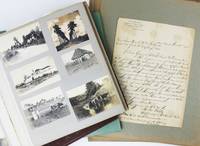
19025176Various locations in Cuba 1902. Very good. Seventeen loose folio scrapbook leaves each with mounted correspondence or other documents; one vernacular photograph album; two scrapbooks; and a small number of loose documents and newspaper clippings as detailed below. An informative archive comprised of material from two generations of the McCook family of Ohio specifically two different military officers -- Major General Alexander McDowell McCook and his son-in-law Brigadier General Chauncey Brooke Baker 1860-1936. Baker was married to McCook's eldest daughter Lucianna "Lucy" McCook Baker who seems to have compiled the various components of the present archive which mostly documents the career of her husband Chauncey Baker. The collection includes seventeen loose folio scrapbook leaves each with mounted correspondence or other documents one photograph album two scrapbooks and a small number of loose documents and newspaper clippings.<br /> <br /> Union Army General Alexander McDowell McCook one of the "Fighting McCooks" continued his army career after the war in the regular Army. He commanded Fort Leavenworth Kansas from 1886-1890 the Department of Arizona from 1890-1893 and the Department of Colorado from 1893-1895. He was joined in each location by his daughter and son-in-law. Chauncey Brooke Baker married Lucy McCook while at Leavenworth and later served as McCook's aide-de-camp and acting engineering officer at Los Angeles and Denver Headquarters Department of Arizona and Colorado. Later promotions and the start of the Spanish-American War led Baker to Cuba in a quartermaster role. It seems his wife accompanied him there and began acquiring the images now housed in the photograph album offered here. Lucy Baker died in 1923 placing the scrapbooks completion date before that time. The material is detailed as follows:<br /> <br /> 1 Seventeen loose scrapbook leaves containing twenty-five pieces of correspondence typed documents and printed documents primarily associated with the later business dealings of Alexander M. McCook while he was stationed in Utah Colorado Kansas. This material dates mostly between 1882 and 1898. Letters are from a variety of correspondents and reflect McCook's post-war military career at frontier installations his involvement in the railroads investments and other personal matters. One of the more informative documents details the history of McCook's military service from his entry to West Point in 1847 through his appointment to the Department of Arizona in 1894. The collection also includes a handful of loose documents and letters as well as an envelope of newspaper clippings documenting McCook's later affairs. One notable item is a four-page offprint of a memorial of McCook written by Col. Horace N. Fisher and first published in the Boston Transcript on Sunday June 13 1903. General McCook had just passed away the previous day at Lucy's house in Dayton Ohio.<br /> <br /> 2 Vernacular Photograph Album Documenting Cuba Under Spanish Occupation and the United States Military Government's Occupation. Various locations in Cuba: ca. 1898-1902. 24 leaves illustrated with 303 silver gelatin photographs from 3.25 x 2.25 to 7.5 x 9 inches. Quarto. Contemporary three-quarter calf and black cloth boards. Spine perished most leaves separated from spine but held to each other by cloth gutter in a few groupings. Leaves worn silvering to some images. Inscribed on front free endpaper "Lucy McCook. Fort Leavenworth Kansas Nov 21st 1888." Lucy likely dated the album in 1888 then never used it as all of the images in the album emanate from Cuba. The photographs depict a mixture of rural and urban scenes featuring native Cubans as well as Americans Cuban and American military personnel landmarks military installations ships recreation building interiors with some images depicting the remnants of war. Notable are three large format photographs at the end of the album: a photograph of armed soldiers and a religious figure exiting a fortress-like structure with handwritten caption below "On the way to the Garote Castillo del Principe - during the Spanish occupation;" a photograph showing a large group of men assembled at tables and chairs in a gallery-style room with a handwritten caption reading "Opening of the Cuban Constitutional Convention - Havana - Nov. 5th 1900 General Leonard Wood Military Governor reading address in full uniform Temporary President on his left;" and a photograph of Havana's large cathedral with a crowd gathered captioned "Governor General Weyler entering Cathedral Havana Spanish Occupation." Captions were likely added by Lucy McCook whose husband was serving at the time as quartermaster chief quartermaster and depot quartermaster in the U.S. Army's Division and Department of Cuba. This album is the most historically-important and useful item in the present archive.<br /> <br /> 3 Scrapbook of Newspaper Clippings and an Original Drawing of an American Military Officer in Indian Territory. N.p.: early 1900s. 11 leaves illustrated with newspaper clippings and one drawing. Quarto. Contemporary brown cloth elaborately tooled in black title in gilt on front cover and spine. Moderate wear rubbing and dust-soiling. Inscribed on front free endpaper "Lucy McCook Baker / Los Angeles - California / April 1892." An interesting collection of mostly newspaper clippings associated with Native American rituals related to the Moqui Indians the Army and articles on General McCook or Lieutenant Chauncey Baker. The album also includes an original pen drawing titled in manuscript "Tent of The Macauley in Camp at Guthrie I.T. 20th June 1889." The drawing features a military figure standing in a road holding a small shovel in the air in front of a sign pointing one way to Oklahoma and the other way to Ft. Leavenworth. The drawing is signed at bottom "Glück."<br /> <br /> 4 Scrapbook of Ephemeral Items Relating to the Military Careers of Alexander McDowell McCook and Chauncey Baker Plus Later Items Related to Another Member of the McCook Family. N.p.: early 1900s. 9 leaves illustrated with telegrams pamphlets invitations and other ephemeral items. Quarto. Contemporary aqua cloth with gilt titles on front cover string tied. The items primarily concern McCook's and Baker's military service including an "In Memoriam" for Alexander McDowell McCook as well as some items relating to the later military career of Alexander McCook Craigshead.<br /> <br /> A diverse collection of materials relating to the careers of two notable military men serving in the American West and in Cuba during the Spanish-American War with a wonderful vernacular photograph album documenting the latter and the whole likely retained and organized by the daughter and wife respectively of the men involved. unknown
1929WRCAM55851Mainly Virginia Alabama and Texas 1929. Approximately thirty-two letters some with original transmittal envelopes; twenty-three photographs and real photo postcards; and assorted family documents calling cards and greeting cards. Overall very good condition. Housed in a modern gray archival box. A wide-ranging collection of correspondence photographs and documents centered on the Hancock family of Virginia Alabama and Texas in the second half of the 19th century and first quarter of the 20th. The Hancock family members involved in the correspondence or pictured in the photographs in this archive include Benjamin Palmer Hancock Arthur B. Hancock Thomas Benton Hancock Jane A. Hancock Jane C. Hancock Richard J. Hancock Claudia Hancock and Harris Hancock. Richard J. Hancock Sr. was father to Richard J. Jr. Arthur B. and Harris Hancock and uncle to Benjamin Palmer Hancock. Jane C. Hancock was B.P. Hancock's daughter. Thomas Benton Hancock and Jane A. Hancock were married and Claudia Hancock was their daughter. The family though spread out over vast distances seems to have remained relatively in touch with one another. The correspondents also often write from or receive letters from different cities suggesting they moved around a bit or traveled more widely than most families at the time. <br> <br> Benjamin Palmer "B.P." Hancock 1868-1943 lived in Dallas Crockett and Corpus Christi Texas in the late 19th-century and worked for both the Mexican National Railroad and the Texas Mexican Railway. He later returned to Texas working as the Division Traffic Superintendent for the Western Union Telegraph Company in Dallas from 1913 until his retirement in 1938. He also maintained a family estate in Scotia Alabama. In one 1905 letter B.P. Hancock writes home to his wife Martha in Scotia with detailed instructions for her imminent travel to meet him in New York City. He also writes a very loving letter to his daughter Jane C. Hancock in 1913 while she was living in Winslow Arkansas. He praises Jane for "the fine little girl - almost young lady - that you are today." <br> <br> Richard J. Hancock Jr. 1873-1920 writes a long letter to B. Palmer Hancock on April 12 1890. Richard was apparently working for the Galveston Harrisburg & San Antonio Railway as he writes his four-page letter on the company's stationery and mentions hearing about a couple of colleagues "surveying a new extension for San Antonio Pacific road." Richard acknowledges that B.P. and their mother are going to Virginia to visit family and encourages B.P. to "make a good impression on all of the Hancock family." He also offers B.P. a new suit and money to look good in front of the Virginia Hancocks. Richard then reports on a recent trip "down to Rio Grande" where he "had lots of fun." <br> <br> Richard J. Hancock Sr. 1838-1912 writes three letters to his nephew B. Palmer Hancock in 1902 on "Ellerslie" stationery. Ellerslie Plantation later Ellerslie Farm near Charlottesville Virginia came into the Hancock family after Richard married Thomasia Harris whose family owned the estate. Richard J. Hancock served as a Confederate captain under Stonewall Jackson during the Civil War. His letters to Palmer are mostly concerned with family business matters especially Palmer's property in Alabama. At one point Richard consoles B.P. for his mother's ill health apparently from typhoid fever. In his third letter Richard mentions his growing aversion to the life of a farmer at Ellerslie commenting that he would "quit farming and sell out but for my son Arthur." Richard had already largely turned away from farming to breeding thoroughbred racehorses at Ellerslie and became quite famous and successful at the venture winning the 1884 Preakness Stakes with his horse Knight of Ellerslie. His son Arthur Hancock later established a breeding farm in Kentucky named Claiborne Farm and became one of the most legendary horse breeders of the 20th century. <br> <br> Thomas Benton Hancock 1834-1870 lived in Centreville Alabama; a letter to him dated 1859 from a friend at the University of Virginia implores Hancock to spend some time at the school. A slightly earlier autograph note dated 1857 from a professor at Centenary College in Jackson Louisiana grants Thomas Benton leave from the school: "Mr. Thos. B. Hancock has been a student at Centenary College La. and that he has been honorably dismissed at his own request." There is also present here an 1860 letter of recommendation from a different professor at Centenary College praising T.B.'s "scholarship prudence and gentlemanly deportment" and recommending him as a teacher. T.B. Hancock died young at the age of thirty-six in 1870 and is buried in Oakland Mississippi. <br> <br> Three letters from 1882 written to "Mrs. J.A. Hancock" in Corpus Christi Texas are particularly interesting. The recipient was most certainly Jane Alexander Hancock widow of the late Thomas Benton Hancock. The three letters all concern stories submitted by J.A. Hancock to THE YOUTH'S COMPANION a long- running children's literary periodical in Boston. One of these stories titled "Sorrel Top" is bought by the magazine in one of the present letters and Mrs. Hancock is encouraged to send more stories. "Sorrel Top" appeared in the magazine later in the year as "Mrs. Marks' 'Sorrel Top'" in the October 19 1882 issue. All three letters are signed "Perry Mason & Co." the publishers of THE YOUTH'S COMPANION. Perry Mason founded the magazine in 1827 and served as its editor until his death; Erle Stanley Gardner was fond of THE YOUTH'S COMPANION as a young reader and borrowed the editor's name for his protagonist when he began writing a series of stories and books centered on his now-famous attorney/detective. <br> <br> The photographs in the present archive are a combination of cabinet card portraits and real photo postcards. The identified portraits include three of B.P. Hancock one as a younger man in Corpus Christi another inscribed "Your Son BP Hancock Dallas Tex March 1886"; one of Harris Hancock in Overton Virginia from a Charlottesville studio; and a portrait of Mrs. J.A. Hancock inscribed "For BP Hancock age 52 years." The real photo postcards feature a handful of shots from a family picnic and a large home presumably belonging to the Hancock family. <br> <br> The assorted additional material includes J.A. Hancock's copy of a Presbyterian Church pamphlet; a 1902 trust document involving Richard Hancock B. Palmer Hancock Clavelia A. Hancock Helen J. Hancock and Thomasia O. Hancock wife of Richard J. Hancock; and other assorted documents cards and invitations. There is also a handful of material relating to H.L. Carleton of Taylor and Austin Texas. Carleton was a noted pharmacist and president of the Texas Pharmaceutical Association in the early 20th century. The connection to the Hancock family is unknown though Carleton may represent another side to the family of a Hancock decendant. <br> <br> A wide-ranging slice of Hancock family history and an archive with notable research and genealogical potential. unknown books
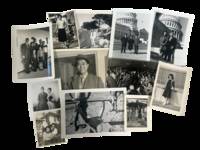
1940226451940. Japanese AmericanWWII Japanese American military service and postwar life photograph archive documenting Nisei participation in the United States armed forces and the reintegration of Japanese American families into public life after World War II 1940s-1960s. The photographs capture Japanese Americans in military uniform as well as family gatherings and civilian travel throughout wartime incarceration and postwar recovery and reintegration. The images document the lives of a generation of Nisei soldiers who served in units such as the 442nd Regimental Combat Team and the Military Intelligence Service whose wartime service occurred while more than 120000 Japanese Americans were forcibly removed and incarcerated under Executive Order 9066. The archive encapsulates the complex relationship between patriotic service and racial discrimination during WWII and the reintegration of Japanese Americans into civilian life during the mid twentieth century.<br /> <br /> Archive of 12 black and white photographs produced between the 1940s and 1960s. The images range in size from approximately 2 x 3 inches to 3.5 x 5 inches and include several photographs of Japanese American men in United States military uniform. Other photographs depict Japanese American families posed together in domestic and social settings including women dressed in fashionable postwar clothing typical of the 1950s. A small group of photographs shows Japanese American visitors standing in front of the United States Capitol building in Washington D.C. Several photographs bear numbers dates or personal names written on the verso in both Japanese and English.<br /> <br /> Japanese American military service during World War II was a central element in the broader struggle for Asian American civil rights after the war. Nisei soldiers serving in the 442nd Regimental Combat Team and the Military Intelligence Service played significant roles in combat operations in Europe and in intelligence translation work in the Pacific theater. At the same time their families and communities endured forced removal and incarceration under federal wartime policy. In the decades following the war Japanese American families rebuilt social networks reestablished businesses and professions and increasingly participated in civic life across the United States. Photographs documenting travel to symbolic national locations such as the United States Capitol reflect this period of renewed public presence and political engagement among Japanese Americans in the 1950s and 1960s. Minor edge wear and handling visible to several photographs with occasional annotations on the versos in Japanese and English; overall very good condition. This archive provides visual documentation of Japanese American wartime service and the reestablishment of civic identity during the postwar era. unknown
1914000625Lancaster County Pennsylvania PA Mount Joy. Very Good. 1914. First Edition. Original Cloth. Sensational archive of handwritten diaries centered around the Brubaker family of Lancaster County Pennsylvania. Twenty 20 books comprised of sixteen 16 handwritten diaries three 3 small notebooks and one 1 published book with manuscript notes. The diaries are dated 1914 1916 1917 1917 1918 1919 1920 1921 1922 1923 1923 1924 1926 1927 and 1927. On average the books are 80% full. There are four authors: J. Henry Brubaker has written 12 diaries and most certainly 2 of the 3 notebooks. His wife Anna has written one notebook in her maiden name Groff and daughters Anna Ethel 3 and Susan Violet 1. The Brubakers appear to have been prominent rural business people in the farm supply business. A huge family as evidenced by the copious genealogical notes for the Lancaster County area as the notebooks specifically and the diaries are a wealth of family names and the connections. Family names: Brubaker Stauffer Groff Buckwalter Lefever Landis Nissley Shenk Longnecker Neff Dendlinger Mtzler Hurst Erb Hostetter Shreiner Lunks Griders Linchburger Charles The authors were very kind to fully identify family and relationships. Weather economy births deaths marriages and other local events showing the homefront during and after the first World War years. Overall in very good condition though one diary has some spine damage from nibbling.; Manuscript; 16mo - over 5¾" - 6¾" tall; KEYWORDS: HISTORY OF Hand Written Personal Americana Memoir Handwritten hand written autograph autographs signed letters document documents manuscript manuscripts writers writer author holograph personal Farming Pennsylvania Lancaster County Economy World War I WWI the Great War Homefront Genealogy . hardcover
2080402107100435world book office N.A. Soft Cover. Fine. Volume: 17 world book office paperback
1872000877Boston Massachusetts MA 1872. On offer is a remarkable very intriguing grouping of handwritten letters drawings and covers from the William Tudor family of Boston Massachusetts. There are twelve 12 letters with their envelopes the five letters are from 1872 and 1873 when William was in Paris to marry his wife Elizabeth Whitwell three empty covers and two slips of paper with drawings. The letters date from 1873-1915 and curiously one last letter from 1961. The drawings don't have dates but look like late 1800's. The three remaining empty envelopes are from 1879 1894 and one has no date. William Tudor was born to Frederic "The Ice King" Tudor and Euphemia Fenno Tudor on September 27 1848. He was the fourth of six children. He attended Harvard University and graduated in 1871. He married Elizabeth Whitwell b. 1851 daughter of William Scollay Whitwell and Mary Hubbard in Paris France on May 24 1873. Together they had five children: Henry Dubois William Elizabeth Delia Aimee and Mary. William Tudor had an intense interest in his own genealogy and collected information on his Tudor ancestry. In 1896 he edited and published the diary of his great-great-grandfather Deacon John Tudor as Deacon Tudor's Diary. His primary occupation however was investing in mines. He served on the Boards of Trustees of many of the mining companies he invested in and held positions as an officer in many of them. In 1908 Tudor became the treasurer of the Salida Copper Company in which he held a very large share. In July 1909 Salida Copper Company bought out Sedalia Copper Company. In October Tudor traveled to Salida Colorado to inspect the companies' mines. In 1910 the Mountain Mining Company a spin-off of the Salida Copper Company was formed and in January 1911 Tudor became its president. In 1913 Tudor became treasurer of the Shawmut Consolidated Copper Company. Although Tudor owned homes in Hancock New Hampshire and Auburndale Massachusetts his primary business address was the St. Botolph Club in Boston. He did a great deal of traveling inspecting mines in Juneau Alaska and Salida Colorado and he was married and had his first child in Paris France. He painted for relaxation. William Tudor died in 1923. There is a lot of extraordinary content; one written by William Sturgis Bigelow a famous collector and historian of Japanese culture writes of mediums and speaking to the dead: "My Dear Mrs. Tudor Katy told me a little of your late adventures. Will you pardon a friendly suggestion You had better let the whole thing alone for a while. Put it out of your mind as if you had never heard of it. You cannot find out by seeing such things how and why they exist. .The forms of people you saw are not the real people but reflections from the minds of the spectators or mediums Just how they "Materialize" you would not now understand if you were told. It would be harmless enough apart from the excitement incidental to "seeing ghosts" if the medium were a person so good and pure as yourself. But she is not as you can see by the class of "spirits" especially connected with her. The last thing for you to do would be to establish a connection with such entities .But at any rate put the whole thing out of your head for a while. And when you feel quieter let me know. It is just possible I may be able to help you a little .Keep this letter to yourself W. S. Bigelow." Another letter in which William is writing to his wife and it date April 25th 1893. He's writing from Jacksonville Florida on "Everett Hotel" letterhead. Says he's having a difficult time with the railroad people and says he doesn't mind Florida too much but prefers a small French village." There are also letters written to Bessie from her father and mother after her marriage to William. Here is a delightful example: My Dear baby Bessie A good big baby but my baby still Your life seems full of excitement and events compared to ours. Nothing can be quieter if rest is to make me well. I ought soon to be in perfect health. The bathing is the main event of the day and you would enjoy it very much. The water is not very cold and the more pleasant for swimmers. I have been sorry to be obliged to give it up these few past days on account of severe head ache which I thought the bathing increased but they are better now .There are some fine views in the neighborhood but it is a hard climb to reach them. Last evening May and I walked to the top of a high hill where there is a large private house with extensive grounds magnificently situated commanding a view far out to sea The owner of the house is proud to show our little room with it's fine sea view it balcony its unpainted shell lac'd wooden furniture and little bright rugs on the bare floor is very comfortable and pretty. Leoni our devoted femme de chambre he's brought us a large bunch of flowers You see what quiet lives we lead . Always your loving mother that you know if nothing else." Her mother is not in very good health and has decided to take on the healing waters of the European spas and bathhouses. Bessie and William are still in France one assumes on their honeymoon or perhaps William is working because some are addressed "in care of Monroe & Co. Paris France." Each letter is packed with interesting content from this eclectic family. They are all in a variety of conditions from Fair to VG. . Autograph. Good. 8 x 11 Inches Approx. hardcover
193020204526c1930. Edge wear on cover; Faint coffee splash on blank front end paper. Small ink smudge margin dedication page. Creative - Charming - Skillful - Whimsical In what appears to be the grips of the Great Slump depression a family elects to give one of the daughters the gift of verse and original art as a wedding present. The introduction reads: This book so filled with folly In foolish sketch and rhyme Comes to wish our Collie Joy till the end of time. A pen and ink drawing of a bride and groom standing between two trees adorns the cover. It includes 44 pen and ink drawings some with watercolor and relevant original limericks or often rhyming verse. Each is Initialed by a family member. With one exception the writer of the verse was also the illustrator of the relevant drawing. The book begins with "A dialogue on an Important Subject between members of the Pryke family". It discusses the lack of funds in the family to purchase an appropriate wedding present for one of the daughters "Collie". Titles of the verses include The Lobster Tragedy Household Hints for the Newly-Married. -Saturday's Lunch Bunnies Little Black Sambo Grown-ups Horrors The Sweet Old Lady The Frustration of a Crime 3 pages of text and 3 illustrations Lucy Adventures of My Relatives in 3 parts Riddle-Mee- Ree Bounce Mars An Escape From Dartmoor I Wonder Aunt Fanny The Sea- Serpent the Explanation and A Moral Tale. The last is a rhyme of a young girl who disobeyed her mother and fell from a tree. It concludes with MORAL Now all you little children here Take heed of what I say Always obey your parents dear Or you'll be layed in clay. The limericks include a person from Spain an old lady from China a policeman whose feet a boy from Madrid an old lady of Slough a bold lady from Bristol a young lady of Zenda an old fellow of Louth an old dame in Peru a young man of Forquay a professor at Oxon an old person of Frith a person of London an old lady of Bucks an old man of the Hook and There once was a lady whose face Had slipped by mistake out of place She didn't know where Though she sought it with care So she filled up the gap with French lace A family of equal opportunity insulters leading to some remarkably creative illustrations. A majority of the pages in the book are used. Appears complete as written. Measures 9" x 7 1/4". <br/><br/> unknown books
1850c2206270149xbvkLondon, William Pickering (Chiswick, C. Wittingham), 1850. 1 blank sheet; xii pages (incl. foretitle-sheet, title-sheet, printed dedication-sheet, 'Contents' and 'Introduction to Eidolon'), 240 pages; 1 blank sheet. - Richly gilt handbound green chagrin-leather binding over 5 raised bands with gilt title at spine (stamp-signed ''Bound by Hayday'' at inner frontpanel), all edges gilt, silken marker-ribbon; 8vo.(ca. 18 x 11,5 cm).
49927Auckland New Zealand : s.n. 1860. Handmade album. Octavo 190 x 120 mm the covers taken from a copy of The poetical works of Sir Walter Scott Edinburgh : A. & C. Black 1857 of limp tan cloth with decoration in blind and gilt device to front and rear; the book's original pastedowns and endpapers intentionally preserved the front free-endpaper with a mounted presentation label inscribed in ink in a neat hand: 'New Zealand ferns collected for Miss Grahame by her friends at Hazelbank Auckland 1860' followed by 28 loose sheets with pressed native fern specimens mounted recto only each accompanied by a handwritten caption identifying the specimen by its correct botanical name; the skilfully mounted and knowledgeably labelled specimens with very occasional minor loss the paper mounts with a minimal amount of foxing but overall the contents remarkable well preserved. This charming ""do-it-yourself"" Auckland album represents by far the earliest collection of New Zealand ferns we have handled. Although pteridomania - or fern fever - was undeniably already a phenomenon in the colony in the 1860s the album pre-dates by at least a decade for example the appearance of the first commercial souvenir albums by such specialist preparators as Eric Craig and Thomas Cranwell. The specimens in this album were clearly selected for their aesthetic appeal the majority being particularly delicate and skeletal-like. We believe that the young woman to whom the album was presented by her friends identified only as Miss Grahame is likely to have been a daughter of Auckland merchant Walter Grahame. Walter's brother the wealthy and influential William Smellie Grahame had already returned to England with his own family by 1858. ""Hazelbank"" was the name of a property in Wynyard Street Auckland which was later owned by MÄori businesswoman and philanthropist Mary Geddes. It is now the home of the Elam School of Fine Arts University of Auckland. hardcover
3 vols., 8vo., First Edition; handsomely bound in full crushed morocco (green/blue/burgundy respectively), sides with gilt frame borders, backs with raised bands, second and fourth compartments lettered and ruled in gilt, all other compartments tooled in gilt, gilt tops, hand-made endpapers, ribbon marker in each volume, an elegant set ideal as a gift or for presentation. The set comprises 'My Family and other Animals' (first edition, 1956); 'Birds, Beasts and Relatives' (first edition, 1969); 'The Garden of the Gods' (first edition, 1978). Durrell's Corfu trilogy, now widely recognised as a modern classic, recounts the hilarious adventures of the Durrell family on the island of Corfu during the 1930s. COMPLETE SETS ARE SCARCE.
30367Archive consisting of 374 letters totaling 1888 pages 207 retained mailing envelopes plus over 100 pieces of printed and manuscript ephemera. Of the 374 letters in this collection 270 are incoming correspondence to Lucy Stephenson Hughes wife of Texas rancher William George Hughes an English immigrant to Texas in 1878. Of the letters written to Lucy 82 were written by her daughter Jeanie 63 by her son George and 47 by her son Gerard. George and Gerard were for the most part attending Harvard University at the time they were writing their mother. Lucy wrote 48 of the letters mostly to her children. Other correspondents to Lucy are her aunts in England 8 letters a niece Esther Stout in California 18 letters as well as another family member Sarah F. Hughes 15 letters. There are other correspondents with Lucy who appear to be friends or associates. <br /><br /><p>Biography of the Hughes Family </p><p><br /> William "Willy" George Hughes rancher was born at Kensington London England on May 29 1859. He attended Marlborough College and immigrated to America; he arrived in New York on September 15 1878 reached San Antonio on the twenty-ninth and immediately entered apprentice training as a shepherd without pay. He soon bought 160 acres of land three miles west of Boerne in Kendall County where on March 22 1879 he began what later became a very successful ranching operation. One of his early achievements was to import the superior Oxfordshire Downs sheep and start developing high-quality breeding stock that brought premium prices. Also through diversification outstanding management skills and hard work he amassed some 7000 acres of ranchland of his own and leased several hundred additional acres of state school land. </p><p>Hughes quickly recognized the potential of Angora goats in his integrated ranching operation and was among the first ranchers to bring this breed to Kendall County. He purchased his seed stock from William M. Landrum of Laguna Uvalde County who moved to Texas from California in 1883. When President Grover Cleveland persuaded Congress to reduce import tariffs and Australian wool flooded the United States market in 1887 Hughes immediately switched from sheep to Angora goats and mohair production. Another innovative ranching practice he initiated was to buy cheap mustang mares and breed them to his registered Arabian stallion thus producing a durable high-quality riding horse that was popular with the United States Cavalry. During the Spanish-American War he trained and delivered hundreds of horses to cavalry units both in San Antonio and at the Mustang Island staging area near Corpus Christi. </p><p>Hughes married Lucy C. Stephenson on June 28 1888. Lucy was born August 18 1864 at Alston Nenthead Cumberland England. She died sometime after 1940. She was the daughter of John James Stephenson 1821-1895 and Ann Dover Clark 1827-1905. Her parents immigrated to Kendall County Texas about 1872 where her father had a farm. The family is found in Kendall in the 1880 Census. After her marriage in 1888 Lucy's mother came to live with her and her husband and they are found together in Kendall County in the 1900 Census. Lucy's sister Ella was also living with them. </p><p>The couple had three children Jane Elizabeth "Jeannie" Hughes 1889-1977 George Forbes Hughes 1892-1971 and Gerard "Jerry" Hastings Hughes 1895-1996. In addition to attending her children and keeping house Lucy encouraged by her husband began a productive dairy business with a herd of registered Jersey cows. The dairy sold up to 400 pounds of butter a month in San Antonio. </p><p>Hughes founded Hastings Texas and became its first postmaster on April 17 1890. The post office was named for his father William Hastings Hughes. Hughes helped organize the Hastings one-teacher school in the mid-1890s. He wrote numerous articles and scientific papers on raising and marketing Angora goats. He also collaborated with his famous uncle Thomas Hughes author of the classic <i>Tom Brown's School Days</i> and founder of Rugby Tennessee in writing letters about his early Texas ranching experiences that were later published in a book <i>GTT -Gone to Texas</i> 1884. Hughes died in a train accident at Bellville Illinois on November 25 1902 while on his way to show his prized Angoras at a northern livestock exhibition. </p><p>William "Willy" George Hughes was the son of William Hastings Hughes an established wine importer who invested in failed land deals with his brother Thomas Hughes which forced the young Willy to head out on his own to Texas. William George Hughes' uncle Thomas Hughes was a scholar known for his classic book "<i>Tom Brown's School Days</i>" 1880. Thomas visited America for the first time in 1870 to visit his friend James Russell Lowell. He later founded a Christian-Socialist oriented community at Rugby Tennessee and edited the book "<i>G.T.T. Gone to Texas</i>" published in London by Macmillan & Co. in 1884. The book includes letters written by Thomas' three nephews sons of his brother William: William George Hughes Gerard "Chico" Hughes and Henry "Harry" Hughes. The book is an excellent account of cattle and sheep ranching in Texas and it was intended by Thomas to be used to help prospective English immigrants to Texas. The book is considered one of the best accounts of Texas immigrants and ranch life. </p><p>William George Hughes' father William Hastings Hughes later in life immigrated to New York. William Hastings Hughes' grandfather was John Hughes an artist and author. His wife Margaret Elizabeth Wilkinson immigrated to Thomas Hughes community at Rugby Tennessee. John Hughes was the only child of the Rev. Thomas Hughes vicar of Uffington Church one of three canons at St. Paul's Cathedral London England. The Rev. Hughes wife was Mary Ann Watts friend of Sir Walter Scott. She wrote a biography of Scott. </p><p>After the death of her husband Lucy gave up Texas and moved to Massachusetts where she is found in the 1910 Census living at Milton Norfolk County Massachusetts. Lucy's sons George and Gerard attended Milton Academy. After Milton Academy George and Gerard attended Harvard together. The boys lived in the "yard" at 42 Matthews Hall when in the fall of 1916 a notice was posted which stated the Aviation Section of the Signal Corps the Army Air Corps of those days wanted a group of volunteers to enlist for the purpose of learning to fly and becoming Reserve Military Aviators RMAs. George and Jerry decided to apply together. They were among the vanguard of the early fliers. George had previously had some flying experience when he joined the flying club while attending Dartmouth 1911-1912. They applied and were asked to report to Governor's Island NYC for physical examinations in December of 1916. In late February 1917 they were told to travel to Mineola Field Garden City Long Island New York for one last series of tests they arrived in April of 1917 just at the time that America entered World War One. The lack of trained military pilot instructors meant that the Hughes brothers were taught by civilians. </p><p>The Hughes brothers were among the first of the new American pilots and as such instead of heading to the front and fighting in the war as they had hoped they were initially assigned as pilot instructors. After pilot training and even before his commission as lieutenant George F. Hughes was sent to Dayton Ohio in July of 1917 to be a flight instructor at the new Wilbur Wright Field. There were simply not enough military instructors so George was hurried into becoming an instructor. By October 1917 George was made squadron commander of the 12th Aero Squadron moving it from Dayton Ohio to New York on to Amanty France then to the front. He went from being a flight instructor to being in charge of 10 officers and 150 men and their equipment which formed the 12th Aero Squadron and to make sure everyone and everything arrived in France safely by December 1917. The 12th Aero Squadron was designated an "observation" squadron and were combat ready by May 1918. George flew with the 12th Aero until the middle of July than was put in command of a new outfit the 258th Aero Squadron which he helped to ready. Just as the 258th became combat ready the war ended. </p><p>George's brother Jerry after flight school was also assigned to a position as flight instructor. His station was at Chanute Field Rantoul Illinois. He arrived at the new air field in September of 1917. In December 1917 Jerry got orders to proceed to Rich Field at Waco Texas. He instructed at Waco until August of 1918 when he was sent to France. Foul weather slowed his training at Issoudun's American flying school. After Issoudun he spent time at the American gunnery school at St. Jean de Monts which he completed in a week. He was assigned to a combat unit but arrived in Toul France just as the war ended. </p><p>The brothers thought they would be with the 258th Aero Squadron as part of the occupying forces in Germany but George took sick emotional breakdown and the brothers came back to New York with most of the other soldiers being released from service in February of 1919. </p><p>In 1920 Lucy was found living with her daughter Jeanie in Newburgh Orange County New York. Lucy was listed as not working while Jeanie was a superintendent at a department store. After the war the Hughes brothers bought the Garden City Garage Garden City Long Island New York. Here they ran an airplane and auto mechanic business until 1946. Jerry was active in founding the Garden City Chamber of Commerce and served as its 3rd President. He also helped in a plan to create 6000 parking spaces in the Garden City area for customers of its businesses a project that drew national attention for its scope and planning. </p><p>Lucy in 1925 is found in the New York State Census to be living at Hempstead Nassau County New York with her daughter Jeanie who was now working in real estate and her son Gerard who had the garage. The two brothers had married: George to Frona Brooks in 1927 and Jerry to Charlotte Christ 1904-1995 in 1928. George and his wife had two children Octavia and Anita. Jerry and his wife had four children Anne Thomas Jean and Marian. In the 1930 Census Lucy and her daughter are living together at Garden City Long Island Nassau County New York. Jeanie is now listed as a "psychologist." The two women are living with Octavia the daughter of George who was divorced living with his daughter Octavia and his sister Jeannie and his mother. Gerard Hughes appears to have outlived everyone in the family dying in 1995 at 101 years old. His sister Jeannie died in 1977 with Lucy dying sometime after 1940. </p><p><b>Description of Archive:</b> </p><p><b>1900 - 1903. 3 letters 13 pages 2 envelopes</b> all three of these letter are to Mrs. Lucy Stephenson Hughes at Hastings Texas. One is written by S. F. Hughes Milton MA and two from W. Cameron Forbes Sheridan WY & Boston MA. W. Cameron Forbes is likely to be William Cameron Forbes partner in J. M. Forbes & Co. he writes to Lucy on the company letterhead. An investment banker he later became Governor-General of the Philippines 1908-1913 and Ambassador of the United States to Japan 1930-1932. He was the son of William Hathaway Forbes President of Bell Telephone Company and Edith Emerson daughter of Ralph Waldo Emerson. </p><p><b>1912 -1913. 43 letters 245 pages 37 envelopes</b> of these 43 letters most are written in 1913. Of the 43 letters 37 are written to Mrs. Lucy Stephenson Hughes including letters from her children George 12 Gerard 8 and Jennie 6. Other letters to Lucy are written by her Aunts 5 from England Robeston Wathen Narberth. Sarah F. Hughes writes to Lucy 3 times and 3 times to George Forbes Hughes from Orchard Knoll Milton MA. Other letters are written to Lucy from friends or others. There are also 2 letters written by George one each to his sister Jennie and brother Gerard and one letter written by Gerard to his brother George and one letter written by Gerard to his brother George. The letters to Lucy start out addressed to her at Ossipee New Hampshire but apparently George temporarily moved to Everett Washington There is talk in one letter of George not being able to enter Harvard but instead going to Washington State for work. George writes to his family on the letterhead of the "Everett Railway Light and Water Company" where he apparently worked in its office. Some of the letters from 1913 from Gerard H. Hughes are written when he was attending Harvard University and he and his family are trying to convince George to give up Everett and go to Harvard. The letters offer a look at life at the university at this time. Gerard was living at 42 Gray's Hall in the "yard." One letter talks about unannounced guests a student dropped by in the middle of the night to crash at his place: </p><p><i>"He had with him a futurist picture done by the illustrious Edward Forbes curator of the Fogg Museum and instructor of art in Harvard - at least that's what grandma told Miss Wakefield. It was news to me. The picture was supposed to represent a nigger in a water-melon patch Oh those witty Forbes! So Clever!. When Walter went he said he didn't like carrying that picture because people might think he did it. They would have grounds all right; 'cause he looks like a wandering artist without a cent."</i> </p><p>The same letter describes a prank pulled on a new Jewish student: </p><p><i>"Speaking of kidding people I must tell you about our top floor. The occupants are: Kimball and Richardson K & R. Co. Sylvester Rothschild commonly known as Uncle Roth or simply Roth also "Unk". Besides these are minor characters: Mr. Zunston Zee Saffron & Schoenfeld. Uncle Roth is always on his high horse and one time bade me not speak to him "in such an authoritative manner." He is a Jew and a Freshman and as green as grass.</i> </p><p><i>K & R. Co. have been trying to get his goat all year and they have succeeded pretty well. The other day they were fooling with him and he bust a window pane. Then they saw their chance. They borrowed Zee's typewriter and wrote a letter for "Unk" in which they stated that they were sorry to inform him that because of disorderly conduct he was placed on probation. They signed the letter with "Henry A. Yeomans."</i> Yeomans was the dean of the undergraduates </p><p><i><br /> Roth got the letter yesterday and hasn't slept since. He asked the janitor if he had squealed on him and the janitor said he hadn't. Unk then went and saw his faculty adviser. This august personage fell for it too and said that he couldn't tell how serious it might be but that he didn't like the sound of "disorderly conduct." Natural the poor goat is wild. He left the letter lying on his desk and K & R Co. naturally pinched it and burnt it destroying all evidence against themselves. In the meantime these rascals have been sympathizing with him and scaring him to death. They told him that if he cut he would be fired and so he can't get to see the Dean for fear of cutting. </i> </p><p><i>Anyhow he is going to try and see the Dean tomorrow and confess all his sins. When he tells Yeomans that he is on "pro" for busting a window pane the old boy will die laughing. I have never seen such a simple fool as Rothschild is." </i>Rothschild later became the Vice-Consul to Gothenburg Sweden. </p><p><b>1914 - 51 letters 280 pages 40 envelopes</b> of these letters 42 are written to Lucy C. Stephenson Hughes Her children Gerard 15 Jennie 10 and George 3 wrote most of them but there are also 7 letters written to Lucy from her niece Esther Stout of California 2 letters from her Aunt in England 1 letter from Sarah F. Hughes and 4 letters written by others including her friends and Henry A. Yeomans the Dean of undergraduates at Harvard University where her sons George and Gerard are studying. Also among these 51 letters is one letter written by Lucy to Dean Yeomans a typed copy of the letter sent by Dean Yeomans to Gerard 5 letters from Lucy to Gerard and 1 letter from George to Gerard. It would appear that Gerard was having a tough Freshman year at Harvard and was risking not being welcomed back for Sophomore year. There is also a letter from George to his Uncle Ainslie expressing his thoughts of quitting his job in Everett Washington and returning East to go to school at Harvard. The letters written by George and Gerard are written from Harvard and discuss chool life etc. </p><p><b>1915-1916 186 letters 894 pages 120 envelopes</b> of these letters 124 are written to Lucy with 100 of these 124 written to her by her children Jennie 60 George 19 and Gerard 21. Others were written to Lucy by her Aunt in England 1 Sarah F. Hughes 4 her niece Esther Stout of California 10 and the rest by friends or associates. There are also four letters to Lucy from her stock broker W. C. Buck of J. M. Forbes & Co. The rest of the letters in this group are 9 letters from Lucy to her "boys" George and Gerard combined with 19 letters from Lucy to her son Gerard and 12 letters from Lucy to her son George and one letter to her daughter Jeanie. There are also 7 letters to Gerard from his sister Jeanie and 6 from Jeanie to her brother George. There are 2 letters from Sarah F. Hughes to George plus 1 letter from Esther Stout to her cousin Jeanie and 1 letter from "Edith" to George. One letter to Lucy is from the Dean's Office at Harvard concerning her son George. One letter is written by Gerard to his brother George. There is also a copy of a letter from Dean B. S. Hurlbut concerning the poor academic record of George at Harvard which lands George on probation with the University as well as other letters concerning life at Harvard. For several years Jeanie worked in the department store field W. T. Grant Company Deisel - English Stauses traveling throughout the Midwest New England and New York. In one letter she talks of a company in Ohio wanting her to move there to be their buyer and in another she writes to her mother about being in New York City and happy to get out: </p><p><i>"I am rather glad to be out of New York just at present with so many strikes going on. The men on theFifth Avenue busses were striking when I left & now all of the Third Ave Street lines are striking. Don't worry dear about my becoming intimate with my business associates. There is a barrier which they cannot vault & which they seldom try to overcome."</i> </p><p>She also seems to have addressed women's clubs on her work: </p><p><i>"Before leaving Lima OH today I went to the College Women's Club Luncheon as their only speaker and gave them a short talk on my work. They seemed very much interested. There were only 37 women I believe. I didn't mind talking the least bit."</i> </p><p>In 1916 it was still quite unusual for women to be in the workplace especially traveling on the road. Jeanie experiences what today would be termed sexual harassment. In one letter 22 Mar 1916 to her brother Gerard she writes: </p><p><i>"I am staying at a hotel - you can imagine what it is like - city about thirty to forty thousand salesmen - "drummers" - Moses! How I hate the breed - a victrola that nearly sets my teeth on edge."</i> </p><p>Later in the same letter she writes: </p><p><i>"Oh these drummers! How I <u>hate</u> the <u>breed. </u>My I do wish I could lay some men dead with a glance! There would be a few ready for their coffins in this junk place! One glance is enough to give them my opinion of them and that is all that is really necessary."</i> </p><p>Jeanie also reveals some tricks of the trade to keep men at bay when on the road: </p><p><i>"My little ring is a wonderful asset - it always puts people at ease. Men are such conceited things that if they don't think you are engaged they are sure you are after them."</i> </p><p>Jeanie feels particularly harassed by Jewish men. In a letter dated April 1916 Jeanie is at Toledo Ohio and Anti-Semitic feelings are aroused: </p><p><i>"Back to the Travelers tonight armed with a smile.I am glad that it is to be only two more weeks for although I am getting lots of fun out of it I must say that I shall be glad to be back. I dislike drummers & traveling men and when they begin to think that mine is a traveling profession I hate them worse than ever. Marshall Fields men are usually real men - nice clean cut looking the sort you can talk to about the sale of certain things without putting them into their place every two seconds. But some of those little jews - liars! And vulgar - I feel as though a conversation with them contaminated me. However my work brings me in contact with them abut seldom. The teaching & general efficiency work I enjoy to the fullest. If the Strauses want to pay me $5000.00 I'll see what I can do to elevate them - I wouldn't go for less. I would heaps rather stay with the Deisel people for $1600 any day then go to that place and make thousands for the Strauses anyway. I declare I am getting to hate Jews - they deserve to be persecuted."</i> </p><p><br /> Overall the content of Jeanie's letters relating to her work on the road for department store companies is quite interesting for the time period. </p><p><b>1918 - 25 letters 112 pages 1 envelopes;</b> of these 25 letters 2 are written to Gerard 1 to Jennie and 23 to their Mother. Of the letters written to Mother 22 are written by her son George and 1 by her son Gerard. These 1918 letters offer much interesting description and observation on the lives and experiences of military aviators during World War One. One letter dated 26 August 1918 George makes the following comments to his brother Gerard: </p><p><i>"Paris is a hell of a place take the advice of an older brother and stay away from it. I went there with about $400 and came away poverty stricken in less than a week and didn't have anything to show for it except a pair of shoes that cost me the grand sum of 225 francs. One would have a duck fit back home if a dealer asked $40 for some foot wear but over here it's a case of "c'est la guerre" and one becomes quite immune to little chings like that."</i> </p><p>Later in the same letter he writes: </p><p><br /><i>"I think I'll try and get into bombing in the near future and from there to chasse. I'm beginning to get "fed up" on this observation game. I hear that back in the States they are giving men advance training in the various branches and you cast your lot for better or worse with no chance of transfer from bombing to chasse or vice versa or anything else. If that's so stick at the game of instructing and leave this war business alone. Chasse is too swift a game to go into with out some previous experience on the front and yet I'll be damned if I want to keep on warping these old hay racks for the rest of my days. Of course if one is lucky enough to get into a bunch using a two-seater fighter like the "Bristol" that's all right but ------! All the evidence personal and otherwise that I can get hold of still tends to show that flat skidding turns are the best maneuvers to pull to escape archies and hostile airplane and as a last resort go down in a fast spiral. But the main thing is to keep your eyes peeled in my opinion about 7/10 of all two-seaters shot down were caught napping or the observers' guns jammed; 3/10 may be shot down in a regular fight but I doubt it. A single chasse plane won't go near a two-seater that shows signs of having spotted him - surprise is their winning card and the one they try to play at all times."</i> </p><p>In a letter of 23 Oct 1918 George writes to his mother about the plane he was flying and the difficulty of it: </p><p><i>"I have always had good luck in drawing ships most generally get eh best one in the market; my luck held good that trip and I drew an exceptionally good bus for a Sop. I was the last to take off and strange to say I arrived at the end of our journey about two hours ahead of the next there. It was quite a trip almost up to Calais; its quite a trick to run one of those rotary motors and the gang at the Paris field didn't think I could get away with it as I had never driven anything but a stationary motor; in the rotary type the cylinders are arranged in a circle and the whole think revolves like a big grindstone; naturally when it gets turning over at a clip of 1200 -1350 revolutions a minute there's quite a torque which tends to pull the nose of your ship to one side or the other. I took off down the field lie this → the first think I knew I was in the air like this →↑ and before I could stop the damn thing I was going back down the field over the hangars "commuca"  Strange to say I reached my destination without mishap but the next time I tried to fly the fool think - I could keep the motor running long enough to get off the ground."</i> </p><p>Almost all of the 1918 letters offer this sort of insight into the World War One aviator. </p><p><b>1949 -1966 - 11 letters 32 pages 3 envelopes</b>; 3 letters dated 1949; 7 letters dated 1950 1 letter dated 1966; 3 letters are written by George to his daughter Octavia; 3 letters are written to Octavia from her Aunt Jeanie Hughes; 1 letter written to Octavia from her grandmother Lucy C. Hughes; 1 letter to Octavia from her sister Ann Hughes; 1 letter written to Octavia and Jeanie from a friend; and 1 letter to Jeanie from a friend in England. </p><p><b>Undated - 55 letters 308 pages 4 envelopes.</b> Of these 55 letters 41 of them are written to Lucy C. Hughes with 39 of them written to her by her children Jeanie George and Gerard. There is one letter written to Lucy by Sarah F. Hughes and 1 letter to Lucy by her niece Esther Stout of California. There are 7 letters written to George 3 from his sister Jeanie 1 from his brother Gerard 1 from Sarah F. Hughes and 2 others; 5 letters written to Gerard H. Hughes from his sister and mother and 2 letters are written to Octavia Hughes by her father George F. Hughes. Several letters appear to be incomplete. </p><p><b>Miscellaneous Ephemeral Items</b> </p><p>Checking Account register of Lucy Stephenson Hughes 13 pages1903-1906. </p><p>3 telegrams Jeanie to her mother circa 1913-1915. </p><p>12 postcards/cards 1914-1916. </p><p>1 mss page hours worked for Mrs. Hughes 1914. </p><p>54 letterhead receipts 1913-1915 mostly 1914. </p><p>1 paystub for Octavia Hughes 1949. </p><p>58 mss pages no date appears to be notes some in French for perhaps classwork some verse etc. </p><p>20 various printed items: invitations notices advertisements school items etc. 1913-1965. </p><p>9 envelopes. </p> books
029990Approximately 310 letters comprising 1172 pages dated 1837-1972 with the bulk 145 letters 582 pages written in the 1890s. The letters are mostly manuscript some are typed most of the letters are without envelopes there are several incomplete letters and 67 undated letters. The letters mainly center on the family of Edward James van Lennep and his wife Alice Norton Shedd 1870s-1890s with the later letters also including their children particularly Cara Hart van Lennep Nesbit. Many of the letters were written on the letterhead of the Sedgwick Institute Great Barrington Massachusetts. Edward van Lennep took over the management of the school from his father the Rev. Henry John van Lennep.<br /><br />The archive also includes 4 Diaries 1880 1898-99 1899 1901 2 Account Books 1863 1914 2 Notebooks 1875-76 1 not dated 1 Commonplace Book not dated 1 Guest Book c1890s.<p>The collection contains approximately 306 pieces of ephemera which includes printed and manuscript ephemera including letterhead business receipts medical receipts legal documents property deeds school documents banking documents telegrams manuscript pages of verse manuscript notes and memoranda postcards greeting cards invitations calling cards receipts accounts newspaper clippings pencil drawings photographs used envelopes as well as printed ephemera such as pamphlets booklets circulars advertisements and a map. Ephemera pieces are dated from 1880s-1960s.</p><p> <b>Description of Collection:</b></p><p> <b>Correspondence: 310 letters 1172 pages dated 1837-1972 as follows:</b></p>1830s-1880s: 15 letters 65 pp. dated 1837-1888 mostly 1880s related to the Bird and Shedd families particularly Alice N. Shedd who married Edward J. van Lennep.<p> 1890s: 145 letters 582 manuscript pp. this section begins with letters to and from Alice N. Shedd from her mother and others. Then collection also has letters relating to the courtship of Alice by her future husband Edward J. van Lennep and their marriage in 1895. There are letters to and from Alice from her husband mother and other family members as well as letters by Edward to his mother wife and others. Many of the letters are on the letterhead of the Sedgwick Institute Great Barrington Massachusetts. Edward J. van Lennep had taken over management of the school from his father Rev. Henry John van Lennep.</p><p> 1900s-1910s: 39 letters 96 pp. mostly manuscript some typed most without envelopes.</p><p> 1920s: 26 letters 116 pp. mostly manuscript some typed most without envelopes letters to mother Alice letters to daughter Clara some written by Alice some by Edward others</p><p> 1930s-1970s: 18 letters 90 pp. mostly manuscript some typed most without envelopes.</p><p> Undated Letters: 67 letters 223 pages mostly manuscript without envelopes.</p><p> <b>Account Books Commonplace Books Diaries Notebooks etc:</b></p><p>Account Book inside cover states "Property of William Jackson 1863" 37 manuscript pages measures 4" x 6" bound in limp calf dated 1863. The book appears to list the property of a school globes desks chairs etc. amongst other related things.</p><p> Notebook of William Van Lennep 67 manuscript pages bound in half black leather pebbled cloth covered boards measures 7 ¼" x 8 ½" written in ink in a legible hand dated 1875-1876. This volume appears to be notes for his senior year chemistry class First Session Sept-Dec 1875 and Second Session Jan-April 1876.</p><p> Diary of M. J. Shedd of Great Barrington Massachusetts 21 manuscript pages bound in black cloth limp boards folding flap type diary measures 3" x 5 ¾" three days per page format. Of the 21 pages they comprise 40 days of entries dated from April 8th to December 18th 1880. The diary was kept in ink and pencil in a legible hand and is in good condition. The first page of diary is lacking.</p><p> Guest Book 16 manuscript pages written in ink in various legible hands bound in wrappers measures 6 ½" x 8" dated 1890-1899. Appears to be a guest book for someone named Eunice it contains the signatures of visitors to Eunice's house and the towns of their residences.</p><p> Diary of Mrs. Alice Norton Shedd van Lennep 67 manuscript pages entries dated 21 October 1898 to 21 October 1899 bound in paper backed boards measures 5 ¼" x 7 ¾" paper on boards mostly torn off text good written in ink in a legible hand. The diary starts at the birth of her daughter Emily Bird van Lennep on 27 March 1898. Mrs. Shedd is the wife of Edward James van Lennep 1856-1934.</p><p> Diary of Mrs. Alice Norton Shedd van Lennep 42 manuscript pages lacks wrappers measures 6 ¾" x 8 ½ " written in pencil in a legible hand dated 25 June to 19 November c1899. While not signed there is much on "Birdie" who presumably is Mrs. Shedd's baby daughter Emily Bird van Lennep.</p><p> Diary of Mrs. Alice Norton Shedd van Lennep 37 manuscript pages bound in wrappers measures 6 ½" x 8 ¼" entries written in ink in a legible hand dated 21 April - 26 July 1901.</p><p> Account book 7 manuscript pages measures 3 ½" x 6 ½" unbound written in ink in a legible hand dated 1914. Possibly belonging to either Mrs. Hiram Shedd or E. J. Van Lennep as two pages of the accounts show board being paid by Shedd to Van Lennep.</p><p> Commonplace Book 30 manuscript pages lacks binding measures 6 ½" x 7 ¾" not signed not dated.</p><p> Notebook 26 manuscript pages bound in stiff cardboard; flip top notebook style measures 6" x 9" written in pencil legible hand not dated not signed. This notebook appears to have been kept by someone who was either in the navy or working on a ship as a fireman or signalman.</p><p> <b>306 Pieces of Ephemera as Follows:</b></p><p> 84 pieces of printed and manuscript ephemera includes letterhead receipts medical receipts legal documents property deeds school documents banking documents telegrams etc. mainly belonging to the family of Edward J. van Lennep his wife Alice and their children dated c1890s-1930s.</p><p> 45 manuscript pages mainly verse but with 10 pages of genealogical notes not dated c1910s-1920s. Some of the verse is copied some appears to be original. Possibly belongs to Clara Hart van Lennep.</p><p> 41 postcards greeting cards invitations etc. c1910s-1920s. Several addressed to Mrs. Alice S. van Lennep.</p><p> 33 manuscript receipts accounts etc dated 1880-1927. Mostly for E. J. van Lennep or Alice S. van Lennep.</p><p> 31 newspaper clippings c1920s some deal with a Henry van Lennep son of Edward J. Lennep who was a famous high school baseball player.</p><p> 19 pieces of printed ephemera including several pamphlets or booklets such as "A Reference Guide to Salem 1630" 1935 "Philadelphia" 1906 "A Gentle Hart" by J. R. Miller 1896 printed circulars and advertisements "District School Journal of the State of New York" 1843 "Proceedings Forty-Second Continental Congress National Society D.A.R. "1933 map of Great Barrington Mass. 1952 etc.</p><p> 19 used envelopes dated 1920s-1960s. Most addressed to either Clara Hart van Lennep or to her mother Alice S. van Lennep and father Edward J. van Lennep. Clara may have married a William Nesbit needs to be researched.</p><p> 19 photographs measuring from 2 ½" x 4" up to 6" x 8" not dated includes 5 cdv's only two identified 4 black and white photos of Civil War re-enactors c1950s-1960s 2 photo postcards identified on rear plus others some are identified some not.</p><p> 15 pencil drawings mostly of dogs or horses possibly belonging to Clara Hart van Lennep.</p><p> <b>History of van Lennep Family of Smyrna Turkey and Great Barrington Massachusetts</b></p><p> The Family of the Rev. Henry John van Lennep 1815-1889</p><p> Henry John Van Lennep was a noted 19th-century Christian minister missionary writer and educator born in Smyrna in what today is Izmir Turkey in 1815. The first van Lennep in Smyrna was the Rev. Henry John van Lennep's great grandfather the merchant David George van Lennep 1712-1797. David was the chief merchant of the Dutch trading station and Consul of the Dutch Nation in Smyrna. He originally left Holland for Smyrna in 1731 with Philippe de la Fontaine to set up a business. An older brother of de la Fontaine had been in Smyrna as early as 1704 and they joined him. After the de la Fontaines died retired or were bought out the business came to be called Van Lennep & Enslie. After Enslie withdrew from the business it became known as "Jacob van Lennep & Co." when David's son Jacob Van Lennep 1769-1855 the Rev. Henry's grandfather took over the business from his father.</p><p> Eventually the Van Lennep's business had an extensive network of international contacts exporting silk and angora wool thread from the interior of Turkey and figs citrus and other fruits from the islands in the Aegean Sea. They imported rough cotton linen fine cloth silver and gold cloth coffee sugar indigo herbs pepper porcelain and glass. His company was also the most important commercial bank in Smyrna. Van Lennep's firm was joint owner along with others in a vessel for which David George Van Lennep represented the company as agent and broker.</p><p> David George van Lennep became one of the assessors in Smyrna for the Directorate of Levant Trade and Navigation in the Mediterranean whose responsibility it was for the fitting out of all vessels which passed through the Straits of Gibraltar to verify and check their patents and bills of lading and maintain contact and correspond with the various consuls in the Levant and North Africa. He was an assessor from at least 1752 until his death in 1797. David George van Lennep was described as the uncrowned king of the Dutch Colony and his house the rendezvous of the high society of Smyrna.</p><p> David George van Lennep's son Jacob took over the business from his father along with two of his younger brothers. Jacob served as the Consul General for the Netherlands at Smyrna from 1825 till his death in 1855. Jacob's son Richard eventually joined the firm. The Rev. Henry John van Lennep whose archive is offered here was the son of this Richard Van Lennep 1779-1827 and his wife Adele Maria von Heidenstam 1790-1867. Richard was born in Smyrna and became a partner in the firm of his father's Jacob van Lennep & Co. Richard van Lennep withdrew from the firm in 1804 visited the United States about 1808 to enter into new business relations after his trip to the United States he rejoined Jacob van Lennep & Co. Richard was also for a time the consul of Sweden.</p><p> A revolution in Holland in the mid-1790s along with a naval defeat by the British in 1797 made continental trade difficult for the van Lennep family. These events followed by continental trade restrictions introduced by Napoleon normal overseas trade became almost impossible. It is therefore of interest that Richard having left the family firm made his journey to the United States in 1808 to seek commercial contacts there. As a consequence when he rejoined the family firm upon his return to Smyrna the company's business and trade became almost completely directed to the United States and more especially to Baltimore Philadelphia and Boston while the West Indies also became an area of interest.</p><p> The only son of Richard van Lennep who did not pursue a career in business was the Rev. Henry John van Lennep. Together with his younger brother Gustave Adolphe he was sent by their parents to be educated in the United States at Mount Pleasant School in Amherst and the Hartford Grammar School no doubt to learn the ways of America to help with the family's international business.</p><p> Henry John's brother Gustave Adolphe returned to Smyrna in about 1835 while Henry John continued his education at Amherst College. During his college years he decided to become a missionary and after graduation from Amherst in 1837 he spent a year at Andover Theological Seminary. He completed his training under the direction of a theologian and was ordained as a Congregational preacher the 27th of August 1839.</p><p> Shortly after marrying Emma Bliss Henry John left for Turkey together with his new wife as a missionary for the American Board of Commissioners for Foreign Missions. This board had been created in 1812 as a variant of the Dutch Réveil Movement and had since 1830 begun spreading the "true" gospel amongst Jews Greeks and Armenians in the Near and Far East. Their missionaries also concentrated on education so that under their direction an extensive network of schools was created in the Levant. Henry John's first posting was in his birthplace Smyrna. Unfortunately his wife Emma died in 1840. After travelling extensively in Turkey and Greece Henry John returned to the United States in 1843 where he married for the second time this time Mary Elisabeth Hawes the daughter of his former tutor. Sadly his second wife also died in Constantinople in September 1844 within a year of their marriage.</p><p> During the following ten years Henry John did missionary work from Constantinople and taught at a seminary in that town. During visits to Syria and Palestine he gathered material for a subsequent publication Bible Lands Their 28 Modern Customs and Manners Illustrative of Scripture 1875.</p><p> In 1849 he was again in the United States where he married for the third time Emily Ann Bird 1825-1898. Emily was born in Beirut Lebanon the daughter of Isaac Bird and Ann Parker. Four years after the wedding he was transferred from Constantinople to Tokat a tiny town located along the foothills of the mountains flanking the northwestern part of central Anatolia. There he was to open a missionary post and theological seminary. During his various trips around Tokat he made detailed notes concerning the various archaeological sites he came across which he later published in two volumes as <i>Travels in Little-Known Parts of Asia Minor</i> 1870. He himself made the illustrations for this publication. It was at Tokat that his son Edward J. van Lennep was born in 1856. In November 1858 Henry was visited by the German Orientalist Mordtmann who described Henry John as "one of the very few erudite missionaries in this part of the world who have a solid knowledge of both the country and its languages. He is not only a linguist but also a painter musicologist hunter and botanist in short a universal genius."</p><p> His rather unconventional behavior caused jealousy amongst his colleagues some of whom tried to have him removed from his post. Fortunately Henry John managed to forestall this attempt. In 1861 the couple left Tokat. After a short stay in the United States they returned to Smyrna to teach there for six years. By then the problems with his eyesight and further disagreement concerning missionary policy made him decide to return to the United States and to settle there permanently about 1867.</p><p> In the U.S. he taught natural sciences Greek and modern languages at Ingham University in LeRoy New York for three years after which he moved to Great Barrington Massachusetts about the year 1870 where he became director and owner of the Sedgwick School for Boys also known as the Sedgwick Institute. Henry's son Edward worked with him at the Sedgwick School and eventually took it over after his father's death.</p><p> Besides the two publications already mentioned Henry John also published <i>Oriental Album</i> 1862 and <i>Ten days amongst Greek Bandits</i> 1868. He also executed several drawings for Professor Edward Hitchcock that were included in his <i>Geology of Massachusetts</i> 1841 and <i>Illustrations of Surface Geology</i> 1860. Amherst College has a collection of his artwork several sketch albums and individual pieces and several folders of papers mostly ephemeral items.</p><p> Henry John van Lennep's son William van Lennep was a well-known surgeon and professor at Hahnemann Hospital at Philadelphia a leader in the homœopathic field of medicine.</p><p> Edward James van Lennep 1856-1934 and Alice Norton Shedd 1869-1957</p><p> Edward James van Lennep 1856-1934 was born at Tokat Asia Minor Turkey on 26 July 1856. He first came to Great Barrington after his father relocated from Turkey about the year 1870 when Edward was only 14 years old. He attended Sedgwick Institute his father's school and was prepared for Princeton University where he graduated with two degrees Bachelors and Masters. He took a job as a professor at his father's Sedgwick Institute. Edward worked at the school teaching languages French Greek Armenian Turkish then took over as managing director and proprietor of the Sedgwick Institute after his father's retirement. Edward spent over fifty years 1877-1934 at the Sedgwick Institute. Besides teaching languages he stressed rowing organized crews for regattas and at one time owned a boat house at Lake Buel where the students did their practicing. Many of those tutored by van Lennep continued the activities at college and made a name for themselves. He also emphasized gymnastics and practiced what he preached. When he was 75 years old he noticed some children endeavoring to stand on their heads. He stopped and gave them a demonstration how to do it. At the same age of 75 he was still able to walk upstairs on his hands. Edward was a member of the First Congregational Church and served at one time as superintendent of the Sunday school. Edward John van Lennep died at Great Barrington on 1 April 1946.</p><p> Edward married Alice Norton Shedd at West Stockbridge Massachusetts on 18 July 1895. Alice was born in South Egremont Berkshire County Massachusetts on 3 September 1869 and died at Great Barrington on 29 June 1957. She was the daughter of Luke Shedd and Julia Ada Norton. Luke Shedd was at one time a professor/teacher and in retirement was listed as a landlord. Another name that appears in this archive is Urania Shedd Luke Shedd's sister.</p><p> Edward and Alice had at least four children: Julia Norton van Lennep 1896-1897 who died as an infant Emily Bird van Lennep 1898- Clara Hart van Lennep 1901-1980 and Henry John van Lennep 1902-1989.</p><p> Henry John van Lennep was named for his grandfather and was a famous baseball player at the high school and college level Brown University. An injury appears to have cut short his career. He became an officer in the Post Office at Great Barrington Massachusetts.</p><p> Clara Hart van Lennep married in 1937 to one William Bonnell Nisbet 1902-1976. Nisbet was an interior decorator. He was the son of William Browning Nisbet and Edith Bonnell. There are letters in this collection written by Clara as well as artwork. She was stated to be a painter particularly of horses as well as a photographer and an equestrian.</p><p>Emily Bird van Lennep married in 1922 to Harold K. Allen 1896-2013. Together the couple had at least four children: Harold K. Allen Jr. Peter Allen Charles Ellsworth Allen 1925- who married in 1952 Marilyn Ann Miller and Robert Allen 1927-.</p> books
199090742John Murray. New. 1990. Hardcover. 0719548543 . FREE UPGRADE to Courier/Priority Shipping Upon Request - IN STOCK AND IMMEDIATELY AVAILABLE FOR SHIPMENT - Flawless copy brand new pristine never opened -- 202 pp. ; illustrated. Description: " Presents the first scholarly study of a family firm of decorators whose conservative historicist aesthetics dominated British interior design in the Georgian and Victorian periods their projects including the Royal Pavilion Windsor Castle and the House of Lords. Illustrated with drawings sketches and photographs the catalogue features eight essays discussing the Craces' royal commissions the Rococo Neoclassical and Oriental motifs they favored and all aspects of their work in domestic interior decoration including their use of painted ornamentation and their selection of furniture wallpaper upholstery and carpets." -- with a bonus offer-- . John Murray hardcover
199067479John Murray. New. 1990. Paperback. 0948723130 . FREE UPGRADE to Courier/Priority Shipping Upon Request - IN STOCK AND IMMEDIATELY AVAILABLE FOR SHIPMENT - Flawless copy brand new pristine never opened -- 232 pp. With 131 ills. 31 col. . 28 x 20 cm. Description: " Presents the first scholarly study of a family firm of decorators whose conservative historicist aesthetics dominated British interior design in the Georgian and Victorian periods their projects including the Royal Pavilion Windsor Castle and the House of Lords. Illustrated with drawings sketches and photographs the catalogue features eight essays discussing the Craces' royal commissions the Rococo Neoclassical and Oriental motifs they favored and all aspects of their work in domestic interior decoration including their use of painted ornamentation and their selection of furniture wallpaper upholstery and carpets." -- with a bonus offer-- . John Murray paperback
199868955Deutscher Kunstverlag. New. 1998. Hardcover. 3422062297 . FREE UPGRADE to Courier/Priority Shipping Upon Request - IN STOCK AND IMMEDIATELY AVAILABLE FOR SHIPMENT - Flawless copy brand new pristine never opened -- Text in German. 584 pp. With 434 ills. 124 col. . 29 x 22 cm. -- with a bonus offer-- . Deutscher Kunstverlag hardcover
198666680Arts Council. New. 1986. Paperback. FREE UPGRADE to Courier/Priority Shipping Upon Request IN STOCK AND IMMEDIATELY AVAILABLE FOR SHIPMENT - Flawless copy brand new pristine never opened -- 64 pp. With 28 ills. 17 col. 2 foldout. 31 x 24 cm. -- with a bonus offer-- . Arts Council paperback
199860675RMN. New. 1998. Paperback. 271183669X . FREE UPGRADE to Courier/Priority Shipping Upon Request IN STOCK AND IMMEDIATELY AVAILABLE FOR SHIPMENT - Flawless copy brand new pristine never opened - Text in French. 120 pp. With 110 ills. 8 col. . 24 x 17 cm. -- with a bonus offer-- . RMN paperback
199475537Kerber. New. 1994. Hardcover. 3924639337 . FREE UPGRADE to Courier/Priority Shipping Upon Request - IN STOCK AND IMMEDIATELY AVAILABLE FOR SHIPMENT - Flawless copy brand new pristine never opened -- Text in German. 152 pp. With 119 ills. 13 col. . 31 x 31 cm. -- with a bonus offer-- . Kerber hardcover
199560542Cambridge University Press. New. 1995. Hardcover. 0521432480 . FREE UPGRADE to Courier/Priority Shipping Upon Request IN STOCK AND IMMEDIATELY AVAILABLE FOR SHIPMENT - Flawless copy brand new pristine never opened -- 540 pp. With 481 ills. 32 col. . 26 x 20 cm. -- with a bonus offer-- . Cambridge University Press hardcover