87 090 résultats
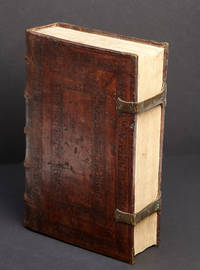
TM 625<p>MISCELLANY WITH ELEVEN IMPORTANT TEXTS REFLECTING THE SPIRITUALITY OF THE MODERN DEVOTION. In Latin Low German and Dutch decorated manuscript on paper Netherlands Southeastern or West Germany c. 1460-1480. Dimensions 244 x 143 222 folios on paper apparently complete written by at least four scribes in expert cursive gothic bookhands in 28-30 long lines seven ORIGINAL TABS or place-markers made from white leather strips blank spaces for 2-line initials guide notes for rubricator majuscules stroked with red 6- to 2-line red initials. BINDING:modern half-tawed leather and exposed wood two brass clasp-and-catch fastenings straps missing fastening back to front spine with four raised bands. TEXT:A carefully thought-out miscellany that reflects the spirituality of the Modern Devotion religious movement and includes the <i>Imitation of Christ</i> five visionary texts describing journeys to Heaven and Hell one copied twice and six texts on the Passion of Christ. PROVENANCE: Written in the Netherlands probably in the Southeastern region or in neighboring Western Germany c. 1460-80 as indicated by the languages in the manuscript and the watermarks. Later the manuscript belonged to Rev. A. d. Wagner 1824-1902 of Brighton a noted collector with a library of more than 12000 volumes his ink stamp on f. 4. The manuscript was later owned by Rev. Cecil Deedes 1843-1921 prebendary and librarian of Chichester Cathedral his note glued inside front cover. Later Edward Croft-Murray 1907-80 former keeper of prints and drawings at the British Museum owned the manuscript ownership note below Deedes's. It was then owned by Joost R. Ritman b. 1941 Dutch businessman and distinguished collector of art and books who acquired it from Maggs London in 1993. CONDITION:some water damage but text remains legible quires reinforced f. 198 tear occasional dirty smudges in the outer margins some soiling and very slight wear along joints of binding otherwise in very good condition. Full description and images available. TM 625</p> Netherlands (Southeastern?) or Western Germany, c. 1460-1480 books
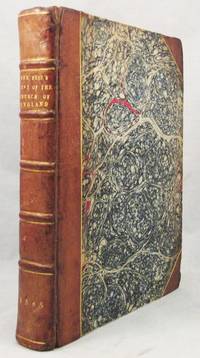
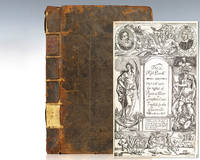
156532099Antwerp: John Laet 1565. Five books in one volume. A VERY RARE COMPLETE COPY the First Edition of Historia ecclesiastica gentis Anglorum translated into English. Provenance: Montanus 1602 -- Sir Roger Twysden 1648 and Sir John Saunders Sebright armorial bookplate. With woodcut device on titlepage woodcut armorial dedication to Queen Elizabeth woodcut plate of St. Augustin with Elbert King of Kent in anno 596 woodcut plate of King Oswald uniting the Umbrian kingdoms halfpage woodcut of Elbert building St. Paul's and with many large and handsome woodcut initials all throughout. The woodcuts are possibly by Arnaud Nicolai. Small 4to 188 x 140 mm in antique three-quarter russia over marbled boards the spine with raised bands ruled in gilt one compartment gilt lettered gilt dating at the tail gilt lined back and cornerpieces. 1-6 >1-4 #1-4 192 9 pp. A truly excellent survival of a book rarely found complete. The text-block is especially fresh and well preserved crisp and very clean. The blanks date from the time of the binding but the text is otherwise wholly complete and original the binding is handsome though its age is evident and there was restoration some time ago to the hinges the front of which is also strengthened from within. VERY RARE FIRST EDITION IN ENGLISH OF THE FIRST AND GREATEST WORK OF ENGLISH HISTORY BY THE FATHER OF ENGLISH HISTORY. RARE IN COMPLETE STATE when one reads the catalogue entries of copies in even some of the worlds most prestigious institutions one finds descriptions of missing signatures facsimile titles or entire sections excised to be quite the norm. This copy but for its probable early 19th century blank flies and endpapers is wholly intact and in a truly exceptional state of preservation.<br> The Venerable Bede's title of "The Father of English History" is well deserved. He was England’s greatest historian in the Middle Ages. His greatest work is the Historia Ecclesiastica here in its first English edition. It is an ecclesiastical history of the English people. Bede begins with Caesar’s invasion in 55 BCE and St. Alban’s martyrdom in Roman Britain tracks the spread of Christianity following St. Augustine’s mission to England in 597 and provides an account of critical events such as the Council of Whitby which decided that Roman rather than Celtic Christian customs would be followed in Britain.<br> Bede drew on the many manuscripts in the Jarrow monastery’s outstanding library and correspondents provided him materials. He was a diligent scholar and properly credited his sources. To the benefit of historical scholarship Historia Ecclesiastica spread widely throughout Europe in the Middle Ages with some 160 manuscripts still surviving. Not long after his death he became known as the Venerable Bede. His was one of the first printed history books published in Latin in Strasbourg about 1475. Highly popular on the Continent and in Britain it was reprinted in 1500 1506 and 1514.<br> Due to its strong association with Catholicism this first translation into the English tongue was published in Antwerp as the book was then prohibited in England as traitorous. Stapleton was educated in Oxford where he became a fellow in 1553. On Queen Elizabeth’s accession he left England to study theology in Louvain and Paris. His translation of Bede was his first of many fine works. Stapleton used Bede’s history to remind the reader that “we Englishmen also these many hundred of years kept and preserved sound and whole the precious perle of right faith and belefe†and he admonished that “after we forsooke the first paterne off the Christen faith delievered to us we have fallen in to plenty of heresies.†He added that the Venerable Bede a most reliable source describes many miracles that occurred in Britain under the true faith. Stapleton's translation has been called an "enduring contribution to this sparkling collection of recusant prose" -DNB <br> This is also a copy of fine and established provenience. It was formerly owned by the renown historian and antiquary Roger Twysden whose ownership signature is dated 1648. Having been caught up in civil war strife Twysden retired to his seat Roydon Hall and devoted himself to his study and writings particularly on early English histories and monasticism. His collection passed to Sir John Sebright who sold the main portion at auction in 1807. Much of Twysden's collection later passed to Sir John Sebright whose fine engraved armorial plate is afixed to the front paste-down. The present binding was likely made while the book was in Sebright's possession. <br> Contrary to the implications of Stapleton's edition of Bede Twysden's Historical vindication of the Church of England 1657 argued that it was the Church of England rather than Rome which had held fast to the true faith and that the pope's powers over England gained gradually over the centuries had been submitted to voluntarily out of love not duty for the archbishop of Canterbury had no mediate superior but only Christ and God see Jessup Sir Roger Twysden pp. 192-5. Completed in 731 Bede's Historia ecclesiastica gentis Anglorum is 'probably one of the most popular history books in any language and has certainly retained it popularity longer than any rival. The enthusiasm shown for his writings in the eighth century by English missionaries on the Continent such as Boniface Lul and others led to the spread of knowledge of his works not only in England but also in western Europe . . . . From then on as the spread of his manuscripts shows the History became popular all over western Europe and 160 of them survive today in spite of all the wars and other dangers to which manuscripts are always subject' Colgrave & Mynors p. xvii. It was first printed c. 1475 at Strasbourg PMM 16. 'Bede provided for over a thousand years and to a large extent still provides nearly all the knowledge available of the early history of England. His Historia is the only work other than parts of the Bible which has been read by every English generation from his own day to the present. It has the power to move and to convey something of the personality of its author to a degree which has called forth not only admiration but a kind of affection' Oxford DNB. John Laet hardcover
6759Numerous fine woodcut initials diagrams tables & maps in the text. Woodcut printer’s device at end. 14 p.l. 18 leaves 6 leaves 30 xxxi-cxxvi leaves 4 leaves. Folio cont. Flemish blindstamped calf binding over wooden boards rather well rebacked a few unimportant stains rolls of medallion heads & foliage forming a double panel orig. clasps and catches metal corner guards. Cologne: J. Prael for P. Quentel 1537.<br /> <br/> <br/> bound after:<br /> <br/> <br/> ANSELM ARCHBISHOP OF CANTERBURY. In Omnes Pauli Apostili Epistolas enarrationes. Title within fine woodcut border by Anton Woensam of Worms. Some fine large woodcut initials. 8 p.l. 531 pp. Folio. Cologne: E. Cervicornus for G. Hittorp 1533.<br/> <br/> A most attractive sammelband of two well-illustrated books in an attractive contemporary blind-stamped binding probably made at the Stavelot monastery in Belgium.<br/> <br/> I. First collected and illustrated edition of the scientific writings of the Venerable Bede including De Natura Rerum dealing with cosmology and natural history and De Temporum Ratione a work on chronology that still exercises a considerable influence over our daily life today. This edition was edited and commented upon by Joannes Noviomagus i.e. Jan van Bronchorst of Nijmegen 1494-1570 philosopher and mathematician then a professor of philosophy at the Collegium Montanum in Cologne. It would appear that he used the manuscript at the Dombibliothek no. 103 of Cologne to prepare this edition.<br/> <br/> The De Temporum Ratione is a significant book in several ways. Most notably “this book helped to establish the custom of counting years from the birth of Christ. When we say that Queen Elizabeth II was born in 1926 not ‘in the 16th year of the reign of George V’ or ‘in the year 2678 after the foundation of Rome’ or in the ‘2nd year of the 481st Olympiad’ we are indebted to the Venerable Bede.â€â€“Printing & the Mind of Man 16n.<br/> <br/> “Bede’s greatest practical effect was on the Western calendar. His decisions beginning the year calculation of Easter names of days and months calculations of eras and so forth in most instances finally determined usage that was only refined not changed by Gregorian reform.â€â€“D.S.B. I p. 565.<br/> <br/> “The De Ratione Temporum first published in 1505 is particularly important. It contains a remarkable theory of tides based upon Pliny but also upon personal observation; first mention of the establishment of a port i.e. the mean interval between the moon’s meridian passage and high water following; this interval is different in different ports.â€â€“Sarton I p. 511. Pierre Duhem described Bede’s establishment of a port as the only original formulation of nature to be made in the West for some eight centuries. <br/> <br/> Also contained here is the De Natura Rerum 1st printing: 1529 which contains such physical science as was then known. It collects the wisdom of the ancient world on these subjects and has the special merit of referring phenomena to natural causes. It contains a particularly important section — the “De Comptu vel Loquela digitorum†— which is “our main almost our only source for the study of mediaeval finger reckoning or symbolism.â€â€“Sarton I pp. 510-11. See also Smith History of Mathematics II p. 200.<br/> <br/> The rest of the book contains further treatises by Bede on arithmetic astronomy and the calendar and chronology.<br/> <br/> II. Very rare.<br/> <br/> PROVENANCE: Early inscription of “Antonius abbatis a Sancto Remaclo†on front flyleaf; Benedictine monastery of Stavelot Belgium inscription “Liber Monasterii Stabulensis†on title-page of Anselm; auction sale of the monastery library Catalogue d’une belle Collection de Livres et Manuscrits précieux sur vélin du VIIIe et du IXe siècle Ghent 26 April 1847 lot 42; Michel Chasles 1793-1880 the mathematician with bookplate his sale Paris 27 June-18 July 1881 lot 28; Robert B. Honeyman 1897-1987 his sale Sotheby’s 30 October 1978 lot 265.<br/> <br/> BINDING: Stavelot had its own bindery at this time and it is quite likely that this binding was executed there see Goldschmidt Gothic & Renaissance Bookbindings no. 90.<br/> <br/> Fine large copies preserved in a box.<br/> <br/> ⧠I. Adams B448–calling for two additional preliminary leaves but no other collation calls for them. Smith Rara Arithmetica p. 159n. Zinner 1657. II. Adams A1174. unknown
6759Numerous fine woodcut initials diagrams tables & maps in the text. Woodcut printer's device at end. 14 p.l. 18 leaves 6 leaves 30 xxxi-cxxvi leaves 4 leaves. Folio cont. Flemish blindstamped calf binding over wooden boards rather well rebacked a few unimportant stains rolls of medallion heads & foliage forming a double panel orig. clasps and catches metal corner guards. Cologne: J. Prael for P. Quentel 1537. bound after: ANSELM ARCHBISHOP OF CANTERBURY. In Omnes Pauli Apostili Epistolas enarrationes. Title within fine woodcut border by Anton Woensam of Worms. Some fine large woodcut initials. 8 p.l. 531 pp. Folio. Cologne: E. Cervicornus for G. Hittorp 1533. A most attractive sammelband of two well-illustrated books in an attractive contemporary blind-stamped binding probably made at the Stavelot monastery in Belgium. I. First collected and illustrated edition of the scientific writings of the Venerable Bede including De Natura Rerum dealing with cosmology and natural history and De Temporum Ratione a work on chronology that still exercises a considerable influence over our daily life today. This edition was edited and commented upon by Joannes Noviomagus i.e. Jan van Bronchorst of Nijmegen 1494-1570 philosopher and mathematician then a professor of philosophy at the Collegium Montanum in Cologne. It would appear that he used the manuscript at the Dombibliothek no. 103 of Cologne to prepare this edition. The De Temporum Ratione is a significant book in several ways. Most notably "this book helped to establish the custom of counting years from the birth of Christ. When we say that Queen Elizabeth II was born in 1926 not 'in the 16th year of the reign of George V' or 'in the year 2678 after the foundation of Rome' or in the '2nd year of the 481st Olympiad' we are indebted to the Venerable Bede."-Printing & the Mind of Man 16n. "Bede's greatest practical effect was on the Western calendar. His decisions beginning the year calculation of Easter names of days and months calculations of eras and so forth in most instances finally determined usage that was only refined not changed by Gregorian reform."-D.S.B. I p. 565. "The De Ratione Temporum first published in 1505 is particularly important. It contains a remarkable theory of tides based upon Pliny but also upon personal observation; first mention of the establishment of a port i.e. the mean interval between the moon's meridian passage and high water following; this interval is different in different ports."-Sarton I p. 511. Pierre Duhem described Bede's establishment of a port as the only original formulation of nature to be made in the West for some eight centuries. Also contained here is the De Natura Rerum 1st printing: 1529 which contains such physical science as was then known. It collects the wisdom of the ancient world on these subjects and has the special merit of referring phenomena to natural causes. It contains a particularly important section - the "De Comptu vel Loquela digitorum" - which is "our main almost our only source for the study of mediaeval finger reckoning or symbolism."-Sarton I pp. 510-11. See also Smith History of Mathematics II p. 200. The rest of the book contains further treatises by Bede on arithmetic astronomy and the calendar and chronology. II. Very rare. PROVENANCE: Early inscription of "Antonius abbatis a Sancto Remaclo" on front flyleaf; Benedictine monastery of Stavelot Belgium inscription "Liber Monasterii Stabulensis" on title-page of Anselm; auction sale of the monastery library Catalogue d'une belle Collection de Livres et Manuscrits précieux sur vélin du VIIIe et du IXe siècle Ghent 26 April 1847 lot 42; Michel Chasles 1793-1880 the mathematician with bookplate his sale Paris 27 June-18 July 1881 lot 28; Robert B. Honeyman 1897-1987 his sale Sotheby's 30 October 1978 lot 265. BINDING: Stavelot had its own bindery at this time and it is quite likely that this binding was executed there see Goldschmidt Gothic & Renaissance Bookbindings no. 90. Fine large copies preserved in a box. ❧ I. Adams B448-calling for two additional preliminary leaves but no other collation calls for them. Smith Rara Arithmetica p. 159n. Zinner 1657. II. Adams A1174. hardcover books
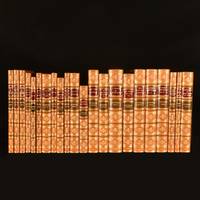
1853878P39DLondon: Nathaniel Cooke; H. Ingram & Co; Geo. Routledge & Co; Ward and Lock; James Blackwood; Charles H. Clarke; Richard Bentley; Saunders Otley & Co; Simpkin Marshall & Co 1853-86. First edition. Leather. Fine. 7.5" by 5"; 6" by 5". Cuthbert Bede; Edward Bradley; W. M'Connell; Alfred Crowquill. A beautiful fine set of the collected first editions works of Cuthbert Bede pen name of Edward Bradley a set of his scarce novels uniformly bound by Bickers. A very smart first edition set of of the works of 'Cuthbert Bede' the pseudonym of Edward Bradley.In a full tan calf binding by Bickers.Edward Bradley was a prolific but now largely forgotten novelist who wrote under the pen name 'Cuthbert Bede' a name taken from his time at Durham University. He is best known for his character 'Verdant Green'.This set includes;'Adventures of Mr. Verdant Green' published in 1853. With in-text illustrations by the author throughout. Six pages of adverts to the rear. 'Further Adventures of Mr. Verdant Green' published in 1854. Original wraps are bound in. Illustrated with a frontispiece and in-text illustrations throughout by the author. Four pages of adverts to the rear.'The Diverting Pathetic and Humorous Adventures of Mr. Sydenham Greenfinch Gentleman and of His Friends in London' published in 1854. A very scarce work. Original wraps are bound in. Illustrated with a frontispiece and in-text illustrations throughout by W. M'Connell. Eight pages of adverts to the rear.'Love's Provocations' published in 1855. A very scarce work. Original wraps are bound in with adverts to the reverse of each wrap and to the recto of the front endpaper and verso of the rear endpaper. Illustrated with a frontispiece three plates and in-text engravings by the author. 'Motley' published in 1855. A scarce work. Half-title is present. Illustrated with a frontispiece engraved title and in-text engravings by the author. 'Book of Beauty' published in 1856. A very scarce work. Illustrated with a frontispiece engraved title and in-text engravings throughout. 'Tales of College Life' published in 1856 also bound with 'Medley' and 'Motley'. 'Medley' illustrated with an engraved title and in-text engravings bound without the title page. 'Motley' with half-title illustrated with a frontispiece engraved title and in-text engravings throughout. 'Medley' undated dated 1856 from Jisc from a copy held at the British Library. A very scarce work. Original wraps are bound in. Bound without engraved title. Illustrated with in-text engravings throughout. Four pages of adverts to the rear. 'Nearer and Dearer' published in 1857. An uncommon work. Half title present. Illustrated with a frontispiece nine plates and in-text engravings. 'Mr. Verdant Green Married and Done For' published in 1857. An uncommon work. Original wraps bound in. Illustrated with in-text engravings throughout. Twelve pages of adverts to the rear.'Fairy Fables' undated dated 1858 from Jisc from a copy held at the British Library. A very scarce work. Publisher's original cloth bound in to the rear. Illustrated with in-text engravings by Alfred Crowquill. 'Happy Hours; at Wynford Grange' published in 1859. A very scarce work. Publisher's original cloth bound in to the rear. Illustrated with a hand-coloured frontispiece three hand-coloured plates and in-text engravings throughout'Our New Rector' published in 1861. A very scarce work. Half-title is present. Publisher's original cloth bound in to the rear.'The Curate of Cranston; With Other Prose and Verse' published in 1862. A very scarce work. Half-title is present. 'A Tour in Tartan-Land' published in 1863. A very scarce work. Publisher's original cloth bound in to the rear.'The White Wife; With Other Stories Supernatural Romantic and Legendary' published in 1865. A scarce work. Publisher's original cloth bound in to the rear. Half-title is present. Illustrated with a frontispiece and in-text engravings throughout by the author. 'The Rook's Garden' published in 1865. A very scarce work. Half-title is present. Publisher's original cloth bound in to the rear. 'Mattins & Muttons' Volumes I and II published in 1856. A very scarce work. Publisher's original cloth bound in to the rear of each volume. 'Little Mr. Bouncer and His Friend Verdant Green' undated dated 1873 from Jisc from a copy held at the British Library. Half-title is present. With in-text engravings throughout by the author.'Figaro at Hastings St. Leonards' undated dated 1877 from Jisc from a copy held at the British Library. A very scarce work. Original wraps are bound in with adverts to the reverse of the wraps to the verso of the rear endpaper and to the recto and verso of both the front endpaper and front free. With in-text engravings throughout by the author. 'Fotheringhay and Mary Queen of Scots' published in 1886. A scarce work.Illustrated with a frontispiece being an original contemporary portrait of Mary now first published. Further illustrated with nine plates most by the author. Publisher's original cloth bound in to the rear.Bookplate of W. A. Foyle of Beeleigh Abbey to the front paste downs. In a full calf binding by Bickers. Externally smart with only a few small marks and patches of rubbing. Bookplate to the front paste downs. Internally firmly bound. Pages are bright and clean with only the occasional scattered spot. Prior owner has coloured the hair of the figure to the vignette to the final page of text of 'Mr Verdant Green is Married and Done For'. Some spots to the last pages of some volumes due to the original cloth being bound in. Fine Nathaniel Cooke; H. Ingram & Co; Geo. Routledge & Co; Ward and Lock; James Blackwood; Charles H. Clarke; Richard Bentley; Saunde hardcover
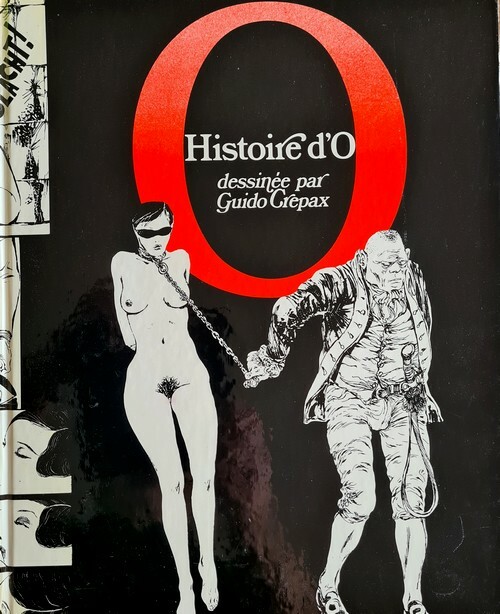
31255Magnifique planche originale de Guido Crépax pour son album " Histoire d'O ". Planche 101 de 1974 au format 50,5 x 36 cm. Encre de Chine sur carton-dessin, signée par Guido Crépax. Rarissime planche où la soumission érotique et sadomasochiste est sublimée par les formes féminines et le désir. Guido Crépax prouve ici qu'il fut un des libérateurs de la bande dessinée érotique et un maître absolu du neuvième art. Merveilleux dessinateur qui jamais ne sombra dans la pornographie et mit son trait toujours fin et parfait au service de l'art érotique. Cette planche au sublime découpage provient de l’adaptation en bande dessinée du cultissime romen de Pauline Réage / Dominique Aury, " Histoire d’O " qui narre les aventures d’une femme choisissant délibérément de devenir une esclave sexuelle. Vendue encadrée.
2024CBS-9781804064436Ed Tech Press 2024. New. Ed Tech Press unknown
2024CBS-9781804064436Ed Tech Press 2024. New. Ed Tech Press unknown
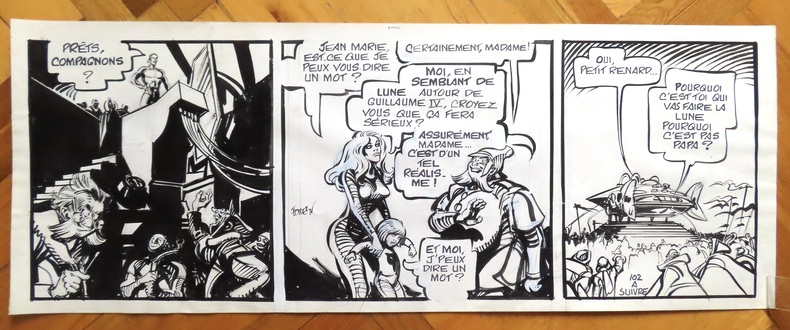
24400Encre de Chine, rehauts et corrections de gouache blanche. Au format imposant et atypique de 95 x 36 cm. (tout de même !). Vraisemblablement réalisé pour la prépublication dans France-Soir et, plus tard, pour la page 35 de l'album « Le Semble-Lune », publié en 1977 chez Pierre Horay. Présence centrale de Barbarella à la 2e case, dans son look iconique de combinaison moulante. Encrage dense et parfaitement lisible, papier légèrement gondolé par endroits (lié au grand format et à l'encrage), quelques traces ou frottements marginaux sans impact sur l'image.
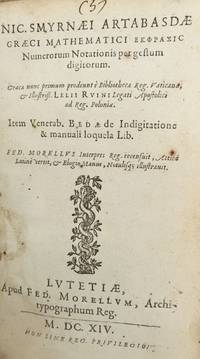
16143296Lutetiae Paris: Apud Fed. Morellum Architypographum Reg 1614. First edition. In later vellum using old book binding materials. First title page restored at the gutter not affecting the text. A tiny wormhole at the lower outer edge on the first three leaves. Contemporary ink numerals on first and last title pages. Brown spottings here and there. Overall in very good condition. First edition. In later vellum using old book binding materials. 2 3–7 1; 8; 8 p. Coll.: A4 A4 a4. <p><br /> Scarce first edition of Rhabdas’ work on finger reckoning together with Bede’s text on the same subject.<br /> <p><p><br /> Nicolaus Rhabdas’ work on the notation of numbers through finger gestures represents an important contribution to the mathematical knowledge of his era. This volume the first printed edition of his work presents the original Greek text alongside a Latin translation by the printer and publisher Fédéric Morel Federicus Morellus; c. 1523–1583 a renowned humanist scholar based in Paris during the Renaissance.<br /> <p><p><br /> In addition to Rhabdas' treatise the volume includes a summarized version of Bede the Venerable's work De computo vel loquela per gestum digitorum which addresses the same subject.<br /> <p><p><br /> The book is divided into three sections. The first section titled “… Artabasdae … ΕΚΦΡΑΣΙC numerorum notationis … Bedae de Indigitatione & manuali loquela Lib. …†contains preliminary texts by Fédéric Morel including a dedication to Lelio Ruini a distinguished book collector and Apostolic Nuncio to Poland. The second section features Rhabdas' Expositio notationis numerorum digitalis presented in its original Greek with Morel's accompanying Latin translation. The final section includes Bede's Liber de loquela per gestum digitorum which provides a condensed overview of the first part of Bede's treatise.<br /> <p><p><br /> Both Rhabdas’ and Bede's works explore the practice of representing numbers through finger positions. Often referred to as finger reckoning this technique primarily served as a mnemonic tool for remembering numbers. It was also used in markets and fairs where traders lacked a common language.<br /> <p><p><br /> Nicolaus Rhabdas Artabasda or Nicolaus of Smyrna originally from Smyrna and active in Constantinople between 1320 and 1340 was among the last Greek mathematicians to write in his native language before Greek mathematical texts were revisited in their original form during the Renaissance. He was recognized for his expertise in arithmetic and geometry though only three of his mathematical works are known to have survived.<br /> <p><p><br /> Rare on the market RBH has documented the sale of only one copy in the past sixty years.<br /> <p><p><br /> Ref.: Erwin Tomash Library A 104; USTC 6001670<br /> <p><p><br /> LIterature: Manolova D. Acerbi F. & Pérez MartÃn I. 2019. The Source of Nicholas Rhabdas’ Letter to Khatzykes: An Anonymous Arithmetical Treatise in Vat. Barb. gr. 4. Jahrbuch der Österreichischen Byzantinistik 682018 1-37. <br /> <p>. Apud Fed. Morellum, Architypographum Reg unknown
190586269Mechtshausen, 12. VI. 1905. Kl.-quer-8vo. 1 p.
CBS-9780122276000Elsevier. New. Elsevier unknown
CBS-9780122276000Elsevier. New. Elsevier unknown
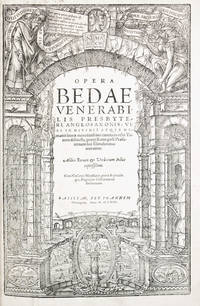
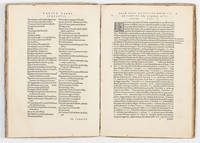
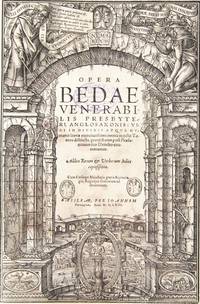
1563254015Basileae i.e. Basle: Per Joannem Hervagium 1563. First collected edition. Title within architectural border with device of Johann Herwagen. Profusely illustrated with iwoodcut maps music tables diagrams. Text in two columns; with Index. 4 vols. Folio. Contemporary calf rebacked new leather spine labels labels misnumbered later endpapers; covers worn but sound one joint starting but firm. Text show various degrees of slight worming and scattered light foxing but overall a very good sound set of this massive collected edition complete except for the final blank leaf of Volume VI. First collected edition. Title within architectural border with device of Johann Herwagen. Profusely illustrated with iwoodcut maps music tables diagrams. Text in two columns; with Index. 4 vols. Folio. The Father of English History. This is the first of three continental editions of the works of Bede the others being from Cologne in 1612 and 1688. Johann Herwage  a printer originally from Strassburg  married  the widow of the great Basel printer Johann Froben and for a while collaborated with his stepson Hieronymus Froben. From 1532 however he again started printing under his own name.<br/><br/>RARE ON THE MARKET. Adams B-477 Per Joannem Hervagium unknown books
1563254015Basileae i.e. Basle: Per Joannem Hervagium 1563. First collected edition. Title within architectural border with device of Johann Herwagen. Profusely illustrated with iwoodcut maps music tables diagrams. Text in two columns; with Index. 4 vols. Folio. Contemporary calf rebacked new leather spine labels labels misnumbered later endpapers; covers worn but sound one joint starting but firm. Text show various degrees of slight worming and scattered light foxing but overall a very good sound set of this massive collected edition complete except for the final blank leaf of Volume VI. First collected edition. Title within architectural border with device of Johann Herwagen. Profusely illustrated with iwoodcut maps music tables diagrams. Text in two columns; with Index. 4 vols. Folio. This is the first of three continental editions of the works of Bede the others being from Cologne in 1612 and 1688. Johann Herwage a printer originally from Strassburg married the widow of the great Basel printer Johann Froben and for a while collaborated with his stepson Hieronymus Froben. From 1532 however he again started printing under his own name.<br /> <br /> RARE ON THE MARKET. Adams B-477 Per Joannem Hervagium unknown
161228124Coloniae Agrippinae (Köln), Sumptibus Anton. Hierati et Ioan. Gymnici, 1612. Folio. Bound in two contemporary, uniform full vellum bindings with remains of silk-ties on boards. Some traces of use to extremities. Some pages evenly browned, some brownspotted. First two volumes richly illustrated with woodcut diagrams, musical notes, earth- and heaven-maps etc. in the text, numerous woodcut initials throughout, engraved title-page. (10) pp, columns 1-168 (84 pp.), pp. 169 - 322, columns 323 - 452 (65 pp.) + (1) f., 238 pp. + (2) ff., columns 1 - 500 (250 pp.) + (2) ff., columns 1 - 916 (458 pp.) + (1) f., columns 1 - 816 (408 pp) + (1) f., columns 1 - 852 (426 pp.) + (2) ff., columns 1 - 485 (243 pp.) + (2) ff., columns 1 - 968 (484 pp.), 55 ff. (Index).
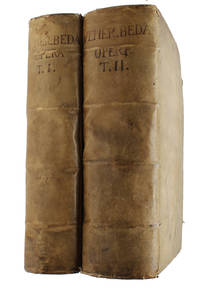
161228124Coloniae Agrippinae Köln Sumptibus Anton. Hierati et Ioan. Gymnici 1612. Folio. Bound in two contemporary uniform full vellum bindings with remains of silk-ties on boards. Some traces of use to extremities. Some pages evenly browned some brownspotted. First two volumes richly illustrated with woodcut diagrams musical notes earth- and heaven-maps etc. in the text numerous woodcut initials throughout engraved title-page. 10 pp columns 1-168 84 pp. pp. 169 - 322 columns 323 - 452 65 pp. 1 f. 238 pp. 2 ff. columns 1 - 500 250 pp. 2 ff. columns 1 - 916 458 pp. 1 f. columns 1 - 816 408 pp 1 f. columns 1 - 852 426 pp. 2 ff. columns 1 - 485 243 pp. 2 ff. columns 1 - 968 484 pp. 55 ff. Index. <br/><br/><em>Very rare early and apparently first complete edition of the seminal works by the "Father of English History" the venrable Bede. Bede’s most famous work his "An Ecclesiastical History of the English People" Historia Ecclesiastica Gentis Anglorum begins with the invasion of the British Isles by Roman forces and is considered one of the most important historical records documenting Roman rule Anglo-Saxon settlement and the evolution of the Church on the island. With its focus on Anglo-Saxon history the work is considered a key foundational text in the forming of a national English identity. The "Ecclesiastical History" contains stories that serve as the only source documenting the conversion to Christianity of the Anglo-Saxon tribes. It tells the story of Britons from Julius Caesar’s invasion to the time of Bede himself . He tells the story of battles conversions and miracles performed by monks and bishops and details Britain’s early history from the Roman invasion. He furthermore describes the organization and establishment of Christianity in the English church and covers the personal history of Holy Ethelwald and miracles of growth within the English church such as the development of the bishopric. "Bede’s works fall into three groups: grammatical and “scientific†scriptural commentary and historical and biographical. His earliest works included treatises on spelling hymns figures of speech verse and epigrams. His first treatise on chronology De temporibus “On Times†with a brief chronicle attached was written in 703. In 725 he completed a greatly amplified version De temporum ratione “On the Reckoning of Time†with a much longer chronicle. Both these books were mainly concerned with the reckoning of Easter. His earliest biblical commentary was probably that on the Revelation to John 703–709; in this and many similar works his aim was to transmit and explain relevant passages from the Fathers of the Church. Although his interpretations were mainly allegorical treating much of the biblical text as symbolic of deeper meanings he used some critical judgment and attempted to rationalize discrepancies. Among his most notable are his verse 705–716 and prose before 721 lives of St. Cuthbert bishop of Lindisfarne. These works are uncritical and abound with accounts of miracles; a more exclusively historical work is Historia abbatum c. 725; “Lives of the Abbotsâ€. In 731/732 Bede completed his Historia ecclesiastica. Divided into five books it recorded events in Britain from the raids by Julius Caesar 55–54 BCE to the arrival in Kent 597 CE of St. Augustine of Canterbury. For his sources he claimed the authority of ancient letters the “traditions of our forefathers†and his own knowledge of contemporary events. Bede’s Historia ecclesiastica leaves gaps tantalizing to secular historians. Although overloaded with the miraculous it is the work of a scholar anxious to assess the accuracy of his sources and to record only what he regarded as trustworthy evidence. It remains an indispensable source for some of the facts and much of the feel of early Anglo-Saxon history." Encycl. Britt. Only three editions of Bede's Opera Omnia are known before Dr. Giles' edition from 1843 - 44. The first was printed in 1563 and the third in 1688. The 1688-edition constitutes the second edition of the present 1612-edition which is "According to Dr. Henry the only complete edition" Lowndes I:143. These three editions are also the only ones known to have been printed in folio though Lowndes mentions the 1688-edition as 4to. The 1612-edition is the rarest. Some of the works contained in this edition are said not to be Bede's own as some of the many scientific richly illustrated works on geography the heavens the universe music etc. bear small resemblance to his other works. Lowndes I:143 Brunet 1:731. </em> hardcover
1688000011508Coloniae Agrippinae = Cologne: Ioannem Wilhelmum Friessem 1688. Later edition. Hardcover. Very Good. 4 vol. 8 vol. bound in 4. Folio. 8 2-452 2; 1-238 with a section of these leaves mispaginated; 4 2-499 2; 4 2-916 1; 2 2-815; 2 2-851; 4 2-486 1; 4 2-967 a lengthy unpaginated index of words and subjects at the end of the volume plus a blank before the rear endpaper pp. Contemporary full blind-tooled pigskin contemporary ink titling on the spines with the volumes numbers; all edges decoratively stained black. Volume one with an engraved title page and its title page printed in red and black also with several in-text woodcuts and charts. The later volumes each have their own title page all volumes with woodcut initials head and tailpieces. Brunet 276. Graesse 321. NCBEL 346. Oxford DNB J. Campbell "Bede St Bede Bæda known as the Venerable Bede 673/4–735". This edition was first published in Cologne in 1612 these volumes are the second edition printed there. Saint Bede is remembered for his contributions to ecclesiastical and British historical writings. Bede wrote analytically and was fascinated by time and the creation of life as they were written about in early Christian sources. The sources available to him included Eusebius of Caesarea Orosius Eutropius and the earlier British historian Gildas. Historians label his Historia Ecclesiastica Anglis Gentorum as the greatest culmination of his writings and some point out that it helped to create the sense of a national English identity at a time when the Angles and the Saxons were still forging intertribal unity. His history of Christianity in Britain largely focuses on the years 597-731 after a brief explanation of Christianity in Roman-controlled Britain. Bede wrote in his own autobiography that his life was devoted to "learning and letters" and he was well-beloved in his own time and long after including by Britain's first king Alfred which is largely why most of his work survives today. His translations of various religious histories and lives of the Saints into Latin made these works accessible to his fellow monks and Bede even did an Old English translation of St. John's Gospel which had it survived would be the earliest lengthy work of prose in English. Bede was an author who was influenced greatly by the writers of Late Antiquity and his career is one of the most significant among those who wrote during the early Middle Ages. With a small later bookplate and an 18th century ownership mark Signet Library on each front pastedown. No other institutional markings. Boards with a few small spots of wear and yellowing overall a lovely set. Ioannem Wilhelmum Friessem hardcover
675816 p.l. 74 leaves. Folio later vellum-backed boards foot of spine defective occasional light soiling & dampstaining. Basel: H. Petri 1529. First edition of the two texts together. The De Temporum Ratione is a significant book in several ways. Most notably "this book helped to establish the custom of counting years from the birth of Christ. When we say that Queen Elizabeth II was born in 1926 not 'in the 16th year of the reign of George V' or 'in the year 2678 after the foundation of Rome' or in the '2nd year of the 481st Olympiad' we are indebted to the Venerable Bede."-Printing & the Mind of Man 16n. "Bede's greatest practical effect was on the Western calendar. His decisions beginning the year calculation of Easter names of days and months calculations of eras and so forth in most instances finally determined usage that was only refined not changed by Gregorian reform."-D.S.B. I p. 565. "The De Ratione Temporum first published in 1505 is particularly important. It contains a remarkable theory of tides based upon Pliny but also upon personal observation; first mention of the establishment of a port i.e. the mean interval between the moon's meridian passage and high water following; this interval is different in different ports."-Sarton I p. 511. Pierre Duhem described Bede's establishment of a port as the only original formulation of nature to be made in the West for some eight centuries. This is the first printing of De Natura Rerum which contains such physical science as was then known. It collects the wisdom of the ancient world on these subjects and has the special merit of referring phenomena to natural causes. It contains a particularly important section - the "De Comptu vel Loquela digitorum" - which is "our main almost our only source for the study of mediaeval finger reckoning or symbolism."-Sarton I pp. 510-11. See also Smith History of Mathematics II p. 200. This work was edited by Johannes Sichardt 1499-1552 professor of law who during the years 1526-30 lived in Basel and while teaching also edited and prepared for printing Latin manuscripts he had found in libraries in monasteries. He also served as adviser to the Basel printers Cratander Bebel and Henricus Petri. Good copy preserved in a box. Early signature of "Mallarii" on title with motto in Greek. Armorial bookplate dated 1915 of Bishop's College Cheshunt an Anglican theological college that closed in 1968. ❧ Sichardt: Bietenholz ed. Contemporaries of Erasmus Vol. III p. 247. hardcover books
1682138282London: Printed by M.W. for Thomas Basset at the George in Fleetstreet and Ralph Smith at the Bible under the Piazza of the Royal Exchange in Cornhill 1682. Third edition in English of Higo Grotius' foundational work on international law. Folio bound in full contemporary paneled calf with a burgundy morooco spine label lettered in gilt title page printed in red and black added engraved title by T. Cross Senior bound opposite the printed title page. Translated into English by William Evats. In good condition. Armorial bookplate and period ownership signature. A pre-eminent contributor to international legal doctrine Hugo Grotius was an influential Dutch jurist philosopher and theologian. In this momentous work Grotius describes situations in which war is a valid tool of law enforcement and outlines principles for the use of force. Though based on Christian natural law Grotius advances the novel argument that his system would still be valid if it lacked a divine basis. In this regard he points to the future by moving international law in a secular direction. Barksdale's translation the first in English includes an original biographical sketch of Grotius. This edition "is perceived to be part of a larger movement in England aimed partly at setting out an ideological alternative to reformation proposals under discussion and to clarifying the relations between civil and ecclesiastical authority in England" Butler xii. Printed by M.W. for Thomas Basset at the George in Fleetstreet, and Ralph Smith at the Bible under the Piazza of the Royal Excha unknown
196862625Frankfurt a. M., Verlag Ars librorum, 1968. Gr.-Fol. (49 x 35,5 cm). Mit 12 sign. Orig.-Kaltnadel-Radierungen von Oskar Kokoschka. 2 Bll. (davon eines weiß), 98 S., 5 Bll. (davon 4 weiß), Rohe Bogen in illustr. OHLwd.-Decke u. OLdr.-Kassette mit blindgepr. Rückentitel.
1969163011969 Dessin original à la mine de plomb et à l'encre de Chine sur papier, collage dans la bulle , signé et daté au verso 1969, 35 x 25 cm., encadré.
5439Basel Switzerland: Johannes Herwagen 1563. 1st Edition. Pigskin binding. Very Good. 4 Folio Volumes bound in contemporary full blind-tooled tawed-alum pigskin Clasps missing. Title within architectural border with device of Johann Herwagen. Profusely illustrated with woodcut maps Astronomy music tables diagrams. Text in two columns; with Index. 4 vols. Folio. This is the first of three continental editions of the works of Bede the others being from Cologne in 1612 and 1688. Johann Herwage a printer originally from Strassburg married the widow of the great Basel printer Johann Froben and for a while collaborated with his stepson Hieronymus Froben. From 1532 however he again started printing under his own name. Johannes Herwagen unknown
CBS 9781804064436USA Edition . New. Brand New! Fast Delivery US Edition and ship within 24-48 hours. Deliver by FedEx and Dhl & Aramex UPS & USPS and we do accept APO and PO BOX Addresses. Order can be delivered worldwide within 6-10 days and we do have flat rate for up to 2LB. Extra shipping charges will be requested if the Book weight is more than 5 LB. This Item May be shipped from India United states & United Kingdom. Depending on your location and availability. unknown
15636955Basilae Per Ioannem Heruagium Anno M.D.LXIII. 1563. 1563 Folio. 8 volumes. Later vellum bindings each volume with two labels. New labels and vellum spine to Vol. I. Stamp of an English monastic library on the title pages and also an earlier small stamp from a continental library. Engraved architectural title page to Vol. I. some illustrations music and historiated initials in the text. Old dampstains at the front of Vol. I. A good sound set of the first collected edition of Bede's works. In the autobiographical account appended to his Historia Ecclesiastica Gentis Anglorum Bede lists over thirty of his written works. It omits some of Bede's writings and includes a Commentary on St. Paul which is not by Bede. PBFA Basilae, Per Ioannem Heruagium, Anno M.D.LXIII. hardcover