Bede The Venerable (673–735 AD)Biblio.com
2 446 résultats
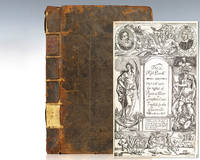
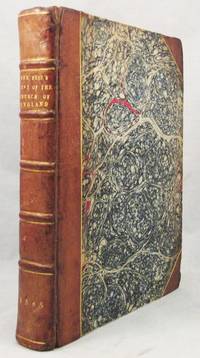
156532099Antwerp: John Laet 1565. Five books in one volume. A VERY RARE COMPLETE COPY the First Edition of Historia ecclesiastica gentis Anglorum translated into English. Provenance: Montanus 1602 -- Sir Roger Twysden 1648 and Sir John Saunders Sebright armorial bookplate. With woodcut device on titlepage woodcut armorial dedication to Queen Elizabeth woodcut plate of St. Augustin with Elbert King of Kent in anno 596 woodcut plate of King Oswald uniting the Umbrian kingdoms halfpage woodcut of Elbert building St. Paul's and with many large and handsome woodcut initials all throughout. The woodcuts are possibly by Arnaud Nicolai. Small 4to 188 x 140 mm in antique three-quarter russia over marbled boards the spine with raised bands ruled in gilt one compartment gilt lettered gilt dating at the tail gilt lined back and cornerpieces. 1-6 >1-4 #1-4 192 9 pp. A truly excellent survival of a book rarely found complete. The text-block is especially fresh and well preserved crisp and very clean. The blanks date from the time of the binding but the text is otherwise wholly complete and original the binding is handsome though its age is evident and there was restoration some time ago to the hinges the front of which is also strengthened from within. VERY RARE FIRST EDITION IN ENGLISH OF THE FIRST AND GREATEST WORK OF ENGLISH HISTORY BY THE FATHER OF ENGLISH HISTORY. RARE IN COMPLETE STATE when one reads the catalogue entries of copies in even some of the worlds most prestigious institutions one finds descriptions of missing signatures facsimile titles or entire sections excised to be quite the norm. This copy but for its probable early 19th century blank flies and endpapers is wholly intact and in a truly exceptional state of preservation.<br> The Venerable Bede's title of "The Father of English History" is well deserved. He was England’s greatest historian in the Middle Ages. His greatest work is the Historia Ecclesiastica here in its first English edition. It is an ecclesiastical history of the English people. Bede begins with Caesar’s invasion in 55 BCE and St. Alban’s martyrdom in Roman Britain tracks the spread of Christianity following St. Augustine’s mission to England in 597 and provides an account of critical events such as the Council of Whitby which decided that Roman rather than Celtic Christian customs would be followed in Britain.<br> Bede drew on the many manuscripts in the Jarrow monastery’s outstanding library and correspondents provided him materials. He was a diligent scholar and properly credited his sources. To the benefit of historical scholarship Historia Ecclesiastica spread widely throughout Europe in the Middle Ages with some 160 manuscripts still surviving. Not long after his death he became known as the Venerable Bede. His was one of the first printed history books published in Latin in Strasbourg about 1475. Highly popular on the Continent and in Britain it was reprinted in 1500 1506 and 1514.<br> Due to its strong association with Catholicism this first translation into the English tongue was published in Antwerp as the book was then prohibited in England as traitorous. Stapleton was educated in Oxford where he became a fellow in 1553. On Queen Elizabeth’s accession he left England to study theology in Louvain and Paris. His translation of Bede was his first of many fine works. Stapleton used Bede’s history to remind the reader that “we Englishmen also these many hundred of years kept and preserved sound and whole the precious perle of right faith and belefe†and he admonished that “after we forsooke the first paterne off the Christen faith delievered to us we have fallen in to plenty of heresies.†He added that the Venerable Bede a most reliable source describes many miracles that occurred in Britain under the true faith. Stapleton's translation has been called an "enduring contribution to this sparkling collection of recusant prose" -DNB <br> This is also a copy of fine and established provenience. It was formerly owned by the renown historian and antiquary Roger Twysden whose ownership signature is dated 1648. Having been caught up in civil war strife Twysden retired to his seat Roydon Hall and devoted himself to his study and writings particularly on early English histories and monasticism. His collection passed to Sir John Sebright who sold the main portion at auction in 1807. Much of Twysden's collection later passed to Sir John Sebright whose fine engraved armorial plate is afixed to the front paste-down. The present binding was likely made while the book was in Sebright's possession. <br> Contrary to the implications of Stapleton's edition of Bede Twysden's Historical vindication of the Church of England 1657 argued that it was the Church of England rather than Rome which had held fast to the true faith and that the pope's powers over England gained gradually over the centuries had been submitted to voluntarily out of love not duty for the archbishop of Canterbury had no mediate superior but only Christ and God see Jessup Sir Roger Twysden pp. 192-5. Completed in 731 Bede's Historia ecclesiastica gentis Anglorum is 'probably one of the most popular history books in any language and has certainly retained it popularity longer than any rival. The enthusiasm shown for his writings in the eighth century by English missionaries on the Continent such as Boniface Lul and others led to the spread of knowledge of his works not only in England but also in western Europe . . . . From then on as the spread of his manuscripts shows the History became popular all over western Europe and 160 of them survive today in spite of all the wars and other dangers to which manuscripts are always subject' Colgrave & Mynors p. xvii. It was first printed c. 1475 at Strasbourg PMM 16. 'Bede provided for over a thousand years and to a large extent still provides nearly all the knowledge available of the early history of England. His Historia is the only work other than parts of the Bible which has been read by every English generation from his own day to the present. It has the power to move and to convey something of the personality of its author to a degree which has called forth not only admiration but a kind of affection' Oxford DNB. John Laet hardcover
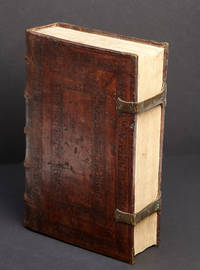
6759Numerous fine woodcut initials diagrams tables & maps in the text. Woodcut printer’s device at end. 14 p.l. 18 leaves 6 leaves 30 xxxi-cxxvi leaves 4 leaves. Folio cont. Flemish blindstamped calf binding over wooden boards rather well rebacked a few unimportant stains rolls of medallion heads & foliage forming a double panel orig. clasps and catches metal corner guards. Cologne: J. Prael for P. Quentel 1537.<br /> <br/> <br/> bound after:<br /> <br/> <br/> ANSELM ARCHBISHOP OF CANTERBURY. In Omnes Pauli Apostili Epistolas enarrationes. Title within fine woodcut border by Anton Woensam of Worms. Some fine large woodcut initials. 8 p.l. 531 pp. Folio. Cologne: E. Cervicornus for G. Hittorp 1533.<br/> <br/> A most attractive sammelband of two well-illustrated books in an attractive contemporary blind-stamped binding probably made at the Stavelot monastery in Belgium.<br/> <br/> I. First collected and illustrated edition of the scientific writings of the Venerable Bede including De Natura Rerum dealing with cosmology and natural history and De Temporum Ratione a work on chronology that still exercises a considerable influence over our daily life today. This edition was edited and commented upon by Joannes Noviomagus i.e. Jan van Bronchorst of Nijmegen 1494-1570 philosopher and mathematician then a professor of philosophy at the Collegium Montanum in Cologne. It would appear that he used the manuscript at the Dombibliothek no. 103 of Cologne to prepare this edition.<br/> <br/> The De Temporum Ratione is a significant book in several ways. Most notably “this book helped to establish the custom of counting years from the birth of Christ. When we say that Queen Elizabeth II was born in 1926 not ‘in the 16th year of the reign of George V’ or ‘in the year 2678 after the foundation of Rome’ or in the ‘2nd year of the 481st Olympiad’ we are indebted to the Venerable Bede.â€â€“Printing & the Mind of Man 16n.<br/> <br/> “Bede’s greatest practical effect was on the Western calendar. His decisions beginning the year calculation of Easter names of days and months calculations of eras and so forth in most instances finally determined usage that was only refined not changed by Gregorian reform.â€â€“D.S.B. I p. 565.<br/> <br/> “The De Ratione Temporum first published in 1505 is particularly important. It contains a remarkable theory of tides based upon Pliny but also upon personal observation; first mention of the establishment of a port i.e. the mean interval between the moon’s meridian passage and high water following; this interval is different in different ports.â€â€“Sarton I p. 511. Pierre Duhem described Bede’s establishment of a port as the only original formulation of nature to be made in the West for some eight centuries. <br/> <br/> Also contained here is the De Natura Rerum 1st printing: 1529 which contains such physical science as was then known. It collects the wisdom of the ancient world on these subjects and has the special merit of referring phenomena to natural causes. It contains a particularly important section — the “De Comptu vel Loquela digitorum†— which is “our main almost our only source for the study of mediaeval finger reckoning or symbolism.â€â€“Sarton I pp. 510-11. See also Smith History of Mathematics II p. 200.<br/> <br/> The rest of the book contains further treatises by Bede on arithmetic astronomy and the calendar and chronology.<br/> <br/> II. Very rare.<br/> <br/> PROVENANCE: Early inscription of “Antonius abbatis a Sancto Remaclo†on front flyleaf; Benedictine monastery of Stavelot Belgium inscription “Liber Monasterii Stabulensis†on title-page of Anselm; auction sale of the monastery library Catalogue d’une belle Collection de Livres et Manuscrits précieux sur vélin du VIIIe et du IXe siècle Ghent 26 April 1847 lot 42; Michel Chasles 1793-1880 the mathematician with bookplate his sale Paris 27 June-18 July 1881 lot 28; Robert B. Honeyman 1897-1987 his sale Sotheby’s 30 October 1978 lot 265.<br/> <br/> BINDING: Stavelot had its own bindery at this time and it is quite likely that this binding was executed there see Goldschmidt Gothic & Renaissance Bookbindings no. 90.<br/> <br/> Fine large copies preserved in a box.<br/> <br/> ⧠I. Adams B448–calling for two additional preliminary leaves but no other collation calls for them. Smith Rara Arithmetica p. 159n. Zinner 1657. II. Adams A1174. unknown
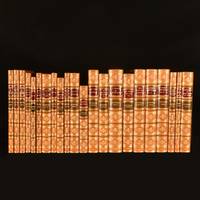
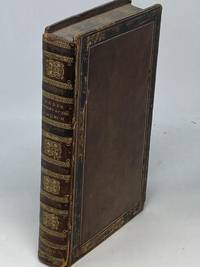
1853878P39DLondon: Nathaniel Cooke; H. Ingram & Co; Geo. Routledge & Co; Ward and Lock; James Blackwood; Charles H. Clarke; Richard Bentley; Saunders Otley & Co; Simpkin Marshall & Co 1853-86. First edition. Leather. Fine. 7.5" by 5"; 6" by 5". Cuthbert Bede; Edward Bradley; W. M'Connell; Alfred Crowquill. A beautiful fine set of the collected first editions works of Cuthbert Bede pen name of Edward Bradley a set of his scarce novels uniformly bound by Bickers. A very smart first edition set of of the works of 'Cuthbert Bede' the pseudonym of Edward Bradley.In a full tan calf binding by Bickers.Edward Bradley was a prolific but now largely forgotten novelist who wrote under the pen name 'Cuthbert Bede' a name taken from his time at Durham University. He is best known for his character 'Verdant Green'.This set includes;'Adventures of Mr. Verdant Green' published in 1853. With in-text illustrations by the author throughout. Six pages of adverts to the rear. 'Further Adventures of Mr. Verdant Green' published in 1854. Original wraps are bound in. Illustrated with a frontispiece and in-text illustrations throughout by the author. Four pages of adverts to the rear.'The Diverting Pathetic and Humorous Adventures of Mr. Sydenham Greenfinch Gentleman and of His Friends in London' published in 1854. A very scarce work. Original wraps are bound in. Illustrated with a frontispiece and in-text illustrations throughout by W. M'Connell. Eight pages of adverts to the rear.'Love's Provocations' published in 1855. A very scarce work. Original wraps are bound in with adverts to the reverse of each wrap and to the recto of the front endpaper and verso of the rear endpaper. Illustrated with a frontispiece three plates and in-text engravings by the author. 'Motley' published in 1855. A scarce work. Half-title is present. Illustrated with a frontispiece engraved title and in-text engravings by the author. 'Book of Beauty' published in 1856. A very scarce work. Illustrated with a frontispiece engraved title and in-text engravings throughout. 'Tales of College Life' published in 1856 also bound with 'Medley' and 'Motley'. 'Medley' illustrated with an engraved title and in-text engravings bound without the title page. 'Motley' with half-title illustrated with a frontispiece engraved title and in-text engravings throughout. 'Medley' undated dated 1856 from Jisc from a copy held at the British Library. A very scarce work. Original wraps are bound in. Bound without engraved title. Illustrated with in-text engravings throughout. Four pages of adverts to the rear. 'Nearer and Dearer' published in 1857. An uncommon work. Half title present. Illustrated with a frontispiece nine plates and in-text engravings. 'Mr. Verdant Green Married and Done For' published in 1857. An uncommon work. Original wraps bound in. Illustrated with in-text engravings throughout. Twelve pages of adverts to the rear.'Fairy Fables' undated dated 1858 from Jisc from a copy held at the British Library. A very scarce work. Publisher's original cloth bound in to the rear. Illustrated with in-text engravings by Alfred Crowquill. 'Happy Hours; at Wynford Grange' published in 1859. A very scarce work. Publisher's original cloth bound in to the rear. Illustrated with a hand-coloured frontispiece three hand-coloured plates and in-text engravings throughout'Our New Rector' published in 1861. A very scarce work. Half-title is present. Publisher's original cloth bound in to the rear.'The Curate of Cranston; With Other Prose and Verse' published in 1862. A very scarce work. Half-title is present. 'A Tour in Tartan-Land' published in 1863. A very scarce work. Publisher's original cloth bound in to the rear.'The White Wife; With Other Stories Supernatural Romantic and Legendary' published in 1865. A scarce work. Publisher's original cloth bound in to the rear. Half-title is present. Illustrated with a frontispiece and in-text engravings throughout by the author. 'The Rook's Garden' published in 1865. A very scarce work. Half-title is present. Publisher's original cloth bound in to the rear. 'Mattins & Muttons' Volumes I and II published in 1856. A very scarce work. Publisher's original cloth bound in to the rear of each volume. 'Little Mr. Bouncer and His Friend Verdant Green' undated dated 1873 from Jisc from a copy held at the British Library. Half-title is present. With in-text engravings throughout by the author.'Figaro at Hastings St. Leonards' undated dated 1877 from Jisc from a copy held at the British Library. A very scarce work. Original wraps are bound in with adverts to the reverse of the wraps to the verso of the rear endpaper and to the recto and verso of both the front endpaper and front free. With in-text engravings throughout by the author. 'Fotheringhay and Mary Queen of Scots' published in 1886. A scarce work.Illustrated with a frontispiece being an original contemporary portrait of Mary now first published. Further illustrated with nine plates most by the author. Publisher's original cloth bound in to the rear.Bookplate of W. A. Foyle of Beeleigh Abbey to the front paste downs. In a full calf binding by Bickers. Externally smart with only a few small marks and patches of rubbing. Bookplate to the front paste downs. Internally firmly bound. Pages are bright and clean with only the occasional scattered spot. Prior owner has coloured the hair of the figure to the vignette to the final page of text of 'Mr Verdant Green is Married and Done For'. Some spots to the last pages of some volumes due to the original cloth being bound in. Fine Nathaniel Cooke; H. Ingram & Co; Geo. Routledge & Co; Ward and Lock; James Blackwood; Charles H. Clarke; Richard Bentley; Saunde hardcover
2024CBS-9781804064436Ed Tech Press 2024. New. Ed Tech Press unknown
2024CBS-9781804064436Ed Tech Press 2024. New. Ed Tech Press unknown
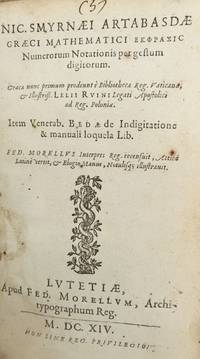
16143296Lutetiae Paris: Apud Fed. Morellum Architypographum Reg 1614. First edition. In later vellum using old book binding materials. First title page restored at the gutter not affecting the text. A tiny wormhole at the lower outer edge on the first three leaves. Contemporary ink numerals on first and last title pages. Brown spottings here and there. Overall in very good condition. First edition. In later vellum using old book binding materials. 2 3–7 1; 8; 8 p. Coll.: A4 A4 a4. <p><br /> Scarce first edition of Rhabdas’ work on finger reckoning together with Bede’s text on the same subject.<br /> <p><p><br /> Nicolaus Rhabdas’ work on the notation of numbers through finger gestures represents an important contribution to the mathematical knowledge of his era. This volume the first printed edition of his work presents the original Greek text alongside a Latin translation by the printer and publisher Fédéric Morel Federicus Morellus; c. 1523–1583 a renowned humanist scholar based in Paris during the Renaissance.<br /> <p><p><br /> In addition to Rhabdas' treatise the volume includes a summarized version of Bede the Venerable's work De computo vel loquela per gestum digitorum which addresses the same subject.<br /> <p><p><br /> The book is divided into three sections. The first section titled “… Artabasdae … ΕΚΦΡΑΣΙC numerorum notationis … Bedae de Indigitatione & manuali loquela Lib. …†contains preliminary texts by Fédéric Morel including a dedication to Lelio Ruini a distinguished book collector and Apostolic Nuncio to Poland. The second section features Rhabdas' Expositio notationis numerorum digitalis presented in its original Greek with Morel's accompanying Latin translation. The final section includes Bede's Liber de loquela per gestum digitorum which provides a condensed overview of the first part of Bede's treatise.<br /> <p><p><br /> Both Rhabdas’ and Bede's works explore the practice of representing numbers through finger positions. Often referred to as finger reckoning this technique primarily served as a mnemonic tool for remembering numbers. It was also used in markets and fairs where traders lacked a common language.<br /> <p><p><br /> Nicolaus Rhabdas Artabasda or Nicolaus of Smyrna originally from Smyrna and active in Constantinople between 1320 and 1340 was among the last Greek mathematicians to write in his native language before Greek mathematical texts were revisited in their original form during the Renaissance. He was recognized for his expertise in arithmetic and geometry though only three of his mathematical works are known to have survived.<br /> <p><p><br /> Rare on the market RBH has documented the sale of only one copy in the past sixty years.<br /> <p><p><br /> Ref.: Erwin Tomash Library A 104; USTC 6001670<br /> <p><p><br /> LIterature: Manolova D. Acerbi F. & Pérez MartÃn I. 2019. The Source of Nicholas Rhabdas’ Letter to Khatzykes: An Anonymous Arithmetical Treatise in Vat. Barb. gr. 4. Jahrbuch der Österreichischen Byzantinistik 682018 1-37. <br /> <p>. Apud Fed. Morellum, Architypographum Reg unknown
CBS-9780122276000Elsevier. New. Elsevier unknown
CBS-9780122276000Elsevier. New. Elsevier unknown
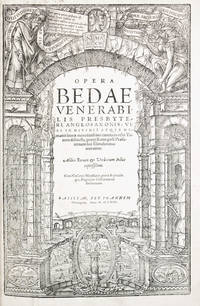
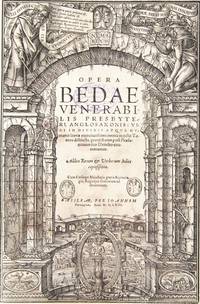
1563254015Basileae i.e. Basle: Per Joannem Hervagium 1563. First collected edition. Title within architectural border with device of Johann Herwagen. Profusely illustrated with iwoodcut maps music tables diagrams. Text in two columns; with Index. 4 vols. Folio. Contemporary calf rebacked new leather spine labels labels misnumbered later endpapers; covers worn but sound one joint starting but firm. Text show various degrees of slight worming and scattered light foxing but overall a very good sound set of this massive collected edition complete except for the final blank leaf of Volume VI. First collected edition. Title within architectural border with device of Johann Herwagen. Profusely illustrated with iwoodcut maps music tables diagrams. Text in two columns; with Index. 4 vols. Folio. This is the first of three continental editions of the works of Bede the others being from Cologne in 1612 and 1688. Johann Herwage a printer originally from Strassburg married the widow of the great Basel printer Johann Froben and for a while collaborated with his stepson Hieronymus Froben. From 1532 however he again started printing under his own name.<br /> <br /> RARE ON THE MARKET. Adams B-477 Per Joannem Hervagium unknown
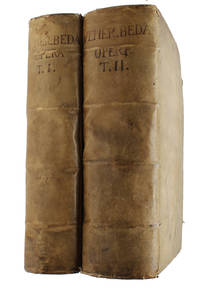
161228124Coloniae Agrippinae Köln Sumptibus Anton. Hierati et Ioan. Gymnici 1612. Folio. Bound in two contemporary uniform full vellum bindings with remains of silk-ties on boards. Some traces of use to extremities. Some pages evenly browned some brownspotted. First two volumes richly illustrated with woodcut diagrams musical notes earth- and heaven-maps etc. in the text numerous woodcut initials throughout engraved title-page. 10 pp columns 1-168 84 pp. pp. 169 - 322 columns 323 - 452 65 pp. 1 f. 238 pp. 2 ff. columns 1 - 500 250 pp. 2 ff. columns 1 - 916 458 pp. 1 f. columns 1 - 816 408 pp 1 f. columns 1 - 852 426 pp. 2 ff. columns 1 - 485 243 pp. 2 ff. columns 1 - 968 484 pp. 55 ff. Index. <br/><br/><em>Very rare early and apparently first complete edition of the seminal works by the "Father of English History" the venrable Bede. Bede’s most famous work his "An Ecclesiastical History of the English People" Historia Ecclesiastica Gentis Anglorum begins with the invasion of the British Isles by Roman forces and is considered one of the most important historical records documenting Roman rule Anglo-Saxon settlement and the evolution of the Church on the island. With its focus on Anglo-Saxon history the work is considered a key foundational text in the forming of a national English identity. The "Ecclesiastical History" contains stories that serve as the only source documenting the conversion to Christianity of the Anglo-Saxon tribes. It tells the story of Britons from Julius Caesar’s invasion to the time of Bede himself . He tells the story of battles conversions and miracles performed by monks and bishops and details Britain’s early history from the Roman invasion. He furthermore describes the organization and establishment of Christianity in the English church and covers the personal history of Holy Ethelwald and miracles of growth within the English church such as the development of the bishopric. "Bede’s works fall into three groups: grammatical and “scientific†scriptural commentary and historical and biographical. His earliest works included treatises on spelling hymns figures of speech verse and epigrams. His first treatise on chronology De temporibus “On Times†with a brief chronicle attached was written in 703. In 725 he completed a greatly amplified version De temporum ratione “On the Reckoning of Time†with a much longer chronicle. Both these books were mainly concerned with the reckoning of Easter. His earliest biblical commentary was probably that on the Revelation to John 703–709; in this and many similar works his aim was to transmit and explain relevant passages from the Fathers of the Church. Although his interpretations were mainly allegorical treating much of the biblical text as symbolic of deeper meanings he used some critical judgment and attempted to rationalize discrepancies. Among his most notable are his verse 705–716 and prose before 721 lives of St. Cuthbert bishop of Lindisfarne. These works are uncritical and abound with accounts of miracles; a more exclusively historical work is Historia abbatum c. 725; “Lives of the Abbotsâ€. In 731/732 Bede completed his Historia ecclesiastica. Divided into five books it recorded events in Britain from the raids by Julius Caesar 55–54 BCE to the arrival in Kent 597 CE of St. Augustine of Canterbury. For his sources he claimed the authority of ancient letters the “traditions of our forefathers†and his own knowledge of contemporary events. Bede’s Historia ecclesiastica leaves gaps tantalizing to secular historians. Although overloaded with the miraculous it is the work of a scholar anxious to assess the accuracy of his sources and to record only what he regarded as trustworthy evidence. It remains an indispensable source for some of the facts and much of the feel of early Anglo-Saxon history." Encycl. Britt. Only three editions of Bede's Opera Omnia are known before Dr. Giles' edition from 1843 - 44. The first was printed in 1563 and the third in 1688. The 1688-edition constitutes the second edition of the present 1612-edition which is "According to Dr. Henry the only complete edition" Lowndes I:143. These three editions are also the only ones known to have been printed in folio though Lowndes mentions the 1688-edition as 4to. The 1612-edition is the rarest. Some of the works contained in this edition are said not to be Bede's own as some of the many scientific richly illustrated works on geography the heavens the universe music etc. bear small resemblance to his other works. Lowndes I:143 Brunet 1:731. </em> hardcover
1688000011508Coloniae Agrippinae = Cologne: Ioannem Wilhelmum Friessem 1688. Later edition. Hardcover. Very Good. 4 vol. 8 vol. bound in 4. Folio. 8 2-452 2; 1-238 with a section of these leaves mispaginated; 4 2-499 2; 4 2-916 1; 2 2-815; 2 2-851; 4 2-486 1; 4 2-967 a lengthy unpaginated index of words and subjects at the end of the volume plus a blank before the rear endpaper pp. Contemporary full blind-tooled pigskin contemporary ink titling on the spines with the volumes numbers; all edges decoratively stained black. Volume one with an engraved title page and its title page printed in red and black also with several in-text woodcuts and charts. The later volumes each have their own title page all volumes with woodcut initials head and tailpieces. Brunet 276. Graesse 321. NCBEL 346. Oxford DNB J. Campbell "Bede St Bede Bæda known as the Venerable Bede 673/4–735". This edition was first published in Cologne in 1612 these volumes are the second edition printed there. Saint Bede is remembered for his contributions to ecclesiastical and British historical writings. Bede wrote analytically and was fascinated by time and the creation of life as they were written about in early Christian sources. The sources available to him included Eusebius of Caesarea Orosius Eutropius and the earlier British historian Gildas. Historians label his Historia Ecclesiastica Anglis Gentorum as the greatest culmination of his writings and some point out that it helped to create the sense of a national English identity at a time when the Angles and the Saxons were still forging intertribal unity. His history of Christianity in Britain largely focuses on the years 597-731 after a brief explanation of Christianity in Roman-controlled Britain. Bede wrote in his own autobiography that his life was devoted to "learning and letters" and he was well-beloved in his own time and long after including by Britain's first king Alfred which is largely why most of his work survives today. His translations of various religious histories and lives of the Saints into Latin made these works accessible to his fellow monks and Bede even did an Old English translation of St. John's Gospel which had it survived would be the earliest lengthy work of prose in English. Bede was an author who was influenced greatly by the writers of Late Antiquity and his career is one of the most significant among those who wrote during the early Middle Ages. With a small later bookplate and an 18th century ownership mark Signet Library on each front pastedown. No other institutional markings. Boards with a few small spots of wear and yellowing overall a lovely set. Ioannem Wilhelmum Friessem hardcover
1682138282London: Printed by M.W. for Thomas Basset at the George in Fleetstreet and Ralph Smith at the Bible under the Piazza of the Royal Exchange in Cornhill 1682. Third edition in English of Higo Grotius' foundational work on international law. Folio bound in full contemporary paneled calf with a burgundy morooco spine label lettered in gilt title page printed in red and black added engraved title by T. Cross Senior bound opposite the printed title page. Translated into English by William Evats. In good condition. Armorial bookplate and period ownership signature. A pre-eminent contributor to international legal doctrine Hugo Grotius was an influential Dutch jurist philosopher and theologian. In this momentous work Grotius describes situations in which war is a valid tool of law enforcement and outlines principles for the use of force. Though based on Christian natural law Grotius advances the novel argument that his system would still be valid if it lacked a divine basis. In this regard he points to the future by moving international law in a secular direction. Barksdale's translation the first in English includes an original biographical sketch of Grotius. This edition "is perceived to be part of a larger movement in England aimed partly at setting out an ideological alternative to reformation proposals under discussion and to clarifying the relations between civil and ecclesiastical authority in England" Butler xii. Printed by M.W. for Thomas Basset at the George in Fleetstreet, and Ralph Smith at the Bible under the Piazza of the Royal Excha unknown
5439Basel Switzerland: Johannes Herwagen 1563. 1st Edition. Pigskin binding. Very Good. 4 Folio Volumes bound in contemporary full blind-tooled tawed-alum pigskin Clasps missing. Title within architectural border with device of Johann Herwagen. Profusely illustrated with woodcut maps Astronomy music tables diagrams. Text in two columns; with Index. 4 vols. Folio. This is the first of three continental editions of the works of Bede the others being from Cologne in 1612 and 1688. Johann Herwage a printer originally from Strassburg married the widow of the great Basel printer Johann Froben and for a while collaborated with his stepson Hieronymus Froben. From 1532 however he again started printing under his own name. Johannes Herwagen unknown
CBS 9781804064436USA Edition . New. Brand New! Fast Delivery US Edition and ship within 24-48 hours. Deliver by FedEx and Dhl & Aramex UPS & USPS and we do accept APO and PO BOX Addresses. Order can be delivered worldwide within 6-10 days and we do have flat rate for up to 2LB. Extra shipping charges will be requested if the Book weight is more than 5 LB. This Item May be shipped from India United states & United Kingdom. Depending on your location and availability. unknown
15636955Basilae Per Ioannem Heruagium Anno M.D.LXIII. 1563. 1563 Folio. 8 volumes. Later vellum bindings each volume with two labels. New labels and vellum spine to Vol. I. Stamp of an English monastic library on the title pages and also an earlier small stamp from a continental library. Engraved architectural title page to Vol. I. some illustrations music and historiated initials in the text. Old dampstains at the front of Vol. I. A good sound set of the first collected edition of Bede's works. In the autobiographical account appended to his Historia Ecclesiastica Gentis Anglorum Bede lists over thirty of his written works. It omits some of Bede's writings and includes a Commentary on St. Paul which is not by Bede. PBFA Basilae, Per Ioannem Heruagium, Anno M.D.LXIII. hardcover
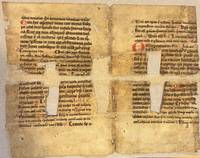
3591Southern France or Northern Italy late 13th century. Manuscript on vellum. Written space approx. 65 × 95 mm; overall leaf size ca. 90 × 125 mm. Text in two sizes of gothic textualis written in dark brown ink rubrics in red. Reused as binding waste with rectangular cut-outs consistent with sewing support slots for an early modern binding. Trimmed at one side with staining worming and losses to the text yet the passages are largely legible and the text could be identified. Manuscript on vellum. Written space approx. 65 × 95 mm; overall leaf size ca. 90 × 125 mm. Text in two sizes of gothic textualis written in dark brown ink rubrics in red. Bifolium; 4 pages. <p><br /> Unusual 13th-century breviary fragment combining the legend of Saint Cecilia with Bede’s All Saints’ Day homily.<br /> <p><p><br /> A small-format bifolium from a Latin breviary preserving a liturgical reading cycle that interweaves the Historia passionis sanctae Caeciliae virginis with Bede’s Homilia LXXI. In solemnitate Omnium Sanctorum. The texts are copied in a compact formal book hand with smaller rubricated insertions and interlinear additions in a secondary notula script. The size layout and script suggest a portable breviary produced for monastic or private devotion.<br /> <p><p><br /> The Cecilia text includes familiar episodes from the Latin Passio including Angelum Dei habeo amatorem Haec Valerianum quendam iuvenem habebat sponsum and Cantantibus organis along with the insertion Domine Iesu Christe seminator casti consilii. These segments appear in the form typical of liturgical readings not continuous narrative.<br /> <p><p><br /> Interwoven is a significant portion of Bede’s Homilia LXXI. In eadem solemnitate Omnium Sanctorum traditionally read on the feast of All Saints which begins: Laudem Domini qui superna caelorum regna spiritibus angelicis… While the Cecilia passages derive from the broader Passio tradition textual features show alignment with versions known from homiliaries. This direct juxtaposition of Cecilia’s passion with Bede’s theological reflections is unusual: we could not locate another surviving breviary containing both texts in this combination suggesting a regionally specific reading order or a customized compilation.<br /> <p><p><br /> Saint Cecilia one of the most venerated Roman martyrs was revered from the early Middle Ages as the patron saint of music virginity and spiritual marriage. Her Passio though apocryphal in parts circulated widely and was integrated into liturgical use by the 9th century. The Homiliae of Bede ca. 673–735 particularly those for major feasts remained standard reading in monastic contexts for centuries. The presence of both in this fragment suggests a breviary or homiliary adapted to a community with a particular devotion to Cecilia and access to Bede’s homiletic corpus.<br /> <p><p><br /> The script—a regular and angular gothic textualis with looped ascenders and clubbed minims—is consistent with manuscripts produced in southern France or northern Italy in the latter half of the 13th century. The rubricated initials and the textualis–notula script pairing support the same dating.<br /> <p>. unknown
152542822Venice: in aedibus Ioannis Tacuini Tridinensis 1525. <p>Bede the Venerable 672/73 - 735. De computo vel loquela per gestum digitorum and De ratione unciarum. In Hoc in volumine haec continentur M. Val. Probus de notis Roma. ex codice manuscript castigatior . . . ed. Giovanni Tacuino Venice: G. Tacuino 1525 ff. LV - LVII. Whole volume 4to. 4 LXXIX i.e. LXXXI 1ff. Title in red and black. Full-page woodcut of a sibyl within an architectural setting signed "b. M." in the block probably Benedetto Montagna a few woodcut initials. 211 x 153 mm. Modern vellum. Fine. </p> <p>Probably the Earliest Printings of Bede's accounts of finger-reckoning and duodecimal fractions. Bede's "De computo vel loquela per gestum digitorum" On calculating and speaking with the fingers and "De ratione unciarum" On calculating duodecimal fractions form part of the introduction to his treatise De temporum ratione On the reckoning of time written around 725 A.D. The editio princeps of De temporum ratione was published by Sichardus in 1529 four years after the present work. Portions of De temporum ratione appeared in print as early as 1505 but these do not appear to have included the section on finger-reckoning. Smith in his Rara arithmetica states that the 1522 edition of Johannes Aventinus's Abacus atque vetustissima veterum latinorum per digitos manusque numerandi contains a description of Bede's finger-reckoning; however we think this may be an error since we have not been able to find any record of this edition in OCLC or the Karlsruhe Virtual Catalogue. Smith himself described only the 1532 edition of Aventinus's work see Rara arithmetica pp. 136-138. </p> <p>Bede's two disquisitions are contained in a collection of works on Latin abbreviations symbols weights measures and inscriptions edited by Giovanni Tacuino. The collection is devoted primarily to works on deciphering the abbreviations used in classical-era stone or bronze inscriptions a subject of great interest to humanistic scholars eager to discover more about the ancient world. Included in the collection is the editio princeps of Petrus Diaconus' De notus literarum more Romano liber which Tacuino had discovered along with a new edition of M. Valerius Probus' De notus Romanorum and several transcriptions of Roman inscriptions in quasi-facsimile. The typographic design of the title is reminiscent of an ancient text in stone. </p> <p>Finger-reckoning a method of computation in which numbers are represented by finger and hand gestures had been practiced since ancient times and was commonly used during the Middle Ages; however there are very few written accounts of the technique dating from these times probably because it was used primarily by "common or illiterate people" Menninger p. 201 who passed its methods on orally. Bede's account of the practice although not the first was the best and most influential. His purpose was to provide a useful method for calculating the Christian calendar most importantly the date of Easter and other movable feasts. </p> <p>Bede listed finger- and hand symbols for the numerals 1 through 9999; these </p> <p>"roughly work like a placement system. The middle ring and little fingers of the left hand denote the digits; the thumb and index fingers on the left hand express the tens; the thumb and index finger on the right hand the hundreds; and the middle ring and little fingers the thousands . . . The informal manner in which Bede explains how to flex the fingers and form gestures seems to retain traces of oral instruction" Kusukawa pp. 28-29. </p> <p>Prior to Europe's adoption of Arabic numerals finger-reckoning provided a rudimentary method of place-value calculation. "Neither Bede nor any of his contemporaries in Western Europe knew about place value or zero but finger reckoning enabled them to proceed as if they did. Finger joints supplied place value-one joint 10s another 100s and so on-and zero was indicated by the normal relaxed position of the fingers-by nothing so to speak. The system was even capable of simple computation" Crosby The Measure of Reality: Quantification in Western Europe 1250-1600 p. 42. </p> <p>Bede's explanation of the Roman system of duodecimal fractions which follows the description of finger-reckoning clarifies the terminology and provides a list of synonyms for different types of fractions. Kusukawa "A manual computer for reckoning time" in Sherman Writing on Hands: Memory and Knowledge in Early Modern Europe pp. 28-34. Menninger Number Words and Number Symbols: A Cultural History of Numbers pp. 201-8.</p> . in aedibus Ioannis Tacuini Tridinensis unknown
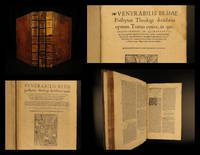
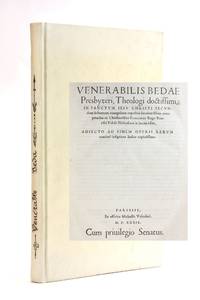
154511735<p><b>1545 Saint Venerable BEDE Bible & Commentary English Monk Church Cosmology </b></p><p>Saint Venerable Bede was an English monk during the 7th- and 8th-centuries. He is most remembered for his ecclesiastical work on the history of English people in which he discusses the establishment and growth of the church throughout the known world. He also wrote important commentaries on the books of the Bible. This work explains relevant Biblical passages as well as describes the allegorical notes of Church Fathers. However he did not write exclusively of church theology. He also wrote on the development of time and ideas of cosmology. </p><p>This 16th-century Latin edition was published in Paris by Roigny. An impressive three-volume folio set!</p><p>Item number: #11735</p><p>Price: $3500</p><p>BEDE Saint Venerable</p><p><b><i>Venerabilis Bedae presbyteri theologi doctissimi juxta ac sanctissimi commentationum in Sacras Literas tomus primus : in quo ea maximè quae Veteris Testamenti sunt ita perspicuè ac dilucidè enarrantur ut inter celeberrimos ejus argumenti tractatores…</i></b></p><p>Parisiis : Apud Joannem Roigny 1545/44. 1st editions</p><p><br /></p><p><u>Details</u>: </p><p>· Collation: Complete with all pages; 3 volumes</p><p>o Vol I – 16 272</p><p>o Vol II – 16 264</p><p>o Vol III – 12 260</p><p>· References: USTC 149316</p><p>· Language: Latin</p><p>· Binding: Leather; tight & secure</p><p>· Size: ~13in X 9in 33.5cm x 23cm</p><p>· Exceedingly rare and desirable set</p><p>Our Guarantee:</p><p>Very Fast. Very Safe. Free Shipping Worldwide.</p><p>Customer satisfaction is our priority! Notify us with 7 days of receiving and we will offer a full refund without reservation!</p><p>11735</p><p>Photos available upon request. </p> Joannem Roigny hardcover
CBS 9780122276000USA Edition . New. Brand New! Fast Delivery US Edition and ship within 24-48 hours. Deliver by FedEx and Dhl & Aramex UPS & USPS and we do accept APO and PO BOX Addresses. Order can be delivered worldwide within 6-10 days and we do have flat rate for up to 2LB. Extra shipping charges will be requested if the Book weight is more than 5 LB. This Item May be shipped from India United states & United Kingdom. Depending on your location and availability. unknown
1539505317Michaelis Vascosani Michel Vascosan 1539. Leather. NEAR FINE. 4 218pp. 9 Index. Folio in 6's collation complete: 2 A3-T6 2. Vulgate text printed in larger font with woodcut drop caps marginal references. Nicely bound in recent vellum with hand-written spine title in a convincing antiquarian hand. Some light staining to the edges small wormhole to top margin toward the gutter not affecting text; else FINE internally; a nice fresh copy. Bede the Venerable was one of the greatest minds of the Middle Ages and his immense learning is on full display in this commentary on the Fourth Gospel drawing on the church fathers as well as interlocating Old Testament and intertextual references. Bede had a particular devotion to the Johnannine gospel; his translation of the Vulgate into Old English is held as the first vernacular translation. The value of this particular edition is due to its significance in the history of printing. Vascosan set up his press 1530 under the banner of his father in law the famed printer Badius and adorned his title pages with the Badius printer's device through the decade. For reasons unclear possibly a dispute with relatives sharing an interest in the firm in 1539 Vascosan stopped using the Badius device. Rather than cut his own device Vascosan simply printed his title pages without one remarkably becoming the first printer to forego this branding tool that was so essential to printer differentiation in an age when books were sold without bindings. While his motivations at the outset are unclear it may have been simply needing to sell some books before a proper device could be cut he took a liking to it and maintained this style throughout his career. Today he is remembered as a pioneer of this 'unadorned elegance of his editions' Oxford Companion to the Book p. 1238. His text-only title pages were 'a harbinger of a new approach to title pages. Vascosan’s decision flew in the face of the Parisian and more generally European book-trade where printers’ devices had played a vital role in the identification and marketing of printers’ and booksellers’ output. He was trail-blazing a new method of promoting his works – a minimalist style which would challenge the use of ornate devices so popular among the first generation of Parisian printers and booksellers. Coupled with his rejection of a printer’s device was what one might call his ‘purification’ of the title page for his title pages are incredibly simple in style the whiteness of the paper dominating. Henri-Jean Martin wittily calls this ‘the graphic mode’ of ‘solemnization of the title page’ as opposed to the second ‘monumental mode’ which by the end of the sixteenth century became saturated with symbols and architectural motifs.' Exhibition Catalog 'Printing in Sixteenth-Century France at the Edward Worth Library.' While we cannot speculate on the priority of printings within the year 1539 we can say that no other copies of a 1539 Vascosan imprint are available in trade at this time and only one appears in auction records. OCLC 60698411 listes 8 copies. Michaelis Vascosani [Michel Vascosan] unknown
19332090202122900297Bun-za shorin 1933. Soft Cover. Fine. Number of books: 1 Bun-za shorin paperback
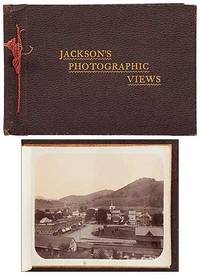
1901408888Grand Rapids Mich: B.D. Jackson 1901. Hardcover. Near Fine. Oblong 12mo. Silk cord-tied red cloth boards with "Jackson's Photographic Views" on front board in gilt. 32 sepia-toned albumen images each approximately 5.75" x 3.75". Each image is captioned by hand on two partially printed with Jackson's name and address contents pages in the front. After a few images et in Vermont the remainder are set in the Midwest particularly Michigan Missouri and Ohio. The Ohio-born Jackson was a professional photographer who started in Grand Rapids but moved to Pomona California in 1901 thus our attribution of the date where he was a success in both portraiture and where he eventually became well-known for landscape photography for the production of stereographs and postcards. His archives are at the Huntington Library. While this group displays some lovely landscapes this album seems more personal and perhaps half are of people several identified and at least one at the home of J.B.H. Jackson in Michigan very likely a relative. Among the images are several of camps and parks locations include Haslet Park Pine Lake and Harwick Michigan; several of Catalfa Grove in Missouri; and Lake Brady Cuyauga River and several of Maple Dell Ohio; as well as the first few set in Royalton Vermont. One image of two small black children is labeled "Chocolate Drops" Really exceptional quality images from the earlier part of Jackson's career. B.D. Jackson hardcover
1907mon0000194158George Bell and Sons 1907-01-01. Hardcover. Good. in x in x in. Not ex-library. Clean copy in good condition. George Bell and Sons hardcover
159701London: Times Newspapers 1970. First Edition. First Edition. <br /> <br /> The Times Authors series presented gatherings of resources relating to an author including newspaper reviews offprints of articles film stills and various ephemera created for use by students and available for purchase via mail order from the "Times Education Services" office in London. This edition noted as No. 2 focused on George Orwell. Other authors featured included Dylan Thomas Arnold Wesker and Allan Sillitoe. <br /> <br /> As noted on the folder on offer each issue in the series was "carefully selected and arranged but organised in a loose-leaf format with no imposed sequence. For individual study or group work this flexibility will be found especially helpful for there are numerous points of entry and the direction and centre of interest can depend on the book or books being studied." <br /> <br /> Among the resources in the edition are:<br /> <br /> Eight gatherings of reproductions of newspaper articles and reviews relating to Orwell with a number of newspapers represented including "The Observer" "Scrutiny" "The Daily Mirror" "The Times Literary Supplement" "Tribune" and "The Guardian." <br /> <br /> A reproduction of four articles written by Orwell originally published in "As I Please" his weekly column for the left-wing British newspaper "Tribune."<br /> <br /> A comic strip based on the 1954 animated film directed by John Halas and Joy Batchelor and created by the film's lead animator Harold Whitaker. <br /> <br /> A poster advertising Halas and Batchelor's film with a striking black-and-white drawing of charismatic swine leader Napoleon. <br /> <br /> A double-sided character and set design illustration and a booklet featuring ten black-and-white photographs from the 1954 film.<br /> <br /> An offprint of two of the five essays from Orwell's 1947 book "The English People" and reproducing the book's covers and title page. <br /> <br /> A bifold bibliography of Orwell's publications and critical works relating to Orwell.<br /> <br /> "The English People": Fine in staple-bound wrappers. <br /> <br /> Harold Whitaker strip: Small scratch on the front wrapper else Near Fine in side-stapled wrappers. <br /> <br /> Poster: 19.5 x 14.5 inches folded. About Fine.<br /> <br /> Newspaper reproductions bifold bibliography design illustration and stills booklet: Very Good plus to Near Fine with some faint offsetting along the top edges. <br /> <br /> All materials housed in a pictorial green folder measuring 12 x 9 inches. <br /> <br /> Folder and contents housed in publisher's original plastic envelope Near Fine. Times Newspapers unknown
181488015London England: Printed for the Translator and sold by Messrs. Keating Brown and Keating 38 Duke-street Grosvernor-squeare; Mr. Booker 61 New Bond -street; Mr. Jackson Duke-street Lincoln's-Inn Fields; Mr. Keys Coleman-street; Mr. Ryan 353 Oxford-street; Mr. Cooper 11 Dar5tmouth-street Golden-square; Mr. Field Somers' Town; Mr. T. Hadock Manchester &c &c 1814. First Edition. Hardcover. Good Plus. Octavo 8.8 in. x 5.2 in. pp. xxviii 556. Illustrated with frontispiece engraving. Contemporary brown light brown diced russia. Blind and dyed pointillé tooling and gilt roll and gilt to all edges of leather boards as well. Hand-tooled inner dentelles in slanted bar pattern each with its own pointillé tooling. Elaborate gilt designs to spine each non-raised hub separated by a gilt bar which echoes the stamped border to front and rear boards. Very basic "clouds and speckling" marbling to all edges. Engraved Frontispiece.<br /> <br /> Front hinge cracking but holding by cords. Rubbing to extremities with corners just showing. Black on decorative frame is well rubbed. Head and tail of spine worn. Marbled edges and endpapers.Light spotting to preliminary pages. Solid textblock with tight spine. Spine appears to have been repaired; book may have been rebacked. Rubbing and scuffing to extremities and boards corners showing. Lovely Stormont marbling to endpapers in salmon-pink and midnight blue. Previous owner's "Charles Walmesley Westwood" armorial bookplate to front pastedown and his name in manuscript near top of title page. The introduction i.e. in this work entitled "Advertisement" the translator Mr. Hurst cites two previous translations of Bede's History -- the first by Rev. Thos. Stapleton in 1565 which he says contains numerous obsolete and now 1814 "almost unintelligible". The second by Mr. John Stevens in 1723 he writes is "so literal as to appear in many places both very obscure and defective in the style." All in all Mr. Hurst claims ".this interesting and edifying history of the conversion of our own country to Christianity lies concealed from the knowledge of most people; who therefore are ignorant of the true nature of that religion which our ancestors professed."<br /> <br /> Beda Venerabilis lived from 673 to 736 and wrote this history several years before his death. Printed for the Translator, and sold by Messrs. Keating, Brown, and Keating, 38, Duke-street, Grosvernor-squeare; Mr. Booker, 61 hardcover