[Bede the Venerable]; [Saint Cecilia]Biblio.com
87 088 résultats
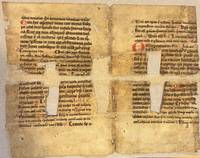
3591Southern France or Northern Italy late 13th century. Manuscript on vellum. Written space approx. 65 × 95 mm; overall leaf size ca. 90 × 125 mm. Text in two sizes of gothic textualis written in dark brown ink rubrics in red. Reused as binding waste with rectangular cut-outs consistent with sewing support slots for an early modern binding. Trimmed at one side with staining worming and losses to the text yet the passages are largely legible and the text could be identified. Manuscript on vellum. Written space approx. 65 × 95 mm; overall leaf size ca. 90 × 125 mm. Text in two sizes of gothic textualis written in dark brown ink rubrics in red. Bifolium; 4 pages. <p><br /> Unusual 13th-century breviary fragment combining the legend of Saint Cecilia with Bede’s All Saints’ Day homily.<br /> <p><p><br /> A small-format bifolium from a Latin breviary preserving a liturgical reading cycle that interweaves the Historia passionis sanctae Caeciliae virginis with Bede’s Homilia LXXI. In solemnitate Omnium Sanctorum. The texts are copied in a compact formal book hand with smaller rubricated insertions and interlinear additions in a secondary notula script. The size layout and script suggest a portable breviary produced for monastic or private devotion.<br /> <p><p><br /> The Cecilia text includes familiar episodes from the Latin Passio including Angelum Dei habeo amatorem Haec Valerianum quendam iuvenem habebat sponsum and Cantantibus organis along with the insertion Domine Iesu Christe seminator casti consilii. These segments appear in the form typical of liturgical readings not continuous narrative.<br /> <p><p><br /> Interwoven is a significant portion of Bede’s Homilia LXXI. In eadem solemnitate Omnium Sanctorum traditionally read on the feast of All Saints which begins: Laudem Domini qui superna caelorum regna spiritibus angelicis… While the Cecilia passages derive from the broader Passio tradition textual features show alignment with versions known from homiliaries. This direct juxtaposition of Cecilia’s passion with Bede’s theological reflections is unusual: we could not locate another surviving breviary containing both texts in this combination suggesting a regionally specific reading order or a customized compilation.<br /> <p><p><br /> Saint Cecilia one of the most venerated Roman martyrs was revered from the early Middle Ages as the patron saint of music virginity and spiritual marriage. Her Passio though apocryphal in parts circulated widely and was integrated into liturgical use by the 9th century. The Homiliae of Bede ca. 673–735 particularly those for major feasts remained standard reading in monastic contexts for centuries. The presence of both in this fragment suggests a breviary or homiliary adapted to a community with a particular devotion to Cecilia and access to Bede’s homiletic corpus.<br /> <p><p><br /> The script—a regular and angular gothic textualis with looped ascenders and clubbed minims—is consistent with manuscripts produced in southern France or northern Italy in the latter half of the 13th century. The rubricated initials and the textualis–notula script pairing support the same dating.<br /> <p>. unknown
152542822Venice: in aedibus Ioannis Tacuini Tridinensis 1525. <p>Bede the Venerable 672/73 - 735. De computo vel loquela per gestum digitorum and De ratione unciarum. In Hoc in volumine haec continentur M. Val. Probus de notis Roma. ex codice manuscript castigatior . . . ed. Giovanni Tacuino Venice: G. Tacuino 1525 ff. LV - LVII. Whole volume 4to. 4 LXXIX i.e. LXXXI 1ff. Title in red and black. Full-page woodcut of a sibyl within an architectural setting signed "b. M." in the block probably Benedetto Montagna a few woodcut initials. 211 x 153 mm. Modern vellum. Fine. </p> <p>Probably the Earliest Printings of Bede's accounts of finger-reckoning and duodecimal fractions. Bede's "De computo vel loquela per gestum digitorum" On calculating and speaking with the fingers and "De ratione unciarum" On calculating duodecimal fractions form part of the introduction to his treatise De temporum ratione On the reckoning of time written around 725 A.D. The editio princeps of De temporum ratione was published by Sichardus in 1529 four years after the present work. Portions of De temporum ratione appeared in print as early as 1505 but these do not appear to have included the section on finger-reckoning. Smith in his Rara arithmetica states that the 1522 edition of Johannes Aventinus's Abacus atque vetustissima veterum latinorum per digitos manusque numerandi contains a description of Bede's finger-reckoning; however we think this may be an error since we have not been able to find any record of this edition in OCLC or the Karlsruhe Virtual Catalogue. Smith himself described only the 1532 edition of Aventinus's work see Rara arithmetica pp. 136-138. </p> <p>Bede's two disquisitions are contained in a collection of works on Latin abbreviations symbols weights measures and inscriptions edited by Giovanni Tacuino. The collection is devoted primarily to works on deciphering the abbreviations used in classical-era stone or bronze inscriptions a subject of great interest to humanistic scholars eager to discover more about the ancient world. Included in the collection is the editio princeps of Petrus Diaconus' De notus literarum more Romano liber which Tacuino had discovered along with a new edition of M. Valerius Probus' De notus Romanorum and several transcriptions of Roman inscriptions in quasi-facsimile. The typographic design of the title is reminiscent of an ancient text in stone. </p> <p>Finger-reckoning a method of computation in which numbers are represented by finger and hand gestures had been practiced since ancient times and was commonly used during the Middle Ages; however there are very few written accounts of the technique dating from these times probably because it was used primarily by "common or illiterate people" Menninger p. 201 who passed its methods on orally. Bede's account of the practice although not the first was the best and most influential. His purpose was to provide a useful method for calculating the Christian calendar most importantly the date of Easter and other movable feasts. </p> <p>Bede listed finger- and hand symbols for the numerals 1 through 9999; these </p> <p>"roughly work like a placement system. The middle ring and little fingers of the left hand denote the digits; the thumb and index fingers on the left hand express the tens; the thumb and index finger on the right hand the hundreds; and the middle ring and little fingers the thousands . . . The informal manner in which Bede explains how to flex the fingers and form gestures seems to retain traces of oral instruction" Kusukawa pp. 28-29. </p> <p>Prior to Europe's adoption of Arabic numerals finger-reckoning provided a rudimentary method of place-value calculation. "Neither Bede nor any of his contemporaries in Western Europe knew about place value or zero but finger reckoning enabled them to proceed as if they did. Finger joints supplied place value-one joint 10s another 100s and so on-and zero was indicated by the normal relaxed position of the fingers-by nothing so to speak. The system was even capable of simple computation" Crosby The Measure of Reality: Quantification in Western Europe 1250-1600 p. 42. </p> <p>Bede's explanation of the Roman system of duodecimal fractions which follows the description of finger-reckoning clarifies the terminology and provides a list of synonyms for different types of fractions. Kusukawa "A manual computer for reckoning time" in Sherman Writing on Hands: Memory and Knowledge in Early Modern Europe pp. 28-34. Menninger Number Words and Number Symbols: A Cultural History of Numbers pp. 201-8.</p> . in aedibus Ioannis Tacuini Tridinensis unknown
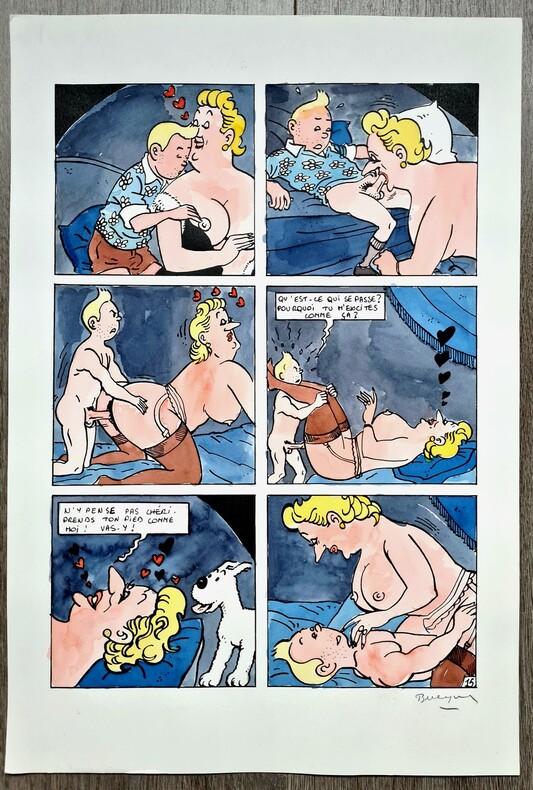
1850Magnifique planche originale en couleurs, signée, réalisé par Jan Bucquoy en 1992 pour sa BD parodique : La Vie Sexuelle de Tintin, d'après Hergé. Planche de 6 cases au format 48,5 x 33 cm, mettant en scène dans des actes sexuels, Tintin, Milou et Bianca Castafiore. Etat superbe. De toute rareté.
191258474[London, Cambridge University Press, 1912]. Gr.-8°. S. (425-)460, Späterer OKart.-Bd.
1988198641988 1 Dessin à l'encre de Chine et réhauts de couleur verte, 1988, 20.5 x 13 cm., encadré.
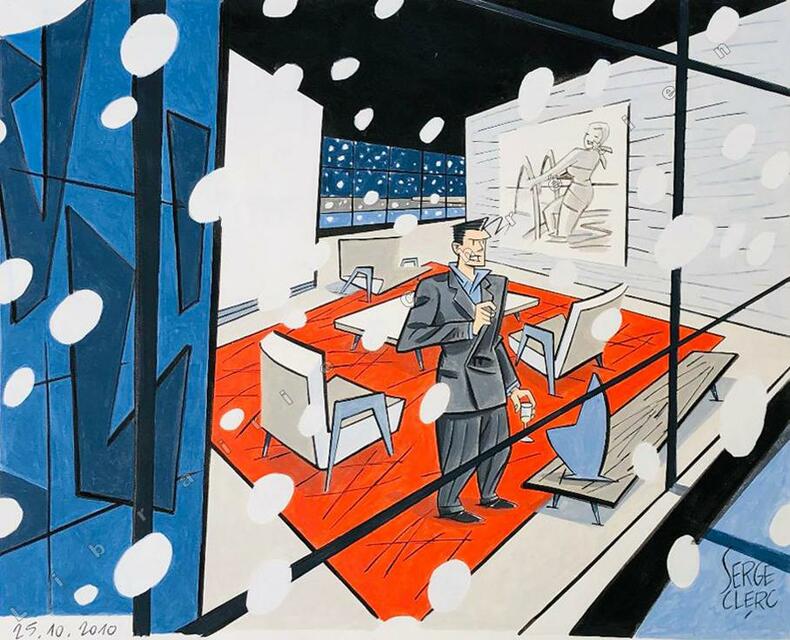
2010238252010 Encre et gouache signée en bas à droite, daté du 25.X.2010, 40 x 50 cm. (format du dessin), 50 x 65 cm. (format de la feuille), encadrée.
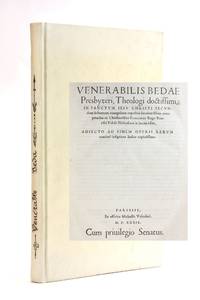
154511735<p><b>1545 Saint Venerable BEDE Bible & Commentary English Monk Church Cosmology </b></p><p>Saint Venerable Bede was an English monk during the 7th- and 8th-centuries. He is most remembered for his ecclesiastical work on the history of English people in which he discusses the establishment and growth of the church throughout the known world. He also wrote important commentaries on the books of the Bible. This work explains relevant Biblical passages as well as describes the allegorical notes of Church Fathers. However he did not write exclusively of church theology. He also wrote on the development of time and ideas of cosmology. </p><p>This 16th-century Latin edition was published in Paris by Roigny. An impressive three-volume folio set!</p><p>Item number: #11735</p><p>Price: $3500</p><p>BEDE Saint Venerable</p><p><b><i>Venerabilis Bedae presbyteri theologi doctissimi juxta ac sanctissimi commentationum in Sacras Literas tomus primus : in quo ea maximè quae Veteris Testamenti sunt ita perspicuè ac dilucidè enarrantur ut inter celeberrimos ejus argumenti tractatores…</i></b></p><p>Parisiis : Apud Joannem Roigny 1545/44. 1st editions</p><p><br /></p><p><u>Details</u>: </p><p>· Collation: Complete with all pages; 3 volumes</p><p>o Vol I – 16 272</p><p>o Vol II – 16 264</p><p>o Vol III – 12 260</p><p>· References: USTC 149316</p><p>· Language: Latin</p><p>· Binding: Leather; tight & secure</p><p>· Size: ~13in X 9in 33.5cm x 23cm</p><p>· Exceedingly rare and desirable set</p><p>Our Guarantee:</p><p>Very Fast. Very Safe. Free Shipping Worldwide.</p><p>Customer satisfaction is our priority! Notify us with 7 days of receiving and we will offer a full refund without reservation!</p><p>11735</p><p>Photos available upon request. </p> Joannem Roigny hardcover
CBS 9780122276000USA Edition . New. Brand New! Fast Delivery US Edition and ship within 24-48 hours. Deliver by FedEx and Dhl & Aramex UPS & USPS and we do accept APO and PO BOX Addresses. Order can be delivered worldwide within 6-10 days and we do have flat rate for up to 2LB. Extra shipping charges will be requested if the Book weight is more than 5 LB. This Item May be shipped from India United states & United Kingdom. Depending on your location and availability. unknown
196713592Paris 1967 1 Série de 18 planches sur carton et calques préparatoires à la mine de plomb, encre et crayons de couleurs, datées au dos, 1967, 30.5 x 27 cm.
180221182ABLeipzig, Baumgärtner, 1802-1806. 31,5 cm. Mit 105 Kupfertafeln. (So komplett) Marmorierter Pappband (Hardcover), Fadenheftung. Band 4 (Hefte 37 bis 48) Gutes unbeschnittenes Exemlar. Einband bestoßen, beschabt und berieben, Bezugspapier mit Fehlteilen. Seiten insgesamt etwas braunfleckig.
1539505317Michaelis Vascosani Michel Vascosan 1539. Leather. NEAR FINE. 4 218pp. 9 Index. Folio in 6's collation complete: 2 A3-T6 2. Vulgate text printed in larger font with woodcut drop caps marginal references. Nicely bound in recent vellum with hand-written spine title in a convincing antiquarian hand. Some light staining to the edges small wormhole to top margin toward the gutter not affecting text; else FINE internally; a nice fresh copy. Bede the Venerable was one of the greatest minds of the Middle Ages and his immense learning is on full display in this commentary on the Fourth Gospel drawing on the church fathers as well as interlocating Old Testament and intertextual references. Bede had a particular devotion to the Johnannine gospel; his translation of the Vulgate into Old English is held as the first vernacular translation. The value of this particular edition is due to its significance in the history of printing. Vascosan set up his press 1530 under the banner of his father in law the famed printer Badius and adorned his title pages with the Badius printer's device through the decade. For reasons unclear possibly a dispute with relatives sharing an interest in the firm in 1539 Vascosan stopped using the Badius device. Rather than cut his own device Vascosan simply printed his title pages without one remarkably becoming the first printer to forego this branding tool that was so essential to printer differentiation in an age when books were sold without bindings. While his motivations at the outset are unclear it may have been simply needing to sell some books before a proper device could be cut he took a liking to it and maintained this style throughout his career. Today he is remembered as a pioneer of this 'unadorned elegance of his editions' Oxford Companion to the Book p. 1238. His text-only title pages were 'a harbinger of a new approach to title pages. Vascosan’s decision flew in the face of the Parisian and more generally European book-trade where printers’ devices had played a vital role in the identification and marketing of printers’ and booksellers’ output. He was trail-blazing a new method of promoting his works – a minimalist style which would challenge the use of ornate devices so popular among the first generation of Parisian printers and booksellers. Coupled with his rejection of a printer’s device was what one might call his ‘purification’ of the title page for his title pages are incredibly simple in style the whiteness of the paper dominating. Henri-Jean Martin wittily calls this ‘the graphic mode’ of ‘solemnization of the title page’ as opposed to the second ‘monumental mode’ which by the end of the sixteenth century became saturated with symbols and architectural motifs.' Exhibition Catalog 'Printing in Sixteenth-Century France at the Edward Worth Library.' While we cannot speculate on the priority of printings within the year 1539 we can say that no other copies of a 1539 Vascosan imprint are available in trade at this time and only one appears in auction records. OCLC 60698411 listes 8 copies. Michaelis Vascosani [Michel Vascosan] unknown
El capitán Trueno adalid de la justicia liberador del yugo de quienes profesan la esclavitud y desinteresado caballero andante es uno de los personajes más populares del a historieta española.
179921140ABLeipzig, Baumgärtner, 1799-1802. 31,5 cm. Titelbl. deutsch, Titelbl. franz. mit 108 Kupfertafeln, davon 11 handkoloriert. Marmorierter Pappband der Zeit. Fadenheftung auf 3 Bändern. Band 3 (Hefte 25 bis 36). [12 Warenabbildungen] Gutes, unbeschnittenes Exemplar. Einband bestoßen, beschabt und berieben. Durchgehend braunfleckig. 1 Kupfer mit Abriss herausgetrennt, nur kurz den Plattenrand berührend. Zwischen den Tafeln Reste der herausgerissenen Seidenhemdchen.
179721134ABLeipzig, Baumgärtner, 1797-98. 33 cm. Titelbl. deutsch, Titelbl. franz. mit 108 Kupfertafeln, davon 26 handkoloriert (so komplett). Marmorierter Pappband (Hardcover) der Zeit auf 3 echten Bändern geheftet. Band 2 (Hefte 13 bis 24). Schönes, unbeschnittenes Exemplar. Einband bestoßen, beschabt und berieben. Seiten zumeist randgedunkelt und etwas braun- und fingerfleckig. 1 Tafel mit einem langen Einriss. Die ersten 7 Blatt sowie das Vorsatzblatt restauratorisch aufgezogen und gereini
3793Tournai, Castermann, 1996; cartonnage illustré de l'éditeur, jaquette en couleurs.
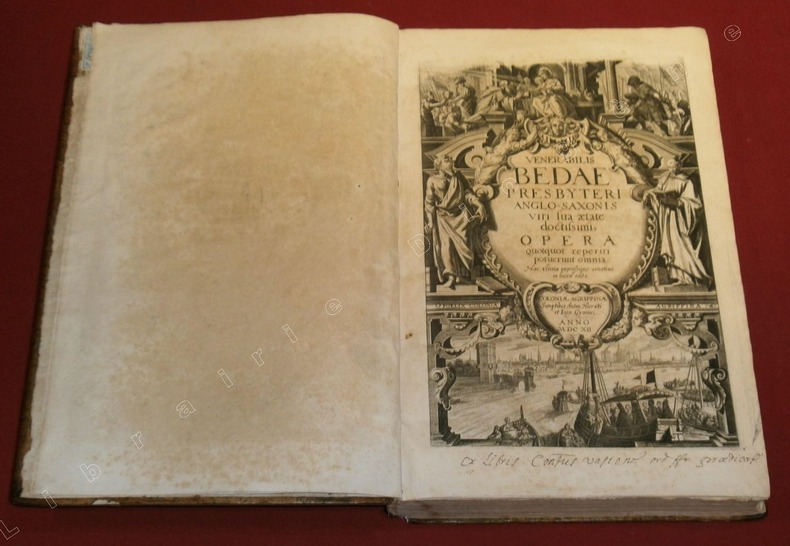
81318Coloniae Agrippinae : sumptibus Antonij Hieratus Gymnici, 1612, 8 tomes reliés en 4 volumes de 250x390 mm environ, Volume 1, tome I. (7) ff. (page de titre gravée, vie de Bède, table), 452 pages ; tome II. Philosophie, (1)f. (page de titre), 238 pages, (1)f., - Volume 2, tome III. Histoire, (3) ff. (titre, table, au Roi, au lecteur), 500 pages, (1) f. ; tome IV. Commentaires Ancien Testament, (2) ff. (titre, table), 916 pages, (1) f., - Volume 3, tome V. (1) f. (titre), 816 pages annoncées (erreurs de pagination, 855 pages) ; tome VI. (1) f. (titre), 852 pages, (1) f., - Volume 4, tome VII. (2) ff. (titre, table) 486 pages ; tome VIII. Ancien Testament, (2) ff. (titre, table), 968 pages, (64) ff. (index), (1) f., reliures plein cuir granité brun, dos à 6 nerfs portant titres et tomaisons dorés, sur pièces de titre en veau fauve, ornés de caissons à riches motifs dorés, tranches mouchetées de rouge. Avec de nombreuses figures, tableaux, diagrammes, calendriers. Ex-libris manuscrits sur les page de titre. Fréquentes erreurs de pagination, le nombre de pages annoncés est parfois erroné, mais ces volumes sont bien complet avec pagination des cahiers cohérente, rousseurs mouillures, des pages brunies, léger manque de papier sur la dernière page du tome II, épidermures, frottements, coiffes ébréchées avec début de fente sur les mors, des tampons de bibliothèque, bon état pour le reste.
19332090202122900297Bun-za shorin 1933. Soft Cover. Fine. Number of books: 1 Bun-za shorin paperback
2000204722000 Dessin sur papier à l'encre noire, 2000, 19.7 x 28.4 cm, signé dans la planche en bas à droite, mentions manuscrites dans la planche, encadré.
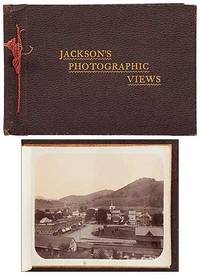
1901408888Grand Rapids Mich: B.D. Jackson 1901. Hardcover. Near Fine. Oblong 12mo. Silk cord-tied red cloth boards with "Jackson's Photographic Views" on front board in gilt. 32 sepia-toned albumen images each approximately 5.75" x 3.75". Each image is captioned by hand on two partially printed with Jackson's name and address contents pages in the front. After a few images et in Vermont the remainder are set in the Midwest particularly Michigan Missouri and Ohio. The Ohio-born Jackson was a professional photographer who started in Grand Rapids but moved to Pomona California in 1901 thus our attribution of the date where he was a success in both portraiture and where he eventually became well-known for landscape photography for the production of stereographs and postcards. His archives are at the Huntington Library. While this group displays some lovely landscapes this album seems more personal and perhaps half are of people several identified and at least one at the home of J.B.H. Jackson in Michigan very likely a relative. Among the images are several of camps and parks locations include Haslet Park Pine Lake and Harwick Michigan; several of Catalfa Grove in Missouri; and Lake Brady Cuyauga River and several of Maple Dell Ohio; as well as the first few set in Royalton Vermont. One image of two small black children is labeled "Chocolate Drops" Really exceptional quality images from the earlier part of Jackson's career. B.D. Jackson hardcover
1907mon0000194158George Bell and Sons 1907-01-01. Hardcover. Good. in x in x in. Not ex-library. Clean copy in good condition. George Bell and Sons hardcover
112255Dargaud editions, collection du Lombard, DL 3e trimestre 1959. Un album cartonné d'environ 30 x 23 , 64 pages collées, bien complet du point tintin sur la page 64. Dos et coiffes en très bon état. De très légers frottements sont observables sur les tranches et coins inférieurs. Une marque de pliure est présente sur la première page de garde, et la page de titre porte une très légère trace de gommage, sinon la bande dessinée est en très bon état.
1997232561997 Dessin à l'encre noire, 1997, signé en bas à droite, référence de la case en haut à droite, 16 x 21 cm. (format à vue), 21 x 29.5 cm (format de la feuille), encadré.
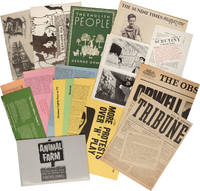
159701London: Times Newspapers 1970. First Edition. First Edition. <br /> <br /> The Times Authors series presented gatherings of resources relating to an author including newspaper reviews offprints of articles film stills and various ephemera created for use by students and available for purchase via mail order from the "Times Education Services" office in London. This edition noted as No. 2 focused on George Orwell. Other authors featured included Dylan Thomas Arnold Wesker and Allan Sillitoe. <br /> <br /> As noted on the folder on offer each issue in the series was "carefully selected and arranged but organised in a loose-leaf format with no imposed sequence. For individual study or group work this flexibility will be found especially helpful for there are numerous points of entry and the direction and centre of interest can depend on the book or books being studied." <br /> <br /> Among the resources in the edition are:<br /> <br /> Eight gatherings of reproductions of newspaper articles and reviews relating to Orwell with a number of newspapers represented including "The Observer" "Scrutiny" "The Daily Mirror" "The Times Literary Supplement" "Tribune" and "The Guardian." <br /> <br /> A reproduction of four articles written by Orwell originally published in "As I Please" his weekly column for the left-wing British newspaper "Tribune."<br /> <br /> A comic strip based on the 1954 animated film directed by John Halas and Joy Batchelor and created by the film's lead animator Harold Whitaker. <br /> <br /> A poster advertising Halas and Batchelor's film with a striking black-and-white drawing of charismatic swine leader Napoleon. <br /> <br /> A double-sided character and set design illustration and a booklet featuring ten black-and-white photographs from the 1954 film.<br /> <br /> An offprint of two of the five essays from Orwell's 1947 book "The English People" and reproducing the book's covers and title page. <br /> <br /> A bifold bibliography of Orwell's publications and critical works relating to Orwell.<br /> <br /> "The English People": Fine in staple-bound wrappers. <br /> <br /> Harold Whitaker strip: Small scratch on the front wrapper else Near Fine in side-stapled wrappers. <br /> <br /> Poster: 19.5 x 14.5 inches folded. About Fine.<br /> <br /> Newspaper reproductions bifold bibliography design illustration and stills booklet: Very Good plus to Near Fine with some faint offsetting along the top edges. <br /> <br /> All materials housed in a pictorial green folder measuring 12 x 9 inches. <br /> <br /> Folder and contents housed in publisher's original plastic envelope Near Fine. Times Newspapers unknown
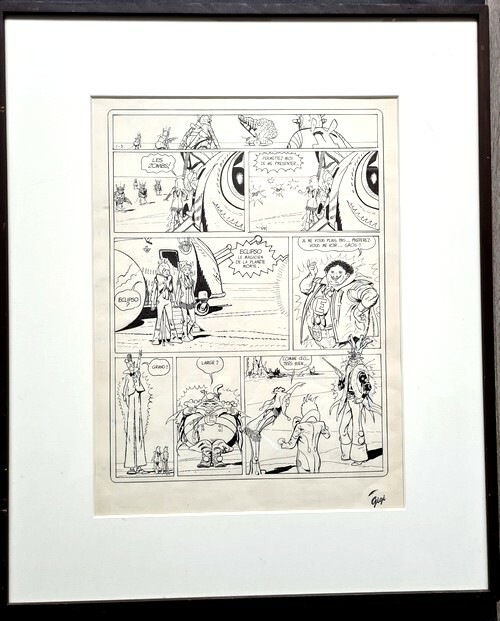
196629192Planche originale, signée, réalisée à l'encre de Chine sur papier, en 1975 par Robert Gigi, au format 41 x 31 cm, pour l'album " Eclipso, le Magicien de la Planète Morte ", tome 3 de la série Agar, publié en 1976 chez Dargaud sur scénario de Claude Moliterni. Etat superbe. De toute rareté. Vendue encadrée.Robert Gigi est un des grands de la BD française. Elève de Raymond Poïvet, il a été professeur à Angoulême. Ses principales séries sont : comme Scarlett Dream, Ugaki le samourai, Orion le laveur de planètes et Agar. Il fut aussi illustrateur pour des magazines, comme : J'ai 15 ans, Salut les Copains, etc.
1989232801989 Aquarelle sur papier fort et collages, signée en bas à droite, légendée, 1989, 36.4 x 28 cm. (format à vue), 39 x 29.7 cm. (format de la feuille).