Jacques PERRETBiblio.com
1 815 résultats
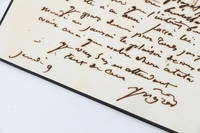
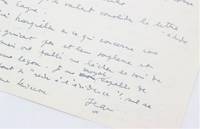
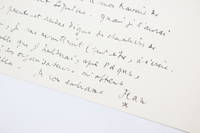
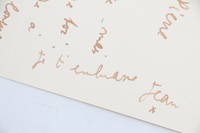
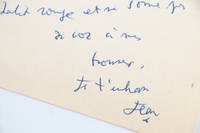
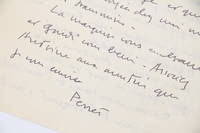
196084817s. l. 1960. Fine. s. l. s. d. ca 1960 13.50 x 18 cm une page Autograph letter signed by Jacques Perret 33 lines in black ink addressed to a colleague probably Roger Nimier apologizing for being unable to attend a meeting organized by the review Arts. Fold marks inherent to posting. For lack of time Jacques Perret was unable to honor his promise to write a preface requested by his correspondent: "". if you are pressed for time and you have a replacement preface writer at hand have no scruples of course as I will not be able to deliver proper work before my return."" Jacques Perret then evokes his passion for rugby: ""On Rancoule's repositioning three-quarter wing of Stade Toulousain whom he later joined on the staff. I therefore had the joy of outflanking the Cardinal's defense and going for the try. It remains for me to convert it by going to embrace my dear Raoul in that army of Princes from whom we still await wonders."" Jacques Perret royalist writer fierce partisan of French Algeria and virulently anti-Gaullist was stripped of his civil rights then in 1963 struck from the military medal roll despite protests from some of his fellow writers suspects that his political positions do not favor honorary decorations: ""I think we were made to sign a manifesto manifestly designed to torpedo my ribbon."" unknown
18-0340New York: James Lowe Autographs 1960s. 8vo. ca 40 pp. Very Good. Soft Covers. Staples wraps. Some foxing to front cover. Pages fine. Mailed to Frederick G. Ruffner Jr.From the collection of the late Frederick Ruffner Jr. founder of Gale Research Detroit. New York: James Lowe Autographs, [1960s?]. paperback
31710This Democratic senator from Rhode Island 1851-57 was an engineer and machinist and developed a promising new projectile called the "James projectile"; while a major general in the Rhode Island State Militia in 1862 his invention was being demonstrated at Sag Harbor New York when one of his shells accidentally exploded killing him. Clipped signature 2½" X 1" tan stock n.p. n.y. Very good. Boldly penned in brown ink likely during his senatorial career. Uncommon. unknown
40522This popular extraordinarily prolific British writer penned nearly one hundred novels such as "Richelieu" 1829 "The Gypsy" 1835 as well as plays poetry and historical writings such as "The Life and Times of Louis XIV" 1838 exceeding the voluminous output of his mentor Sir Walter Scott; later he turned to diplomacy serving as a British consul in America and vice-consul at Venice. ALS 2pp inlaid 4¼" X 6 3/4" Norfolk VA 1853 May 5. Addressed to M.M. Ballou at Gleason Pictorial in Boston 1820-95 Boston publisher novelist travel writer first editor of Boston Daily Globe. Near fine. "Please excuse my seeming negligence in not having sooner answered your note. When it arrived I was absent from home wandering about for a few days and the letter was mislaid It is thus only today that I have seen it and I hasten to apologize for acknowledging it at an earlier period thinking that in the mean time you have not thought very hardly of Your faithful Servant." Boldly attractively penned in brown ink. So profuse is James's apology though that he fails to mention the object of Ballou's note! Amusingly the very next year Ballou's illustrated pictorial founded 1851 passed along this unflattering tidbit from a London magazine: "The American papers report the particulars of a fire in the house of Mr. G.P.R. James whereby one storey was consumed. What a pity it didn't burn many more! unknown
20662Betty Grable's one-time husband was a brilliant trumpeter and long-time bandleader. IPS 8" X 10" n.p. n.y. ca. 1960. Near fine. Tiny pinhole at each upper corner. Handsome head-and-shoulders portrait in white suite trumpet barely visible inscribed boldly in blue in a light portion to the right of his face: "To / Mr & Mrs / Kerker / From / Harry James." Quite nice. unknown
19005Juvenile star of the original "Our Gang" series and other films; also starred in radio series such as "The Parker Family." Scarce signature and date 1969 November 1 on a heavy stock 5" X 3" card n.p. Fine. With original envelope. unknown
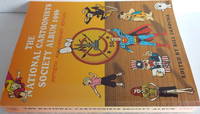
1996010125NY: National Cartoonists Society. Signed first edition. Softcover. Published NY: National Cartoonists Society 1996. 4to. wrappers 8 1/2" x 11" 395pp. illustrated throughout with b/w photographs and reproductions. Inscribed by editor Bill Janocha to cartoonist Mary Anne Case: "Welcome to the NCS Mary Anne! heart drawing Bill Janocha-199" A virtual encyclopedia of American cartoonist each with a photographic or drawn portrait capsule bio/statement and typical cartoons. Includes articles Our Photo Album - historical photographs of the society lists of award winners. Crease along spine. Very good plus. Business cards and post notes of other cartoonists names/phone numbers/signatures laid in. . Very Good Plus. Soft cover. 1st. 1996. National Cartoonists Society, paperback
1823829561823. Fine. s. d. jeudi 9 13.50 x 20.80 cm une feuille Autograph letter signed by painter Jean-Auguste-Dominique Ingres about his pupil Albert Magimel with whom he worked in close collaboration. Magimel published a catalogue raisonné of his master's artworks. Handsome signature of Ingres in the lower part of the letter. unknown
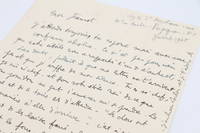
195185222Milly-la-Forêt 1951. Fine. Milly-la-Forêt 7 Février 1951 21 x 27 cm une page Autograph letter signed by Jean Cocteau addressed from his house in Milly-la-Forêt 15 lines in black ink to Olivier Quéant. Traces of folds inherent to postal mailing. ""Milly Février 1951 7 Très cher Quéant Pardonnez moi. Je traverse une crise très pénible de santé. L'opération a redéclenché les symptomes de mes supplices de la Belle et la Bête. Les médécins s'y perdent et je vais être tenu de changer de climat. Bref tout un ordre ou un désordre qui m'empêchent d'écrire surtout sur un tel sujet. Je sais que vous m'aimez bien et me comprendrez. S'il s'agissait de plusieurs mois peut-être tenterai-je la chose mais vous le voyez je forme à demi mes lettres. Tt coeur à vous. JeanC."" ""Milly February 1951 7 Very dear Quéant Forgive me. I am going through a very painful health crisis. The operation has triggered again the symptoms of my torments from Beauty and the Beast. The doctors are at a loss and I will have to change climate. In short a whole order or disorder that prevents me from writing especially on such a subject. I know that you care for me and will understand. If it were a matter of several months perhaps I would attempt the thing but as you can see I can barely form my letters. All my heart to you. JeanC."" unknown
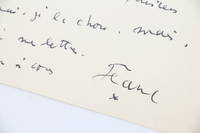
194084633Perpignan 1940. Fine. Perpignan juillet 1940 21 x 27 cm deux pages sur un feuillet Autograph letter by Jean Cocteau signed with his famous star addressed to his great love the actor Jean Marais. Dated by the author July 1940. One and a half pages in black ink on a sheet. Two small marginal tears not affecting the text. Traces of transverse folds inherent to posting. Magnificent love letter from Cocteau to Marais who formed one of the most legendary artistic couples of the 20th century. Against the backdrop of defeat and German Occupation their unbreakable bond is embodied in this letter from the writer with its desperate accents. Published in the Lettres à Jean Marais 1987 p. 157. This missive from a love-stricken Cocteau was written shortly after the Armistice of June 22 1940 marking the end of the French defeat. Marais mobilized had joined the front in May 1940 while Cocteau had taken refuge in Perpignan. Communication in these troubled times proved difficult: ""Mon Jeannot j'attends toujours ta réponse mais avec une confiance absolue. Ce n'est pas pour rien que notre étoile nous a rapprochés l'un de l'autre et sans doute fallait-il que mes lettres ne t'arrivent pas et que je souffre de mon silence"" ""My Jeannot I am still waiting for your response but with absolute confidence. It is not for nothing that our star brought us closer to one another and no doubt it was necessary that my letters not reach you and that I suffer from my silence"" ""Tu es né chef je suis né chef. Et sous notre étoile rien de ce que nous . ne peut s'annexer ni se perdre. Le principal est de se taire et d'attendre. entre guillemets : les choses ont une manière à elles d'arriver."" C'est à nous de le savoir et de les laisser faire ."" ""You were born a leader I was born a leader. And under our star nothing of what we . can be annexed or lost. The main thing is to remain silent and wait. in quotation marks: things have their own way of happening."" It is up to us to know this and let them do so ."" The Cocteau - Marais partnership would soon return to Paris and endure the torments of the German occupation which would ban the revival of their scandalous play Les Parents terribles which had enjoyed great success in 1939. unknown
195083936s. l. 1950. Fine. s. l. 4 février 1950 21 x 27 cm une page sur un feuillet Autograph letter signed ""Jean"" and with a small star addressed to his English translator Marie Hoeck one page in blue ink on a sheet of fine white paper. Transverse folds inherent to posting. On the verso notes by the translator in ballpoint pen. Jean Cocteau is overworked by several projects: ""I have finished the mixtures of sounds and music for Orphée. I will probably finish the images for Les Enfants Terribles next week. . I do not speak to you of Léone because I look at her feel her steep myself in her - but alas my English allows me nothing more than to breathe in her light ink."" He shares with his translator his great fatigue: ""Then relaxation and fatigue - for fatigue only manifests itself in rest. . I am quite at ease concerning your springs. They do not creak and their flexibility is perfect. Mine nearly gave way on me the evening in Brussels. It is a lesson. I thought myself capable of the impossible. One must ""face the facts"" no one can do it."" unknown
196386003Fréjus 1963. Fine. Fréjus 17 Avril 1963 21.50 x 27.50 cm une page Autograph letter dated and signed by Jean Cocteau 20 lines in black ink on letterhead of the committee for the edification of the chapel of Notre-Dame de Jérusalem de Fréjus. Fold marks inherent to postal dispatch one tear in left margin of the letter at the level of the fold. Jean Cocteau offers profuse apologies while acknowledging mitigating circumstances regarding the emotional burden overwhelming him: ""J'accepte vos reproches avec beaucoup de honte. Mais si je pouvais vous raconter la période que je traverse votre coeur me comprendrait et m'absoudrait."" ""I accept your reproaches with great shame. But if I could tell you about the period I am going through your heart would understand and absolve me."" due to a recently deceased friendship about which he does not wish to reveal more: ""N'en parlons plus et priez pour moi."" ""Let us speak no more of it and pray for me."" Jean Cocteau prefers to discuss his projects: ""Actuellement je me consacre à mon travail de la chapelle du Saint-Sépulcre. Quand je l'aurai construite peinte et rendue digne des chevaliers de Jérusalem je me remettrait sic peut-être à écrire."" ""Currently I am devoting myself to my work on the chapel of the Holy Sepulchre. When I have built it painted it and made it worthy of the knights of Jerusalem I will perhaps start writing again."" and the prospects that delight him: ""Il est probable que je resterais après Pâques à Fréjus où les organisateurs m'offrent une petite villa."" ""It is likely that I will remain after Easter in Fréjus where the organizers are offering me a small villa."" unknown
195486537Saint-Jean-Cap-Ferrat 1954. Fine. Saint-Jean-Cap-Ferrat 10 Mai 1954 13.50 x 21 cm une page Autograph letter dated and signed by Jean Cocteau 17 lines in black ink to a friend describing his Sevillian sojourn. Fold marks inherent to being placed in an envelope. Jean Cocteau explains his silence: his patron and very close friend Francine Weisweiller had been ill: ""Excuse ce long silence. mais on parle souvent de toi. Francine a été très très malade à Kitzbühel en Autriche et longue à reprendre des forces."" Excuse this long silence but we often speak of you. Francine was very very ill in Kitzbühel in Austria and slow to regain her strength. But to cut short his bad news he prefers to recount the enchantment of Seville: ""Nous revenons de Séville. Il pleuvait sur les calèches et les gitanes - mais dans le vieux Séville pareil à Pompéi les orangers embaument."" We are returning from Seville. It was raining on the carriages and the gypsies - but in old Seville like Pompeii the orange trees are fragrant. unknown
195388024Saint-Jean-Cap-Ferrat 1953. Fine. Saint-Jean-Cap-Ferrat 29 Août 1953 21 x 27 cm une page Autograph letter dated and signed by Jean Cocteau 26 lines in blue ink to Olivier Quéant editor of the magazine Plaisir de France sent from villa Santo-Sospir. Fold marks inherent to postal handling. Quéant journalist and notably editor of the magazine Plaisir de France maintained a fine friendly and literary correspondence with the writer. He notably delivered a glowing review of Antigone at its premiere in 1944: ""depuis Racine l'on avait rien écrit d'aussi beau d'aussi grand et d'aussi profondément humain"" since Racine nothing so beautiful so great and so profoundly human had been written L'Illustration. Jean Cocteau at the twilight of his life rebels and complains about his diminished and merely symbolic role in French theater of the 1950s. The second sentence of this letter will be taken up almost word for word in the famous verses of his longest poem Requiem 1962: ""Il est juste qu'on m'envisage / Après m'avoir dévisagé"" It is right that I should be considered / After having been stared at which will also serve as his epitaph. Despite official recognition Cocteau felt until his death ""méconnu inconnu invisible"" misunderstood unknown invisible Jean Cocteau sur le fil du siècle 2003 - a malaise masterfully expressed through these lines. ""Voilà plusieurs années que j'accepte d'être en secret mis à ma place et publiquement remis à ma place. Bref de n'être pas envisagé mais dévisagé. Il est beau de recevoir des lettres ""retournées"" où Anouilh me dit ""Sans vos pièces je n'aurais pas écrit une ligne des miennes"" et Giraudoux ""Rilke avait raison. Nos figures blanches à côté du hâle de tes séjours dans l'antiquité."" Il est beau d'être comme le Pisanelle - enterré sous les roses ."" For several years I have accepted being secretly put in my place and publicly put back in my place. In short not being considered but stared at. It is beautiful to receive ""returned"" letters where Anouilh tells me ""Without your plays I would not have written a line of mine"" and Giraudoux ""Rilke was right. Our pale faces beside the tan of your sojourns in antiquity."" It is beautiful to be like Pisanello - buried under roses . Interesting and touching missive from Cocteau with disordered and furious handwriting twisting and stretching in the manner of a calligram. unknown
195283726Saint-Jean-Cap-Ferrat 1952. Fine. Saint-Jean-Cap-Ferrat août 1952 20.80 x 34 cm 52 pages Autograph manuscript by Jean Cocteau early version of the poetry collection Appogiatures - published in 1953 by Éditions du Rocher in Monaco - comprising 47 leaves of thick paper taken from a large drawing pad and 5 smaller leaves of thin paper written in blue ink and blue ballpoint pen. Numerous deletions and corrections. The leaves are numbered up to 25 including one number 8 bis and most bear a small cross or the mythical Cocteau star. The last leaf containing the poem titled ""Lettre"" is dated in the poet's hand August 15 1952. Also in Cocteau's hand the first leaf bears the final title above which is crossed out the initially envisaged title - Soucoupes volantes - the date 1952 and the place - St Jean Cap Ferrat; it also features a crossed-out dedication: ""À la mémoire de Baudelaire et de Max Jacob qui nous apprirent ces exercices de style."" While the collection clearly shows the influence of Baudelaire's Petits Poèmes en prose and Max Jacob's Le Cornet à dés this tribute was not retained in the published version and was replaced by a dedication to the publisher Henri Parisot. An exceptional ensemble containing 33 of the 51 published poems 11 texts rejected on the advice of publisher Henri Parisot and published in ""En marge d'Appogiatures"" uvres poétiques complètes de la Pléiade pp. 818-831 and 6 unpublished texts. David Gullentops in the edition of Jean Cocteau's uvres poétiques complètes in the Pléiade notes the existence of a second set of manuscripts and typescripts preserved at the Bibliothèque Historique de la Ville de Paris BHVP. He further indicates that he had access to no manuscript of the poem ""Lanterne sourde."" Yet this poem is indeed part of our ensemble which would thus be the first version of the collection envisioned by Cocteau. Jean Cocteau began writing this collection of poems in verse and prose commissioned by his friend the publisher Henri Parisot at the end of July 1952 while staying at Saint-Jean-Cap-Ferrat in Francine Weisweiller's Villa Santo-Sospir. The first version of the collection was completed in mid-August as attested by the two dates on our manuscript ""août 1952"" and ""15 août 1952"" and this entry in Cocteau's diary: ""J'ai terminé la mise au point des courts poèmes en prose pour Parisot. Il y en aura vingt-six à moins que le mécanisme continue ce que je ne souhaite pas car à la longue ces exercices d'écriture illustrés par Baudelaire et Max Jacob fatiguent."" Le Passé défini Tome 1 1951-1952 August 14 1952. Our ensemble would thus be a mixture of the first poems sent to Henri Parisot written with a pen and several added texts written with a ballpoint pen. This hypothesis is supported by the writing of the final title Appogiatures on the title page of our manuscript; Cocteau relates this change again in his diary dated August 29 1952: ""Ai . classé les poèmes pour Parisot sous le titre : Appogiatures."" Our early manuscript version contains significant variants concerning the titles of the poems; thus the poem ""Livre de bord"" was initially titled ""Le Spectacle"" likewise for ""Au poil"" for which Cocteau had previously chosen ""La langue française"" or ""Le tableau noir"" originally titled ""Le lièvre et la tortue."" The order of the poems was also considerably modified for printing: our ensemble shows that Cocteau wished to begin the collection with ""Le voyageur"" which would finally be replaced by ""Seul"" and moved to second position. Also noteworthy in our dossier is the presence of eight poems entirely in verse: these would be removed Appogiatures becoming a collection exclusively in prose. The ensemble heavily deleted and corrected also presents long passages suppressed in the published version for example this very beautiful extract from the poem ""Scène de ménage"" evoking the ""countess"" Francine Weisweiller: ""Et les larmes de la comtesse se disaient : nous sommes la mer. Et la mer se unknown
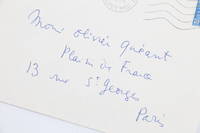
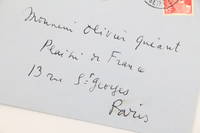
195485235Saint-Jean-Cap-Ferrat 1954. Fine. Saint-Jean-Cap-Ferrat 27 Septembre 1954 14.50 x 11 cm une enveloppe Handwritten envelope addressed by Jean Cocteau to his friend Olivier Quéant sent from Saint Jean Cap-Ferrat 4 lines in blue ink. unknown
195185234Milly-la-Forêt 1951. Fine. Milly-la-Forêt 8 Janvier 1951 14.50 x 11 cm une enveloppe Handwritten envelope addressed by Jean Cocteau to his friend Olivier Quéant sent from his house in Milly-la-Forêt 4 lines in black ink. unknown
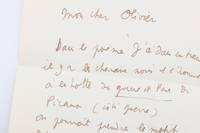
195485159Kietzbühel Kitzbühel 1954. Fine. Kietzbühel Kitzbühel 8 Février 1954 13.50 x 21 cm une page une enveloppe Autograph letter signed by Jean Cocteau addressed from the Grand Hotel Kietzbühel 16 lines in black ink to Olivier Quéant. Fold marks inherent to mailing envelope included. ""Grd Hotel Kietzbühel 8 Feb. 1954 my dear Olivier dans le poème ""J'ai dans un train"" il y a les chevaux noirs et l'homme le lotte du guerre et paix de Picasso isti guerre on pourrait prendre le motif séparé du livre qui flambe sous le pied d'un cheval noir. Il ferait une belle image. Si tu ne l'as pas demande le catalogue illustré de Rome . Eugenio Réale 3 rue Mangili Rome."" in the poem ""J'ai dans un train"" there are the black horses and the man the lotte of Picasso's guerre et paix isti guerre we could take the separate motif of the book that burns under the foot of a black horse. It would make a beautiful image. If you don't have it ask for the illustrated catalogue from Rome . Eugenio Réale 3 rue Mangili Rome. unknown
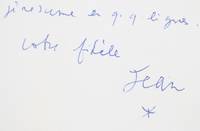
196185154Saint-Jean-Cap-Ferrat 1961. Fine. Saint-Jean-Cap-Ferrat 23 Janvier 1961 21 x 27 cm une page Autograph letter signed by Jean Cocteau on letterhead from Villa Santo-Sospir in Saint-Jean-Cap-Ferrat which he decorated 13 lines in blue ink to Roger Nimier. Fold marks inherent to mailing. ""23 Janv. 1961 Très cher Nimier voici pour accompagner le portrait dessin. Si vous le trouvez trop bref demandez chez Grasset un exemplaire de journal d'un inconnu. Dans le chapitre de l'amitié je raconte un déjeuner entre Simenon Pagnol et moi.- sans nommer personne. Mais le passage est très significatif de ce que je résume en q.q. lignes. Votre fidèle Jean. P.S. Dites moi vite si tu as reçu cette note et son P.S."" ""23 Jan. 1961 / Very dear Nimier / here is something to accompany the portrait drawing. If you find it too brief ask Grasset for a copy of Journal d'un Inconnu. In the friendship chapter I tell of a lunch between Simenon Pagnol and myself - without naming anyone. But the passage is very significant of what I summarize in a few lines. Yours faithfully Jean. P.S. Tell me quickly if you received this note and its P.S."" unknown
195885233Saint-Jean-Cap-Ferrat 1958. Fine. Saint-Jean-Cap-Ferrat 4 N ovembre 1958 13.50 x 21 cm trois pages et demi sur deux feuillets Autograph letter signed by Jean Cocteau 52 lines in blue ink to Olivier Quéant sent from the Villa Santo-Sospir in Saint Jean Cap-Ferrat which he decorated. Fold marks inherent to the mailing. Jean Cocteau waxes bucolically enthusiastic about the place where he resides and works: "". chaque jour je travaille à flanc de colline dans une sorte de ferme exquise où ne fleurisse que les grains qui tombent d'ailleurs."" "". each day I work on the hillside in a sort of exquisite farm where only the seeds that fall from elsewhere flourish."" and rhapsodizes about the local craftsmanship: "". des artisans véritables. travailler chez eux c'est le contraire de lire un journal. On aime voir ce miracle de l'équilibre entre le coeur et la main."" "". true artisans. working with them is the opposite of reading a newspaper. One loves to see this miracle of balance between heart and hand."" He informs Olivier Quéant of his upcoming exhibition: ""J'expose le 15 13 pour la première 6 rue Bonaparte. je ne te demande pas de venir voir mes oeuvres mais leur besogne ils le méritent."" ""I'm exhibiting on the 15th 13th for the opening 6 rue Bonaparte. I'm not asking you to come see my works but their labor they deserve it."" and also explains the aesthetic causes he intends to defend henceforth: "". nous menons la même croisade : celle de soutenir ces braves types qu'on dédaigne comme des aristocrates du milieu ouvrier. Le drame c'est que l'artiste qui tournait amoureusement un pied de fauteuil Louis 15 apporte la même application mais froide à forger la pièce d'une machine qui fabriquera le fauteuil."" "". we wage the same crusade: that of supporting these good fellows who are disdained as aristocrats of the working class. The tragedy is that the artist who lovingly turned a Louis XV chair leg applies the same care but cold to forging the part of a machine that will manufacture the chair."" while lamenting that artisanal traditions and know-how are sinking into oblivion: "". les jeunes refusent d'apprendre le métier par exemple des femmes de soixante ans qui firent ce prodige : ma tapisserie de Judith et Holopherne. disaient : c'est la dernière."" "". young people refuse to learn the trade for example women of sixty who performed this miracle: my tapestry of Judith and Holofernes. said: it's the last one."" He hopes to see his friend Olivier Quéant soon: ""Tu en verras une chez les Weill si tu me fais la grâce de venir et si le déluge parisien cesse et si tu ne dois pas atteindre la rue Bonaparte en arche ou gondole."" ""You'll see one at the Weills' if you do me the grace of coming and if the Parisian deluge ceases and if you don't have to reach rue Bonaparte by ark or gondola."" unknown
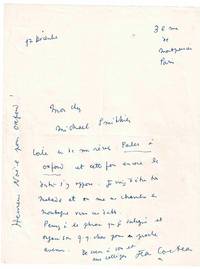
195575873Paris 1955. Fine. Paris s. d. 17 décembre 1955 20.80 x 26.80 cm une page sur un feuillet Autograph letter signed by Jean Cocteau addressed to Michael Smithies. One page written in blue ballpoint pen. Two transverse folds inherent to the mailing. Interesting letter filled with disappointment: ""Here is one of my dreams: to speak at Oxford and once again fate opposes it. I have just been very ill."" One easily understands Cocteau's state of health following the sentence very confused: ""on me me chambre la montagne vers ces dates"". ""Think of the sentence I underline and let us organize something for the near future."" The poet's dream would be fulfilled the following year; promoted to the rank of doctor of letters honoris causa by Oxford University on June 12 1956 he would deliver the Discours d'Oxford on the 14th. unknown
197962633Paris 1979. Fine. Paris 22 juin 1979 13.50 x 21 cm 2 pages sur une feuille Signed autograph letter of Jean Dutourd to Jean Rimeize written in black ink envelope attached. Date at the top of the letter and signature of Jean Dutourd at the bottom of the letter Paris address of Jean Dutourd on the envelope. Fold trace of the letter caused by mailing. The academician sends this letter to thank him for the paper his destiny wrote and which touched Jean Dutourd. This paper by Jean Rimeize comes from a conversation between the two men. Jean Dutourd writes that he will link this article as soon as he can. unknown
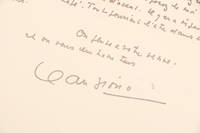
1955844221955. Fine. s. d. circa 1955 13.50 x 21 cm une feuille Autograph letter signed by Jean Giono addressed to Roger Nimier 11 lines in black ink in which he justifies his delay in responding to a request for an article submitted to him by the author of Hussard Bleu. Trace of fold inherent to envelope insertion. ""Pour Mars ça me paraît difficile. Au surplus je n'ai pas le texte et j'ai oublié mes anciennes lectures."" ""For March that seems difficult to me. Moreover I don't have the text and I have forgotten my previous readings"" but Jean Giono does not give up on all production: "". je vais m'efforcer de faire quelque chose pour Arts."" "". I will endeavor to do something for Arts."" He also rejoices at the publication of a new work by Antoine Blondin great friend of Roger Nimier probably the bookstore release of L'humeur vagabonde in 1955 or Un singe en hiver in 1959 with a thunderous: ""Enfin Blondin ! "" ""Finally Blondin!"" unknown
195284966s. l. 1952. Fine. s. l. ca 1952 21 x 27 cm une feuille Autograph letter signed by Jean Giono 14 lines in black ink addressed to Roland Laudenbach who jointly ran the magazine Opéra with his friend Roger Nimier. Fold marks inherent to the mailing. ""Cher Roland j'y pense : Voulez-vous quelque chose pour Opéra de qualité d'assez sensationnel et qui fuisse faire sept à huit numéros peut-être plus à votre gré Le Journal. Le Journal de 1936 à 1949. Si cela vous plait parlez en avec Nimier pensez à un chiffre proposez le moi ça ira sûrement et c'est d'accord. Il y en a déjà pas mal de tapé ! Tout le journal l'être dans un mois. On pense à votre venue et on vous embrasse tous. Jean Giono."" Dear Roland I'm thinking: Would you like something for Opéra Something quality rather sensational that could run for seven to eight issues perhaps more as you wish The Journal. The Journal from 1936 to 1949. If this appeals to you discuss it with Nimier think of a figure propose it to me it will surely work out and we're in agreement. Quite a bit of it is already typed! The entire journal will be ready in a month. We're thinking of your visit and we all embrace you. Jean Giono. A very visual letter bearing Jean Giono's handsome signature. unknown
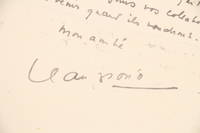
195284964s. l. 1952. Fine. s. l. ca 1952 21 x 27 cm une feuille Autograph letter signed by Jean Giono 9 lines in black ink addressed to Roger Nimier. Fold mark inherent to postal handling. ""Dear Nimier thank you for your letter; and for letting me hope for your visit. I should point out right away that I will be absent Monday 9th and Tuesday 10th. Apart from those two days your collaborators can come whenever they wish. My friendship. Jean Giono."" Very visual letter bearing the beautiful signature of Jean Giono. unknown