D'AMEZEUIL, C.Livre Rare Book

88 résultats
18751130571875 A Paris, E. Dentu, éditeur, libraire de la société des gens de lettres - 1875 - Petit in-8, broché, couverture illustrée - 299 p.
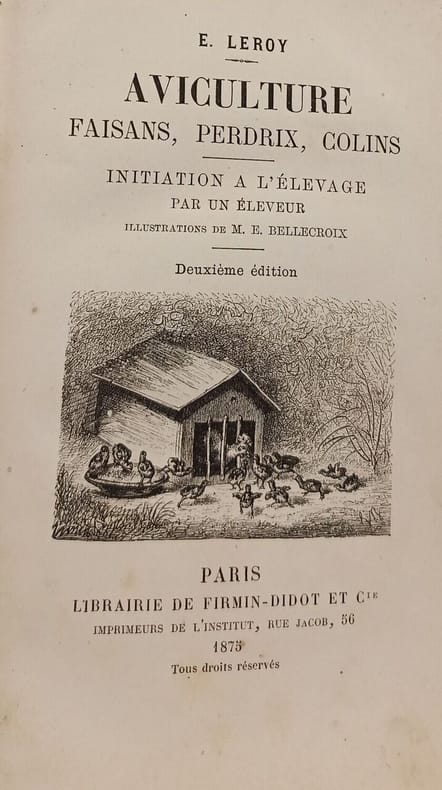
1875100150184Librairie de Firmin-Didot et Cie 1875 in12. 1875. Cartonné. Ouvrage de 1875 d'Ernest Leroy publié par la Librairie de Firmin-Didot et Cie qui constitue un manuel d'initiation à l'élevage des faisans perdrix et colins. Il aborde également d'autres espèces comme les cailles tragopans lièvres et canards sauvages pour le repeuplement
1851CHA2018MRelié, 445 pages, paru en 1851, livre en très bon état, protégé sous plastique.
18891127781889 Editions de Bordeaux, Imprimerie nouvelle A. Bellier et Cie - 1889 - Petit in-8, broché, couverture rempliée et illustrée en N&B - 89 p. - Illustré de 15 gravures et vignettes par F. Masson et L. Bigot, 3 planches hors-textes et nombreuses croquis en N&B
184421201844 Edition Charles Lebossé, Angers,1844. In-8 demi-basane époque, dos orné. 15 pages, 4 feuillets, 4 feuillets, 125 feuillets, 4 feuillets. Notes biographiques, et notice bibliographique en tête de volume. Reproduction de l'édition de 1585. Nombreuses illustrations sur bois à mi-page
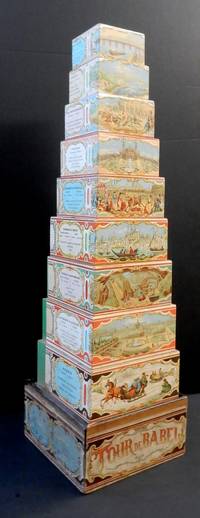
18823220299<i>A nest of nine wooden blocks ranging in size from 78 x78 x 46 mm to 182 x 182 x 60 mm each with a chromolithograph wrap-around illustration depicting European countries with statistical information; contained in the original box with a wrap around title label including four cartouche scenes printed in blue; with a sliding lid replaced.</i><br /><br />Each of the blocks is illustrated with a typical scene from European countries Russia the largest block showing a number of troikas in a winter landscape Germany & Austria with a view of Vienna Sweden and Denmark with mining for iron Turkey & Greece with a view of Istanbul etc. Also included are cartouches with basic information on the population and chief products of each country. <br /><br />The now ubiquitous graduated nested set of blocks for children was quite a late development in toy design with the earliest known patent being applied for in the US in 1881. Watilliaux's Tour of Babel was first marketed as interlocking jigsaw like pieces that could be joined together as hexagons and then stacked to form a tower that was issued at the time of the 1878 Paris Exposition here depicted as the illustration representing France. However when first American nested blocks began to appear Watilliaux evidently adapted the printed design and applied it to his own set of graduated blocks. Unfortunately this reworking did not quite fit the increased surface area of the blocks and a blank section has perforce had to be filled by a section of green glazed paper. It also necessitated the dropping the country of Switzerland and in that case the original pattern was too large to be adapted without their being some lose to the design.<br /><br />No doubt the original design had some educational value although this is somewhat lessened as there is no dexterity needed to correctly interlock the jigsaw pieces and instead only to stack and knock down the Tour de Babel.<br /><br />In 1874 Charles Watelliaux took over the publisher and manufacturer of many board games and toys Bernard Coudert and became a major producer until its sale in 1908 to Revenaz & Tabernat. Watilliaux, Editeur, Lith. J. Marie, Faub St Denis, 61.
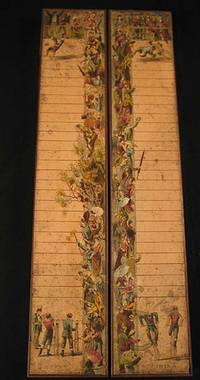
1890379561890. 24 x 9 1/2 inches. 1 vols. Wooden frame with chromolithographic panels on front lid and lower panel. Printed on inside as well with skating rink. 24 x 9 1/2 inches. 1 vols. unknown books
189037920np 1890. Box 7 3/4/ x 5 x 2 1/4 inches. Lid is split at joint else a fine set. Box 7 3/4/ x 5 x 2 1/4 inches. unknown books
187537921Paris: M.J. & Cie 1875. 10 1/4 x 10 1/4 x 5 inches. Some minor wear. 10 1/4 x 10 1/4 x 5 inches. M.J. & Cie unknown books
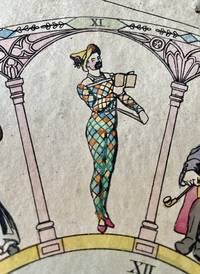
18405201<p>GAME. Arlequin und Columbine oder Arlequins Hochzeit. Nach der bekannten Pantomime gleichen Namens stellen bei diesem Spiele sämtliche Mitspieler Freier um Pantolons Tochter Columbine vor. n.p. n.p. ca 1830. </p><p> VAT in EU & UK</p><p>Lithograph broadside mounted on board 365 x 325 mm hand-coloured; board showing some staining and edges a little frayed; numbered 222 at bottom.</p><p>A well preserved board game played with two dice relating to the marriage of Harlequin and Columbine. Based on the well-known pantomime of the same name in this game all the players introduce suitors for Pantolon's daughter Columbine etc. The central circular field depicts the wedding couple surrounded by a number of acrobats. The surrounding twelve numbered arches show twelve stock male courtship figures all vying for Columbine's attention. The four corners show Commedia dell'arte figures.</p><p>Clockwise from the top the arches are numbered 2 7 5 4 10 2 8 3 6 9 2 11 while the central circle is numbered 12. The numbers thus represent all chances upon double dice with double 1 appearing three times. The rules give pay or take instructions for the various throws. The rules of the game are printed below. One participant is the 'banker' who organises the game and takes the pawns from all participants and arranges for the money to be distributed. The players throw dice andmove along according to their results.</p><p>This board game is number 222 from the fund of an unknown German publisher printed about 1840.</p><p>See Plock Phillippa and Adrian Seville "The Rothschild Collection of printed board games at Waddesdon Manor" in XIIIth Board Game Studies Colloquium Paris 14-17 April 2010; Buijnsters P.J. Papertoys. Speelprenten en papieren speelgoed in Nederland 1640-1920. Waanders Uitgevers-Zwolle 2005.</p> n.p.
188639050New York: F. M. Lupton 1886. Early printing. Printed self-wrappers. Age toning to paper. Two stab holes in margin along spine. A VG copy. 16 pp text triple column. Ornamental masthead. Folio. 11-5/8" x 8-3/8" <br/><br/> F. M. Lupton unknown books
1858146689Weimar, Druck und Verlag von Bernard Friedrich Vogt 1858. XXX, 426 Seiten. Halbleinwand-Einband der Zeit. (Geringe Gebrauchsspuren). 17x11 cn
1886R320077328DOIN OCTAVE. 1886. In-12. Broché. Etat passable, Plats abîmés, Dos abîmé, Mouillures. XXXII + 398 + 16 pages - Quelques illustrations en noir et blanc dans et hors texte - Des traces de mouillure en tranches (gouttiere) sans conséquence réelle sur la Lecture - 1er plat et page de titre manquants - VENDU EN L'ETAT.. . . . Classification Dewey : 140-Les divers systèmes philosophiques
1889Q81482Philadelphie/ Paris/ Madrid, Lippincott/ Dentu/ Fuentes y Capdeville s.d. [+/- 1889] 270pp., 19cm., br.orig. (restauré, dos renforcé), texte et intérieur en bon état, cfr. Caillet no.4517, Q81482
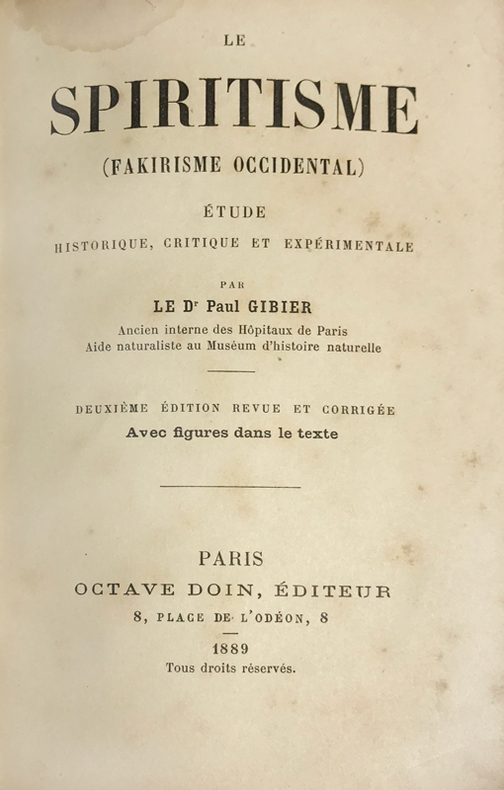
188910709Paris, Octave Doin, 1889 ; in-16, bradel rigide de papier marbré, premier plat (abimé) conservé, non rogné (reliure moderne) ; (4), XXXII-398, (2) pp.
1891335233eme. Ed. revue et corrigée.- Paris: Octave Doin Ed. 1891.- XXXII-398 p. en numeración continua: Ilustraciones; 8º 189 x 125 cm.; Texto en francés; Fina encuadernación a la alemana en Tela Nueva tejuelo. La portadilla con una falta de papel pequeña en su base. El papel algo grisáceo. Por lo demás en buen estado. ESOTERIA TEOSOFÃA PARAPSICOLOGÃA ALQUIMIA CARTOMANCIA SECTAS Y CIENCIAS OCULTAS EN GENERAL Livre en français Octave Doin hardcover
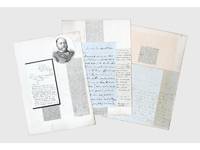
1837156409Kabul and elsewhere: 1837-41 & 1859. Correspondence chess A carefully assembled collection of material connected to players in the "great game" including Colonel Stoddart and Captain Arthur Conolly both famously beheaded at Bukhara Major Henry Rawlinson the political agent at Kandahar and Captain Sir Alexander "Bukhara" Burns. The material mounted on album leaves with accompanying newspaper clippings and other ephemera is tied together by Connolly and Stoddart's dramatic death. Sent on a mission to secure an agreement of friendship between Britain and the Emir of Bukhara in 1838 Stoddart was arrested by the emir on charges of spying and imprisoned. Conolly the intelligence agent credited with coining the term "great game" in an 1840 letter to Rawlinson arrived in Bukhara in late 1841 to negotiate his compatriot's release. Both men were killed in June 1842 and became household names back home. In the first two letters Burns writing about a year before he was killed by a mob in Kabul shares his views with Rawlinson on the latest moves in the "great game". He writes of Stoddart's short-lived release from prison and of the importance of Conolly's current intelligence-gathering in Central Asia. Shah Shuja "is surrounded by a parcel of harpies" and Burns advises caution about the use of British troops to prop up the Shah's rule: "Nothing contributes so much to lower the King's power as the employment of our troops against Afghans & I would avoid it if possible." As for Lord Auckland the governor-general "does not have great faith in the sincerity of Russia in abandoning her Khiva designs but it gives us time." The third letter from Conolly to Rawlinson discusses local news and offers a lighter-hearted window onto the life of a political agent far from home. He has swapped the diplomatic chessboard for the card table: "We miss you very much - especially at whist" the previous night's rubber being "stale and flat but not unprofitable for I won 9 rupees." This letter is mounted with a page of Stoddart's notes on taking navigational bearings which Stoddart gave to Rawlinson before departing for Central Asia in 1837. The final piece touches on the wider appeal of the Stoddart-Conolly story. Writing to the Cornish baronet Sir Hugh Molesworth almost two decades later Dr Joseph Wolff mentions his second expedition to Bokhara mounted to ascertain the fate of the two men and how the profits from the two editions of his best-selling Narrative of a mission to Bokhara 1845 were sufficient to finance a parsonage and schoolhouse in his living. a Sir Alexander Burns to Major Henry Rawlinson 21 December 1840 Kabul. ALS bifolium written across all sides. b Sir Alexander Burns to Major Henry Rawlinson 20 January 1841 Kabul. ALS bifolium written across all sides. c Captain Arthur Conolly to Major Henry Rawlinson 1840 Kabul. ALS bifolium and single sheet written across 5 sides addressed on final side remains of wax seal. d Colonel Stoddart's autograph notes on taking navigational bearings single sheet written one side. Endorsed on verso by Rawlinson "Given to me by Col. Stoddart on his departure for Bokhara in 1837. H. Rawlinson"; later note to the same effect but in a different hand below. e Revd Dr Joseph Wolff to Revd Sir Hugh H. Molesworth 31 August 1859 Taunton Somerset. ALS bifolium written across 3 sides. 4 autograph letters and single sheet of notes totalling 17 sides of manuscript tipped to or mounted on stubs to card album leaves 370 x 265 mm with laid-down material 11 newspaper clippings 2 printed illustrations sheet of manuscript later brief captions in manuscript. Letters and sheet of notes generally well preserved staining and creasing as expected stubs occasionally just touching text but no loss to sense: a very good collection. unknown
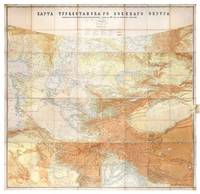
1881149774St Petersburg: Cartographic Institute of the Military-Topographic Department of the General Staff 1881. The cartographic climax of the "great game" Second edition significantly improved from the first edition 1877 to incorporate the latest military intelligence from field surveys. This magisterial work of "great game" cartography was presented at Russia's Tashkent military headquarters to the daring French explorer Stanislas Benoist-Méchin during his epic 1881-3 overland journey from Beijing to Europe. We have traced no other copies. A presentation inscription on the verso of the map reads in French "To Mr Baron Benoist-Méchin from Generals Kouropatkine and Levaschew October 1882 Tashkent." Benoist-Méchin 1854-1923 began travelling the world as a young man and then served as the French cultural attaché in Tokyo 1880-1. In 1881 he decided to return to Europe via the daring route through Central Asia. Leaving Beijing on 15 September with his regular travelling companion Comte Humbert Adrien de Mailly-Chalon 1853-1921 he journeyed through Manchuria and across Russian Siberia. In 1882 having reached Kashgar they received permission to cross Russian Turkestan spending six weeks in Tashkent as the honoured guests of General Mikhail Tchernayev the architect of Russian's expansion across Central Asia General Aleksey Nikolayevich Kuropatkin 1848-1925 and the aforementioned General Levaschov likely the artillery officer Vladimir Levaschov 1834-1898. After reaching Samarkand they travelled in extreme cold through Bukhara and via Khiva to Tehran reaching Moscow in October 1883 where they were accorded a hero's welcome. Their descriptions of this feat of exploration were published in 1885 in the Bulletin de la Société de géographie. This map was made for the use of the Russian military high command in St Petersburg and in the Turkestan Military District which had been established in the 1860s amid the occupation of Tashkent and Bokhara and dates from a period following the Second Anglo-Afghan War and the Battle of Geok Tepe when tensions were at their height. It encompasses almost the entire playing surface of the "great game" extending east-west from Xinjiang and Tibet to the Caspian Sea and Afghanistan and north-south from Siberia to northern India. Unparalleled in terms of accuracy and detail it names every city town and village and the legend has entries for such features as fortifications railways mail and caravan roads and mines. Spot heights are given in feet and deserts are marked with a light red pattern. It is much improved on the first edition which had only 48 panels and did not extend as far south. Chromolithograph map 195 x 200 cm dissected onto 64 sections and mounted on linen as issued laid-down printed slip stating "corrected up to 1881" small folding tab at right edge. Folding away to 28.5 x 28 cm. Housed in green quarter morocco solander box with chemise by the Chelsea Bindery. Map surface generally clean and brighta few stains toning and soiling at edges small repair at top-left edge verso foxed and with couple of areas of linen reinforcement: very good. unknown
1868G121025Roma, Tip. Tiberina 1868 [17] pp. + 3 folding engraved plates, 22cm., contemporary blind wrappers (some use), offprint from "Annali dell'Instituto di correspondenza archeologia" T.XL, small stamp on title page, [The Gioco del cottabo, or the game of cottabus, was a popular skill-based game played during ancient Greek and Etruscan banquets (symposia). Participants would attempt to flick the last dregs of wine from their drinking cup (kylix) at a specific target. The game often had a romantic or prophetic meaning : a player would dedicate their throw to a loved one, and hitting the target was seen as a favorable omen for their future in love], G121025
188738873London: Republished by Field & Tuer 1887. Small 8vo 18.5 cm 7.25". 4 iv 7-29 2 pp. 4 ads ff.; 1 plt. col. illus. <br><br>Riddles and counting-out rhymes all part of a fun game whose instructions serve as a preface. The text is printed on one side of a leaf only and => each printed page has a hand-colored illustration.<br>Â Â Â Â The work was first printed by Dean & Munday in 1823 and is here presented as vol. II in the Leadenhall Press "Series of Forgotten Picture Books for Children."<br>Â Â Â Â Provenance: From the children's book collection of Albert A. Howard small booklabel "AHA" at rear. Buff-color printed wrappers with hand-colored vignette on front wrapper; stitched head and foot of spine chipped rear wrapper detached and reattached with archival tissue. A good copy. Republished by Field & Tuer unknown books
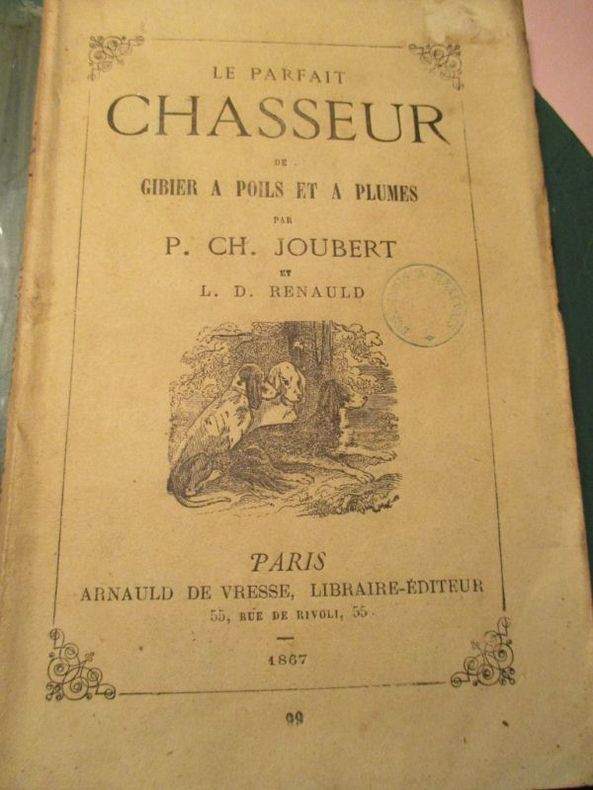
186755851867 Paris Arnauld de Vresse librairie-éditeur 1867 In12 broché 95 pages cachet de colportage sur la couverture
18760041461876 Paris, J. Rothschild, 1876. Petit in-folio (288 X 362) demi-chagrin vert lierre, dos cinq nerfs, fleuron doré dans les compartiments, auteur et titre dorés, nom de l'éditeur en queue, tranches dorées (reliure de l'époque); (1) f. blanc, (2) ff. de faux-titre et titre imprimé en rouge et noir, frontispice, 140 pages, 45 planches couleurs hors-texte sous serpente, (1) f. blanc. Quelques rares rousseurs, principalement aux serpentes, trois taches sur le cuir du plat supérieur, sans gravité.
190025498Madrid: La Caza Ilustrada 1900.- Año IV: desde el nº 76 10 de enero de 1900 hasta el nº 110 20 de diciembre de 1900; 4º mayor 27 cm.- En total son 30 fascículos que abarcan el año completo a falta de 5. Se venden todos como colección conjunta al precio indicado. Como se indica faltan 5 números para completar el año. Su estado de conservación es muy bueno sobre todo dado el tiempo transcurrido y que los fascículos se hallan sueltos. CAZA Y PESCA Libro en español La Caza Ilustrada paperback
1890GITj980Paris HAchette 1890. In-8 2 feuillets non chiffrés (faux-titre, titre) II-IV 6-415pp. Demi maroquin acajou à coins signés, dos à nerfs, tête dorée, non rogné, 1er plat de la belle couverture illustrée en couleurs conservé, reliure de l'époque. Orné de 2 plans de chenil à pleine page, 54 vignettes en tête de chapitre, cul de lampe et dans le texte d'après Bodmer et Krafty, 33 planches d'après Bodmer et de Penne (18 de races de chiens, 15 de gibiers). Rousseurs par endroits. Bel exemplaire complet du texte et des illustrations, reliure solide de bonne qualité. Thiébaud colonne 572. Edition plus complète que l'originale parue en 1858.
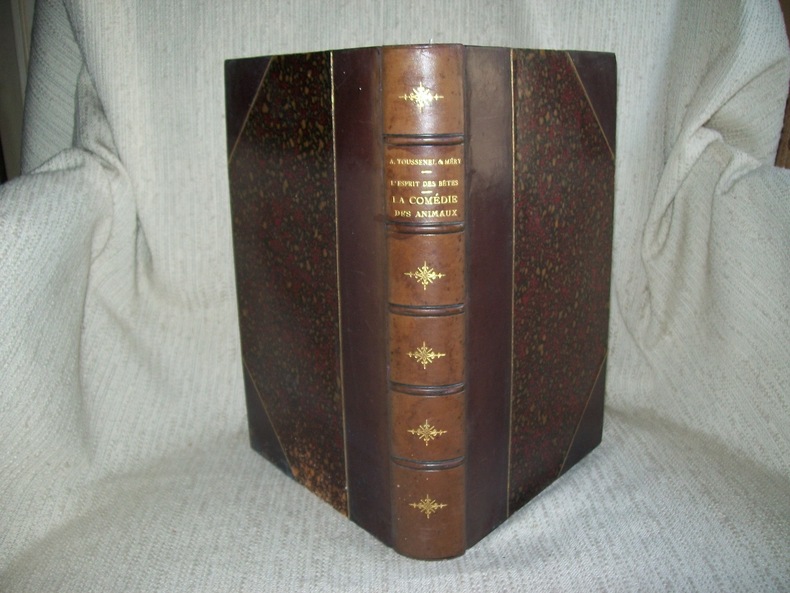
1886GITj991Paris Librairie Ch Delagrave 1886. Paris Hetzel sans date vers 1880. 2 ouvrages en 1 volume grand in-8 384pp et VIII 308pp. Demi basane acajou à coins signés, dos à nerfs orné de fleurons dorés, tête dorée, non rogné, reliure de l'époque. MERY: portrait de l'auteur en frontispice, abondante illustration dont 16 hors texte comprises dans la pagination par Morin, Speecht et Bombled, rousseurs. TOUSSENEL: Titre-frontispice et nombreuses illustrations dans le texte par Emile Bayard, quelques rousseurs par endroits. Les deux ouvrages sont complets. Dos uniformément passé au brun, reliure de l'époque solide et décorative malgré le défaut signalé.