4 134 résultats
1) 260:340 mm. 2) 260:350 mm. 3) 260:360 mm. James Weir (d. 1820) was Captain of Marines on HMS Audacious from 1795 to 1800, and was also an accomplished watercolourist. His drawings show 1) "The Seraglio from the Marmora March 1806", 2) "The Seraglio at Constantinople from the harbour", and "7 towers Constantinople 19 March 1806".
Folio (243 x 372 mm). (12), 389, (3) pp. With double-page-sized engraved frontispiece (G. Wingendorp sc., bound after p. 8), 12 engravings in the text, and 139 woodcuts in the text (wants the engraved portrait). 18th century full calf with giltstamped red label to gilt spine in seven compartments. All edges red. First edition of this description of the important natural-historical and ethnological collection assembled by the famous Danish physician and naturalist Worm (1588-1654), forming the nucleus of the museum he founded, one of the first natural history museums ever established. The double-page frontispiece (sometimes counted as an additional engraved title page) shows his natural history collection inboxes, on shelves and hanging from walls and ceiling. This plentiful text illustrations show exotic as well as Scandinavian animals, plants, fossils, ethnological trophies, archeological discoveries, etc. For many items in the mineralogical and chemical section, the Arabic names are given (such as Borax or "Baurach", Alkali, Tinkur, etc.). Among the exotic flora are many plants endemic to the Middle East and Arabia, including the "Nabuch Arabum", the "Nux indica" (with reference to Avicenna), the date palm, pistachio ("ex Persia, Arabia & Syria"), gum arabic etc. - Binding slightly scuffed in places, but well preserved. Slight browning and brownstaining to interior, mainly confined to blank margins. A few early marginalia and underlinings in ink (trimmed by binder's knife when rebound in the later 18th century). As virtually all copies available for comparison, ours lacks the portrait (to be bound after the preliminaries). Nissen, ZBI 4473. Willems 772 ("Description raisonnée du cabinet d'histoire naturelle formé par le savant danois Olaus Worm").
4to. 6 vols. 12, 942, (2) pp. (4), 968, (2) pp. (2), 936 pp. (2), 1048 pp. (2), 66, 512 pp. VII, one blank, 262, one blank leaf, VIII, 265-781, one blank page, (2) pp. With 6 letterpress plates in vol. I. Near-contemporary half cloth over marbled boards with giltstamped volume numbers to spine. 2 volumes bound with the original printed wrappers. First edition, rare. The 19th century classic edition of Yaqut's famous geography, prepared by the German orientalist Ferdinand Wüstenfeld (1808-99). The four volumes of Arabic text are completed by annotations and indexes in volumes V and VI, including "some 12,000 persons, many with additional bibliographical references" (cf. Fück). Composed between 1224 and 1228 and considered a literary geography, Yaqut's work is essentially an alphabetical index of place names from the literary corpus of the Arabs. The geographical descriptions are enriched with historical, ethnographic, and associated narrative material, historical sketches and accounts of Muslim conquests, names of governors, monuments, and local celebrities. - The four volumes of text are removed from the library of the Munich Franciscan monastery, with their stamp of ownership to versos of title-page or flyleaf. Later in the collection of the German historian Else Reitemeyer (b. 1873) with her handwritten ownership to flyleaves (vols. I-IV). German title-page and foreword of first volume (12 pp.) bound between pp. 480 and 481. Extremities occasionally very slightly rubbed. Last 20 pages of volume V pierced near right margin (not touching text). In all a very well preserved copy of this monumental series. Fück 193f. OCLC 3423433. Not in Zenker.
8vo (150 x 206 mm). (564) pp. Ottoman Turkish and Arabic manuscript written in Naskh script on polished oriental paper. 2 columns, 17 lines. Black ink; chapter headings in red. Text ruled in gilt, red and black; first two pages have attractive 'unwan decorations in gilt, red, lapislazuli, pink, and orange; final page has gilt floral scrollwork decoration. Gilded line decorations on some pages, a red and gillt inscribed figure known as the "Flag of the Prophet on the Day of Judgment" (Liwa al-Hamd) on one page. 19th century oriental brown leather binding with fore-edge flap, decorated with gilt borders and lozenge-shaped ornamentation to both covers. Marbled endpapers. Early Turkish manuscript of the "Magharib al-Zaman" ("Sunsets of Time"), a widely popular devotional work on the Prophet Muhammad, first written in Arabic in 1449 by the Ottoman Sufi poet Yazicioglu Mehmet (d. 1491) and translated into Ottoman Turkish by his younger brother Ahmed Bican. Mehmet, a native of the Gallipoli peninsula, was a follower of Haci Bayram-i Veli (1352-1430) and was influenced by the writings of Andalusian mystic Ibn 'Arabi. The earliest printed edition appeared in 1842 at Istanbul's Military Press. - Comprising some 9,000 couplets, the "Muhammadiyah" is one of the longest works in Turkish literature, but its style is easily accessible, and it contributed much to the formation of Ottoman Sufi culture. Written to disseminate the basic tenets of Islam among the common people, it covers Muhammad's biography, various aspects of Muslim devotion, and eschatological matters, including Gog and Magog, the Sun rising in the west, and the Day of Resurrection. Mehmet is notably preoccupied with the eschatological role of Jesus and of the Ottoman conquest of Constantinople, which he anticipated by several years. - Anonymously copied (as common for religious texts), this manuscript includes occasional explanations and Qur'an verses that are extraneous to Yazicioglu's text and were introduced by the scribe (or by the copyist of the MS he followed). Among the appealing decorations the first two leaves stand out, as does the gilt depiction of the Prophet's standard, "Liwa al-Hamd" (Banner of Praise), which is to be unfurled on the Day of Judgment. Three phrases written in red ink appear on this banner: "Al-Hamdu Lillahi Rabbil-'Alamin" (Praise be to God, Lord of the Universes), "Bi-smi llahi r-rahmani r-rahim" (In the name of Allah, the Most Gracious, the Most Merciful), and "La ilaha illallah, Muhammadun rasulullah" (There is no god but Allah and Muhammad is messenger of Allah). - Occasional light brownstaining, mainly confined to margins; generally very finely preserved. The first leaf of the book bears a faint Ottoman note of acquisition from the 19th century: "Isbu bin iki yüz doksan bes senesi Zilkade'nin yigirmi üçüncü sali günü yüz elli gurus fiyat" ("This book was bought for 150 Kurush on 23 Dhu al-Qadah, 1295 H" [18 November 1878 CE]. A complete list of the individual chapter titles is available on request. Cf. J. Spencer Trimingham, The Sufi orders in Islam (Oxford, 1971); Arin Shawkat Salamah-Qudsi, Sufism and Early Islamic Piety: Personal and Communal Dynamics (Cambridge, 2018).
Stencil-coloured lithograph. 33.7 x 42.8 cm. One of the very rare Weißenburg illustrated broadsheets showing oriental motifs. These were published under the fictitious address of Hassan Uwais (Auvès) in Cairo. The actual publisher, Camille Burckardt, was head of the Weißenburg company from 1880 until 1888. - Slight crease with minor edge damage; occasional browning. All of these prints are very rare; a different print commanded £21,250 at Sotheby's in 2012.
Small folio (230 x 295 mm). Arabic manuscript on cream-coloured paper. 58 ff. (plus 2 flyleaves), 5 lines per extensum, written in crisp Sini script in black ink. Text within red double rules, verses separated by gilt roundels, surah heading in gold outlined in red. Opening bifolio with brightly coloured and gilt quasi-geometric illumination, final bifolio with gold and polychrome Central Asian floral and tendril motifs in the borders. Contemporary blind-tooled brown leather binding with fore-edge flap. Indigo blue cotton endpapers. Prettily illuminated Qur'an Juz' (one of thirty parts of varying lengths into which the Qur'an is divided) written in late 18th or early 19th century China. Arab presence in China dates back as far as the first Caliphate: the Prophet's companion Sa'd ibn Abi Waqqas is traditionally credited with introducing Islam to China as ambassador in 650. Indeed, many major cities in China, such as Xi'an (or Chang'an, as it was known during the height of the Silk Road) and Beijing boast a long and rich Muslim history. Qur'an sections written by Chinese Muslims show Chinese influence clearly in both the decoration and the script, which is derived from naskh. The section of the Qu'ran copied here is the twelfth Juz', which comprises surah 11 (Hud), aya 6, to surah 12 (Yusuf), aya 52, named after the prophets Hud and Joseph. - Fingerstaining to lower corner and margin; a few leaves loose. An attractively illuminated example of the Chinese Muslim manuscript tradition.
Small folio (ca. 210 x 300 mm). 74 pp. Arabic manuscript in black Naskh, headings and key words in red, ruled in red (often to form tables and geometric patterns). Several diagrams, 2 ff. with circular diagrams, some ruled leaves blank. Contemporary limp leather. A theological manuscript entitled "The book of description (or attributes) of the Prophet and the Leader". - Binding a little rubbed, spine chipped. A few leaves loosened. Some light staining and finger-soiling throughout; a few ink smudges; a number of edge tears (some professionally repaired).
Large 4to (176 x 262 mm). Arabic ms. on oriental paper. 325 ff., expertly written naskh script, possibly in more than one hand, black ink with rubrics, usually 6-8 lines to the page, considerable interlinear and marginal glossing. Full-leather Islamic binding with fore-edge flap; original blind tooled ornamentation (medallion). Manual on Islamic Law by Abu al-Barakat `Abdallah b. Ahmad b. Mahmud al-Nasafi (d. 710/1310), an important Hanafi legist and theologian. Born in Nasaf in Sogdian, he taught in the Madrasa al-Kutbiya al-Sultaniya in Kirman, came to Baghdad in 710 and died in Rabi` I 710 (August 1310), apparently on his return journey to Idjadj (in Khuzistan), where he was buried. The Kanz al-Daqa'iq is an important text on Hanafite law and formed the basis for a great number of commentaries, especially in the 9th/14th and 10th/15th centuries (EI² VII, p. 96; GAL II, pp. 250-53). Contains both the `Ibadat and the Mu`amalat. - Final 12 leaves (f. 313ff.) show edge damage with some loss of text. Copied by Khidr b. Shaykh `Ali (colophon in a chancery hand on f. 325v). Cf. GAL S II, 265.
Imperial folio (520 x 415 mm). 17, (1) pp. With additional coloured title in Persian and 44 coloured plates. Original blue cloth portfolio with gilt-embossed floral and oriental decoration. Marbled endpapers. Very rare monograph about Henri Moser's collection of oriental arms and armour. The present copy in German is no. 103 of a small press run of 125 German copies (total number of copies: 300). The outstanding plates, printed in colour by the Vienna Court Printing Office, show extraordinary pieces of Moser's precious collection containing over 1,300 weapons. The Swiss merchant and art patron Henri Moser (1844-1923) left Schaffhausen at the age of 23 and began travelling through Asia. During his expeditions he collected many pieces of art, weapons, armour, and hunting trophies. His remarkable collection was displayed at various museums throughout Europe. - Cloth portfolio splitting at hinges. A few insignificant edge flaws; some staining, mainly confined to the text fascicule, otherwise in excellent condition.
8vo. (12), 200 ff. Title with architectural woodcut border. 17th century vellum with ms. title to spine. An early merchants' guide to the measurements of the Mediterranean and Near East, this pocketbook for sixteenth-century Italian traders is one of the foremost sources for the study of the metrologies of Venice and her trading partners in the early sixteenth century. It enabled conversion between Venetian currency, weights and measures and units of other Italian city-states, European neighbours and more exotic locations in the Levant, North Africa, the Near and Middle East, including Constantinople, Aleppo, Tripoli, Damascus, Cyprus, Corfu, Rhodes, and Crete. Pasi's manual is invaluable as a record of the panoply of commodities traded in the Mediterranean at the beginning of the sixteenth century, including pearls, silks, wool, saffron, chestnuts, figs, galangal, vegetable oils, gold and silver. On fols. 3, 11, and 12, Pasi recorded the tariffs on pearls in Damascus, Aleppo, Cairo, Alexandria, Constantinople and Venice. It is very likely that the famous merchant Balbi carried a copy of this classic with him on his travels. First printed in Venice in 1503, and again in 1521, this 1540 edition appears to be the third and was followed by another in 1557. -- Some brownstaining to preliminary matter; a few contemporary ink marginalia slightly trimmed in the course of the 17th-century rebinding. On the whole an excellent clean copy. Very rare: the only copy of any edition to surface at auction within the last thirty years appears to be the Honeyman copy of the 1503 edition. Kress 51. Adams P 374. Smith, Rara Arithmetica, 79. Cf. Goldsmiths' 7 (1503 edition). R. A. Donkin, Beyond price. Pearls and pearl fishing: origins to the age of discoveries (Philadelphia, 1998), p. 138.
4to. (8), 181, (1) pp. With folding woodcut map. Modern half calf. First German edition. - "This is an important source work for the battle of Lepanto. Contarini has written a detailed account of the battle, including the events leading up to it. He includes many interesting statistics - the source of the various ships, numbers of men taking part, etc." (Navari). "One of the most extensive accounts of the Battle of Lepanto, with details as to the Venetian, Spanish, and Papal ships" (cf. Göllner). - Title page numbered; a few old underlinings. Closely trimmed at upper edge (occasionally touching headlines); insignificant brownstaining. Very rare: not a single copy in postwar German auction records. Formerly in the Ottoman collection of the Swiss industrialist Herry W. Schaefer. VD 16, C 4965. IA 143.974. BM-STC 221. Blackmer 396 (note). Schottenloher 43475 c. Apponyi 1837. Kertbeny 860. Göllner 1617.
Folio. (32), 248, (36) pp. With engraved frontispiece by Christian Rothgiesser, full-page engraved author's portrait, double-page engraved map, and 21 large engravings in text, mostly signed by Rothgiesser; woodcut initials and head- and tailpieces. Contemporary blind-ruled leather, remnants of ties. First complete German edition of an important and entertaining travel account by Johann Albrecht von Mandelslo, edited by Adam Olearius. Mandelslo was attached to the diplomatic mission of Frederick III, Duke of Holstein-Gottorp, to Moscow and Persia. Frederick's aim was to negotiate a new trade route for Persian silk and to make his small duchy an important centre of European silk trade. After visiting Moscow, the mission continued along the Volga to Astrakhan and from there to Persia, crossing the Caspian Sea near Shamakhi. Via Ardabil, Qazvin and Kasan the party finally reached the capital, Isfahan. The ambassadors remained in Persia for several months (only to return without concrete results), but Mandelslo travelled further to the east. He sailed from Hormuz to Surat and proceeded through Gujarat to Agra, Lahore, Goa, Bijapur and Malaba, visiting Ceylon, Madagascar, the Cape of Good Hope and St. Helena on his return voyage in 1639. Before his death 5 years later, he had entrusted his rough notes to Olearius, who subsequently published them with a third part containing descriptions of the Coromandel coast, Bengal, Siam, Sumatra, Java, Borneo, Bantam, the Philippines, Formosa (Tai-wan), China and Japan. Small contemporary owner's entry ("Jos[eph] Baudler"?). Some foxing and brownstaining; slight tears in lower margin of pp. 31 and 137. A very good copy of an important account of an embassy to Persia and further to the East. VD 17, 23:233226D. Lipperheide Ld 1. Adelung II, pp. 306-308. Alt-Japan-Katalog 943. Bircher A 6927f. Cordier, Japonica, cols. 362-368. Cox I, 271f. Dünnhaupt, pp. 293-294, 30.1. V. Gelder, Het Oost-Indisch avontuur, pp. 77, 99, 263. Howgego I M38. Commissariat, "Mandelslo's Travels in Western India", in: The Geographical Journal, 78 (1931), pp. 375ff.
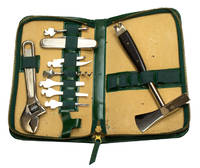
264204in two Boxes. This lot features a large collection of Augusta National collectibles many of them produced in limited edition for distribution to the spouses of club members during the Masters Tournament. Present are the following: <br/>Buttons: 8 gold blazer buttons 6 sleeve and 2 jacket by Waterbury & Co with Augusta National logo. <br/>Jewelry cases: Dark green leather jewelry strap roll with Augusta National logo to clasp by Garrard & Co London. Together with silk jewelry case with Augusta National logo. <br/>Leather goods: Dark green calf address book with gilt stamped logo of Augusta National 1967 to upper cover. 2 Dark green folding pocket wallets with printed Augusta National logo to interior. Large green leather pack with strap with Augusta National logo. 2 light green pigskin ladies wallets with printed Augusta National logo to interior. 4 dark green alligator key rings with Augusta National logo to interior 3 in original boxes. Ladies clutch dark green alligator 3 1â„2 by 6 1â„2 inches German make with Augusta National logo on clasp. <br/>Silver and gold: Sterling silver trivet 7 inches in diameter engraved at center with image of Augusta National clubhouse and at lip with images of course flora by Garrards of London. Sterling silver porridger 2 pieces with inscription to Cliff Roberts made by Garrard of London. Three small 14K gold brooches of Augusta National logo. <br/>Kits: Medical kit in green casing with Augusta National logo. 2 dark green calf travel sewing kits logo to exterior. Ladies Manicure set in green case with Augusta National logo. Tool kit in green leather case with Augusta National logo. 2 metallic ladies compacts one in ponchette logo on powder lid. <br/>Plus other miscellaneous Augusta National souvenirs. A comprehensive collectionBorn in Morning Sun Iowa Roberts had a troubled family life as a boy and left school in the ninth grade. He worked at a great variety of jobs all around the United States and eventually chose the investment industry for his career.1 He served as Chairman of Augusta National Golf Club from 1931 through 1976 and was named "Chairman in Memoriam" after his death. He also served as Chairman of the Masters Tournament from 1934 through 1976.<br/>An investment banker on Wall Street from the late 1920s Roberts was a partner with Reynolds & Company. He was the co-founder with Bobby Jones of the Augusta National Golf Club. In the early years he and Jones personally extended invitations to the tournament. Roberts' friendship with American president Dwight Eisenhower led to the Eisenhowers making Augusta National their retreat during the 1950s.<br/>Roberts was sometimes described as a 'benevolent dictator'. Roberts received many awards and honors during his lifetime including service on the PGA Advisory Committee from its inception in 1943 until his death appointment by the United States Golf Association to serve on the Bob Jones Award Selection Committee and election to the World Golf Hall of Fame in 1978. He was the author of The Story of the Augusta National Golf Club published in 1976 and a subject of a book titled The Making of the Masters Clifford Roberts Augusta National and Golf's Most Prestigious Tournament by David Owen published in 1999.<br/>It was not until 1975 that Lee Elder became the first black golfer to play in the Masters Tournament although he was not the first non-white golfer to compete; Sukree Onsham of Thailand played in 1970 and 1971. Roberts is quoted as saying "to make an exception would be practicing discrimination in reverse." Lee Elder later said "I don't want anything special. I will make it on my own." Another comment attributed to Roberts is: "As long as I'm alive all the golfers will be white and all the caddies will be black."2 3<br/>Roberts age 84 committed suicide by gunshot in 1977 on the banks of the par-3 course at Augusta National. He had been in ill health for several months. unknown books
17 vols. Royal 8vo (24 x 16 cm). With numerous illustrations (including the series by Albert Letchford), repeated on laid paper; the 17 frontispieces repeated in colour. Contemporary three quarter olive green morocco, gold-tooled spine, tops gilt. A handsome edition of Burton's "Arabian Nights", finely illustrated and printed in a limited edition of 100 hand-numbered copies. Bold to a fault, Richard Burton travelled to Mecca, explored the African Great Lakes, shocked his readers with his candid travel accounts, and gained fame and riches with his translation of the Arabian Nights. The first edition was published in 1885-88 and re-issued by the Burton Club shortly thereafter. The present edition is a reprint of the first Burton Club edition, illustrated with, among others, Albert Letchford's famous plates. - Spines slightly faded. Fine set, uncut and partly unopened. Cf. Howgego III, B98 (p. 146, first ed. 1885-88).
12mo. XXX, 161, 113 pp. Modern brown calf preserving original marbled covers. First edition of "Sind-Bâd" and the first independent printing of any part of the Arabian Nights in Arabic. Although traditionally included in the corpus of the Thousand and One Nights (Alf layla wa-layla) as told by Scheherazade, it is thought that the series of stories that make up the voyages of Sindbad have older and separate origins, incorporating elements of Homer, Panchatantra, other Persian, Arab and Indian literary material as well as historical material relating to trade and navigation. Set traditionally during the reign of Haroun al-Rashid, Sindbad undertakes seven voyages from Basra, each leading one to the other, encounters fabulous creatures, faces exhaustive ordeals and amasses fabulous wealth. The publisher of the present edition, Louis-Mathieu Langlès (1763-1824), an important figure in the study of Middle-Eastern and Oriental languages and literature, was a correspondent of William Jones in Calcutta, co-founder of the École des Langues Orientales Vivantes in Paris, and the keeper of the Indian manuscript department in the Bibliothèque Nationale in Paris. "Un ouvrage classique, et d'une certaine importance sous le point de vue scientifique, historique ou littéraire" (preface). - Some browning and waterstaining throughout; occasional paper defects to edges (no loss to text); an Arabic stamp to p. 90 of the French text. Chauvin VII, p. 2. Brunet III, 820. OCLC 4433261.
11 vintage photo prints (ca. 90 x 120 mm, but one 105 x 170 mm) on backing cardboard (20 x 25 cm). Highly uncommon photographs of Arabian horses (all individually captioned) at the famous Bábolna stud in Hungary, the principal stud for producing the best horses for the Austro-Hungarian military in the 19th century. The "Bábolna Nemzeti Ménesbirtok" (Bábolna National Stud) was founded by Emperor Joseph II in 1789. In 1816 it was decreed that henceforth only Arabian stallions should be used for stud service - a policy that raised the quality of the Austrian cavalry's horses to a famous level and necessitated the frequent introduction of new pure-bred Arabian stallions from the Middle East. One of the greatest commanders and stud-masters of Bábolna, Mihály Fadlallah el Hedad, hailed from Syria. - The photos show portraits of the horses Sechun, Nadir, Tahita, Nasira, Celeby, Dzerid, El Hafi, El Denedzi, Hiläl, Riat, as well as a larger group portrait showing several of the horses with their Arabian and Austro-Hungarian trainers. Some slight staining to backboards, but altogether well-preserved. Extremely rare.
A total of 267 photographs of construction work on the Aswan Dam. Comprises 190 large photographs (ca 25 x 30 cm), frequently with captions in the negative, mainly by D. S. George but also including A. Gianny and G. Kemble Bolam of Cairo (56 tipped in to an album and captioned, 21 loosely inserted within another album, 108 stored loosely within a portfolio, and 5 separately matted). Also, 77 smaller photographs (gelatin prints) of the dam and its environs, ca 15 x 18 cm (including a few duplicates), in an envelope. An impressive collection of photographs detailing the construction and opening of the Aswan Low Dam between 1899 and 1902 and of the work to raise it in 1907-1912. The images (frequently captioned in English on reverse) include views of the navigation channel in various stages of completion, the countless hundreds of local workers toiling in the unfinished West Channel and on the masonry of Bab el Maroum, the locks, trenches, Asyut Barrage, the accumulator house, the inauguration ceremony, but also a friendly football match between the "10th Soudanese Regiment (Blacks)" and the "Whites" (final score: Blacks 0, Whites 5). A stark panoramic shot shows the solar eclipse of 28 May 1900 above the Mohammed Ali Channel, seen from Awad. - Owing to its rainless climate Egypt has always depended on the annual flooding of the Nile for irrigation. The Aswan dam was designed by eminent British engineers to provide storage of annual floodwater and to augment dry season flows; construction about 1000 kilometres up the river from Cairo was begun in February 1899 by the London-based contractor John Aird & Co. Nothing of its scale had ever been attempted; on completion, it was the largest masonry dam in the world. It created an artificial lake extending 200 miles up the valley, partly submerging Ptolemy's temple on the island of Philae. The 1.25 mile-long dam with 180 sluice gates cost 3 million pounds sterling. It was opened by the Khedive on 10 December 1902. Originally limited in height by conservation concerns, the dam worked as designed but provided inadequate storage capacity for planned development and was raised between 1907 and 1912. The heightening still did not meet irrigation demands, and in the 1960s the Aswan High Dam was built 6 kilometres upstream. - A few nicks along the edges, some gelatin prints somewhat faded and with occasional creases. Mats generally foxed, with some foxing to the matted images, but on the whole an outstandingly preserved ensemble printed in rich, crisp detail.
8vo. (10), 736 pp. Printed in red and black throughout. Contemporary blindstamped black calf binding. The Arabic Horologion (following the Byzantine rite), containing the breviary, canonical prayers and hymns for the feast days of the Saints throughout the year. From the printing office of the Melkite monastery of St. John the Baptist at al-Shuwayr in the Lebanese Kisrawan mountains, operative between 1734 and 1899, during which time it produced in all 69 Arabic books, including re-editions (cf. Silvestre de Sacy I, pp. 412-414; Middle Eastern Languages and the Print Revolution. A Cross-Cultural Encounter, Westhofen 2002, pp. 179-181). Occasional insignificant brownstaining; slight chipping to extremeties of the appealing original binding. Rare: OCLC lists two copies only (at the University of Leiden and the Veech Library, Catholic Institute of Sydney, Australia). OCLC 68525490, 224329156.
Folio (354 x 526 mm). (2) pp., 5 engraved folding maps and plans. In the publisher's original blue marbled wrappers. (Includes:) Le Père, [Jacques-Marie]. Mémoire sur la communication de la Mer des Indes à la Méditerranée, par la Mer Rouge et l'Isthme de Soueys. [Paris, l'Imprimerie Imperiale, 1809]. 21-186 pp. (With:) Bois-Aymé, [Aimé] du. Mémoire sur les anciennes limites de la Mer Rouge. 187-192 pp. Modern white boards with giltstamped black spine label. Folio (290 x 442 mm). The five-plate atlas to accompany the mémoire regarding the possibility of constructing a modern canal from the Mediterranean to the Red Sea via the Isthmus of Suez, which J.-M. Le Père, chief engineer of the Ponts et Chaussées, would submit to Napoleon in 1803. The plates include a hydrographical map of Lower Egypt and the Isthmus, a plan of the port of Suez, a plan and view of the "Fontaine de Moïse", a synoptic chart of the (supposed) various water levels along the Isthmus, and a plan of the city and ports of Alexandria. Even here, in their earliest publication, dated 1802 on the title page, the plates already bear the numbers under which they would be published in 1809 and 1817 within the monumental "Description de l'Égypte", bearing witness to the accuracy with which the editors had planned their famous work. Indeed, the commission to distil into a publication the enormous amount of data accumulated in Egypt by Napoleon's savants had only been established in February 1802, and the table of contents (on the reverse of the title page) specifies that "ces planches font partie du grand Atlas de l'ouvrage de la Commission d'Égypte, état moderne". - Le Père's mémoire itself was not published at all before it formed part of the "Description": a copy of this first publication, removed from part II: État Moderne, volume 1, is included with this set (it would be published independently, with the atlas, in 1815). - During the 1798 campaign in Egypt, Napoleon's officers had discovered remnants of the ancient "Canal of the Pharaohs", a west-east waterway built under Darius I of Persia that linked the Nile and the Red Sea. Napoleon contemplated the construction of a north-south canal to connect the Mediterranean with the Red Sea, and Le Père was commissioned to investigate the possibility of building such a canal. While the plan was abandoned because it wrongly concluded that the sea levels were different and the waterway would require locks, the report was important as a basis for Ferdinand de Lesseps' successful plans for the Suez Canal many decades later. - Occasional foxing to margins of plates, binding somewhat loosened in places, but in excellent condition altogether. Very rare. Ibrahim-Hilmy I, 374. OCLC 492528366. Gay 1999.
8vo. French manuscript on paper. 216 pp. Text in brown ink with some word highlighted in red, enclosed within red and brown borders. With 5 hand-drawn plates, one of which folding, one in original hand colour. Contemporary full calf with gilt spine and green morocco label; name "Mr Decullant" gilt to upper cover within florally gilt borders; leading edges gilt. Marbled endpapers. All edges lightly sprinkled red. Unpublished hippological manuscript in neat French calligraphy, discussing horse breeds, proportions, balance, paces, coats, horseshoes, and warranty issues. A separate section on Arabian horses discusses the breeders' practice of issuing certificates of authenticity for each individual animal, as well as that of branding: "L'origine des individus [...] est attestée par des Certificats à l'authenticité des quels ils tiennent avec une Extrème Rigeur, ils les marquent de plus au feu sur nombre d'endroits du Corps" (p. 109f.). The Arabian horse is singled out for its speed and praised for its boldness, as are the riders' impressive skills, envied by many a European army: "Nos armées ont admiré [...] et deploré souvent, cette petulance des chevaux, aussi bien que la Bravour de leurs Cavaliers pour qu'il soit Bésoin d'en faire un éloge plus pompeux" (p. 111). Furthermore, the author collects useful advice for buying horses and on distinguishing features to appreciate, including various deformities to be considered. The drawings illustrate the horse's proportions, displaying the animal in profile, from front and from behind; they also show the effects of leverage and equilibrium, and illustrate basic concepts of geometry. Throughout the text, the author repeatedly refers to hippiatric authorities such as the veterinarians Charles Bourgelat (1712-79), François Alexandre de Garsault (1691-1778), and Philippe-Étienne Lafosse (1738-1820). The wording "cette troisième section du cours" (p. 1) suggests that the present manuscript was conceived as part of a series of hippological textbooks, but no publication could be traced, nor could the author be identified. - Early 20th century handwritten notes on the treatment of a riding horse, probably transcribed from another work, loosely inserted. Extremities slightly rubbed, interior crisp and clean. A unique survival.
8vo. (3)-708, (2) pp., XV pp. of plates. With four folding maps within pouch inside lower cover. 519, (3) pp., IX pp. of plates. Lacks the map, but with a different, supernumerary map within pouch inside lower cover. Modern (vol. 1) and original (vol. 2) blue cloth with giltstamped cover and spine titles (vol. 2 with closing fore-edge flap). Only edition of this rare, secret Naval Intelligence Handbook, compiled by D. G. Hogarth, Keeper of Antiquities at the Ashmolean Museum, Oxford (and close friend of T. E. Lawrence) for the British Admiralty's new Naval Intelligence Division, intended for the exclusive use of British officers operating on the Arabian Peninsula during the Great War. Although the information contained was classified as confidential, it could "in certain cases be communicated to persons in H.M. Service below the rank of commissioned officer", though officers exercising this power were warned to impart such data only with "due caution and reserve". As the introductory "Note" informs the reader, "The sources from which this work has been compiled include native information obtained since the outbreak of the war [...] Separate chapters are devoted to each of the great districts of Arabia [...] After the area of the territory under review has been defined, its physical character is described unter the subsections of Relief and Climate. Then follow social and political surveys of the district, the former usually arranged under the sub-headings of Population, Life and Appliances, Products and Trade, Currency, and Weights and Measurements, the latter describing the system of Government, Recent History, and Present Politics. The last section of such a chapter is purely geographical and is devoted to the Districts of the territory [...] In a composite chapter, such as that on the Gulf Coast, dealing with several independent territories, the same general arrangement, when practicable, has been followed for each area [...] The plates at the end of each volume have been chosen to illustrate the varieties of country which are characteristic of Arabia". The second volume is devoted "mainly to detailed routes, preceded by two chapters on methods of transport and lines of communication [...] Chapters have been incorporated on Meteorological Observations, Hygiene and Disease, and Vocabularies". All four maps of the first volume (Districts and Town; Orographical Features; Land Surface Features; Tribal Map) are present as called for; the "Key Map of Routes" in the second volume has been replaced by an orographical map of Palestine and Trans-Jordan (1933). While the first volume (I. D. 1128) has been rebound to style (lacking the half-title noting the confidential character of all information contained), the second volume (C. B. 405) is preserved in its original binding as issued, bearing also the copy number "Copy 117" in gilt on the upper cover. A Note of Confidentiality calls attention to "the penalties attaching to any infraction of the Offical Secrets Act". Stamps on flyleaf and pastedown trace its provenance to the Royal Central Asian Society, founded in 1901, and the book remained on the shelf of that Society's secretary when it was renamed the "Royal Society for Asian Affairs" in 1975. This ownership is cancelled in ballpoint, with a note "Sold to Mr. M. Graham" (i.e., Murray Graham, British collector and exploration agent in Arabia, d. 2008). Acquired from UK trade. OCLC 29922535, 775016994. Not in Macro.
350 x 240 mm standard notebook and typewriter sheets. 7 vols., plus loose typewritten and notepad paper. Those bound are in original wrappers. Extensive archive relating to surveying work conducted by A. L. Holt for the Cairo-Baghdad air route in 1921, likely from Holt's own collection. This trove of original documents sheds light on British efforts to establish control over the post-Ottoman Middle East in the aftermath of WWI and the 1920 Iraqi Revolt. Plans for an air route between Cairo and Baghdad were originally drawn up in 1919 by Winston Churchill as Secretary of State for Air in collaboration with Hugh Trenchard, marshal of the Royal Air Force. Major A. L. Holt (1896-1971) was a decorated former Royal Engineers officer who during the 1920s was employed by Iraq Railways and the Turkish Petroleum Company, and pioneered mechanized exploration in the region. Holt additionally authored "Some Journeys in the Syrian Desert" (1923) and "The Future of the North Arabian Desert" (1923). - Another notable presence in this collection is that of Nuri ibn Sha'lan, leader of the Ruwallah tribe and the last major Arab leader to join the Arab Revolt. He was courted assiduously by T. E. Lawrence and the British military establishment, but only an intervention and payment by King Faisal prevailed (Tauber). - The archive comprises: - 1. [Report on two Cairo-Baghdad air route reconnaissance missions], 1921. Typescript with manuscript annotations, 34 pp. (rectos and versos), describing "The expedition to Ma' Dak Han" (oasis near Ramadi) and the "First Ford expedition" ("The ostensible purpose was a political mission to Nuri ibn Shalan of the Rowallah tribe", p. 11), incidents include an encounter with Arab chieftain "Faad ul Duchaim" ("He seemed to think that he ... should receive the same consideration and subsidy as his cousin Fahad Beg ibn Hadhal whose son had taken an active part against the Turks during the war", p. 30), 2 leaves of related manuscript notes attached. - 2. "2nd Ford Reconnaissance on the Baghdad-Cairo Air Route, June 6th-16th", ca. 1921. Manuscript, 79 ff., begins "Purposes of the Expedition. 1. To establish by ground and air No 4 landing ground at 200 miles from Ramadi, 2. To meet the Cairo reconnaissance party at L.G. 4 and pilot them to Baghdad", describes numerous encounters with locals, e.g., "Met a crowd of Arabs on the move. These proved to be the people of Jiza ibn Bahr. Consulted Jiza ibn Bahr himself about a guide and he produced one Zumaitan ibn Matar who proved himself excellently acquainted with the country" (f. 23), "Met a raiding party of Arabs about 100 strong under Mutlaq ibn Thamir going to raid the Beni Sabbar people" (f. 32), "Arrived Al Mat. Found camped there one Sheikh Mishrif al Awagi (Suwailmat) with about fifty tents but no camels. The camels had been sent away to better grazing while he remained there to retain the right to the water" (f. 35), and the airlifting of wounded sheikh Murthi al Rifadi ("an excellent piece of propaganda", f. 61). - 3. "Short Diary of Instructions & Action Taken in Connection with the Aerial Route to be Constructed between Amman and Ramadi. From 13.3.21 to [30.6.21]", 7 September 1921. Typescript, 16 ff., marked "confidential" on title-page. - 4. "Report on Desert Journey to Establish L[anding] G[round] 4", from the Assistant Divisional Adviser, Ramadi, to Major Holt, 22 June 1921. Carbon typescript, 4 ff., typescript covering note attached. - 5. "Names of Places". Carbon typescript, 3 ff., containing names and description of topographical landmarks apparently in Iraq. - 6. Holt, A.L. Baghdad-Amman Air Route. Report on Proposed Trans-Desert Highway for Mechanical Transport. Baghdad: printed by the Superintendent, Railway Press, 1922. 3 copies, folio, each in original wrappers, 9 pp., "Confidential. Report No. 1" printed on front covers. - Together with similar items relating to Holt's work on other projects, including several large maps. These include: "Iraq Railways. Proposed Baghdad Haifa Railway. Notes on Estimates Drawn up from Reconnaisance [sic] Surveys with Map of Proposed Route. District Engineer, Construction and Surveys, Baghdad" [cover title], 24th April 1930. Carbon typescript, 8 [1] ff., folding cyanotype map printed on linen (330 x 1200 mm); hand-coloured lithographic map of proposed oil pipelines from Naft Khaneh, Iraq, to Tripoli and Haifa (345 x 635 mm), and the "Port d'Alexandrette. Projet", folding lithographic map of Iskenderun, modern Turkey (650 x 750 mm). - Altogether a quite complete and engrossing collection with relevance to interwar politics, the early development of aircraft-based infrastructure, and 1920s Iraq. Some light wear and a few rust stains from paperclips and pins; altogether well preserved. Omissi, Air Power and Colonial Control: The Royal Air Force, 1919-1939, pp. 135f. Tauber, The Arab Movements in World War I, pp. 148f.
4to (150 x 210 mm). 137 ff. Arabic manuscript on polished laid paper. 17 lines per extensum, text in black ink with marks in red. Text in black ink in a neat commentary naskh style, influenced by the widespread Persian nastaliq hand. Limp tan goatskin binding with red goatskin spine. Late 18th century Arabic manuscript apparently written in Western Persia, containing a commentary on several theological propositions taken from various parts of Ibn Sina's encyclopedical Kitab al-Shifa’, the author's major work on science and philosophy, intended to "cure" or "heal" ignorance of the soul. Thus, despite its title, it is not concerned with medicine, in contrast to his earlier "Qanun". The book is divided into four parts: logic, natural sciences, mathematics (a quadrivium of arithmetic, geometry, astronomy, and music), and metaphysics. It was influenced by ancient Greek philosophers such as Aristotle, Hellenistic thinkers such as Ptolemy, and earlier Muslim scientists and philosophers such as Al-Kindi, Al-Farabi, and Al-Biruni. - The author of this commentary was the Shiite Iranian polymath and scholar Mohammed Mahdi ibn Abi Zarr Naraqi (1716-95). Praised by Henry Corbin in his "Histoire de la philosophie islamique", Naraqi was a significant figure on the verge of the early Qagar era of Shiite philosophy. Here, each Avicennian proposition is highlighted by the rubrication of the Arabic expression "qawl-hu" ("his saying [is … etc.]"). In some contrast to Ibn Sina's own Neo-Platonically informed interpretation of Islam, Naraqi's commentary belongs to a deeply Shiite mystical tradition. - Some paper repairs. With a Persian bequest statement (waqfiya), elegantly penned in tawqi hand, stating: "This [leather-]bound (mugallad) manuscript had been donated for the study of the religious sciences (ulum diniya) on the part of the residents of the Dar as-Saltanat in Esfahan, Persia, at the month of Rabi at-Tani 1292 H (= May 1875 CE)". Cf. GAL I, 454, 18.
44 albumen prints and 1 picture postcard. Various sizes (58 x 85 mm - 160 x 212 mm). Inserted in protective sleeves. Stored in a black calf binder. A substantial collection of rare images of Kings Faisal I and Faisal II of Iraq, showing the monarchs greeting international delegations, attending banquets and meetings, or inspecting the troops. Includes a photograph of the Arab delegation in the Blue House Hotel during a finance conference in 1944. - In addition, the set includes a portrait of Iraqi president Abdul Salam Arif. The postcard shows a group picture including the Ottoman Pasha and Mohamed Al Sheheri around 1925, after the Arab Revolt. - Finally, three small photographs of a group of white-dressed girls dancing also form part of this collection. - Many photos with stamps of the corresponding studio on verso; the bulk prepared by Elias Jamoua, several other photos produced by A. Abbosh and Arshak in Baghdad. - Some pictures with Arabic or English captions. Not traced in the Keystone or Hulton/Getty press photo archives. Very well preserved.
Original watercolour drawing over ink. 267 x 196 mm. On thick oriental wove paper. Original ink drawing of the armillary sphere (Zâtü'l-Kürsü, "instrument on pedestal") published in 1732 in the famous universal Islamic geography "Kitab-i Cihânnümâ" of Katib Chelebi (1609-57). The present watercolour by Ahmed Al-Qirimi, who also contributed the maps to Ibrahim Müteferrika's famous publication of Katip's atlas, probably served as the direct model for the engraved plate. Müteferrika, a Hungarian convert to Islam, completed Katip's unfinished work, which had hitherto circulated in manuscripts only. He had the maps specially drawn and cut for it, and printed it at his own press, the first printshop in Turkey. - While extremely close in design and size to the present drawing, the published plate differs from it in several respects, lacking numerous details as well as - most conspicuously - the four additional instruments which here decorate the corners; on the other hand, the print shows the pedestal placed upon an additional short plinth not seen in the sketch. - Evenly browned and with a few small edge flaws, but well preserved.