4 134 résultats
Small 8vo. 2 vols. (16), 286 pp. (8), 195, (1) pp. Contemporary limp vellum (modern endpapers). Very rare first Spanish translation of this sensational account, which spurred numerous re-printings, piracies, and abridgements. A perfect ideal of the 'Oriental despot', the recent exploits of Nadir Shah (Tahmasp Quli Khan, 1698-1747) fascinated his European contemporaries as much as the shocking overthrow of the Ming Dynasty by the barbarian Manchus a century earlier. From humble beginnings as a shepherd-boy, Nadir's rapid conquest of much of Western Asia and his prowess as a military leader earned him (later) comparisons to Napoleon. - The present work, translated by Jacinto de Lisasueta, was based on the "Histoire de Thamas Kouli-Kan, Sophi De Perse" published at Amsterdam earlier that year. - Barbier mistakenly supposed the French original to have been authored by J. A. du Cerceau, but “this attribution is clearly incorrect, because the book deals with events up to 1739, while du Cerceau died on the 4th of July, 1730" (Lockhart, Nadir Shah, p. 315). Today, it is supposed that the Histoire was based instead on the accounts of the Jesuit missionary Kruzinski (1675-1756) who was active in the Safavid Empire between 1707 and 1728. - Light browning; occasional repaired edge flaws. Recently rebound in slightly differing vellum, with new endpapers. Vol. 2 bears the collection drystamp of Victor Arce Blanchard. Aguilar Piñal, 6, 684. OCLC 807763638. Not in Palau.
8vo. (6), 29, (4) pp. (Bound after): Piscator, Benedict A. (auct.) / Celsius, Olaf (praes.). De peregrinatione Muhammedanorum Meccana dissertatio. Ibid., 1722. (6), 37, (3) pp. - (Bound after: 11 additional Uppsala dissertations, 1698-1720). Contemporary full vellum. All edges red. A fine collection of Uppsala philological dissertations, including two by the theologian Bengt Piscator (1694-1776), later vicar and provost of Älvdalen in Värmland, about - 1) "Mecca, Muhammad's Fatherland" (with sections on the geography, politics, and history of the Hejaz), and - 2) on "The Muslims' Pilgrimage to Mecca" (discussing the holy sites, with mention of the Kaaba, as well as the ceremonies and circumstances of the Hajj proper). These exceptionally rare treatises, unknown to all the great bibliographers of the region, constitute remarkable documents of Northern European scholarly interest in the Arabian peninsula's geography and culture four decades before Niebuhr's famous expedition. - The additional dissertations are likewise all rare, many with oriental language interest, including several with Arabic specimens in the text: 3) Wallin, Jöran (auct.) / Lundius, Daniel (praes.). [Parah adumah], seu juvenca rufa. Ibid., 1706. (12), 104, (8) pp. With an engr. frontispiece (after prelims); portions in Arabic. - OCLC 28138594. - 4) Wallin, Jöran (auct.) / Bellman, Johannes A. (praes.). [Mekor minhage ha-`Ivrim], i.e. De origine rituum Hebraicorum. Ibid., 1706. (8), (105)-156 pp. Published as a continuation of the previous item; with Arabic interspersions. - OCLC 28393846. - 5) Lucullus. Grönwall, Andreas (auct.) / Upmarck, Johannes (praes.). Ibid., 1703. (2), 22 pp. - OCLC 247997805. - 6) Frondin, Elias (auct.) / Forelius, Hemming (praes.). Exercitium philosophicum, indolem consensus breviter perlustrans. Ibid., 1707. (6), 62 pp. - OCLC 499154348. - 7) Hermonius, Michael (auct.) / Törner, Fabian (praes.). Ens rationis. Ibid., 1706. (6), 31, (3) pp. - OCLC 248525678. - 8) Schult, Johannes (auct). / Palmroot, Johannes (praes.). Liber Miclal Jophi R. Salomonis b. Melech in Geneseos caput primum. Uppsala, Keyser, 1701. (8), 40, 16 pp. With the Hebrew text. - OCLC 474724498. - 9) Barchius, Nicolaus Laurens (auct). / Palmroot, Johannes (praes.). De hospitalitate Hebræorum. Ibid., 1698. (8), 96 pp. - OCLC 556737817. - 10) Herdelius, Eric (auct). / Palmroot, Johannes (praes.). Mulier hebraea in cosmicis. Ex Esai, III 16-24. Ibid., 1699. (4), 36, (2) pp. - OCLC 28138600. - 11) Kylander, Olaus (auct). / Palmroot, Johannes (praes.). De sacrificiis Hebraeorum. Ibid., 1700. (6), 98 (misnumbered: 106), (4) pp. - OCLC 248531395. - 12) Molin, Eric (auct). / Palmroot, Johannes (praes.). Dissertatio philologica De [lehem panim]. Uppsala, Werner, 1703. (4), 27, (1) pp. - OCLC 233921551. - 13) Kammecker, Martin (auct.) / Hermansson, Johannes (praes.). Dissertatio historico-politica de seditionibus religionis praetextu motis. Ibid., 1720. (12), 48, (4) pp. - OCLC 270951878. - Some browning throughout, with the occasional contemporary correction or annotation in ink; handwritten table of contents on flyleaf. Altogether a well-preserved, remarkable sammelband. Burrell sale 629 & 628. OCLC 499151730 & 257252927. Not in Macro or Gay.
560 x 827 mm. Chromolithographic map of the Arabian Peninsula, from Turkey in the north to the Indian Ocean in the south, and covering Saudi Arabia, Egypt, Israel, Palestine, Jordan, Syria, Lebanon, Iraq, Iran, Kuwait, Bahrain, Qatar, United Arab Emirates, Oman, North and South Yemen. Scale 1:5,000,000. Folded. Extremely rare Israeli strategic map of the Arabian Peninsula showing oilfields and associated infrastructure. Printed in black, red and blue, the map demarks the political boundaries of the time along with the areas covered by oil companies' concessions. Pipelines form a web across the northern part of the Arabian Peninsula (shown in uncommon vertical orientation), while oilfields and refineries, large and small, are also marked. The map was most probably created by the IDF in reaction to the Suez Crisis and its associated geopolitical shifts. With the Egyptians operating the Suez Canal, and Britain and France being forced by the USA to abandon their post-imperial plans, Israel now counted in both U.S. and Soviet plans for their control of Middle Eastern politics. Britain was forced to anchor its Middle Eastern influence in Cyprus, Aden and Iraq, while the increased American influence can be seen in the huge swathe of territory assigned to Aramco. We have only been able to trace a single institutional copy of this map in the National library of Israel. - Scale and key in Hebrew inset to top-right, inset explanatory panels in Hebrew and English, compass rose in Saudi Arabia. A couple of small light stains, some uneven creasing and edge tears along creasefolds with a couple of tiny holes at fold joins. Traces of pins from former wall mounting.
Folio (240 x 376 mm). 65 ff., 66-114, (4) pp. With 79 (incl. 1 repeat) engravings in the text. Contemporary leather binding over wooden boards (restored) with 8 brass bosses to corners. Remains of clasps. These explanations of the Ottoman and Arabian costume engravings based on the account of Nicolas Nicolay d'Arfeuille and on the Byzantine prophecies of Thomas Artus, Sieur d’Embry (c. 1550-after 1614), who is known for his satirical take on the French court, "Les Hermaphrodites", were variously published throughout the 17th century as an appendix to the history of the Ottoman Empire of Chalkokondyles, but were also issued separately, as is the case with the present copy. The repeated plate 60/61 and the duplicated plate number 64 identify this as Guillemot's 1632 Paris edition. Among the plates are an "Arabic merchant", an "Emir, descended from Muhammad", "Pilgrims returning from Makkah", a "Persian gentleman", a "Turkish lady dressed for going to town" etc.; at the end: prophecies foretelling the downfall of the Ottoman Empire. - Occasional insignificant brownstaining; some slight worming (also touching text and images); some repaired edge defects. Formerly in the Ottoman collection of the Swiss industrialist Herry W. Schaefer. Colas 2207 (note). OCLC 83490314. Cf. Hage Chahine 860. This edition not in Hiler or Lipperheide.
Large folio (approx. 33 x 49 cm). (4), 41, (3) pp. With 58 plates (all with tissue guards; all edges gilt). Contemporary cloth portfolio. A fine set of plates, with extensive scholarly commentaries by three specialists, showing not only a wealth of Chinese and and Japanese, but also Arabic ceramics from Austrian princely and noble collection. The Middle-Eastern works are mainly in the Hispano-Mauric tradition of mediaeval Spain. Includes an illustrated essay by Josef Karabacek on Muslim ceramics. - Occasional slight foxing to wide margins of plates, otherwise well-preserved.
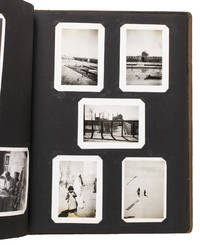
1943ABC_484291943. Contemporary embossed brown cloth with the title embossed in silver on the front board the name of the owner painted in silver and the green shoulder sleeve insignia of the Persian Gulf Command embedded in the front board. Ca. 32.5 x 26 cm. With 76 gelatin silver photographs various sizes. Remarkable military photo album with 76 photographs of the activities of the Persian Gulf Command PGC at various locations in Iran. The PGC was a branch of the United States Army established in 1941 to assure the supply of U.S. Lend-Lease war material to the Soviet Union through the Persian Corridor. After the war members of the PCG received an empty album to fill with personal memories of their time in Iran. These albums are now relatively rare. The present one was compiled by Colonel S. Morgan Thomas dates unknown a PGC member who carried out inspections of the railroads. It includes various photographs of him at work.This album also contains photographs of PCG commander Donald Prentice Booth 1902-1993 a visit by Soviet soldiers and a young child military activity in Teheran locals and soldiers sending telegrams. Loosely inserted in the album are maps of Iran the lands surrounding Hamadan and the Trans Iranian Railroad which would have been important to carry for someone who inspected the railroads. The work offers a rare insight into life of a PGC member stationed in Iran.The corners of the boards are somewhat scuffed. One of the inserted maps is somewhat foxed and another has a tear that has been repaired with tape in the lower margin not affecting the image some leaves are missing one of the corner mounts the photographs are mounted on possibly missing a photograph on the verso of leaf 4. Otherwise in very good condition. hardcover
8vo. (2), 348, (6), 44 pp. Contemporary full mottled calf with gilt spine (hinges weakened, binding professionally restored and lacquered). All edges sprinkled red. Rare news journal containing the lengthiest entry on pirates known in any contemporary periodical, spanning eleven closely printed pages (pp. 246-256) that went on to be cited in numerous piracy studies. The relevant section begins with a report from Jamaica that the pirates have been so active that they now number about 1500. There is a letter from Andrew Kingston detailing the loss of his ship to John Roberts (also known as Bartholomew Roberts, and later "Black Bart") about four miles from Antigua, followed by proclamations and speeches of Nicholas Lawes, Governor of Jamaica, and an attempt by him to collect recompense from the alcaldes of Trinidad in Cuba ("I find the Port of Trinidado a Receptacle to Villains of all Nations"). The English governor also demanded that the two pirates Nicholas Brown and Christopher Winter be handed over, which was refused - on the grounds that they had been baptized in the Catholic faith. Pages 253-256 contain an account by Captain Mackra who lost his ship Cassandra to pirates in the East Indies "between the coasts of Arabia and Malabar", and the unfortunate seaman's negotiations with the pirates' "chief Captain", the notorious Edward England. - The "Historical Register" was a quarterly news periodical originally issued to the clients of London's Sun Fire insurance. First printed in 1716, it ceased publication with no. 92 in 1738. This is the complete 1721 volume, comprising numbers 21 through 24 of the Register as well as the Chronological Diary for 1721. Complete year-volumes are rare: Bonhams NY (11 April 2016, lot 30) estimated a disbound copy of issue no. 23 only at $2500-$3500. ESTC T154297. OCLC 642461330.
8vo (208 x 150 mm). Contemporary blind- and goldstamped calf with fore-edge flap, decorated with corner stamps. Illuminated Arabic ms. on paper, 305 ff., single 15-line column, Naskh script on polished paper. Double-page 'unwan on first two pages shows elaborate gilt and coloured ornamentation. Text framed by three parallel golden and black lines. Gold discs between verses, sura headings written in gold.
Folio (280 x 190 mm). 70 ff. Italian ink ms. on paper, with a rare engraved folding map of the siege of Vienna by Johann van Ghelen (1684). 19th-century Italian blue sponged marbled boards. A remarkable, apparently unpublished manuscript chronicle of the 1683 Siege of Vienna by the Turks, which marked the turning point in the 300-year struggle between the forces of the Central European kingdoms and the Ottoman Empire and cemented the Habsburgs power. The manuscript begins with a historical account and background, touching on the problems of religious liberty, the Hungarian resentment against German domination, and other problems which led to the interference of the Turks and their aggression against the West. The chronicle continues in great detail, almost in the form of a contemporary diary, providing a day-by-day account of the unfolding events from 1 August 1683 until the end of the siege when the defeat of the Turkish army at Vienna became the turning point in the long East-West struggle. The story gives, among other things, detailed figures of the strength of the Christian and Turkish forces, listing all regiments with their commanders and the number of troops. The pagination, which despite being a self-contained account begins on 131, and the legible uncorrected script, indicate this was likely prepared for publication in a larger work. Includes (before f. 160) a rare engraved folding map of the siege of Vienna from Johann van Ghelen's "Relazione compendiosa e veridica del famoso assedio dell'imperiale città di Vienna, attaccata da Turchi li 14. di luglio, e liberata li 12. di settembre 1683".
Folio. XVIII, (2), 579, (1) pp. Modern blue wrappers with cover label. Top edge gilt. British papers and correspondence with local agents on the international slave trade, including missives exchanged between Colonel Sheil and Earl Granville about steps to be taken against slave trade by Persian vessels in the Arabian Gulf, plans to intercept slaving vessels in the Gulf, the continued slave trade by the "Arabs of the coast" (p. 324) and importation of slaves by Gulf sheiks and a discussion of the penalties to be inflicted on the sheikhs who persist in importing slaves. - Well-preserved.
8vo. First edition. XV, (1), 328 pp. With lithographic map bound as frontispiece. First edition; flyleaf inscribed by the author to "Mr A. Regnaudin". Important overview of Turkish trade, resources, infrastructure and municipal organisation by the diplomat David Urquhart (1805-77). After two and a half years fighting in the Greek war of independence, Urquhart was invited to accompany Sir Stratford Canning to Constantinople in November 1831 as an advisor during negotiations to settle the Greek boundary. In 1832 Urquhart was sent to Albania to cultivate the support of Rechid Pasha, leading advisor to the Turkish sultan. Urquhart became a great supporter of Turkey, spending most of 1834 in the country, and encouraged the British government to ally itself with Turkey against Egypt. This substantial book was written to inform the British political class of the possible commercial benefits of an Anglo-Turkish alliance. - Some negligible toning to first few leaves. Very good, uncut in original grey paper-covered boards, spine with original printed label, light wear to extremities. Scarce, particularly in original condition as here. Goldsmiths’ 27883. OCLC 65261681.
8vo. 574, (2) pp. Contemporary full red leather binding, finely stamped and gilt with rules and the supralibros of the Husainids of Tunis to both covers. All edges gilt. First edition of this widely received study of medical and sanitary standards in the Arabic countries. The principal work of Bertherand (1821-90), a French physician and medical-legal expert active in Algeria, written in the context of a discussion over assimilation within the French colonial empire. In contrast to Montesquieu's traditional theory, which explained cultural differences with the climatic zones of their origin, Bertherand attributed them to moral conditions which, in the case of contemporary medicine in the Muslim countries, he associated directly with Islam. His suggestions for colonial politics are informed by the racist and eugenic theories of his age (cf. Ellen Amster [2014], Medicine and the Saints: Science, Islam, and the Colonial Encounter in Morocco, p. 59ff.). - Light browning and occasional foxing as common. A splendidly bound copy from the library of Muhammad II ibn al-Husayn (1811-1859), the Bey of Tunis. The Husainid dynasty ruled the Beylik of Tunis from 1705 until 1957. OCLC 7369595. Gay 739; Playfair 1806 (both erroneously citing an edition Lille, 1854). Not in Tailliart.
Small folio (216 x 335 mm). 2 vols. LII, (2); IX, (1), 154; XI, (1), 116; VI, 82 pp. With 1 map. (6), VII, (1), 50, (2), 51-78; VI, 81, (1); V, (1), 93, (1); VI, 77, (1); IV, 40 pp. Original red cloth with gilt title to spine. Facsimile edition of eight collections of confidential documents from Britain's Foreign Office on affairs in the Arabian Gulf and beyond in 1905-1906. A goldmine of information, these secret intelligence communiques include direct communication with or discussion of key historical figures, including Sheikh of Abu Dhabi Zayed bin Khalifa Al Nahyan (1835-1909), Sheikh of Bahrain Isa ibn Ali Al Khalifa (1848-1942), his son and heir Hamad ibn Isa Al Khalifa (1872-1942), and his nephew Ali ibn Ahmad-Khalifa; Abdulaziz bin Abdul Rahman Al Saud (1875-1953) and his father Abdul-Rahman ibn Faisal al-Saud (1850-1928), Sheikh of Qatar Ahmad bin Muhammad Al-Thani (1853-1905), "effective ruler of Qatar" Jassim bin Mohammed Al Thani (1825-1913), and Abdul-Rahman ibn Idan (an "agent of the Shaikh of Qatar in Bahrain"); Sultan of Muscat and Oman Faisal ibn Turki (1865-1913); and names British "agents" active in Bahrain and Muscat. - The Foreign Office Confidential Print - the basis of this collection - was started as the quickest and most convenient method of circulating important mail within the Foreign Office. It is thus not an edited compilation of documents but a collection of reports shown almost exactly as they arrived in Whitehall, providing a rare glimpse into British Intelligence and Arabian affairs. - Binding a little tender, otherwise in good condition. Removed from the Library of the University of Texas at San Antonio with requisite stamps and shelfmark labels to spines. OCLC 584226. Nos. 8472, 8482, 8548, 8561, 8668, 8709, 8767, 8883.
Large folio (680 x 500 mm). 43 plates (36 of which are in colour), 2 double-page coloured maps. XXVI, (2) pp. Original wrappers. German text in wrappers and loose plates in original grey cloth portfolio with giltstamped titles. First edition of "the first great book on turkoman rugs" (Arntzen/Rainwater). The magnificent plates in full colour are printed on special paper, each sheet bearing the label of the St. Petersburg "Manufacture des Papiers de l'État". - Title page of the text volume shows a closed tear, otherwise fine. Cf. Arntzen/Rainwater P618 (the 1973 reprint only).
Folio (305 x 190 mm). (2), 61, (1) pp. Title page printed in red and black. With 11 (instead of 18?) plates containing 22 copper engravings. Modern boards. Fascinating, little-received geographical study focusing on the Eastern Mediterranean and Asia Minor, then under Ottoman rule. The anonymous late 17th-century German author hides behind the name of "Philo Cosmographus" and is evidently identical with the "Philo Chronographus" who produced the similarly themed chronographical work, "Arca Temporum", which was often issued together with this, though produced by a different publisher and catalogued separately. The present work features an overview of the geography of the Ottoman Empire, including the Aegean, the Sea of Marmara, and the Black Sea region - the "three seas" to which the title refers. Numerous pages of plates (each page containing two copper engravings) depict maps and views as well as animals (a hyena and sheep, Iraklion and Chania, Nauplia, Koroni, Rhodes, Thessaloniki, Belgrade, Izmir, etc.). - The number of plates, and indeed even the arrangement of engravings on a single page, varies from copy to copy, but this wants 8 plates as compared to the table of plates provided in "Arca Temporum". Occasional inkstains, but well-preserved. VD 17, 7:688727L; 3:605737C. Weller, Pseud. 439.
(20), 600, (24) pp. Text in Latin, Hebrew and Arabic. Contemporary vellum with ms. title to spine. 4to. Fine copy of the authoritative second edition of Hottinger's chief work, expanded by several long sections in the original languages. "One of the most significant contributions to the history of Islam to have been published in the seventeenth century" and "a groundbreaking account of the history and basic tenets of Islam which relied almost entirely on authentic Islamic sources" (Loop). Principal work of the theologian Hottinger (1620-67), a founder of oriental linguistics. Includes extensive chapters on the Prophet's genealogy, the main doctrines and the religious context of Islam, as well as many lengthy quotations in Arabic. While preparing the "Historia Orientalis", Hottinger had to cope with several problems, the most important being the lack of Arabic printing types. In the first edition of 1651 he had solved this issue by transliterating the Arabic quotations into Hebrew and using Hebrew letters with 'niqquds' to cover the Arabic alphabet. In the 1650s, however, the Swiss printers Johann Jakob and Heinrich Bodmer had started the casting of Arabic, Syriac and Samaritan types in their own foundry, and the present second edition of the "Historia" could be printed with Arabic types. Hottinger presents the entire body of knowledge about Islamic history and religion available at the time. He revised the first edition, published in 1651, during his stay in Heidelberg in 1655, where he had been summoned by the Elector Palatine. - Some browning as common, but an outstanding copy, with the handwritten ownership of Elisabeth Malainda (gift, dated Höchstädt, 28 Dec. 1676) on the pastedown. VD 17, 23:000384N. Chauvin XI, 577. Fück 91f. Ibrahim-Hilmy I, 311. Fürst I, 414. Brunet III, 347. Durstmüller 147. Graesse III, 378. Paisey H-1725. BL-STC German 17th c. I, H-1725. Not in Smitskamp. Cf. Loop, "Johann Heinrich Hottinger (1620-1667) and the 'Historia Orientalis'", in: CHRC vol. 88 (2008), no. 2, pp. 169-203.
Small folio (204 x 306 mm). (10), 140 pp. Text in Latin and Arabic, with some Hebrew and Greek, woodcut initials and tail-pieces. Tasteful modern sheep-backed marbled boards with giltstamped spine label. First edition of the "notes on the Gospel of Matthew" by the pioneering Arabist and physician Peter Kirsten (1577-1640), who started a private press in Breslau (Wroclaw) in 1607 (cf. Reske 130). His Arabic type, the first to be cut in Germany (by Peter von Selau), shows the influence of the Medicean types. - This is the issue with the letterpress title; another issue has an engraved title. Some copies lack the fifth preliminary leaf (present here): a singleton printed on different paper and in a different typeface, containing a 26-line laudatory poem in Hebrew by Jakob Ebert of Frankfurt, with the Latin translation on the recto. - Kirsten's notes on Matthew's Gospel "are mainly a comparison of the Arabic with the Greek version, and serve to explain the Arabic text. The Coptic and Syriac versions mentioned in the title are no more than marginal readings indicated as such in the Arabic manuscript which he used. These versions, as well as the Hebrew version, are mostly given in Latin translation, but occasionally a slight 12 pt Hebrew type-face is employed" (Smitskamp). - "One of the earliest non-Dutch scholar-typographers in [the] post-Medici tradition was the German Peter Kirsten (1575-1640), a physician of Breslau (Wroclaw), who had travelled and studied in both Italy and Leiden. He created a superior type-face, with some calligraphic qualities" (Roper). - Some very light browning and spotting, but a good copy. OCLC records two copies in the US (New York Public Library and University of Pennsylvania, both apparently with only four preliminary leaves). VD 17, 1:071605E. Smitskamp, PO 113. Fück 58, note 143. Waller 19836. Not in Schnurrer. Cf. Geoffrey Roper, "Early Arabic printing in Europe", in: Middle Eastern Languages and the Print Revolution (Mainz 2002), pp. 129-150, at p. 143.
Small folio. 2 vols. XII, (2), 644 pp. With folding engr. map and 11 plates. VII, (1), 715, (1) pp. With 11 plates. Contemporary full calf with giltstamped spine label. First edition of this "ouvrage importante" (Brunet), based on Malcolm's (1769-1833) three diplomatic visits to Persia. While the history it provides extends back to the earliest kings known at the time, the most valuable contribution made by this book is its detailed description of the contemporary Qajar dynasty from its outset. Complete with 24 copper engravings on 23 plates including the large folding map of Persia as well as several portraits and views. Occasional foxing to margins; contemporary ownership to title page. Bindings a little rubbed, with slight weakening to hinges. A good, wide-margined copy. Howgego II, M7. Ghani 236-239. Wilson 134. Brunet III, 1333. Graesse IV, 350. Schwab 360. Sotheby's, Hopkirk sale, 963. Sotheby's, Burrell sale, 496. OCLC 19941897.
Large 8vo (172 x 240 mm). Scrapbook containing clippings of the newspaper series "Arabische Reise" and other articles on Arabia, along with various illustrations and music. 80 pp., each sheet covered on one side with coloured paper or cloth. Contemporary green library cloth with cover label. Original clippings of Muhammad Asad's "Arabian Journey", serialized in the "Neue Zürcher Zeitung" in 1927, and including other early newspaper articles by Asad (as well as an essay by Hermann Hesse). The handsome album, apparently assembled by a German or Swiss traveller, Georg Hartmann (whose ownership is inscribed on the pastedown and initialled to the upper cover), is decorated with numerous illustrations cut from contemporary magazines, including several showing camel-mounted bedouins in the desert, a view of Mecca, portraits of Abdul Aziz ibn Saud, the muezzin's call to prayer (arranged in musical notes), and the original business wrapping paper of the Istanbul confectioner Hajji Bekir, whom Hartmann seems to have visited during a 1928 visit to Turkey. On the pastedown, Hartmann has entered a table of contents (with a - possibly slightly later - portrait of Ibn Saud as King). - Muhammad Asad (previously, Leopold Weiss) was a leading traveller and journalist of the 20th century who, in 1926, converted to Islam from Judaism, eventually becoming a diplomat for Pakistan and a best-selling author. His enthusiasm for Wahhabism is evident from these early travel reports from the Arabian Peninsula, where Ibn Saud had just captured Mecca and proclaimed independence in the Hejaz and Nejd, but had not yet united his dominions into the Kingdom of Saudi Arabia. Indeed, Asad's feature on Ibn Saud (also included here) constitutes nothing less than a hagiographic portrait of the ideal ruler, and his incisive writings on Islam aim to familiarize western audiences with what he perceived as the purest and truest form of the religion he had come to embrace, criticizing occidental images of the Muslim faith gleaned from the Ottoman or Persian tradition, which he viewed as corruptions.
8vo. (4), 304 pp. With a frontispiece showing the author in Arab garb, 88 illustrations in text, most of them reproductions of drawings and photographs by the author, and a folding map loosely inserted in a pocket at the end. Publisher's green cloth. First and only edition, in the original Danish, of an account of a journey through the Arabian Peninsula. Sponsored by the Royal Danish Geographical Society, Barclay Raunkiaer (1889-1915) set out to penetrate the hitherto unexplored deserts of south-east Arabia. Although the traveler came equipped with a modest amount of scientific instruments and a camera, the use of these became almost impossible. The foreigner was looked on with suspicion by the Arabs and Raunkiaer could only use his camera, with great risk, at certain unwatched moments (p. 12). At the beginning of 1912, the traveler reached Kuwait, where he stayed at the palace of Sheikh Mubarak. Since it was Mubarak's policy to keep Kuwait free of foreign interference, it took some active lobbying of the British envoy to convince the Kuwaitis that Runkiaer was a harmless traveller. After that, it seems that the Dane enjoyed a certain amount of freedom, as numerous photographs, including one of pearl-fishers and a portrait of Sheikh Mohammed, testify. Raunkiaer was very impressed by the volume of trade in Kuwait, which he considered to be the most important trading town on the east coast of Arabia. - In Kuwait, Raunkiaer became seriously ill, but his tuberculosis was undiagnosed. After a period of rest, he travelled further to Riyadh. As the first western traveller in the city in half a century, Raunkiaer was graciously received by Ibn Saud. After a short stay in Riyadh, Raunkiaer followed a caravan which mostly consisted of 150 pearl-fishers bound for Bahrain. During a stay in Hofuf, where the book ends, Raunkiaer's health became worse and he sailed to Bahrain to recuperate. From there he travelled back to Copenhagen via Bombay. After a few years working for the East Asiatic Company, Raunkiaer died from tuberculosis. - Shortly after the appearance of the Danish edition, the book was translated into German. T. E. Lawrence, who considered it to be one of the "readable Arabian books", helped facilitate an English translation in 1916, which was privately printed by the Arab bureau in Cairo. - Inscribed by the author to the Danish historian of religion Ditlef Nielsen (1874-1949), with and a few annotations in pencil in the final chapter. Binding slightly worn along the edges, with a small stain on the title. Endpapers foxed with the text browned; some small random pen marks at the lower margin of p. 47. The map with a few tears along the folds, most of them expertly repaired; a very good copy. Facey, Kuwait by the first photographers, pp. 50-51; "Mr. Raunkiaer's expedition in east-central Arabia", The geographical journal XL (1912), pp. 331-332; "Danish expedition to Arabia", The geographical journal XLIV (1914), pp. 85-86; not in Howgego.
Folio (218 x 282 mm). (12), 382, (2) pp. With separate engraved title-page, 21 engravings in the text, 3 engraved headpieces and 3 engraved initials. Contemporary full calf with giltstamped spine (rebacked preserving the original spine). The rare first French edition (first issue, in-folio) of Sir Paul Rycaut‘s famous Turkish chronicle, drawn from various authentic sources and from the author‘s own observations. "His most important work [...] presents an animated and, on the whole, faithful picture of Turkish manners" (DNB). "This work is regarded as one of the best of its kind with respect to the religious and military state of Turkey" (Cox). "Provides an account of the society and political system of the Ottoman Empire with unprecedented thoroughness" (cf. Osterhammel, Die Entzauberung Asiens, 32). "An extremely important and influential work, which provides the fullest account of Ottoman affairs during the 17th century" (Blackmer). The attractive engravings depict dignitaries and persons of various ranks in their costumes, also including the illustration of a turban. "Rycaut was appointed consul in Smyrna, where he resided for eleven years. His information on the Ottoman Empire was taken from several sources: original records, and from a Polish resident of some nineteen years at the Ottoman court" (Aboussouan). - 18th century ink ownership of Paul Lignon de Brassac on title page; additional ownership ("Dr. Lignon") and notes on flyleaf. Some browning fingerstaining, mainly confined to margins; slight worming affecting upper edge of first two leaves. Binding rubbed; corners bumped. A wide-margined copy. Weber II, 330. Goldsmith R 1262. Aboussouan 806 (lacking a leaf). Graesse VI/1, 108. Cf. Atabey 1069. Blackmer 1464. Lipperheide Lb 19 (all 2nd ed.). Hiler 770 (1686 English ed.). Howgego R 92 (Rouen 1677 ed.). Cox I, 210. Not in Colas.
Watercolour over pencil. 780 x 525 mm. Signed and dated by the artist. Matted.
Large 4to. 2 vols. XII, 227, (1), 87, (3) pp. XII, (229)-559, (1), 83, (1). With engraved frontispiece in vol. 1, 8 engr. maps (6 folding), and 1 folding table. - (Bound with): The Voyage of Nearchus, and the Periplus of the Erythrean Sea. Oxford, Cadell & Davies, 1809. XV, (1), 119, (1) pp. With 1 plate. Contemporary giltstamped English full calf; spines rebacked with original gilt labels. First edition of this rare Middle Eastern geography, published in two parts: 1. From the Sea of Suez to the Coast of Zanguebar; 2. From the Gulph of Elana, in the Red Sea, to the Island of Ceylon. Includes an extensive discussion of the Arabian Peninsula, including sections on Myos Hormus, the Wealth of Arabia, the Coast of Yemen, Aden, Mokha and Oman, Oriental Commerce by the Gulph, etc. Among the plates are a map of the western Arabian coastline, a chart of the Red Sea, and al-Idrisi's famous world map, "a pinnacle of mediaeval cartography as well as of the history of geographical research" (cf. Lex. z. Gesch. d. Kartographie, p. 325; Tooley II, 405). William Vincent (1739-1815) served as headmaster and later Dean of Westminster, and "ancient geography was the subject which Vincent made his chief study" (DNB). Also includes Vincent's edition of the Greek text of the voyage of Nearchus. - Covers rubbed; corners bumped. Traces of old stamps, removed from title pages and half titles. Somewhat browned and brownstained. From the library of the antiquary and bookseller Francis Drake (1828-85), a descendant of the like-named English navigator and privateer, with his engr. bookplate to pastedowns. A good, wide-margined copy. Ibrahim-Hilmy II, 311. DNB LVIII, 364. Graesse VI/2, 325. OCLC 6388867. Not in Atabey, Blackmer, Aboussouan, Weber, Henze, etc.
4to. (16), 170, (4) pp., final blank f. With 2 large folding maps. Contemporary vellum. First edition. - Early study on the sources of the Nile by the Dutch classicist and librarian Isaac Voss (1618-89). The maps show north-eastern Africa from Zanzibar to the Nile Delta (with large parts of the Arabian Peninsula) and a detail thereof, focusing on the tributary region of Lake Tana in Dembiya, Ethiopia. Also includes an "Appendix ad scriptum de natura et proprietate Lucis. Accedit epistola ad amicum, de potentiis quibusdam mechanicis" (p. 77-170), an early and little-received discussion of the nature of light, refraction, colours, optics, mechanics, and even comets (for a note on Voss's work on Snel's law of refraction of light rays, cf. DSB XII, 501). - Slight browning, spine defective. Early 19th c. title inked to corner of upper cover. Provenance: 1) in the collection of the cleric and abolitionist Francis Wrangham (1769-1842), later Archdeacon of the East Riding, with his 1804 ownership to t. p.; 2) in 1810/11 the book was in the collection of Percy B. Shelley's friend Thomas Jefferson Hogg (1792-1862), famously expelled from Oxford together with the young poet for having published the treatise, "The Necessity of Atheism" (his ownership "T. Jeff.n Hogg, Univ. Coll., Oxon." on pastedown); 3) in 1898 the volume passed into the library of the Swiss-born U.S. officer Edward Louis Berthoud (1828-1910), best known for his role as chief engineer and secretary of the Colorado Central Railroad during its expansion throughout Colorado in the 1870s (his stamp and ms. ownership to t. p. and the reverse of the plates); 4) acquired on 12 Feb. 1903 by the Colorado chemist Charles Skeele Palmer (1858-1939) (his ownership on t. p.); 5) Ida May Lewis (ownership, dated 1945, on pastedown). With irreverent ms. notes at the end of the dedication (to King Louis XIV) by either Berthoud or Palmer: "Vossius give us a rest"; under the author's signature: "A Brick". Ibrahim-Hilmy II, 312. OCLC 8556942. Cf. Gay 2317 (Paris ed.).
Small folio (206 x 324 mm). (8), 162, (6) [instead of 8] pp. Title-page printed in red and black. With double-page-sized frontispiece, 39 (instead of 41) engr. plates and 2 engr. maps; numerous woodcuts in the text. Contemp. blindstamped leather over wooden boards with 2 clasps. First edition of this highly interesting, appealing work, a topical publication produced but a year after the 1683 Siege of Vienna. Four additional volumes would be prepared by 1689. The plates show views of Hungary, the Ottoman Empire, and the Near and Middle East (Jerusalem, Egypt, Babylon, etc.), as well as Sultan Mehmet IV and the relief of Vienna. - Binding rubbed. Some brownstaining throughout with occasional waterstains. Several leaves rebacked or reinforced in the margins (occasional loss to text or image); wants the view of Ofen (Buda) and the "Crowning of the Empress" as well as one leaf of the index. VD 17, 23:300271C. Lipperheide LB 22. Nebehay/W. 794. Not in Apponyi.