4 134 résultats
8vo. 354, (14) pp., wanting final blank. Contemporary blindstamped brown calf. Rare Psalter from the printing office of the Melkite monastery of St. John the Baptist at al-Shuwayr in the Lebanese Kisrawan mountains, operative between 1734 and 1899, during which time it produced in all 69 Arabic books, including re-editions (cf. Silvestre de Sacy I, pp. 412-414; Middle Eastern Languages and the Print Revolution. A Cross-Cultural Encounter, Westhofen 2002, pp. 179-181). Nasrallah counts 15 editions of the Psalter alone, the last (produced in 1899, the only as-Shuwayr Psalter in the Aboussouan collection) constituting the swan-song of that important press. "Le Psautier a longtemps été le livre classique unique des écoles d'Orient. Cela nous explique pourquoi il fut si souvent édité" (Nasrallah, p. 38). - Binding a little rubbed; some light browning and brownstaining (mainly confined to margins). A good copy. Not in Nasrallah.
4to. (8), 474, (8) pp. Title page printed in red and black. Contemporary vellum with ms. title to spine. Edges sprinkled in red. Second edition of Savary's Arabic Psalter; more precisely, a re-issue of the 1614 original edition, with only the title changed and the remaining pages re-used from the first. Prepared by two Maronite scholars, Nasrallah Salaq al-'Aquri, better known as Victorius Scialac Accurensis, and Gabriel Sionita. "Scialac was one of the first Oriental Christian scholars who by his publications furthered the causes of both European Orientalism and Oriental Christianity. He taught Arabic and Syriac in the Roman University from 1610 to 1631" (Smitskamp, p. 161). The publication is famous for the clarity and elegance of its typeface created by Savary de Brèves: the extensive vocalisation helped this handy quarto volume achieve immense popularity among oriental scholars throughout Europe. Formerly it was assumed that the type design was based on specimens Savary had seen during his time as French envoy at Constantinople; today his probable model is believed to be a calligraphical manuscript from Qannubin, preserved in the Bibliotheca Vaticana. The cutting and founding of the types were done in Rome, in collaboration with Stefano Paolini, an experienced printer formerly of the Typographia Medicea. The Psalms' text is based on a manuscript Savary de Brèves had bought in Jerusalem (cf. Balagna, L’imprimerie arabe en occident, p. 55f.); as it occasionally departs from the Vulgate (as does the translation by the Maronites Sionita and Scialac), an extensive imprimatur was necessary. - The Arabic-Latin Psalter (1614/19) and Bellarmin's Arabic catechism (1613) would remain the only works to leave the Typographia Savariana in Rome; the types have survived and are now in the archives of the Imprimerie Nationale in Paris. - Occasional paper flaws professionally restored; insignificant brownstaining in places. A good copy. Darlow/Moule 1643. Schnurrer 324 (note) & p. 505. Ebert 18088 (note). Brunet IV, 921 (note). STC 108. Cf. Smitskamp 33. Fück 56.
Large 12mo. V, (3), 20 pp. Modern half calf over marbled boards with black morocco label to spine, gilt. Padded at the end with 22 sturdy blank leaves with binder's ticket of "Period Binders, Bath". First edition of this rare introduction to Arabic. As the author writes in his dedication to the Rev. John Frederick Usko, "The object of the following pages is to put the Hebrew student in possession of just so much Arabick as may enable him to profit by the illustrations of Hebrew words in the Lexicons of Simonis and others." He proceeds to explain and justify his methods in the face of the many difficulties encountered by students. The text looks at the construction of the alphabet itself, compares Hebrew and Arabic letters, and similarly verbs and their tenses. - Attributed to Thomas Burgess (1756-1837), who served successively as Bishop of Salisbury and St. David's. He was educated at Winchester college and gained a scholarship to Corpus Christi College, Oxford, where he spent most of his time studying Greek. He was ordained in 1784 and at this time he became interested in Hebrew and theology. A prolific author, he published over a hundred works - the first while at Oxford. Early in his career, he came under the patronage of the Bishop of Salisbury. In his spare time, he helped increase the number of Sunday schools and contributed in writing primers for the students. The present work is an obvious fruit of these interests. - No copies listed in auction records of this unusual Newcastle imprint, which also names the London bookseller and dealer in continental books, W. H. Lunn. Some contemporary handwritten annotations in ink & ownership inscription to title-page "A Bertiz / August 5, 1829". - Rare. OCLC 55524381.
8vo. 2 volumes. (40), "976" [= 980] pp. (8), "855" [= 847], (1) pp. Pages progress from right to left like a normal Arabic book. With an Arabic title-page on the second page of each volume, each with the Propaganda Fide's woodcut Jesus and apostles device and each preceded (on the back of the same leaf) by a Latin half-title. Further with woodcut tail-pieces, 1 woodcut decorated initial, and tailpieces and factotums built up from cast fleurons. Set in 2 sizes of nashk Arabic type, with the 13-page dedication to Pope Pius VI and a few other preliminary pages also in Latin on the facing pages, set in roman and italic type. Early 19th-century half sheepskin parchment, sewn on recessed cords with a hollow back, hand-lettered spine titles, shell-marbled sides, brown sprinkled edges. First unabridged Arabic edition of the catechism translated from the Latin version authorized by the Council of Trent and the most extensive Arabic catechism ever published, comprising 1827 pages plus preliminaries. It follows the Roman Catholic rite and was printed and published by the Propaganda Fide in Rome. It is based on the Latin text authorized by the Council of Trent under Pope Pius V, first published in Latin in 1566. While some small Arabic catechisms of a few dozen pages had been printed as early as 1580, only a few more extensive ones had appeared, with Bellarmino's growing from 86 pages (not including the parallel Latin text) in 1613 to 411 pages in 1770 and De Beauvais and Richelieu's 1640 Paris edition comprising 415 pages. The present edition is probably the most extensive Arabic work that the Propaganda Fide ever published. Volume 1 is dated 1786 on the Latin half-title and it may have been issued without the dedication (quires *-2*) in that year, but the dedication is dated 22 December 1787 and volume 2 is dated 1787 on the half-title. The Vatican established the Propaganda Fide in 1622 to promote Catholic missionary work, especially in the Middle and Near East, and it set up its own printing office in Rome in 1626. The printing office acquired many types for exotic languages from various earlier Roman printing offices that had operated under the authority of or in close cooperation with the Vatican and also had many new types cut for them, mostly by their own in-house punchcutters. In this way they assembled what was probably the largest collection of exotic printing types in the world, most of them exclusive to their press. The press had declined in the 18th-century, but began to flourish again when the future cardinal Sefano Borgia took chage of the Propaganda Fide and Giovanni Cristoforo Amaduzzi of the press in 1770. The type used for the main text of the present catechism was cut for the Propaganda Fide, probably in-house, and first used for Tommaso Obizzino, Thesaurus Arabico-Syro-Latina, 1636. With a nineteenth-century library stamp, apparently from the Propaganda Fide's own college, in the unprinted areas on both Arabic title-pages (only partly legible, but apparently reading "Pont. Univ. de Propaganda Fide"). With occasional minor and mostly marginal foxing and an occasional quire slightly browned, but otherwise in very good condition, with only an occasional tiny hole or small marginal chip. Only slightly trimmed, preserving an occasional deckle. The most ambitious Arabic catechism produced to this date. Schnurrer 308. WorldCat (2 copies); not in Smitskamp, Philologia orientalis.
Six works bound in one volume. 8vo. 67, (1); IV, 226; 8; 3, (1); 3, (1); 3, (1) pp. Contemporary tan half calf over marbled boards, spine with gilt rules, gilt lettered red label, gilt initials to the foot of the spine. Folding map to the second work. A bound collection of confidential reports from consular officials primarily regarding trade with the countries of the near and Middle East. The first work contains reports from cities such as Baghdad, Aleppo, Trebizond and Beirut. The second includes numerous short reports from all across the region, including a one and a quarter page report from the Consul at Jeddah describing local trade along with brief descriptions of the state of transport and communications routes. - Repairs to the upper ends of both joints, very good.
6 black and white photographs. 70 x 95 and 60 x 83 mm. Framed and glazed as a set. The photos depict images of boats and coastal life in and around Dubai's harbour, two women wearing abayas with hijabs and niqabs, walking in a desert plain of Sharjah, as well as desert dwellings and ports and boardwalks in Sharjah. This collection gives us a glimpse of the Dubai and Sharjah before the construction boom that started in the 1970s. Overall an intriguing collection in very good condition, capturing the coastal and desert life of a bygone era.
6 original gelatin silver photographs, the smallest measuring 90 x 139 mm and the largest 106 x 148 mm. - (Includes): 2 gelatin silver postcards of Dubai (Noor Ali, Photo-Press International, Dubai), ca. 90 x 139 mm, [ca. 1960s]. Framed and glazed. Rare photographs of Dubai in the early 1960s, showing Al Fahidi Fort, Dubai Old Town, Dubai Creek, Al Maktoum Bridge and the British Bank of the Middle East. They were published by "Studio Andalus", a photographic studio which (according to the stamp) was based on "New Street, near the National Library". Four are captioned in blue ink (another has an unfinished caption) and two have an Arabic studio stamp to their versos. Includes two contemporaneous postcards of Dubai, both also original photographic prints, showing principal views of the town. - A few corners bumped and creased, otherwise very good. A fine ensemble of rare photographs showing Dubai as a "Trucial State", shortly before the oil era and its development into what is today the largest city in the United Arab Emirates.
Small folio (240 x 296 mm). (4), 563, (1) pp. Modern half calf over marbled boards with giltstamped red label to spine. The most comprehensive and relevant edition of "a work which may almost be regarded as the standard one on the subject to which it is devoted" (Preface), i.e., the legal code in force within the provinces ruled by the British East India Company - a rule which would last until 1858, when, following the Indian Rebellion of 1857, the British Crown would assume direct control. Numerous statutes concern the slave trade in the Arabian Gulf or regulate relationships with the local Arab Sheikhdoms, such as 12 & 13 Victoriae, Cap. LXXXIV: "An Act for carrying into effect Engagements between her Majesty and certain Arabian Chiefs in the Persian Gulf", citing the chiefs "Sultan Bin Sugger, Shaik of Ras-el-Khyma and Shargah in the Persian Gulf, the chief of the Joasmee Arabs", "Muktoom Bin Buttye, Shaik of Debaye", "Abdool Azeez Bin Rashid, Shaik of Eginan", "Shaik Abdullah Bin Rashid, Shaik of Amulgavine", and "Saeed Bin Tahnoon, Shaik of the Beni Yas, chief of Aboothabee", as well as "Shaik Mahomed Bin Khuleefa Bin Subman, chief of Bahrein", and the engagements they concluded with the British crown (pp. 414ff.). Other acts relate to engagements with "Syed Syf bin Hamood, the Chief of Sohar, in Arabia" (p. 437), with Seid Saeed bin Sultan, the Imaum of Muscat (pp. 220, 383), etc. - Very well preserved, in a modern binding in contemporary style. OCLC 3062490.
22 typewritten sheets (4to) in carbon duplicates, revised by hand, with two smaller hand-drawn coloured maps of the Arabian Gulf, showing Bahrain and Qatar with the "Pirate Coast". A closely typed report on Bahrain, written in the autumn of 1936, outlining the country's history, situation, population, government, economy, foreign relationships and influences. This is accompanied by two detailed coloured sketch maps of the Gulf, showing Bahrain off the coast of Qatar and the entire Gulf from Kuwait to Oman, with the British and American spheres of interest and the international air routes marked. - During the two years that followed the end of the Great War, the British held control of most of Ottoman Mesopotamia (now Iraq) and the southern part of Ottoman Syria (Palestine and Transjordan), while the French controlled the rest of Syria, Lebanon, and other portions of southeastern Turkey. In the early 1920s, British and French control of these territories became formalized by the League of Nations' mandate system, and in 1923 France was assigned the League of Nations mandate of Syria. It would last until 1943, when Syria and Lebanon emerged as independent countries. - Occasional insignificant edge flaws; rust stains from old paperclips. Holes punched along left edge. A rare survival.
Collection of approximately 300 original betting cards, produced and intended for soliciting bets, sixty years before gambling was made legal. Three complete of sets of illustrated printed betting tickets, 100, 200, and 500 numbered series, respectively, each measuring 95 x 50 mm. Featuring an engraved illustration of English jockey Frederick Archer, a famously daring and successful Victorian rider who won most or possibly all of the great English turf prizes and accumulated a large fortune. Tickets are printed in Leeds, with stamp in bottom margin reading J. Richardson, "Bookmaker's Outfitter," Sporteries Leeds. Contained in the shoulder bag Charles Drew, English bookmaker who was arrested for charges of illegally soliciting bets on at least one occasion in 1901. Leather shoulder bag measuring 340 x 240 mm, with original strap, working clasps, inner pockets, his name in gilt to one side. Very good condition. Little is known of gambling bookie Charles Drew, but that his residence and business were based in South Shields, Tyne and Wear, in Northeast England, he married Ann Brown on 19 Jul 1852 at the South Shields St. Hilda parish church, and that he actively, illegally solicited gambling on streets by circulating betting cards for horse races. On 15 March 1901, the South Shields Daily Gazette reported on Drew's illegal activities: "At South Shields to-day, Charles Drew, bookmaker, was charged with betting East Street on Thursday last." Detective Sanderson and other officers deposed to the defendant being in the street taking bets in the usual way from 12 p.m. till 3 p.m. on the day named..." Several decades later, the gambling pastime which was already firmly entrenched in British culture would finally become a legal pastime. 1 September 1960, BBC: "1 January 1961 gambling for small sums will be legal for games of skill [...] betting shops will take gambling off the streets [...] At the moment, anyone who wants to place a bet on the horses has to demonstrate they have enough credit to set up an account with a bookmaker and do their dealings by telephone".
8vo. 2 vols. XIV, 283, (1) pp. (2), 285-699, (5) pp. With a few diagrams in the text. Contemporary boards with handwritten spine labels. Rare first edition, "dedicated to the devotees and connoisseurs of oriental literature, by an assiduous student of the same, in Constantinople". One of Hammer's earliest works, written as a barely 30-year-old while serving as secretary to the Austrian delegation in Istanbul, this is the first German version of the bibliographical encyclopedia compiled by the Turkish scholar Katib Çelebi (1609-57), already used by Herbelot. Hammer amplifies this text from six additional manuscripts. - Katib Çelebi's introduction investigates the history, divisions, and estimation of science in the orient. This is followed by more than 300 sub-branches in seven general subjects: writing and calligraphy; language and history; propedeutics; speculative philosophy including natural and arcane science, medicine, and music (the most substantial class, comprising some 250 pp.); practical philosophy (ethics, political science); law and theology; as well as the inward sciences (ascetics). Each branch is headed by its original title printed in Breitkopf's Arabic typeface, often provided with extensive commentary (even discussing the various musical and astronomical instruments) and bibliography. - Bindings rubbed and bumped; spine sunned; interior somewhat browned and foxed as common. From the library of the Prussian chamberlain Rudolf von Stillfried-Rattonitz (1804-82) with his armorial bookplate "Ex Bibliotheca Stillfridiana" on the front pastedown. Goedeke VII, 750, 13. Graesse III, 32.
Ca. 72 x 83 mm. Engraved bronze. Rare and exceptionally well-preserved document of the Roman presence on the Arabian Peninsula. This diploma was issued for a member of the ala praetoria singularium, an auxiliary cavalry unit stationed in Syria, under the command of Aulus Furius Saturninus during the reign of Emperor Domitian (81-96). It can be dated with a high degree of certainty, as Aulus Furius Saturninus is only traceable to military diplomas issued as part of an imperial military constitution for 5 alae and 2 cohorts in Syria from 8 November 88. - The ala praetoria singularium was one of 14 alae and 33 cohorts stationed in the province of Syria between 88 and 157. These troops built and defended the almost 1500 kilometre Limes Arabicus, a system of streets, watchtowers, and forts that had its origin in the Roman conquest of Syria in 64 BCE and reached its greatest extent in the second century. Palmyra and Damascus were among the fortified cities along the Limes Arabicus. - From the German collection of Peter Weiß, acquired before 1980. Published: P. Holder, Roman Military Diplomas V (London: University of London, Institute of Classical Studies, 2006). P. Weiß, Neue Militärdiplome, in: Zeitschrift für Papyrologie und Epigraphik 117 (1997), pp. 227-268.
Two copies of two folding maps colour printed on both sides of a sheet of silk (103 x 78.5 cm) on a scale of ca. 1:1,000,000. The two maps (ONC-H-6 & ONC-H-7) show one continuous area. Rayon pilot's map of the Arabian Gulf region focusing on the Trucial States (modern United Arab Emirates), Qatar, Bahrain, Oman, Iran and Saudi Arabia, including the main oil installations. Items of specific interest to aircraft, such as airfields and even seaplane bases, are particularly listed. Warnings to stay within the specific flying routes while in Iran are placed on multiple locations. While the map depicts a continuous area on both sides of one sheet, it actually consists of two maps, originally published separately. We here include two copies so the whole area can be displayed at once. The maps are reproduced after the third and fourth edition. - In very good condition.
4to. (108) pp. With woodcut title vignette and 7 woodcuts in the text (one full-page). Modern calf using the remains of a 16th century binding with blindstamped rules and roll-tools. Edges red. Rare 16th century edition of this poem on gemstones, ascribed to the legendary Evax, king of Arabia, and sometimes entered in bibliographies accordingly (cf. BM-STC or Thorndike I, 776), though in fact written by Marbod, the bishop of Rennes, in the late 11th century. The book, which survives in more than sixty manuscripts, was first printed in Vienna in 1511 as "Libellus de lapidibus pretiosis"; the present Leipzig edition is only the third to attribute authorship to King Evax on the title-page. Sources include Pliny, Isidore of Seville, Origines, Orpheus, and Solinus. "In short, Marbod's work briefly describes 60 gemstones, which number includes several that are not now considered to be in that category, and gives for each their magical and medicinal virtues" (Sinkankas, p. 665). They include mythical stones, mineral species such as emeralds, onyx, magnets, carbuncles, hematite, asbestos, etc., with numerous varieties of quartz, stones coming from the body of an animal, and several other hard substances that are not really minerals at all, among which is coral, described as "a stone that lives in the ocean, forming branches like wicker" (E3v). - "One of the questions connected with this work is whether it is by Marbodus or by an Arab called Evax. It has arisen because the poem opens with an allusion to a person of that name. Lessing does not see why Evax should not have written a work on precious stones, or why Marbod should have said that his poem was extracted from Evax's work, if it were not so. Reinesius thinks Marbodus made himself the interpreter of Evax" (Ferguson). Today, all scholars "agree that Marbod was the true author and Evax an invention" (Sinkankas). The present editor, the German humanist Henrik Rantzau (1526-98), was an associate of Tycho Brahe. At the end of the book he includes an illustrated genealogy of his own family. He "states that the poems of Marbod are here issued completely for the first time 'as far as he knows', although this is not the case" (ibid.). - Rather severely browned throughout; several 17th century underlinings and marginal annotations. Gutter repaired and completely rebound in the 20th century with modern endpapers but using old material for the covers. VD 16, M 935 (R 878). BM-STC German 291. Sinkankas 4179. Ferguson II, 74. Not in Adams.
121 x 92 cm. Colour-printed map (folded). Scale 1:20,000,000. A large wall map of the Middle East shortly before the Yom Kippur War, showing the Arabian Peninsula, north-eastern Africa with Libya, Egypt and Sudan as well as Turkey and Iraq pictured in their entirety. A separate inset shows Israel, others show statistics such as population and trade, oil production, etc. - A few large tears to folds, some adhesive tape reinforcements to reverse, but well preserved.
Engraving with caption in German and Arabic. 39:45 cm. The Moroccan envoy Mohammed Ben Abdul visited Vienna in 1783 to seal a friendship treaty and trade agreement. He was welcomed at the Hofburg by Emperor Joseph II on February 28. The engraving depicts the reception, with the High Chamberlain Prince Orsini-Rosenberg leading the envoy (holding a writ in his hand) and his companions before the Emperor, who receives them standing. Next to the Emperor are the interpreter von Bihn, the Vice-Chancellor Graf Cobenzl, and another high state official. The publication of this engraving was announced in the "Wiener Zeitung" on 26 April 1783. - Very rare. Catalogue "Hieronymus Löschenkohl", Historisches Museum der Stadt Wien, 1959, no. 46a.
4to. Title and 24 pp., all inset into folio leaves. Marbled spine. Rare contemporary manuscript copy of the peace treaty, in 22 articles, concluded between King José I of Portugal and the Sultanate of Morocco. After the Reconquista, Portugal had expanded into Africa, starting with the territory of Morocco, by occupying cities and establishing fortified outposts along the Atlantic coast. The Portuguese seized numerous Moroccan cities and built coastal fortresses there, but most of these had to be abadoned soon. When Tangier was ceded to England in 1661 and Ceuta finally handed over to Spain in 1668, Portugal's direct involvement in Morocco had essentially come to a close, and when King Juan I abandoned Mazagan under the pressure of Mohamed ben Abdallah in 1769, Moroccan reconquest was complete. Five years later, in 1774, the Governments of Morocco and Portugal concluded a Peace and Friendship Agreement, one of the oldest bilateral agreements of both nations. Ever since his accession in 1757, Sultan Mohamed had sought to adopt the European trading system, while simultaneously safeguarding the spirit of Islam amongst his peoples. To this end, he ratified earlier peace treaties with Great Britain and with the Netherlands, then went on to sign several more, beginning with Denmark, Sweden and Venice; similar treaties were closed with France and Spain (both 1767) and Tuscany (1782). A fundamental principle that was enshrined in all of them was rooted in the annual payment of a fee in cash or in kind. - Slight browning to inset leaves. Apparently removed from a 19th-century document collection, with the original leaves remargined to folio size. A principal document of Luso-Moroccan relations.
92 x 126 cm. Scale: 1:1,000. Whiteprint on thick paper. Title, scale and compass executed in manuscript in blue pen. Impressive plan of the excavation site of Tell Halaf (now on the Syrian-Turkish border), the location of the great ancient Aramaean town of Guzana, and one of the most important archaeological revelations of the modern era. Then in the Ottoman Empire, it was discovered in 1899 by the German diplomat Max von Oppenheim (1860-1946) while travelling through northern Mesopotamia on behalf of Deutsche Bank, working on establishing a route for the Bagdad Railway. - This is a working copy of the official, authoritative plan of the site produced during the 1911-13 excavation led by Oppenheim, printed at Tell Halaf for the use of the senior archaeological team. Signed in the upper right-hand corner by Theodor Dombart (1884-1969), a professional architect and one of Oppenheim’s principal associates, later an esteemed professor of ancient Middle Eastern architecture and an authority on Munich history. - A little worn, slight toning along old folds, else very good.
4to (170 x 215 mm). 38 pp. With frontispiece, 6 plates, and 16 full-page illustrations in the text. Original printed, illustrated buff wrappers. Very rare restricted British Army manual, dealing with the terrorist explosive devices and methods employed by the Zionist insurgents during their paramilitary campaign carried out against British rule in Mandatory Palestine. Includes instructions how to detonate various types of mines and booby traps, as well as a history of terrorist activity in 1946 undertaken by Jewish groups. Plates of various attacks are included, such as the partially destroyed King David Hotel in July 1946, and the demolished building in the David Quarter, Jerusalem, bombed in November 1946. Of that attack the booklet reads, "This incident is included for its illustration of the extreme methods which Jewish Terrorists may employ when planning deliberate murder". - Wrappers slightly soiled; interior shows occasional brownstaining. An extraordinarily rare survival; only three copies in libraries internationally: National Library of Israel; Johns Hopkins University; University of Toronto Fisher Rare Book Collection. OCLC 233992872.
Large 4to. (4), 175, (1) pp. With a folding engraved plate. Contemporary half calf with giltstamped spine title over red marbled boards. First edition of one of the earliest studies of the Rosetta Stone, published some 18 years before Champollion deciphered the text. N. G. Palin (1765-1842) was a leading Swedish diplomat whose postings included Madrid, Vienna, Dresden, and Constantinople. He made several journeys to Asia Minor, Greece, and Egypt, twice reaching the Cataracts of the Nile. On leave from 1824, he devoted all his time to his Egyptological studies. - Binding only very slightly rubbed; spine professionally rebacked preserving gilt title label and old library label. Paper a little browned; bookplate of the Portuguese historian Francisco Soares de Lacerda Machado (1870-1955) to flyleaf. Rare. Gay 1792. Ibrahim-Hilmy II, 194. Brunet VI, 29107. Kayser I, 57. OCLC 40974048.
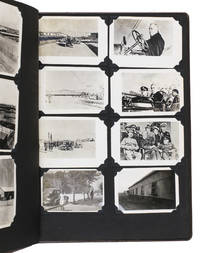
1943ABC_484281943. Contemporary embossed brown cloth with the title embossed in silver on the front board and the green shoulder sleeve insignia of the Persian Gulf Command embedded in the front board. Ca. 32.5 x 26 cm. With 150 gelatin silver photographs various sizes. Unusual military photo album with 150 photographs of the activities of the Persian Gulf Command PGC at the base in Andimeshk Iran. The PGC was a branch of the United States Army established to facilitate the supply of material from the U.S. Lend-Lease programme through the Persian Corridor. This material was sent to the Soviet Union to strengthen it so it could help defeat Nazi Germany. The photographs in this album which cannot be found anywhere else offer a visual documentation of this time. However they show the simple soldiers; the men tasked with driving trucks maintaining oil supply lines or working alongside Iranians at the two factories producing trucks for the war effort. The work therefore offers a fascinating insight into daily life of PCG members in Persia in the Second World War.This album was compiled by John Stefano dates unknown a technician fourth grade in the PGC. It includes photographs of the Tehran conference in 1943 the first World War II conference between the Soviet Union the United States and the United Kingdom where it was decided to open a second front against Germany. Other than this there are photographs of the barracks the men lived in the military vehicles they used the marches and excercises they partook in but also the surrounding landscape and the local people.Inserted in the album is a booklet with images and information about Persia with a letter by PCG commander Donald Prentice Booth 1902-1993 which was sent to PCG members after the war to congratulate them on a job well done. He hoped the booklet would serve as a memento. Together with the album it continues to do so until this day.With the shoulder sleeve insignia of the Persian Gulf command mounted on the inside of the frfont board some of the photographs are captioned on the back. The eyelets for the string on the front board have come loose. The corners of the leaves are slightly creased. Overall in very good condition. hardcover
Folio. With two folding lithographed maps, one centered on the Middle East and the other detailing the seats of the plague in Mesopotamia and south-west Persia. Original publisher’s blue printed paper wrappers. Compilation of observational governmental reports on various outbreaks of the bubonic plague in the Middle East, Persia and Egypt between 1853 and 1877. As stated in the introduction, this publication was compiled to study the epidemic in detail, in hopes that such knowledge might benefit Great Britain in the event of an outbreak of the plague in its own territories. The information in these reports proved to be of value during the intensive study of the plague in the 1890s, which led to the identification of the origin of the disease in 1894. - The compilation comprises three parts: the first contains extracts from reports of the medical officers of the local government board, the second is a memorandum by Mr. Netten Radcliffe, and the last contains a few papers considering the medical aspects of quarantine. - Binding worn at the edges and the paper spine damaged at the head and foot. Upper corner of the first few pages slightly soiled, but still in good condition. Creighton, A history of epidemics in Britain (1965) I, 162. Ethnographic Plague: Configuring Disease on the Chinese-Russian Frontier, p. 166. Histories of Post-Mortem Contagion: Infectious Corpses and Contested Burials, p. 25.
126 prints mounted in album, two to a page. Ca. 17 x 12 cms each. 4to. Showing horses, riders and the audience at a Polo tournament at an unidentified, though apparently German, track. In the background, the names of several players (of Anglo-Saxon, German and even Hungarian background) are visible on the boards marked "Blau" and "Weiss": W. Sommerhoff, H. V. Scott, Capt. T. Melvill, Gildemeister, G. Heye, Graf A. Sigray, etc. - First quire detached, occasional slight fading, but well preserved altogether.
12mo. (20), 168 pp., including a folding genealogy of Mohammed as *10, bound here before *2. With a woodcut vignette of the Blue Mosque (?) on title-page as well as an engraved frontispiece of Mohammed presenting the Qur'an to the world, along with Zulfiqar (his legendary double-bladed sword), and a dove on his shoulder. - Bound with (II): Orientalischer Kirchen-Staat. Gotha, Jakob Mevius, 1699. (2), 155, (1) pp. (and 2 other works). Contemporary vellum. Very rare sole edition of this detailed exposition of the Qur'an for German readers, replete with a frontispiece depicting Mohammed giving the 'Alcoran' to the world as well as a folding genealogy of the Prophet. The preface discusses the threat which Islam poses to the West; and yet Pritius remarks that "meanwhile no-one will be hurt by learning a little more precisely about the opinions of these people, against whom Christendom has so long struggled" (*2v). - Chapter I covers the tenets of Islamic faith, rituals, customs, and pilgrimage. This includes numerous excerpts from the Qur'an and a lengthy discussion of the entire process of the Hajj, as well as the rituals the pilgrims take part in once they arrive in Mecca (pp. 89-113). Chapter II concerns the role of "muftis, priests, monks, and hermits" in Islam; and Chapter III recounts the life and death of Mohammed, taken from the usual European sources. - The inner workings of Islam had long fascinated the German Protestants, who saw an ally in their struggle against the common enemy of the Habsburgs / Roman Catholic Church. The present work is exceptionally detailed, however, and offers far more than the usual brief discussions of Mohammed's life; indeed, it is evident that Pritius had access to one of the Qur'an translations available in Europe at the time. - Extremely rare: OCLC shows no copies in American or UK libraries; VD 17 shows holdings in six German libraries. - Bound at the end of the volume is a manual of the various faiths of the orient, which includes a chapter on Islam and a discussion of the schism between Sunni and Shiite Muslims. Two other theological works bound first: (III) Spener, Philipp Jakob. Die Seligkeit der Kinder Gottes [...]. Frankfurt, Johann David Zunner, 1692. (138), 427, (25) pp. - (IV) Schmidt, Sebastian. Regenten-Predigten, welche zu gewissen Zeiten des Jahrs der christlichen Gemeine in Straßburg aus dem Alten Testament erkläret und vorgetragen worden. Braunschweig, Caspar Gruber, 1694. (2), 308 pp. - Some browning and occasional waterstaining throughout; binding darkened. Some edge chipping to the genealogical plate. VD 17, 39:144883H. Chauvin XI, p. 186, no. 667. Imaginationen des Islam: Bildliche Darstellungen des Propheten Mohammed, no. 20. Cf. also Fischer, Bildung durch Reisen? Deutsche Aufklärung und Islam II, p. 85 (note); on Pritius cf. ADB XXVI, 602ff. - (II): VD 17, 39:144877G. BL (German books) O224.
Original silver-gelatin photograph (90 x 143 mm). Ms. pencil caption to verso "AVM Brook-Popham and Ibn Saud". A historically significant photograph of Abdulaziz bin Abdul Rahman Al Saud (1875-1953) at the Khabari Wadha meeting, where he discussed the surrender of rebel Ikhwan leaders with British officials. All original photographs of Abdulaziz are rare, especially those of him before the unification of the Kingdom of Saudi Arabia. - The Khabari Wadha meeting signalled the end of the Ikhwan revolt, a rebellion against the authority of the Al Saud which started in 1927. It was held approximately 150 miles south of Kuwait, where Faisal al-Duwaish and other Ikhwan leaders had sought refuge after suffering a string of military defeats. Over several days, Abdulaziz and British officials (responsible for political affairs in Kuwait and the Gulf) debated what to do with the rebels, finally settling on handing them over to Abdulaziz "on the condition that their lives should be spared and that the property which they looted from the people of Kuwait and Iraq should be returned" (Wahba, Arabian Days, p. 143). Abdulaziz was greatly relieved at the result, as it fatally weakened the Ikhwan and removed the main obstacle to unifying his Kingdom. Sheikh Hafiz Wahba recalls him saying "From today we live a new life" (ibid., p. 145). - The photograph shows Abdulaziz seated centrally at the front, with Sir Hugh Biscoe (British Resident, Persian Gulf) to his right and Charles Burnett (Air Vice-Marshal, RAF) to his left. Stood behind him, among other officials, are the important figures of H. R. P. Dickson (British Consul, Kuwait) and Sheikh Hafiz Wahba (diplomat and advisor to Abdulaziz). The caption on the verso suggests Robert Brooke-Popham is also present, but we cannot locate him. - For fuller descriptions of the Khabari Wadha meeting see Dickson's "Kuwait and her Neighbours" (London, 1956, pp. 318 ff.) and Hafiz Wahba's "Arabian Days" (London, 1964). The latter book also includes the present photograph (plate facing p. 113), described as "A meeting in the desert between the late King Ibn Saud and the British political agents in the Persian Gulf with the author standing behind the King (January 1930)". - A good strong image, with only a little fading toward the edges of the photograph. Reproduced in: V. Dickson, 40 Years in Kuwait, plate 5 (opposite p. 96).