4 134 résultats
Small 4to. Disbound, spine lined with a strip of black paper. Extremely rare second edition of a rare Portuguese translation of the History of Ganem, the slave of love, a story from the Arabian Nights. The story tells of Ganem, a son of a merchant from Damascus, who upon his father's death travels to Baghdad to sell his father's leftover stock. Once in Baghdad, the young Ganem falls in love with the favourite concubine of the caliph. The story is translated into Portuguese from Jean Antoine Galland's early 18th century French translation. - With spots on the first and last leaves, a stain on leaf B1 and a couple tiny holes in the outer margin of the last leaf. In good condition. OCLC 62187442. Cf. Rodrigues, Novelística estrangeira 268. Not in Chauvin (cf. VI, 188).
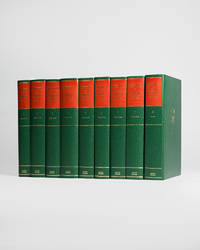
121954London Archive Editions 1991. . 8 vols 8vo 25.5 x 16.5 cm; 7 vols text & map portfolio containing 12 large folding maps; publisher's original green cloth gilt arms of Qatar to upper boards gilt lettering to spines with red lettering pieces top edges gilt a fine set.<br /> An unrivalled collection of material revealing the history of Qatar from 1820 to 1960 focussing on primary documents charting the history of the peninsular from Qatar's first maritime treaty with Britain in 1820 up to the abdication of Ali bin Abdullah in 1960. Many of the documents within are published for the first time.<br /> London, Archive Editions, 1991. hardcover
4to. 72, (14), VIII pp.; (2) ff. with engravings. Text set in roman, Hebrew, Greek and Arabic type. With a small Portuguese woodcut coat of arms on the title-page and 4 engraved plates on 2 leaves bound at the end of the book. Later blue paper wrappers. First and only edition of an instruction manual for the compositors of the Portuguese Impressão Regia on the proper setting of Greek, Hebrew and Arabic type. It was written by Custodio José de Oliveira (d. 1812), professor of Greek at the Colégio Real dos Nobres in Lisbon and one of the Directores Litterarios of the Impressão Regia, serving until 1807, for which he wrote the present work. The present work is identified as "very useful" by Innocencio and according to him, it was the only Portuguese manual on typesetting he knew so far ("Trabalho mui aproveitavel, para o tempo em que sahiu, e o unico que sobre o assumpto temos até agora escripto orginalmente em portuguez"). Oliveira shows in both the tables and inserts within the text the alphabets and numbers in Greek, Hebrew and Arabic with their roman equivalents. The last four plates (printed on both sides of two leaves) show common ligatures and abbreviations in Greek. The present copy of this very rare work is complete with all plates, the "Prefação aos compositores typograficos" (numbered I-VIII) and the seven-leaf dedication, all bound at the end of the book. An important work on the subject of typesetting and the only work on this topic known in Portuguese. - With the bookplate of Américo Cortez Pinto (1896-1979) on the front wrapper, a Portuguese physician, writer, poet and historian who also wrote some works on the art of printing. Front wrapper half loose and back wrapper loose, spine partly gone, wrappers a little frayed, discoloured and slightly stained. Paper edges slightly frayed as it is an untrimmed copy, sometimes with the bolts unopened. Some marginal staining, very minor foxing, but overall a very rare work on printing and typography which is still in fine condition. Bigmore/Wyman II, 90. Innocencio II, 461. The literature of printing: a catalogue of the library illustrative of the history and art of typography, calcography and lithography of Richard M. Hoe, p. 85. Not in Porbase.
4to. (2), 750 pp. French manuscript on paper. Contemporary gilt and blindstamped full green cloth with giltstamped title to spine and cover. Appealing, unpublished handwritten travelogue commemorating the French president Émile Loubet's tour of Algeria and Tunisia. Each page is enclosed within blue, white and red borders, with chapter titles and first initials also in tricolour. Apparently a presentation manuscript prepared for Michele Modica, vice-consul of Italy in Algeria, whose name is giltstamped on the front cover, it is signed - and probably written - by the prefecture's huissier Roche. In very neat handwriting, the account describes Loubet's two-week tour of French North Africa from Algiers to Oran, on to Tunisia and back to Marseille, mentioning visits to palaces, hospitals and race tracks, local delegations received by the president, as well as feasts and banquets held in his honour. - Extremities lightly scuffed. Ink corrosion along the left vertical blue border affecting the final 20 pages; slightly foxed in places. - An exceptional manuscript befitting the high rank of its recipient.
8vo. 26, (2) pp. Later half morocco, spine gilt, with the original printed wrappers bound within. Schwerdt copy. One of 150 copies. - Spine rubbed. Schwerdt I, 103. Thiébaud 166.
Folio (305 x 190 mm). 2 parts in 1 volume. (4), 31, (1), 64 pp. With 12 (instead of 16) plates containing 24 copper engravings. Modern boards. Fascinating, little-received chronographical study focusing on the history of the Eastern Mediterranean and Asia Minor, then under Ottoman rule. The anonymous late 17th-century German author hides behind the name of "Philo Chronographus" and is evidently identical with the "Philo Cosmographus" who produced the similarly themed geographical work, "Trinum Marinum", which is announced on the title page and was often issued together with this, though produced by a different publisher and catalogued separately. The first part of the work contains a general introduction which relates the 24 hours of the day to the time from Creation to the year 1800 (which is conceived of as the end of the world, leaving another mere 107 years of history to come!). The second part features a chronicle of the "Rule of the Ottoman Porte", from Sultan Osman to Suleyman II. - Numerous pages of plates (each page containing two copper engravings) depict costumes, animals and plants, maps and views of towns (Sultan Osman, the Ottoman Residence and a view of Constantinople, dolphins and cranes, Turkish ladies in their various garments, a cypress and a mastix tree, etc.). - The number of plates, and indeed even the arrangement of engravings on a single page, varies from copy to copy, but this wants 4 plates as compared to the table of plates. Well-preserved. VD 17, 12:645730N. Weller, Pseud. 439.
8vo. (4), 54 pp, (1 integral blank leaf). Purple wrappers. Extremely rare sole edition of these definitive statements on slavery by both Fourier and his disciple, the Guadeloupe-born créole lawyer Charles Dain. Both Fourier’s article (“Remède aux Divers Esclavages”, pp. 43-54) and Dain’s “De l’Abolition de l’Esclavage” had also appeared in the impossibly rare "Première Serie" of the journal La Phalange (1836-40). Giving up his legal career in Paris, Dain (1812-72) turned to Fourier and the proto-Communists and was elected Representative for Guadeloupe by the newly-emancipated slaves there in 1848. - “Charles Fourier denounced British apprenticeship [an intermediate solution for emancipated slaves] and the compensation for slave owners embedded in the parliamentary emancipation bill of 1833: ‘And the fruit of this gigantic donation? Nothing other than a vicious circle, as we see in England, where […] one finds […] legions of poor, both theoretical and real” (Jennings, French Anti-Slavery, p. 44). “As far as the indemnity was concerned, Fourier opposed the need for it from the very first words of his [Remède aux Divers Esclavages]. He believed it was madness to spend millions on freeing the slaves, as the English government had done and as the anglophiles among the French advocated […] On the other hand, for Fourier, slavery was the same kind of problem as poverty […] The cause was the excessive fragmentation of landholdings which prevented small landowners from supporting the costs needed to work the land productively” (Simona Pisanelli, Economic Thought and Institutional Change in France, p. 69). - Fourier (1772-1837) and Dain thus believed in a ‘gradualistic’ approach to emancipation and considered slavery as just one of many ‘servitudes’ inflicted upon humanity by corrupt and immoral social strictures. Here, Dain comments that “what we especially call slavery is only the culminating and pivotal point where all of the suffering of society comes together”. These concepts ultimately made their way to America, influencing Albert Brisbane and the American Associationists (cf. Guarnerip, The Utopian Alternative: Fourierism in 19th-Century America, pp. 252f.). - OCLC shows just a handful of copies worldwide, including just one in the US – at the George Washington University Law Library (an apparently physical copy noted on OCLC with 26 holdings is in fact a digital reproduction). As noted above, examples of the Première Serie of La Phalange (1836-40) are of the utmost rarity (we can find no copies in auction records of the last 50 years). - The present copy sounds very similar to (and may well be) the copy sold at Pierre Bergé in 2013 for €1,180 (“la plaquette est rare. Exemplaire en partie debroche, manques de papier au dos”). - Traces of old block-stitching in the gutter; pages clean and fresh. A good copy. Goldsmiths' Library of Economic Literature II, 29695. Cf also Schmidt, Abolitionnistes de l'esclavage et réformateurs des colonies: 1820-1851, p. 199; Andrews, “Breaking the Ties: French Romantic Socialism and the Critique of Liberal Slave Emancipation”, The Journal of Modern History 85 (2013), pp. 489-527.
Small folio (207 x 311 mm). 295, (1) pp. 26 ff., numbered 1-27. Issues 1 through 7 (of 8) bound together, with an additional booklet is bound at the end of the volume (addendum file no 1., 29 Oct. 1967). Contemporary blue full cloth binding with gilt-printed title label in Hebrew and Arabic to upper cover. The first orders issued by the IDF military authorities in the West Bank after the Six-Day War (Milhemet Sheshet Ha-Yamim, or Harb 1967). Printed in Hebrew and Arabic, the pamphlets include more than a hundred and fifty orders, proclamations and lists of position-holders. - Binding somewhat stained, but generally well preserved. OCLC 20345168.
8vo. 3 vols. (8), 15, (1), 587, (1) pp. (6), XII, 543, (3) pp., final blank leaf. (4), IV, 565, (1) pp., final blank leaf. Contemporary brown boards with giltstamped red spine label. First edition, printed with the beautiful Arabic types of the Imprimerie Imperiale by J. J. Marcel, who in 1798 had brought printing to the Arabic world when he set up the first press in Cairo. - "Opus maximopere, nec vero ultra quam fas erat, laudatum et celebratum ab omnibus qui de eo referrent" (Schnurrer). "Like his Grammar, de Sacy's Chrestomathy was first compiled for his students. In the early 19th century there was a very limited body of reading matter for academic learners of Arabic [...] The Chrestomathy was intended to remedy this fault. But de Sacy immediately combined with this practical aim the scholarly task to use and make known valuable texts from the manuscript troves of the Royal Library in Paris, and so his Chrestomathy contains extensive extracts from late historians (Maqrizi) and geographers, from Hariri's Maqamat, from the Druze canon and from Qazwini's cosmography, as well as several poems from Nabiga to Ibn Farid, and, finally, keeping in mind the practical needs of future interpreters, a collection of state documents, all of this in the original Arabic with French translation and a wealth of annotations [...] It is a credit to de Sacy's interpretative mastery that the Chrestomathy [...] enjoyed a much longer life than similar works usually do, which tend soon to show their age due to the progress of scholarship: for nearly a century his work introduced learners to the masterpieces of Arabic literature" (cf. Fück). - Bindings rubbed and bumped at extremeties; interior well preserved. Scarce on the market. Schnurrer 153. Fück p. 146-148. OCLC 3822297.
Large folio (ca 35 x 47 cm). An album of 87 albumen photographs, mostly ca 36 x 26 cm to 26 x 20 cm, of which 17 show Egyptian locations. Mounted on cardboard leaves, bound in heavy, relief-stamped full calf. White moirée endpapers. All edges gilt. Among the Egyptian images (mostly unsigned, but several by Pascal Sébah and another by Antoine Beato) are a plan of the Suez Canal (with several inset images), Pompey's Column, the obelisk now known as "Cleopatra's Needle" (in New York City's Central Park), the Heliopolis Obelisk, the ruins of the ancient town of Hermonthis (Armant), the Sphinx, the Great Pyramid, a palm grove near Giza, groups of Arab men and women, street scenes, a panoramic view of Cairo, the Mosque of Muhammad Ali, etc. Loosely inserted are a large (19 x 28 cm) portrait of an Arab warrior in Bedouin costume and a composite photo of eight portraits of Arab men and women in various types of local costume, with a handwritten note by the owner: "Bought at Port Said July 1876". The remainder of the photos of this fine souvenir album shows views and sights in Naples, Pompeii, Capri, Salerno, Rome, Venice, Genoa, Florence, and Pisa. - Binding rubbed and bumped, but a well-preserved set.
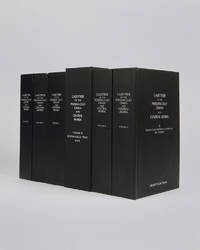
122010London Archive Editions 2003. . 6 vols 8vo 25.5 x 16.5 cm; includes maps & genealogical tables; publisher's original black cloth white lettering to upper board and spine a fine set.<br /> Lorimer's Gazetteer of the Persian Gulf was compiled by officials of the British Government in India during the decade after Lord Curzon's Vice-Regal tour of the Gulf in 1903. When first issued in 1915 it was classified as Secret and for Official Use Only and just a few dozen copies were printed for circulation to British Government departments and agencies.<br /><br />The work was planned in two parts; the first comprising a history of the Gulf region the second being a geographical dictionary but grew to encompass all aspects of Gulf life culture cities towns tribes and topography.<br /><br />Lorimer was an official of the India Civil Service who had spent most of his career on the North West Frontier. He was placed on 'special duty' to compile the Gulf handbook which was intended to be completed in six months but due to Lorimer's dedication and extensive field trips the work took some ten years to complete.<br /><br />The present edition printed from the India Office Records makes available one of the most important primary sources for the study of the Gulf region from the seventeenth to the early twentieth century.<br /> London, Archive Editions, 2003. hardcover
8vo. 2 parts in 1 vol. (4), 318 pp. (4), 441, (1) pp. Modern red half morocco with giltstamped spine title; original blue printed wrappers bound within. First edition in book form ("Extrait du Journal Asiatique, 9. sér., v. 3-7, 1894-96"). The French scholar Henri Sauvaire (1849-96), a leading photographer and numismatic collector, served as a Consul in Damascus and Casablanca. He spent the last years of his life writing on Arab culture. In 1864 he embarked on translating into French the "Description of Damascus" by Abd al-Basit al-Amawi, who lived in Damascus in the mid-16th century (d. 1573/4). - Rare and well-preserved. OCLC 23427282.
8vo. 55, (1) pp. With woodcut printer's device on title page (Christ sending the Apostles forth to spread the Gospel). Unbound as issued. Very scarce catalogue of oriental books printed by the Propaganda Fide press. Pages 10-12 list no fewer than 28 publications in Arabic, many of which (such as Scialac's and Sionita's 1613 version of the "Doctrica Christiana") are still considered milestones of Arabic typography. Prints in other languages such as Chaldaean, Persian, Syriac, and Ottoman Turkish bear further witness to the unrivalled excellence of the Propaganda Press in the field of Middle Eastern typography. A first such catalogue had appeared in 1765; of this second, expanded edition OCLC lists no more than two copies (Tübingen and Copenhagen). - Well-preserved throughout. OCLC 465974789. Not in Besterman.
Oblong 4to. 5 cloth-bound volumes with stamped titles, containing 253 original photographs mounted on cardboard with accompanying text. Extensive photo documentation of Polish Arabian horses, recording year of birth, ancestors, racing results, descendants, etc. - No copy in any library recorded in WorldCat or KVK. A fine, clean copy.
8vo. (8), 83, (1) pp. (8), 57, (1) pp. (8), 74 pp. (8), 52 pp. (4), 26 pp., final blank f. (4), 26 pp. 38 pp. (index). Publisher's printed green cloth. A manual of "geographical, economic, historical, social, religious and political" information compiled for the British delegates to the Peace Conference that took place in Versailles in 1919, here issued "for public use" for the first time. The extensive section on the Arabian coastal regions includes not only detailed statistics (giving the population of Abu Dhabi, Dubai, and Sharjah at 6,000, 20,000, and 15,000 inhabitants, respectively), but also, in a separate appendix, the full text of the treaties signed between the United Kingdom and the Sheikhs and rulers of the "Trucial Coast" in 1820 and 1853, including the names of all signatories: Sh. Hassan bin Rahmah for Ras al-Khaimah, Sh. Shakbout for Abu Dhabi, Sh. Zayed bin Syf for Dubai, Sh. Sultan bin Suggur for Sharjah, Sh. Rashid bin Hamid for Ajman, Sh. Abdullah bin Rashid for Umm al-Quwayn, etc. - Issued as vol. XIII of the "Peace Handbooks" by the Historical Section of the Foreign Office. Comprises in all: nos. 76 (Persian Gulf), 77 (French India), 78 (French Indo-China), 79 (Portuguese India), 80 (Portuguese Timor), and 81 (Macao). - Binding slightly stained. Withdrawn from the University Library of Manchester (their ownership, bookplate, and deaccession stamp to endpapers). - Rare. OCLC 28122772.
480 x 680 mm. Fine handwritten, calligraphic description of a perfect horse's anatomy, explaining its ideal proportions. Located in the centre is a printed horse study taken from Bourgelat's "Treatise on the choice and care of horses they require" ("Traité du choix des chevaux et des soins qu'ils exigent", 1769). - The founder of veterinary colleges at Lyon in 1761, Claude Bourgelat, was as an oft-consulted authority on horse management. - Small defects to edges; some dust-staining on reverse.
4to. 77 original photographs, comprising 48 colour and 29 black-and-white photos. Ca. 85 x 110 mm. With one Aramco press photograph. Captioned in English. Contemporary half calf with giltstamped spine in a full calf case with metal clasp. Private photo album of the petroleum engineer and Aramco employee Herschel Edmund Zirger (1926-2015). After joining Aramco in 1955, Zirger was involved in the construction of the ADMP-2 platform - a gigantic off-shore oil rig showcased here in impressive photographs which make up the bulk of the collection. Built in the fall of 1965 and spring of 1966 in Vicksburg, it was towed down the Mississippi river, across the Atlantic and through the Suez Canal, to arrive in Saudi Arabia in September 1966. The set includes spectacular images of the rig being launched into the river, passing under the Natchez-Vidalia Bridge, the largest bridge on the Mississippi, and travelling past New Orleans. A pioneering project, the ADMP-2 platform was constructed "to operate in 200-ft water depths compared to the 77-ft maximum of the earlier rig [ADMP-1]. The design of the No. 2 also anticipates Aramco moving out into deeper Gulf waters" (World Petroleum). - Another set of images displays the arduous transport of an oil rig derrick through the desert near Abqaiq. Zirger is seen posing in front of enormous trucks and following the convoi. Sadly, the endeavour ended in a severe accident: after weeks of hard work, the derrick was destroyed in a desert storm. - Finally, several images depict an oil platform in the Arabian Sea, including detailed views of a drill head. - Nearly every picture is captioned in white ink in Zirger's handwriting. Zirger's label of ownership to front cover. - In 1971 Zirger established a Saudi-Registered Limited Liability Partnership which provided consulting services and consultants to Aramco for the supervision, inspection and maintenance of oil wells, water wells and drilling operations. - Full calf case slightly rubbed. An extraordinary collection.
Colour printed map, 1015 x 710 mm. Rare map of oil concessions in the Middle East. With an inset map of the Southern Arabian Peninsula. - Rich in detail, the chart depicts the concessions of various oil companies active in the Arabian Peninsula, the largest by far being that held by Aramco since the 1933 royal concession. However, the map also shows smaller concessions, including those held by Sirip (Société Irano-Italienne des Pétroles), Kuwait Oil, and Japan Petroleum. In addition, it shows oil fields, oil and gas pipelines, pump stations, and refineries, as well as important towns and international borders. - Published as a supplement to the international outlook issue of World Oil. - Slightly duststained, otherwise very well preserved. OCLC 137384087.
Oblong folio (ca. 425 x 300 mm). Photo album with 31 original black-and-white photographs, including 4 loosely inserted photographs. 205 x 255 mm. Contemporary full calf decorated with Arabian-themed scenery to front cover. Cord-bound. Compelling images of the fleet of vehicles operated by Aramco in Saudi Arabia. Uncommon in its extent, the collection was presumably prepared by an Aramco employee and motor enthusiast. It features large trucks mainly manufactured by Blumhardt, Kenworth and Fruehauf, which served in the transportation and installment of oil drilling facilities, as well as some close-ups of enormous tires and cargo areas. Some pictures feature oil derricks, refineries, tanks, cars, and office buildings in the background. - Very well preserved. A rare glimpse of the immense engine power required to produce oil in the Saudi Arabian desert.
Folio (211 x 330 mm). 54 pp. Original blue printed wrappers. Sewn. Detailed official military reports from the war theatre in the Gulf region, issued by Generals W. S. Delamain, A. A. Barrett, and J. E. Nixon between February and August 1915 (covering operations as early as November 1914), in the early months of the British Empire's Mesopotamian campaign against the Ottoman Empire, while T. E. Lawrence was still posted to the military intelligence staff at the Arab Bureau in Cairo. - A few edge and corner flaws to the first few pages.
794 x 628 mm. Scale 1:4,000,000. Mounted on cloth. Folded. Rare, large-scale map of western Arabia including all but the easternmost part of the Peninsula (ending about 100 miles east of Qatar). "This map has been compiled almost entirely from published sources, of which the principal are (1) Hunter's Arabia 1:2,000,000; (2) War Office quarter inch of S.W. Arabia; (3) War Office 1:250,000 of the rest of the Turkish Empire; R.G.S. materials have also been used" (editor's note). Some slight brownstaining in places, otherwise well-preserved. Not in OCLC.
4to (180 x 220 mm). Persian manuscript on polished oriental paper. (16), 1 blank, (23), 1 blank, (13), 1 blank ff., 17-20 lines, per extensum, text enclosed by red and black rules. Black ink with red emphases. With numerous ink diagrams in the text. Contemporary blindstamped full calf, restored and spine rebacked. A mid-19th century Persian manuscript comprising three treatises on astronomical matters, illustrated throughout with diagrams in red and black ink and containing several tables. - Some worming throughout the text but not affecting legibility. Corners bumped. A loose slip of paper inserted at the beginning mentions three titles which do not appear to correspond to the works here contained.
Foolscap folio (ca. 205 x 330 mm). (30) and (31) ff. (rectos only) of duplicate typescript with occasional manuscript corrigenda and addenda. Split-pin fastener in the top left-hand corner of each month. Unpublished confidential daily field reports from the Sinai and Palestine campaign of the Middle Eastern theatre of World War I, fought by the Arab Revolt and the British Empire against the Ottoman Empire and its Imperial German allies. The reports include the critical period between the Battle of Beersheba in late October and the fall of Jerusalem at the end of 1917. - Usually comprising one leaf for each day of the month, the individual reports commence with an overview of the brigade's activities, followed by further details for each regiment. The account of 9 November, e.g., records the strategically highly important advance on Burayr, one of the first places to be captured by the Allied Forces from the Ottoman Empire, consolidating the British hold on positions controlling the approaches to Jaffa and Jerusalem: "A great day for the Brigade 5th and 7th Regts. moving parallel on left and right respectively and 6th in support were heavily shelled from right flank; but made Bureir and Huleikat without opposition from those places, but had number of casualties from this shell fire. Great quantities of stores waggons and material of all sorts taken 7th Regt took a convoy of about 150 waggons 350 prisoners and many animals most of latter in a wretched condition at Kaukabah. Very many abandoned waggons on the road and stores being looted by Arabs. In afternoon moved on again and 5th Regt supported by one Sqdn of 7th most dashingly rushed another convoy of over 100 wagons and took over 350 prisoners. This convoy subjected to heavy shell fire from enemy on friend and foe alike. Squadron of 7th attached to 5th cleverly took 231 more prisoners in the dark [...]". - The 2nd Light Horse Brigade, a mounted infantry brigade of the Australian Imperial Force consisting of the 5th, 6th and 7th Light Horse Regiments, formed a very distinctive national force within the Egyptian Expeditionary Force, the British and allied army that drove the Ottoman Turks and their German allies back across the Sinai desert in 1916, into Palestine in 1917, and went on to capture Damascus on the first day of October 1918, shortly before the armistice. - Lacks the sheet for the first day of each month; reports of 9 November and 14 December comprising two leaves. Both first leaves (2 November and 2 December) detached, with some marginal loss, as well as slight loss of text to 2 November. Occasional marginal chips and creases throughout, early leaves tanned. - From the Paul Lucas Collection of Australian military history. A unique survival.
5 original black and white photographs. 68 x 44 mm to 104 x 74 mm. On Velox photographic paper. Rare original photos of five aircraft on the runway. Includes one of the few surviving images of the G-ALYU de Havilland Comet - the plane that in May 1952 completed the world's first passenger jet service from London to Johannesburg. Less than two years later G-ALYU was scrapped and its fuselage used for metal fatigue research following the crash of another B.O.A.C. Comet in January 1954. All Comet 1 aircraft were grounded in April 1954. - Among the other depicted aircraft is a Handley Page Hermes IV, registered G-ALDM. The Hermes IV model entered service with B.O.A.C. in 1950, taking over from the Avro York on the West Africa service from London to Accra via Tripoli, Kano and Lagos, with services to Kenya and South Africa commencing before the end of the year. - Pencil annotations to versos. Somewhat warped; slightly toned. Some notable specimens of aviation photography.
Black and white photograph (gelatin silver print, 80 x 70 mm) mounted on brown cardboard (90 x 85 mm). Captioned in white ink. HH Sheikh Hamad ibn Isa Al Khalifa, KCIE, CSI (1872-1942) was the King (Hakim) of Bahrain from 1923 until his death. Throughout the 1920s and 1930s, his palace in Al-Sakhir was a centre where both Gulf Sheikhs and British nobility and political figureheads were regularly invited to dine and discuss foreign policy of the region. The photograph shows the monarch in a deck chair on a ship in the company of noble retainers. The caption reads "Sheikh Hamad. Ruler of group of Islands Persian Gulf". - A well-preserved, glossy print in good contrast.