4 134 résultats
in-8°, 159 pp, croquis et illustrations photographiques, broche, couverture illustree plastifiee. Bel exemplaire. [SP-1]
Folio. (24), 1162, (2) pp. With woodcut printer’s device on the final leaf by Urs Graf, 14 double-page maps as well as 37 double-page views and approximately 900 woodcuts in the text. Modern vellum. A very early edition of Münster’s monumental work. The Cosmographia by Sebastian Münster (1488-1552), a German cartographer and cosmographer, was one of the most successful and popular books of the 16th century. It passed through 24 editions in 100 years, and was most important in reviving geography in 16th-century Europe, being the most valued of all cosmographies. - In very good condition, with some very slight overall discoloration; map of the Americas shows unobtrusive rust mark. VD 16, M 6717. Burmeister 89. Hantzsch 77.32. BM-STC German 633. Adams M 1910. Sabin 51381. Borba de Moraes II, 90. BNHCat M 834. Brunet III, 1945. Graesse IV, 622.
2000503465ImagAenaria edizioni, Ischia Lacco Ameno 2000. 22 x 14 cm. Opuscolo originale con patta. 61 (2) Pagine con numerose illustrazioni, per lo più a tutta pagina, a colori e in bianco e nero che mostrano i costumi femminili di Ischia. Leggermente volpe sul retro. Buona copia. --- Originale Klappenbroschur. 61 (2) Seiten mit zahlreichen, zum großen Teil ganzseitigen Abbildungen in Farbe und schwarzweiss, die die weiblichen Trachten von Ischia zeigen. Am Rücken leicht stockfleckig. Gutes Exemplar.
1932GIT0116cParis Flammarion 1932. In-8 broché 283pp. Edition originale. 1 des 100exp hors commerce, sur papier de couleur non numérotés, réservés à l'auteur. Celui-ci avec un bel envoi signé de sa main.
Large folding map (64 x 86 cm), hand-coloured and mounted on linen. Scale 1:6,969,000. Alai, General maps E.323. Not in Al Ankary; Al-Qasimi.
2015500141964Hachette 2015 2015.
8vo. XVI, 668 pp. With a frontispiece printed in colours and gilt in the style of an Arabic title (lith. Bastide). Elegant oriental-style red morocco binding with fore-edge flap, covers blindstamped with gilt borders, spine gilt in western style. Marbled endpapers. Widely received introduction to Arabic by L. J. Bresnier (1814-69), a disciple of Silvestre de Sacy and the first professor of Arabic in Algiers. - Some insignificant foxing to margins, but a fine copy in a unique binding, from the library of the Algerian essayist and Muslim leader Mourad Kiouane, a participant in the World Muslim Conference held in Karachi in February 1951 (with his ownership stamps). Even many leaders among the Algerian Muslims of the 1950s, educated by the French colonial system, spoke good French but only Algerian Arabic rather than the standard variety, which hampered their ability to converse with the leaders of other Arab nations. Famously, Algeria's first president Ahmed Ben Bella broke out in tears when invited by Nasser to speak for the first time before an Egyptian audience, but finding himself unable to do so. Partly in response to this, and to promote pan-Arabism, Nasser sent droves of Arabic instructors to Algeria in the 1960s. OCLC 929616431.
24mo, 98 pages, not illustrated. eng
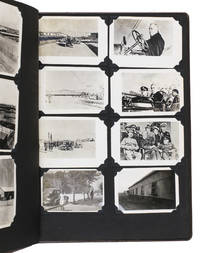
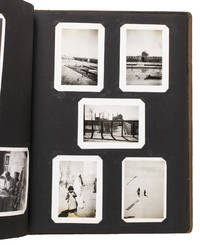
1943ABC_484281943. Contemporary embossed brown cloth with the title embossed in silver on the front board and the green shoulder sleeve insignia of the Persian Gulf Command embedded in the front board. Ca. 32.5 x 26 cm. With 150 gelatin silver photographs various sizes. Unusual military photo album with 150 photographs of the activities of the Persian Gulf Command PGC at the base in Andimeshk Iran. The PGC was a branch of the United States Army established to facilitate the supply of material from the U.S. Lend-Lease programme through the Persian Corridor. This material was sent to the Soviet Union to strengthen it so it could help defeat Nazi Germany. The photographs in this album which cannot be found anywhere else offer a visual documentation of this time. However they show the simple soldiers; the men tasked with driving trucks maintaining oil supply lines or working alongside Iranians at the two factories producing trucks for the war effort. The work therefore offers a fascinating insight into daily life of PCG members in Persia in the Second World War.This album was compiled by John Stefano dates unknown a technician fourth grade in the PGC. It includes photographs of the Tehran conference in 1943 the first World War II conference between the Soviet Union the United States and the United Kingdom where it was decided to open a second front against Germany. Other than this there are photographs of the barracks the men lived in the military vehicles they used the marches and excercises they partook in but also the surrounding landscape and the local people.Inserted in the album is a booklet with images and information about Persia with a letter by PCG commander Donald Prentice Booth 1902-1993 which was sent to PCG members after the war to congratulate them on a job well done. He hoped the booklet would serve as a memento. Together with the album it continues to do so until this day.With the shoulder sleeve insignia of the Persian Gulf command mounted on the inside of the frfont board some of the photographs are captioned on the back. The eyelets for the string on the front board have come loose. The corners of the leaves are slightly creased. Overall in very good condition. hardcover
1943ABC_484291943. Contemporary embossed brown cloth with the title embossed in silver on the front board the name of the owner painted in silver and the green shoulder sleeve insignia of the Persian Gulf Command embedded in the front board. Ca. 32.5 x 26 cm. With 76 gelatin silver photographs various sizes. Remarkable military photo album with 76 photographs of the activities of the Persian Gulf Command PGC at various locations in Iran. The PGC was a branch of the United States Army established in 1941 to assure the supply of U.S. Lend-Lease war material to the Soviet Union through the Persian Corridor. After the war members of the PCG received an empty album to fill with personal memories of their time in Iran. These albums are now relatively rare. The present one was compiled by Colonel S. Morgan Thomas dates unknown a PGC member who carried out inspections of the railroads. It includes various photographs of him at work.This album also contains photographs of PCG commander Donald Prentice Booth 1902-1993 a visit by Soviet soldiers and a young child military activity in Teheran locals and soldiers sending telegrams. Loosely inserted in the album are maps of Iran the lands surrounding Hamadan and the Trans Iranian Railroad which would have been important to carry for someone who inspected the railroads. The work offers a rare insight into life of a PGC member stationed in Iran.The corners of the boards are somewhat scuffed. One of the inserted maps is somewhat foxed and another has a tear that has been repaired with tape in the lower margin not affecting the image some leaves are missing one of the corner mounts the photographs are mounted on possibly missing a photograph on the verso of leaf 4. Otherwise in very good condition. hardcover
4to. (8), 206 pp. (wanting final blank). With woodcut printer's device on title. - (Bound after) II: Pirhing, Ehrenreich, SJ. Facilis, et succincta S.S. canonum doctrina [...]. Venice, Nicolo Pezzana, 1693. (12), 350, (14) pp. Title printed in red and black with two-coloured woodcut vignette. - (And) III: Moretto, Bernardo. Propugnacolo della cattolica, apostolica, e universale Santa Romana Chiesa alle false obiettioni de scismatici, & heretici contra la parola Romana nella dottrina Christiana [...]. Venice, Andrea Poletti, 1685. (14 [instead of 16?]), 112 pp. With engraved armorial vignette on title. Contemporary blindstamped leather over wooden boards with 2 clasps. All edges red. First Italian edition of the "Taqwim al-Tawarikh", an annalistic chronicle from the creation of Man to the year 1648, when it was composed by the famous Turkish polymath Katib Chelebi (1609-57). This is, at the same time, the first printing of any work of Katib Chelebi's in any language: the chronicle was not published in the original mixture of Persian and Ottoman Turkish until 1733, by Müteferrika. "[T]he work originated as an excerpt of [Chelebi's previous effort,] 'Fazlakat aqwal al-ahyar', but continued up to Chelebi's own time [...] Becoming highly popular as an easy reference work, it was continued after Chelebi's death by several authors, including Hüseyin Hezarfenn, Seyhi, and Ibrahim Müteferrika, who published it as the twelfth product of his press [...] Equally popular in Europe as a reference work, it was translated into Latin, Italian, and French. Today, the afterword is the main part of interest, as it contains a brief discussion of the regularities or laws of history, and an initial elaboration of his ideas of causation in history, which are later copies by Na'ima (d. 1128/1716) in his theoretical discussion" (Kafadar, Karateke, Fleischer: Historians of the Ottoman Emprire, s.v.). - Bound before this are two other rare Venetian works of the late 17th century, namely a single-volume reduction of the "Jus Canonicum" (1674) by the Bavarian Jesuit Pirhing (1606-79), and the second edition of an instructional dialogue between a Catholic and a heretic by the Venetian jeweller Moretto (first published in 1647). Some brownstaining and waterstaining; a few edge and corner flaws. Last leaves rather wrinkled, lacking lower flyleaf. I: Babinger, GOW, 197. BN XXIII, 990. Encyclopaedia of Islam² IV, 761. OCLC 563174142, 457543094. - II: De Backer/Sommervogel VI, 854.
582 pages. A lively anthology in which experts from around the world debate 24 issues that dominate the world arena today - from the New World Order to the Persian Gulf War, GATT to NAFTA, human rights to the environment. Moderate wear. Clean and unmarked. Binding intact. Nice working copy. Book
8vo. (38), 97-144, (8) pp. Title-page printed in red and black. With engraved frontispiece and folding letterpress table. - Bound after this is a 10-page German manuscript by a contemporary hand in red and black ink, entitled "Continuatio curiosorum experimentorum collocatio". Modern half vellum with marbled covers and spine title. Edges sprinkled in red. Later edition of this oft-reprinted but rare manual of geomancy, a divination system with Arabian origins. The term is derived from the ancient Greek "geômanteía", a translation of the Arabic "'ilm al-raml" - the "science of the sand", or the art of foretelling from dots or lines randomly marked upon the ground or on paper. The method, probably developed in the Near and Middle East, arrived in mediaeval Europe via North Africa. In the European context it was seen as an ancillary science to astrology and was attributed to Hermes Trismegistus. It was especially Robert Fludd's "Utriusque cosmi maioris scilicet et minoris metaphysica, physica atque technica historia" (1618) that made geomancy popular in the late Renaissance. "Pointing, or geomancy, was among the most popular of the divinatory entertainments of the 17th and 18th century" (cf. Daxelmüller, Zauberpraktiken, p. 200, with fig. 35). Purportedly translated from Arabic, this manual cites Cornelius Agrippa, Henry de Pisis, Trithemius, and Fludd as its authorities. - The manuscript bound at the end of the volume treats of "Onomantia", or the so-called science of divining a person's future from their names - a method explicitly said to work not only with Christian names given at baptism, but also with any name bestowed by a similar process upon a Jew or Muslim. - Slightly browned, but well preserved. 1744 handwritten and stamped ownership of the Lieutenant Christoph Carl König on title page, with his initials and date at the head of the instructions to the reader. Graesse (Bibl. Mag. et Pneum.) 105. Not in Ackermann, Caillet, Dorbon-Aine, Rosenthal, etc.
80 pages, illustrated. (Play better Golf) eng
80 pages, illustrated by Ken Lewis. (Play better Golf) eng
4to. 8 pp. With 2 woodcut vignettes. Sewn. First Portuguese edition. Exceedingly rare account of an attack on an Ottoman corn vessel by Spanish forces in the port of Tangier in Morocco. Essentially an encomium of Domingo Pignatelli and the 42 men who approached the Ottoman ship under heavy fire. Simultaneously published in Spanish in the Gaceta de Madrid. - Near-contemporary foliation in ink (77-80), suggesting the work was originally part of a larger volume. Slightly browned. BGUC Misc. 24, 488. Palau 66444. Not in OCLC.
8vo. (4), 74, (2) pp. With 27 (17 folding) engr. plates and folding engr. map. Contemp. vellum (wants ties). One of several descriptions of the Mediterranean published by Enderlin. Includes reports of Constantinople, Moscow, and Kiev as well as the islands of Cyprus, Crete, and the Crimean. The plates show views of Candia, Canea, Famagusta, Kaminiek and Constantinople, as well as plants and animals. - Index to illustrations cropped and mounted on reverse of title. Some browning and brownstaining. Formerly in the Ottoman collection of the Swiss industrialist Herry W. Schaefer. VD 17, 23:279658Z. Blackmer 1303. Cf. Atabey 402.
Large 12mo. 24 vols. With engraved portraits of Barros, Couto, Henry the Navigator, and Afonso de Albuquerque and 3 (instead of 5) folding maps. Uniformly bound in contemporary half calf over marbled boards, spines with giltstamped titles and volume numbers. Edges lightly sprinkled red. A fundamental travel work: the best and most complete edition of what is considered the most comprehensive publication on Portuguese exploration and colonial history by João de Barros (decades I-IV) and Diego de Couto; the first edition to include decades X and XI. Books 2 and 3 of the "Decada Segunda" offer a detailed narrative of Afonso de Albuquerque's expedition to the Arabian Gulf and his conquest of Ormuz in 1507; the island remained under Portuguese occupation from 1515 to 1622. As vassals of the Portuguese state, the Kingdom of Ormuz jointly participated in the 1521 invasion of Bahrain that ended Jabrid rule of the Arabian archipelago. - This is "the best edition of this famous work on Portuguese colonial history. The first edition appeared at Lisbon, Madrid and Paris from 1552 to 1645. It consists of 12 "Decadas" (decades), comprising the history of the years 1420-1600. Only Decadas I, II, III and a part of IV are by J. de Barros, the rest is by D. de Couto, who begins his part also with Decada IV, so that there are two Decadas IV" (Laures). De Barros (1496-1570), head agent for the Portuguese overseas trade authority "Casa da Índia", managed to persuade King João III to commission from him a history of the Portuguese in India (including Asia and southeast Africa). The result earned him renown as one of the first great Portuguese historians, and the the title of a "Portuguese Livy". The 'Decades' contain "the early history of the Portuguese in India and Asia and reveal careful study of Eastern historians and geographers, as well as of the records of his own country. They are distinguished by clearness of exposition and orderly arrangement. They are also lively accounts" (Enc. Britannica). Cordier, BJ, 34 and BS, 2309. Innocencio III, 322. Laures 642. Streit IV, 667 (with extensive list of contents) & VI, 630. This edition not in Borba de Moraes. For the maps cf. Gole, India, 8.
Large 12mo. 24 vols. With engraved portraits of Barros, Couto, Henry the Navigator, and Afonso de Albuquerque and 5 folding maps. Uniformly bound in contemporary full calf, spines with titles and number of volume on giltstamped red labels. Edges lightly sprinkled red. A fundamental travel work: the best and most complete edition of what is considered the most comprehensive publication on Portuguese exploration and colonial history by João de Barros (decades I-IV) and Diego de Couto; the first edition to include decades X and XI. Books 2 and 3 of the "Decada Segunda" offer a detailed narrative of Afonso de Albuquerque's expedition to the Arabian Gulf and his conquest of Ormuz in 1507; the island remained under Portuguese occupation from 1515 to 1622. As vassals of the Portuguese state, the Kingdom of Ormuz jointly participated in the 1521 invasion of Bahrain that ended Jabrid rule of the Arabian archipelago. - This is "the best edition of this famous work on Portuguese colonial history. The first edition appeared at Lisbon, Madrid and Paris from 1552 to 1645. It consists of 12 "Decadas" (decades), comprising the history of the years 1420-1600. Only Decadas I, II, III and a part of IV are by J. de Barros, the rest is by D. de Couto, who begins his part also with Decada IV, so that there are two Decadas IV" (Laures). De Barros (1496-1570), head agent for the Portuguese overseas trade authority "Casa da Índia", managed to persuade King João III to commission from him a history of the Portuguese in India (including Asia and southeast Africa). The result earned him renown as one of the first great Portuguese historians, and the the title of a "Portuguese Livy". The 'Decades' contain "the early history of the Portuguese in India and Asia and reveal careful study of Eastern historians and geographers, as well as of the records of his own country. They are distinguished by clearness of exposition and orderly arrangement. They are also lively accounts" (Enc. Britannica). - A crisp, uniform set with a contemporary ink note by L. Quesnel on the front pastedown of the index volumes and 19th century collector's blue monogram labels (JCQ?) to flyleaves. Cordier, BJ, 34 and BS, 2309. Innocencio III, 322. Laures 642. Streit IV, 667 (with extensive list of contents) & VI, 630. This edition not in Borba de Moraes. For the maps cf. Gole, India, 8.
Roma, 1955 marzo 27, copertina illustrata a colori in fascicolo originale completo di pp. 24 de "La Tribuna illustrata" .
4to (140 x 190 mm). Complete Arabic manuscript on strong Chinese paper. 165 ff. (337 numbered pages), leaf size ca. 132 x 182 mm, written space ca. 82 x 128 mm). 6 lines, per extensum (except 4 lines on pp. 3-4; 11 lines on pp. 11-34). Illustrations of the Kaaba in Mecca and the burial sites of the first three Rashidun Caliphs on pp. 47-48. Text written in "sini" calligraphy typical of Chinese Muslims, in an archaic form oscillating between naskh and muhaqqaq. Black ink, various sections highlighted in red, text within single or double red rules; sporadic notes or corrections on the margins. Contemporary black, red and gold painted and lacquered over paper and cloth. Painted boards show floral designs in black and gold on a red background, all within a black border with red wave designs. With remnants of leather on the brown cloth spine. Extremely rare specimen of the famous Sunni prayerbook "Dala'il al-khayrat": an Arabic manuscript written in what is today Xinjiang, China. - The "Dala'il al-khayrat" ("Waymarks of Benefits" or "Proofs of Good Deeds"), an extensive book of poems in praise of the Prophet Muhammad, was compiled by the Moroccan Sufi scholar Muhammad ibn Sulaiman al-Jazuli (807-870 H / 1405-1465 CE) and was quickly received throughout the Islamic world, functioning as a kind of Muslim catechism. Al-Jazuli's inspiration for the book is said to have come before he left Fez to spend forty years in Mecca, Medina and Jerusalem, but he completed it in Fez during the last years of his life. The present manuscript, written in so distant an Islamic community as that of Eastern Turkestan, a territory dominated throughout by Mongols or Chinese, where Muslims were commonly viewed as strangers, gives striking evidence of the range and scope of a tradition lasting for almost six centuries: the utopia of Islam as the Religion of Oneness, aiming to unite all the Muslim peoples in a single community reaching from Europe to the Far East. - The text begins with an introductory praise of Muhammad, followed by the 99 names of Allah (leaves 1-46) and a compilation of eulogies and prayers divided into seven subsequent chapters (each referred to as "juz", or "section"): 1, pp. 46-113; 2, pp. 113-136; 3, pp. 136-181; 4, pp. 181-217; 5, pp. 217-236; 6, pp. 236-256; 7: pp. 256-end. Interestingly, the double page 47/48 does not show Mecca and Medina, as is typical for manuscripts of this text, but rather presents naive illustrations of the "Ka’ba of Allah" (!) and the burial sites of the first three Caliphs. No date in colophon, written in the form of prayer. Leaves 12 to 19, extraneous to the text proper and containing additional prayers and the 99 Names of Allah, are inserted on contemporary Chinese paper. Edges worn; lower corner rounded and fingerstained from long use, but very well legible and altogether well preserved.
Bi-chrome printed map, 735 x 510 mm. Scale 1:10,000. Exceedingly rare first issue of the first map of Damascus published by the British Forces only a week after the Fall of Damascus. Drafted by the Royal Engineers from a "captured enemy map" and printed under the surveyors' supervision in the field, probably in Damascus, on a portable press carried by the Field Survey Company unit. - The ancient city of Damascus, one of the final prizes taken by the Entente Powers, was long a great cultural centre, the head of the Syrian Hajj Road, and more recently the northern terminus of the Hejaz Railway and the headquarters of the Ottoman-German forces in the Middle East. In the latter period of WWI, British forces met stiff resistance in Palestine, and it was only near the end of the conflict that they managed to break into Syria. British forces and their allies captured the Damascus on 1 October 1918. Lawrence of Arabia, who was part of the conquering force, was disappointed not to have been amongst the first Allied troops to enter the city, especially as he envisaged Damascus as the future capital of an independent and unified Arab state. - The British occupying force, commanded by Edmund Allenby, was suddenly in control of city of which they only possessed dated information. To ensure public order, to allocate military resources, and to deliver vital goods to civilians, the British command was in urgent need of an accurate, up-to-date map of Damascus. - All maps printed by Entente forces in the field in the Middle East during WWI are extreme rarities. The present map would have been issued in a only very small print run for the use of senior British officers, and printed on fragile paper in a large format, its survival rate would have been very low. We can trace only a single other example of the present first issue of the map, held by the British Library. The second issue, printed by the Survey of Egypt in 1919, is also extremely rare. - In very good condition, clean and bright, with just some minor creasing from having been rolled for many years. OCLC 557017180. British Library Cartographic Items Maps 48855.11.
8vo. XV, (1), 557, (1) pp. German & Arabic text. Contemporary marbled boards with giltstamped spine label; sprinkled edges. First edition of this compendium of Arabic versification. The German classicist and theologian Freytag (1788-1861) studied at Göttingen, but in his final year accepted an appointment as sub-librarian at Königsberg. In 1815 he became a chaplain in the Prussian Army and visited Paris in that capacity. Upon the proclamation of peace Freytag resigned his chaplaincy and returned to his research in Arabic, Persian, and Turkish, studying in Paris under Silvestre de Sacy. In 1819 he was appointed to the professorship of Oriental Languages at the new University of Bonn, and he held this post until his death. His principal work was the "Lexicon Arabico-Latinum" (Halle, 1830-1837), an abridgment of which was published in 1837. - Occasional browning; slight chipping to spine; early Swiss ownerships ("Dahler", "R. Tschudi", "Meier") to flyleaf. Stamp of "Stadt-Bibliothek Zürich" on upper cover; deaccessioned from the Zentralbibliothek Zürich (stamp on reverse of t. p.). Zenker I, 342. Fück 166. Gay 3361.
198647149ABDüsseldorf/Wien, Econ-Verlag, 1986. Völlig überarb. u. erg. Neuausg. 21 cm. 183 S. Pp., OU. Guter Zust., 1 Biblioth.-Stemp. a. Tit.-Bl.
1987915295Bad Homburg : Limpert, 1987. 227 S. : Ill., gebundene Ausgabe mit Umschl.