Lepsius, [Karl] R[ichard].MareMagnum

4 134 résultats
Large 4to. (4), 64 pp., partly printed in red and black. Modern brown half cloth. First edition. - Rare work by the Egyptologist and linguist Carl R. Lepsius (1810-84), leader of the 1842/45 Prussian expedition to Egypt. In this treatise, he presented what must be regarded as one of the earliest attempts at a standardised phonetic alphabet for all languages - a function today fulfilled by the International Phonetic Alphabet (IPA), which is still based primarily on the Latin alphabet. Among the many alphabetical systems which Lepsius takes into account are also Egyptian hieroglyphs as well as Hebrew, Arabic, Farsi, Sanscrit, Bengali, Armenian, Malay, Chinese, etc. - Somewhat browned and brownstained throughout with a noticeable waterstain. Some edge flaws. Title page shows library stamp of the Gymnasium of Venray, Netherlands. Kayser XIV, 24.
4to. (4), 92 pp. Printed on thick paper with 2 text illustrations and 1 plate (counted as III). Contemporary brown half cloth over marbled covers with old paper label pasted on the spine. First edition of this important study of Arabic papyrology, exceedingly rare. With quotations and interspersions in Arabic. The orientalist Joseph Maria von Karabacek (1845-1918) was professor at the University of Vienna and director of the Imperial Court Library. This is the first and only independent, monographic edition in German, an offprint (with separate pagination) from vols. II and III of the "Mittheilungen aus der Sammlung der Papyrus Erzherzog Rainer" (1887). The book was translated into English in 1991 (republished in 2001); it remains a classic textbook referenced by specialized literature such as Adam Gacek's handbook on Arabic manuscripts (Leiden: Brill, 2009). - In very good condition: title-page showing light foxing; contemporary library stamp of the Brünn German Technical University on the cover, their bookplate on the pastedown. Binding slightly rubbed; extremeties bumped. A wide-margined copy. OCLC 17791658. Cf. Gacek, Arabic Manuscripts, pp. 191f., 306 (citing the serialized edition and the English translation).
04391Stranberg, Kless-Böker, oJ. PP, OU, 249S, gutes Exemplar,
Engraving, 252 x 308 mm. Matted. Hormuz Island, near Qeshm Island in the Arabian Gulf. Cf. Al-Quasimi 175.
19878226Zürich: Diogenes Verlag AG, 1987. Diogenes Taschenbuch 21520 267 Seiten , 19 cm, kart.,
198905965Münster, Coppenrath, 1989. Ln, tadelloses Exemplar
045376München., Keyserssche Verlagsbuchhandlung. Übersetzt und bearbeitet von C. A. Freiherr von Thüna. 283 Seiten mit Zeichnungen im Text. Ohne Jahr (ca. 1960). Guter Zustand. Gr.-8°. OLeinen.
199408200Erlangen, Müller, 1994. PP, 527S, einige Anstreichungen mit Textmarker, gutes Exemplar
4to. IX, (1), 356 pp. With steel-engraved title-page, 79 engraved plates (of which 24 are coloured steel-engravings, 54 tinted woodcuts, and one a tinted lithograph), and one steel-engraved folding map of Palestine in original hand colour. Contemporary giltstamped and blindstamped full cloth with title to cover and spine. All edges gilt. First edition. - Lavishly illustrated work on the Holy Land by the professor of archaeology and later conservator at the Bavarian National Museum, Messmer (1829-79), featuring the same illustrations as Friedrich Adolph Strauss in his 1861 work "Die Länder und Stätten der heiligen Schrift". However, Messmer's work greatly differs in the text, which is "preferable [to that of Strauss] as it discusses the element of architecture much more thoroughly" (cf. Tobler). It is sometimes inaccurately described as an extract or abbridgement of another publication by Strauss, entitled "Sinai und Golgatha", first published in 1847. The steel-engraved illustrations include views of Jaffa, Jerusalem, Bethlehem, Nazareth, and Damascus, the interior and exterior of the Church of the Holy Sepulchre, views of Mount Olivet, the Temple Mount, the Jericho desert, and Mount Sinai, as well as archaeological sites like Abu Simbel, and a violent scene showing the assassination of a Maronite priest and the kidnapping of women by Druzes and Bedouins. The woodcut plates include views of Beirut, Gaza, Hebron, Jericho and Sidon. - Hinges somewhat chafed. Several pages show traces of one or two horizontal folds starting from right margin (most prominent in pp. 151-175); occasional light brownstaining; small flaw to lower corner of p. 221f., no loss to text. Otherwise very well preserved. Tobler 171f. (note). Röhricht 2093 (note). OCLC 174874595.
24 vintage photographs (albumen prints) by Ch. Schmid, Reutlingen, mounted on cardboard with printed captions (c. 487 x 320 mm; images c. 270 x 210 mm to 190 x 137 mm). With 4 pp of letterpress text (folio, green papered spine). In custom-made green half morocco solander. Fine set of original photographs showing the Royal Wuerttemberg Stud in Marbach and its famous horses. Owned by Wilhelm, King of Württemberg, Marbach was the first Arabian stud in Europe. From 1852 to 1871 it was directed by Baron Julius von Hügel, who purchased valuable stock from the Egyptian stud of Abbas Pasha, "thus raising it to the highest standard of excellence" (W. R. Brown, The Horse of the Desert, p. 161/166). Hügel was succeeded by Cäsar Paul von Hofacker (1831-96), who issued the present photo series and also composed the accompanying text: the latter discusses the history of the Stud and its horses, including the stallion Sanspareil, son of the Arabian Bajan and bred in 1816; in 1860 another pure-bred Arabian was acquired from the Wuerttemberg Weil Stud. Among the photoportraits are the pure-bred Arabian Zarif, his daughter Zinka, and the stallion Shah. Well-preserved.
198548771Duesseldorf, Econ Verlag, 1985.
8vo (150 x 230 mm). (2), XVIII, 257, (3) pp. Contemporary green full calf, spine prettily gilt with title and ornaments, cover with gilt rules and border decoration enclosing a blind-tooled Rocaille centrepiece. Leading edges gilt, gilt inner dentelle, all edges gilt. Red silk divider. First edition of this important study of the plague in Egypt and the quarantine laws to prevent its spread; the "principal work" (Hirsch) of the German physician J. F. Reinhold Grohmann (1784-1867). Educated in Leipzig and Vienna, Grohmann was travelling to Constantinople when the Russo-Turkish War of 1806 stopped short his journey in Bucharest. He remained there and witnessed a particularly severe plague epidemic in 1813. He spent much of his subsequent career in the East before settling in Vienna; from 1831 to 1833 he was a member of a committee convened to formulate new standards for plague epidemics. In his medical work he described the plague as a nervous fever affecting the brain, little influenced by the climate. His son Paul Grohmann would go on to be one of Austria's most famous mountaineers of his age. - Very well preserved in a splendid Austrian master binding. Removed from a baronial library with a crowned monogram stamp "MK" to title-page. Ibrahim-Hilmy I, 278. Hirsch II, 661. OCLC 14832432. Not in Wellcome.
Large folio (450 x 330 mm). 114 ff., illustrated throughout with original photographs, with tissue guards. Original padded cloth with inlaid cast metal coverpiece. Stunning album commemorating the National Socialist exhibition on the history of the horse as represented in art from the stone age to the 20th century, held in Munich's Residenz from July 22 until November 15, 1936. Only 300 copies were produced (this copy is numbered 220). Perfectly preserved. Cf. OCLC 162880518 (4to).
Small folio (212 x 277 mm). 44 pp. Contemporary blue half cloth over marbled boards. Scholarly German translation of the lapidary of Zakariya al-Qazwini (1203-83), being the mineralogical section from the author's famous "Aja'ib al-makhluqat", which was hailed by Brockelmann as "the most valuable cosmography in Islamic culture" (GAL S I, 882). - The Heidelberg-based science educator Julius Ruska (1867-1949) studied ancient oriental languages to focus on the Islamic history of mathematics and science and later became professor at Heidelberg and Berlin. His sons Ernst and Helmut Ruska pioneered the electron microscope, for which invention the former received the Nobel Prize in Physics. - Well preserved. GAL I, 481, no, 12. OCLC 28083936. Not in Sinkankas.
199463594Hamburg : Christians 1994. 128 S. : m. Fotos, Beil.: 1 Faltbl. ; 28 cm + Beil. (1 Bl.) Top Zustand, kart., Softcover/Paperback, Exemplar in gutem Erhaltungszustand
4to (185 x 262 mm). Persian manuscript on polished, unsophisticated wove paper. (12), 282, (6) leaves. 18 lines of black and occasional red Nast'aliq within double red rules. Numerous marginal glosses in black ink. Contemporary full leather binding with blind-stamped oriental decorations to both covers. A comprehensive Persian-language manual of therapeutics, discussing the diseases of the various organs. The physician Sultan Ali practiced medicine for 40 years in his native Khorasan as well as in Transoxiana (Central Asia). He began writing his medical treatise "Dastur al-‘ilaj" in the year 933 AH (1526 CE) at the request of Abu al-Muzaffar Mahmud-Shah Sultan, whom he had successfully treated in Samarqand. - "The treatise consists of two sections (maqalahs), the first divided into 25 chapters (babs) concerning diseases specific to particular parts of the body. The second section, in 8 babs, is on diseases affecting the entire body and not specific to a particular part. After completing the treatise, Khurasani subsequently added an introductory essay (muqaddimah) composed of 16 chapters (babs) concerned with the preservation of health and hygiene. The introductory essay has a dedication to Abu al-Ghazi Sultan Abu Sa'id Bahadur Khan who ruled Samarqand from 1530 to 1533" (National Library of Medicine, online). - Leaves 253-254 bound in reverse order and upside-down after fol. 247; fol. 248 bound upside down after fol. 252, but complete. Some waterstaining to lower corner, entirely confined to margins. A few old stamps, some obliterated with correction fluid or felt-tip pen. The colophon is dated the 2nd of Shawwal 1217 AH, stating the copyist as Mirza Abdullah Tablah (reading of the last name uncertain).
4to. (8), 474, (8) pp. Title page printed in red and black. Contemporary vellum with ms. title to spine. Edges sprinkled in red. Second edition of Savary's Arabic Psalter; more precisely, a re-issue of the 1614 original edition, with only the title changed and the remaining pages re-used from the first. Prepared by two Maronite scholars, Nasrallah Salaq al-'Aquri, better known as Victorius Scialac Accurensis, and Gabriel Sionita. "Scialac was one of the first Oriental Christian scholars who by his publications furthered the causes of both European Orientalism and Oriental Christianity. He taught Arabic and Syriac in the Roman University from 1610 to 1631" (Smitskamp, p. 161). The publication is famous for the clarity and elegance of its typeface created by Savary de Brèves: the extensive vocalisation helped this handy quarto volume achieve immense popularity among oriental scholars throughout Europe. Formerly it was assumed that the type design was based on specimens Savary had seen during his time as French envoy at Constantinople; today his probable model is believed to be a calligraphical manuscript from Qannubin, preserved in the Bibliotheca Vaticana. The cutting and founding of the types were done in Rome, in collaboration with Stefano Paolini, an experienced printer formerly of the Typographia Medicea. The Psalms' text is based on a manuscript Savary de Brèves had bought in Jerusalem (cf. Balagna, L’imprimerie arabe en occident, p. 55f.); as it occasionally departs from the Vulgate (as does the translation by the Maronites Sionita and Scialac), an extensive imprimatur was necessary. - The Arabic-Latin Psalter (1614/19) and Bellarmin's Arabic catechism (1613) would remain the only works to leave the Typographia Savariana in Rome; the types have survived and are now in the archives of the Imprimerie Nationale in Paris. - Occasional paper flaws professionally restored; insignificant brownstaining in places. A good copy. Darlow/Moule 1643. Schnurrer 324 (note) & p. 505. Ebert 18088 (note). Brunet IV, 921 (note). STC 108. Cf. Smitskamp 33. Fück 56.
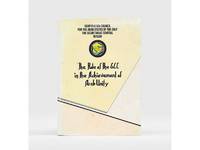
1985177401Bahrain: Printed by the Arab Printing and Publishing Establishment 1985. Second edition of this booklet produced to showcase the Arab Thought Forum held in Riyadh in April 1985. The first part comprises "Arab Unity: A General Outlook" a speech delivered by Prince Saud al-Faisal Foreign Minister of the Kingdom of Saudi Arabia. It is concerned with the difference between the "failed" concepts of Arab unity and Arab nationalism and their relationship with Islamic doctrines. The second part is devoted to a research paper by the GCC Secretary General concerning the role of the GCC in the achievement of Arab unity. It analyzes regional changes in the decade 1971-1981 and the "Arab degeneration and decline and the downfall of the unity of Arab security" before the establishment of the GCC. Octavo 240 x 165 mm. Text in English and Arabic. Original yellow printed wrappers wire-stitched as issued. Extremities and covers a bit rubbed sunned and foxed first recto and last verso toned: a very good copy. unknown
8 vols. 1mo and folio. With 7 (of 8) engraved frontispieces (lacking that of volume 4), 4 engraved dedications, 117 engraved maps on 61 leaves, 7 engraved plates and 502 engravings in text. Further with 127 (of 128) title-pages (including a general title-page, a title-page to 7 (of 8) volumes, lacking that of volume 4, and 118 for the separate works). Volume 1-3 & 5-8: contemporary mottled calf, gold-tooled spine and board edges; volume 4: modern calf. Large paper copy of the so-called "folio-edition" (although here mostly printed as 1mo) of Van der Aa's voluminous collection of important voyages to the East and West Indies and other countries, undertaken by all European countries, other than the Dutch. Including voyages by Acosta, Balbi, Cabot, Cavendish, Chester, Columbus, Cortes, Coutinho, Da Cunha, Drake, Evesko, Frobisher, Gallonye, Da Gama, Garay, Garcia, Gilbert, Jenkinson, Harcourt, Herberer, Magallanes, Mildenhal and Cartwright, Mouette, Petelin and Andrasko, Raleigh, Saris, De Soto, etc. - The work is falsely attributed on the title-page to Johan Lodewijk Gottfried, by Van der Aa, most likely because he made good money publishing Gottfried's "Chronicle" in 1702. In reality Gottfried had nothing to do with the present work. The work was edited and co-published by Pieter van der Aa, known for his ambitious projects. Where other publishers were primarily concerned about the profits, Van der Aa wanted to publish outstanding books. For the present series of travels he either reused and revised older Dutch translations or had the original accounts translated for the first time into Dutch. In 1706 he already started publishing the translated voyages both in small (8vo) and large instalments (folio or 1mo), and a year later he published a 28-volume set of the 8vo editions. The folio editions were afterwards issued and divided in four large collections of two volumes each. The present issue, is a reissue of these four collections with their own independent title-pages and frontispieces, and ads a new general title-page and list of subscribers. - While all sets seem to be described as "folio" the present set is printed mainly as 1mo, with some occasional quires in folio. And as the large editions of the two volume sets were available on normal paper (80 guilders) and on large paper (100 guilders; Hoftijzer, p. 43), it seems very likely the present set is one printed on large paper. All leaves are unwatermarked and the 1mo leaves are only slightly trimmed (measuring 396 x 238 mm with the tranchefiles often still visible) the folio leaves are trimmed more and don't have visible tranchefiles. The fourth volume is from a different set which is trimmed down much more, but also combines both 1mo and folio leaves. - Some occasional spots, a couple minor restorations and a few wormholes; a very good set, but with the fourth volume from a different and heavily trimmed set (though printed on the same large paper), in a modern binding and lacking the frontispiece and the title-page to the volume. The seven volumes with contemporary bindings slightly worn along the extremities and with some minor wear on the sides, but otherwise very good. Cordier (Sinica) 1942f. Muller, America 1889. Sabin 3 (note). Tiele, Bibl. 10. For Van der Aa: P.G. Hoftijzer, Pieter van der Aa (1659-1733), Leids drukker en boekverkoper (1999).
Small 4to (150 x 195 mm). Part 1 (of 2). (4), 168 pp. With a large woodcut illustration on title-page, hand-coloured by an early hand, and woodcut printer's device on the last leaf verso. 17th century sheepskin vellum over thin boards. Extremely rare edition of this collection of nine alchemical tracts, including "De tinctura metallorum" (On the Colorations of Metals), attributed to the great Arab scientist Ibn Sina, who is known in the Latin tradition as Avicenna. Ibn Sina was one of the most significant thinkers and writers of the Islamic golden age, and his bibliography comprises nearly 270 titles, several of which fall into the category of the arcane sciences (cf. GAL I 458 V and GAL I S, p. 828). "Ibn Sina studied the philosophical and scientific foundations of this subject [alchemy] and even undertook alchemical experiments" (DSB). - The collection further includes two works attributed to Raymond Lull, one of the most interesting scholars of the Middle Ages, another published under the name of Aristotle, and five anonymous ones. A second part was published in the same year, containing only one work: the famous Rosarium philosophorum. It can be regarded as a separate publication and is not included here. Curiously, a late 16th century manuscript copy of only this volume (a folio of 70 leaves) is held by the Wellcome Collection (MS.233, acquired in 1906). - Binding very well preserved. Contemporary handwritten marginal annotations and underscoring throughout, an early owner's inscription (struck through) and some further notes on the title-page. Annotations slightly trimmed by the 17th century binder's knife, somewhat browned throughout and dampstains in the first half of the book, otherwise in fine condition. VD 16, A 1632. BM-STC German 17. Adams A 574. Duveen, p. 11 ("excessively rare"). Ferguson, Bib. chem. I, p. 18. MacPhail I, 20. Schmieder, Geschichte der Alchemie (1832), p. 98, no. 3. For Ibn Sina see DSB XV, pp. 494-500.
4to. (2), 56, (2) pp. With engr. printer's device on t. p. Marbled wrappers. University oration on the Arabic language, its age, beauty, and usefulness, held by the noted Arabic scholar Thomas Hunt (1696-1774). Hunt studied at Christ Church, Oxford, and was chaplain to Thomas Parker, 1st Earl of Macclesfield. In 1738, he became the fourth Laudian Professor of Arabic, additionally becoming Lord Almoner's Professor of Arabic in 1740 (the year in which he was elected a Fellow of the Royal Society) and Regius Professor of Hebrew in 1747. - Many type specimens in Arabic, as well as some in Greek, Hebrew, and Syriac. Traces of old binding stitches; slight tear in final errata leaf restored with Japanese paper. Schnurrer 12. OCLC 27855095.
4to. (2), 56, (2) pp. With engr. printer's device on t. p. Disbound. University oration on the Arabic language, its age, beauty, and usefulness, held by the noted Arabic scholar Thomas Hunt (1696-1774). Hunt studied at Christ Church, Oxford, and was chaplain to Thomas Parker, 1st Earl of Macclesfield. In 1738, he became the fourth Laudian Professor of Arabic, additionally becoming Lord Almoner's Professor of Arabic in 1740 (the year in which he was elected a Fellow of the Royal Society) and Regius Professor of Hebrew in 1747. - Many type specimens in Arabic, as well as some in Greek, Hebrew, and Syriac. Trimmed rather closely. Some foxing near beginning and end; t. p. shows punched library ownership ("Philadelphia Divinity School") and shelfmarks. Schnurrer 12. OCLC 27855095.
Small folio (184 x 250 mm). (8), 330, (28) pp. Architectural title page engraved (Cl. Mellan sculps.). With woodcut printer's device on final page and several initials, head- and tailpieces. Contemporary full red morocco, lavishly gilt, with the arms of the Barberini family on an inlaid shield of different-coloured leather on both covers. All edges gilt. First edition, dedication copy. - One of the fundamental sources for the Ottoman conquest of Cyprus in 1571, when the Turkish forces invaded the island with 400 ships and some 100,000 men, massacring Nicosia's 20,000 inhabitants. Thus wrested from the Venetians, Cyprus would remain under Ottoman rule until 1878, when it was ceded to Britain as a protectorate; Ottoman sovereignty continued until the outbreak of World War I. - A. M. Graziani (1537-1611) studied the law at Padua before becoming secretary to Pope Sixtus and, in 1592, bishop of Amelia (in Umbria). Pope Clement VIII sent him as his nuncio to the Italian princes and states to unite them in a league against the Ottomans. Graziani having died in 1611, his account was published only posthumously: it was edited by his son Carolo, who dedicated the book to Cardinal Francesco Barberini, nephew of Pope Urban VIII. Barberini was created a cardinal in 1623; in 1627 he became librarian of the Vatican, and in 1632 vice-chancellor. The engraved architectural title (by Claudio Mellan after Antonio Pomeranci) shows History, "magistra vitae", seated atop an elaborate Baroque structure which incorporates Barberini's arms. This is the dedication copy bound for Cardinal Barberini himself: both covers show the crowned bee arms of the Barberini family on dark green leather, enclosed within borders of blind rules and double fillets with corner fleurons and two different bee cornerpieces, all set within a wide floral border and double gilt fillets. Even the spine is richly decorated with bee tools running up and down between a floral railing. - Corners insignificantly bumped, joints barely starting at foot. Some browning and slight waterstaining throughout, also visible on covers, but endpapers replaced with old paper. Later armorial bookplate of the collector John Stafford Reid Byers (1903-84), of Waterfoot House, Newcastle, County Down, to pastedown. Blackmer 726. Cobham/Jeffery, p. 24. Bruni/Evans, Italian 17th-c. books in Cambridge libraries STC 2547. NUC 211:420. BMC 91:156. Maggs, Cat. 697 (1940-1), no. 114 (this copy). Not in Atabey or Aboussouan. Not in Brunet, Ebert, or Graesse.
8vo. 16 pp. Uncut and untrimmed in contemporary wrappers. Only edition. This rare treatise in the form of a letter addressed to the Arabist and bibliographer Schnurrer discusses the famed sixteenth-century Venetian edition of the Qur'an in Arabic. De Rossi, the distinguished orientalist and librarian of Parma, here proves that Paganini ceased printing in 1518, at which time he was succeeded in his business by his son Alessandro. Rossi therefore places the printing of the Qur'an at 1518 or earlier, although others have proposed it could have been printed as early as 1509, which would have made Paganini's Qur'an the first book printed in Arabic. In fact, Paganino and Alessandro Paganini produced what was the first printed edition of the Qur'an in Arabic, probably intended for export to the Ottoman Empire, between 1537 and 1538. While there existed numerous contemporary reports of its existence, all physical evidence of it disappeared for centuries, and rumor had it that the Pope had the complete print run burned. The book was long even considered a bibliographical "ghost" until a single copy was rediscovered in the library of the Franciscan Friars of San Michele in Isola, Venice, by Angela Nuovo in 1987 (cf. A. Nuovo, "Il Corano arabo ritrovato", in: Bibliofilia LXXX.9 [1987], pp. 237-272, and the English translation in The Library, 6th series, 12.4 [1990], pp. 273-292). - Uncut and untrimmed as issued; a wide-margined copy of this fine Bodoni imprint in perfect condition. Brooks 1415e. Schnurrer, p. 403. OCLC 18368416.
8vo. 2 vols. in one. (38), 373, (51) pp. (6), 338, (36) pp. With engr. t. p. (wants the table). Contemp. auburn morocco, richly gilt. All edges gilt. Third edition, the second edited by Andreas Beyer (first published in London in 1617). Selden (1584-1654) "first won fame in Europe as an orientalist by his treatise 'De Diis Syris', the first of his oriental studies [...] use was also made of it by Vossius in his great treatise on idiolatry" (DNB). - Elaborately bound gilt binding; insignificantly rubbed with minute restoration to upper spine-end. VD 17, 23:320175K. DNB 1161. Graesse VI/1, 343. Cf. STC S 1861.