Abraham LincolnBiblio.com
11 347 résultats
6943056Stanford University Press pp. 376 . Papeback. New. Stanford University Press unknown
0366558250.Ghardcover. Good. Access codes and supplements are not guaranteed with used items. May be an ex-library book. hardcover
0259196711.Gpaperback. Good. Access codes and supplements are not guaranteed with used items. May be an ex-library book. paperback
0366053671.Gpaperback. Good. Access codes and supplements are not guaranteed with used items. May be an ex-library book. paperback
0484891359.Ghardcover. Good. Access codes and supplements are not guaranteed with used items. May be an ex-library book. hardcover
048384599X.Ghardcover. Good. Access codes and supplements are not guaranteed with used items. May be an ex-library book. hardcover
0483708828.Ghardcover. Good. Access codes and supplements are not guaranteed with used items. May be an ex-library book. hardcover
1330503112.Gpaperback. Good. Access codes and supplements are not guaranteed with used items. May be an ex-library book. paperback
1333023847.Gpaperback. Good. Access codes and supplements are not guaranteed with used items. May be an ex-library book. paperback
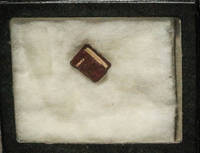
192939671Kingsport TN: Training Div. Kingsport Pr. Very Good with no dust jacket. 1929. Hardcover. 15mm x 20mm; 139 pp colophon pages; Bound in full red limp morocco leather. Aeg Spielmann 103. This tiny wonder smaller than most fingertips has a place in any Lincolniana collection. An unusually complex endeavor in printing. This book has been professionally restored and conserved by David Donahue of Philadelphia. This consisted primarily of reattaching covers. Book comes in small glass fronted case. . Training Div. , Kingsport Pr. hardcover
0332178471.Ghardcover. Good. Access codes and supplements are not guaranteed with used items. May be an ex-library book. hardcover
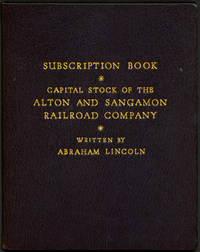
185127561<p>A list of stockholders entirely in Lincoln's hand filed as evidence in his first significant railroad case. Lincoln's own appearance in the shareholder list represents only the second known instance of a stock purchase by the future president. The Illinois Supreme Court's ultimate ruling in favor of Lincoln and the railroad set an important legal precedent upholding the binding nature of a stockholder's contractual and financial obligations. "The decision subsequently cited in twenty-five other cases throughout the United States helped establish the principle that corporation charters could be altered in the public interest and it established Lincoln as one of the most prominent and successful Illinois practitioners of railroad law" Donald p.155.</p><p><strong>ABRAHAM LINCOLN.</strong> Autograph Manuscript Signed by Lincoln in text constituting his official transcript of the "<em>Subscription Book of the Capital Stock of the Alton and Sangamon Rail Road Company</em>" incorporated February 27 1847 transcribed in early 1851. Comprising a cover sheet titled in Lincoln's hand the joint stock subscription statement and list of 91 shareholders with the number of shares subscribed and leaf with Lincoln's legal docket: "<em>Alton and Sangamon Railroad Company vs. James A. Barret. Copy of contents of subscription book</em>." 8 pp. 6 x 8¼ x ¼ in. With Lincoln's original stock certificate for the six shares noted in his manuscript. One of only two instances of his owning a stock and the only certificate of his known to survive.</p><p><strong>Historical Background</strong></p><p>The Alton and Sangamon Rail Road Company was chartered in 1847 to construct a line from Alton via New Berlin to Springfield. In 1850 however the Illinois General Assembly approved a more direct route bypassing the landholdings of some investors. Claiming breach of contract James A. Barret refused to make further installment payments for his 30 shares of stock as did several others who no longer stood to benefit from the new line. In 1851 Lincoln was hired to compel the defaulting shareholders to pay the balance of their promised investment.</p><p>The tactical details are spelled out in a February 19 1851 letter from Lincoln to William Martin a commissioner for the sale of the company's stock. Four suits were to be brought against stockholders who had subscribed to the initial offering but had then failed to make the additional installment payments. In preparation Lincoln listed the essential documents he would need in order to win a judgment. "We must prove" he advised Martin "that the defendant is a Stockholder" "that the calls have been made" and "that due notice of the calls has been given." To show that the defendants were in fact stockholders Lincoln explained he needed to produce "the subscription book with the defendant's name and proof of the genuineness of the signature together with any competent parole or evidence that he made the advance payment" Basler 2:99.</p><p>Lincoln's meticulous transcript of the subscription book was a key piece of the evidence filed in Sangamon Circuit Court on February 22 1851. The book includes Barret's name and the subscription statement transcribed by Lincoln on page two is explicit about the shareholders' obligations.</p><p><em>We the subscribers to the Capital Stock of the Alton and Sangamon Rail Road Company.do hereby agree.to pay the balance of the installments due on said stock by us subscribed when the same may be called for by the board of Directors of said Company when duly organized in conformity with the Charter approved February 27th 1847.</em></p><p>"<em>A. Lincoln</em>" with six shares for $600 is prominent among the 91 subscriber names. The only other known record of a Lincoln stock purchase dates from 1836 when he bought one share in the Beardstown and Sangamon Canal.</p><p>In June of 1847 as head of a committee to promote subscriptions for the projected railroad Lincoln wrote an open letter to the "People of Sangamon County" appealing for their support. Railroad construction was booming and Lincoln anticipated that a line between Springfield and Alton would prove a lucrative investment for himself and his state. "The whole is a matter of pecuniary interest" he argued. "The proper question for us is whether with reference to the present and the future and to direct and indirect results it is our interest to subscribe. If it can be shown that it is we hope few will refuse" Basler 1:396-398.</p><p>The list of subscribers is itself of considerable interest. It includes John Hay 1775-1865 the grandfather of Lincoln's later secretary John Hay 2 shares Ninian W. Edwards 1809-1889 husband of Mary Todd Lincoln's sister 20 shares John T. Stuart 1807-1885 Lincoln's law partner 5 shares Henry Yates 1786-1865 father of Illinois governor Richard Yates 10 shares Noah W. Matheny 1815-1877 clerk of Sangamon County and others. In the subscription book Henry Yates hedging his bets has added a condition beneath his name: "<em>if the Road intersects the M. & S R R at New Berlin.</em>"</p><p>Lincoln was mindful of the critical issues raised by the Alton and Sangamon lawsuits and "took extraordinary pains to construct an airtight case for his client" Donald p.155. To Martin he pointed out the legal issues adding "I have labored hard to find the law" in preparation for the trials. In the end two of the defaulting stockholders paid their delinquent calls. The suits against James A. Barret and Joseph Klein came to trial in the Sangamon Circuit Court in August of 1851 with Lincoln handling both the trials and the appeals for the railroad.</p><p>Lincoln's preparation proved its worth the rulings were in favor of the railroad. "Illinois Supreme Court Justice Samuel H. Treat ruled that public utility superseded private profit. If Barret had won the case other stockholders would balk at fulfilling their obligations. The rule of caveat emptor protected corporate management from stockholder's personal interests and encouraged subsequent investment" <em>Lincoln Legal Briefs</em> Oct-Dec 1990 no. 16 online.</p><p>At the time he transcribed this document Lincoln was an attorney on the 8th Judicial Circuit and also managed a thriving appellate and federal court practice. He handled a number of railroad-related cases representing both private individuals as well as the railroads themselves. He was not as some have argued a hired gun for corporate interests. Rather as his law partner William Herndon described him Lincoln was "purely and entirely a case lawyer."</p><p>The fact that Lincoln despite his commitment to railroading often handled suits against the carriers casts light on his understanding of the lawyer's role in societyHe simply could not afford to take only one side in legal disputes. Nor did Lincoln pursue some political or philosophical agenda through litigation. He was not concerned with developing a consistent legal ideology. His business as Donald reminds us "was law not morality." James W. Ely "Lincoln as Railroad Attorney" Indiana Historical Society Symposium April 15-16 2005</p><p>Though a prominent lawyer Lincoln was still smarting over recent political defeats. Elected to the U.S. Congress in 1846 he had served out his term but his outspoken opposition to the Mexican-American War had cost him any chance at a second term. He subsequently failed in his attempt to become commissioner of the General Land Office. Lincoln declined an appointment as governor of the Oregon Territory instead returning to his law practice with William H. Herndon in Springfield Illinois. He would not attempt a political comeback until 1854.</p><p>The rail line was ultimately highly profitable. Lincoln's overriding belief in the broader benefits of internal improvements is best expressed in a speech he delivered before Congress in 1848.</p><p>Let the nation take hold of the larger works and the states the smaller ones; and thus working in a meeting direction discreetly but steadily and firmly what is made unequal in one place may be equalized in another extravagance avoided and the whole country put on that career of prosperity which shall correspond with it's extent of territory it's natural resources and the intelligence and enterprize of it's people.</p><p><strong>Reference</strong></p><p>"<em>Barret v. Alton & Sangamon Railroad</em>" in Daniel W. Stowell et al. eds. <em>The Papers of Abraham Lincoln: Legal Documents and Cases</em> 4 vols. Charlottesville: University of Virginia Press 2008 2:172-210.</p>
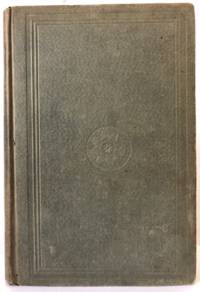
1860158491860. Lincoln Abraham. The Lincoln and Douglas Debates 1860 printed record of the seven public debates between Abraham Lincoln and Stephen A. Douglas during the 1858 Illinois Senate campaign a pivotal series of political confrontations over slavery and the future of the United States. The debates addressed the expansion of slavery into western territories and the constitutional implications of the Supreme Court's Dred Scott decision. Lincoln used the campaign to articulate a moral and political critique of slavery's expansion including the position he expressed in his earlier convention speech that "a house divided against itself cannot stand." Although Lincoln lost the Senate race to Douglas the debates established him as a leading national figure within the Republican Party and played a major role in shaping the political arguments that led to his presidential election in 1860.<br /> <br /> Lincoln Abraham. The Lincoln And Douglas Debates. A Political Debates between Hon. Abraham Lincoln and Hon. Stephen A. Douglas. In the Celebrated Campaign of 1858 in Illinois. Columbus: Follett Foster and Company 1860. First edition third issue identified by the numeral "2" on page 13 and the presence of the publisher's advertisement. Octavo volume containing 268 pages. Bound in publisher's original olive green textured cloth with blind stamped borders and spine lettered in gilt.<br /> <br /> The Lincoln Douglas debates represented one of the most influential series of political exchanges in nineteenth century American history addressing the central constitutional and moral questions surrounding slavery in the years immediately preceding the Civil War. Douglas defended the doctrine of popular sovereignty arguing that territories should decide the legality of slavery for themselves while Lincoln challenged the compatibility of that doctrine with the Dred Scott decision and emphasized the moral consequences of the institution. Although Douglas retained his Senate seat Lincoln's articulate presentation of the issues drew national attention and positioned him as a major political figure within the emerging Republican Party. Slight chipping to the head of the spine fading to boards and gilt minor damp staining with light foxing and toning consistent with age. Overall good condition. unknown
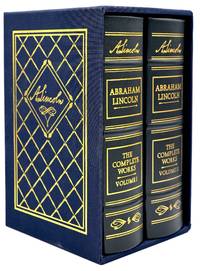
2021300336Norwalk: Easton Press 2021. Full Leather. Near Fine binding. Complete two volume set of octavos; in full navy blue leather with titling and design in gilt; three raised bands on each spine; with silk moire endpapers; edged in gilt; housed in the publisher’s navy blue cloth slipcase; minimal wear to slipcase. Near Fine binding. Easton Press unknown
6509ABRAHAM LINCOLN 1809-1865. Lincoln was the Sixteenth President.DS. 1pg. August 1 1864. Washington. A vellum military commission signed Abraham Lincoln as President and co-signed E.M. Stanton as Secretary of War. The President appointed James Wylie Crawford a First Lieutenant in the Veterans Reserve Corps. Crawford 1832-1910 was from Maine; according to family lore he was badly wounded at Antietam I bought this directly from a descendant. This injury required his enlistment in the Veterans Reserve Corps. The Veterans Reserve Corps allowed wounded soldiers to remain active often performing small tasks and light duty; established in the middle of 1863 it was first known as the Invalid Corps until the official name was changed. The document recently underwent conservation with the vellum stretched and flattened; the top right corner of the vellum has shrunk and the document was once rolled. The Lincoln autograph is a tad light and gets lighter as the autograph gets towards the conclusion; the Stanton is also a bit faint but vellum does not hold ink that well especially compared to paper. hardcover
0331234653.Ghardcover. Good. Access codes and supplements are not guaranteed with used items. May be an ex-library book. hardcover
B9781019585344Hardback. New. hardcover
0365343366.Ghardcover. Good. Access codes and supplements are not guaranteed with used items. May be an ex-library book. hardcover
1334088217.Gpaperback. Good. Access codes and supplements are not guaranteed with used items. May be an ex-library book. paperback
0666616337.Ghardcover. Good. Access codes and supplements are not guaranteed with used items. May be an ex-library book. hardcover
1333351615.Gpaperback. Good. Access codes and supplements are not guaranteed with used items. May be an ex-library book. paperback
028267747X.Gpaperback. Good. Access codes and supplements are not guaranteed with used items. May be an ex-library book. paperback
0365237523.Ghardcover. Good. Access codes and supplements are not guaranteed with used items. May be an ex-library book. hardcover
1396022759.Gpaperback. Good. Access codes and supplements are not guaranteed with used items. May be an ex-library book. paperback
1396677666.Ghardcover. Good. Access codes and supplements are not guaranteed with used items. May be an ex-library book. hardcover