11 347 résultats
1864369149New York: The New-York Times 1864. 8pp. Oblong folio. Central fold elae Fine. 8pp. Oblong folio. <br/><br/> The New-York Times unknown
23936N.p. Springfield: Illinois Commission 1964. Broadside. Folio 30" X 23". Fine. Superb broadside printing of the Gettysburg Address created specifically for the 1964-65 New York World's Fair. Below the large headline in deep blue this typographically interesting piece depicts the Illinois State Historical Society's holograph version of Lincoln's masterpiece at center at actual size in deep purple. To the left of this facsimile the same text appears in four languages each printed in a different color: Hebrew deep purple Japanese blue Greek green and French red. To the right of the facsimile the text appears in another four languages again with each printed in a different color: German blue Spanish green Russian deep purple and Latin red. Ralph G. Newman founder of Chicago's noted Abraham Lincoln Book Shop was a member of the Illinois Civil War Centennial Commission and was no doubt instrumental in having this piece created. Interest in all things Lincoln and Civil War was high at this centennial time and the New York World's Fair held a special Illinois Day as well. Walt Disney's famed Abraham Lincoln talking robot was debuted at this same World's Fair. The broadside was designed by Carl Regehr and printed by Gregg-Moore Lithographing Company. It is in exceptionally bright fresh condition. unknown
190950414N.p.: Frank W. Williams 1909. 20" X 16". Very good. Minor edge tears archivally closed on verso. Composite photogravure showing left to right half-length portraits of Lincoln McKinley and Garfield. Printed on a thin glossy stock this image is scarce in such attractive condition. Clearly produced for the Lincoln centennial but with the most recently-assassinated president McKinley front and center and largest to play on popular interest. Frank W. Williams unknown
1860809901860. LINCOLN Abraham. Political Debates Between Hon. Abraham Lincoln and Hon. Stephen A. Douglas In the Celebrated Campaign of 1858 in Illinois; Including the Preceding Speeches of Each at Chicago Springfield etc.; also the Two Great Speeches of Mr. Lincoln in Ohio in 1859 as Carefully Prepared by the Reporters of Each Party and Published at the Times of Their Delivery. Columbus: Follett Foster and Company 1860. iv 268 pp. Later cloth. Scattered foxing old waterstain to upper free corner of first few leaves else a very good copy. HOWES L-338 "aa." Monaghan 69. Early state but not 1st. Rule above publisher on copyright page; "2" on p. 13; no "2" on p. 17; lacks advertisements. "Historically the most important series of American political debates"-Howes. unknown
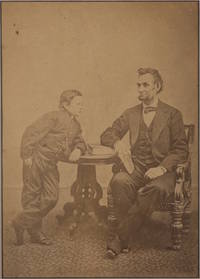
186632820664<br />Perhaps the most delightful of the Lincoln family photographs this portrait shows an impish Tad leaning on a table as his seemingly bemused father sits on Gardner's studio chair. Thomas "Tad" Lincoln was the youngest of the Lincoln boys.<p>Abraham Lincoln an indulgent father let his children run wild at his law offices and at the White House. His law partner William H. Herndon recounted "I have felt many and many a time that I wanted to wring their little necks and yet out of respect for Lincoln I kept my mouth shut. Lincoln did not note what his children were doing or had done."Lincoln sat for this portrait at Alexander Gardner's studio on February 5 1865. Just a month later he delivered the Second Inaugural Address and within weeks he was assassinated. It would be his final sitting for Gardner who made five poses that day. This fine portrait does not show the heavy retouching evident in later prints</p><p>By this date the end of the Civil War seemed to be drawing near. The war years had taken a heavy toll on Lincoln and on the nation. Horace Greeley observed "his face was haggard with care and seamed with thought and trouble. It looked care-ploughed tempest-tossed and weatherbeaten."</p><p>Albumen print 14 x 10 in. card mount. Minimal wear and fading two spots at the upper left. Good tones. An excellent photograph. Framed.</p><p>Ostendorf <i>Lincoln's Photographs</i> O-114.</p><p><b>This fine portrait is the largest example we have seen and a scarce survival showing Lincoln as a loving father.</b></p><br /> Gardner
1864101729Np New York: For sale by all News Agents. Price $1 per 100. 1864. 4to. Broadside text in two columns; creased from prior folding and split at creases some toning and paper clip rust staining. Republic campaign broadside reprinting an interview with Lincoln by former Wisconsin State Assemblyman Joseph T. Mills and former state Governor Alexander Williams Randall. Lincoln vigorously defends the use of Black soldiers in the Union Army against Democratic candidate McClellan's strategy of leniency towards Southern States rejoining the Union: "The slightest knowledge of Arithmetic will prove to any man that the rebel armies cannot be destroyed with Democratic strategy. It would sacrifice all the white men of the North to do it. There are now in the service of the United States near 200000 able-bodied colored men most of them under arms defending and acquiring Union territory. The Democratic strategy demands that these forces be disbanded and that the masters be conciliated by restoring them to slavery. Will you give our enemies such military advantages. to get them back into the Union Abandon all the posts now garrisoned by black men take 200000 men from our side and put them in the battle-field or corn-field against us and we would be compelled to abandon the war in three weeks. . There have been men base enough to propose to me to return to slavery the black warriors of Port Hudson and Olustee and thus win the respect of the masters they fought. Should I do so I should deserve to be damned in time and eternity. My enemies pretend I am now carrying on this war for the sole purpose of abolition. So long as I am president it shall be carried on for the sole purpose of restoring the Union. But no human power can subdue this Rebellion without the use of the emancipation policy and every other policy calculated to weaken the moral and physical forces of the Rebellion." This is the first separate printing of the interview which was first published as "The Loyal Road to Peace and the Disloyal Road to Ruin President Lincoln on Democratic Strategy" in the Wisconsin Grant County Herald August 1864. The broadside also prints Grant's letter to E.B. Washbourne "The Rebels have now in their ranks their last man. The little boys and old men are guarding prisoners guarding railroad bridges and forming a good part of their garrisons for entrenched positions " and a poem by Bayard Taylor on the Democrats' presidential nominating convention. REFERENCE: Sabin 41157; Weinstein Against the Tide 141 For sale by all News Agents. Price, $1 per 100. unknown
22455N.p.: N.p. n.y. ca. 1864. 2½" X 3 3/4". Very good. Mildest bit of edgewear; corners ever-so-slightly rounded. Artist's rendering based on the well-known 1864 photograph of a seated Lincoln with a large book in his lap his son Tad standing alongside watching. Small printed caption "President Lincoln at Home" on bottom margin. No backstamp on verso. Despite bit of wear the image is dark and bold. unknown
18642547081864. very good-. This historic and rare black printed broadside presents the platforms of both parties the Republicans having convened in Baltimore in June and nominated Abraham Lincoln for President and Andrew Johnson for Vice President and the Democrats having convened in Chicago in August and nominated George B. McClellan for President and George H. Pendleton for Vice President. This copy measures 29 x 23 cm is double columned and with the imprint "For sale by all News Agents. Price $1 per 100." Very light foxing at the bottom margin more visible on the verso. Fraying at the margins as usual. Sabin 63348 Exceedingly scarce.<br/> <br/> unknown
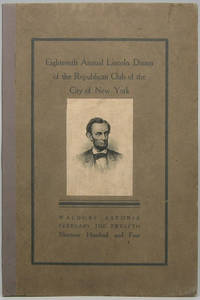
190444855New York: Press of Henry I. Cain and Son 1904. Paperback. Small 4to. Stiff green wrappers with tipped-on front wrapper plate and brown cloth spine. 96pp. Very good. Minor edgewear. Tight and nice first edition of the speeches given at this regular gathering "Celebrated at the Waldorf-Astoria the Ninety-Fifth Anniversary of the Birthday of Abraham Lincoln." Addresses include Indiana senator and soon-to-be vice president Charles W. Fairbanks Secretary of the Navy W.H. Moody and New York senator Chauncey M. Depew. In a facsimile letter signed by President Theodore Roosevelt he regrets his inability to attend. Rather uncommon. MONAGHAN 1444. Press of Henry I. Cain and Son paperback
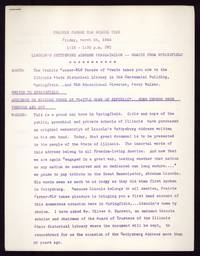
1944560432Chicago: WLS Studios 1944. Unbound. Near Fine. Radio script or transcript. Small quarto. Eight 8½" x 11" corner-stapled leaves spirit-duplicated rectos only. Final two leaves with a tiny bit of faint staining final blank page tanned very near fine. Coverage of the Illinois State Historical Library receiving a manuscript copy of the Gettysburg Address that was purchased by the state's schoolchildren. Features brief interviews with librarian and Lincoln scholar Oliver R. Bennett State Superintendent of Public Instruction Vernon L. Nickell and the four students who represented the students of Illinois. Presumably printed in very small numbers. WLS Studios unknown
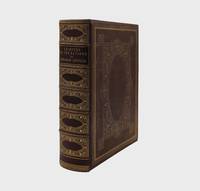
1867376997Washington D.C.: Government Printing Office 1867. Frontispiece portrait. 2XXX930pp. 4to. Original full brown turkey morocco elaborately stamped in gilt repair to front joint. Frontispiece portrait. 2XXX930pp. 4to. One of only 100 specially-bound copies of this official government printing reproducing in its totality the foreign correspondence and declarations of sympathy received from foreign governments and diplomats across the world in response to Lincoln's assassination. <br /> <br /> Congress' resolution for the publication of this work is printed within: "Resolved by the Senate and House of Representatives of the United States of America in Congress assembled That in addition to the number of copies of papers relating to foreign affairs now authorized by law there shall be printed for distribution by the Department of State on fine paper with wide margin a sufficient number of copies of the Appendix to the Diplomatic Correspondence of 1865 to supply one copy to each senator and each representative of the Thirty-ninth Congress and to each foreign government and one copy to each corporation association or public body whose expressions of condolence or sympathy are published in said volume; one hundred of these copies to be bound in full Turkey morocco full gilt and the remaining copies to be bound in half Turkey morocco marble edged." <br /> <br /> The text organizes the messages of sympathy alphabetically by source country and contains an extensive and detailed index to the correspondents within. The frontispiece reproduces the famous Darby & Miller engraved portrait of Lincoln. Monaghan mentions that a small number of copies were bound with Carpenter's portrait as the frontispiece. Monaghan 881; Sabin 41174 Government Printing Office unknown
1947236530New Brunswick: Rutgers 1947. First edition. 1 vols. 8vo. Bound in three quarter red morocco and cloth. Almost fine. First edition. 1 vols. 8vo. <br/><br/> Rutgers hardcover
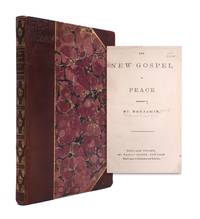
1864334954New York: Sinclair Toussey 121 Nassau Street parts 1 and 2 . Sinclair Tousey Succeeded by the American News Company part 3 1864. 42; 48; 47 1pp. Original wrappers bound in. 8vo. Later half burgundy dyed calf and marbled paper covered boards. Provenance: Sondley Reference Library with bookplate and other markings. 42; 48; 47 1pp. Original wrappers bound in. 8vo. The first three of an eventual four parts to this Lincoln satire written in Bibilical style and attributed to journalist and social critic Richard Grant White writing under the pseudonym of "St. Benjamin." Howes W368 Sinclair Toussey 121 Nassau Street [parts 1 and 2] ... Sinclair Tousey Succeeded by the American News Company [part 3] unknown
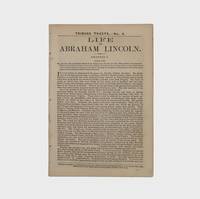
1860377692New York: Horace Greeley & Co 1860. 32pp. 8vo. Disbound. 32pp. 8vo. An early campaign biography of future president Abraham Lincoln written by John Locke Scripps of the New York Tribune. Scripps reports on the life of Abraham Lincoln in eight chapters touching on the major events of his life and career beginning with his early life and his move to Illinois through his transition from merchant to lawyer and legislator and covering his time in Congress with accounts of Lincoln's opposition to the Mexican-American War his support of the Wilmot Proviso and his involvement with the organization of the Republican Party. <br /> <br /> Wessen states that this edition was printed by Horace Greeley "from plates cast from the same type forms" as the 1860 Chicago edition which is considered the first published biography of Lincoln. An advertisement for the Tribune and the Tribune Almanac fills the bottom two thirds of the last page. <br /> <br /> "Most authentic of Lincoln campaign biographies" - Howes. Howes S247a "aa"; Managhan 79 note; Wessen Campaign Lifes of Abraham Lincoln 12 ref; Miles 418a; Abraham Lincoln: His Life in Print p. 85 Horace Greeley & Co unknown
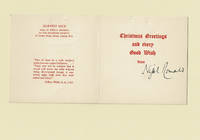
100784<p>Very good. - A 4 inch high by 4 inch wide Christmas card with a sienna-toned illustration of Sheila Dorrell's "Harvest Mice" identified in red on the recto with a quote from Gilbert White. "Christmas Greetings and every good wish from" is printed in red on the facing page signed in black ink by the British Ambassador to Portugal Nigel Ronald. There are staple holes through the top edge. Very good.</p><p>A wonderful association signed by the British ambassador to Portugal from the estate of the American ambassador to Portugal Lincoln MacVeagh.</p><p>The British civil servant and diplomat Nigel Ronald 1894-1973 joined the civil service in 1920 after serving with the King's Regiment during the first World War and the Grenadier Guards. Rising through the civil service he was appointed ambassador to Portugal in 1947.</p><p>From the estate of Lincoln MacVeagh 1890-1972 a Renaissance man who graduated from Harvard magna cum laude in 1913. He went on to study languages at the Sorbonne and became fluent in German French Spanish Latin Greek and Classical Greek. After World War I he became a director of the Henry Holt and Company publishing firm where he became friendly with the poet Robert Frost. In 1923 he left the firm and founded the Dial Press. His name appears on the imprint of many of their publications. In 1933 President Roosevelt appointed him Minister to Greece. He followed presentation of his credentials with a speech in Classical Greek. While in Greece he conducted excavations beneath the Acropolis and made archeological contributions to the National Museum in Athens. He left Greece in 1941 when the German army over ran the country. From there he was appointed the first US Minister to Iceland where he negotiated agreements for the construction of the Keflavik airfield. In late 1942 he became Minister to the Union of South Africa and coordinated American wartime agencies there. In 1943 he was sent to Cairo as Ambassador so that he could assist the governments in exile of Greece and Yugoslavia. He returned to Athens as Ambassador in 1944. MacVeagh gave secret testimony before Congress concerning the Balkans in 1947 testimony that was an important factor in the formation of the Truman Doctrine. In 1948 as Ambassador to Portugal MacVeagh was influential in admitting her into NATO. In 1952 President Truman named him Ambassador to Spain. President Truman wrote to him on March 9 1948: "On the occasion of your appointment as Ambassador to Portugal I would like to make some personal expression of appreciation for the high services you have already rendered your country. During the past fifteen critical years you have served with distinction as Chief of the United states Missions to Iceland the Union of South Africa Yugoslavia and Greece. In this last post especially - as Minister from 1933 to 1941 and as Ambassador since 1943 - your scholarly statesmanship and diplomatic judgment have been of the utmost value."</p>
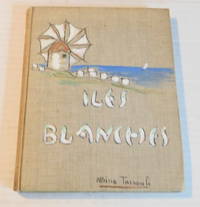
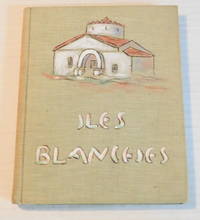
193998741Athenes: Imprimerie Rythmos 1939. 1939. Very good. ASSOCIATION COPY INSCRIBED BY THE AUTHOR TO THE AMERICAN MINISTER TO GREECE LINCOLN MACVEAGH - Quarto 8-1/2 inches high by 6-1/2 inches wide. Hardcover bound in tan buckram hand-painted with the image of a Skyros windmill in brown blue & white titled in white on the front cover and signed by Athina Tarsouli. The spine is slightly darkened. The original wrappers are bound in and feature a lithographic front cover with a variation of the Skyros windmill in blue & white. 133 pages with profuse textual illustrations in black and white & 3 tipped-in color plates. The text block is cracked opposite the title page and there is some occasional soiling and darkening to the top edges of a few pages. Very good. <p>First edition.<p>Inscribed by Athina Tarsouli on the title page: "A Monsieur et a Madame Mak Vey sic les grands amis de la Grece et auteurs inspires du beau livre 'Elliniko taxidi' / Hommage respectueux de l'auteur Decembre 1940." In addition to the personal inscription all copies of the book were signed by Tarsouli on the verso of the half-title. The reference she makes to the book by the MacVeaghs is to the Greek edition of "Greek Journey" an illustrated children's book by the couple published by Dodd Mead & Company in 1937.<p>The islands included in the description are Tinos Myconos Paros Antiparos Naxos Santorin and Skyros.<p>Athina Tarsouli 1887-1975 was born in Athens. She studied painting in France and as an artist was represented in several group exhibitions in Athens Alexandria and Cyprus. She was in addition to being a painter she was also a folklorist with a special interest in Greek folklore. She was a member of the literary section of "Parnassos" and the Lyceum of Greek Women.<p>From the library of Lincoln MacVeagh and his wife Margaret with their "Arcades Ambo" bookplate on the front paste down. Lincoln MacVeagh 1890-1972 a Renaissance man graduated from Harvard magna cum laude in 1913. He went on to study languages at the Sorbonne and became fluent in German French Spanish Latin Greek and Classical Greek. After World War I he became a director of the Henry Holt and Company publishing firm where he became friendly with the poet Robert Frost. In 1923 he left the firm and founded the Dial Press. His name appears on the imprint of many of their publications. In 1933 President Roosevelt appointed him Minister to Greece. He followed presentation of his credentials with a speech in Classical Greek. While in Greece he conducted excavations beneath the Acropolis and made archeological contributions to the National Museum in Athens. He left Greece in 1941 when the German army over ran the country. From there he was appointed the first US Minister to Iceland where he negotiated agreements for the construction of the Keflavik airfield. In late 1942 he became Minister to the Union of South Africa and coordinated American wartime agencies there. In 1943 he was sent to Cairo as Ambassador so that he could assist the governments in exile of Greece and Yugoslavia. He returned to Athens as Ambassador in 1944. MacVeagh gave secret testimony before Congress concerning the Balkans in 1947 testimony that was an important factor in the formation of the Truman Doctrine. In 1948 as Ambassador to Portugal MacVeagh was influential in admitting her into NATO. In 1952 President Truman named him Ambassador to Spain. President Truman wrote to him on March 9 1948: "On the occasion of your appointment as Ambassador to Portugal I would like to make some personal expression of appreciation for the high services you have already rendered your country. During the past fifteen critical years you have served with distinction as Chief of the United states Missions to Iceland the Union of South Africa Yugoslavia and Greece. In this last post especially - as Minister from 1933 to 1941 and as Ambassador since 1943 - your scholarly statesmanship and diplomatic judgment have been of the utmost value." Athenes: Imprimerie Rythmos, 1939. hardcover
193998742Athenes: Imprimerie Rythmos 1939. 1939. Very good. ASSOCIATION COPY FROM THE LIBRARY OF THE AMERICAN MINISTER TO GREECE LINCOLN MACVEAGH - Quarto 8-1/2 inches high by 6-1/2 inches wide. Hardcover bound in tan buckram hand-painted with the image of a Skyros Greek Orthodox church in brown & white by Athina Tarsouli and titled in white on the front cover. The spine is slightly darkened. The original wrappers are bound in and feature a lithographic front cover with an illustration of the Skyros windmill in blue & white. 133 pages with profuse textual illustrations in black and white & 3 tipped-in color plates. The text block is starting to crack opposite the title page. There is some minor chipping to the bottom edges of the front endpaper and pastedown. Very good. <p>First edition signed by the author artist Athina Tarsouli.<p>The islands included in the description are Tinos Myconos Paros Antiparos Naxos Santorin and Skyros.<p>Athina Tarsouli 1887-1975 was born in Athens. She studied painting in France and as an artist was represented in several group exhibitions in Athens Alexandria and Cyprus. She was in addition to being a painter she was also a folklorist with a special interest in Greek folklore. She was a member of the literary section of "Parnassos" and the Lyceum of Greek Women.<p>From the library of Lincoln MacVeagh and his wife Margaret with their "Arcades Ambo" bookplate on the front paste down. Lincoln MacVeagh 1890-1972 a Renaissance man graduated from Harvard magna cum laude in 1913. He went on to study languages at the Sorbonne and became fluent in German French Spanish Latin Greek and Classical Greek. After World War I he became a director of the Henry Holt and Company publishing firm where he became friendly with the poet Robert Frost. In 1923 he left the firm and founded the Dial Press. His name appears on the imprint of many of their publications. In 1933 President Roosevelt appointed him Minister to Greece. He followed presentation of his credentials with a speech in Classical Greek. While in Greece he conducted excavations beneath the Acropolis and made archeological contributions to the National Museum in Athens. He left Greece in 1941 when the German army over ran the country. From there he was appointed the first US Minister to Iceland where he negotiated agreements for the construction of the Keflavik airfield. In late 1942 he became Minister to the Union of South Africa and coordinated American wartime agencies there. In 1943 he was sent to Cairo as Ambassador so that he could assist the governments in exile of Greece and Yugoslavia. He returned to Athens as Ambassador in 1944. MacVeagh gave secret testimony before Congress concerning the Balkans in 1947 testimony that was an important factor in the formation of the Truman Doctrine. In 1948 as Ambassador to Portugal MacVeagh was influential in admitting her into NATO. In 1952 President Truman named him Ambassador to Spain. President Truman wrote to him on March 9 1948: "On the occasion of your appointment as Ambassador to Portugal I would like to make some personal expression of appreciation for the high services you have already rendered your country. During the past fifteen critical years you have served with distinction as Chief of the United states Missions to Iceland the Union of South Africa Yugoslavia and Greece. In this last post especially - as Minister from 1933 to 1941 and as Ambassador since 1943 - your scholarly statesmanship and diplomatic judgment have been of the utmost value." Athenes: Imprimerie Rythmos, 1939. hardcover
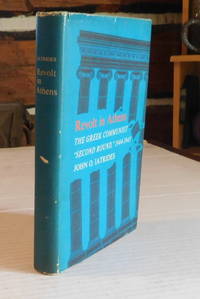
197299033<p>Princeton New Jersey: Princeton University Press 1972. 1972. Very good. - Octavo 8-1/2 inches high by 5-1/2 inches wide. Hardcover bound in blue cloth titled in white on the spine laid into a red white and blue dust wrapper featuring black Greek columns. The dust jacket is slightly soiled and rubbed with some minor chips to the jacket's edges. xiv & 340 pages. The fore and top edges of the book are foxed. Very good.</p><p>First edition.</p><p>Inscribed on the front endpaper: "To Mrs. Lincoln MacVeagh with my warmest regards John O. Iatrides." An author's compliments card is laid in.</p> Princeton, New Jersey: Princeton University Press, (1972). hardcover
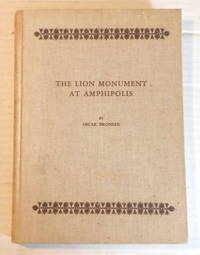
194198734Cambridge MA: Harvard University Press 1941. 1941. Very good. - Quarto 10 inches high by 7 inches wide. Hardcover bound in tan buckram titled in brown within brown decorative borders on the front cover. The titling on the spine is faded. xvii 3 pages 1-76 illustrated with a frontispiece and profuse photographic illustrations as well as a portfolio of 11 plates at the end of the book which includes photographs by MacVeagh. There is some minor foxing to the endpapers and pastedowns and the edges of the pastedowns are soiled. Near fine. <p>The RARE FIRST EDITION from the library of the book's Dedicatee "The Honorable Lincoln MacVeagh".<p>The prospectus "The Lion of Amphipolis - A Plea for its Reconstruction" by Lincoln MacVeagh is a 10 by 7-1/2 inch 4-page pamphlet with a 1934 photograph of the fragments of the lion laid in. It was published in Athens in 1934. ".recently during the progress of the great work in connection with the drainage of the Serres Plain and the deepening of the Amphipolis Gorge the engineers of the Monks-Ulen Company of New York became impressed with the majesty and immensity of the all-but-buried and half-forgotten fragments of the Lion of Amphipolis. Enthusiastically they brought the idea of its reconstruction to me. I visited the site; and the plan herein set forth in which it is my hope that a sufficient number of lovers of Greece and of Greek Art will join was born."<p>The lecture by MacVeagh "The Lion of Amphipolis" was delivered to The French School of Archaeology at Athens in 1937. It is a 10 by 7-1/4 inch 12-page pamphlet illustrated with 4 photographs and 2 maps showing the location of Amphipolis. The lecture is for the most part an account of the restoration work to date. "While the collaboration of the French and American Schools was thus producing unexpected results the Greek authorities were also helping and besides giving the whole enterprise their blessing kindly accorded the schools the collaboration of Mr. Panayiotakis of the National Museum. This able sculptor spent weeks at Amphipolis again thanks to the Monks-Ulen Companies which lent their camp and collected the necessary workmen and tools for his operations. With great effort and patience far from the conveniences of the city Mr. Panayiotakis successfully carried through the task of making moulds some of them of truly gigantic size of all the existing fragments of the Lion. From these he made casts on the spot and again with the help of the engineers fitted these together under an enormous shed and provided in plaster the missing pieces to complete the whole figure. This year it is planned to put the actual fragments themselves together and make the missing parts out of marble cement of a color agreeable to the rest."<p>From the library of Lincoln MacVeagh and his wife Margaret with their "Arcades Ambo" bookplate on the front paste down. Lincoln MacVeagh 1890-1972 a Renaissance man graduated from Harvard magna cum laude in 1913. He went on to study languages at the Sorbonne and became fluent in German French Spanish Latin Greek and Classical Greek. After World War I he became a director of the Henry Holt and Company publishing firm where he became friendly with the poet Robert Frost. In 1923 he left the firm and founded the Dial Press. His name appears on the imprint of many of their publications. In 1933 President Roosevelt appointed him Minister to Greece. He followed presentation of his credentials with a speech in Classical Greek. While in Greece he conducted excavations beneath the Acropolis and made archeological contributions to the National Museum in Athens. He left Greece in 1941 when the German army over ran the country. From there he was appointed the first US Minister to Iceland where he negotiated agreements for the construction of the Keflavik airfield. In late 1942 he became Minister to the Union of South Africa and coordinated American wartime agencies there. In 1943 he was sent to Cairo as Ambassador so that he could assist the governments in exile of Greece and Yugoslavia. He returned to Athens as Ambassador in 1944. MacVeagh gave secret testimony before Congress concerning the Balkans in 1947 testimony that was an important factor in the formation of the Truman Doctrine. In 1948 as Ambassador to Portugal MacVeagh was influential in admitting her into NATO. In 1952 President Truman named him Ambassador to Spain. President Truman wrote to him on March 9 1948: "On the occasion of your appointment as Ambassador to Portugal I would like to make some personal expression of appreciation for the high services you have already rendered your country. During the past fifteen critical years you have served with distinction as Chief of the United states Missions to Iceland the Union of South Africa Yugoslavia and Greece. In this last post especially - as Minister from 1933 to 1941 and as Ambassador since 1943 - your scholarly statesmanship and diplomatic judgment have been of the utmost value." Cambridge, MA: Harvard University Press, 1941. hardcover
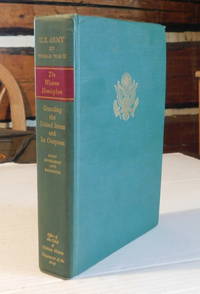
196498740Washington DC: Office of the Chief of Military History / Department of the Army 1964. 1964. Very good. - Octavo 9-3/4 inches high by 6-3/4 inches wide. Hardcover bound in green cloth with the American Bald Eagle crest stamped in gilt on the front cover and titled in gilt on the spine. The corners of the covers and the head and tail of the spine are bumped. xvii 1 & 593 pages with numerous photographic illustrations 4 fold-out maps and an additional 2 large folding maps in a rear pocket. The edges of the last few pages are lightly creased as a result of the thick pocket mounted at the rear. Very good. <p>First edition.<p>Inscribed on a special presentation plate on the front endpaper to the "Honorable Lincoln MacVeagh" who is mentioned in the book for his activities as Minister to Iceland during the war. The presentation plate is signed by each of the three authors and by the Chief of Military History Brigadier General Hal C. Pattison.<p>From the library of Lincoln MacVeagh and his wife Margaret with their "Arcades ambo" bookplate. Lincoln MacVeagh 1890-1972 a Renaissance man graduated from Harvard magna cum laude in 1913. He went on to study languages at the Sorbonne and became fluent in German French Spanish Latin Greek and Classical Greek. He served in the Atois St. Mihiel and Meuse Argonne campaigns of World War I as an aide to the commanding general of the 80th Division and of the Ninth and Sixth Army Corps. He rose to the rank of Major. After the war he became a director of the Henry Holt and Company publishing firm where he became friendly with the poet Robert Frost. In 1923 he left the firm and founded the Dial Press. His name appears on the imprint of many of their publications. In 1933 President Roosevelt appointed him Minister to Greece. He followed presentation of his credentials with a speech in Classical Greek. While in Greece he conducted excavations beneath the Acropolis and made archeological contributions to the National Museum in Athens. He left Greece in 1941 when the German army over ran the country. From there he was appointed the first US Minister to Iceland where he negotiated agreements for the construction of the Keflavik airfield. In late 1942 he became Minister to the Union of South Africa and coordinated American wartime agencies there. In 1943 he was sent to Cairo as Ambassador so that he could assist the governments in exile of Greece and Yugoslavia. He returned to Athens as Ambassador in 1944. MacVeagh gave secret testimony before Congress concerning the Balkans in 1947 testimony that was an important factor in the formation of the Truman Doctrine. In 1948 as Ambassador to Portugal MacVeagh was influential in admitting her into NATO. In 1952 President Truman named him Ambassador to Spain. President Truman wrote to him on March 9 1948: "On the occasion of your appointment as Ambassador to Portugal I would like to make some personal expression of appreciation for the high services you have already rendered your country. During the past fifteen critical years you have served with distinction as Chief of the United states Missions to Iceland the Union of South Africa Yugoslavia and Greece. In this last post especially - as Minister from 1933 to 1941 and as Ambassador since 1943 - your scholarly statesmanship and diplomatic judgment have been of the utmost value." Washington, DC: Office of the Chief of Military History / Department of the Army, 1964. hardcover
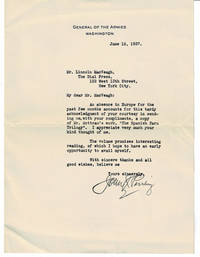
192798654Washington D.C.: June 18 1927. 1927. Very good. - Over 85 words typed on 9-1/4 inch high by 7 inch wide "GENERAL OF THE ARMIES" letterhead with attached integral blank leaf. General Pershing writes to Lincoln MacVeagh founder and president of The Dial Press thanking him for sending "a copy of Mr. Mottram's work 'The Spanish Farm Trilogy'. I appreciate very much your kind thought of me". The letter is signed in full "John J. Pershing". The World War I novel which Pershing mentions centers on a Flemish farm woman around whom the author relates his war experiences. MacVeagh published the work at his Dial Press in 1927 the year of this letter. Folded for mailing with some light creases to the edges and inner corners. Very good. <p>A wonderful association as "With the American Expeditionary Force in World War 1 Mr. MacVeagh served in the Artois St. Mihiel and Meuse Argonne campaigns as an aide to the commanding general of the 80th Division and of the Ninth and Sixth Army Corps. He rose to major and was cited by General of the Armies John J. Pershing in 1919 for exceptionally meritorious services". - Quoted from the New York Times January 17 1972 issue.<p>John Joseph Pershing 1860-1948 nicknamed "Black Jack" was a senior United States Army officer. He served most famously as the commander of the American Expeditionary Forces during World War I from 1917 to 1920. Pershing is the only American to be promoted in his own lifetime to General of the Armies the highest possible rank in the United States Army.<p>Lincoln MacVeagh 1890-1972 a Renaissance man graduated from Harvard magna cum laude in 1913. He went on to study languages at the Sorbonne and became fluent in German French Spanish Latin Greek and Classical Greek. After World War I he became a director of the Henry Holt and Company publishing firm where he became friendly with the poet Robert Frost. In 1923 he left the firm and founded the Dial Press. His name appears on the imprint of many of their publications. In 1933 President Roosevelt appointed him Minister to Greece. He followed presentation of his credentials with a speech in Classical Greek. While in Greece he conducted excavations beneath the Acropolis and made archeological contributions to the National Museum in Athens. He left Greece in 1941 when the German army over ran the country. From there he was appointed the first US Minister to Iceland where he negotiated agreements for the construction of the Keflavik airfield. In late 1942 he became Minister to the Union of South Africa and coordinated American wartime agencies there. In 1943 he was sent to Cairo as Ambassador so that he could assist the governments in exile of Greece and Yugoslavia. He returned to Athens as Ambassador in 1944. MacVeagh gave secret testimony before Congress concerning the Balkans in 1947 testimony that was an important factor in the formation of the Truman Doctrine. In 1948 as Ambassador to Portugal MacVeagh was influential in admitting her into NATO. In 1952 President Truman named him Ambassador to Spain. President Truman wrote to him on March 9 1948: "On the occasion of your appointment as Ambassador to Portugal I would like to make some personal expression of appreciation for the high services you have already rendered your country. During the past fifteen critical years you have served with distinction as Chief of the United states Missions to Iceland the Union of South Africa Yugoslavia and Greece. In this last post especially - as Minister from 1933 to 1941 and as Ambassador since 1943 - your scholarly statesmanship and diplomatic judgment have been of the utmost value." Washington, D.C.: June 18, 1927. unknown
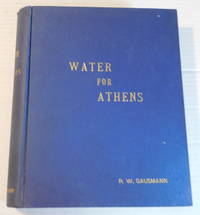
194098653Athens Greece 1940. 1940. Very good. - Quarto 11-3/8 inches high by 9 inches wide. Hardcover bound in blue cloth titled in gilt on the front cover and on the spine. 2 x & 328 mechanically reproduced pages printed on the rectos only. Illustrated with an original photograph as the frontispiece a pictorial title page 60 inserted charts and plates not included in the pagination and a folding plate reproducing a document. Most of the plates with drawings were created by the author. Near fine. <p>A RARE AND VALUABLE UNPUBLISHED WORK. Of 15 mimeographed copies this is No. 5 designated for Lincoln MacVeagh and was his copy.<p>Laid into the book is a map outlining the Parnassos Aqueduct with notes on the stages of construction and a "General Plan" of the Athens-Piraeus Waterworks in 1945.<p>The author Roy W. Gausmann was one of the designing engineers of the Marathon Dam and until 1941 the general manager of EEY the Greek Water Company. He trained as an engineer at Columbia University and worked for Ulen & Co. on the Shandaken Tunnel bringing water from the Catskill Mountains to New York City. During World War II he supervised camouflaging the dam and purification plant in Athens in order to prevent the Germans from taking control of the water company.<p>From the library of Lincoln MacVeagh and his wife Margaret with their "Arcades ambo" bookplate. Lincoln MacVeagh 1890-1972 a Renaissance man graduated from Harvard magna cum laude in 1913. He went on to study languages at the Sorbonne and became fluent in German French Spanish Latin Greek and Classical Greek. He served in the Atois St. Mihiel and Meuse Argonne campaigns of World War I as an aide to the commanding general of the 80th Division and of the Ninth and Sixth Army Corps. He rose to the rank of Major. After the war he became a director of the Henry Holt and Company publishing firm where he became friendly with the poet Robert Frost. In 1923 he left the firm and founded the Dial Press. His name appears on the imprint of many of their publications. In 1933 President Roosevelt appointed him Minister to Greece. He followed presentation of his credentials with a speech in Classical Greek. While in Greece he conducted excavations beneath the Acropolis and made archeological contributions to the National Museum in Athens. He left Greece in 1941 when the German army over ran the country. From there he was appointed the first US Minister to Iceland where he negotiated agreements for the construction of the Keflavik airfield. In late 1942 he became Minister to the Union of South Africa and coordinated American wartime agencies there. In 1943 he was sent to Cairo as Ambassador so that he could assist the governments in exile of Greece and Yugoslavia. He returned to Athens as Ambassador in 1944. MacVeagh gave secret testimony before Congress concerning the Balkans in 1947 testimony that was an important factor in the formation of the Truman Doctrine. In 1948 as Ambassador to Portugal MacVeagh was influential in admitting her into NATO. In 1952 President Truman named him Ambassador to Spain. President Truman wrote to him on March 9 1948: "On the occasion of your appointment as Ambassador to Portugal I would like to make some personal expression of appreciation for the high services you have already rendered your country. During the past fifteen critical years you have served with distinction as Chief of the United states Missions to Iceland the Union of South Africa Yugoslavia and Greece. In this last post especially - as Minister from 1933 to 1941 and as Ambassador since 1943 - your scholarly statesmanship and diplomatic judgment have been of the utmost value." Athens, Greece, 1940. hardcover
1863244615Washington D.C.: GPO 1863. First edition. 802 pp. 1 vols. Thick 8vo. Quarter morocco pine perished fine internally. Bookplate of James Torr Harmer. First edition. 802 pp. 1 vols. Thick 8vo. <br/><br/> GPO unknown
195018093Worcester Mass: Achilles St. Onge 1950. One of 1500 copies printed from Monotype Plantin type on J. Barcham Green's hand made all rag wove paper by the Chiswick Press. Photographs. 1 vols. 12mo 3 x 2 inches. Bound in full blue morocco by Sangorski & Sutcliffe. One of 1500 copies printed from Monotype Plantin type on J. Barcham Green's hand made all rag wove paper by the Chiswick Press. Photographs. 1 vols. 12mo 3 x 2 inches. Inscribed "To Joseph Miller with kindest regards Achille St. Onge. Achilles St. Onge unknown
3531968vo & 12mo. Abiout fine. 8vo & 12mo. unknown