11 347 résultats
186331428New York: Baker & Godwin 1863. 8vo. 9 x 5 5/8 inches. 48pp. Publisher's lettered wrappers publisher's ad on rear wrapper. Repair to paper spine. Within a modern box.<br/> <br/>"Four score and seven years ago.": the earliest publication of the Gettysburg Address in book form preceded only by the exceptionally rare sixteen-page pamphlet The Gettysburg Solemnities known in only three copies.<br/> <br/>Lincoln made his speech at the dedication of a cemetery on the Gettysburg battlefield some four months after the bloody and pivotal battle that turned the tide of the Civil War in favor of the Union. Lincoln's speech was preceded by an address from Edward Everett the most famous orator of his day. Everett's speech took some ninety minutes to deliver and is largely forgotten. Lincoln's speech delivered in only a few minutes is immortal. It is a supreme distillation of American values and of the sacrifices necessary for the survival of liberty and freedom. "The Washington Chronicle of 18-21 November reported extensively on this ceremony and included a verbatim text of 'Edward Everett's Great Oration.' On the fourth day it noted in passing that the President had also made a speech but gave no details. When it came to the separate publication on 22 November Everett's 'Oration' was reprinted from the standing type but Lincoln's speech had to be set up. It was tucked away as a final paragraph on page 16 of the pamphlet The Gettysburg Solemnities. It was similarly treated when the meanly produced leaflet was replaced by a 48-page booklet published by Baker and Godwin of New York in the same year" PMM. Lincoln's address appears on page 40 and parenthetical notes are added indicating "applause" and "long-continued applause." A diagram on page 32 gives the details of the Soldiers' National Cemetery at Gettysburg.<br/> <br/>Howes E232 "b"; Monaghan 193; Grolier American 100 72 note; Streeter Sale 1747; Sabin 23263; cf. Printing and the Mind of Man 351; Garry Wills Lincoln at Gettysburg pp.191-204. Baker & Godwin unknown books
18463117130/03/1846. <blockquote><p>At the time Lincoln wrote this he was running for Congress</p></blockquote><blockquote><p>It shows the relationship between perhaps the most famous senior and junior law partners</p><p> </p></blockquote><p>https://vimeo.com/943731365share=copy</p><p> </p><p>In his nearly 25 years as a lawyer in Springfield Illinois Abraham Lincoln had three partners. He joined John Todd Stuart as a junior partner then started a new practice as a junior partner with Stephen T. Logan. In 1844 Lincoln and Logan took on William H. Herndon. In the fall of 1844 Lincoln was tired of being a junior partner. He had worked for senior partners with political ambitions and Lincoln wanted a younger partner to whom he could relate. Logan and Lincoln dissolved their partnership in December 1844. Logan wanted to practice law with his son David and Lincoln wanted to start his own law firm. In October Lincoln invited his friend William Herndon to form a partnership with Herndon as junior partner. Thus was born Lincoln and Herndon. The firm would become a legend. In all three firms Lincoln functioned as a general practitioner taking a wide variety of civil and criminal cases. Herndon did not disappoint his friend. He contributed to the practice by performing research for his older and more experienced partner building the firm's law library and overseeing young men who came to study law read the law at their office.</p><p>Business began slowly for the new firm. Not until March 1845 was their first case heard in the Sangamon County Circuit Court. That first case was Hope v. Beebe et al and was action in debt with Lincoln and Herndon appearing for plaintiff and Logan for defendant. Here is a description of that case: A plaintiff Norwood had won a replevin suit against the Beebee also spelled Beebe Brothers in the U. S. Circuit Court Beebee Brothers v. Whitney & Norwood. Hope the marshal of the U. S. Circuit Court District of Illinois to help Norwood collect what he was owed retained Lincoln and Herndon and sued Beebee and others in an action of debt the intent being to collect money ordered paid by the court. Beebee and others named on the replevin bond in the federal suit failed to perform the obligation of bond - they did not or would not pay. Beebee claimed that he was unable to pay because of another suit that Norwood instituted against Beebee.</p><p>On March 18 1845 the case was continued and heard again in July when Lincoln filed documents allowing for concessions on both sides. It was again continued until March of 1846. Lincoln with the help of Herndon then drafted another document seemingly pointing to the another aspect of the suit and explaining why the plaintiff should not have to drop the suit.</p><p>In 1846 Lincoln was running for what would be his first elected position Congressman. In August he won that election and served one term. In March he was campaigning and seeking to gain support.</p><p><strong>Autograph document signed</strong> <em>""Lincoln & Herndon""</em> Springfield late March 1846 in the hand of both partners showing their collaboration. It begins in Lincoln's hand: <em>“And for further replication"" before switching to Herndons for the lines"" to the said plea of the said defendants by them above pleaded said plaintiff says that to be further precluded from maintaining his said action against said defendants because of the matters in said plea alleged he ought not because he says that since the pleading of the last plea by said defendants to wit on — day of February AD 1846 the said replevin suit by the said Norwood and Turner against the said Beebees in the Said plea mentioned was by the same court at which it was pending determined in favor of the said Beebees and against the said Norwood and Turner and by the judgment of said court a return of the bacon in the plea mentioned.â€</em></p><p>Lincoln hand wrote the balance: <em>“…Mentioned was awarded to the said Beebees and also adjudged that the said Beebees should recover of and from the said Norwood and Turner the sum of $650 damages and costs of suit and this he is ready to verify. Wherefore he prays judgment.â€</em> At that time Lincoln was preparing for his run for Congress his only national election until 1860.</p><p>The parties would later reach an agreement in March 1847 and the court dismissed the case. Lincoln and Herndon received fees of $25 for their legal services. A final version of this filed document is published by the Papers of Abraham Lincoln as is the judge's further March 1846 continuance. The present document is three pieces affixed either by Lincoln or at a later date.</p><p>This is the only paperwork from Lincoln and Herndon’s first case we have ever seen on the market.</p><p><img class=""alignnone size-post-window wp-image-25018"" src=""https://cdn.raabcollection.com/wp-content/uploads/20231204144051/Folder-site-11-1600x1327.jpg"" alt="""" width=""1600"" height=""1327"" /></p> unknown
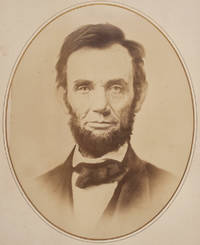
186332820640<p>Mammoth albumen print 17 ½ x 22 in mounted oval gilt-rule mat. Retouched vignetted enlargement. A few spots some toning. Very good condition.</p><p>This famous "Gettysburg portrait" with Lincoln looking directly into the camera was made just days before he delivered the Gettysburg Address on November 19 1863.</p><p>A giant of American photography Alexander Gardner is credited with introducing the large-format Imperial portrait to the United States while working as a staff photographer for Mathew Brady. Gardner left Brady's employ in early 1863 and his studio quickly rivaled Brady's for the quality and extent of its war and portrait photography. Gardner first photographed Lincoln as president-elect while working for Brady and he went on to take Lincoln's portrait more than any other photographer.</p><p>Lincoln sat for Gardner on several occasions usually visiting his studio on Sunday to avoid crowds. Lincoln sat for this splendid portrait on Sunday November 8 1863. His private secretaries John Hay and John Nicolay joined him. Hay noted in his diary that "We had a great many pictures taken … some of the Prest. the best I have seen." This print emphasizes Lincoln's head and shoulders enlarging them to a size rarely seen.</p><p>The gilt-ruled paper mat is characteristic of the 1860s and 1870s with this style of mat being popular during this period. Moses Rice subsequently had access to Gardner's negatives and routinely signed his prints with his name suggesting that Gardner himself made this enlargement. He died in 1882.</p><p>The photography session of November 8 1863 also produced the mammoth portrait we offer for $95000. That photograph and the present are among the only early mammoth Lincoln portraits we have ever encountered.</p><p>This is the only mammoth example of the famous Gettysburg portrait that we have seen.</p><p>Ostendorf O-77</p>
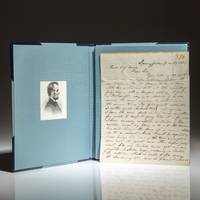
185316994Springfield Ill: Handwritten Letter 1853. ALS. Cloth. Very good. A two-page handwritten letter from Abraham Lincoln to fellow attorney Thomas J. Turner of Freeport Illinois addressing their future legal strategy since ".the Judge has already decided." The letter is dated June 27 1853 and is self-addressed. Octavo 4pp. Previously folded glue remnant along top edge. Several folds of the letter are weakened some partially separated. Small paper loss at intersecting fold with archival tissue repair. The letter is addressed in Lincoln's hand with "Springfield" and "Paid 3" stamped on cover. Housed in custom folding folio quarter blue morocco blue cloth title in gilt on the spine illustration of Lincoln on the front pastedown. This letter concerns the case of Kemper v. Adams & Bovey a land dispute in Freeport Illinois. Lincoln was retained by Adams and Bovey who after a series of losses and appeals prevailed in March 1858 by appealing to U.S. Circuit Court of Northern Illinois. Full letter reads: "Springfield June 27. 1853. / Hon. T. J. Turner: / Dear Sir: Your letter of the 20th. reached me day-before yesterday. I had the day before written to Adams to be on hand with his witnesses- but at the request of Judge Logan who is Kemper's attorney I put in a Post-script saying to Adams if he was agreed the cause should be continued over the summer term. On subsequent reflection I rather wish Adams may not agree. I have the case fresh in my mind and therefore wish to keep it going till it is finished. I have already drafted a Bill of Exceptions and my plan is to put the common lawsuit through the forms of a second trial up to a verdict which must be against us under Judge D's view of the law except & save all the points and then before judgment file our Bill and get an injunction. I shall begin preparing a Bill this afternoon which I which I wish to file during the evening term; and I believe I will do this Mr Adams must come down to swear to the Bill. In no event can we be ready for proof in the chancery suit at this time so that we will need no other witness than the one that was here last summer. I wrote Mr Adams about a Register's certificate & if he can find one or two missing tax receipts let him bring them. I should be glad to see you & shake you by the hand; but as there is no contested jury question I scarcely think you need be at the trouble & expense of coming. All the law questions which can arise at this term the Judge has already decided. Very truly yours A. Lincoln." Provenance: Originally the property of Claribel Mitchell of Freeport Illinois a principal at the Lincoln School until 1916. The letter was sold at auction by the American Art Association on January 30 1923 to Mr. George A. Ball of Muncie Indiana the namesake of the Ball Mason Jar Company. This letter was published in The Collected Works of Abraham Lincoln by Roy Basler New Brunswick NJ: Rutgers University Press 1953 2:199-200. Handwritten Letter unknown
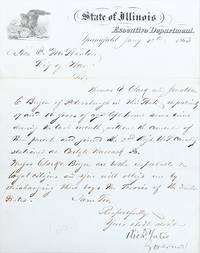
1863192290Springfield Illinois: 22 January 1863. Lincoln intercedes for two runaway boys On the verso of a letter to Stanton from Illinois Governor Richard Yates 1815-1873 the president writes "The families to which these boys belong are among my old acquaintances. A. Lincoln. Jan. 22 1863". Yates 1815-1873 was a longtime friend of Lincoln's. His letter dated 12 January 1863 states that "Thomas E. Clark and Jonathan C. Bergen of Petersburg in this state respectively 17 and 16 years of age left home some time during the last month without the consent of their parents and joined the 2nd Reg't U.S Cavalry stationed at Carlyle Barrack Pa". Yates requests to Stanton that "Messrs Clark & Bergen are both respectable & loyal citizens and you will oblige me by discharging these boys from the service of the United States". Petersburg Illinois is near New Salem where Lincoln lived from 1831 to 1837. Lincoln also received letters from the fathers George S. Bergen and David Clark which he referred to the Adjutant General of the Army Lorenzo Thomas on 21 January Collected Works of Abraham Lincoln Vol. 8 1953 p. 509. Although no one under 18 could legally enlist without the written consent of a parent or guardian many did so. By one recent estimate underage enlistees accounted for roughly a tenth of the Union forces Clarke & Plant. Parents filed thousands of petitions with Union authorities and state courts to secure their children's discharge. Here the families were sufficiently well-connected to appeal at the highest level; Lincoln's endorsement implies that the request was granted. Provenance: Elsie O. and Philip D. Sang their sale at Sotheby Parke Bernet 1978 lot 484; Louise Taper Beverly Hills California; acquired by the Abraham Lincoln Presidential Foundation as part of the Taper Collection 2007; sold by the Foundation at Freeman's Hindman in their Lincoln's Legacy sale 2025 lot 78. Single sheet on State of Illinois Executive Department letterhead 253 x 197 mm handwritten by Yates on recto endorsed by Lincoln on verso alongside a note it was forwarded to Stanton. Central folds repaired still in very good condition. The endorsement is published in Roy P. Basler The Collected Works of Abraham Lincoln First Supplement 1974 page 175. Frances M. Clarke & Rebecca Jo Plant Of Age: Boy Soldiers and Military Power in the Civil War Era 2022. unknown
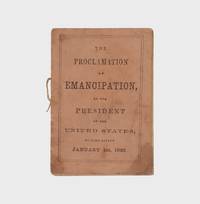
1862376858Boston: J.M. Forbes 1862. 7 1 blankpp. Miniature 3-1/4x2-1/8 inches. Original wrappers unstitched. Small repair to tears at gutter. Housed in a blue morocco backed box. 7 1 blankpp. Miniature 3-1/4x2-1/8 inches. The first and only contemporary printing of Lincoln's historic preliminary Emancipation Proclamation in separate pamphlet form. <br /> <br /> This small pamphlet was printed by John Murray Forbes a Boston industrialist and abolitionist for distribution by Union soldiers to African Americans in the south. In 1899 the publisher's daughter recalled the genesis of this pocket-sized edition: "With the view of placing the Proclamation of Emancipation in the hands of the negroes themselves my father had printed 1000000 copies on small slips one and half inches square put into packages of fifty each and distributed among the Northern soldiers at the front who scattered them about among the blacks while on the march. Massachusetts Senator Charles Sumner approved the idea ." Sara Forbes Hughes Letters and Recollections of John Murray Forbes pp. 348-49. Indeed in a letter to Forbes on Christmas Day 1862 Sumner asked "Why not send to all the hospitals camps posts The more the better" However the diminutive printing's scarcity in institutions and in the market would seem to belie that notion as it is among the rarest of editions of the Proclamation no doubt in part because of its small size. <br /> <br /> The preliminary proclamation of the Emancipation Proclamation was issued on September 22 1862 shortly following the Battle of Antietam and declared the freedom of all slaves in any Confederate state that did not return to Union control by January 1 1863. The text of the final official proclamation was the result of Lincoln's consultation with his cabinet on the morning of Dec. 31 1862 in which many changes were suggested. Lincoln then retired to consider all the cabinet members' recommendations and compose the final proclamation which he completed late in the day just before it would take effect. <br /> <br /> A signal moment in American history and the ideological raison d'etre of America's bloodiest war. Eberstadt 7; Monaghan 147 J.M. Forbes unknown
195300524461Upton Sinclair 1953. First Edition. Unknown. Very Good/No Jacket. 4to - over 9¾" - 12" tall. Believed to be the last of Upton Sinclair's unpublished book-length manuscripts in private hands AMERICAN FABLES is a uniquely important piece of American literary history. Sinclair's body of work dealt with numerous issues and trends in American life society and politics during this era but often as part of a larger character-driven narrative. AMERICAN FABLES was his signal attempt to synthesize these key threads by combining sections of his work with that of other authors. The work takes the form of 30 'Fables' seventeen of which are Sinclair thirteen by others including such prominent American authors and friends Jack London Sinclair Lewis Lincoln Steffens and John Reed. Also included are contributions by Cornelius Vanderbilt Jr the noted anarchist Prince Kropotkin E. W. Scripps Harry Price Prynce Hopkins and others. Sinclair's own seventeen 'Fables' are taken from or based on previously published works authored 1923-48 with new unpublished material composed in 1952. The thirteen 'Fables' of the other authors Jack London Sinclair Lewis et al. are mostly from between the wars but range from 1899 Kropotkin - a bit of an outlier to 1951. This work has been much discussed for decades among Sinclair scholars. It has been described as Sinclair's attempt to create a politically-layered fictionalized history of America between the wars told through key stories taken from his own work and that of others. From what Sinclair told Ron Gottesman it was intended as a domestic 'prequel' of sorts to the Lanny Budd series. It was an outgrowth of several earlier drafts conceived of it is said as an American equivalent to the 'Arabian Nights' or 'One Thousand and One Nights'. Gottesman indicated that after Sinclair worked through a number of drafts for the better part of a decade under a different title see below finishing and sending this 'final' draft to Sinclair's literary agent Bertha Klausner right around the time of the publication of THE RETURN OF LANNY BUDD in 1953 which was the culmination of the enormous series of eleven volumes begun with WORLD'S END in 1940. Sinclair had expected Viking to publish the work or to easily find another publisher. But this was not to be as Senator Joseph McCarthy's incendiary attacks against the Left created such a hostile environment that it intimidated all potential publishers of this new work by the avowed Socialist and one-time Democratic nominee to be Governor of California. After that first flurry of submissions and what Sinclair described to Gottesman as somewhat panicked rejections the work sat forgotten for years in the files of Sinclair's literary agent Bertha Klausner until it was returned to Sinclair in the 1960's. FORMAT: The work is 400 pages typed on white watermarked paper 8.5 x 11 inches with 350 of the 400 leaves bearing holograph additions corrections and excisions mainly by Upton Sinclair but some in the hand of his wife author Mary Craig Sinclair 1 page entirely in holograph. The vast majority of typed leaves are ribbon copies. Pagination is almost entirely supplied by hand correcting the prior typed pagination. The COLLATION is 1-2 17-54 54a 55-189 190-1 192 193a-193b 194-215 261-17 218-263 263a 264-267 267a 268-284 285-99 300-425. PROVENANCE: The estate of Upton Sinclair; by inheritance to his son David by inheritance to David's wife Jean Sinclair. Ink stamp of Sinclair's literary agent Bertha Klausner on title/index leaf. Upton Beall Sinclair Jr. 1878-1968 pioneering muckraker American novelist winner of the Pulitzer Prize author of the influential novel THE JUNGLE which created such public controversy about the meat packing industry that it is in large part credited with the passing of the Pure Food and Drug Act and ultimately to the creation of the Food and Drug Administration FDA. Outside his literary work Sinclair was notable in many fields. He was in some ways a precursor to Bernie Sanders an avowed Socialist who was the Democratic nominee for Governor of California in 1934 running on the EPIC platform End Poverty in California. He and Mary Craig produced Sergei Eisenstein's landmark 'Que Viva Mexico' in 1930-32. He was a pioneer in such diverse fields as nutrition and health cooperative living investigative journalism self-publishing free speech and civil liberties etc. etc. Sinclair's relationships with the authors of the other work included here were often of long-standing. As examples: Jack London had been President of the Intercollegiate Socialist Society with Upton Sinclair as his Vice President and he and Sinclair were lifelong friends. In fact London's futuristic novel THE IRON HEEL 1908 was written in response to Sinclair's THE INDUSTRIAL REPUBLIC 1906 and provided the introduction to Sinclair's pioneering anthology of literature on social protest THE CRY FOR JUSTICE 1915. London also was one of the subjects of Sinclair's anti-alcohol book THE CUP OF FURY 1956. Sinclair Lewis served for two months as janitor of Upton Sinclair's abortive co-operative colony Helicon Hall in Englewood Cliffs NJ which Sinclair established win 1906 with profits from THE JUNGLE it burned down in 1907. BIBLIOGRAPHIC REFERENCES: For discussion of this item and its earlier unfinished incarnations from the prior decade see Gottesman and Silet 'The Literary Manuscripts of Upton Sinclair' #A26. See also G&S A26a-f describing six earlier drafts dating from the 1940's of what became this work under the working titles 'American Nights' Entertainments'. Upton Sinclair unknown
1862WRCAM55729Boston: J.M. Forbes 1862. 7pp. Miniature 3 1/4 x 2 1/8 inches. Original printed salmon wrappers. Slight soiling to wrappers light tanning. Very good. In a cloth chemise and half morocco and cloth slipcase spine gilt. The first and only contemporary printing of Lincoln's historic act in separate pamphlet form the seventh edition overall. The preliminary proclamation of the Emancipation Proclamation was issued on September 22 1862 shortly following the Battle of Antietam and declared the freedom of all slaves in any Confederate state that did not return to Union control by January 1 1863. A quotation by Alexander Stephens "Vice President of the so-called Confederate States" entitled "Slavery the Chief Corner- Stone" is printed on the rear wrapper. This small pamphlet was printed by John Murray Forbes in Boston for distribution by Union soldiers to blacks at the front lines and legend has it that he printed a million copies. Its scarcity in institutions and in the market however would seem to belie that notion; it is among the rarest of editions of the Proclamation no doubt because of its small size. EBERSTADT LINCOLN'S EMANCIPATION PROCLAMATION 7. MONAGHAN 147. J.M. Forbes hardcover books
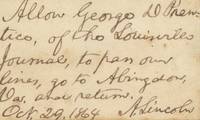
18643503129/10/1864. <blockquote><p>Journalist George D. Prentice's son was a Confederate officer captured by Union forces who would later be charged with murder</p></blockquote><p>George D. Prentice was born in Connecticut on December 18 1802 and graduated from Brown University in 1823. He came to Kentucky in 1830 to write a campaign biography entitled The Biography of Henry Clay and remained in this state until his death on January 22 1870 in Louisville. Prentice became the editor of the Louisville Journal the newspaper of the Whig Party. The main focus of this paper was the promotion of Henry Clay’s agenda and his multiple presidential campaigns. Prentice brought the Journal from upstart newspaper to the most widely read newspaper in the western United States because of his wit and command of the English language. Upon the failure of the Whig Party Prentice supported the Know-Nothing Party. Prentice then supported John Bell and his Unionist platform in the 1860 election calling for the Southern states to stay in the Union. Following the repeal of neutrality in Kentucky the pro-Union Prentice wrote in the Louisville Journal on September 19 1861: “Well thank God we at last have weighed anchor and set out for the haven of safety and of honor. Now let all possible sail be spread and the noble ship of state be driven into the lines of her insolent foe with the whole might of the valor and devotion of her true men.†Prentice became part of Lincoln’s core group of advisors for Kentucky affairs during the war. But despite Prentice’s Unionist satisfaction that Kentucky was no longer neutral his two sons fought in the Confederate army one dying in 1862 and the other being captured in 1863.</p><p>The son of Prentice Clarence J. Prentice was one of the most colorful Kentuckians in the Confederate Army. From 1863 to 1865 he commanded the 7th Confederate Cavalry Battalion. Based in southwestern Virginia the 7th was composed of mountaineers who resided along the Kentucky-Virginia border. The unit was difficult to discipline and was regarded as a ""black sheep"" battalion by other units in the department. While some members of the battalion accompanied Gen. John Hunt Morgan on his last Kentucky raid they were part of the dismounted brigade. Prentice and the balance of the 7th was left behind to guard Pound Gap. In his ""Kentucky Cavaliers in Dixie"" George Dallas Mosgrove left a lively pen portrait of the young officer. He described the 7th as wild and difficult to discipline but added that the men were afraid of Prentice who was a crack shot. Major Prentice was captured on March 31 1863.</p><p>George Prentice wrote to Lincoln to enlist his help in securing a parole for his son. In his letter to Lincoln dated Journal Office Louisville Ky. May 6 1863 Prentice stated: “I wrote to you last week in regard to my son Major Clarence Prentice now a rebel prisoner at Camp Chase. He would ere this have been forwarded for exchange but Gen. Burnside at my solicitation consented to have him detained until I could have time to hear from you. I think there has been time but I have received nothing from you either by mail or telegraph. I know that the pressure of the affairs of state upon you is very great. Perhaps you did not read my letter at all. Major Prentice is the only child left to me. My household is very desolate. My son is tired of the war but unfortunately he thinks the south right. I ask you to direct his release upon his taking the non combatants oath and giving bond and security for its scrupulous observance. If you cannot do this as I painfully fear you cannot I earnestly appeal to you to parole him to stay outside of both the United States and the Southern Confederacy until after the rebellion. I should scarcely venture Mr. President to make this appeal to you but that I think I have served the Union cause faithfully devotedly and successfully. I have suffered very much and sacrificed very much in its behalf—more I am sure than any other man in Kentucky; and I am likely even at the best to suffer and sacrifice much hereafter. I think there is not a candid and intelligent Union man in this state who would hesitate to say to you that I have saved it to the Union politically.</p><p>“And now dear sir pray grant me what I ask in behalf of my only son. His mother is half delirious and so am I. I am scarcely capable of performing my daily duties to the country but if my request were granted I feel I should be buoyant with new life. Please let me know your decision soon for if my son cannot be paroled upon either of the conditions I have mentioned I want him sent forward as soon as possible to City Point as he is extremely uncomfortable in his present situation.â€</p><p>Ten days later Lincoln issued an order written on the back of Prentice's letter instructing General Burnside to parole young Prentice ""to remain outside the limits of both the loyal and disloyal States or so-called 'Confederate States’…during the present rebellion and to abstain from in any wise aiding or abetting said rebellion."" He was released in May 1863. However Clarence Prentice immediately upon his release from Camp Chase violated his oath and re-entered the Confederate Army. He was promoted to lieutenant colonel. Only a few months after his parole he was back to robbing banks burning courthouses and spreading terror and destruction generally along the Kentucky-Virginia border.</p><p>In the fall of 1863 after being released from Union custody Prentice shot and killed a hotel proprietor named White in Abingdon Va. during a ""personal difficulty."" His trial was set for November 8 1864 in Abingdon and his father wanted to attend and assist him at his trial. George Prentice again wrote Lincoln asking for his assistance.</p><p>Lincoln complied with Prentice’s request. <strong>Autograph note signed</strong> Washington October 29 1864.<em> “Allow George D. Prentice of the Louisville Journal to pass our lines go to Abingdon Va. and return.â€</em></p><p>Prentice also wrote to Secretary of State William Seward on October 25 1864. A letter of Captain R. H. Baptist exists October 22 1864 to Prentice offering to give evidence in the forthcoming trial of his son saying “a conversation occurred between White & myself that ought to be made known in the trial of your son by all means.†Prentice sought Seward’s help in lining up Baptist up as a witness for his son: “Capt Baptist who formerly served under my son…and is now a prisoner…at Johnson's Island writes to me some facts which would be of vast importance to my erring child in his approaching trial…and which Capt. B. says he would state on oath…if he could be paroled to the Southern Confederacy or exchanged…I think that the exchange of Capt Baptist would subserve the cause of truth humanity and justice.’’ After being shown Baptist's letter Lincoln arranged for his parole so that he could testify on behalf of Clarence Prentice.</p><p>Thus did Lincoln intervene twice to aid his Kentucky advisor.</p><p>Clarence Prentice was acquitted of the murder charge. He continued to serve in the Confederate Army until the war ended.</p><p><img class=""alignnone wp-image-25018 size-post-window"" src=""https://cdn.raabcollection.com/wp-content/uploads/20231204144051/Folder-site-11-1600x1327.jpg"" alt="""" width=""1600"" height=""1327"" /></p> unknown
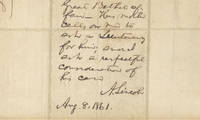
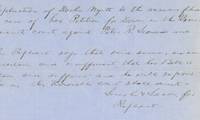
18613521508/08/1861. <blockquote><p>""It is said that the young man named within was in the Great Bethel affair. His mother calls on me to ask a Lieutenancy for him""</p><p> </p><p>We have never before a document on the market referencing Bethel by name or referring to the battle as great</p><p> </p><p>Part of a private collection assembled at Sesslers more than a half century ago</p></blockquote><p>The Civil War formally began with the bombardment of Fort Sumter on April 12–13 1861 but the first sustained clash between organized armies on land was the Battle of Big Bethel also called the Battle of Bethel Church fought on June 10 1861 near Hampton Virginia.</p><p>Virginia's decision to secede from the Union had been ratified by popular vote on May 23 and Confederate colonel later major general John B. Magruder was sent down to the peninsula to deter any advance on the state capital Richmond by Union troops based at the well-defended post of Fort Monroe.</p><p>Confederate forces under Magruder defeated a probing Union attack led by John Adams Dix and field commander Theodore Winthrop who was killed in the assault. The Union objective was to push back Confederate outposts guarding the Yorktown Road but poor coordination and a nighttime friendly-fire incident ruined surprise. When Union troops advanced at dawn they were repulsed by well-positioned Southern artillery and infantry around Big Bethel Church. The battle ended in a Confederate victory providing an early morale boost to the South while exposing the inexperience and disorganization of Union forces in the war’s opening weeks. It confirmed that the conflict would not be short or bloodless.</p><p>Abraham Lincoln was distressed by the Union defeat at Big Bethel. The battle underscored for him the Union's lack of military preparedness and the challenges in finding capable commanders reinforcing his determination to avoid future losses.</p><p>During his presidency Lincoln would regularly meet with members of the public who would wait to see him in the foyer of his office in the White House. This included soldiers and their family members.</p><p>Autograph letter signed Frank J. White as Captain of Company A 10th Regiment Fortress Monroe July 27 1861 seemingly given to the soldier himself or his sent to his family. ""Mr. Charles. J. Seymour has been a member of my company for three months and has gained my highest esteem for the excellent manner in which he has discharged his duties. He is well qualified to hold a much higher position than his present one.""</p><p><strong>Autograph document signed</strong> August 8 1861 on a detached leaf no recipient but likely Secretary of War Simon Cameron. <em>""It is said that the young man named within was in the Great Bethel affair. His mother calls on me to ask a Lieutenancy for him; and I ask a respectful consideration of his case.""</em></p><p>Seymour received the promotion Lincoln requested becoming a lieutenant just weeks later on August 27 1861. He served as Aide-de-Camp on the staff of Gen. Daniel E. Sickles and was later promoted to major. He also assisted in recruiting efforts in New York City.</p><p>This was acquired from Mabel Zahn at Sesslers in the 1970s.</p><p><img class=""alignnone wp-image-25018 size-post-window"" src=""https://cdn.raabcollection.com/wp-content/uploads/20231204144051/Folder-site-11-1600x1327.jpg"" alt="""" width=""1600"" height=""1327"" /></p> unknown
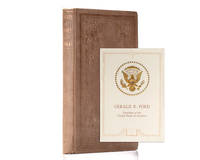
1860149362Columbus: Follett Foster and Company 1860. First edition early issue of the most famous debates in American history which cemented Lincoln as a national presidential candidate. Octavo original cloth stamped in blind. Ownership bookplate of President Gerald R. Ford to the front pastedown. President Gerald R. Ford and Abraham Lincoln occupy distinct yet symbolically linked places in American presidential history united by their encounters with political violence and national division. Abraham Lincoln the 16th president led the United States through the Civil War and became the first American president to be assassinated when he was shot by John Wilkes Booth at Ford’s Theatre in 1865—a moment that transformed him into a martyr for the Union and a symbol of democratic perseverance. Over a century later Gerald R. Ford the 38th president survived two assassination attempts within seventeen days in 1975 both carried out by women—Lynette “Squeaky†Fromme and Sara Jane Moore—amid the turbulence of the post-Watergate era. While Ford’s brush with assassination did not result in tragedy it echoed the lingering volatility of American political life that had claimed Lincoln’s. In near fine condition. An exceptional example with even better provenance. Running as a little-known candidate for the Illinois senatorship in 1858 Lincoln challenged incumbent and Democratic leader Stephen Douglas to a series of debates. The result was a memorable chain of lively arguments in front of cheering crowds. Though Lincoln lost the senatorial race “he began collecting a scrapbook of his best speeches particularly those from the just-concluded campaign against Douglas for possible inclusion in a book. Assiduously pasting newspaper accounts of the debates into the scrapbook Lincoln cast about for a publisher. Initial efforts failed mainly because Lincoln wanted the book printed in Springfield which had no local publishing or printing facilities. Eventually however the Columbus Ohio firm of Follett Foster & Company showed interest and he began preparing the first edition… Somewhat surprisingly for an attorney Lincoln did not seek Douglas’ permission to publish a book of their combined speeches although Douglas was later given the last-minute opportunity—he declined—to make corrections to his own remarks†Morris 121. Follett, Foster and Company hardcover
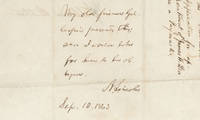
15093547615/09/1863. <blockquote><p>The letter itself was from Lamb a pallbearer after Lincoln's assassination</p></blockquote><p>Joseph Gillespie was a Whig member of the Illinois Assembly in 1840-41 and then served in the State Senate from 1847 to 1859. He joined the Republicans in 1856. Gillespie chaired the Illinois Republican State Convention in 1860 where presidential electors were selected who would vote for Abraham Lincoln and served as circuit court judge in Southern Illinois from 1861 to 1873.</p><p>From when they met in 1840 Gillespie was a key political ally lawyer and trusted and intimate friend to Abraham Lincoln. They consulted on legal cases and in political matters where they kept each other informed of political developments. Gillespie visited President-elect Lincoln at Springfield before he left for Washington. When Lincoln was president Gillespie occasionally went to Washington to see him and kept him informed about the political situation in the western states. Their correspondence shows a close personal bond.</p><p>James L. Lamb was a meatpacker industrialist and friend of Lincoln from Illinois known for his business dealings with the future President and his role as one of the pallbearers at Lincoln's funeral. In a letter addressed to President Lincoln Lamb wrote him from Springfield Ill. September 10 1863 to secure a position for a relative. “My friend and relative Mr. James H. Lea is an applicant for the position of paymaster in the army. His appointment I am sure would meet the approbation of all true friends of the Government who are acquainted with him. I have long known him as a reliable competent businessman and one whose integrity could be fully relied upon. His moral character is without blemish and the most satisfactory assurances can be given of his integrity and fitness for the position.†The docket states “Springfield Sep. 10/63 James L. Lamb to the President. Application for appointment of James H. Lea as a Paymaster.â€</p><p>This letter was not mailed by Lamb to Lincoln. Instead Lamb gave the letter to Gillespie to enlist his support and use his influence with Lincoln. Gillespie presented Lamb’s letter to Lincoln with his request that it be honored.</p><p><strong>Autograph endorsement signed</strong> Washington September 15 1863. <em>“My old friend Gillespie presents this; and I would like for him to be obliged.†</em>This is unpublished and not in Basler’s Collected Works of Abraham Lincoln. The wording of Lincoln’s endorsement saying that Gillespie presented this to Lincoln and the implication that Gillespie will need to be presenting this to the Secretary of War raises the possibility that Gillespie handed this to Lincoln in person and then took the endorsement to Stanton.</p><p>On October 10 Gillespie wrote Lincoln that the appointment had not yet been made and relating a communication with Stanton saying<em> “I would beg to call your attention to the subject of the appointment of my friend James H. Lea of Alton to the office of paymaster in the regular army. Secy. Stanton told me that he would retire one now on the list to make place for Mr Lea in a short time. I have heard nothing from him since. I would take it as a great favor if this thing could be done soon. I am aware how much you must be pressed with business of an engrossing character at this juncture but hope you may find leisure to jog the secretary’s memory.â€</em></p><p>According to papers in the Library of Congress James H. Lea was appointed an additional paymaster of volunteers to rank from February 23 1864. He signed his oath of office in April.</p><p>This is a fascinating endorsement showing how Lincoln sought to assist his old friends to the extent he appropriately could.</p><p><img class=""alignnone wp-image-25018 size-post-window"" src=""https://cdn.raabcollection.com/wp-content/uploads/20231204144051/Folder-site-11-1600x1327.jpg"" alt="""" width=""1600"" height=""1327"" /></p> unknown
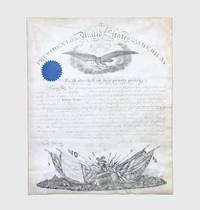
15073254115/07/1864. <blockquote><p>A real rarity the first Lincoln appointment to the Signal Corps for an officer active in Sherman’s Georgia Campaign we have seen</p></blockquote><p>On March 29 1860 the United States House of Representatives approved the Army appropriations bill for fiscal year 1861 which included the following amendment: ""For the manufacture or purchase of apparatus and equipment for field signals $2000; and that there be added to the staff of the Army one signal officer with the rank pay and allowance of a major of cavalry who shall have charge under the direction of the Secretary of War of all signal duty and all books papers and apparatus connected therewith."" The United States Senate eventually approved the appropriations bill over the objections of Jefferson Davis now Senator from Mississippi and President James Buchanan signed it into law on June 21 1860 the date now celebrated as the birthday of the modern U.S. Army Signal Corps.</p><p>Now armies on the go could report back to their civilian leadership in real time and those leaders could make decisions without waiting for a messenger on horse. This changed the face of warfare. President Lincoln himself spent significant time in the telegraph office sending and receiving war correspondence. He often walked alone from the White House to the office and chatted with the operators. As Bates later wrote “During the Civil War the President spent more of his waking hours in the War Department telegraph office than in any other place except the White House. While in the Telegraph Office he was comparatively free from official cares and therefore more apt to disclose his natural traits and disposition than elsewhere under other conditions.â€</p><p>John Quincy Adams first enlisted in 1862 with the 38th Ohio Volunteers. On October 15 of that year he was a quartermaster sergeant with the 10th Ohio Cavalry. After a stint as acting lieutenant on July 15 1864 he was appointed by the President Second Lieutenant to date from March 3 1863. Adams was actively involved in the Georgia campaign conducted by Gen. William T. Sherman. He was with left wing of the 16th Army Corps on the march to Chattanooga Tenn. In the Atlanta Campaign he participated in the battles of Resaca Dallas Kenesaw Mountain. and Jonesboro. He manned signal corps stations at Kenesaw Mt. and Allatoona.</p><p>Adams was in the engagements at Port McAllister and Rice Mill station in the campaign from Savannah through the Carolinas including battles at Columbia Bentonville and Raleigh; and at the surrender of Confederate Gen. Joseph E. Johnston to Sherman on April 26 1865. Adams was breveted 1st lieutenant for gallant and meritorious service in the Signal Corps at the battle of Allatoona; he was breveted captain for gallant and meritorious services in the Signal Corps at the capture of Fort McAllister and Savannah and throughout the war. Adams was mustered out August 22 1865. After the war he was in the 1st U. S. Cavalry and was in the Indian wars and finished his career as captain and aide to Gen. O.O. Howard in October 1884. He is listed on the roster of the U.S. Signal Corps in the Civil War.</p><p>Adams is also a protagonist in one of the most famous telegraph exchanges of the war during the battle near Allatoona. During this battle legend goes that Sherman signaled to General Corse and his men to ""hold the fort"" a phrase that inspired the later popular religious hymn entitled Hold the Fort by Chicago evangelist Philip P. Bliss which featured the chorus 'Hold the fort for I am coming’ which then became a common expression. We still use ""hold down the fort"" today. Adams was the signal officer who received that message or rather a variant as Sherman did not use that exact phrase though captured the sentiment.</p><p>This is President Lincoln’s appointment of Adams as Second Lieutenant. <strong>Document signed</strong> Washington July 15 1864 naming Adams <em>""Second Lieutenant in the Signal Corps""</em> dating from the third of March 1863.</p><p>This document is a real rarity as we have never before seen a Lincoln appointment to the Signal Corps for an officer active in Sherman’s March to the Sea. Moreover Lincoln Signal Corps appointments are themselves uncommon this being our first.</p><p>It was acquired from the Adams descendants and has never been offered for sale before.</p><p><img class=""alignnone wp-image-25018 size-post-window"" src=""https://cdn.raabcollection.com/wp-content/uploads/20231204144051/Folder-site-11-1600x1327.jpg"" alt="""" width=""1600"" height=""1327"" /></p> unknown
18623341204/03/1862. <p>As 1862 opened the war was not going well for the Union. In the east Bull Run had been a disaster and led to the shake-up of command with no results yet to show for it. In the west the loss at Wilson’s Creek gave the Confederates the upper hand. The Federal armies in the west then turned their attention to implementation of the Anaconda Plan – to cut the Confederacy in half by securing the Mississippi River from St. Louis all the way to the Gulf of Mexico and clearing a maritime invasion route into the heart of the Confederacy by taking the Tennessee and Cumberland Rivers which lay just to the east of the Mississippi. If successful these maneuvers would cut Texas Arkansas and Louisiana off from the main body of the South hold Kentucky and Missouri firmly in the Union and make it difficult for Tennessee to cooperate with her sister Confederate states. The first moves would be to take and hold commanding locations north on the Tennessee and Cumberland rivers and command of the operation was given to Brig. Gen. Ulysses S. Grant an obscure and largely unproven officer.</p><p>On February 6 1862 Fort Henry commanding the Tennessee River was captured by Grant’s forces. It had a poor defensive position and was reduced mainly by the bombardment of gunboats on the river. Nonetheless its fall opened the Tennessee River to Union gunboats and shipping past the Alabama border and provided a real victory for Union arms. Grant next focused his attention on Fort Donelson eleven miles away on the more strategically important Cumberland River. This fort had a much stronger physical position and the Confederates had placed some 20000 men and a number of senior commanders on site to engage in its defense. They were not about to concede the fort and they were ready and waiting for Grant. Grant arrived at Fort Donelson late on February 12 and on the 13th established his headquarters near the left side of the front of the line. That day was spent in battle preparation with a few small probing attacks being carried out against the Confederate defenses.</p><p>Grant's headquarters was at Cairo Ill where the head of Ordnance was Stephen Lyford. Grant arrived at Fort Donelson late on February 12 and on the 13th established his headquarters near the left side of the front of the line. That day was spent in battle preparation with a few small probing attacks being carried out against the Confederate defenses.</p><p>The battle was severe with nearly 1000 soldiers on both sides killed and about 3000 wounded. When Simon Buckner the Confederate commander asked for surrender terms Grant famously replied “No terms except unconditional and immediate surrender can be accepted“ adding “I propose to move immediately upon your works.†Buckner surrendered his command of about 15000 men; this was the first of three Confederate armies that Grant captured during the war.</p><p>The capture of Fort Donelson gave the North control of the Cumberland River which provided the road that opened the Deep South to Union invasion. It boosted morale in the North which now saw that the war could result in great victories and not just defeats. It gave President Lincoln the fighting general he was looking for and it made Grant’s career in the process; he was soon promoted to major general of volunteers.</p><p>Stephen C. Lyford had a long and distinguished career. He served from May to August 1861 in the defenses of Washington D. C. and in the Manassas Campaign participating in the Battle of Bull Run July 21 1861. He was Aide-de_Camp to Brig. General McDowell in the defenses of Washington D. C. August to October 1861 and Asst. Ordnance Officer at St. Louis Arsenal Mo. November 2 1861 to February 1 1862; in command of the Cairo Ordnance Depot Ill. February to May 1862 being detached to the Cumberland River and was present at the Surrender of Ft. Donelson. He was part of Gen. Halleck's Mississippi Campaign May to July 1862 being engaged in the Siege of Corinth May 1862 and was Chief of Ordnance for Department of the Tennessee July 11 1862 to September 6 1863 and fought in the Battle of Corinth. He would go on to teach at West Point and also serve as aide-de-camp for Gen. Halleck and as representative of the US to Japan to bring back information and technology relevant for American ordnance.</p><p><strong>Document signed</strong> with engravings of flags and weapons Washington March 4 1862 Naming Lyford a <em>“Second Lieutenant in the Ordnance Department.""</em></p><p><img class=""alignnone wp-image-25018 size-post-window"" src=""https://cdn.raabcollection.com/wp-content/uploads/20231204144051/Folder-site-11-1600x1327.jpg"" alt="""" width=""1600"" height=""1327"" /></p> unknown
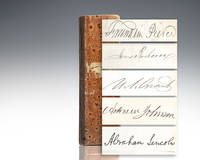
18771465621877-1880. Unique 19th-century autograph album containing the signatures of six American presidents fifteen senators several cabinet members and governors including Abraham Lincoln Ulysses S. Grant James Buchanan and Franklin Pierce. Narrow quarto bound in one quarter period dark brown cloth over stiff marbled wrappers the autograph album is a repurposed 19th-century caucus record dating from ca. 1870. The caucus book is alphabetically tab-indexed and filled out in ink voters are tracked by their name with caucus results appearing in the back. Although this is labeled “Ward 5†in the first page the term "Ward" was flexible in its usage. This could have been for a Ward election precinct caucus legislative congressional or state convention caucus. The autographs are mounted over the caucus records in their respective alphabetical tab. Also mounted at front are 6 printed pieces of 19th-century ephemera. The autograph album was assembled between 1877 and 1880 and can be dated by a contemporary pencil note that John Sherman had transitioned from the Senate to be Secretary of the Treasury. From the collection of a Mr. Boyd a 19th-century Ward politician in the upper Midwest Minnesota or Wisconsin. The Presidential autographs are primarily clipped from Presidential appointments and include: Abraham Lincoln James Buchanan Ulysses S. Grant Andrew Johnson Franklin Pierce and Rutherford B. Hayes. In very good condition. A very rare and unique collection. hardcover
18433570010/1843. <blockquote><p>Miles who was also a prominent Whig politico and part of Lincoln’s political circle used Lincoln’s legal services a number of times</p></blockquote><p>Abraham Lincoln and Stephen T. Logan formed a prominent Illinois law partnership called Logan & Lincoln from 1841 to 1844 during which Logan an experienced attorney mentored Lincoln and introduced him to complex areas of the law. During his partnership with Logan Lincoln also increased his caseload before the Illinois Supreme Court and handled appeals from all areas of the state. Logan and Lincoln handled many cases together not merely at their Springfield office but around the state. This ls because Lincoln had a circuit law practice that involved riding the Eighth Judicial Circuit in Illinois covering 14-15 counties including Menard County on horseback or buggy. Logan remained in Springfield while Lincoln traveled the Circuit. As a general practitioner Lincoln handled diverse cases including property disputes debts torts. slander and criminal law. The Logan & Lincoln partnership ended amicably in 1844 after which Lincoln partnered with William H. Herndon who was a clerk in the Logan & Lincoln law office and whose father had been a Lincoln friend for many years.</p><p>George U. Miles was Herndon’s father-in-law. He came to Illinois in 1816 at age 20 settling first in St. Clair County and then in White County where he married Jane McCoy on November 18 1821. They had three children. Miles removed to Logan County and then in 1836 he went to Sangamon County where he lived on a farm six miles north of Springfield. In 1839 he moved to Petersburg in Menard County where he served as public administrator from 1845 to 1849. Miles was a Whig and a Menard County delegate to conventions that chose Whig candidates. Miles and Lincoln knew each other as neighbors and fellow Whigs and also because of Miles’ family relationship to Lincoln’s friend and partner Herndon. In early 1843 Lincoln sought a nomination for Congress and hoped for Miles’ political support.</p><p>Miles used Lincoln as an attorney a number of times both before and after Herndon became Lincoln’s partner. In late 1843 Miles retained Logan & Lincoln and sued John Webb and Thomas Rogers to collect a $368.60 debt on a promissory note.</p><p><strong>Autograph document signed</strong> all in Lincoln’s hand Menard County Illinois October-November 1843 being a petition in the county court in which Miles asks for judgment for a debt. <em>“George U. Miles plaintiff states that he holds a note on the defendants John Webb and Thomas Rogers in substance as followeth: ‘$368.60. One day after date we or either of us promise to pay George U. Miles or order three hundred and sixty eight dollars and sixty cents with twelve percent interest from date for value received. Our hands & seals: John Webb and Thomas Rogers Petersburg Ill. April 20th 1843.’ Yet the same debt remains unpaid wherefore he prays judgment for his debt and damages for the detention of the same together with his costs. Logan & Lincoln.â€</em></p><p>Lincoln won the case. The defendants were found to have defaulted and the court awarded Miles $392.67 counting costs. The case was decided November 1 1843. It is listed at lawofficeofabrahamlincoln.org.</p><p>After Lincoln’s assassination Miles acted as one of Herndon's key investigators. Miles famously interviewed individuals including Ann Rutledge’s aunt to gather information about Lincoln's early life and relationships serving as a vital source for Herndon's research. Herndon would write a famous biography of Lincoln in the 1880s.</p><p><img class=""alignnone wp-image-25018 size-post-window"" src=""https://cdn.raabcollection.com/wp-content/uploads/20231204144051/Folder-site-11-1600x1327.jpg"" alt="""" width=""1600"" height=""1327"" /></p> unknown
18643560801/08/1864. <blockquote><p>This appointment is listed in War Department General Orders no. 256</p></blockquote><p>According to the National Museum of Civil War Medicine and other sources Lt. Adam Miller of the 2nd Mass. Vols. aged twenty-three years was badly wounded August 9 1862 at the Battle of Cedar Mountain by an elongated musket ball which entered below the right eye socket and traversing the nasal cavity emerged through the left eye socket destroying the globe of the left eye and lacerating the left lower eyelid. He was made a prisoner and taken to a hospital at Charlottesville Va. where his wound ultimately formed a scar with great deformity. After being exchanged he entered the New York Eye Infirmary and on April 10 1863 a plastic surgical operation was performed by Dr. Henry B. Sands for the restoration of the eyelid. The operation was eminently successful and on April 22 1863 the parts were sufficiently healed to permit the insertion of an artificial eye. He thus survived a catastrophic facial wound and underwent pioneering plastic surgery.</p><p>Due to his injuries which made him unfit for active field duty but still capable of light service he was transferred to the Veteran Reserve Corps in August 1863 with his commission dating back to June 27 1863. The Veteran Reserve Corps was a military organization of the Union Army created for partially disabled or otherwise infirm soldiers who could still perform simple duties such as guarding prisoners or patrolling cities. This appointment is listed in War Department General Orders no. 256.</p><p><strong>Document signed</strong> with engravings of an eagle flags and weapons Washington August 1 1864 naming Adam Miller a lieutenant in the Veteran Reserve Corps effective June 27 1863.</p><p>An extraordinary Lincoln appointment of a soldier who made medical history in the Civil War.</p><p><img class=""alignnone wp-image-25018 size-post-window"" src=""https://cdn.raabcollection.com/wp-content/uploads/20231204144051/Folder-site-11-1600x1327.jpg"" alt="""" width=""1600"" height=""1327"" /></p> unknown
18611571129/03/1861. <p>James E. Harrison though born in Virginia served the Union cause during the Civil War. He received his first appointment as a Second Lieutenant to the 2d U. S. Cavalry in June 1856 and was stationed in Texas and various forts in the West until December 1858 when he was assigned to scouting Indians. He returned East and with the Civil War imminent he was promoted to First Lieutenant 2d U.S. Cavalry in March 1861 and then to Captain 5th U.S. Cavalry in May of that year. Harrison was engaged in the Peninsular campaign and commanded a regiment in the Army of the Potomac from September 1862 to June 1863. During that time he served at the battles of Antietem Chancellorsville and Brandy Station among many others. He was Breveted Major U.S. Army for gallant and meritorious services at the battle of Hanover Court House and Brevet Lieutenant Colonel U.S. Army for gallant and meritorious services at the battle of Antietam. In July of 1864 Harrison was assigned to be Inspector-General of Cavalry in the Department of Arkansas and was later appointed as Special Inspector of Cavalry in West Mississippi.</p><p><strong>Document signed</strong> as President Washington March 29 1861 effective retroactively to February 27 1861 an ornate vignetted commission with an eagle cannons and flags appointing Harrison to the rank of “First Lieutenant in the Second Regiment of Cavalry.†The document is countersigned by Secretary of War Simon Cameron.</p> unknown
14952US President who guided the nation through Civil War and was famously assassinated. 2 page recto verso Manuscript Document Signed by Lincoln on June 19 1862 the same date on which he signed the historic bill abolishing slavery in the U.S. territories. In this document Lincoln extends mercy to an inmate by providing a pardon. Measures 10.75x16.5".Lincoln issued this pardon after several petitions arrived on Lambert's behalf emphasizing his family's financial need as well as the support of two convicting juror at his trial five years prior. <br/><br/>This pardon states in part: "Whereas at the December Term A.D. 1857.Isaac Lambert was convicted on two indictments for Larceny and was sentenced to imprisonment in the Penitentiary for the term of three years under each conviction;-And whereas the said Isaac Lambert has served over three-fourths of his double term of six years in a patient penitent and exemplary manner;-And whereas it appears that the family.are in a destitute condition and that his labor is necessary for their support.I Abraham Lincoln President of the United States of America.grant unto him the said Isaac Lambert a full and unconditional pardon." Boldly signed at the conclusion "Abraham Lincoln" with a white paper seal affixed to the upper left that remains fully intact. <br/><br/>In addition to granting this individual mercy to Lambert on June 19 Lincoln also initiated the process of abolition in the U.S. by signing a historic bill that banned slavery in all current and future U.S. territories. Overturning the controversial Dred Scott decision in which the Supreme Court had denied the federal government regulatory power over the territories' slave trades and policies Lincoln took a public action that helped the nation move closer to emancipation within the states. In cooperation with Lincoln Congress enacted legislation on June 19 emancipating slaves in the territories and banning slavery there hereafter. The law read simply: "Be it enacted by the Senate and House of Representatives of the United States of America in Congress assembled That from and after the passage of this act there shall be neither slavery nor involuntary servitude in any of the Territories of the United States now existing or which may at any time hereafter be formed or acquired by the United States otherwise than in punishment of crimes whereof the party shall have been duly convicted." This straightforward legislation paved the way for the Emancipation Proclamation which Lincoln announced in September 1862 and signed into effect on January 1 1863.<br/><br/>A highly desirable example signed at an important moment in the abolition of slavery.To obtain a signed document or letter directly relating to Emancipation would likely cost over $1 million today. At the height of the financial crisis in 2008 a document by Lincoln affixing the seal of the President "on my Proclamation" without mentioning the word "emancipation" sold for $800000. Repaired separations to intersecting folds one vertical fold passing through a single letter of the signature and scattered toning otherwise fine condition. unknown books
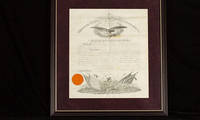
1864132067April 21 1864. American naval commission signed by Abraham Lincoln as President of the United States and Gideon Welles as Secretary of the Navy. Folio partially engraved on vellum the document is dated April 21 1864 and promotes Charles W. Tracy to the rank of Lieutenant. In near fine condition. Matted and framed with a portrait of Lincoln and engraved plate. The Commission measures 19 inches by 16 inches. The entire piece measures 34 inches by 29.5 inches. Abraham Lincoln served as the 16th President of the United States from March 1861 until his assassination in April 1865. He led the United States through the American Civil War the country's greatest moral cultural constitutional and political crisis and in doing so preserved the Union of the United States of America abolished slavery and strengthened the federal government. Lincoln ran for President in 1860 sweeping the North in victory. The South was outraged by Lincoln's election and in response secessionists implemented plans to leave the Union before he took office in March 1861. War began in April 1861 when secessionist forces attacked Fort Sumter in South Carolina just over a month after Lincoln's inauguration and after years of deadly military conflict officially ended on April 9 1865 when Confederate General Robert E. Lee surrendered to Union General Ulysses S. Grant at the Battle of Appomattox Court House. On April 14 1865 just days after the war's end at Appomattox Lincoln was attending a play at Ford's Theatre with his wife Mary when he was assassinated by Confederate sympathizer John Wilkes Booth. Lincoln is remembered as the martyr hero of the United States and is consistently ranked as one of the greatest presidents in American history. hardcover
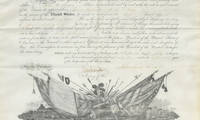
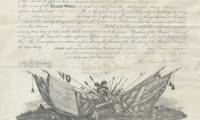
1863172650Washington DC: 10 March 1863. Signed four months before the Battle of Gettysburg A military appointment signed by Abraham Lincoln at the height of the American Civil War. Such documents were instruments of authority and means of identification as soldiers crossed through military lines and took command. The document appoints James Gillette to the position of "Commissary of Subsistence of Volunteers with the rank of Captain". James Gillette 1838-81 enlisted as a private and rose quickly through the ranks. He served as Commissary of Subsistence for the 2nd Division XII Corps under General John W. Geary. For his meritorious service he was breveted lieutenant colonel U.S. Volunteers and for gallantry at the battle of Chancellorsville he was breveted major in the regular Army. A week earlier on 3 March Lincoln signed the Conscription Act mandating the impressment of able-bodied young men into the service of the Union Army. A clause allowing for exemption by paying a fee provoked national fury leading to riots in New York. Engraved military appointment 415 x 340 mm on vellum with the sections accomplished in manuscript attractive cartouche of the American eagle at the head and large trophy of arms at the foot engraved by J. V. N. and O. H. Throop blue wafer seal at left War Department docketing notations at upper left. Mounted and framed with UV conservation glazing framed size 64 x 53 cm. Originally folded into sixths leaving light creases as usual. Slightly discoloured at extremities ink a little faded but still clear. In very good condition. hardcover
1862190938Washington DC: 28 July 1862. Taxing the new state of Oregon to fund the Civil War Lincoln appoints Lawrence White Coe collector of federal taxes for the State of Oregon. In August 1861 Congress passed a new direct tax to fund the Civil War. Oregon's share was $35000 seven eighths of the state's annual revenue Bancroft p. 640. The measure marked both a substantial expansion of federal taxation and a wartime extension of presidential patronage through the appointment of tax officers. Oregon had become a state in 1859. Coe 1831-1897 resident in Wasco County had opened steam navigation on the upper Columbia River with the stern-wheeler Colonel Wright which was contracted to carry army supplies to Fort Walla Walla. His father Nathaniel Coe had been appointed by President Fillmore as the first postal agent in the Northwest. Printed document with manuscript additions 281 x 434 mm embossed seal of the US Treasury. Presented in a wooden frame with conservation acrylic glazing 555 x 425 cm. Minor chipping at extremities tape residue on verso from former framing minor soiling and light spotting. In very good condition. Hubert Howe Bancroft History of Oregon Vol. II 1888. unknown
18533514603/11/1853. <blockquote><p>The case is well known and illustrates Lincoln’s penchant for aiding women who had been unjustly treated</p></blockquote><blockquote><p>""Said answers are untrue uncertain and insufficient that her Bill is true certain and sufficient and he Lincoln will so prove it to be""</p><p> </p></blockquote><p>During his 25-year legal career in Illinois Abraham Lincoln was involved in a substantial number of cases involving women as litigants. He was known for seeking to represent women and working to get justice for them in an era when women’s cases were often shunned by lawyers or not taken seriously.</p><p>Lincoln handled some 147 divorce cases about 40% of all divorce cases in his home county of Sangamon. Importantly more than half of the litigants he represented were women. He handled these cases with ""tender consideration"" learning from experience that the law could be a dangerous place for women who had few rights under the legal doctrines of the time. Lincoln also represented women in cases involving land disputes and in slander lawsuits which often involved accusations of adultery and were important for maintaining a woman's community reputation.</p><p>Lincoln was known for taking cases for women where he felt justice was on his client's side. Notable examples include: Nance Legins-Costley - In 1841 Lincoln successfully represented this African American woman to prevent her from being sold into slavery arguing that slavery was illegal in Illinois; Melissa Goings - He defended Mrs. Goings an elderly woman charged with her abusive husband's murder in a case based on self-defense; Doshia Wyatt - In 1853 Lincoln took on the case of Mrs. Wyatt a widow whose claim was that she was being cheated out of her inheritance.</p><p>A petition for dower is a legal request filed by a surviving spouse typically a widow to claim a portion of their deceased spouse's estate such as in real property based on common law dower rights. This is a formal process that requires the surviving spouse to file a petition in court describing the property and naming the heir or person with the next immediate estate of inheritance. The court then holds a hearing to determine the rights to dower and the property.</p><p>Doshia Wyatt widow of Robert Wyatt retained Lincoln and sued for her dower. Thomas Wyatt died in 1847 and left all of his property to his son Robert. Robert Wyatt lost part of the land the Mill Farm to satisfy a judgment against him in the U.S. District Court of Illinois. Robert Wyatt sold another property the Prue Farm to George Brewner. After Robert Wyatt's death in 1852 Doshia Wyatt sued Leonard and Brewner's heirs. Leonard contested the petition claiming that he did not believe Doshia and Robert Wyatt had been legally married. Leonard also claimed that Robert Wyatt had already left Doshia Wyatt land in his will which Leonard claimed was recorded.</p><p>Hearing the case was Judge David Davis a friend of Lincoln whom as President he would appoint to the U.S. Supreme Court. Ward Hill Lamon Lincoln’s co-attorney on the case began his professional association with Lincoln in 1852 when they became law partners. Though they had different styles they remained close personal and professional friends. After the partnership dissolved in 1857 their friendship continued and Lamon would later become Lincoln's bodyguard and U.S. Marshal for the District of Columbia during Lincoln's presidency. As the bodyguard Lamon was not in Washington on the night of Lincoln’s assassination being on assignment in Richmond at Lincoln’s request. In his Recollections of Abraham Lincoln Lamon reveals that before he left for Richmond he implored the President not to ""go out at night after he was gone particularly to the theatre.""</p><p>This document relates to the case of Doshia Wyatt. In a petition to the Court filed by Lincoln Wyatt stated her case: “Your petitioner would further represent to your honor that she your petitioner is the widow of the said Robert Wyatt — that she has never relinquished her dower to the said aforesaid land or any part thereof - nor has her dower ever been set off - or assigned her in said premises - that said Robert Wyatt on or about the 28th of July AD 1852 departed this life leaving her the said Doshia widow as aforesaid…Your petitioner would further pray that this honorable court appoints commissioners to assign her dower in & to all of the above described tracts or parcels of land according to the statue in such cases made and approved. And your petitioner would pray for such & gather relief as may be according to equity and good conscience and as in duly abound your petitioner will ever pray.â€</p><p>This is a pleading in Lincoln’s hand which contains the answer of Wyatt to the defendants’ responses to her allegations. <strong>Autograph document signed</strong> Vermillion County Illinois Circuit Court November 3 1853. <em>“The replication response of Doshia Wyatt to the defendants’ answers filed in the case for her Petition for Dower in the Vermillion Circuit Court against Peter R. Leonard and others. This repliant respondent says that said answers are untrue uncertain and insufficient that her Bill is true certain and sufficient and he Lincoln will so prove it to be as this Honorable Court shall direct. Lincoln & Lamon for Repliant respondent.â€</em> On the verso Lincoln has docketed the document <em>“Dosha Wyatt vs Peter R. Leonard Replication.â€</em> The clerk of court Samuel Craig then notes that the plea was filed on November 3 1853.</p><p>An uncommon document in Lincoln’s hand concerning his representation of women. As for the case the parties likely reached a settlement as Wyatt ended up dismissing the case while Leonard paid the costs.</p><p><img class=""alignnone wp-image-25018 size-post-window"" src=""https://cdn.raabcollection.com/wp-content/uploads/20231204144051/Folder-site-11-1600x1327.jpg"" alt="""" width=""1600"" height=""1327"" /></p> unknown
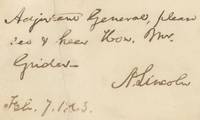
18633619207/02/1863. <blockquote><p>This document has been in a private collection for a generation</p><p> </p><p>Kentucky Unionists were important to Lincoln a Kentucky native as he famously said ""I hope to have God on my side but I must have Kentucky.â€</p><p> </p><p>The Congressman Henry Grider apparently needed to see Thomas to discuss the Act its impact on Kentucky and the details of how the recruitment would be handled</p></blockquote><p>Kentuckian Henry Grider was a Whig who served in Congress from 1843-1847 and then as a Unionist from March 4 1861 until 1865. For the Thirty-ninth Congress 1865–1867 Grider shifted to the Democratic Party but retained his commitment to the Union serving from March 4 1865 until his death in office on September 7 1866. Grider represented a Kentucky pro-slavery but Union-loyal constituency and he retained that point of view throughout the Civil War. Kentucky Unionists like Grider were particularly important to Abraham Lincoln a Kentucky native who had famously said ""I hope to have God on my side but I must have Kentucky.†Lincoln is known to have consulted with Grider about Kentucky affairs and relied on his support and that of the Kentucky delegation to Congress.</p><p>On February 7 1863 Congress passed an Act providing that “the Governor of the State of Kentucky by the consent and under the direction of the President of the United States shall have power to raise and organize into regiments a volunteer force not exceeding twenty thousand rank and file to be raised within the State of Kentucky to serve for the term of twelve months to be employed within the limits of Kentucky in repelling invasion suppressing insurrection and guarding and protecting the public property: Provided That at any time it may be necessary in the discretion of the President of the United States these troops may be employed out of the limits of Kentucky against the enemies of the United States.â€</p><p>Thus the Governor of Kentucky would raise a force of 20000 volunteers to serve in Kentucky but President Lincoln had the authority to order them used outside the state. This Act was received with mixed reviews in Kentucky and on the very day it was enacted Grider’s son Benjamin C. Grider a slave-holding Unionist resigned from the Union Army. From the timing of his resignation one can surmise that he disapproved of the Act. He had commanded the 9th Kentucky Volunteers.</p><p>Lorenzo Thomas was the Adjutant General of the U.S. Army at that time and his job was to maximize operational effectiveness of the army by manning recruiting for and sustaining military operations.</p><p><strong>Autograph note signed</strong> Washington February 7 1863 the day of the Act to Lorenzo Thomas expediting Grider’s ability to see Thomas. <em>“Adjutant General Please see and hear Hon. Mr. Grider. A. Lincoln.â€</em> It seems clear that Grider needed to see Thomas to discuss the Act its impact on Kentucky and the details of how the recruitment would be handled and managed. Not in Basler. A separation running vertically archivally mended.</p><p>This is a very scarce communication involving Lincoln aiding a Kentucky Unionist.</p><p><img class=""alignnone wp-image-25018 size-post-window"" src=""https://cdn.raabcollection.com/wp-content/uploads/20231204144051/Folder-site-11-1600x1327.jpg"" alt=""historical memorabilia dealer"" width=""1600"" height=""1327"" /></p> unknown
18623568928/02/1862. <blockquote><p>He was later promoted to Lt. Colonel for gallantry in action at the Battle of Groveton</p></blockquote><p><strong>Document signed</strong> with fine engravings of an eagle flags and cannons Washington February 28 1862 naming Percy B. Spear a Commissary of Subsistence of Volunteers with the rank of Captain effective November 30 1861. The document is countersigned by Secretary of War Edwin M. Stanton. The appointment is listed in the U.S. Army Register.</p><p>The Civil War Commissary Department was responsible for procuring storing and distributing food to soldiers. The rations managed by the department included such things as pork beef bread coffee and soap.</p><p>But Spear did not serve solely as a Commissary for the entire war. He would soon serve an aide-de-camp in the Fifth Corps in the Gettysburg campaign with Gen. James Barnes mentioning him with distinction in dispatches. Spear ended the war as a Brevet Major. In July 1865 he was appointed Lt. Colonel of Volunteers for meritorious service and for gallantry in action at the Battle of Groveton in 1862. After the war he was again named Commissary of Subsistence this time at the recommendation of Gen. George G. Meade.</p><p><img class=""alignnone wp-image-25018 size-post-window"" src=""https://cdn.raabcollection.com/wp-content/uploads/20231204144051/Folder-site-11-1600x1327.jpg"" alt="""" width=""1600"" height=""1327"" /></p> unknown