Abraham LincolnBiblio.com
11 347 résultats
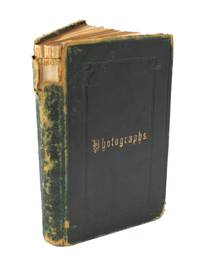
1864175101864. Abraham Lincoln and Civil War Figures Album of pasted oval portraits with signatures underneath each image. 1861. Features most notably Abraham Lincoln with a pasted signature below his image. This mid-nineteenth-century photographic album assembles oval portraits of political and military figures during the Civil War era including a pasted signature beneath an engraved portrait of Abraham Lincoln on the 15th page. Dated inscriptions from 1861 situate the compilation at the outset of national conflict. The inclusion of Lincoln Henry Clay and numerous uniformed figures reflects contemporary practices of collecting and memorializing political leadership through photographic reproduction and autograph acquisition.<br /> <br /> Photographic album measuring approximately 4.5 x 7 inches. Dark green morocco boards with gilt "Photographs" title. Contains 93 black-and-white and sepia portraits most approximately 2.5 x 2.25 inches mounted on pages. Lincoln portrait with separate pasted signature "A. Lincoln"; Henry Clay portrait with pasted signature; additional signatures written directly on album leaves. Spine chipped at head with separation; rubbing along margins; binding intact; photographs generally clear with minor age toning. Overall condition very good. he album reflects nineteenth-century commemorative culture preserving images and autographs of national figures during a transformative political moment. unknown
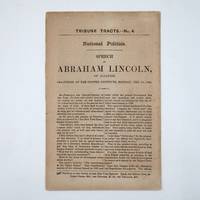
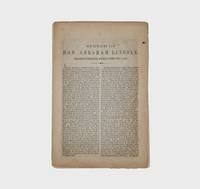
18602444New York: New York Tribune 1860. First edition. Original wrappers. Very Good. FIRST EDITION of Lincoln's historic Cooper Union Address delivered on February 27 1860 at the Cooper Institute in New York. The speech is largely credited to having launched Lincoln's Presidential bid. In the fall of 1859 James A. Briggs who served on the lecture committee of the Plymouth Church in Brooklyn invited presidential candidate hopeful Abraham Lincoln to speak to a New York audience on any subject of his choosing. Lincoln accepted the invitation choosing to speak of the current political climate in America. William O. Stoddard an Illinois journalist who worked for President Lincoln during his administration noted that "No previous effort of his life cost him so much hard work as did that Cooper Institute speech" and that the resulting speech "was a masterly review of the history of the slavery question from the foundation of the government with a clear bold statesmanlike presentation of the then present attitude of parties and of sections. It exhibited a careful research a thorough knowledge and understanding of political movements and developments that staggered even the most laborious and painstaking students. It showed a grasp a breadth a mental training and a depth of penetration which compelled the admiration of critical scholars" Stoddard Abraham Lincoln: The True Story of a Great Life. <br /> <br /> "Horace Greeley had rushed out the speech in pamphlet form as 'Tribune Tract' Number 4 under the headline: National Politics. Speech of Abraham Lincoln of Illinois Delivered at the Cooper Institute Monday Feb. 27 1860. The pamphlet was ready March 6 while Lincoln was still traveling through Connecticut. When he returned to New York he found it already available to the public. <br /> <br /> "Greeley marketed the eleven-page Tribune edition aggressively. As a bonus the publication included Wisconsin Republican senator James Doolittle's February 24 speech attaching 'the new doctrine of judicial infallibility' as did Lincoln's address at Cooper Union just three days later and also like Cooper Union railing agains 'the headstrong zeal pursued by the other party to force slavery into Territories'.<br /> <br /> "It was as if Republicans were now speaking with one voice: identifying with the founders attacking the Dred Scott decision rebuking John Brown and drawing their own 'dividing line' on slavery extension. Lincoln did not say it alone; but he said it best. 'Mr. Lincoln's is probably the most systematic and complete defense yet made of the Republican position with regard to Slavery' the Tribune declared in its initial advertisement for the reprints. 'We believe no speech has yet been made better calculated to win the intelligent minds over to our standard. Will the friends of the Cause everywhere aid us to circulate it'<br /> <br /> "The answer was yes. The Tribune Tract edition proved enormously popular going through at least five additional editions. Lincoln's New York oration was enjoying a new and sustained life in pamphlet form and was being purchased individually and in bulk alike by admirers and groups across the North.<br /> <br /> "The Cooper Union address tested whether Lincoln's appeal could extend from the podium to the page and from the rollicking campaigns of the rural West to the urban East. Cooper Union held the promise of transforming Lincoln from a regional phenomenon to a national figure. Lincoln knew it and rose to the occasion." Harold Holzer Lincoln at the Copper Union: The Speech That Made Abraham Lincoln President.<br /> <br /> New York: New York Tribune Tribune Tracts No. 4 1860. Octavo original wrappers; custom box. Lincoln's speech comprises pages 1-11 out of a total of 16 pages. With New York Tribune ads and subscription terms on rear wrapper. Only a spot of soiling in the bottom margin of the rear wrapper creeping lightly into preceding leaves. A beautiful copy in a remarkable state of preservation. RARE. New York Tribune unknown books
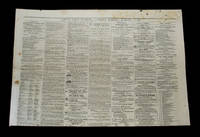
186369186Boston: Boston Daily Courier 1863. Full Description:<br> <br> LINCOLN Abraham. Emancipation Proclamation."President's Proclamation. Emancipation of Slaves in Rebellious States." Boston. Published in: Boston Daily Courier Volume LXXVIII no. 2. Friday Morning January 2 1863.<br> <br> The publication of Lincoln's Emancipation Proclamation in the Boston Daily Courier and one of if not the first official public announcements of the Final Emancipation Proclamation once it was signed and in effect as of January 1 1863. The Proclamation is featured at the top of the center column of page 3.<br> <br> We could find no other copies of this or any other January 2nd edition at auction and it is not mentioned in Eberstadt. Eberstadt's entry for the second edition of the "Final Proclamation" Eberstadt 9 states "Second edition. Apparently the only separate newspaper edition of the final proclamation and the earliest non-official edition. Printed on Friday evening January 2 1863 this Extra in point of chronological sequence was preceded only by the first official edition." Our present copy although not a separate newspaper edition was rushed to press and published in the Friday Morning edition of the Courier placing it's publication prior to Eberstadt 9.<br> <br> According to Eberstadt "A number of newspapers did not issue on January 2nd because of the previous day's holiday but most of those that did carried the final proclamation. Many of the others printed it on January 3rd." pg. 17.<br> <br> Broadsheet folio one large leaf folded along side to make four pages two leaves printed on recto and verso. Seven-column format. 26 x 19 inches; 655 x 490 mm. Light creases down the middle in both directions. A few minor closed tears. A large old ink signature along top margin of front page causing some bleed-through and foxing but not affecting text. Still a very good copy of this important declaration.<br> <br> Abraham Lincoln issued the preliminary Emancipation Proclamation on September 22 1862 stating that if the rebelling states did not cease fighting and rejoin the Union by January 1 1863 the slaves in those states would be set free. Once January 1st 1863 arrived President Lincoln signs and issues the final Emancipation Proclamation freeing the slaves in the Confederate states. The Boston Courier issued this early printing of Lincoln's Proclamation the very next morning January 2 1863. "<br> <br> HBS 69186.<br> <br> $8500. Boston Daily Courier unknown
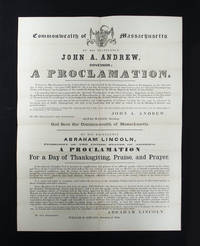
186368373Massachusetts 1863. LINCOLN Abraham. Massachusetts: 1863.<br> <br> Letterpress broadside 27 3/4 x 20 in.; 708 x 508 mm on paper incorporating several display and ornamental fonts as well as the seal of Massachusetts docketed on the verso "Post Office Hanover.' Some light offsetting. Nearly invisible professional repairs to the verso along the folds. A very nice example of this rare and important broadside<br> <br> This original broadside produced in Massachusetts is formatted in two halves with the top half being Governor John A. Andrew's announcement of Lincoln's Proclamation endorsing the observation of this day of Thanksgiving in his state dated July 27 1863 and the bottom half being Lincoln's actual proclamation dated July 15th 1863 and announcing that August 6th shall be set aside as a National Day of Thanksgiving. Though the exact printing date is unknown it can be assumed that it was printed within the week following July 27th.<br> <br> Thanksgiving was observed as a Holiday since colonial times and each state would set aside its own day for celebration. This proclamation was the first time that the Holiday would be celebrated on a set day nation wide making it the first observed Thanksgiving as a National Holiday.<br> <br> Though later the same year on October 3rd 1863 Lincoln made a second proclamation again announcing Thanksgiving as a Holiday but this time in November a date closer to the time most states had been celebrating it in the past. This earlier proclamation is actually the first time Thanksgiving was given national status but because the second proclamation was widely accepted the knowledge of this earlier one has been somewhat forgotten making this piece a rare and important document in the annals of American history.<br> <br> Though this broadside is for the State of Massachusetts no other broadsides from any other states that announce this date are known to exist and only three other copies of this rare document are located through OCLC.<br> <br> HBS 68373.<br> <br> $8500. Massachusetts unknown
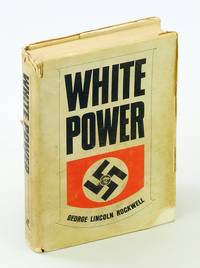
1967237j0231Dallas Texas: Ragnarok Press. Fair in Fair dust jacket. 1967. Second Edition. Hardcover. "George Lincoln Rockwell 1918-1967 Commander of the American Nazi Party graphically describes the present status of the White Race in a crumbling and degenerate world. Leaves no doubt in the reader's mind that the White Race is doomed if it does not soon recognize and destroy the source of the Black Power which is threatening its very existence. Commander Rockwell establishes the case for ACTION." - dust jacket. This second edition copy was printed in September 1967 a month after the first edition. In that brief interval Rockwell was assassinated by a former party member. 482 pp. Grainy black and white reproductions of photos and documentation. Truth Seeker rubber ink stamp to copyright page otherwise unmarked. White illustrated boards are moderately warped. Narrow openings run the full length of each side of the backstrip. Binding tender but intact. Heavy wear and soiling to fragile dust jacket now preserved in glossy new archival-grade Brodart. A worthy reference example of this scarce work. Singerman 1176 Weems p. 92.; 8vo . Ragnarok Press hardcover
6509ABRAHAM LINCOLN 1809-1865. Lincoln was the Sixteenth President.DS. 1pg. August 1 1864. Washington. A vellum military commission signed Abraham Lincoln as President and co-signed E.M. Stanton as Secretary of War. The President appointed James Wylie Crawford a First Lieutenant in the Veterans Reserve Corps. Crawford 1832-1910 was from Maine; according to family lore he was badly wounded at Antietam I bought this directly from a descendant. This injury required his enlistment in the Veterans Reserve Corps. The Veterans Reserve Corps allowed wounded soldiers to remain active often performing small tasks and light duty; established in the middle of 1863 it was first known as the Invalid Corps until the official name was changed. The document recently underwent conservation with the vellum stretched and flattened; the top right corner of the vellum has shrunk and the document was once rolled. The Lincoln autograph is a tad light and gets lighter as the autograph gets towards the conclusion; the Stanton is also a bit faint but vellum does not hold ink that well especially compared to paper. hardcover
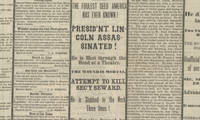
15042913315/04/1865. <blockquote><p>The Assassination:<strong><br /></strong></p></blockquote><p>Abraham Lincoln continues to stand as America’s most beloved President. Of our nation’s historical icons Lincoln is the quintessential embodiment of American possibility in his mythic-like rise from rail-splitter to Chief Executive and Emancipator of the oppressed. The admiration felt by Americans for Lincoln’s humble integrity his performance in office his noble statesmanship and his keen sense of justice is enduring. Lincoln is not given the highest marks just for character but for the transformation of the nation that he left behind which was both profound and long-lasting.</p><p>Polls of historians generally show their belief that Lincoln faced the hardest job of any president. He had to define the issues inspire the people be steadfast in the face of losses win the Civil War free the slaves and lay the groundwork to reunite the nation. All that in the face of determined opposition. He accomplished all this in four years but was assassinated on April 14 1865 and his death left him unable to finish the job a job that quite likely he was the only one with a chance to get completed in a way that would truly bring the nation together.</p><p>The end of the Civil War left the nation with two overwhelming questions: what to do with and do for the millions of freed slaves; and how to reintegrate the South into the Union. On the first point Lincoln was focused on African American access to land economic prosperity and legal rights and had just approved Gen. William T. Sherman’s order distributing parcels of former slave plantations to the slaves themselves. Lincoln wanted black Union veterans to have the right to vote which was a step to ultimately embracing full suffrage for African American males. In what proved to be his final speech three evenings before his death Lincoln had become the first president ever to support black voting. Lincoln’s successor Andrew Johnson was a Southerner uninterested in fair treatment of the liberated slaves. He opposed plans designed to guarantee the civil rights of black Americans and cancelled Sherman’s order granting land to slaves. Johnson accepted the draconian post-Civil War Black Codes which limited the rights and liberties of African-Americans something Lincoln would never have done.</p><p>On the second point the readmission of the Southern states Johnson felt that once Southern states returned their loyalty to the national government they could manage their own affairs. This meant they could pass any Jim Crow laws they liked. He opposed the Republican plan for Reconstruction of the South including provisions designed to guarantee the civil rights of black Americans. The Republican Congress had no rapport with Johnson and the initial four years era of Reconstruction which was a disaster to the nation was essentially a bitter battle between a North and South that remained locked in contention presided over by a weak President Johnson and a Congress at loggerheads with him. Lincoln had enormous power and influence some of which extended into the South. He saw the end of the war as an opportunity to not simply celebrate victory but an opportunity to move the country forward. Johnson had no such feeling. Lincoln would have been much better placed to direct moderate and ease the contentions of Reconstruction.</p><p>John Wilkes Booth was a member of a famous acting family and he enjoyed a phenomenally successful stage career during the Civil War: By 1864 he earned $20000 a year at a time when the average Northern family earned around $300 annually. A Marylander by birth Booth was an open Confederate sympathizer during the war. A supporter of slavery Booth believed that Lincoln was determined to overthrow the Constitution and to destroy his beloved South. After Lincoln’s reelection in November 1864 Booth devised a plan to kidnap the president and spirit him to Richmond where he could be ransomed for some of the Confederate prisoners languishing in northern jails. That winter Booth and his conspirators plotted a pair of elaborate plans to kidnap the president; the first involved capturing Lincoln in his box at Ford’s Theater and lowering the president to the stage with ropes. Booth ultimately gave up acting to focus on these schemes. Neither of the kidnapping plans bore fruit. On the evening of April 11 the President stood on the White House balcony and delivered a speech to a small group gathered on the lawn. Two days earlier Robert E. Lee had surrendered the Army of Northern Virginia at Appomattox Court House and after four long years of struggle it had become clear that the Union cause would shortly emerge from the war victorious. Lincoln’s speech that evening outlined some of his ideas about reconstructing the nation and bringing the defeated Confederate states back into the Union. Lincoln also indicated a wish to extend the franchise to some African-Americans—at the very least those who had fought in the Union ranks during the war - and expressed a desire that the southern states would extend the vote to literate blacks as well. Booth stood in the audience for the speech and this notion seems to have amplified his rage at Lincoln. “That means nigger citizenship†he told Lewis Powell one of his band of conspirators. “Now by God I’ll put him through. That is the last speech he will ever make.â€</p><p>Three days later Booth made good on his promise. Upon learning that Lincoln and his wife intended to see the play “Our American Cousin†at Ford’s Theater Booth used his actor’s connections there to gain access to the President’s box. He shot Lincoln at about 10 pm on April 14 1865 and Lincoln died about after 7 am on the 15th.</p><p>Dr. Charles Leale was in the audience. Leale leapt over theater seats got to the president’s box and announced that he was a doctor. As he entered the President was sitting in a chair with his eyes closed and head slumped. He already looked dead Leale recalled. He felt Lincoln’s right arm for a pulse but couldn’t find one. He and some others eased Lincoln to the floor and Leale began searching for the wound. “I quickly passed the separated fingers of both hands through his blood-matted hair…and I discovered his mortal wound†Leale recalled. “The president had been shot in the back part of the head behind the left ear.†Leale stuck the little finger of his left hand into the hole in Lincoln’s skull. “I then knew it was fatal and told the bystanders†he wrote later. Leale knew he had to get Lincoln out of the theater to treat him. But he believed a carriage ride back to the White House would kill him. He and several other men lifted the president and with Leale holding Lincoln’s head they began to maneuver him outside. Across the street from the theater was the house of William Peterson and Lincoln was taken there. Lincoln was carried to a small back room stripped of his clothes and covered with blankets. His 6-foot-4-inch frame had to be placed diagonally to fit on the bed. Leale ordered the window opened and the wait began. A parade of anguished government officials and family members came and went. The President sank steadily his breathing labored and his pulse nearly undetectable. At 7:22 am on April 15 President Lincoln breathed his last. Leale smoothed the contracted muscles of Lincoln’s features placed two coins over his eyes and pulled a sheet up over his face. Famously Secretary of War Stanton saluted the fallen President and uttered “Now he belongs to the ages.†Stanton further eulogized Lincoln with the apt observation “There lies the most perfect ruler of men the world has ever seen.â€</p><p><strong>Original report</strong> on the assassination printed the very day he died</p><p>The public was hungry for information and the newspapers equally hungry to report the momentous news. One of these was the Binghamton Daily Republican and this is its issue of April 15 1865 with black mourning columns.</p><p>The front page as was routine at the time was taken up by ads. The news then began on page two. There at top left is the headline <em>“The Assassination of President Lincoln! A Nation in Mourning!!!â€</em> It begins <em>“We feel too unfitted by this awful event to allude to the calamity in terms becoming its solemnity and importance! LINCOLN IS DEAD! Struck down by the hands of a brutal assassin in the midst of the triumphs which were commemorating his salvation of the country. A great man indeed has fallen! The foremost man of his time is no more…We dare not contemplate what may follow this sad and inscrutable providence.â€</em> This was followed by a proclamation of the governor of New York. On page three were dispatches from 12:30 AM to noon to 3:00. An early dispatch reports that<em> “the President was shot… and is not expected to liveâ€</em> and told of the events of the assassination then available in detail. It mentioned <em>“The screams of Mrs. Lincoln first disclosed the fact to the audience that the President had been shot.â€</em> Later it reported of Lincoln <em>“At midnight the Cabinet…a few personal friends with Surg. Gen. Barnes and his immediate assistants were beside his bedside…The parting of his family with the dying president is too sad for description.â€</em></p><p>At noon the newspaper had more news and reported <em>“Later concerning the President. He died this morning at 7:20. Two villains engaged in the horrible crime. The murder planned before March 4th.â€</em> At the bottom of the column is a report on the progress of the army of General William T. Sherman saying that in response to Grant’s hope Sherman would pursue the remaining Confederates Sherman said <em>“I think we’ll do it.â€</em> At 3:00 the paper printed the latest from Washington. It contained <em>“Full particulars of the Death of Abraham Lincolnâ€</em> plus <em>“Inauguration of President Johnsonâ€</em> and Johnson’s statement on taking office.</p><p>Original newspapers reporting Lincoln’s assassination have become very scarce this being our first in over a decade. This one is comprehensive and with its black borders and large headlines is evocative of the moment and would be perfect for display.</p><p><img class=""alignnone wp-image-25018 size-post-window"" src=""https://cdn.raabcollection.com/wp-content/uploads/20231204144051/Folder-site-11-1600x1327.jpg"" alt="""" width=""1600"" height=""1327"" /></p> hardcover
186425614<p>The second in a series of four racist political cartoons published in 1864 by Bromley & Company which was closely affiliated with the Copperhead New York <i>World</i> newspaper. These prints sought to undermine Abraham Lincoln's chances for reelection by branding him as a "miscegenationist" and playing on white fears of "race-mixing." The cartoon scene pictures several interracial couples enjoying a day at the park eating ice cream discussing wedding plans and a woman's upcoming lecture. Two African American families have white employees a carriage driver and footmen and a babysitter.</p><p>The only other example traced at auction brought $7800 in 2010.</p> <b>ABRAHAM LINCOLN. RACISM.</b>Print. "Miscegenation or the Millennium of Abolitionism." Political Cartoon. New York: Bromley & Co. 1864. 1 p. 20¾ x 13â… in.<p><br /></p><p>American politics had long played on fears of sexual relationships between races. A powerful new word for "race-mixing" was coined in an anonymous December 1863 pamphlet entitled <i>Miscegenation: The Theory of the Blending of the Races Applied to the American White Man and Negro</i> published in New York. Purporting to advocate the virtues of the "blending of the white and black races on this continent" it was a literary forgery prepared by <i>The World</i> managing editor David Goodman Croly and reporter George Wakeman. The authors were unsuccessful in their attempt to trick President Lincoln into endorsing the work.</p><p>At the far left of the image Abraham Lincoln declares "<i>I shall be proud to number among my intimate friends any member of the Squash family especially the little Squashes.</i>" The African American woman to whom he is speaking replies "<i>I'se 'quainted wid Missus Linkum I is washed far her 'fore de hebenly Miscegenation times was cum. Dont do nuffin now but gallevant 'round wid de white gem'men! he-ah! he-ah! he-ah!</i>"</p><p>Senator Charles Sumner says "<i>Mr. President! Allow me the honor of introducing my very dear friend Miss Dinah Arabella Aramintha Squash.</i>" A white carriage driver complains in the background "<i>Gla-a-ang there 240t! White driver white footmen niggers inside my heys! I wanted a situation when I took this one</i>" while a black man in the carriage tells his companion "<i>Phillis de_ah dars Sumner. We must not cut him if he is walking.</i>" A black woman at a table tells a white man with her "<i>Ah! Horace its-its-its-bully 'specially de cream</i>" and he replies "<i>Ah! my dear Miss Snowball we have at last reached our political and social Paradise. Isn't it extatic</i>"</p><p>To the right are two couples embracing each a white woman and an African American man. The first white women tells her partner "<i>Oh! You dear creature. I am so agitated! Go and ask Pa</i>" to which he replies "<i>Lubly Julia Anna name de day when Brodder Beecher shall make us one!</i>" The second white woman says "<i>Adolphus now you'll be sure to come to my lecture to morrow night won't you</i>" to which he answers "<i>I'll be there Honey on de front seat sure!</i>" In the background are various immigrant minorities viewing the scene. One exclaims "<i>Most hextwadinary! Aw neva witnessed the like in all me life if I did dem me!</i>" and another adds "<i>Mine Got vat a guntry vat a beebles!</i>" An Irish girl complains "<i>And is it to drag nagur babies that I left old Ireland Bad luck to me.</i>"</p><p>Manton Marble the editor of <i>The World</i> collaborated with printmaker Bromley & Company to issue a series of four anti-Lincoln "Political Caricatures." The present example was the No. 2 in that series. No. 1 was "The Grave of the Union or Major Jack Downing's Dream"; No. 3 "The Abolition Catastrophe Or the November Smash-up"; and No. 4 "The Miscegenation Ball."</p><p>Republicans responded by trying to turn the "miscegenation" charge against the Democrats. A Republican print "The Political "Siamese" Twins: The Offspring of Chicago Miscegenation" pictures McClellan and Pendleton joined together despite their very different ideas on ending the war.</p><p>Although Abraham Lincoln won New York states' electoral votes in 1860 Stephen Douglas had carried New York City and its environs. Financial elites fearing that civil war would ruin business and recent immigrants fearing competition with free black labor supported Douglas. Lincoln's unpopularity in New York City during the Civil War was a factor in the deadly 1863 Draft Riots.</p><p>In 1864 Lincoln again won the states' electoral votes while New York City favored his Democratic opponent McClellan. In fact Lincoln's majority dropped from 50136 votes in 1860 to only 7373 votes in 1864 with approximately 50000 more total votes cast than in 1860.</p><p>Bromley and Company continued to sell the caricatures after the election as this January 1865 advertisement from an Ohio newspaper makes clear. Another advertisement assured purchasers that the set of four prints available for $1 were "sent on wooden rollers to insure safe carriage."</p><p><b><i>The World</i></b> 1860-1931 a daily independent newspaper was published in New York City. Alexander Cummings founded it as a religious Republican outlet in 1860. August Belmont and others purchased it in 1862 changing the editorial focus. With editor Manton Marble 1834-1917 <i>The World</i> soon became the country's leading Democratic newspaper. In 1864 Union authorities shut down <i>The World</i>and another paper for three days after they published forged documents purportedly written by Lincoln that were really part of a hoax to manipulate the price of gold. The paper actively supported George B. McClellan against Lincoln in 1864.</p><p><b>Condition</b></p><p>Fine for exhibit despite flaws. Cropped with loss of "Political Caricature No. 2" from top edge and part of printed pricing information from bottom edge publisher's name rubbed out from the copyright statement lacking ½" from lower left corners a few short tape repairs by the edges a 2" closed tear through the second dialogue bubble along the top edge and a 3" closed tear parallel to the right edge. Mount remnants on verso.</p> books
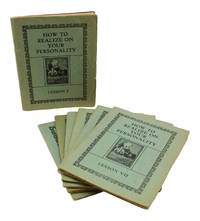
1921140947792East Aurora NY: The Roycrofters 1921. Near Fine. 7 volumes. Bound in publisher's side-stapled light green wraps printed in black; lacking the scarce original cardboard box. Near Fine with light fading and slight toning to covers and contents. Cover of volume I is creased with a small closed tear at the edge; volume VII has light markings to front cover. Included is a slightly toned tri-fold personality chart that lists associated assets and traits; initials written in pencil at the verso. <p>A scarce self-help guide intended to determine the assets and attributes of a individual's personality through physical traits. A precursor to constitutional psychology somatotypes developed in the 1940's and borrowing from 19th-century phrenology these booklets evaluate a person's temperament through eye shapes mouth curves nose slopes hand appearance hair color torso sizes and face shapes. The Benedicts offer to teach the reader how to recognize these physical types and understand their innate differences. For example a person with Thoracic personality type has a "flushed complexion" a "quick temper" and is "charming" according to the Benedict's Law of Combinations. Someone who is determined to be Cerebral or someone with a "larger than average forehead" is "self-sacrificing" "has none" when it comes to business assets and should "avoid speculation." <p> The suffragette turned motivational speaker was a pioneer in New Thought texts laying the foundation for Napoleon Hill and Dale Carnegie. Affectionately coined "The Wonder Woman" and advertised as the world's best known lecturer Elsie Lincoln Benedict spoke to over three million people in her lifetime. She was a millionaire by age 30 and drew a larger crowd than sitting President Wilson during the 1920 Human Analysis lecture series in Seattle a testament to her universal appeal. The Roycrofters unknown
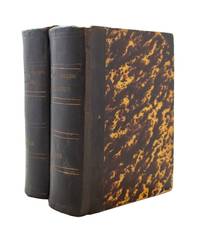
186369520Washington D.C.: War Department 1863. CIVIL WAR. War Department General Orders 1863. Washington D.C.: War Department 1863.<br> <br> Full Description:<br> <br> LINCOLN Abraham. CIVIL WAR. Emancipation Proclamation War Department General Orders 1863. Washington D.C.: War Department 1863.<br> <br> The first War Department printing General Orders #1 Jan 2 1863 and fifth overall printing of the final Emancipation Proclamation. The 4 page pamphlet bound together with a nearly complete run of War Department general orders for the year 1863. Two octavo volumes 6 7/8 x 4 5/8 inches; 174 x 119 mm. Volume I comprising General Orders of the War Department Adjutant General's Office Numbers 1-221 2 January 1863 to 16 July 1863 and Volume II comprising Numbers 222-400 16 July 1863 to 28 December 1863. Nearly complete only lacking numbers 55 63 116-119 148 in volume I and 274 352 and 381 in volume II. With 5 copies of number 149 and and 3 copies of number 240.<br> <br> Contemporary half calf over marbled boards. Spine lettered in gilt. All edges speckled brown. Hinges repaired. Some rubbing to board edges. Previous owner's contemporary ink signature Bvt. Col. E.J. Wells on front paste down of each volume. Numerous annotations in the same old ink throughout generally noting when the order was received and dated 1863. Some glue marks to the General Order #1 not affecting text. A small tear to last leaf of text in volume I with no loss. Overall a very good copy.<br> <br> In addition to the very important first War department printing of the Emancipation Proclamation these volumes contain several other very important and interesting General Orders from the War Department as well as President Abraham Lincoln in relation to the military during this year in the Civil War.<br> <br> Notably:<br> <br> No. 100 April 24 "Instructions for the Government of Armies of the United States in the Field." "commonly known as the 'Lieber Code' after its main author Francis Franz Lieber. The Lieber Code set out rules of conduct during hostilities for Union soldiers throughout the U.S. Civil War. Even today it remains the basis of most regulations of the laws of war for the United States. The Lieber Code consists of 157 provisions that deal with a wide range of legal issues that must be considered in armed conflict. It contains general principles but also very detailed rules. Among the issues addressed are whether armed force is justified by military necessity the principle of humanity the distinction between combatants and civilians POW status retaliation and permissible methods and means of warfare." LOC"<br> <br> No. 143 May 22 the establishment of the United States Colored Troops. This authorized the establishment of a bureau regulating the recruitment training and organization of the U.S. Army's first regiments composed entirely of African-American soldiers.<br> <br> Numerous court cases are documented including #17- The sentenced hanging death of a "colored man" for "attempted rape". #346- The trial of George Woolfolk for "Being secretly within lines of the US forces as the same time belonging to the so-called Confederate Army." He was sentenced to be shot to death. And #396- The trial brought by Colonel John Gault against Dr. Aaron James for "Being the captain of a band of guerillas or marauders and shooting at US soldiers." He was sentenced to death but the President disapproved the sentence and directed him to be released.<br> <br> A number of orders of Military discharges both honorable and dishonorable as well as military promotions. #337 announces "Major General U.S. Grant U.S. Army is placed in command of the Military Division of the Mississippi Headquarters in the field." #349 announces "Major General William T. Sherman is appointed to the command of the Department and Army of the Tennessee Headquarters in the field." #194 is the appointment of Major General George Meade as commander of the Army of the Potomac who would defeat General Robert E. Lee at Gettysburg only days later. And #398 honors Ulysses S. Grant for his Mississippi River campaign and presents him a gold medal.<br> <br> Numerous obituaries including #71 which announces the death of Major General E.V. Sumner who fell ill and died on his way to take command of the Department of the Missouri and directs the ways that Department should give him military honors.<br> <br> Important presidential proclamations including #58- Calling to all soldiers who were "absent without leave" urging them to return to their regiments and would not face punishment beside loss of wages for time missed. #252- Orders regarding the treatment of prisoners of war stating that 'if the enemy shall sell or enslave anyone because of his color the offence shall be punished by retaliation upon the enemy's prisoners in our possession'. "President Abraham Lincoln issued an 'eye-for-eye' order warning the Confederacy that Union soldiers would shoot a rebel prisoner for every Black prisoner shot. It also would condemn a rebel prisoner to a life of hard labor for every Black prisoner sold into slavery. AA Registry. #315- Lincoln's suspension of the "writ of habeas corpus." "The doctrine of habeas corpus is the right of any person under arrest to appear in person before the court to ensure that they have not been falsely accused. Lincoln's suspension of the "writ of habeas corpus" was one of the most controversial acts of his administrations. Lincoln defended himself against charges that his administration had subverted the Constitution however arguing that acts that might be illegal in peacetime might be necessary "in cases of rebellion" when the nation's survival was at stake." The Gilder Lehrman Institute of American History. #340- Proclamation by the President calling for three hundred thousand volunteers. "Whereas the term of service of a part of the volunteer forces of the United States will expire during the coming year; and Whereas in addition to the men raised by the present draft it is deemed expedient to call out 300000 volunteers to serve for three years or the war not however. exceeding three years."<br> <br> And numerous other General Orders pertaining to soldiers and the war effort including #35- A list of items that could be sold to soliders by sutlers. #40- The establishment of a Volunteer force for Kentucky. #163- "A resolution to encourage the enlistments in the Regular Army and Volunteer forces." #323- which authorized each enlisted cook "two under-cooks of African descent who shall receive for their full compensation ten dollars per month and one ration per day." #351- This discusses the governance of "The Employment of women nurses in the U.S. General Hospitals." and #364 which discusses the cos of clothing and camp for the U.S. Army and includes a folding chart.<br> <br> Eberstadt 12. Grolier 100 American 71. Streeter 1751.<br> <br> HBS 69520.<br> <br> $7500. War Department unknown
186425614<p>The second in a series of four racist political cartoons published in 1864 by Bromley & Company which was closely affiliated with the Copperhead New York <i>World</i> newspaper. These prints sought to undermine Abraham Lincoln's chances for reelection by branding him as a "miscegenationist" and playing on white fears of "race-mixing." The cartoon scene pictures several interracial couples enjoying a day at the park eating ice cream discussing wedding plans and a woman's upcoming lecture. Two African American families have white employees a carriage driver and footmen and a babysitter.</p><p>The only other example traced at auction brought $7800 in 2010.</p> <b>ABRAHAM LINCOLN. RACISM.</b>Print. "Miscegenation or the Millennium of Abolitionism." Political Cartoon. New York: Bromley & Co. 1864. 1 p. 20¾ x 13â… in.<p><br /></p><p>American politics had long played on fears of sexual relationships between races. A powerful new word for "race-mixing" was coined in an anonymous December 1863 pamphlet entitled <i>Miscegenation: The Theory of the Blending of the Races Applied to the American White Man and Negro</i> published in New York. Purporting to advocate the virtues of the "blending of the white and black races on this continent" it was a literary forgery prepared by <i>The World</i> managing editor David Goodman Croly and reporter George Wakeman. The authors were unsuccessful in their attempt to trick President Lincoln into endorsing the work.</p><p>At the far left of the image Abraham Lincoln declares "<i>I shall be proud to number among my intimate friends any member of the Squash family especially the little Squashes.</i>" The African American woman to whom he is speaking replies "<i>I'se 'quainted wid Missus Linkum I is washed far her 'fore de hebenly Miscegenation times was cum. Dont do nuffin now but gallevant 'round wid de white gem'men! he-ah! he-ah! he-ah!</i>"</p><p>Senator Charles Sumner says "<i>Mr. President! Allow me the honor of introducing my very dear friend Miss Dinah Arabella Aramintha Squash.</i>" A white carriage driver complains in the background "<i>Gla-a-ang there 240t! White driver white footmen niggers inside my heys! I wanted a situation when I took this one</i>" while a black man in the carriage tells his companion "<i>Phillis de_ah dars Sumner. We must not cut him if he is walking.</i>" A black woman at a table tells a white man with her "<i>Ah! Horace its-its-its-bully 'specially de cream</i>" and he replies "<i>Ah! my dear Miss Snowball we have at last reached our political and social Paradise. Isn't it extatic</i>"</p><p>To the right are two couples embracing each a white woman and an African American man. The first white women tells her partner "<i>Oh! You dear creature. I am so agitated! Go and ask Pa</i>" to which he replies "<i>Lubly Julia Anna name de day when Brodder Beecher shall make us one!</i>" The second white woman says "<i>Adolphus now you'll be sure to come to my lecture to morrow night won't you</i>" to which he answers "<i>I'll be there Honey on de front seat sure!</i>" In the background are various immigrant minorities viewing the scene. One exclaims "<i>Most hextwadinary! Aw neva witnessed the like in all me life if I did dem me!</i>" and another adds "<i>Mine Got vat a guntry vat a beebles!</i>" An Irish girl complains "<i>And is it to drag nagur babies that I left old Ireland Bad luck to me.</i>"</p><p>Manton Marble the editor of <i>The World</i> collaborated with printmaker Bromley & Company to issue a series of four anti-Lincoln "Political Caricatures." The present example was the No. 2 in that series. No. 1 was "The Grave of the Union or Major Jack Downing's Dream"; No. 3 "The Abolition Catastrophe Or the November Smash-up"; and No. 4 "The Miscegenation Ball."</p><p>Republicans responded by trying to turn the "miscegenation" charge against the Democrats. A Republican print "The Political "Siamese" Twins: The Offspring of Chicago Miscegenation" pictures McClellan and Pendleton joined together despite their very different ideas on ending the war.</p><p>Although Abraham Lincoln won New York states' electoral votes in 1860 Stephen Douglas had carried New York City and its environs. Financial elites fearing that civil war would ruin business and recent immigrants fearing competition with free black labor supported Douglas. Lincoln's unpopularity in New York City during the Civil War was a factor in the deadly 1863 Draft Riots.</p><p>In 1864 Lincoln again won the states' electoral votes while New York City favored his Democratic opponent McClellan. In fact Lincoln's majority dropped from 50136 votes in 1860 to only 7373 votes in 1864 with approximately 50000 more total votes cast than in 1860.</p><p>Bromley and Company continued to sell the caricatures after the election as this January 1865 advertisement from an Ohio newspaper makes clear. Another advertisement assured purchasers that the set of four prints available for $1 were "sent on wooden rollers to insure safe carriage."</p><p><b><i>The World</i></b> 1860-1931 a daily independent newspaper was published in New York City. Alexander Cummings founded it as a religious Republican outlet in 1860. August Belmont and others purchased it in 1862 changing the editorial focus. With editor Manton Marble 1834-1917 <i>The World</i> soon became the country's leading Democratic newspaper. In 1864 Union authorities shut down <i>The World</i>and another paper for three days after they published forged documents purportedly written by Lincoln that were really part of a hoax to manipulate the price of gold. The paper actively supported George B. McClellan against Lincoln in 1864.</p><p><b>Condition</b></p><p>Fine for exhibit despite flaws. Cropped with loss of "Political Caricature No. 2" from top edge and part of printed pricing information from bottom edge publisher's name rubbed out from the copyright statement lacking ½" from lower left corners a few short tape repairs by the edges a 2" closed tear through the second dialogue bubble along the top edge and a 3" closed tear parallel to the right edge. Mount remnants on verso.</p>
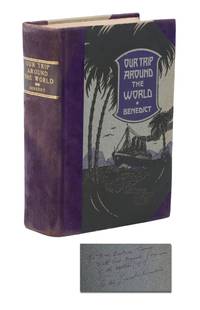
1926140948152East Aurora NY: The Roycrofters 1926. First Edition. Near Fine/Fair. First edition. Signed by Elsie Lincoln Benedict on the front free endpaper and inscribed to the former owner in purple ink "To Mrs. Beatrice Turner with best regards from one of the authors "E"." Bound in publisher's quarter purple suede over illustrated paper boards with morocco spine label stamped in gilt; top edge gilt. Near Fine with uneven fading to spine and edges light wear; silk ribbon book marker creased light fraying at ends. In tattered remnants of the dust jacket. <p>The power couple's travelogue diary of their travels around the world funded by the money made from Elsie's speaking events and book royalties. The suffragette turned motivational speaker was a pioneer in New Thought texts laying the foundation for Napoleon Hill and Dale Carnegie. Affectionately coined "The Wonder Woman" and advertised as the world's best known lecturer Elsie Lincoln Benedict spoke to over three million people in her lifetime. She was a millionaire by age 30 and drew a larger crowd than sitting President Wilson during the 1920 Human Analysis lecture series in Seattle a testament to her universal appeal. Inscribed to Newport artist and recluse Beatrice Turner d. 1948. Turner who died in obscurity produced thousands of self-portraits in oil throughout her lifetime at the family's nouveau riche ocean side mansion Cliffside; scarce signed. The Roycrofters unknown
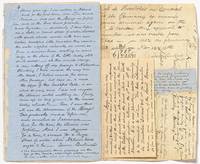
1860601691Salem Massachusetts 1860. Unbound. Very Good. A collection of autobiographical writings retained by two prominent seamen father and son from Salem Massachusetts. The archive was compiled by the son Isaac Bullock 1800-70: a self-taught scholar and artist who first went to sea aboard fishing vessels and later as chief mate aboard ships owned by the famous Salem merchant Joseph Peabody. As he recounts in a manuscript note on his father's 1799 Seaman's Protection Certificate: his father "died of yellow fever July 1800 in his 25th year on a voyage to Havana - when I was about 3 months old." The Certificate issued to protect American sailors from the British practice of impressment is signed by Benjamin Lincoln: a famous Major General during the Revolutionary War as George Washington's second in command he formally accepted the British surrender at Yorktown and the first United States Secretary of War.<br /> <br /> Also included is the elder Isaac Bullock's shipboard account of a meteor shower written in manuscript on a quarto sheet titled: "Some particular remarks of the appearance of the sky on the 12 November 1799 at sea - in Latt. of 49:20 North & Longt. of 22:00 West." This was the first recorded meteor shower in North America by American astronomer Andrew Ellicot who had witnessed it from a ship off the Florida Keys. Bullock witnessed it "on the Brig Helen Andrew Haraden Master - from Boston bound to London": "At 4 am being my watch on deck . I saw with astonishment the stars shooting or otherwise falling repeatedly from the sky down to the horizon as if they were compelled to leave their native abodes and dwell in the lore lower world. Some leaving after them a stream of fire which continued in the sky for the space of a minute . These continued shooting or otherwise falling till day light . we could see their blaze shooting in every direction till almost sun rise. What it is foreboding we cannot tell . ." Tipped onto the 1799 quarto manuscript sheet are several smaller sheets of appended manuscript notes and comments by Bullock's son dating from the early 1850s including a pencil sketch portrait of the great German naturalist Alexander von Humboldt who had observed the meteor shower from Central America.<br /> <br /> The rest of the archive consists of five gatherings of miscellaneous autobiographical writings and musings compiled by the son Isaac Bullock in which he relates various notable voyages including being pursued by an armed pirate ship "off the double headed shot Keys Cay Sal Bank" and barely surviving a shipwreck in the English Channel. <br /> <br /> Also included are accounts of two trips to California he twice spent time prospecting and mining on the South Fork of the American River first in 1850 at Salmon Falls and then in 1852 at Mormon Island: ". in 1849 the gold Crusade to California enticed me to try if Fortune would smile on me as a Miner. I shipped as 2d mate of ship Nestor of Salem for San Francisco and started from Boston in the autumn of '49 with a large number of passengers bound to See the Elephant! - I saw him! and have survived the sight! . A year of privation and excessive labour broke me down in a long fever and in partial recovery I started for home - Returned through the Nicaraguan route and escaping its perils and privations I once more reached home .". Soon thereafter he decides to try his luck in the mines again: "hoping for better success . I landed in Aspinwall traveled on foot through the dense tropic forest to Panama losing all my baggage by robbers . At last I reached San Francisco again . ."<br /> <br /> Most if not all of Bullock's reminiscences and musings were written and compiled upon his return from California: one manuscript is dated 1853 and another 1862. He was well read in classical literature and ancient history and comments on Alexander von Humboldt and Hester Thrale in the manuscripts. When not abroad he lived in Salem where some his other papers are held at the Peabody Essex Museum.<br /> <br /> An entertaining and historically important collection of writings documenting the lives of two prominent seamen who sailed out of Salem when it was among the most significant seaports in America. A detailed list of the manuscripts with selected excerpts is available. unknown
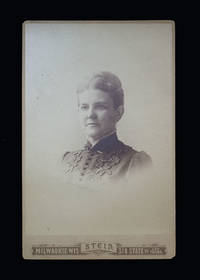
188468544Boston: Roberts Brothers 1884. Full Description:<br> <br> LINCOLN Mary Johnson. Mrs. Lincoln's Boston Cook Book. What to do and What Not to do in Cooking. By Mrs. D.A. Lincoln of the Boston Cooking School. Roberts Brothers Boston: 1884.<br> <br> First edition first issue with six advertisements on four pages at end. Octavo 7 3/8 x 5 inches; 189 x 127 mm. xiv 2 536 4 ads. Bound with twelve blank leaves at the end. With numerous small black-and-white illustrations in the text.<br> <br> Publisher's original half brown cloth over marbled boards. Spine is ruled in black and lettered in gilt. Some rubbing to boards. Corners a bit bumped and head and tail of the spine with some wear. Page 265 with a small tear to outer blank fore-edge margin not touching text. Otherwise internally extremely clean for a cookbook. Overall a very good copy. Chemised and housed in a half morocco-look brown cloth slipcase.<br> <br> Together with<br> <br> LINCOLN Mary Johnson subject. Cabinet Card Photograph. Milwaukee Wisconsin: Stein Photographer n.d.c.a. 1900.<br> <br> Black-and white cabinet card photograph of Mary Johnson Lincoln. photo: 5 3/8 x 4 inches; 146 x 103 mm; card: 6 1/2 x 4 1/4 inches; 166 x 107 mm. Inscribed on the verso by Lincoln "With the Compliments of Mary J. Lincoln" and in an anonymous hand "Author of the Boston Cook Book. Head of Boston Cooking School." Recto is a three-quarter profile of Lincoln affixed to the card with Stein's imprint along bottom margin.<br> <br> "Mary Johnson Bailey Lincoln know professionally as Mrs. D.A. Lincoln was a Boston housewife forced to go to work by her husband's health and business setbacks. She was invited to teach at the new Boston Cooking School which aimed to teach women who wanted to make a living as cooks or women who wanted to tell their servants how to do it. She changed her mind and took the job that launched her career as one of America's most influential cookbook authors ever. She became a celebrity cook who endorsed products wrote a syndicated column lectured and founded a baking powder company. Her cookbook Mrs. Lincoln's Boston Cook Book: What To Do and What Not To Do in Cooking paved the way for Fannie Merritt Farmer's famous cookbook. In 1946 the prestigious Grolier Club put together an exhibition of the 100 most influential books published before 1900. One cookbook was chosen the one written by Mary J. Lincoln." New England Historical Society.<br> <br> Grolier American 86; Crahan 74; ; Wheaton p.152 #3707; Vicaire p.524 1887 edition; Bitting p. 288 citing 1896 edition<br> <br> HBS 68544.<br> <br> $6500. Roberts Brothers unknown
186325971<p>"<i>The brave men living and dead who struggled here have consecrated it far above our poor power to add or detract…</i>"</p><p>Lincoln's Gettysburg Address is on page 2 along with Edward Everett's entire speech and a report on the ceremonies. Printed in an important newspaper owned by John Forney this version is in some ways more accurate than the more widely spread Associated Press report.</p> <b>ABRAHAM LINCOLN. GETTYSBURG ADDRESS.</b>Newspaper <i>Philadelphia Press</i> Philadelphia November 20 1863. Complete 4 pp. approx. 20¼ x 28 in.<p><b><br /></b></p><p><b>John Wien Forney</b> 1817-1881 had been a Democrat whose support for President James Buchanan brought appointment as clerk of the House of Representatives and lucrative printing contracts. However after Forney lost his election bid for the U.S. Senate he started the anti-Buchanan Philadelphia <i>Press</i> and switched to the Republican Party in 1860 becoming a key Lincoln supporter. Forney again served as House clerk and then secretary of the Senate until 1868. In that position he was one of only four men to sign the official 13th Amendment Resolution: President Lincoln Vice President Hamlin Speaker of the House Schuyler Colfax and Forney writing "I certify that this Resolution originated in the Senate." At the same time he maintained his editorial "Letter from Occasional" column in the <i>Press</i> and established the Washington <i>Chronicle</i> aimed at the public and to soldiers in the Army of the Potomac. He interviewed the President on issues such as freedom of the press and the probable effects of the Emancipation Proclamation and was invited to consult about cabinet appointments. His White House access caused opponents to call him "Lincoln's dog."</p><p>The night before the Gettysburg Cemetery Forney got "roaring drunk and gave a violently pro-Lincoln speech" Boritt. Given that history he probably should not have been chosen to chaperone newly-elected vice president Andrew Johnson at the March 4 1865 inauguration; Johnson was widely criticized for his drunken performance there. After Lincoln's assassination and Johnson's veto of the Freedman's Bureau Act in 1868 Forney changed positions and campaigned for impeachment. Selling the <i>Chronicle</i> and returning to Philadelphia the chameleon-like editor switched back to the Democrats and started a weekly magazine <i>The Progress</i>. In addition he served as a director of the Texas & Pacific Railway.</p><p><b>Partial Transcript:</b></p><p>"<i>Four score and seven years ago our fathers brought forth upon this continent a new nation conceived in liberty and dedicated to the proposition that all men are created equal. Applause Now we are engaged in a great civil war testing whether that nation or any nation so conceived and so dedicated can long endure. We are met on a general battle-field of that war; we are met to dedicate a portion of it as the final resting place of those who here gave their lives that that nation might live. It is altogether fitting and proper that we should do this but in a larger sense we cannot dedicate we cannot consecrate we cannot hallow this ground. The brave men living and dead who struggled here have consecrated it far above our poor power to add or detract. Applause The world will note nor long remember what we say here but it can never forget what they did here. Applause. It is for us the living rather to be dedicated here to the unfinished work that they have thus far so nobly carried on. Applause. It is rather for us here to be here dedicated to the great task remaining before us that from these honored dead we take increased devotion to that cause for which they here gave the last full measure of devotion. That we here highly resolve that the dead shall not have died in vain. Applause That the nation shall under God have a new birth of freedom and that the Government of the people by the people and for the people shall not perish from the earth. Long applause. Three cheers given for the President of the United States and the Governors of the States…</i>"</p><p><b>Textual Differences</b></p><p>The speed with which printings were produced given 19th century communication issues and the lack of any official manuscript or text produced questions about Lincoln's exact words. This version includes the word "poor" in the line "<i>far above our <b>poor</b> power to add or detract.</i>" This was heard by some reporters and is present in both of Lincoln's drafts though is lost in most other contemporary printings. This version correctly quotes Lincoln's "<i>unfinished work</i>" which the AP incorrectly transcribed as "refinished work." The applause notations also differentiates the <i>Philadelphia Press</i> version from the AP report especially with the three cheers at the speech's conclusion.</p><p>Additional differences:</p><p>- The "<i>general battle-field of that war</i>" is the "great battle-field of that war" in the AP text.</p><p>- "<i>We are met to dedicate</i>" is "We have come to dedicate" in Lincoln's written copies.</p><p>- "<i>carried on</i>" is found here and in Lincoln's second draft but Lincoln used "advanced" in subsequent versions: "<i>have thus so far</i> so <i>nobly</i> carried on advanced"</p><p><b>Other Contents of the Paper</b></p><p>Page 1 starts with a column of advertising ie "<i>Cotton is not king yet.-I am selling linen sheetings at prices that are cheaper than cotton.</i>" The news begins with a report from Chattanooga: "<i>We lost 100 a fourth of whom were killed. The enemy had completely invested the place but Gen. Burnside will defend it to the last man … Our troops are in the best spirits. Every import point is fortified and confidence prevails that we shall whip the enemy out.</i>" Also reports from Charleston Atlanta Cumberland MD Harpers' Ferry VA Texas etc. A report via Baltimore on November 19th carries "most gloomy" news from Union prisoners at Richmond ending "these men must not be permitted to starve." A New York bank was rumored to have been robbed of $20000.</p><p>From Europe there's notice of a speech of Emperor Napolean III the differing interpretations as to whether it called for peace or war. There are reports of war like preparations in Russia.</p><p>An interesting notice: "<i>A slander on Mr. Lincoln refuted.-The remark said to have been ascribed to President Lincoln by Wendall Phillips to the affect that 'the greatest folly of his life was the issuing of the Emancipation Proclamation' out of which such Copperhead journals as The World and The National Intelligencer are attempting to make political capital is emphatically pronounced in high quarters to be all together untrue.</i>"</p><p>Column 4 starts the extensive reporting on the National Cemetery at Gettysburg dedication including a "documentary history on the battles of July" and General Meade's letter sending his official report on the battle.</p><p>Column 5 discusses the grounds of the cemetery and starts Edward Everett's two hour oration which on page 2. Transcriptions include the prayer the dirge after the dedication the consecration speech by Charles Henry Brock and more.</p><p>Page 2 column 5 has more foreign news re Japan Britain Napoleon III's war with Mexico etc. Column 8 includes lengthy reports on battles in Tennessee and Virginia "half of Lee's army reported to be falling back to Richmond." At the bottom a <i>Boston Journal</i> description of some of Confederate firebrand Robert Toombs' slaves is republished.</p><p>Page 3 includes advertisements list of arrivals at hotels the offering of about 200 million dollars in treasury notes and the "five-twenty" six percent loan with Jay Cooke as subscription agent.</p><p>Page 4 includes a report from New York on the raising of colored troops and a notice about Professor McCulloh "who recently left a professorship in Columbia College … suddenly turned up in the south as Confederate brigadier general. He's said to be a native of Baltimore and a graduate of Princeton College. The <i>Pittsburgh Commercial</i> says that several years ago he was a professor of mathematics and natural sciences in Jefferson College Pennsylvania and was subsequently connected with the Coast Survey and the Philadelphia Mint."</p><p>More political news includes from a Western newspaper a platform "said to have been adopted by Ohio and others elsewhere since the elections: "<b>Resolved That we air in favur uv subjoogashen emansipashen confiscashen taxashen conscripshen exterminashen nigger enlistments and f there is anything else the peeple desire let em write post-pade and weel pass the necessary resolushen.</b>"</p><p>Reports from Philadelphia including police account of an attempted murder by a deserter who was passing counterfeit money a case of concealed deadly weapons and an arraignment of a women for running a "disorderly house". Plus Philadelphia financial reports "gold was much excited today and rose to 153 ½" p 4 col 3.</p><p>This is a scarce large format paper.</p><p><b>Condition</b></p><p>Some archival tape repairs on front page which we will have removed by a conservator.</p> books
1842617581842. Lear's 25pp. speech approx. 4000 words selfwraps with ms. title page bound at left margin with a thin ribbon. Lear's prose celebrates the 40th anniversary of the founding of the United States its Constitution and first President but also speaks of the more recent events of the War of 1812. Lear's summation of the country's virtues include "extensive territory a salubrious climate a fertile soil & a people hardy enterprising brave & virtuous" and a Constitution which has proved its excellence and efficacy in both peace and war: "These are some of the blessings which distinguish us from every other state which has ever been prophesied in history. These attract to our shores the virtuous & the persecuted and will soon raise us to a proud preeminence among the nations." The speech was apparently published in the July 9 1816 edition of the "Daily National Intelligencer" in Washington DC. An autographed note signed by Mayor James H. Blake 1p. approx. 26 words is included here congratulating Lear and requesting a copy for publication though we have found no record of a separate printing. Blake was mayor during the siege and burning of the city by the British in 1814.<br/>This group of material also includes two ms. letters from Benjamin Lear in Washington to his stepmother Fanny Dandridge Henley Lear one from May 7 1815 2 1/4 pp. approx. 400 words and one from May 21 1815 3pp. approx. 625 words. Fanny was away from home visiting relatives in Surry Co. Virginia and Benjamin was reporting on his stewardship of the household his attempts to sell a calf and his settling into the house enough to invite people to dinner. He tell her his business in the city has increased greatly and "my dear father Tobias Lear advises me to go to Philadelphia in the course of the summer to purchase a library- oh! I shall yet be a great man. I trust and it is the height of my ambition to be the greatest lawyer in this country." He also says his father has been suffering with a rheumatic headache. Lear mentions that friends from Gibraltar and Tripoli have recently arrived in the city including Mr. Morgan who "never heard from any of their friends in Cadiz the slightest hint of the malicious report which we had here" regarding Richard S. Hackley Consul to Cadiz.<br/>The remaining three ms. letters in this collection are joint letters from Benjamin Lear's young daughter Louisa nicknamed 'Loulean' and his widow Louisa Sophia Bomford Lear who had married Richard Derby following Benjamin's death to her former mother-in-law Fanny Lear. Though none of the three have year dates Loulean's activities indicate she was under 10 years old at the time. The first letter dated Dec. 30 no year is 3 1/2 pp. approx. 700 words. The first two pages are written in a child's careful hand complete with smudges reporting on practicing her Catechism dancing the "Cachucha" and performing in plays. Her mother's note follows explaining why she has not heard from them sooner saying it took Loulean about three weeks to write what she did. The next two letters from July are equally charming and full of the little girl's activities. Benjamin Lincoln Lear was the only child of Tobias Lear most well known as George Washington's personal secretary and tutor to his step grandchildren. Benjamin was born at the President's house in Philadelphia in 1792 and Washington was named his godparent. His mother Mary "Polly" Long died when he was two and Tobias married second Frances Bassett Washington widow of President Washington's nephew George Augustine Washington and third Frances Dandridge Henley Martha Washington's niece. Benjamin spent his youth at boarding schools or with his grandmother in New Hampshire. In these letters Benjamin addresses Fanny Dandridge Lear 1779-1856 as "dear mother."<br/>Benjamin Lincoln Lear had a successful career as a lawyer in Washington DC until cholera claimed his life in 1832 just shortly before the birth of his only child Louisa. <br/><br/> paperback books
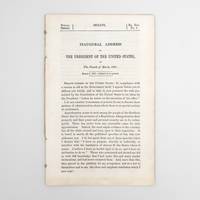
1861377680Washington D.C.: Government Printing Office 1861. Special Session Senate Ex. Doc. No. 1. 10pp. 8vo. Disbound. Housed in a cloth box. Special Session Senate Ex. Doc. No. 1. 10pp. 8vo. Lincoln began drafting his first inaugural in Springfield soon after his election hoping the speech would impart a spirit of reconciliation toward the seceded states. His speech balances his pledge to protect Federal property in the south while insisting that he would not use military force unless attacked first. In all he eloquently argues against secession presenting the United States as undissolvable. Lincoln ends his speech with the memorable lines: "We are not enemies but friends. We must not be enemies. Though passion may have strained it must not break our bonds of affection. The mystic chords of memory stretching from every battle-field and patriot grave to every living heart and hearth-stone all over this broad land will yet swell the chorus of the Union when again touched as surely they will be by the better angels of our nature."<br /> <br /> "Lincoln became President on March 4 1861. Before being sworn in he gave his First Inaugural Address devoting it entirely to the secession crisis. It was the linguistic equivalent of an optical illusion: one could view it two ways. As historians have noted he seemed to placate the South; he would not 'interfere with the institution of slavery in the States where it exists.' This language was the old Lincoln . The new Lincoln was a resolute executive who had no choice but to enforce the Constitution a contract that does not allow states to withdraw from it unilaterally. In his enforcement there would be no bloodshed 'unless it be forced upon the national authority" Mazy Boroujerdi editor Abraham Lincoln: His Life in Print p. 108.<br /> <br /> Lincoln had begun writing his inaugural the month prior before leaving Springfield and once in Washington asked William Seward to review the draft. It was Seward who suggested softening the tone so as not to appear too inflammatory suggesting "a nostalgic call for unity emphasizing the country's shared history. Lincoln embraced the idea but massaged it into near poetry. Seward's prosaic text ended up as Lincoln's oft quoted appeals to the 'mystic chords of memory' and 'the better angels of our nature.' The words did nothing to reverse disunion" Ibid. p. 97.<br /> <br /> This is the official government printing of Lincoln's first inaugural address issued as a document of a special session of the Senate printed by their order four days after its delivery being only the second printing overall of the memorable speech. Monaghan 102; Abraham Lincoln: His Life in Print p. 108 [Government Printing Office] unknown
1860367583New York: Office of the New York Tribune 1860. First edition Monaghan's first issue. 1 2-15 1pp. Lincoln's speech comprises pages 1-11 out of a total of 16 pages. With New York Tribune ads and subscription terms on rear wrapper. 8vo. Stitched self-wrappers minor toning minor chip to terminal leaf. First edition Monaghan's first issue. 1 2-15 1pp. Lincoln's speech comprises pages 1-11 out of a total of 16 pages. With New York Tribune ads and subscription terms on rear wrapper. 8vo. This address made at the Cooper Institute in New York on February 27 1860 catapulted Lincoln into the public eye and made him a viable presidential candidate. Indeed many historians have considered it the key to his success in the 1860 election and it is probably the most important speech Lincoln made after the Gettysburg Address and his inaugural addresses.<br /> <br /> The Cooper Union address was months in preparation; Lincoln was fully aware of its importance in moving himself from a regional favorite son to a viable national candidate. In the event some 1500 people including many prominent political figures attended on a snowy new York evening. The speech divides into three major parts. In the first Lincoln addressed the spread of slavery arguing that the framers of the constitution had been opposed to it and that the Federal government could regulate the question. In the second he argued that the Republicans were not a sectional Northern party and attacked the threats of southern Democrats to secede if the Republicans should win the election. Finally he addressed his fellow Republicans calling on them to act carefully and do "nothing through passion and ill temper.Let us have faith that right makes might and in that faith let us to the end dare to do our duty as we understand it."<br /> <br /> The Cooper Union speech was a resounding success. Horace Greeley described it as "one of the happiest and most convincing political arguments ever made in this City. No man ever made such an impression on his first appeal to a New York audience." Greeley quickly issued the speech in the form of this "Tribune Tract." It includes a final page of advertisements for other Tribune publications. The speech was later widely reprinted and made Lincoln nationally famous.<br /> This printing differs from other editions by its inclusion of a speech by James Doolittle Senator from Wisconsin and the message of Samuel Medary Democratic governor of the Kansas Territory vetoing the Kansas abolition bill.<br /> <br /> "The Cooper Union address tested whether Lincoln's appeal could extend from the podium to the page and from the rollicking campaigns of the rural West to the urban East. Cooper Union held the promise of transforming Lincoln from a regional phenomenon to a national figure. Lincoln knew it and rose to the occasion" Harold Holzer Lincoln at the Copper Union: The Speech That Made Abraham Lincoln President. Monaghan 50 Office of the New York Tribune unknown
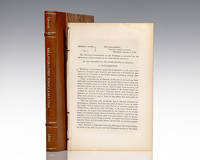
1863149486Washington: Government Printing Office January 2 1863. Rare first War Department and fifth overall printing of the Emancipation Proclamation. Twelvemo General Orders No. 1 extracted from the larger volume of orders for 1863 4 pages disbound. President Lincoln had intended to issue the order earlier in 1862 but deliberately delayed its release until after the Union's strategic victory at Antietam at which point he announced the Preliminary Emancipation Proclamation. General Order No. 139 September 22 1862 which declared that all slaves held in rebelling states would be forever free from the first day of January 1863. The text of the final Emancipation Proclamation present in this order is noted for its direct and decisive language: "By the President of the United States of America . That on the first day of January in the year of our Lord one thousand eight hundred and sixty-three all persons held as slaves within any State or designated part of a State the people whereof shall then be in rebellion against the United States shall be then thenceforward and forever free; and the Executive Government of the United States including the military and naval authority thereof will recognize and maintain the freedom of such persons and will do no act or acts to repress such persons or any of them in any efforts they may make for their actual freedom." The first printing for the War Department of General Orders No. 1 was distributed to various military outposts and bureaus throughout the United States. Based on the extensive research of Charles Eberstadt the copy for the War Department was the fifth time the final version of the Emancipation Proclamation appeared in print on January of 1863 following three hastily prepared issues for the State Department and another for Lincoln's hometown Illinois States Journal newspaper in Springfield Illinois. A copy of the War Department Printing was included in the Grolier Club's One Hundred Influential American Books Printed before 1900. Eberstadt 12; Grolier Club One Hundred Influential American Books 71; Streeter 1751. In near fine condition. Housed in a custom half morocco case. A scarce work. The Emancipation Proclamation issued by President Abraham Lincoln on January 1 1863 represented a pivotal moment in the trajectory of the American Civil War and the broader struggle over the institution of slavery. Although it did not immediately free all enslaved individuals the proclamation declared that all persons held as slaves in states or parts of states still in rebellion against the United States were to be henceforth free. This executive order grounded in Lincoln's war powers as commander-in-chief was intended primarily as a military measure to weaken the Confederacy by undermining its labor force and discouraging foreign powers from recognizing or supporting the secessionist cause. The proclamation also signaled a significant shift in Union war aims reframing the conflict from a struggle solely to preserve the Union to one explicitly linked to the abolition of slavery. While its immediate legal impact was limited to areas outside Union control the Emancipation Proclamation laid the groundwork for the eventual passage of the Thirteenth Amendment which formally abolished slavery throughout the United States. Government Printing Office unknown
186222179<p>"<i>We cannot escape history… In giving freedom to the slave we assure freedom to the free… We shall nobly save or meanly lose the last best hope of earth.</i>"</p><p>One month before signing the Emancipation Proclamation the president proposes colonization and his plan for compensated emancipation discusses foreign affairs reports on progress of the Pacific Railroad the war and finance. This rare "<i>Sentinel Extra</i>" broadsheet apparently unrecorded in OCLC has other news of the day on the verso including a fantastic article quoting General Meagher's reaction to the resignation of several officers after McClellan was removed.</p> <b>ABRAHAM LINCOLN.</b>Broadsheet <i>"Sentinel Extra"</i> place unknown ca. December 2 1862 9⅛ x 24 in. 2 pp.<p><b><br /></b></p><p><b>Excerpt:</b></p><p>"<i>The suspension of specie payments by the banks… made large issues of United States notes unavoidable. In no other way could the payment of the troops and the satisfaction of other just demands be so economically or so well provided for… A return to specie payments however at the earliest period … should ever be kept in view. Fluctuations in the value of currency are always injurious… Convertibility prompt and certain convertibility into coin is generally acknowledged to be the best and surest safeguard against them; and it is extremely doubtful whether a circulation of United States notes payable in coin and sufficiently large for the wants of the people can be permanently usefully and safely maintained…</i></p><p><i>There is no line straight or crooked suitable for a national boundary upon which to divide…Among the friends of the Union there is great diversity of sentiment and of policy in regard to slavery and the African race amongst us… emancipation will be unsatisfactory to the advocates of perpetual slavery but the length of time 37 years in Lincoln's compensated emancipation proposal should greatly mitigate their dissatisfaction. The time spares both races from the evils of sudden derangement… while most of those whose habitual course of thought will be disturbed by the measure will have passed away before its consummation. They will never see it. Another class will hail the prospect of emancipation but will deprecate the length of time. They will feel that it gives too little to the now living slaves. But it really gives them much. It saves them from the vagrant destitution which must largely attend immediate emancipation in localities where their numbers are very great and it gives the inspiring assurance that their posterity shall be free forever… Let us ascertain the sum we have expended in the war since compensated emancipation was proposed last March and consider whether if that measure had been promptly accepted by even some of the slave States the same sum would not have done more to close the war than has been otherwise done…</i></p><p><i><b>Fellow-citizens we cannot escape history.</b> We of this Congress and this administration will be remembered in spite of ourselves. No personal significance or insignificance can spare one or another of us. <b>The fiery trial through which we pass will light us down in honor or dishonor to the latest generation. We say we are for the Union. The world will not forget that we say this. We know how to save the Union. The world knows we do know how to save it. We—even we here—hold the power and bear the responsibility. In giving freedom to the slave we assure freedom to the free—honorable alike in what we give and what we preserve. We shall nobly save or meanly lose the last best hope of earth.</b></i>"</p><p><b>Additional Content Below Lincoln's State of the Union</b></p><p>Three news items cover the bottom half of the third column verso.</p><p>The first discusses the three top western cities as grain shippers Chicago Milwaukee and Toledo. The numerical measurements of the grain are counted in bushels. Chicago tallied a total export of <i>Wheat Corn Oats Rye and Barely</i> which amounted to <i>55526816</i> bushels. Milwaukee totaled <i>14869625</i> bushels. Toledo totaled <i>18667817</i> bushels.</p><p>The second re-prints news from <i>Liverpool Journal of Commerce</i> published on November 11th regarding the British government's adherence to neutrality policies.</p><p>The third reports on Gen. Thomas Meagher's reaction to the resignation of some of his officers after Gen. McClellan was removed from his command of the Army of the Potomac:</p><p>"<i>Commanding a brigade composed principally of Irish soldiers the Brigadier-General considers it not out of place to remind them that the great error of the Irish people in their struggle for an independent national existence has been their passionate and blind adherence to an individual instead of to a principle of cause. Thus for generations their heroic efforts in the right direction have been feverish and spasmodic when they should have been continuous equable and consistent.</i>"</p><p><b>Thomas Francis Meagher</b> 1823-1867 was an Irish nationalist and leader of the Young Irelanders in the Rebellion of 1848. After being convicted of sedition he was first sentenced to death but received transportation for life to Van Diemen's Land in Australia. In 1852 he escaped and made his way to the United States where he settled in New York City. At the beginning of the American Civil War Meagher joined the U.S. Army and rose to the rank of brigadier general. He was most notable for recruiting and leading the Irish Brigade U.S. 69th Infantry Regiment New York State Volunteers and encouraging support among Irish immigrants for the Union. He had one surviving son from his first wife.</p><p>Following the Civil War Meagher was appointed acting governor of the Montana Territory. In 1867 Meagher drowned in the swift-running Missouri River after falling accidentally from a steamboat at Fort Benton.</p> books
15859Lincoln Abraham. The Republican Party Vindicated--The Demands of the South Explained. Speech of Hon. Abraham Lincoln of Illinois at the Cooper Institute New York City February 27 1860. 16 pages caption title as issued. Lincoln's Historic Cooper Union discourse which catapulted him to serious presidential consideration and provided a cogent and widely-publicized argument that slavery was and always had been contrary to American values. <br/><br/>Lincoln's great Cooper Union speech argues that the Framers and early Congresses contemplated a narrow role for slavery. Examining the constitutional and early Congressional debates he demonstrates that contemporary statements viewed slavery "as an evil not to be extended but to be tolerated and protected only because of and so far as its actual presence among us makes that toleration and protection a necessity." Lincoln's argument received wide press coverage; it catapulted him into presidential contention for its great contribution placed the new Republican Party at the center of American constitutional and legal thought rather than an unacceptable extreme paving the way for his 1860 presidential win on the Republican ticket. An unusual 16-page issue of Lincoln's Cooper Union discourse followed at the middle of page 9 by John Hickman's July 24 1860 campaign speech. Page 16 prints Stephen Douglas' endoursement of the Dred Scott Decision and criticisms of his doctrine of Popular Sovereignty. Most copies print Lincoln's speech only in 8 pages. Scattered foxing dusting blank margin chipped not affecting text. Very good copy of this historic speech by Abraham Lincoln presaging his presidential nomination. unknown books
1916319056New York: Privately Printed 1916. First edition. 10 plates including map and frontispiece. 32pp. 1 vols. 12mo. Later blue cloth. Bookplate of Samuel B. Webb. First edition. 10 plates including map and frontispiece. 32pp. 1 vols. 12mo. Lincon Ellsworth 1880-1951 polar explorer and benefactor of the American Museum of Natural History produced a small private edition of his first-hand account of this hunt in the Bitterroot Mountains of Montana in 1911. The last large herd of buffalo in the U.S. had grazed in the Flathead Reservation and had been sold to the Canadian government four years before. After the round-up several outlaw bulls were still at large in the rugged terrain. Ellsworth describes a three-week hunt in which he finally stalked and shot a large bull.<br/>With outstanding provenance from the library of Samuel B. Webb a descendant of the Vanderbilt and Havemeyer families. Phillips p. 112; Streeter Sale 4131; Litchfield 76; Heller 1:95; OCLC 16140977 Privately Printed unknown books
18846914Boston: Roberts Brothers 1884. Octavo 19 x 13 cm. 536 7 pages. Additional blanks. Advertisements; fifty illustrations in the text. General index table of contents and alphabetical index. WITH: Cabinet photograph 16.6 x 10.75 cm. by Stein Photographer of Milwaukee Wisc. of the author in three quarter view. The verso has a manuscript annotation in an anonymous hand "Author of the Boston Cook Book. Head of Boston Cooking School" and inscribed by the subject "With the compliments of Mary J. Lincoln". Very slight soil otherwise fine. ~ The book: FIRST EDITION SECOND PRINTING same year as the first with sixteen advertisements on seven pages rather than six on four pages. Both issues copyright 1883 but title page stating "1884". Except for the advertisements the contents and pagination of the '84 '85 '86 and '87 printings are identical. The milestone cookbook from the first principal of the Boston Cooking School and a student of Maria Parloa. According to the preface the work was "undertaken at the urgent request of the pupils of the Boston Cooking School who have desired that the receipts and lessons given during the last four years in that institution should be arranged in a permanent form." Considered one of the first American cookbooks to provide scientific information about cooking and nutrition. It helped set the pattern of rational organization for cookbooks to come. Both famous and important "this book marked a change in culinary literature. Having directed the Boston Cooking School est. 1879 she Lincoln was able to arrange her material in an orderly plan and to set it forth in plain sensible language that housewives could understand. While it instantly became the standard kitchen companion it had still greater effect in shaping the course of early work in domestic science in grade and normal schools. Fanny Farmer's Cook Book is a direct outgrowth from this. The New York book stores currently display the sixth complete revision which states on the jacket that it is the 63rd printing and that 2286000 copies have been sold to date 1947." Number 86 of the Grolier Club One hundred influential American books printed before 1900. With twenty-one additional recipes in manuscript at the rear including a few medicinal recipes but mostly culinary receipts such as Fig Filling for Cake Cornucopias Vinegar Cookies and Miss Kingsbury's Pineapple Cream. The interior variously soiled throughout and with wear to some fore edges; edge of dedication page trimmed; amateur repair to one leaf pages 304/5. In half black calf over pebbled black cloth; spine gilt-titled and -compartmented. Hinges worn but holding; rubbing to corner. in a custom clamshell box. Altogether a complete sound and not altogether unattractive copy of a rare book in either issue of the first printing. Grolier Club One Hundred Influential American Books Printed in Before 1900 page 116-117; Bitting page 288 1896 ed. Cagle 478 the first printing; Streeter 4206 first issue; Sotheby's Crahan Sale. October 1984 earning $2300. Roberts Brothers hardcover books
15849LINCOLN Abraham. The Lincoln And Douglas Debates. A Political Debates between Hon. Abraham Lincoln and Hon. Stephen A. Douglas. In the Celebrated Campaign of 1858 in Illinois. Published by Columbus Follett Foster and Company 1860. First edition third issue as identified by a number 2 on page 13 and publishers ad. Publisher's original olive green textured cloth with blind-stamped borders. Slight chipping to headband. Spine lettered in gilt. 268 pages.<br/><br/>As the Republican nominee for the Senate Lincoln delivered his famous convention speech declaring 'A house divided against itself cannot stand.' He challenged his opponent Stephen Douglas to seven debates highlighting the inconsistency in favoring popular sovereignty and the Dred Scott decision. Lincoln further stressed the moral iniquity of slavery. Gilt and boards faded chipping to upper some damp stain minor foxing and toning as usual. Overall a good copy. Although Douglas won the election Lincoln's thoughtful and clear ideation enhanced his fame and led him to winning the Presidency in 1860. unknown books
1858376861Springfield IL 1858. 8pp. printed in double columns. 8vo. Unbound. Minor toning. Housed in a cloth box. 8pp. printed in double columns. 8vo. The only separate printing of this address given by Lincoln at Springfield Illinois. Lincoln's speech which preceded his debates with Douglas puts forth the great themes that marked his political philosophy during the last ten years of his life. More importantly it firmly placed Lincoln as against the expansion of slavery and Douglas on the opposite side of the issue. By targeting Douglas a strategy that resurrected Lincoln's political career he made his fellow Illinoisan out to be the embodiment of the wicked forces safeguarding slavery's expansion . This speech is Lincoln's opening salvo against Douglas for the 1858 senate campaign: 'Free men of Illinois - free men of everywhere - judge ye between him and me'" Abraham Lincoln: His Life in Print p. 67<br /> <br /> Urging that slavery be placed on course for "ultimate extinction" he repeats his "House Divided" warning first given at the State Republican Convention a month earlier. He insists that the Kansas-Nebraska bill was "the beginning of a conspiracy" to nationalize slavery. Attacking Douglas and defending himself against the charge that he would "invite a war of sections" he stands on "the principles of our Declaration of Independence." Though African Americans are not the equal of whites "in all respects" the Declaration "does mean to declare that all men are equal in some respects; they are equal in the right to 'life liberty and the pursuit of happiness.'" Most significantly "In the right to put into his mouth the bread that his own hands have earned he is the equal of every other man white or black."<br /> <br /> A scarce Lincoln speech. Monaghan 12; Byrd 2960 unknown