11 347 résultats
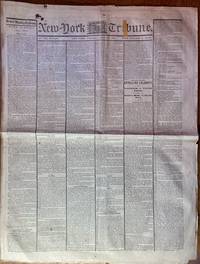
186536782New York: New York Tribune 1865. Newspaper. Good. Newspaper. Approximately 21.25" x 16.5." Folded. 8 pages. Six columns. A few ink spots top edge page 1. Previous owner paper name label top edge page 1 Wm Lockwood. Light toning and scattered foxing to the paper. Good condition.<br /> <br /> Each page of this issue has printed black vertical lines indicating mourning. Contents include extensive coverage of the Assassination of Abraham Lincoln with a minute by minute accounting of his passing. Other articles include the "Attempted Murder of Secretary Seward"; "Capt. McGowan's Account of the Assassination"; "The Nations Loss"; "The Inauguration of Andrew Johnson; "Andrew Johnson's Speech on the fall of Richmond"; negotiations between General Sherman and General Johnston and several more articles on the conclusion of the Civil War. New York Tribune unknown
2008mon0003243737Weider History Group 2008. Hardcover. Very Good. . Facsimile reprint edition from the original edition of 1905. 12-volume set. Leather spines with green cloth boards gilt ruling and lettering. Covers show minor wear pages are clean. Weider History Group hardcover
1862129821862. Original Civil War dated newspaper. The Republican Herald and Post dated Providence Saturday morning September 27 1862. 4 pages recto verso. Includes a front page print of a September 22 proclamation from Abraham Lincoln. The proclamation reads in part: "I Abraham Lincoln President of the United States of America and Commander-in-Chief of the Army and Navy thereof do hereby proclaim and declare that hereafter as heretofore the war will be prosecuted for the object of practically restoring the constitutional relations between the United States and the people thereof. Abraham Lincoln." Newspaper is in excellent condition with some minor chipping to the edges. unknown
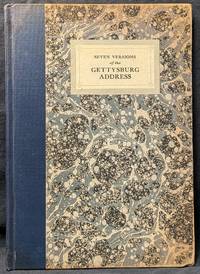
19255486Boston: Smith & Porter Press 1925. Limited Edition. Hardcover. Very Good. 12mo. Marbled paper boards with navy backstrip printed paper title card on front board deckled edges. Limited edition privately printed copy. Bound-in hand-written note from the publisher "The President of the Society of Printers offers this little volume to a valued member of the Society. To Warren S. Kilburn from Herbert G. Porter February 1936." Edge wear/tearing and rubbing on edges of boards and head of spine; toning/discoloration on outer edges of front and back boards. Blue ink stamp on back pastedown. Binding tight text clean and unmarked. 12mo - over 6¾ - 7¾" tall. Smith & Porter Press hardcover
186424899<p>"<i>The will of the people is supreme.</i>"</p><p>"<i>The vital principle of</i> Lincoln's <i>whole administration has been his recognition of the fact that our Government is simply a machine for carrying into effect THE WILL OF THE PEOPLE.</i>"</p> <b>ABRAHAM LINCOLN. HENRY CHARLES LEA.</b>Printed Pamphlet. <i>No. 18: The Will of the People</i> January – April 1864. 8 pp. 5½ x 8½ in.<p><b><br /></b></p><p><b>Excerpts:</b></p><p>"<i>It has been generally assumed that the acts of the President have been the exponents of his own individual convictions. Democrats have censured him for converting the 'war against disunion' into a 'war against slavery.' Radical Republicans have been equally prone to condemn him as a half-hearted Abolitionist who required perpetual stimulation to perform his duty and who is not to be trusted because he did not immediately on his inauguration carry out the views which he had previously expressed of opposition to slavery.</i></p><p>"<i>Both parties seem to have forgotten that our form of government is as purely democratic as can be reduced to a practical system. Our whole political machinery is devised for the purpose of allowing the people to regulate the national policy. The will of the people is supreme.</i>" p3</p><p>"<i>For twenty years prior to his election he had on all fitting occasions expressed his disapprobation of slavery and his desire that it could be constitutionally done away with. Yet in the popular vote which made him President he saw the expression simply of a determination to resist the aggressions of slavery and not the condemnation of the system itself.</i>" p4</p><p>"<i>As the nation changed its views so he was ready to change his policy. When therefore the Emancipation Proclamation made its appearance the people was prepared to welcome that which a year earlier would have aroused a tempest of disapprobation.</i>" p5</p><p>"<i>The next step was the arming of negro troops. In July 1862 Congress authorized the employment of 'persons of African descent' in our armies. The public mind was not yet prepared to accept the assistance of the despised race. The administration accordingly did not press the matter.</i>" p5-6</p><p>"<i>Those who have witnessed the marvellous revolution in public opinion on this subject cannot but admire the manner in which Mr. Lincoln's honest deference to public opinion has produced results which the tact of the cunning statesman might have failed to secure. Taking each step as the voice of the people demanded it he has never been forced to retrace his position. Supported by and supporting the popular feeling he has moved onward in unison with it and each new development has afforded sure foothold for further progress.</i>" p6</p><p>"<i>His Proclamation of Amnesty puts into practical shape the wishes which have long been silently forming themselves in every loyal heart. Again has he divined the will of the people and at the fitting time his acts have responded making as far as his competence extends that will the law of the land. To this intuitive perception of public opinion and this skill in translating it into action Mr. Lincoln owes much of the success of his administration. He is at once the leader and the led.</i>" p7</p><p>"<i>The transitory passions of the multitude are very different from the slowly formed convictions of the people. The President has known to distinguish between them and he has at times shown as lofty a firmness to resist the former as he has ever manifested alacrity to respect the latter. The vital principle of his whole administration has been his recognition of the fact that our Government is simply a machine for carrying into effect THE WILL OF THE PEOPLE.</i>" p8</p><p><b>Excerpts from Resolutions Passed January 11 1864:</b></p><p>"<i>And Whereas The Union League of Philadelphia composed as it is of those who having formerly belonged to various parties in this juncture recognize no party but their country; and representing as it does all the industrial mechanical manufacturing commercial financial and professional interests of the city is especially qualified to give in this behalf an unbiased authentic utterance to the public sentiment. Therefore</i>" p2</p><p>"<i>Resolved That we cordially approve of the policy which Mr. Lincoln has adopted and pursued as well as the principles he has announced as the acts he has performed: and that we shall continue to give an earnest and energetic support to the doctrines and measures by which his administration has thus far been directed and illustrated.</i>" p2</p><p><b>Historical Background</b></p><p>Loyal Leagues also often known as Union Leagues were men's clubs established during the Civil War largely to support the war effort and the policies of the Lincoln administration. They usually consisted of the professional merchant and artisan classes in northern cities. The first such club formed in Philadelphia in 1862.</p><p>This pamphlet written by Henry C. Lea as director of the Union League of Philadelphia's Board of Publication insisted that Lincoln's policies reflected the will of the people. Six years earlier in his first debate with Stephen A. Douglas in August 1858 Lincoln famously said "In this and like communities public sentiment is everything. With public sentiment nothing can fail; without it nothing can succeed. Consequently he who moulds public sentiment goes deeper than he who enacts statutes or pronounces decisions. He makes statutes and decisions possible or impossible to be executed."</p><p>On April 15 1864 Lea met with Lincoln in Washington and three days later he wrote to Lincoln including two pamphlets he had recently written including this one. He informed Lincoln "I was much gratified to find from your remarks that in one of them—'The Will of the People'—I had to some extent indirectly appreciated the motives which have guided your policy. It appeared to me to present a line of argument likely to be effective before the people & I confess to surprise that it should not have been long since brought more prominently into notice to repel the attacks of radicals & Copperheads." <br /></p><p><b>Henry Charles Lea</b> 1825-1909 was born in Philadelphia and received a classical education from Irish American tutor Eugenius Nulty. Lea showed particular promise in natural history. He joined his father in the publishing business in 1843 but had a nervous breakdown in 1847. While recuperating he read medieval French history and decided to become a historian rather than a scientist. In 1850 he married his first cousin Anna Caroline Jaudon 1824-1912 who was of French Huguenot descent and they had four children between 1851 and 1859. Over the next fifty years Lea produced ten books and numerous articles on medieval institutional legal and ecclesiastical history. During the Civil War Lea was a member of the Union League of Philadelphia and led its Board of Publication. In that role he wrote many of the League's published pamphlets. From 1863 to 1865 he served as a Bounty Commissioner and aided the provost marshal in recruiting soldiers including African Americans. He continued in the publishing business until 1880 when his sons took over the firm. He continued to write and assemble an extensive medieval manuscript collection. He received honorary degrees from both American universities like Harvard Princeton and Pennsylvania and foreign universities in Giessen and Moscow.</p><p><b>Condition</b></p><p>Good with light foxing and toning.</p> books
1894314561New York: The Scovill & Adams Company 1894. First edition. Illustrated. 2 vols. 8vo. Original green cloth st6amped ion gilt and black. Fine. First edition. Illustrated. 2 vols. 8vo. The Seventh and Eighth Volumes in the series. The Scovill & Adams Company unknown books
1894314561New York: The Scovill & Adams Company 1894. First edition. Illustrated. 2 vols. 8vo. Original green cloth st6amped ion gilt and black. Fine. First edition. Illustrated. 2 vols. 8vo. The Seventh and Eighth Volumes in the series. The Scovill & Adams Company unknown
186228694New York 1862. 17 1 blank pp. Stitched in original printed green wrappers. Lightly worn and toned two institutional marks at top blank margin of front wrapper else Very Good. <br/><br/> A scarce open letter to the 37th Congress then in session. The author expresses prevalent pro-Union anti-Negro sentiment of the day: "the 'black man' leaves but little time unemployed upon the hands of our representatives.leaving to 'congress men' their valuable time for maturing plans for the full development of their much admired and more beloved 'Congo men.'" He also mocks Treasury Secretary Chase's plans to print paper money to finance the War. <br/>FIRST EDITION. Bartlett 1936. Sabin 28570. Not in Nevins Work Eberstadt or LCP. unknown books
196731258New York: Riverside Museum 1967. First edition. Paperback. Very Good. Stapled wrappers. 16 unnumbered pages. Text provided by representatives from Farleigh Dickinson University. Illustrated with black and white photographs. Each artist is represented by a page of text and a page of illustration. A very good example. Publisher's promotional sheets for the event laid in. Scarce. Riverside Museum paperback books
186047254Chicago: Press & Tribune Office 1860. Reproduction ca 1955. Mounted on stiff card stock. Now housed in an archival mylar sleeve. Age-toning. 1 cm discoloration spots in margin corners glue. Small paper snag to top edge of upper margin. A Very Good copy. Broadside. Patriotically themed wood engraving in masthead. 13-15/16" x 8-15/16" 35.5 cm x 22.8 cm. <br/><br/>The 1860 Republican National Convention met in Chicago Illinois from May 16 to May 18. The convention selected former Congressman Abraham Lincoln of Illinois for president and Senator Hannibal Hamlin of Maine for vice president. The platform of 17 declaration of principles was drafted by the Platform Committee chaired by Judge William Jessup of Pennsylvania the entirety of which was adopted by the convention members verbatim save for the insertion in the Second clause of famous language from the Declaration of Independence that "All men are created equal; and they are endowed by their Creator with certain inalienable rights." Regarding the platform 10 clauses dealt directly with the issues of free soil principles slavery the Fugitive Slave Act and the preservation of the Union while the remaining 7 dealing with other issues. Clauses 12 through 16 of the platform called for a protective tariff enactment of the Homestead Act freedom of immigration into the United States and full rights to all immigrant citizens internal improvements and the construction of a Pacific railroad. In addition to the preservation of the Union all five of these additional promises were enacted by the Thirty-seventh Congress and implemented by Abraham Lincoln or the presidents who immediately succeeded him. Wiki. In a presumed later printing of the platform we find added after the 17th declaration a Supplementary Resolution not present on our copy but present on one held by the Clements wherein the Committee expresses its sympathies "with those men who have been driven . and are now exiled from their homes on account of their opinions; and we hold the Democratic Party responsible for this gross violation of that clause of the Constitution which declares that the citizens of each State shall be entitled to all the privileges and immunities of citizens in the several States." The original is quite rare known in but a few copies. The one here offered was apparently reproduced in the mid-20th C as it is accompanied by a 1955 letter from the LoC to a Mr Chester Arthur of Oakland acknowledging receipt of a "copy of the recently published reprint of the original broadside containing the Republican Platform of 1860 which is in your possession.” Even in this mid-20th C. reproduction this platform a rare & important document. in which it guides and outlines the philosophy "all men are created equal" policies "True to the Union" & direction "Slavery . is a dangerous political heresy" for the United States as well as its future president Abraham Lincoln at the beginning of one of the nation's most turbulent times. Press & Tribune Office unknown books
1973233815New York: Eakins 1973. Limited. hardcover. fine. Nadelman Elie. Illustrated with 215 fine plates in sepia. Small folio brown morocco-backed linen; matching slipcase. New York: Eakins 1973. Limited first Edition - number 56 of only 75 copies signed by Kirstein but lacking the original dry point from rear pocket otherwise a fine copy.<br/><br/> Includes writings on Nadelman by Andre Gide Gertrude Stein etc. Draft catalogue raisonne.<br/><br/> Eakins unknown books
1935498221935. KIRSTEIN Lincoln. LOW CEILING. New York: G. P. Putnam's Sons 1935. First edition inscribed presentation copy. Kirstein also wrote the recipient's name on the dust jacket. 8vo. red cloth. Near fine; in the dust jacket that is sunned to the spine with overall soil and some spotting to the front cover. unknown books
1973233815New York: Eakins 1973. Limited. hardcover. fine. Nadelman Elie. Illustrated with 215 fine plates in sepia. Small folio brown morocco-backed linen; matching slipcase. New York: Eakins 1973. Limited first Edition - number 56 of only 75 copies signed by Kirstein but lacking the original dry point from rear pocket otherwise a fine copy.<br/> <br/> Includes writings on Nadelman by Andre Gide Gertrude Stein etc. Draft catalogue raisonne.<br/> <br/> Eakins unknown
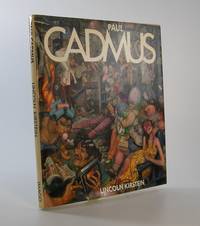
1984207794New York: An Imago Imprint 1984. First Edition. Fine in dust jacket. Square 4to 144pp; cloth-backed boards. Richly illustrated monograph published in celebration of Cadmus's eightieth birthday. This copy has been signed by Kirstein on the front flyleaf and also inscribed and signed "Paul" by Cadmus on the same page at the gallery reception to mark the publication; with the invitation card to the reception laid in. An Imago Imprint unknown
193870128New York:: Museum of Modern Art/ Doubleday 1938. Hardcover. Used very good. Square black cloth hardcover in white 3.95 dust jacket gold lettering on spine 196 pages 87 plates. No additional printings indicated but list of books on back of dust jacket indicates a later printing. Book as new. Dust jacket slightly edgeworn a little soiled from rubbing against other books spine and edges of flaps tanned from sunlight. A very nice copy. We provide professional service and individual attention to your order daily shipments and sturdy packaging. Museum of Modern Art/ Doubleday, hardcover
2007103G2381Canada: C-FAR 2007. Book. Very Good. Paperback. First Edition. 8vo - over 7¾" - 9¾" tall. 43 pages. "Exposing the psychological lies which built the foundation of Canada's censorship laws" - subtitle. Clean and unmarked with light wear. A sound copy. C-FAR Paperback
500809from an etched portrait on a 1/2 length pose of Lincoln with full beard as President. Photograph is on the original mount. Very good. 2 1/2" x 4 1/4" ca. 1861. No Binding. Very Good. unknown books
186521167Washington: War Department Adjutant General's Office 1865. Very good. Single leaf 5 1/4 x 7 1/8 inches possibly originally issued with two leaves the second being blank. 1.5 pages of text signed in print by Lincoln William Seward and E.D. Townsend. Faint folding creases; near fine. Issued March 11 1865 this was the second of two general amnesties issued by the President during the Civil War. These proclamations were intended to bring deserters and draft evaders back into the fold and encourage loyalty to the Union. The first issued on March 10 1863 gave all deserters a full pardon with no consequences if they returned to their units by April 1. Those who did not would have their citizenship revoked and were subject to court-martial with penalties as severe as death. This second proclamation offered the same basic terms but allowed deserters 60 days to return to duty. War Department, Adjutant General's Office unknown books
186436792Ohio 1864. Broadside ticket listing Union Ticket candidates for elections in 1864 beneath illustration of the American Flag. Several candidates are listed for "Supreme Judge" plus candidates for Secretary of State Attorney General Comptroller of the Treasury Board of Public Works; and for Congress John A. Bingham. Some edge wear text complete horizontal fold. Good. unknown books
12982Original Civil War dated newspaper. The Republican Herald and Post dated Providence Saturday morning September 27 1862. 4 pages recto verso. Includes a front page print of a September 22 proclamation from Abraham Lincoln. The proclamation reads in part: "I Abraham Lincoln President of the United States of America and Commander-in-Chief of the Army and Navy thereof do hereby proclaim and declare that hereafter as heretofore the war will be prosecuted for the object of practically restoring the constitutional relations between the United States and the people thereof. Abraham Lincoln." Newspaper is in excellent condition with some minor chipping to the edges. unknown books
1865WRCAM31223New York 1865. 8pp. Large folio newspaper. Split along fold with loss to a few words. About very good unopened. The main news in this edition concerns the ongoing events in the assassination of President Lincoln. A long story from Springfield Illinois reports on the arrival of the funeral procession and there are several stories about the pursuit of the conspirators in the President's murder. One story calls Jefferson Davis "a fugitive from justice with a price set on his head as an assassin." Another long piece brings news from the South as military action in the Civil War winds to a halt. The last page is taken up by an account of the Irish Independence movement and a profile of "Fenians at Home and Abroad." unknown books
1865WRCAM31127New York 1865. 8pp. Large folio newspaper. Moderate foxing. Very good. The assassination of President Lincoln on April 14 1865 came on the same day Gen. Joseph Johnston of the Confederacy contacted Sherman to discuss the suspension of operations under similar terms granted to Lee. The present issue of THE NEW YORK HERALD treats both events with an account of Johnston's actual surrender under desired terms along with a relation of the progress of Lincoln's funeral train across America. The previous day the President's body was in Cleveland on the 29th the body was in Columbus. A poignant slice of America at the close of the Civil War. Long E.B. THE CIVIL WAR DAY BY DAY pp.675- 76684. unknown books
1865WRCAM31216New York 1865. 8pp. Large folio newspaper. Lightly tanned. Split at one fold with loss of a few words. Good unopened. Assassination edition of this weekly version of THE NEW YORK HERALD newspaper dated exactly one week after Lincoln's death. With all the columns bordered in black the paper contains all the news of the previous week from the details of the assassination to the attacks on other government officials and the search for Booth and the conspirators. There is also a long story containing details of Lee's surrender to Grant at Appomattox and a few stories regarding travel abroad. unknown books
1865851301865. PHOTOGRAPHY 19TH CENTURY - LINCOLN Abraham. UNCOMMON CARTE-DE-VISITE PHOTOGRAPH OF ABRAHAM LINCOLN CA. 1865. Providence RI: Salisbury Bro. & Co. n.d. ca. 1865 "Manufacturers of Gold and Plated Jewelry Also Carte de Visites of all Noted Persons." Pale embossed paper mount is 4 x 2 1/2 inches with 1 3/8 x 1 1/8 inch oval photograph a bust of a bearded Lincoln. Very good light soil to the mount with the photo contour partially cut through from being pressed into the paper mount. The embossed design features an eagle laurel leaves flags shield and cannons. The photo is in excellent condition the President's gaze clear and sharp. Free of the toning often seen on this cdv. unknown books
190219199Trenton NJ: Albert Brandt: Publisher 1902. First edition of his first book and his only volume of verse. Illustrated by Edward W. Kemble. 1 vols. 12mo. Original cloth original dust jacket with illustration by Mira Burr Edson on the upper cover. Some rubbing light soiling and short tears along edges but a very good copy of this work. First edition of his first book and his only volume of verse. Illustrated by Edward W. Kemble. 1 vols. 12mo. FIRST BOOK IN DUSTJACKET. Seven Gables "More First Books" Catalogue 176 Albert Brandt: Publisher unknown books