12 256 résultats
20172081502111907915Kaikyo Literary Publishing Company 2017. Soft Cover. Fine. The book is in fine condition. Kaikyo Literary Publishing Company paperback
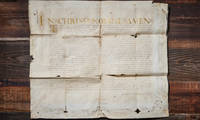
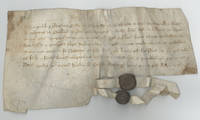
14222599612/04/1422. <div class=""gs""><div class=""""><div id="":2pv"" class=""ii gt""><div id="":2pu"" class=""a3s aiL ""><blockquote><div dir=""ltr"">Part of an important professors collection the majority of which was assembled and last offered for sale 25 years ago</div></blockquote><div class=""adL""></div></div></div></div></div><p>Myles Standish was an English military officer hired to accompany the Pilgrims in 1620 on the ship Mayflower as their military adviser. He played a leading role in the administration and defense of Plymouth Colony. He was one of the first settlers and founders of the town of Duxbury Massachusetts. He died on October 3 1656 in the New World in Duxbury-- a town the Pilgrims had named after his likely ancestral home in Lancashire England and an estate that occupied by these very men. what does this mean On February 17 1621 the Plymouth Colony militia elected him as its first commander and continued to re-elect him to that position for the remainder of his life. Standish served at various times as an agent of Plymouth Colony on a return trip to England as assistant governor of the colony and as its treasurer.</p><p>Taking the Standish Family back to their home in the Greater Manchester towns of Standish Chorley and Duxbury we see this important family’s expansion in terms of land and power. Since the 1200s the Standish Family had been the Lords of the Standish Manor.</p><p>Ralph de Standish was the Lord of the Manor from 1396-1415; in 1406 he acquired the estates of his uncle Sir Ralph de Standish of Scholes. As the Lord of the Manor he supplemented the family’s landholdings through purchases in nearby Wigan Shevington and Winstanley. In 1415 John de Standysshe likely Ralph’s brother was recorded at the Battle of Agincourt. Other Standishes at this important turning point in the Hundred Years War included Thomas Sir Rowland Sir Hugh and Christopher the latter two of which were of the Duxbury Branch of the Standishes. Christopher would become Lord of the Manor of Duxbury from 1421 to 1437 and die shortly thereafter.</p><p>Ralph’s death passed the Lordship of the Manor to his eldest son Lawerence; however he had two other sons Robert and Gilbert. Records about Gilbert only give few details. He was “living in 1423/4†and “in 1400 he was mentioned in a deed and entered into covenants with John Smith chaplain and Henry Matthew chaplain 1411/2 authorized by his mother and father.â€</p><p>Though the records remain inconclusive The Families of Standish states that “Sir Ralph de Standish of Scholes is considered to be the ancestor of the Standishes of Ormskirk and through them the ancestor of Captain Myles Standish of Plymouth and Duxbury Massachusetts who came in the ‘Mayflower’ 1620†p. 51.</p><p>Lancashire England 1422 <strong>Small indenture in Latin</strong> with two seals attached 103mm by 180mm approximately 12 April 1422 10th year of the reign of Henry V affirming a debt of 40 pounds by Gilbert de Standyssh Esq. of Blakerode i.e. Blackrod Lancs. Roger de Molyneux Esq. of Pemberton Lancs. and William son of Roger de Assheton Esq. of Abram Lancs. to Christopher de Standyssh. With original seals attached.</p><p>Through a small document the consolidation of Standish wealth is demonstrated. Further the exchange of £40 equivalent to approximately £34572 or $41700 in modern currency between Gilbert Standish Roger de Molyneux and William de Assheton son of Roger to Christopher Standish demonstrates the intimate ties between important families. Roger Ashton’s father was a soldier under King Henry IV and Henry V; his father before him was Sir John de Ashton who served with John of Gaunt in 1369 and whose part in the siege of Noyon in 1370 is mentioned by name by Froissart’s Chronicles in French.</p><p>Roger’s brother and William’s uncle was the famed alchemist given permission by Henry IV for his experiments.</p><p>See also:</p><p>Weis Frederick Lewis. The Families of Standish of Standish Lancashire England and Standish of Duxbury Arley Ormskirk Gathurst Croston Park Brook and Wantage… 1959.</p><p><img class=""alignnone wp-image-25018 size-post-window"" src=""https://cdn.raabcollection.com/wp-content/uploads/20231204144051/Folder-site-11-1600x1327.jpg"" alt="""" width=""1600"" height=""1327"" /></p> unknown
169038016PRIMERA Y UNICA EDICION.- S.l.: s.n. s.a. ca. 1690 o 1691.- 4 h. 528 p. 4 h.; 4º menor 205 x 16 cm: Con 2 viñetas xilográficas de fin de capítulo; Buena impresión sobre papel verjurado fuerte y limpio; Cinta separadora de lectura; Enc. en Plena Piel pasta época lomo liso con dorados y tejuelo rojo con el título cortes jaspeados. Según Salvá en su Catálogo ficha Nº 3595 este libro debió imprimiese para ser regalado o distribuirlo privadamente pues no consta por ninguna parte ni el nombre del librero que lo publicó ni aún el del pueblo donde salió a luz. Por todo esto la rareza de este libro se debe a su escasísima difusión y corta tirada. Catalina asevera que la impresión debe ser de Madrid."y casi tengo la seguridad de que no se imprimió en Alcalá". No obstante es de señalar que al principio del libro justo al final de la carta impresa en que se dedica el libro al Excmo. Sr. Marqués de Mondejar el autor escribe: Mondejar y Julio 20 de 1690. Por esto deduzco que debió de imprimirse en ese año o a más tardar al siguiente de 1691.- RARISIMA OBRA. Palau nº 276605 Salva nº 3595. Las 14 hojas comprendidas entre las pags. 133 a 161 tienen en la esquina superior externa una máncha de óxido que toca un poco al texto y va disminuyendo hasta desaparecer pero no afecta ni a su lectura ni a la textura del papel. También falta un trocito de papel en la esquina inferior externa de la hoja que corresponde a las pags. 275-76 que toca mínimamente al texto de una apostilla marginal impresa. Con 7 notitas de la época manuscritas a tinta en los márgenes externos. El plano posterior restaurado de dos pequeñas faltas de piel que apenas se notan. A PESAR DE LO DICHO QUE ES PRECEPTIVO EL LIBRO SE ENCUENTRA EN MUY BUEN ESTADO. CASTILLA-LEÓN Libro en español Sin editorial hardcover
88454Ibadan Nigeria: New Culture Studios 1978-1979. First Printing. 11 Issues running from November 1978 to October 1979 with no December 1978 production as issued. Small Quarto. 24.5cm. Publisher's original vibrantly decorated thin card wraps. Approx. 68-80pp. per issue. Clean bright and sharp; internally clean printed on various colors of paper some light spotting and offsetting in places due to the necessarily cheap paper stock with the "Dark Pages" complete and unopened. A very good clean bright set indeed.<br /> <br /> A full run of Demas Nwoko's visually striking and culturally ground-breaking "New Culture" magazine. Ulli Beier the driving force behind the equally impressive and influential "Black Orpheus" described new Culture as "Easily one of the most meticulously structured and planned magazines I have ever seen." Nwoko a visionary architect and now counted as a leading pioneer of Nigeria's 20th century art movement was one of the members of the inflammatory Zaria Art Society popularly called "Zaria Rebels" during the 1950's and later on a prominent member of the legendary creative collective known as the Mbari Club of Ibadan in the years prior to his creation and editorship of New Culture. The drive of the Zaria Rebels was to take their heavily western-influenced art education Nwoko for example studied in Paris and turn its methodology into a uniquely African themed art movement eradicating the concept of African art as subject to Western art critique and interpretation and rendering it its own liberated entity. New Culture was the logical extension of that mission providing a platform for the celebration of pan-African art architecture and literature and most importantly offering a place for cross-generational education on African history folklore and culture to younger Africans with specially curated sections for children's education. The design ethic behind New Culture is not only clear from the layout and general content but also in a sort of considered uniqueness that manifested itself in things like the famous "Dark Pages"; unopened sections of the magazine that contained unknown "surprise" features. Perhaps indicative of Nwoko's theatrical background these pages rendered each issue of New Culture an exercise in surprise revelation and audience participation. The magazine was short lived as most publishing efforts out of Ibadan tended to be a second volume was planned for early 1980 but never came to fruition. This brief vivid run of issues remains however as an indicator of the energy and vibrancy of the definitively African art scene of the period. New Culture Studios unknown
187284883Philadelphia: Porter & Coates Publishers 1872. First Edition. Thick octavo 24.5cm; variant in the publisher's terracotta fine English cloth binding with titles stamped in gilt on spine and front cover; dark brown clay-coated endpapers; 4pp.ads iv7802pp with an engraved frontispiece portrait of Still and 43 plates of illustrations. Gently spine-sunned spine ends pushed and a bit worn minute board exposure to corners some light surface wear and dust-soil to cloth with some partial cracks to front hinge and a small one to lower rear hinge; some light foxing and occasional finger-soil to margins of plates with some staining to lower third of pp.50-51 and the plate in between; a solidly Very Good unrepaired copy.<br /> <br /> A historically significant document by Still a free-born Black man who became an author and abolitionist movement leader in Philadelphia PA. The volume documented the stories of escaped slaves and remains "the only first-person account of Black activities on the Underground Railroad written and self-published by an African-American.William Still was a major contributor to the success of the Underground Railroad activities in Philadelphia and a part of Philadelphia's free Black community that played an essential role in the Underground Railroad. He personally provided room and board for many African Americans who escaped slavery and stopped in Philadelphia on their way to Canada. Through his work with the Pennsylvania Society for the Abolition of Slavery's Vigilance Committee he raised funds to assist runaways and arrange their passage to the North. He was instrumental in financing several of Harriet Tubman's trips to the South to liberate enslaved Africans" Turner Diane D. "William Still's National Significance." Web blog post. William Still: African American Abolitionist. Temple University n.d. 18 August 2016. <br /> <br /> Still kept meticulous notes concerning the many escaped slaves who passed through the Philadelphia "station;" he took pains to record names brief biographies and the destination for each individual along with any adopted aliases in hopes of reuniting family members who were separated by slavery. He kept his notes secret hidden in diaries he kept during those years and published them after the Civil War. The Underground Rail Road went through three editions and was displayed at the Philadelphia Centennial Exhibition in 1876. SCHOMBURG p.7 394; WORK p.338. Porter & Coates, Publishers unknown
187284792Philadelphia: Porter & Coates Publishers 1872. First Edition. Thick octavo 24.5cm; variant bound in the publisher's paneled-style brown pebbled cloth with titling and decorations stamped in gilt on spine and covers; dark brown clay-coated endpapers; all edges gilt; 4pp.ads iv7802pp with an engraved frontispiece portrait of Still and 43 plates of illustrations. Modest rubbing to the binding wear and shallow loss to heel with gentle sunning and biopredation to spine resulting in some erosion to the cloth; a few thin partial cracks to hinges two of them showing evidence of being re-glued with textblock starting to sag very slightly; early owner's small label and neatly rubber-stamped name John D. Harrison on preliminary blank and pp.101 400 and 780 with a small loss to margin at pp.45-46 and two pages with small marginal tears; Very Good.<br /> <br /> A historically significant document by Still a free-born Black man who became an author and abolitionist movement leader in Philadelphia PA. The volume documented the stories of escaped slaves and remains "the only first-person account of Black activities on the Underground Railroad written and self-published by an African-American.William Still was a major contributor to the success of the Underground Railroad activities in Philadelphia and a part of Philadelphia's free Black community that played an essential role in the Underground Railroad. He personally provided room and board for many African Americans who escaped slavery and stopped in Philadelphia on their way to Canada. Through his work with the Pennsylvania Society for the Abolition of Slavery's Vigilance Committee he raised funds to assist runaways and arrange their passage to the North. He was instrumental in financing several of Harriet Tubman's trips to the South to liberate enslaved Africans" Turner Diane D. "William Still's National Significance." Web blog post. William Still: African American Abolitionist. Temple University n.d. 18 August 2016. <br /> <br /> Still kept meticulous notes concerning the many escaped slaves who passed through the Philadelphia "station;" he took pains to record names brief biographies and the destination for each individual along with any adopted aliases in hopes of reuniting family members who were separated by slavery. He kept his notes secret hidden in diaries he kept during those years and published them after the Civil War. The Underground Rail Road went through three editions and was displayed at the Philadelphia Centennial Exhibition in 1876. SCHOMBURG p.7 394; WORK p.338. Porter & Coates, Publishers unknown
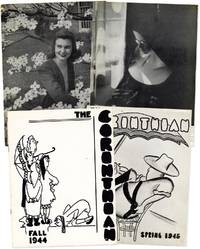
194388110Milledgeville GA: Georgia State College for Women 1943-1945. First Editions. Four slim quarto issues 29.25cm; original photo-illustrated and pictorial wrappers stapled. Publication sequence as follows: Spring 1943 Vol.XVIII No.2 1-1920pp; Fall 1943 December 1-1920pp; Fall 1944 34-1718-20pp; Spring 1945 34-1819-20pp; illus. The Spring 1943 and Fall 1944 issues are Very Good with some light external wear minor dust-soil and occasional foxing to wrappers with a few tiny tears and abrasions and a small ink mark to front cover of one issue. The Fall 1943 issue is Very Good with light wear and dust-soil to wrappers and an ad carefully torn out from inner rear wrapper. The Spring 1945 issue shows some splitting above and below the staples faint foxing along the left edge with the wrappers present but detached and neatly separated along the spine-fold; Very Good. <br /> <br /> A significant collection of issues of the Corinthian the literary magazine of the Georgia State College for Women where Flannery O'Connor attended on an accelerated program from 1942-1945 after graduating from Milledgeville's Peabody High School. She joined the staff of the Corinthian where she rose to the rank of editor in 1944 and contributed numerous poetry and prose pieces and also the occasional cartoon. Aside from her contributions to Peabody High's school newspaper where she served as art director these pieces in the Corinthian constitute some of hear earliest published work. Her contributions to the present issues all credited to M.F. O'Connor are as follows: Spring 1943 - "Elegance Is Its Own Reward" prose "Effervescence" poetry; Fall 1943 - "Home of the Brave" and "Doctors of Delinquency" prose; Fall 1944 - "Fashion's Perfect Medium" prose "Pftt" poetry; Spring 1945 - "Higher Education" poetry "Education's Only Hope" prose. While uncredited and lacking her later stylized "MFOC" initials both the cover of the Fall 1944 issue and two large cartoons illustrating "Fashion's Perfect Medium" are a dead match for O'Connor's style right down to the angular and chinless facial features of her subjects. Issues of the Corinthian are rare in commerce with none appearing in the auction record; OCLC notes 4 locations holding any issues Georgia College & State Univ UGA Brown BL with Emory showing 3 issues from 1942-45 held with O'Connor's papers. <br /> <br /> Provenance: From the collection of Kitty Burruss Bull a friend of O'Connor's at GSCW and her associate editor. Through a descendant. 88110. Georgia State College for Women] unknown
18904628Paris 1890 1890. A beautiful late nineteenth-century illuminated manuscript with the text of the Ordinary of the Mass. 178x125mm. Title page and thirty-two pages. Signed at foot of final page "Germaine Mimey 1890" with the initials "G.M." at the foot of each page. Bound by Emile Rousselle signed at foot of front doublure in tan morocco with a single fillet border framing a wide gilt tooled border inside which is a smaller gilt tooled border which frames a shield with three fleur de lys surmounted by a crown. Below the shield is a dragon. Either side of the shield is stamped four times the letter "F" surmounted by a crown. This is repeated on the lower cover. The spine has five raised bands with four compartments decorated with a fleur de lys the second compartment being blank. The front and rear doublures are of blue morocco with gilt decoration and a brown calf diamond. Turn-ins decorated in gilt. Front and rear free endpapers are in brown silk. The illuminations are gorgeously delicate with the occasional block of colour. The spirit is genuinely medieval with a light sinuousness in contrast to the rather heavier Gothic Revival manner which is often in evidence in this type of late nineteenth century illumination. We have been unable to identify "F" unless of course it simply stands for "France" but with the crowns shield and fleur de lys this beautiful little Missal was clearly done for an aristocratic and perhaps even a royal patron although of course by 1890 he or she would have been a mere Pretender taking solace in this sumptuous devotional book. [Paris] 1890 hardcover
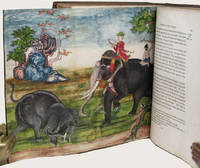
182634747London: Published for the Author 1826. First Edition. THE AUTHOR'S COPY SPECIALLY BOUND. A Highly Important and Unique Copy with 25 Extra Illustrations tipped or pasted in 6 coloured 5 full page. SIGNED BY RANKING with the Inscription - "To remain in the family this correted copy with new notes and Illustrations." The Notes appear on several pages and are rendered in pencil. Folding lithograph frontispiece folding map 1 folding engraved map 6 lithograph and 3 engraved plates plus the 25 extra illustations and engravongs. A large folding handcoloured plate of elephants Quarto conemporary red straight-grained morocco the spine exquisitely designed with wide raised bands gilt rolled the compartments decorated with in both gilt and blind two compartments lettered one being the declaration that this is the author's copy covers bordered with triple gilt rules surrounding an inner panel gilt decorated and ruled the corners with elaborately tooled decorations in gilt an inner diamond and roll tooled border in blind inner gilt dentelles original dark green endleaves all edges gilt a superb binding accomplished for the author. xiv 516 pp. A very handsome copy in a beautifully designed and unique contemporary binding the binding tight and strong and beautifully preserved there is a very faint old stain from damp affecting the lower portion of the pages but this remains a quite extraordinary copy nevertheless. UNIQUE FIRST EDITION SPECIALLY BOUND THE AUTHOR'S OWN COPY WITH HIS INSCRIPTIONS AS TO OWNERSHIP AND FAMILY ASSOCIATION. Ranking's wide-ranging work generally returns to the author's interest in Asiatic and African elephants and his "endeavor to trace the historical proofs that the fossil bones of elephants and wild beasts which have been found throughout Europe are the remains of those animals which have been employed in the wars religious ceremonies and amphitheatrical sports of the Romans and the Mongols" Preface. The book examines the historical roots of fossil remains found in Siberia and other countries arguing that these remains belong to elephants and other animals used in the wars religious ceremonies and amphitheatrical sports of the Romans and Mongols. The author traces the evidence from historical sources including accounts from Marco Polo and other travelers to prove that the number of elephants employed by these empires far exceeded previous estimates. <br> The book also explores the broader context of elephant usage in ancient times from their role in warfare to their significance in cultural and religious practices. Ultimately this book sheds light on the interconnectedness of human history and the natural world providing insights into the complex relationships between humans animals and the environment. <br> The volume full of "much amusing and instructive matter industriously accumulated and detailed with conciseness and perspicuity" American Quarterly Review March 1827 includes chapters on the lives of the Grand Khans and of Tamerlane the "Employment of Elephants from the earliest times" "Fossil Remains of Elephants" "Of Roman and Greek Wars in which Elephants were employed" "Sports and Combats in the Circus and Amphitheatre". Illustrated with a large folding map measuring approximately 17-1/2 by 21 inches unfolded "The Continent of Asia as conquered and governed by Genghis Kahn… and to the Death of Tamerlane" and with ten engraved plates: these include "The Emperor Kublai" a spectacular depiction of "The Emperor Kublai" going to war in a pavilion borne atop four elephants.; three numismatic plates depicting coins and medals from Roman Britain; the "Defeat of Hannibal by Scripio at Zama" portraying a battle with armies cavalry and elephants; views of the "Amphitheatre of Claudius" and a "Circus" with numerous elephants giraffes and lions; and a folding map of Hannibal's storied campaign over the Alps "with large armies and numerous Elephants". Presentation Inscription and Ownership signification to the title-page. Published for the Author hardcover
14502454001/01/1450. <blockquote><p>A very uncommon leaf from Livy very few manuscript examples having survived</p></blockquote><p>Rome having survived the invasions of the Celtic Gauls in the early 4th century BC set its sights on further expansion in the middle part of the century. They re-conquered those Latin and Etruscan towns that had left the fold during the Gallic occupation and in absorbing others reconsolidated their position as the dominant force in Latium and Central Italy. With their home turf secured or so it seemed the Romans looked south towards Campania.</p><p>At this time the Samnites had moved into the fertile lands of Campania from the south-central Appenines. They already controlled the towns of Capua and Cumae to the south of Rome and held sway to the east as well. Rome to protect its flanks while still in the midst of re-taking Latium and Etruria wisely entered into an alliance with the Samnites in 354 BC. Conflict with Samnium over Campanian dominance was inevitable however and would soon turn into a series of wars lasting from 343 - 290 BC.</p><p>The years surrounding the Samnite Wars were not only one of military prowess for Rome but of great public works as well. In 329 BC the Circus Maximus got one of many face-lifts throughout its history gaining permanent horse-stalls and starting gates. The first Roman road the Via Appia was constructed from Rome to Capua in 312 BC and the first aqueduct the Aqua Appia was also established at the same time. These magnificent structures not only were of great benefit to Rome and her people but proved the flourishing disposition of the state even during time of war and expansion. At the end of the Samnite Wars Rome held perhaps as many as 150000 people making it one of the largest cities in the Mediterranean region. As many as 1000000 people claimed citizenship to Rome and vastly larger numbers were obligated through Latin rights and allied status.</p><p>With the defeat of Samnium the last major Italian threat Rome was the master of nearly the entire Italian peninsula save for the Gauls occupying the Po valley in the north and the Greek holdout cities like Tarentum in the far south. This growing power soon gained the attention of regional powers in Greece and later the masters of the Mediterranean the Carthaginians.</p><p>Livy or Titus Livius 59 BC - 17AD wrote his history of Rome starting with the foundation myth of Aeneas 510 BC up to the successful German campaigns and death of Emperor Drusus 9 BC. This history comprised 142 books. Of those books 35 survive to present day with the bulk being the first 10 years Books 1-10 fragments of 11 Books 21-45 fragments of 91 and scattered quotations preserved in secondary works.</p><p>Though the accounts differ the destruction of Livy’s work has been attributed to the hand of Pope Gregory the Great 590–604 who was trying to eliminate pagan works from Christian hands. This biblioclasm whether it was through the Pope’s doing or through the natural loss of material to time has severed us from an important access point to Roman history as some of the material used by Livy has not been found in his source texts.</p><p>With the bulk of the texts destroyed Livy’s History of Rome passed into the Middle Ages primarily through summary and with the extreme length of the work the original Classical and Early Medieval manuscripts were not recopied and fell into decay and loss. Thus by the so-called 12th Century Renaissance Livy’s historical writing was quite rare. It was not until the 1300s that Livy regained popularity. Dante was one of those who respected Livy and in his Inferno the poet references Livy ""come Livïo scrive che non erra"" as Livy wrote who does not err.</p><p>The hunt was on for Livy’s lost manuscripts even just a fragmental scrap was a treasure worth finding in the 1300s. Even Pope Nicholas V turned his efforts towards finding these rare manuscripts some of which had been destroyed by his papal predecessor. The Italian Humanist period into the Renaissance increasingly sought any extant versions of this history; as the esteem for and ardent imitation of Greco-Roman culture increased so did the need for access points to this history. Entire country homes in Italy were sold to buy a single manuscript of Livy’s works copied by one of the men primarily responsible for the new handwriting style now known as the Humanist hand. Scholarship and commentary ranging from England by Dominican Friar Nicholas Trevet to Italy by Laurentius Valla paved the way for further analysis of the Roman historian.</p><p>This Italian manuscript leaf likely from the mid-1400s to the very early 1500s comprises part of Book 9 from BC 308. With only minor deviations from the Loeb Classical Library text which is the scholarly standard. These deviations indicate that this manuscript descends from a different stemma than the most common or most “correct†one which was for the Loeb edition further painting the picture of the Humanist effort to grasp this fading history from the jowls of history and the pains to retaining the original text despite the lack of exemplars.</p><p>In addition to representing an important moment in the recuperation of history the script throws us into modernity. Towards the end of the 14th century several Italian humanists including Niccolò Niccoli and Poggion Bracciolini began set about to reform the increasingly dense Gothic handwriting which had dominated book making since the mid-13th century. The Gothic script whose legacy in printing extends to 20th century German fraktur found in pre-war books was full of letters fused together ornate thorns and hairlines and single strokes called minims which became impossible to read. These 14th century Italians set about to recreate a script that utilized space between each letterform and simpler strokes— a new take on the handwriting endorsed by Charlesmagne himself for the education of his Holy Roman Empire. This script known as Humanist caught on and proliferated. By the time texts were bring printed at the end of the 15th century the printers looked to this script to make a font and further our modern Times New Roman font is based on the Humanist script which is in part why this text of Livy is so legible to us as a modern audience.</p><p>Pierre Maréchaux “The Transmission of Livy from the End of the Roman Empire to the Beginning of the Seventeenth Century: Distortion or Discovery a Story of Corruption†A Companion to Livy ed. Bernard Mineo John Wiley & Sons: 2014 pp. 437-452.</p><p><strong>More details</strong></p><p>LEAF FROM LIVY’S AB URBE CONDITAS in Latin text manuscript on parchment Northeastern Italy perhaps Padua 1456 Single column of 34 lines written in brownish ink in Humanist hand with some slant and ligatures. Letters beginning sections set in margins with two hatch marks in pen next to all but one of the initials. Single correction indicated by strike through with amended word written above line 15 recto; Ruled horizontally in red ink. Distinct hair and flesh sides. Modern pencil number 185 at the bottom left hand of the column on verso. Provenance: Sothebys March 1825 Payne and Foss 1825 Sothebys 1902 & 1923 Parke-Bernet 1941 Otto Ege. Gwara Handlist 52.</p><p><strong>Text & Translation:</strong></p><p>…ruperat Fabius consul nec dubia nec difficili victoria dimicat. Ipsum oppidum—nam ad moenia victor accessit—cepisset ni legati dedentes urbem exissent. Praesidio Perusiae imposito legationibus Etruriae amicitiam petentibus prae se Romam ad senatum missis consul praestantiore etiam quam dictator victoria triumphans urbem est invectus; quin etiam devictorum Samnitium decus magna ex parte ad legatos P. Decium et M. Valerium est versum; quos populus proximis comitiis ingenti consensu consulem alterum alterum praetorem declaravit.</p><p>XLI. Fabio ob egregie perdomitam Etruriam continuatur consulatus; Decius collega datur. Valerius praetor quartum creatus. Consules partiti provincias: Etruria Decio Samnium Fabio evenit. Is profectus1 ad Nuceriam Alfaternam cum pacem petentes quod uti ea cum daretur noluissent aspernatus essetoppugnando ad deditionem subegit. Cum Samnitibus acie dimicatum. Haud magno certamine hostes victi; neque eius pugnae memoria tradita foret ni Marsi eo primum proelio cum Romanis bellassent. Secuti Marsorum defectionem Paeligni eandem fortunam habuerunt.</p><p>Decio quoque alteri consuli secunda belli fortuna erat. Tarquiniensem metu subegerat frumentum exercitui praebere atque indutias in quadraginta annos petere. Volsiniensium castella aliquot vi cepit; quaedam ex his diruit ne receptaculo hostibus essent; circumferendoque passim bello tantum terrorem sui fecit ut nomen omne Etruscum foedus ab consule peteret. Ac de eo quidem nihil impetratum; indutiae annuae datae. Stipendium exercitu Romano ab hoste in eum annum pensum et binae tunicae in militem exactae; ea merces indutiarum fuit.</p><p>Tranquillas res iam in Etruscis turbavit repentina defectio Umbrorum gentis integrae a cladibus belli nisi quod transitum exercitus ager senserat. concitata omni iuventute sua et magna parte Etruscorum ad rebellionem compulsa tantum exercitum fecerant ut relicto post se in Etruria Decio ad oppugnandam inde Romam ituros magnifice de se ac contemptim de Romanis loquentes iactarent. Quod inceptum eorum ubi ad Decium consulem perlatum est ad urbem ex Etruria magnis itineribus pergit et in agro Pupiniensi ad famam intentus hostium consedit. Nec Romae spernebatur Umbrorum bellum et ipsae minae metum fecerant expertis Gallica clade quam intutam urbem incolerent Itaque legati ad Fabium consulem missi sunt ut si quid laxamenti a bello Samnitium esset in Umbriam propere exercitum duceret. Dicto paruit consul magnisque itineribus ad Mevaniam ubi tum copiae Umbrorum erant perrexit.</p><p>Repens adventus consulis quem procul Umbria in Samnio bello alio occupatum crediderant ita exter-ruit Umbros ut alii recedendum ad urbes munitas…</p><p>In the same year the consul Fabius fought a battle with the remnants of the Etruscan forces near Perusia—which together with other cities had broken the truce—and gained an easy and decisive victory. He would have taken the town itself—for after the battle he marched up to the walls—had not ambassadors come out and surrendered the place. Having placed a garrison in Perusia and having sent on before him to the senate in Rome the Etruscan deputations which had come to him seeking friendship the consul was borne in triumph into the City after gaining a success more brilliant even than the dictator’s; indeed the glory of conquering the Samnites was largely diverted upon the lieutenants Publius Decius and Marcus Valerius of whom at the next election the people with great enthusiasm made the one consul and the other praetor.</p><p>In recognition of his remarkable conquest of Etruria Fabius was continued in the consulship and was given Decius for his colleague. Valerius was for the fourth time chosen praetor. The consuls cast lots for the commands Etruria falling to Decius and Samnium to Fabius. The latter marched against Nuceria Alfaterna and rejecting that city’s overtures of peace because its people had declined it when it was offered them laid siege to the place and forced it to surrender. A battle was fought with the Samnites in which the enemy were defeated without much difficulty nor would the engagement have been remembered but for the fact that it was the first time that the Marsi had made war against the Romans. The Paeligni imitated the defection of the Marsi and met with the same fate.</p><p>Decius the other consul was also successful in war. When he had frightened the Tarquinienses into furnishing corn for the army and seeking a truce for forty years he captured by storm a number of strongholds belonging to the people of Volsinii. Some of these he dismantled lest they should serve as a refuge for the enemy and by devastating far and wide he made himself so feared that all who bore the Etruscan name begged the consul to grant them a treaty. This privilege they were denied but a truce for a year was granted them. They were required to furnish the Roman army with a year’s pay and two tunics for each soldier; such was the price they paid for a truce.</p><p>The tranquility which now obtained in Etruria was disturbed by a sudden revolt of the Umbrians a people which had escaped all the distress of war except that an army had passed through their territory. Calling up all their fighting men and inducing great part of the Etruscans to rebel they mustered so large an army that they boasted with much glorifying of themselves and fleering at the Romans that they would leave Decius behind them in Etruria and march off to the assault of Rome. When this purpose of theirs was reported to the consul Decius he hastened by forced marches from Etruria towards the City and encamped in the fields belonging to Pupinia eagerly waiting for word of their approach. At Rome no one made light of an Umbrian invasion. Their very threats had excited fear in those who had learnt from the Gallic disaster how unsafe was the City they inhabited. Accordingly envoys were dispatched to carry word to Fabius the consul that if there were any slackening in the Samnite war he should with all speed lead his army into Umbria. The consul obeyed the order and advanced by long marches to Mevania where the forces of the Umbrians at that time lay.</p><p>The sudden arrival of the consul whom they had believed to have his hands full with another war in Samniurn a long way from Umbria so dismayed the Umbrians that some were for falling back on their fortified cities and others for giving up the war…</p><p><img class=""alignnone wp-image-24457 size-post-window"" src=""https://cdn.raabcollection.com/wp-content/uploads/20231204150746/Folder-site-8-1600x1327.jpg"" alt="""" width=""1600"" height=""1327"" /></p> unknown
1561372709Venice: apud Iuntas heirs of Luca Antonio Giunta 1561. Title page with small woodcut of pope and six bishops; Giunta printer's device in red on title and at end; one full-page woodcut of Crucifixion third-page woodcuts at head of each of three parts 162 woodcuts of liturgical scenes woodcut initials. Text printed in two columns in red and black throughout musical notation in black on staves of four red lines. 4 243 ff. 1 vols. Folio. Contemporary Italian orange morocco gilt boards ruled in gilt central panels in double gilt rule with floral corner tools upper board with cardinal's hat lower board with sunburst initials in central cartouches effaced a.e.g. Spine dark some soiling and rubbing light traces of worming at back. Title page with small woodcut of pope and six bishops; Giunta printer's device in red on title and at end; one full-page woodcut of Crucifixion third-page woodcuts at head of each of three parts 162 woodcuts of liturgical scenes woodcut initials. Text printed in two columns in red and black throughout musical notation in black on staves of four red lines. 4 243 ff. 1 vols. Folio. Liturgical work including the music of the chants and hymns to accompany the services. Adams L1241; EDIT16 CNCE 11860. Provenance: early ownership signature of Joanis Ant. S- on pastedown. General Theological Seminary bookplates and stamps apud Iuntas [heirs of Luca Antonio Giunta] unknown
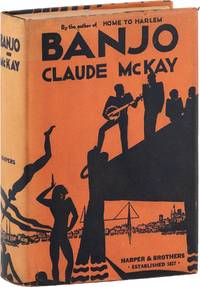
192988435New York: Harper & Brothers Publishers 1929. First Edition. First Printing. Octavo 19.5cm; navy blue and red paper-covered boards and black cloth backstrip with titles stamped in gilt on spine; decorative endpapers; orange topstain; dustjacket; viii23-3262pp. Spine ends gently nudged topstain slightly dulled else a fresh very Near Fine copy. In the original dustjacket designed by Aaron Douglas; unclipped priced $2.50 gently spine-sunned and lightly edgeworn with a few tiny tears a tiny split at rear flap fold and some mild dust-soil; still a bright Near Fine copy. <br /> <br /> McKay's second novel an accurate social perspective of Black life in southern France drawn directly from McKay's experience living in Marseilles. "Lincoln Agrippa known to his drifter cohorts on the 1920s Marseilles waterfront as "Banjo" passes his days panhandeling and dreaming of starting his own little band. At night Banjo Malty Ginger Dengel Bugsy Taloufa Goosey and even Jake of Home to Harlem prowl the rough waterfront bistros drinking looking for women playing music fighting loving and talking - about their homes in Senegal the West Indies or the American South; about Garvey's Back-to-Africa Movement; about being Black. When Ray a writer joins the group it triggers his rediscovery of his African roots and his feeling that at last he belongs to a race "weighted tested and poised in the universal scheme" from the HarperCollins reissue. PERRY 377; GLOSTER p.165-166. 88435. Harper & Brothers Publishers unknown
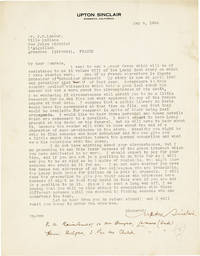
46769V.p.: 1946-47. Archive of six TNS typed notes signed five TLS typed letters signed and one Western Union telegram from Upton Sinclair to the Paris literary agent and translator Jean-Robert Lamour better known by his pseudonym Yves Malartic. Together with ten of Lamour's retained carbons of communications to Sinclair and others. Correspondence spans the period January 1946 to December 1947 and deals with Lamour's efforts to secure publishing contracts for French-language translations of Sinclair's works including The Jungle They Call Me Carpenter Our Lady and others as well as Sinclair's ongoing work on the Lanny Budd series. Sinclair's letters range from notes of as few as four lines to letters of two pages the entirety comprising approximately 2500 words with numerous hand-corrections and signatures in blue or black ink. Lamour's letters to Sinclair comprise nine pieces of correspondence of which three are partial and one draft contract with a total of approximately 3000 words. Three of Lamour's letters are in French addressed to French correspondents all on matters concerning the translation and publication of Sinclair's works. Occasional toning; old folds; onion-skin carbons creased at margins; Very Good. Excellent archive of original correspondence dating from Sinclair's productive wartime and post-War period during which he produced the monumental eleven-volume Lanny Budd series of novels including the Pulitzer Prize-winning Dragon's Teeth. <br /> <br /> The correspondence appears to have been struck up by Lamour in late 1945 those letters not present here seeking rights to translate and publish a number of Sinclair's early proletarian novels including The Jungle They Call Me Carpenter Samuel the Seeker as well as such shorter works as No Pasaran! The Flivver King Depression Island and others. Lamour born ca. 1911 at this date in the early stages of his literary career would go on to translate numerous works by American authors in particular Chester Himes and Alex Haley under the pseudonym "Yves Malartic." In his letters to Sinclair Lamour/Malartic shows careful reading and textual analysis of the novels under consideration expresses admiration for Sinclair's body of work and is clearly excited about exercising a newly-available liberty to publish leftist works after the long occupation of Paris stating in one undated letter: "France is groping for a notion of human socialism and french sic people are very interested in everything that refers to U.S.A." At another point Lamour dismisses the publisher Bernard Grasset who had turned down several of Sinclair's works for translation during war-time: "In 1944 Grasset has been deprived of his ownership for collaboration and a manager has been appointed by the government." indeed following the dismissal of its principal the firm of Grasset would become the primary publisher for many of Sinclair's works in France. <br /> <br /> Sinclair's replies range from long admiring letters to brief acknowledgments and notes of transmittal. Throughout he shows concern not only for his own legacy among French readers but for the wellbeing of his putative translator - Lamour who does in fact appear to have been driven by a somewhat altruistic impulse at one point appears to suggest that he is willing to translate and edit Sinclair's works without compensation to which Sinclair replies: "." Sinclair's ongoing consuming work on Presidential Mission and One Clear Call the eighth and ninth installments in his Lanny Budd series forms a backdrop to the entire correspondence; at one point he attempts to engage Lamour's assistance with background research on One Clear Call; at several others he begs off new writing assignments because of the all-consuming nature of his work even declining to read a recently-published short story by Lamour claiming that all his energies are consumed by the Lanny Budd project. Indeed Sinclair's output during this period was phenomenal: in the two-year span in which these letters were written Sinclair well into his sixties produced three massive novels - A World to Win Presidential Mission and One Clear Call - and was well along on a fourth O Shepherd Speak! published in 1949. <br /> <br /> While Sinclair letters are hardly an oddity in commerce the current archive of correspondence is noteworthy for providing real insight not only into Sinclair's working methods but also into the post-war literary climate in France where it is clear that writers on the left who had been radically disenfranchized during the long Occupation were eager to take on any project that might re-establish their careers while also hopefully putting food on the table. unknown
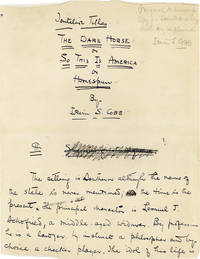
193446764N.p.: S.i. 1934. Holograph manuscript composed in dark blue ink on 152 numbered leaves rectos and housed in a bespoke chemise and slipcase by Barrieri. With presentation inscription from Cobb to MGM film produced and screenwriter Samuel Marx in pencil at upper right corner of title leaf: "Original manuscript copy for Sam Marx Esq / with my compliments / Irvin S. Cobb." A heavily-revised draft with extensive holograph additions and elisions in pencil and in pen throughout marking substantial textual differences between this and the final draft of the screenplay. Mild wear and handling; preliminary leaves with faint creasing to extremities with subtle toning to title leaf; Very Good or better. Slipcase with some light wear and minute board exposure to points around opening else Near Fine. Early unpublished manuscript treatment of the 1939 Paramount Studios film Our Leading Citizen directed by Alfred Santell with a screenplay by Jack Moffitt. A "Capital vs. Labor" story set in a once-small town that has evolved into an industrial city and centered around Lem Schofield an attorney and homespun philosopher and Clay Clinton son of Schofield's deceased partner. Clinton in love with Schofield's daughter and anxious for quick success joins the employ of J.T. Tapley the town's corrupt and influential industrialist. "When Tapley imposes a ten percent wage cut at his factory the workers walk out on strike precipitating a labor war. Lem immediately withdraws as Tapley's attorney but Clay ignorant of the nefarious tactics that Tapley is planning stays on. To crush the strike Tapley calls in a gang of strikebreakers led by Shep Muir. While pacifist union leader Jim Hanna struggles to end the strike peacefully communist agitator Jerry Perkins arrives in town to advocate radicalism and violence. Riots break out and amid an atmosphere of fear and suffering Lem steps in to quell the unrest. After insuring the arrest of agitators Peters and Muir Lem works to institute a labor settlement and Clay finally recognizing Lem's virtues nominates him for the position of United States Senator" TCM. <br /> <br /> While the final script faulted greedy capitalists and violent revolutionaries alike the film was blacklisted by V.J. Jerome head of the communist cultural commission who got an early look at the script and together with film critic Howard Rushmore deemed it potentially anti-communist. S.i. unknown
189544165New York December 8th 1895. Autograph letter signed on recto and verso of single cream laid sheet 22x14.5cm.; approx. 85 words; dated 26 West 61st N.Y. Dec 8th and simply addressed to "Parker" presumably Stanton's friend and fellow-suffragist Parker Pillsbury 1809-1898 who with Stanton had co-edited the women's rights newsletter "The Revolution" twenty years earlier. Faint mail folds small unobtrusive archival paper remnants to two corners from having been previously mounted else Near Fine and still quite fresh. Brief contemporary 1897 pencil note at bottom edge "Mrs. Stanton - born Nov. 12 1815 Now past 82 - C.E.R." though based on contents we would place this letter as having been written around 1895. Brief but significant missive addressed to Parker Pillsbury the American minister and women's suffrage advocate regarding a copy of Stanton's "Woman's Bible" she had just sent him. "I wonder if I could interest them a "Mrs. White" and one other sufficiently in the Woman's Bible to sell ten or twenty copies in there sic respective woman's clubs It is published at my expense hence I am trying to push its circulation." The controversial "Woman's Bible" a series of commentaries pertaining to the portions of the Bible relating to women was published in two parts in 1895 and 1898 and composed almost entirely by Stanton alone her committee of Bible revisors finding the project too controversial and harmful to the cause of women's suffrage. Clearly at the time of writing this letter the book was still meeting with resistance thus our placing the date at around 1895 Stanton turning to Pillsbury as a potential source of influential and wealthy patrons she inquires "Is Mrs. White still living & working Is that rich woman that Mr. illegible used to visit in Maine living". But by 1897 the book had become a best seller though many of the members of the women's suffrage movement would continue to distance themselves from it. This letter quite significant as a testimony to the aging Stanton organizer of the historical 1848 Seneca Falls Convention and her continuing indefatigable efforts and initial lack of support in getting this work circulated. See Tracy A. Thomas "Elizabeth Cady Stanton and the Feminist Foundation of Family Law" 2016 pp. 15 & 223. unknown
20062081402110005283Not Available 2006. Soft Cover. Fine. Number of books: 1 Not Available paperback
20002111902160307367Showa Women's University Institute of Modern Culture 2000. Soft Cover. Fine. Number of pages: 500 pages average Size: B6 size Number of books: 79 volumes Showa Women's University Institute of Modern Culture paperback
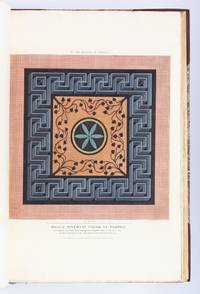
1827ST17496-012London: W. B. Cooke 1827. FIRST EDITION. 566 x 385 mm. 22 3/8 x 15 1/8". Two volumes. <br/> Attractive modern brown half morocco over marbled boards raised bands with gilt design gilt lettering. With six engraved vignettes and 80 ENGRAVED PLATES AND PLANS five hand-colored one double-page some with more than one illustration on each plate original tissue guards. A Large Paper Copy. Brunet II 116 "This beautiful work is in the same format at Stuart's 'Antiquities of Athens'"; Graesse II 207. See also: Benezit III 1167. Bindings with negligible imperfections essentially as new. Light stain to top corner of title in volume I contents with light scattered and mostly marginal foxing fore edge margins occasionally lightly toned or with light thumb smudges but on the whole an excellent copy the foxing never severe the plates overall very clean the margins notably wide and in handsome newer bindings.<br/> <br/> Coinciding with a renewed fascination in the West regarding the ancient world this vast profusely illustrated set details the architectural delights of Pompeii "as the eye of the traveller will now behold them in 1827" inviting viewers to experience the fabled city at a time when it was still half buried and its mysteries only partially unearthed. Based on drawings by watercolorist James P. Cockburn 1779-1847 a well-known artist specializing in travel books the plates show a variety of civic and residential architecture that had previously been excavated including the great Amphitheatre the Temple of Isis and the Grand Forum. Travellers in 19th century dress can often be seen mingling in the foreground of these scenic views highlighting Pompeii's relatively new status as a tourist spot while the smoldering Mount Vesuvius occasionally looms in the distance--a sobering reminder of Pompeii's calamitous past and the volcano's ever-present danger. The plates also depict important cultural and artistic artifacts as well as charming details that offer a glimpse into daily life before the city's annihilation such as stone inscriptions the contents of private homes and even the arrangement of stepping stones on one of the streets. Of particular note are the five lovely hand-colored illustrations that bring to life Pompeii's famous mosaic work painted murals and bath house interiors as well as plans showing the progress of excavations in Pompeii which had begun in earnest during the mid-18th century. The text here was provided by the highly regarded architect Thomas Leverton Donaldson 1795-1885 who is best known as the founder of the Institute of British Architects. DNB calls him "a pioneer in the academic study of architecture" and notes that "in 1879 the prince of Wales had called him 'the father of the institute and of the profession.'" This work is not common: RBH lists just four copies at auction in this century. W. B. Cooke unknown
15852363525/09/1585. <blockquote><p>The Renaissance was a period of crucial cultural artistic social and financial development in late Medieval and Renaissance Italy and particularly the affluent cities of Florence Venice Genoa and Padua.</p></blockquote><p>The Holy Roman Empire spanned central Europe in one form or another for the span of a millennia. For much of that time it contained vast swaths of Italy mainly in the north and included the Italian city of Padua which would become a hub in the Renaissance in that country and a major university center. As the Middle Ages bled into the period of the Renaissance the Empire slowly lost direct control over Italy. It managed to maintain its power into the 16th century in part via old established orders that maintained local control.</p><p>Among these Holy Roman imperial titles was the ""comes palatinus caesareus"" or the imperial count palatine. The office of imperial count palatine was hereditary and the emperors seem to have used it to create an Italian aristocratic class loyal to the empire. In 1357 the Emperor Charles IV added the power of conferring licenses and doctorates of civil law to those of the counts palatine. Later on they acquired the power to confer doctorates in general. In 1363 Charles himself bestowed this honor to Giacomo Santacroce. His heir to this title and power given by it which was significant was Giovanni Santcroce who in addition to being the benefactor for religious and cultural efforts in the region was a businessman.</p><p>The Facino or Facini family was a prominent one from the town of Feltre. The Ioannes Baptista Facinus namd in the document was prominent in the cultural community. There remains today a church bearing the crest of this family constructed shortly before his birth.</p><p>Francisco Fabriano and Andreas Tinto were important functionaries and notaries of the period in Padua.</p><p><strong>Document signed</strong> September 25 1585 in Latin using the Latin names of the people involved including The Holy Roman Emperor Charles signed by important figures of the late Italian renaissance. In it <em>""Ioannes Sancta Cruce""</em> bestows the position of <em>""comes palatinus caesareus""</em> on <em>""Ioannes Baptista Facinus""</em> and all his male heirs. The document is witnessed and signed not only by Santa Cruce himself described as <em>""the most excellent lawyer lord count soldier knight horseman of the Court of Caesar""</em> but also by Fabriano and Tinto. The document is likely in the hand of Tinto himself.</p><p>Such Italian Renaissance documents are very uncommon. The most direct comparable was acquired by J.P. Morgan and is now in the Morgan Library.</p><p>There is an extended portion in the middle about Holy Roman Emperor Charles IV who it describes in 1357 added the power of conferring licenses and doctorates of civil law to the position.</p><p><img class=""alignnone wp-image-23609 size-post-window"" src=""https://cdn.raabcollection.com/wp-content/uploads/20231204153244/Folder-site-6-1600x1327.jpg"" alt="""" width=""1600"" height=""1327"" /></p> unknown
195684129New York: Harper & Brothers Publishers 1956. First Edition. First Printing with "First Edition" and the publisher's "I-F" code on copyright page. Octavo 21.75cm; dark grey cloth boards with titles stamped in white on spine and publisher's logo in white at lower front cover; dustjacket; x2762pp. Inscribed by the author on the front endpaper: "August 28 1964 / Especially for Sybil / with affection and admiration / Pauli Murray." Landau was a Jewish feminist attorney and educator in New York who spent much of her career championing civil rights and lesbian causes and was an early girlfriend of Audre Lorde's. Light wear to spine ends pinpoint wear to lower board edges some offsetting to endpapers and a few tiny indentations to right edge of textblock; about Near Fine. Dustjacket is unclipped priced $3.50 spine-sunned shelfworn with toning to panels a few small tears some losses to spine ends none affecting lettering and a faint splash mark to spine on verso; Good to Very Good. <br /> <br /> Murray's first major literary work a realistic and convincing representation of the Black experience and an account of both her North Carolina family and childhood and her search for identity in her past. "Her book in which history and literature intersect is the product of a lively imagination and four years of devoted research in oral and documented history. She points out that it is the biography of her grandparents the story of three generations of a family "involved in a crucial turning point in our nation's history." Much of the saga centers around the racial conflicts through which the family worked out its destiny focusing on the courage strength and fearlessness in the face of danger that all members of the group exhibited. The women both black and white are noteworthy in their independence and recognition of moral duty and the men are stalwart and refuse to accept any status less than that of honorable men. Race and sex are explosive elements of suffering and shame that Murray exorcises through her honest confrontation of them while education and tenacious survival are the foundations on which she builds a strong and positive indentity" DLB Vol.41: Afro-American Poets Since 1955 p.249. An uncommonly warm association copy from Murray to another prominent attorney. BLOCKSON 3815. 84129. Harper & Brothers, Publishers unknown
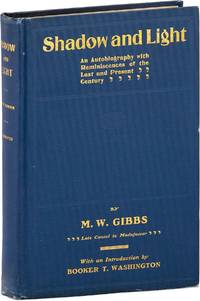
190285955Washington DC: Privately Published 1902. First Edition. First Printing. Octavo 20.25cm; vertically-ribbed blue cloth titled in gilt with a blind-ruled border and decorations on front cover; floral endpapers; iiiiv-xvi3-3722pp with portrait frontispiece of the author and 38 plates of illustrations halftones. Light wear to lower board edges front endpaper neatly detached but present with an old very faint splash mark to upper edge of textblock; Very Good. <br /> <br /> A lively account of the life and times of Mifflin Wistar Gibbs 1823-1915 an American businessman politician and newspaper publisher from Philadelphia. Shadow and Light recalls his impoverished youth his early involvement in aiding fugitive slaves while working with William Grant Still and accompanying Frederick Douglass on his 1849 tour of New York. Gibbs moved west during the Gold Rush in 1850 sensing that there was more money to be made in business than in panning for gold; he and his partner established a prosperous clothing and dry goods business and a few years after Gibbs purchased and became the editor of the Mirror of the Times the local Black antislavery newspaper. He moved to Victoria British Columbia during the Canadian gold rush opening an additional business before returning to the U.S. where he got married began his legal education and established himself in Little Rock Arkansas. "Beginning as a lawyer he was later appointed to county attorney and in 1873 he won election as municipal judge of Little Rock reportedly the first black man in the nation to be so honored" AANB Vol.3 p.484. He lost the judgeship in 1875 but embarked on a career in local and national politics ultimately being appointed by Rutherford B. Hayes as register of the U.S. Land Office for the Little Rock District and eventually as U.S. consul to Tamatave Madagascar 1898-1901. The remainder of his life was dedicated to causes that would advance "the progress of the race." Uncommon in commerce with the last copy in the auction record offered in 1962. BLOCKSON 3987; AANB Vol.3 pp.483-485. 85955. Privately Published unknown
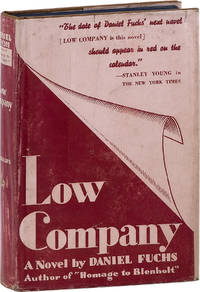
193781105New York: The Vanguard Press 1937. First Edition. First Printing. Octavo 21cm; brown cloth with titles stamped in black on spine and front cover; navy blue topstain; dustjacket; vi23-314pp. Mild offsetting to endpapers a few tiny indentations at mid-spine else a fresh very Near Fine copy with the topstain bright and unfaded. In the correct first printing dustjacket with five blurbs on the rear panel; unclipped priced $2.50 showing modest wear and dust-soil a few tiny nicks and tears four tiny punctures on the spine panel and five pieces of clear tape reinforcement on verso; a solidly Very Good unrestored example. <br /> <br /> The final volume in Fuchs's Williamsburg Trilogy published by Vanguard between 1934-37 which together paint a witty sad and faithful picture of Jewish Brooklyn during the early 1930s. The story is centered around a soda parlor in Neptune Beach a fictitious version of Brooklyn's Brighton Beach "where gangsters and whoremasters compete to control a string of houses where petty gamblers and thieves and brutal amateurish murders appear" Coan p.174. None of the three books were strong sellers; in Fuchs's preface to the 1961 omnibus edition Basic Books he admits Low Company sold only 1200 copies. Basis for Gordon Wiles's 1947 film noir The Gangster with the screenplay written by Fuchs and Dalton Trumbo starring Barry Sullivan Joan Loring Akim Tamiroff and Harry Morgan. The Dark Page Vol.1 pp.108-109; Hanna 1330. The Vanguard Press unknown
162353483Rouen: apud Societatis Typographicam / David du Petit Val 1623. Disbound. Very good. Two parts folio. 72; 37 1: blank pp; 1 full page copperplate engraving; woodcut initials and ornaments. Printed in red and black throughout. Text in Latin generally in two columns with double ruled borders in black. All edges gilt. Boards perished text block very solid with binding cords intact. Occasional light soiling. A very good copy housed in a beautiful new clamshell box of maroon silk moire.<br /> <br /> Concluding sections ONLY of this uncommon local missal for the Archdiocese of Rouen printed on vellum by David du Petit Val. Along with general information about the calendar and the celebration of the Mass this portion of the Missale Ecclesiae Rothomagensis contains tables of the Movable Feasts and Easter Sunday followed by a complete liturgical calendar. The second section contains musical scores with text for Palm Sunday Dominica in Ramispalmarum finito tractu diaconus dicat and Good Friday In die Veneris sancta tractu finito diaconus.<br /> <br /> The beautiful full page engraving of the Annunciation which opens the musical section is signed by Jean Messager. The following verses in praise of the Virgin Mary appear as a caption:<br /> <br /> Virgo tibi plenis exundat gratia rivis<br /> Pone metum: proh quanta refundes gaudia terris<br /> Femineos inter tu praestantissima coetus<br /> Cum Patris aeterni paries virgo integra Natum.<br /> <br /> Virgin you overflow with full streams of grace<br /> Put aside your fear: Oh! How many joys you will bring back to the earth<br /> You preeminent among women<br /> A virgin will bear with the Eternal Father a Perfect Son. References: OCLC 1063115827 one of only two copies located both at the British Library.<br /> Date printer and location taken from colophon; title and publisher information from British Library. Collation: e6 i6 o6 u6 aa6 ee4 ii2; asterisk-3asterisk6 4asterisk1 = 55 leaves. [apud Societatis Typographicam] / David du Petit Val unknown
84787Chicago: Quadrangle Books 1971. First Edition. First Printing. Octavo 24cm; sandy grey paper-covered boards and brick red cloth backstrip with titles stamped in silver on spine and in maroon on front cover; dustjacket; xviii45-3553pp. Inscribed by the author on the title page: "To Sandy and Ed In respect to Kirine and Emily who have help like few others "to let my people go" / Love / Bayard Rustin." Some foxing and dust-soil to backstrip and covers though clean internally; Very Good. Dustjacket is unclipped priced $10.00 lightly edgeworn with a 2.75" closed tear to upper front flap fold faint evidence of a sticker removed at lower spine and a hint of sunning to the red titling at upper spine; Very Good. <br /> <br /> Substantial collection of writings by Bayard Rustin 1912-1987 a leading strategist of the Civil Rights Movement an avowed pacifist and member of the War Resisters League - the oldest secular pacifist organization in the United States. The contents span from the early 1940s through 1971 touching on nonviolence Jim Crow his experiences on a chain gang his Montgomery diary the Civil Rights Movement various letters essays and pamphlets and his thoughts on prominent figures like Langston Hughes Malcolm X Muhammad Ali John F. Kennedy and Martin Luther King Jr. Inscriptions by Rustin are uncommon with no examples of this title traced at auction. BLOCKSON 2737. Quadrangle Books unknown
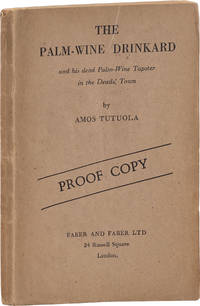
195281395London: Faber and Faber Ltd 1952. First Edition. First Impression. Octavo 20cm; original light brown wrappers titled in black on front cover; 67-1253pp. Pronounced forward lean some light overall wear crown gently bumped with some of the expected subtle tanning to the text edges; still a clean Very Good copy. The Nigerian author's best-known book the first African novel published in English outside of Africa. Tutuola's manuscript "after being rejected by a missionary press and an educational publisher in Nigeria was sent on to London where Faber and Faber published it in May 1952. This unusual story describing the hazardous journey of a drunkard to the land of the dead and his redemption through trials and testing was greeted with enthusiasm by British reviewers who credited Tutuola with remarkable originality. Within a year a separate American edition and a French translation appeared. Yet back home in Nigeria the book was regarded as a national embarrassment partly because it had been written in ungrammatical English and partly because fellow Yorubas recognized most of the tales in it as deriving from their own oral and literary heritage" DAB Vol.6 p.87. Today it is a highly-regarded work considered a successful fusion of the oral tradition and written art. Uncommon in the proof state - this is the first example we've seen or handled. BLOCKSON 7186 for the U.S. edition. Faber and Faber Ltd unknown