[RADICAL & PROLETARIAN LITERATURE] LE PRADE, Ruth (editor); SINCLAIR, Upton (introduction)Biblio.com
12 256 résultats
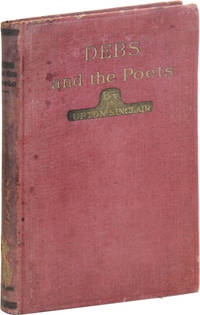
192046734Pasadena: Upton Sinclair 1920. Two octavo volumes 18.75cm; maroon cloth with titles stamped in gilt on spine and front cover; ii9911pp. The first copy is inscribed by Eugene Debs to American film actress screenwriter and editor Helen Louise Gardner on the front endpaper: "To Helen L. Gardner / With love and greetings and with deep appreciation for her beautiful character her lofty spirit her rare vision courage understanding and her high ideals and noble aspirations - Eugene V. Debs / Terre Haute Indiana / December 1924." Gentle sunning to spine oxidation to gilt with moderate scattered soil to covers light wear to extremities and heavier wear with resulting board exposure to upper right corner of front cover; mild offset to endpapers from binders glue; Good. Housed in a clamshell case. <br /> <br /> The second copy is inscribed to Gardner by Ruth Le Prade opposite the title page: "To Helen Gardner - with cordial greetings / Ruth Le Prade." Spine-sunned cloth edge-worn and lightly soiled with oxidation to gilt a few small stains to front cover some erosion to cloth toward lower spine and mild offset to endpapers from binders glue; Good. Poems honoring socialist leader Eugene Debs by a variety of radical 20th century poets including Witter Bynner Max Eastman Charlotte Perkins Gilman Carl Sandburg Siegfried Sassoon Horace Traubel and Israel Zangwill many others. Sinclair contributed the foreword along with letters from H.G. Wells and George Bernard Shaw who states: "Clearly the White House is the only safe place for an honest man like Debs". An interesting pair of copies inscribed to Gardner 1884-1968 acclaimed stage actress and the first actress to form her own production company. <br /> <br /> Moved by his circumstances and deeply influenced by his speeches she visited him in prison in 1920 bringing him an autographed photo and beginning a correspondence that would last through the mid-1920's. In a December 21 1920 letter she writes: "Let me tell you that I was surprised to find my emotional self somewhat unaffected while I listened to you talk. I know the reason now. It is the same with you as it was with Epictetus prison walls cannot confine the spirit -- the mind is ever free. So in a way I did not feel your plight as keenly as I would that of another who had little vision little intelligence little understanding about his body being so small a part of the real him that his confinement was of the physical order only." While the "special edition" of 500 with signed bookplate by Debs appears with some frequency inscribed copies of Debs and the Poets are genuinely uncommon. Upton Sinclair unknown
187184475New York: Woodhull Claflin & Co 1871. First Edition. First printing. Octavo 23cm. Original terracotta cloth titled in gilt on spine and front cover; portrait frontispiece; 247pp. Shallow chips to cloth at head and tail of spine; corners and board edges tapped; spine gilt very slightly dulled else a tight straight Very Good copy free of restoration and with joints external and hinges internal tight and strong. <br /> <br /> Woodhull's important first book in which she analyzes the evolution of human rights through history - with special regard to the landmark civil liberties granted by the U.S. Constitution - to advocate for equality of income opportunity and suffrage for women. The book was published in conjunction with and to bolster her 1872 candidacy for U.S. President for which she campaigned under the banner of the Equal Rights Party; it was the first bona-fide Presidential campaign by an American woman. Though the run was doomed from the start - most obviously by Woodhull's gender but hindered also by her advocacy of such radical notions as free love socialism and spiritualism to say nothing of her age not yet 35 making her constitutionally ineligible for the presidency - it cemented Woodhull's place in American history. Often lost in the discussion is the significance of the current work; which though unquestionably eccentric in spots nonetheless attempted to build a clear logical and historical basis for women's equality thus establishing Woodhull as an important intellectual advocate not only for feminism but for other once-radical causes as well. <br /> <br /> The book was issued by the publishing firm which Woodhull ran in partnership with her sister Tennessee Claflin through which the sisters also issued their weekly newspaper Woodhull & Claflin's Weekly in which preliminary versions of some chapters of the present text first appeared. Though not scarce institutionally the book has become truly infrequent in commerce especially in unrestored condition; we can trace only a single copy at auction in the past two decades. FRANKLIN The Case for Woman Suffrage: A Bibliography p.45. Somehow missed by Krichmar. Woodhull, Claflin & Co unknown
19932110502150903260Seishodoshoten 1993. Soft Cover. Fine. Number of books: 6 Seishodoshoten paperback
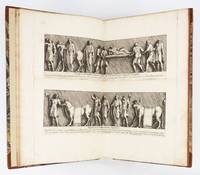
1690ST17496-016Rome: Buagni 1690. 492 x 310 mm. 19 1/4 x 12 1/4". 6 leaves of text numbered in sequence with the plates; i.e. title page frontispiece To the Reader plates 3-15 text leaves 16-19 plates 20-52. <br/> Modern quarter calf over marbled boards raised bands spine panels with gilt starburst centerpiece. With allegorical frontispiece featuring a portrait of the dedicatee Cardinal Otthobono and 46 FINELY ENGRAVED COPPERPLATES OF ROMAN ARCHES half of these double-page all mounted on stubs. Cicognara 3608; Brunet I 758 and VI 29473. Slight signs of use to the covers first and last three leaves faintly foxed one- to two-inch light dampstain to bottom corners far from images or text other trivial imperfections but A FINE COPY--internally clean fresh and bright with excellent impressions of the engravings and in a pleasing binding showing virtually no wear.<br/> <br/> This work depicting the triumphal arches of imperial Rome is considered by Cicognara to be "the most beautiful of this genre and classic especially for the magnificence and elegance of the prints which are the masterpiece of Pietro Bartoli." Bartoli 1635-1700 was an antiquary as well as an engraver; he produced engravings of many Roman antiquities and helped to excavate Nero's Domus Aurea the sprawling complex built by the emperor in the middle of Rome after the fire in 64 A.D. had destroyed much of the city. Bellori 1613-96 was an author and antiquarian who served as curator of antiquities for Pope Clement X. He was later librarian and antiquary to Queen Christina of Sweden who also employed Bartoli. Bartoli's illustrations show the Arch of Constantine the Arch of Titus and the Arch of Septimus Severus examining the details of each. J. M. Suarez wrote the text discussing the Arch of Septimus Severus. The vastness of the present volume the very considerable detail of the plates and the richness of the engravings make this a very impressive book. Buagni unknown
151925179Firenze: di Filippo Giunta 1519. Rare the first printing of Appianus translated into Italian. With the printer's woodblock on the title-page. 8vo antique Italian calf the boards ruled in gilt the spine gilt tooled with central floral devices in compartments between wide flat gilt tooled bands gilt lettered. 287 ff 1 pp. A finely preserved copy with light wear to the binding. A wonderful and very rare survival. VERY RARE FIRST PRINTING BY GIUNTA AND THE FIRST IN A MODERN LANGUAGE. Appian's Roman history comprises narratives of the various Roman conquests from the earliest times to the accession of Vespasian in twenty-four books of which nine books survive complete. di Filippo Giunta hardcover
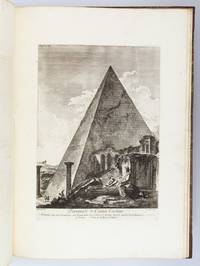
1787ST17496-043Rome: Bouchard et Gravier 1787. 525 x 375 mm. 20 3/4 x 14 3/4". <br/> Near contemporary half calf over marbled boards smooth spine divided by gilt rules into panels with blind-stamped centerpiece red morocco label hinges reinforced with buckram marbled endpapers and edges. Engraved vignette on title page and 99 COPPER-ENGRAVINGS ON 60 PLATES. A 1911 letter from the editor of "Hobbies" magazine in response to a previous owner's questions about the contents of this volume laid in at front. The plate numbered 92 with an 18th century cemetery scene pasted to the verso; rear flyleaf with two engravings pasted on. Cicognara 3595; Brunet I 646. Spine label partly missing front joint cracked from tail edge to midpoint head and tail of spine chipped boards a bit chafed and with a drizzle of white paint to front cover but the binding still solid. Occasional mild marginal foxing or finger smudges but an excellent copy internally fresh and clean throughout and with pleasing impressions of engravings. Not an external beauty as is often the case with architectural tomes but quite attractive inside.<br/> <br/> This is a collection of beautifully engraved plates drawn from the work of a painter and engraver who made engravings for Piranesi's 1748 "Varie vedute di Roma antica e moderna" and collaborated with him on the majestic "Le antichità Romane" 1756. Inspired by his work with the master Barbault drew and engraved his own series of Roman views issued in "Les plus beau monumens de Rome ancienne" 1761 and "Recueil de divers monumens anciens" 1770. The plates in the present volume are drawn from those works. Barbault's picturesque scenes are characterized by a sense of romantic decay: in some the landscape is open and generally free from human intrusion the once-grand ruins rising proudly from the encroaching vegetation. One has the sense of being among the first to stumble across these hidden wonders. In others the artist juxtaposes temple remains with the shed of a contemporary farmer a humbling contrast between past grandeur and present poverty. Jean Barbault 1718-62 had studied painting in Paris with John Restout II before receiving a scholarship from the Académie des Beaux-Arts for travel to Rome in 1721. Once there he stayed building a career as engraver and establishing himself with Piranesi and his circle. Bouchard et Gravier unknown
17423993Frankfurt am Main: Johann David Jung 1742. First Edition. Hardcover. Very Good. 18 double-page or folding plates comprising 6 of processions and 12 of interior and exterior views; 19 portraits; 2 double-page floor plans of coronation events. 100 306 80 2 38 4 96 8 2 28; 20 128 52 2 26 2 34 2 30; 4 20 8 2 10 2 26 48 pages including half-titles in first 2 volumes. Together 3 volumes in one. Frankfurt am Main: Johann David Jung 1742-43. First edition of an account of festivities and events surrounding the coronation of Charles VII 1697-1745. Lipperheide 1963 2517. Folio contemporary vellum; 19th-century institutional stamp on Volume 1 half-title large folding procession plate in Volume 2 lightly dampstained and backed with sheets from 19th-century literary journal. Very rare complete copy of this wonderfully illustrated book in handsome comdition. <br/><br/> Johann David Jung hardcover
155000152972057593498894297: Magdeburg: s. n. Line "Gedrukt zu Magdeburg" at the end of preface hidden under a broad stroke of printer's ink 1550. First German edition; 7 3/4 x 5 3/4; pp. 68 collated; contemporary plain beige wraps; a few small rubbed spots and minor loss of paper to lower corners of wraps and spine; age-toning and some staining to margins mostly not affecting text; cut to fore-edge of third leaf; contemporary notes to margins and underlining; overall very good-.A German translation of the ordinance of 1550 issued by Holy Roman Emperor Charles V against dangerous heretical books. Also included in the publication were the Louvain Index of April 1550 of forbidden books and a list of "good" and "approved" books to be read in schools. The Louvain Index was first drawn on Charles V's demand in 1546 by the University of Louvain and published simultaneously in Latin Dutch and French. In 1550 the list of pernicious books was greatly enlarged the current edition. The books were listed in alphabetical order by author's name and also included were books by anonymous authors and translators by language Welsh New Testament editions Greek and Latin bibles etc. The translator Matthias Flacius Illyricus 1520 – 1575 was a Lutheran reformer from Istria present day Croatia. He was appointed Professor of Hebrew at the the University of Wittenberg in 1544 where he came under the influence of Philipp Melanchthon and Martin Luther. Though as time went by Illyricus began vehemently opposing the two Lutheran reformers who in turn spoke of him as "we have nourished a snake in our bosom." In the preface to his current work which he claimed he had translated from the Flemish he wholeheartedly attacked Charles V and his lists of prohibitions. USTC 681462. Magdeburg: s. n. (Line "Gedrukt zu Magdeburg" at the end of preface, hidden under a broad stroke of printer's ink) paperback
1551001314Martinus Rotarius 1551 4-33 Pp. lacks A2-3. Charles V Holy Roman Emperor 1500-1558. Description: Old velum rubbed & marked woodcut arms on title errata f. at end marginal wormholes browned name at foot of title and errata long note in an elegant 16th century italic hand on verso rebacked new endpapers small 4to. Provenance: Diego de Colmenares 1586-1651 historian author of Historia de. Segovia y.Castilla1637; names on title and at end. Condition: Very good; pages trimmed upper margin to page number. Dimensions: 7 1/2" x 5 1/2" x 1/2." NOTE: Rare USTC N° 408702 lists only 2 copies. There exists also a similar edition with the name of the printer '' Reinerus Velpius''. This last edition seems to be more common; USTC lists 8 copies. 8vo - over 7¾ - 9¾" tall. 1st Edition. Hardcover. Very Good. Martinus Rotarius hardcover
19932110502151003093Seishodoshoten 1993. Soft Cover. Fine. Number of books: 6 Seishodoshoten paperback
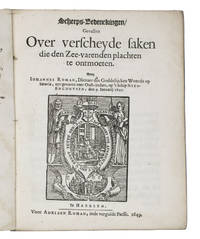
1649ABC_49304Haarlem: Adriaen Roman 1649. Later black and orange painted paper wrappers showing a floral design. 4to. With a large woodcut printers device on the title page depicting a printing press surrounded by the Latin motto Labore et Diligentia and a Dutch quote from Genesis 3:19 with a small view of a school class below. Further with a large woodcut portrait of Laurens Janszoon Coster printer's device of A. Roman dated 1630 in the block on the final page 3 decorated woodcut initials and a woodcut tailpiece. Very rare first and only edition of a pamphlet containing reflections related to seafaring written by the Dutch minister Johannes Roman d. 1689. He had left his birthplace of Haarlem for Batavia in January 1647. On his journey to the Dutch East Indies on board the East Indiaman Nieu-Enchuysen built in 1636 also known under all spelling variations of Nieuw Enkhuisen he probably wrote the present pamphlet - comprising 15 short texts in which he reflects on topics relevant to those embarking on sea voyages. The present work is dedicated by the publisher Adriaen Roman to the directors of the Enkhuizen chamber of the VOC. A long poem in Dutch has been included at the end of the work on pp. 19-23 titled Ziel-verheffing over de verlossinghe die ons de Heere heeft ghedaen uyt verscheyde stormen ende nood-weder ons op de Spaensche zee over-ghekomen. Midtsgaders dat Hy ons heeft laten ontmoeten een Engelsch schip van de Barbades .The author born in Haarlem as son of the Dutch bookseller and publisher Adriaen Roman 1590-1649 went to Batavia in 1647 where he became a minister of a Malaysian church. He was active as a translator and in 1653 he wrote a manual of the Malay language titled Grondt ofte kort bericht van de Maleysche tale . which was published posthumously in Amsterdam in 1674 and again in 1689.With an extensive manuscript annotation in brown ink on the front pastedown containing biographical details on the author a quote from S. Gille Heringa "Naamlijst van Nederlandsche Dichters" in: Konst en letterbode 1848 part II p. 166. The pastedowns and first and last few leaves are very slightly water stained in the gutters and pp. 9-16 show a small water stain in the outer blank margin not affecting the text. Otherwise in very good condition.l Knuttel 6496; Landwehr VOC 767; Petit 2538; STCN 830231420 4 copies; USTC 1026292 4 copies same as STCN; Van der Wulp 9172; WorldCat 69050990 5 copies. Adriaen Roman, unknown
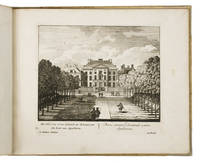
1720ABC_49529Amsterdam: Pieter Schenk 1720. Modern half sheepskin parchment with the manuscript author and title on the spine beige decorative paper sides. Oblong royal 4to ca. 23 x 29 cm. With an engraved dedication also serving as a title-page and 16 unnumbered engraved views 15 x 18.5 cm. A complete set of sixteen views of the magnificent palace gardens mazes fountains sculpture ponds and pavilions of the Royal estate Het Loo near Apeldoorn in the Netherlands the most splendid country estate of King William III of England William of Orange. This estate was the finest example of Anglo-Dutch formal gardens garden art and architecture. Pieter Schenk I 1660-1711 originally published the present views in his six-part Paridisus oculorum 1702 where Het Loo was ''undoubtedly the highlight of the series'' Anglo-Dutch Garden p. 201. The six parts were also issued separately with the dedications to the owners serving as title-pages as is the case here.William of Orange 1650-1702 bought the medieval castle Het Loo in 1684 when he was Dutch head of state and it quickly became his favourite hunting lodge. He had it completely rebuilt under the architect Jacob Roman 1640-1716 beginning in 1686. When William and his wife Mary Stuart were crowned King and Queen of England in 1689 however work on the estate was greatly expanded on a royal scale with sculpture commissioned from Romeyn de Hooghe and the elaborate fountains and gardens shown in the present prints. By the time Schenk produced the present print series just before William's death in 1702 it was one of the world's grandest royal residences. The present set of Schenk's prints is watermarked Strasbourg Bend = IV similar to Heawood 73 & 78 from ca. 1720 so it may have been published by Pieter Schenk II soon after his father's death.The binding shows very slight traces of use. The leaves are very lightly foxed. Otherwise a fine wide-margined copy of the prints of the William of Orange's splendid royal estate Het Loo.l The Anglo-Dutch Garden 68; Hollstein Dutch & Flemish XXV p. 290 1428-1443; Springer Bibl. Overzicht pp. 43-44; STCN 840916604 7 copies 1 incomplete; Wurzbach II p. 576 no. 311 Pieter Schenk, unknown
1957209290214150288716 vols. 1957. Soft Cover. Fine. Size: B5 Number of books: 16 16 vols. paperback
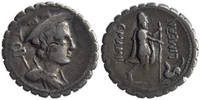
60369Rome minted in 82 BC. 20mm. 3.74 g. Avery nice specimen with clear imprint and light rubbing. Obverse: Draped bust of Mercury right wearing winged petasos; caduceus and control letter behind. Reverse: Ulysses standing right holding staff in left hand and extending right hand to Argus; C•MAMIL to left LIMETAN to right. Crawford 362/1; BMCRR Rome 2725; RSC Mamilia 6. <br/><br/><em>A denarius of the Roman Republic featuring one of the very few references to Homer's Odyssey in ancient coinage. On the obverse is Mercury a god very much propitious to Odysseus easily recognizable by the winged petasos and the caduceus. The reverse depicts one of the most moving passages in literature hardly matched to this day. In book XVII 290-327 Odysseus returns to Ithaca disguised as a beggar. His faithful dog Argos has been waiting for his return for 20 years. Ignored abandoned by everyone the dog is ridden with ticks and fleas lying in a pile of manure. Odysseus is accompanied to the palace by Eumaeus the shepherd who is unaware of the beggar's true identity. Odysseus recognizes his dog and is forced to hide a single tear that rolls down his cheek. He cannot greet the dog as that would give away his identidy. Argos after all those years recognizes his master as well but if he were to run to him it would most certainly cause his death by the suitors. Here Homer cannot do anything other than to end the life of Argos otherwise the entire Odyssey would have been for naught. So Argos dies upon the vision of his master having fulfilled his life purpose: to await his return. It is also the moment that marks the end of the twenty year cycle since Odysseus left for the Trojan War thus announcing the imminent closing of the Trojan Cycle itself. The denarius' reverse depicts the idealized moment of the scene where master and dog would be just about to meet and greet each other but as we have seen the reunion cannot happen. "There lay the hound Argos full of vermin; yet even now when he marked Odysseus standing near he wagged his tail and dropped both his ears but nearer to his master he had no longer strength to move. Then Odysseus looked aside and wiped away a tear. . But as for Argos the fate of black death seized him straightway when he had seen Odysseus in the twentieth year." Mamilius Limetanus is one of the three moneyers for the year 82 BC. The moneyers selected every year were magistrates in charge of the production of coinage and they were at liberty to determine the design of the coins which were often deities and characters associated with their personal family history. Like most Roman Patricians Limetanus claimed to be a descendant of a Homeric character in this case Odysseus—Julius Caesar's family for example thought themselves to be descendants of Aeneas. A wonderful specimen of this magnificent Roman denarius. </em> unknown
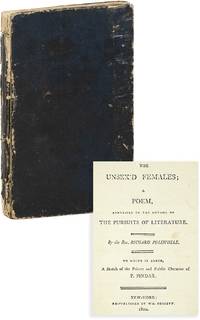
180087844New York: Wm. Cobbett 1800. First American Edition. 18mo 155mm x 100mm. Contemporary paper-covered boards; vi1-68pp. Boards worn with losses to paper at spine ends; slight darkening to text with faint tide-mark visible on rear endpapers; text complete and fresh. A Good sound copy. <br /> <br /> A virulent anti-Jacobin antifeminist tract that first appeared anonymously in London in 1798. It is the best-known or at least most-cited work by Richard Polwhele 1768-1838 an Anglican minister of Cornish birth who became a leading voice of reactionary moral conservatism during the Industrial Revolution. He was a frequent contributor to John Gifford's Anti-Jacobin Review the leading Tory journal of the period and not surprisingly a close associate of William Cobbett under whose auspices the present volume was published in America.<br /> <br /> The poem is a vicious heavy-handed attack upon a cadre of progressive British women authors that included Charlotte Turner Smith Anna Laetitia Barbauld Ann Yearsley and others all of whom Polwhele accuses of having been infected with foreign i.e. French revolutionary ideas and with trying to spread them among a susceptible British working-class. But the primary target for Polwhele's animus is Mary Wollstonecraft whose Vindication of the Rights of Women had been published in 1792 to the general consternation of Anglican conservatives. Given existing attitudes towards Wollstonecraft among Tory commentators it is no surprise that her death in childbirth in 1797 followed by the appearance of an intentionally scandalous biography by her husband the philosopher William Godwin a year later spurred a cottage industry of anti-Wollstonecraft character assassination. The Unsex'd Females published the same year as Godwin's Memoirs fits precisely into this context and does so in the most scurrilous ways imaginable painting its subject as not only irreligious but as practically sub-human a creature driven by animal instincts without regard for law whether human or divine: ".Nature is the grand basis of all laws human and divine: and the woman who has no regard to nature either in the decoration of her person or the culture of her mind will soon 'walk after the flesh in the lust of uncleanness and despise government." In what is perhaps the most alarming passage in the work Polwhele implies that Wollstonecraft's death was a just reward for ".A woman who has broken through all religious restraints will commonly be found ripe for every species of licentiousness.I cannot but think that the Hand of Providence is visible in her life her death and in Godwin's Memoirs themselves. As she was given up to her "heart's lusts" and let "to follow her own imaginations" that the fallacy of her doctrines and the effects of an irreligious conduct might be manifested to the world; and as she died a death that strongly marked the distinction of the sexes." <br /> <br /> That Polwhele's work would find its way to an American audience through the agency of the pugnacious pamphleteer and rabble-rouser William Cobbett is hardly a surprise. Cobbett had fled England for Philadelphia in 1792 and quickly established his reputation in America as a political pamphleteer of great skill and prolificity his American writings published under the pseudonym Peter Porcupine were collected in twelve volumes in 1801. During this period Cobbett's and Polwhele's political instincts were closely aligned though Cobbett would make an about-turn to populist reform later in life and there is some evidence that the two were directly acquainted see Polwhele's Reminiscences 1836 for examples of correspondence between Cobbett and himself. Cobbett's edition of The Unsex'd Females appeared in 1800 shortly before his return to England and includes an essay by Polwhele - "A Sketch of the Private and Public Character of P. Pindar" - that is not present in the British editiion. All editions are uncommon in commerce with no examples at auction in this century and only two since 1966. WING W8134. EVANS 38293. Wm. Cobbett unknown
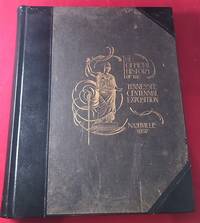
18983800Nashville TN: Brandon Printing Company 1898. First Edition First Printing. Hardcover. Good. 10 1/2 X 13 3/4 Inches. 494 PP Index. Official photographic album created to celebrate the near six-month Centennial celebration of Tennessee statehood. Published under the direction of Dr. W.L. Dudley and G.H. Baskette of the Committee on Publication. An impressive history of the state of Tennessee as well as a veritable who's who of Tennessee history. Illustrated with hundreds of engravings and photographs of historical buildings and citizens as well as the actual Centennial Celebration activities and locations. A notoriously scarce book. <br /> <br /> This copy is rebacked in recent black leather spine and rear board with tips. Retains original front board with gilt illustration and title work. First twenty or so pages quite damaged at edges with primitive tape repairs. While several pages are creased and taped the text is complete. Original color frontis illustration of The Parthenon intact with tape repair to edges. A lower grade example of this book that is rarely seen in commerce. Brandon Printing Company hardcover
194447333New York: Reynal and Hitchcock 1944. First Edition. First Printing. Octavo 21.25cm; yellow cloth with titles stamped in black and red on spine and front cover; dustjacket; x1793pp. Signed by Miller in blue ball-point pen on the title page. Spine ends gently nudged some trivial wear to lower board edges with a hint of sunning to upper board edges and a faint shallow stain to lower edge of rear cover; Near Fine. Dustjacket is unclipped priced $2.00 with two tiny tears at crown and a faint vertical crease along left joint; a bright very Near Fine example. Laid into this copy is an untitled seven-page carbon typescript on onionskin 8" x 10.5" written by Miller in 1943 relating details about the book's conception; horizontal fold at center staple holes at upper left corner with two neat punctures along left margin; Very Good. Attractive copy of the Pulitzer Prize-winning playwright's first book based on his experiences researching the war correspondence of journalist Ernie Pyle. The title derives from the widely-used military acronym slang "SNAFU" Situation Normal: All Fucked Up which translates to a bad situation that is a normal state of affairs. Miller was tasked by Hollywood to gather material for "an honest movie" about American GI's during the war about their training daily life their hopes dreams and why they are fighting. Miller visited several Army camps training living and interviewing soldiers and taking down the unvarnished truth of his discoveries. "I was the person fate picked out of Brooklyn to go among the soldiers and pick up enough facts honest-to-God true facts to make a soldier picture which soldiers could sit through until the end without once laughing in derision. A picture that would properly end all soldier pictures" p.1. The film in question was William A. Wellman's The Story of G.I. Joe to be adapted by Miller for Lester Cowan from Pyle's 1943 book This Is Your War. Miller's version was ultimatley not produced likely due to ideological differences and his leftist political leanings. The typescript written the year before Situation Normal was published summarizes the conception of the book detailing his early meetings with Ernie Pyle over how his work would be translated into film and what they wanted to accomplish. "I bring up the idea that it would be a shame to show this massive canvas without reducing what is chaos to at least an inkling of purpose and order and of course he agrees. But we both feel that to lard on ideology where there is no ideology would be to wrap the truth. You can't have soldiers talking about four freedoms when all they want is to go home. Myself I curse the press and the million textbooks that turn out the billions of words and never add up to an excuse for dying" typescript p.5. A superlative copy of an important debut. Reynal and Hitchcock unknown
16202446Vienna 1620. In very good condition. unknown
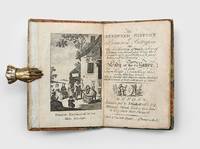
1789178870London: Printed and sold by J. Marshall & Co. 1789. A tale that promotes studying Third and most extensively illustrated edition of this rags-to-riches moral tale for young readers well-preserved in the original publisher's binding. It is decorated throughout with characterful woodcuts. The tale follows a familiar Cinderella-style narrative. The protagonist is born to humble but honest circumstances proves her virtues during tribulations and is rewarded for her efforts with marriage to a wealthy nobleman. However aspects of this seemingly timeless story situate it in the world of the late 18th century. As rationalism had become a widespread philosophy the heroine is not aided by magical intervention but owes her successes to consistent diligent attention to her lessons. This trait is shared by the protagonists of the several inset stories. Primrose Prettyface also functions as promotional material for the publishers as books are shown to be essential material for the virtue of studiousness. John Marshall and Co. were an enterprising firm who built a reputation for themselves as the dominant children's book producers of their day. In 1789 they opened a "retail bookshop specialising in children's publications" Stoker p. 86 at 17 Queen Street where Primrose Prettyface was sold. We have traced just 12 copies in institutional libraries worldwide. Duodecimo 122 x 84 mm pp. 88 4. Engraved title page and frontispiece woodcut illustrations throughout two leaves of publisher's advertisements at end rear pastedown of advertisments for The Juvenile Magazine. Original Dutch gilt paper over boards rebacked with original spine laid down. Housed in custom grey cloth solander box. Ownership inscriptions in childish hands to front pastedown: "H Hannah" in ink "Harris his book" in pencil and pencil markings from former booksellers. Extremities a little worn short split to foot of front board joint some rubbing to covers with a closed tear across back: a well-preserved bright copy of this fragile publication. ESTC T120222 Grub Street 432483. David Stoker "John Marshall John Evans and the Cheap Repository Tracts 17931800" The Papers of the Bibliographical Society of America vol. 107 No. 1 March 2013. hardcover
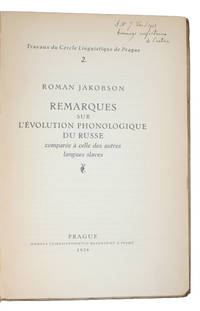
192942791Prague Jednota Ceskoslovenskych Matematiku a Fysiku 1929. 8vo. Uncut and unopened in the original printed wrappers. A bit of minor chipping and bending to extremities. A very nice copy. 118 2 -blank pp. <br/><br/><em>The rare first edition of one of the most important early works by the pioneer of the structural analysis of language and one of the most influential linguists of the 20th century with presentation-inscription for one of the leading French linguists of the period: "A Mr J. Vendryes homage respectueux del'auteur" on the title-page. The work constitutes the starting point of a new approach in linguistics and phonology.The work was published as No. 2 of the foundational "Travaux du Cercle Linguistique de Prague" the publication from the seminal Prague School of Linguistics of which Jakobsen was a founder. The Prague School held its first international conference of Slavic linguists in 1929. Here Jakobson presented his research on the phonological evolution of Russian and other Slavic languages which had led him to conclude that there was a correlation between the description of sound systems and the explanation of their evolution. "He identified the phoneme as the minimal unit of language capable of discriminating word meanings and viewed the phoneme as an indivisible atom. These advances constituted the starting point of a new approach in linguistics and phonology according to which each language is distinguished from all others by its phonemic system that is by the inclusion or omission of particular phonemes available to human speech." American National Biography. The work is fundamental for Jakobson's development of a universal structural-functional theory of phonology which was the first successful theory of its kind in accordance with Saussurean hypotheses. The concept of the phoneme that Jakobson had reached became a fundamental element of linguistic theory and came to greatly affect scientific descriptions and analyses of language. Roman Osipovich Jakobson 1896 - 1982 was a famous Russian linguist and literary critic who became one of the most influential linguists of the 20th century. He is probably most famous as the pioneer of structural analysis of language and as the co-founder of structuralism.Jakobson was born into a Russian Jewish family. Early on he showed a great interest in the theory of language and already as a student he became a leading figure of the Moscow Linguistic Circle. He was very much influenced by Husserl's phenomenology and the work of Saussure and he developed a deep interest in the question of how language the human speech functions and is possible.Due to political troubles in Russia in 1920 Jakobsen moved to Prague where he was to become even more influential. Here in 1926 he co-founded the Prague School of linguistic theory which together with the Copenhagen School was the most influential school of linguistics of its time and of decades to come. It is here that Jakobson develops his seminal ideas of phonology as well as the term structuralism and the contents of it. Among his most important works from this period is his present work in which he compares the phonological evolution of the Russian language to that of other Slavic languages a foundational work for the development of his theories on the structure and function of language.When the Second World War broke out Jakobson moved to Scandinavia where he met the Copenhagen School of linguistics and its main figure Louis Hjelmslev. Later he fled to America where he met Claude Lévi-Strauss Quine Bloomfeld and many other important thinkers within the field of language theory.Jakobson's structuralist theories of language differentiate much from other parts of the structuralist movement in that he constantly bases them on knowledge from other sciences from mathematics philosophy psychology etc. and as such Jakobson's theories are among the most influential and wide-ranging in the history of linguistics as they come to also affect and profoundly influence several other scientific fields.Joseph Vendryes 1875-1960 was a much respected and quite influential French linguist specialized in Celtic languages. He was involved with the standardization and presentation of the universal language Interlingua. </em> unknown
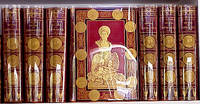
18794026Paris. Librairie Hachette. 1879. Bound in extravagantly ornate gilt pictorial red Morocco depicting gilt tooled Roman emblematic seals and large embellishment of armour eagles and statuary to front and rear covers. Gilt tooled spine compartments embellished with seals and laurel leaves. Raised bands. White silk moire endsheets. a.e.g. Thick 4to. New Edition. Illustrated with 50 brilliantly illuminated full page tissue-guarded chromolithographic plates. Further illustrated with over 3400 gravure engravings and 30 colour maps. A monumental work in a most impressive Hachette gilt binding - truly one of the most stunning bindings we've encountered. Sumptuously illustrated with eye-boggling iridescent Chromolithographs this extremely rare set is a true work of design art. Some chipping to head and tailpieces to various volumes with some small bits lacking hinges rubbed on various volumes some corners bumped through front cover of Vol. 1 starting mild scattered foxing throughout else Very Good. A bright crisp gleaming gilt gem.Featured Sets. Librairie Hachette. hardcover
196784126New York: Random House 1967. First Edition. First Printing. Octavo 21.5cm; bluish-grey paper-covered boards and turquoise cloth backstrip with titles stamped in gilt on spine and authors initials embossed onto front cover; light blue topstain; dustjacket; 4xvi1986pp. Inscribed by Carmichael on the front pastedown: "To my Brother James / Afrika will be free / unified socialist / Kwame Ture / Thank You." Additionally inscribed by Hamilton on the title page: "In the struggle / Charles V. Hamilton." Light rubbing to silver lettering on spine some wear to spine ends dampstain to lower rear cover and a small splash mark to lower edge of textblock closest to backstrip resulting in some mild waviness to lower text edges; Very Good. Dustjacket is unclipped priced $4.95 shelfworn a bit dust-soiled some old dampstains to edges with scattered foxing a few small tears and attendant creases and some underlining and holograph notations in pink pen on rear flap; Good to Very Good. <br /> <br /> A major work by Carmichael and Hamilton first published by Random House in 1967 delineating the political framework and ideology of Black Power which they felt represented "the last reasonable opportunity for this society to work out its racial problems short of prolonged guerrilla warfare. That such violent warfare may be unavoidable is not herein denied. But if there is the slightest chance to avoid it the politics of Black Power as described in this book is seen as the only viable hope" from rear wrapper. Contents include examinations of White power structures chapters on the need and substance for Black Power myths of coalition Mississippi Freedom Democrats Black-Belt elections the politics of deference and problems and unrest within the nation's ghettos. Copies inscribed by both authors are uncommon. BLOCKSON 2415. 84126. Random House unknown
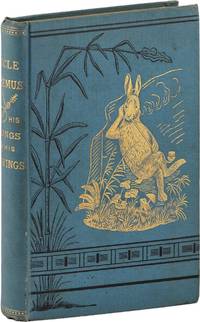
188189007New York: D. Appleton and Company 1881. First Edition. Blanck's first state with "presumptive" on last line of p.9 and ads on p.233 beginning with New Books: A Treatise on the Practice of Medicine. Octavo 19.75cm; publisher's powder blue cloth with titling and decorations stamped in gilt and black on spine and front cover; butterfly-patterned endpapers; 34-2311 8pp ads. Armorial bookplate of real estate magnate and art collector Edward Hubbard Litchfield 1845-1930 mounted to front pastedown. Spine ends gently nudged some softening to corners though still sharp with a hint of sunning to spine and some light dust-soil to extremities; contents clean with hinges sound; Very Good with bright gilt and the pictorial elements unrubbed. Housed in a custom slipcase and chemise. <br /> <br /> Uncle Remus was among the most significant collections of African American folklore recorded by Harris 1848-1908 a white Georgia-born author and journalist. "Harris was not the first to record the stories of Brer Rabbit Brer Fox and Brer Bear which he heard in the cabins of slaves on Georgia plantations but his retellings made them a favorite with American children.The book contains thirty-four "Legends of the Old Plantation" as well as "Plantation Proverbs" songs and chants under the title "His Songs" and a series of sketches about Uncle Remus the African American narrator entitled "His Sayings" Grolier One Hundred Books Famous in Children's Literature 42. BLOCKSON 42; BAL 7100; JOHNSON p.36. D. Appleton and Company unknown
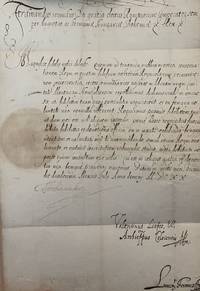
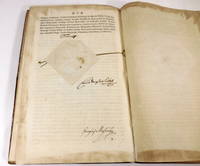
1807041061Hungary: N.P. 1807. In Latin. Laws passed by the Hungarian Assembly of 1807 a tumultous time in this region with the Imperial Seal of Francis II of the Holy Roman Empire later Francis I of Austria. Although the transition was made in 1806 this is still signed as Franciscus II. There is an additional signature below the seal Comes Josephus Erdody . Title page includes an additional inscription by Reverendo Petro Klobuviczky. Full brown leather with decorative borders 13.5 inches tall 2 32 pages. Covers worn with some worming to the covers hinges good but lower of the two binder's cords has separated endpapers age-toned with a modern note about the identity of Franz II neatly written at the bottom of the rear endpaper pages very clean. . Hard Cover. Good. Folio - 12" - 15" Tall. N.P. Hardcover
150860047Haguenau: Pallas Spangelimpensis Johann Rynmannin officina industrii Henrici Gran 1508. Fine. Pallas Spangel impensis Johann Rynmann in officina industrii Henrici Gran Haguenau 1508 20 x 29 cm relié First edition very rare. Colophon f. m7: Impressarum in impiali opido Hagenau finit feliciter anno salutis nostre millesimo quingentesimo octavo Xij die mensis julii. Epistle on the verso of the title page addressed to the bookseller Andreas Grindelhart by Pallas Spangel responsible for the edition. Not in Brunet. One copy at the Bibliothèque Nationale de France one at the Mazarine Library. Half vellum binding from the late 19th century. Smooth spine. Red morocco title label. Marbled paper boards. 2 brown stains on title page affecting the last 4 lines of text 2 perforations in margin. French Dominican friar of the 13th century 1190-1277 Humbert de Romans or sometimes de Bourgogne made his mark through his writings teaching and preaching he was appointed head of the Dominicans in France and worked to unify the liturgy. Besides classical sermons one will find sermons addressed to students of medicine grammar to the poor to the infirm in hospitals to the sick. The sermons are followed by selected correspondence from Humbert. Pallas Spangelimpensis Johann Rynmannin officina industrii Henrici Gran hardcover