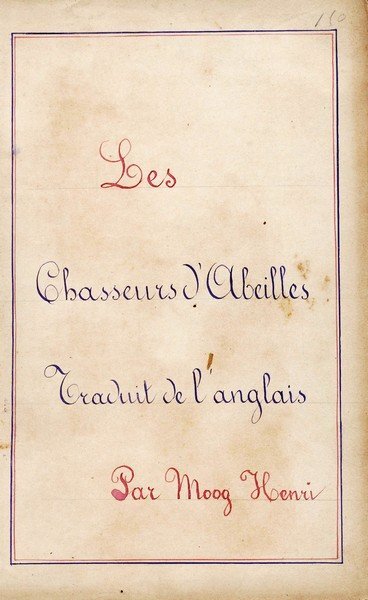
[AIMARD (Gustave)] ; MOOG (Henri)Livre Rare Book
19 839 résultats
14191879. UN « PIERRE MENARD, AUTEUR DU DON QUICHOTTE » DU XIXE SIÈCLE
596850Décharge pour actes de contrat de mariage du 24 juil. 1771, célébration du mariage le 14 août suivant, extrait baptistaire de 1735 et certificat d'ancienne noblesse délivré le 16 janv. 1760, par M. Beaujon. Signé d'Aiguirande, major de dragons, chev. de St Louis, Paris, 7 janv. 1788.
(164) SS. Französische und deutsche Handschrift auf Papier. Mit einigen unbeschriebenen Seiten. Titel und ein Vorsatzblatt auf Pergament. Rot eingefärbter blindgepr. Lederband der Zeit. Marmorvorsätze, dreiseitiger Goldschnitt. 8vo. Hübsches Gebetbuch des niederösterreichischen Land-Untermarschalls und Präses des nö. Ritterstandes Johann Joachim von Aichen (1664-1729). Zwei Drittel der Handschrift in französischer Sprache; durchgehend in ansprechender Kalligraphie. Mit eh. Besitzvermerk am Titelblatt unter Verwendung des Titels des Land-Untermarschalls, der Aichen im Jänner 1718 verliehen wurde, woraus sich das frühestmögliche Entstehungsdatum der Handschrift ergibt: "Mier Johann Joachim von Aichen L. U. Marschall gehörig". Ein kurzer Bericht über die Bruderschaft des heiligen Donatus in Arles mit einem Gebet zur Verschonung vor Unwettern in flüchtiger Kurrentschrift, datiert 1742, belegt eine Weiterführung des Büchleins nach von Aichens Tod. - Kleines Exlibris am Vorsatzblatt, datiert 1874 ("Homo hominibus"). Vorderdeckel leicht aufworfen. Papier durchgehend etwas gebräunt; die Ränder fingerfleckig.
(8) SS. in Schwarz und Goldschrift. Pergamentlibell. Lose einliegend in originalem Prachteinband, Leder mit reicher Deckelvergoldung. 4to. Schöne Doktorurkunde, ausgestellt von Annibal Melarius, Generalvikar des Erzbischofs Asciano II. Piccolomini. Mit eh. Unterschrift des Vincentius Barcius für Franciscus Barcius. Nach Erlangung des Doktortitels wurde Peter von Aichen 1647 Sekretär beim nö. Landmarschallsgericht, 1656 Regierungsrat und 1661 nö. Landschreiber. Am 18. Februar 1666 wurde Peter von Aichen unter die neuen Geschlechter des nö. Ritterstands aufgenommen; er kaufte das Gut Inzersdorf bei Wien. Am 16. März 1674 folgte seine Aufnahme unter die alten nö. Ritterstandsgeschlechter. - Mit wohl eh. Besitzvermerk am Vorsatzblatt: "Peter v. Eichen Dr. Diplom 1645". Rücken oben aufgeplatzt, Bug unten eingerissen; vereinzelte Spuren von Wurmfraß. Schließbänder fehlen.
11760Tapuscrit original inédit, en feuilles, (21 x 30 cm) sous chemise à rabats. 6 parties présentées chacune sous chemise de papier bleu avec le titre manuscrit : 1f.-3pp. - 30pp. - 2ff.-20pp. - 1f.-91pp. - 1f.100pp. - 1f.-15pp. Tâche angulaire sur les 4 premiers feuillets. Quelques corrections manuscrites. Bel état.
ORD-154601. Mémoires de M. de Sartiges sous-préfet de Gannat du 30 aoust 1810. 2. Copie de la lettre de M. Amelot sous-préfet de l'arrondissement de Montluçon en réponse à celle par laquelle le préfet lui demandait des renseignements sur les anciens châteaux et abbayes, etc. du 16 juillet 1810. 12 pages in-4 (ca 170 x 225mm) d'une écriture fine particulièrement lisible. C'est la description des différents châteaux de l'arrondissement de Gannat à l'exception de celui de Chantelle pour lequel le rédacteur renvoie à Nicolas Nicolay, 20 châteaux anciens soigneusement décrits et court paragraphe sur les châteaux modernes. Pour l'arrondissement de Montluçon 3 châteaux et 3 abbayes succinctement décrits. Quelques dessins maladroits, au crayon sur les pages non écrites. Intéressant document.
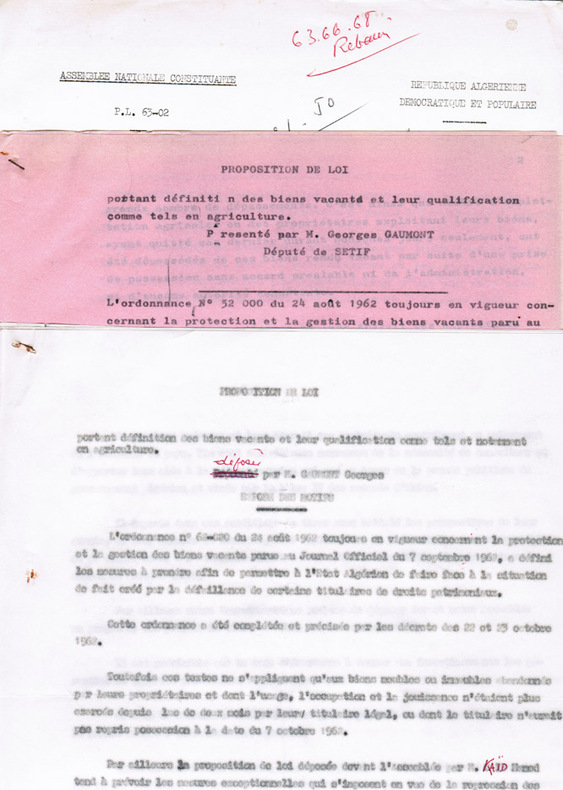
196320121963 La proposition de loi telle que déposée à l'Assemblée constituante algérienne en 1963 (4 pp. - 3 exemplaires), une autre version (3 pp. - 25 exemplaires thermocollés), deux versions préparatoires (copies carbonne du tapuscrit) dont l'une sur papier rose et l'autre comportant quelques corrections autographes.
4to (159 x 218 mm). Latin and Italian manuscript on vellum. 16 leaves, the first part containing notarial records of land ownership paginated 1-15; the second half with 14 pages of symbols, diagrams and cipher text, in red ink. Stored in custom-made morocco-backed clamshell case. An unusual and sophisticated alchemical manuscript showing a range of influences from Paracelsus to the Kabbalah. - Beginning in the middle of the single gathering, the manuscript contains a series of complex symbols and diagrams with cipher text, encoding alchemical processes. The illustrations start off with a symbol incorporating four watchtowers, a Star of David, and alchemical glyphs; later images include various furnaces, stills, and other apparatus, a seven stage ascent beginning with a flask and culminating in a throne (probably representing chemical processes), a fountain (similar to the opening image of the Rosarium Philosophorum), an alchemical rebis, a tree growing on a tomb with seven mountains in the background, a fruit bearing tree growing from a male figure impaled on a sword, a bird (apparently an owl) with an alembic on its head, and a distillatory furnace, many of the images partly composed of lines of cipher characters and incorporating various glyphs, also with diagrams of geometrical speculation, tables with Hebrew letters (perhaps showing permutations of solar and lunar qualities), and related material (ff. 9-15v). - Paracelsian influence is in evidence in the manuscript's list of the three essential ingredients of the Philosophers' Stone (Mercury, Sulphur, Salt), while the geometric representations of these tria prima resemble those found in the works of the Belgian alchemist Gerard Dorn (1530-84). Jewish elements include the use of Hebrew characters and the appearance of a Menorah in the rebis figure. The accompanying text is entirely in a cipher which resembles that of the Aiq Bekr or Kabbalah of the Nine Chambers. This manuscript reveals an alchemist whose work combines in a unique way many features found in contemporary practitioners such as, in England, John Dee. - Prefixed to the alchemical section is a series of notarial records including land transactions and a will, dating from 1537 to 1561 (providing the terminus post quem for the succeeding part) and localisable to northern Italy, specifically the Veneto (there is mention of a church of "Sancti Floriani de Rippa", or Riva, and of Venice itself). - Some staining, smudging to a few images and tears to outermost leaves. - Provenance: Sotheby's, 26 November 2008, lot 7.
Small 4to (140 x 195 mm). 91 leaves, 149 written pages in two hands, the main body of the text complete, up to 29 lines per page, ruled space 85 x 155 mm. Incipit: "In nomine domini amen. Noch dem also gesprochen ist daß alle kunst kunftigk ist von got und ist by im on ende...". Rubrics touched in red, calligraphic initials in red and some with flourishing, 25 watercolour illustrations of scientific apparatus, 10 mathematical and architectural diagrams in pen. 15th century German calf over wooden boards, tooled in blind with vertical rows of hunting scenes within a triple-filet frame, remains of two fore-edge clasps. Stored in custom-made half morocco clamshell case. A Renaissance alchemist's handbook, quoting Al-Razi by name and deeply rooted in the Islamic tradition of alchemical art. An intriguing manuscript which bears witness to early practical chemistry in 15th century Germany and to the immense influence of Arabic alchemy, illustrated with talented watercolour diagrams of the associated apparatus. - Indeed, the word 'alchemy' itself is derived from the Arabic word 'al-kimia', and it was Al-Razi who claimed that "the study of philosophy could not be considered complete, and a learned man could not be called a philosopher, until he has succeeded in producing the alchemical transmutation". Alchemy and chemistry often overlapped in the early Islamic world, but "for many years Western scholars ignored Al-Razi's praise for alchemy, seeing alchemy instead as a pseudoscience, false in its purposes and fundamentally wrong in its methods, closer to magic and superstition than to the 'enlightened' sciences. Only in recent years have pioneering studies conducted by historians of science, philologists, and historians of the book demonstrated the importance of alchemical practices and discoveries in creating the foundations of modern chemistry" (Ferrario). The quest to transmute base metals into gold and to obtain the Philosophers' Stone was a practical as well as theoretical pursuit, as attested by the existence of this manuscript. The main body of the text opens on fol. 5 with an introduction to the art of alchemy, whose practice requires reference to the ancient authorities. Recipes for the various pigments, solutions, acids and alkalis are listed in groups, before descriptions are given of the planets relevant to the alchemist's art, starting with Saturn, and their effect on the elements, again with reference to the ancient authorities including Al-Razi, Origen, Aristotle, Albertus Magnus, and Hermes Trismegistus. There follow notes on the ease of obtaining various elements, before lists of alchemical compounds - including 'sal petri' and 'aqua lunaris' - are grouped according to their nature. Practical instructions, organised by chapter, begin on fol. 17v with the manufacture of vermillion and 'spangrün'; the first of the illustrations depicts two vessels for the burning of cinnabar. Further recipes involve the burning of various substances - illustrated with drawings of furnaces, cucurbits and other vessels, and distillation apparatus - before moving on to the manufacture of acids, bases and oils, mentioning the use of quicksilver, then, finally, turning to the manufacture of gold. The end of the text on fol. 69 is marked with the words 'Alchimia & Scientia' in red ink with calligraphic flourishes, above a floral device. - Collation: written by another scribe and bound before the alchemist's handbook (ff. 5-69) are astrological calculations, including those charting the trajectories of the Sun and the Moon (ff. 1-4, obviously incomplete). At the end, 9 leaves with geometrical calculations, illustrated with pen diagrams (ff. 70v-78, apparently incomplete, 2 leaves loose). The last 12 leaves are blanks (ff. 79-91). - Condition: The binding is sound and intact, but shows significant losses to the upper cover; spine entirely lost. Two leaves loose at the end of the manuscript, outer margins waterstained and tattered, surface soiling most notable to f. 1. Occasionally loose and split at gatherings; presence of bookworm damage on some pages; very occasional wax stains. - Provenance: 1) The script, watermark and binding indicate that the manuscript was made in Germany in the final two decades of the 15th century. The watermark visible on certain pages - a heart beneath a crown, above 'Ib' - is closest to a motif widely used in Germany around 1480-1500 (cf. Piccard 32464-32481), and the binding is contemporary. The pastedowns, taken from a Litany of Saints, are also roughly contemporary. 2) This compendium of cryptic knowledge seems to have lain undisturbed for many years after its compilation: the contemporary stamped leather binding is preserved and no booklabels or ownership inscriptions mark the manuscript changing hands. 3) Zisska & Schauer, 4 May 2010, lot 6. 4) Braunschweig Collection, Paris. - The first pigment recipe books in German would not be published until the 1530s (cf. Schießl, Die deutschsprachige Literatur zu Werkstoffen und Techniken der Malerei, 1989). While the manual at hand never appeared in print, a much later manuscript of the same text, apparently copied by no less an authority than the botanist Hieronymus Bock (1498-1554), survives in Heidelberg's University Library under the title of "Ordenlicher proces der waren alten heimlichen kunst der alchymey in drey bucher gestelt" ("Alchemistisches Kunstbuch", Cod. Pal. germ. 294, dated to the middle or third quarter of the 16th century). Unlike the vividly coloured and deftly shaded illustrations in the present volume from the 15th century, the unsophisticated pen drawings in the later Palatina manuscript were clearly executed by the scribe himself rather than by a trained artist. Also, our manual contains additional illustrations at the end, showing some of the most necessary equipment on a double-page spread, as well as five additional pages of recipes for "lutum sapientiae", "postulatz golt" etc., some parts written in a secret cipher, all of which are lacking from Bock's copy. - A unique survival: the Schoenberg Database of Manuscripts lists no more than eight 15th century German alchemy tracts in institutional possession worldwide. Schoenberg Database SDBM_177979. G. Ferrario, Al-Kimiya: Notes on Arabic Alchemy. In: Chemical Heritage, 25 (2007), 32ff.
Folio (200 x 318 mm). German manuscript, ink on paper. 81 ff., written on rectos and versos. Modern mottled quarter calf over marbled boards, spine stamped in blind and titled in gilt. A German alchemical manuscript comprising five treatises in five different hands. The first part is an anonymous essay on the medical aspects of human excrement ("Auß den Microcosmischen excrementis oder Stercore humano können Medicamenta gemacht werden [...]"); the second, also anonymous, is a brief treatise on the Philosopher's Stone ("Meine meinung den Lapidem Philosophorum zu erlangen ist diese [...]"). Part three is a commentary on the 1660 Amsterdam edition of Joachim Poleman's "Novum Lumen Medicum". Poleman was an adherent to the ideas of Johann Baptista van Helmont (1579-1644) and Ramon Lull. The "Novum Lumen Medicum" is Poleman's elucidation of Helmont's teachings on the secret of philosophers' sulphur, which involved bloodstone, spirit of wine, and "alzali" (alkali?) to produce a sulphuric tincture. First published in 165m the book enjoyed considerable success in many later editions and translations. - The fourth section is a commentary on Johann Gottfried Jugel's "Prima Materia Metallorum", first published 1754. It is one of several works on metals and chemistry by Jugel, and discusses the properties of various substances. The final section presents material from a work attributed to Herward von Forchenbrunn and to Jospeh Kirchweger (d. 1746) titled "Aurea Catena Homeri", which concerns sulphurs and metals and their various medicinal applications. The attempt to distinguish and separate true applicable science and medicine from the traditional occult arts is strongly indicated in the contents of this manuscript. - Browned throughout due to paper stock; some foxing, but well legible throughout. A late 19th century label mounted on the first leaf lists some of the contents. Attractively bound. - Provenance: Emanuel Mai, Catalog des Bücher-Lagers (Berlin 1854), no. 264; later sold by James and Mary Laurie, Booksellers, of St Paul, Minnesota. Last in the library of the noted Russian-American photographer and biologist Roman Vishniac (1897-1990). Cf. Thorndike VII, 231.
596851Monsieur d'Hozier est chargé de remettre un titre (testament de 1574) produit pour Anastasie [Dammelin] de Beaurepaire pour rentrer à la Maison royale de l'Enfant-Jésus. Signé Beaurepaire et Thianges, Paris, 22 nov. 1776.
596846Décharges et courrier. Signé d'Hodan, Duray et d'Anceaume, 1775-1776.
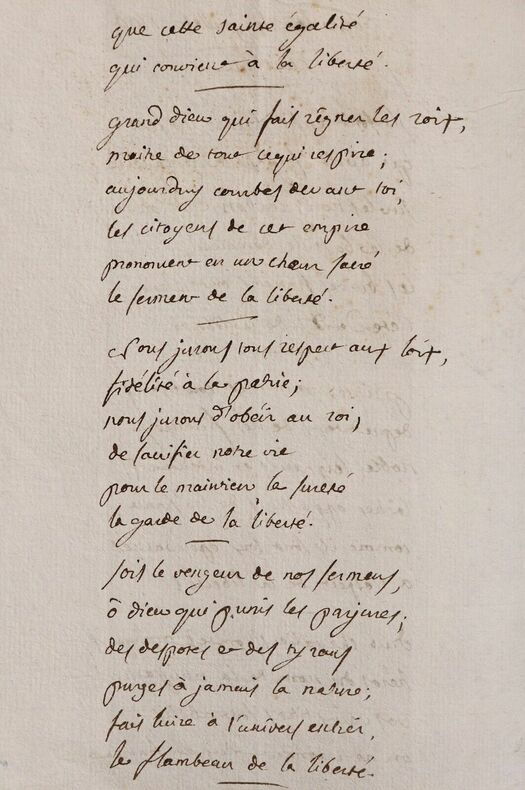
1790AMO-4529S.n., [14 juillet] 1790 Manuscrit autographe anonyme. 2 pages. 36 vers (6 strophes de 6 vers) 1 bi-feuillet 21,7 x 16,8 cm. parfait état. Belle écriture parfaitement lisible. Pièce autographe inédite non encore attribuée.
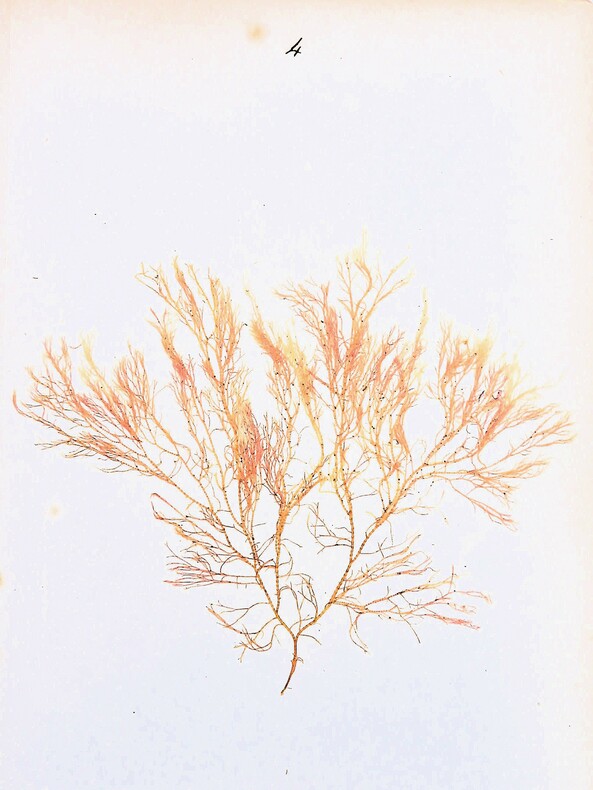
18702634Sans lieu, sans éditeur (manuscrit - pièce unique), sans date (circa 1870). In-8 - 18 x 25 cm. Reliure de l'époque en demi-chagrin rouge, dos à 4 nerfs, orné de caissons et petits fers dorés, titre doré "Algues marine" sur le dos. 85 planches. Alguier extrêmement soigné, composé à la fin du 19e siècle (vers 1870), recueillant 83 spécimens d'algues pressés sur 85 feuillets de papier fort. Planches montées sur onglet. Spécimens non-identifiés (non légendés), en excellent état de conservation. À la fin du XIXe siècle, la collecte et la conservation d'échantillons d'algues sont devenues un passe-temps populaire pour les Européens aisés. Ces collectionneurs passaient de nombreuses heures à sécher, presser et monter avec soin les spécimens qu'ils trouvaient au cours de leurs voyages. Leurs recueils illustrent ce phénomène de mode, mais présentent également, encore aujourd’hui, un intérêt scientifique, par exemple en permettant de constater si certaines variétés ont disparu.
346S. l. : S. d. (milieu du XIXe siècle). UN SUPERBE HERBIER DU MILIEU DU XIXE SIÈCLE
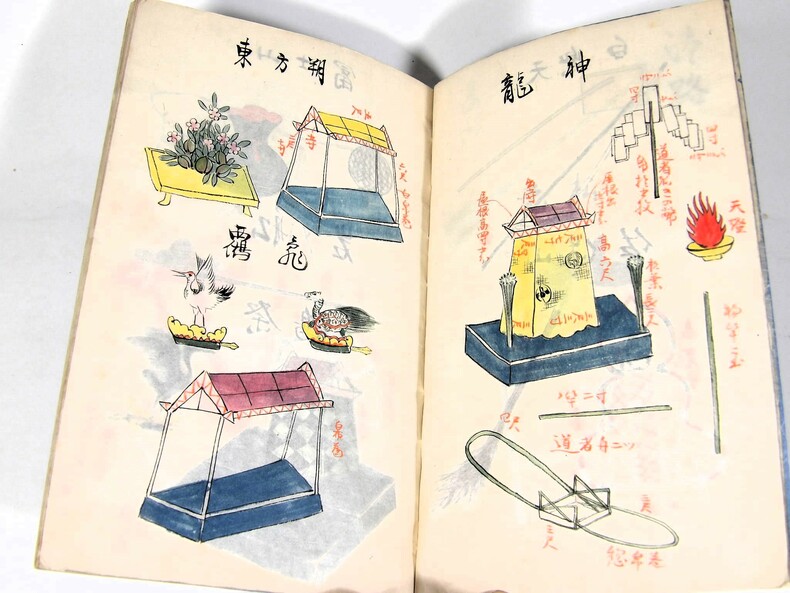
2548(Japan - Japon) Pièce unique. Sans date. 15,5 x 23,5cm. Reliure à la japonaise, couvertures postérieures muettes. 28 feuillets. Contrairement au kabuki, les accessoires complexes, les décors et les plates-formes tournantes ne sont pas utilisés sur la scène du nô. On privilégie plutôt un type d'accessoire modeste appelé tsukurimono (littéralement "objets fabriqués"). Fabriqués à la main à partir de matériaux tels que le bambou, les tsukurimono ne comportent souvent qu'un simple cadre et sont plus symboliques que réalistes. Ils représentent souvent des structures telles que des bateaux, des tombes, des maisons et des puits.
4204, «Composition Lithographique de l’Éditrice P.V. 4» [circa 1900], 24,5 x 36cm pour la litho., Inscriptions dans la planche de l’imprimeur italien P.V. Fiorenza [Edizioni Il Ponte Vecchio] avec la fleur de lys et le pinceau imprimés à froid dans la feuille, très légères traces, bon état.
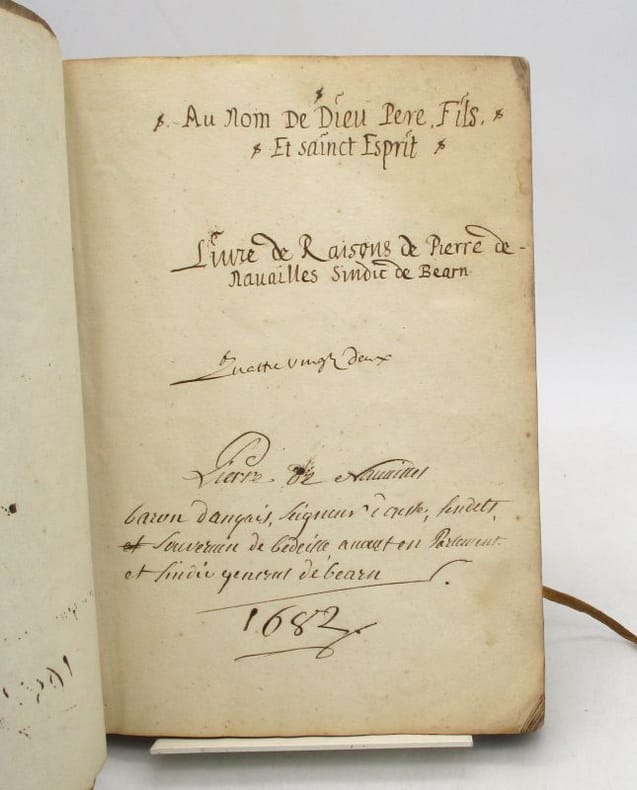
23392Béarn, 1682. In-4, [28]ff. + 7 ff., parchemin souple de l'époque, tranchefiles à passes, liens (reliure défraîchie mais solide, taches et petites rousseurs).
4205, «Composition Lithographique de l’Éditrice P.V. 2» [circa 1900], 24,5 x 36cm pour la litho., Inscriptions dans la planche de l’imprimeur italien P.V. Fiorenza [Edizioni Il Ponte Vecchio] avec la fleur de lys et le pinceau imprimés à froid dans la feuille, très légères traces, bon état.
6521Paris, Éditions M.D., sans date. 4 fascicules in-folio sous couvertures parcheminées Un peu frottées, avec quelques taches). Quelques petites taches aussi ça et là dans le texte.
R22Reliure de l’époque usagée (manques au dos et aux plats), tranches dorées, traces de fermoirs, intérieur correct. Différentes mentions de propriétaires anciens : « A M. Delacour », « M. Prudhomme ». Le principal du manuscrit est numéroté 158 ff. d’une écriture fine et lisible.
596852Décharge pour Gabriel-Louis-Joseph d'Andelot pour rentrer dans la Compagnie des Cadets gentilshommes, signé Larcher Daubencourt, Paris, 3 nov. 1779.
4to (167 x 235 mm). French manuscript on paper. (1 blank, 4), 75 ff. Cursive script in light brown ink, per extensum, left and right margins ruled in lead pencil. Contemporary unsophisticated cardboard with handwritten calligraphic title, date and a skilfully executed drawing of a grashooper to upper cover. Unpublished, highly interesting 17th century French manuscript about the history, religion, and topography of the Ottoman Empire, written to convey in brief the essentials of the Muslim world. Chapters include "Origine des Turcs et leurs conquestes", "De la Secte de Mahomet et des Loix et Polices des Turcs" (an extensive discussion of Islam and the Prophet), "Estat present de l'Empire des Ottomans" (on the Ottoman state), "Princes confinans avec l'Ottoman", "Princes pretendans sur cest Empire", "La maniere de faire une ligue contre les Ottomans", and "Moyen d'attaquer, abbatre et aneantir l'Empire des Turcs". At the end, the manuscript also mentions Arabia "on the Red Sea" and the port of Jeddah, "where the pilgrims of Mahomet disembark for Mecca". Further, the author discusses navigation of the Red Sea (dangerous at night) and the coast of the Arabian Peninsula, including the port of Aden, Ras Fartak, Norbat (Ash Shuwaymiyyah) opposite the Khuriya Muriya Islands, Muscat, the Kingdom of Ormuz and other places in the Gulf under Portuguese rule. - Occasional slight brownstaining, lower half of title-page defective and rebacked (apparently without loss), otherwise a well-preserved, well-legible manuscript, untrimmed in its original 17th century binding.
Deutsche Handschrift auf Papier. (122) SS. Mit gest. Frontispiz. Goldgepr. Lederband der Zeit. Dreiseitiger Goldschnitt, Buntpapiervorsätze. 8vo. In passendem Lederschuber. Privatabschrift mit Auszügen aus dem bekannten "Katholischen Lehr- und Gebetbuch" des katholischen deutschen Pädagogen und Theologen Karl Heinrich Seibt (1735-1806) in sauberer Kurrente aus der Feder des Vinzenz Kramolin. Das Gebetbuch erschien erstmals 1779 in Prag und erlebte bis ins 19. Jahrhundert zahlreiche Neuauflagen und Nachdrucke. Der Kupferstich von Gottfried Bernhard Götz (1708-74) zeigt den heiligen Dismas, den mit Jesus gekreuzigten "rechten" ("guten") Verbrecher oder Schächer, der nach dem Lukasevangelium am Kreuz Reue zeigte, wofür ihm Jesus das Paradies versprach. - Die letzten 14 Seiten enthalten Gesänge für die Heilige Messe in anderer, zeitgenössischer Hand (auf anderem Papier). Einband und Schuber etwas wurmstichig und am Rücken berieben. Wenige Seiten mit kleinen Knickfalten; vereinzelt leicht braunfleckig. Hübsches Dokument privater Andacht, vermutlich aus dem ostösterreichischen oder böhmischen Raum.
8vo. Italian manuscript on paper. ½ p. Unpublished sonnet attributed to a Count Marescalchi of Ferrara. The poem describes the Society of Jesus as a crumbling "bulwark of two centuries", likening it to the Tower of Babel and lamenting their vanity. It concludes with the assertion that the Jesuits are guilty of their own ruin: "Te stessa incolpa della tua ruina". - The sonnet is dated to 16 August 1773, less than a month after the suppression of the Jesuits by Pope Clement XIV through the papal brief "Dominus ac Redemptor Noster". This controversial political act led to a surge in propaganda for and against the Jesuits and the Pope. - The word "Emine[n]za" written on the verso, potentially indicating a dedication. Minor brownstaining.