19 839 résultats
Lateinische Handschrift auf Pergament (645 x 410 mm). 6 Zeilen Text und römische Quadratnoten in schwarzer Rahmung. Mit einer Initiale. Stellenweise etwas fleckig, alte Montagespuren verso.
1924013100Paris Editions de L'Esprit nouveau - Librairie Jean Budry 1924 In-8 broché, couverture illutrée
5968573 décharges : - pour Victor François Arneaud de Laborie de Sarazignac, signé Sarasignac, 3 déc. 1732. - pour Gabrielle Arnault de Sarasignac pour être reçue dans la maison royale de St Louis à St Cyr, signé d'Arnault, 25 fév. 1736. - contrat de mariage de Jean François d'Arnaud de Sarasignac avec Marie de Porsmoguer du 5 oct. 1774, signé du Baudier ; pour Mlle Arnaud de Sarasignac, signé l'abbé de Goyon, 20 sept. 1776.
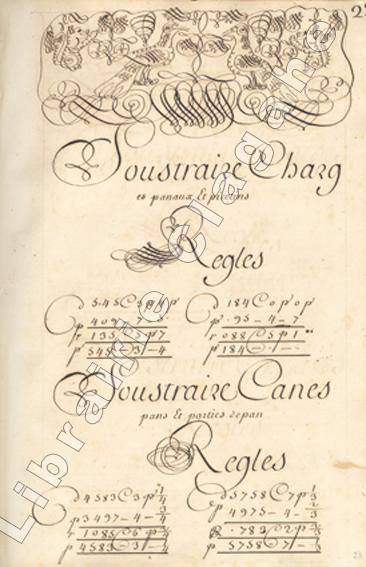
18182Ce traité d’arithmétique est divisé en deux grandes parties, chacune de 9 chapitres : la première traite de la numérotation et des quatre opérations (additions, soustractions, multiplications, divisions) ; règle de trois, règle de monnaies, fractions, réductions, règle de part ; etc. La seconde (p. 103) est une application aux règles de gain et de perte, les “troques”, la tare, les alliages, règles de Compagnie, l’intérêt, les rachats, le change, la règle “d’Esconte”, les règles testamentaires, de fausse position, règle entre marchands et facteur, le livret de trente pour les jours achève le traité. Chaque page est ornée en tête et dans le texte de compositions calligraphiées avec beaucoup de talent, les décors prenant la forme des lettrines et titres ornementaux et d’entrelacs, fleurs, animaux, chiens, oiseaux, volutes, brandebourgs et grotesques.
596855Décharge pour Louis-Philippe d'Arclais de Montamy pour être reçu dans l'Hôtel de l'Ecole Royale militaire. Signé de Chal (Chalo), comtesse de Montamy, rue Féroux proche St Sulpice, Paris, 11 avril 1778.
596856Décharge pour Jean-Baptiste d'Arloz admis comme élève de l'Ecole Royale Militaire. Signé [Marguerite] Gallien de la Chaux, veuve d'Arloz, St Jean le Vieux, 12 may 1765.
15201Manuscrit in-4 (22,5 x 17,5 cm). XIXe siècle. Bradel usagé. Des rousseurs. 92 feuillets illustrés de dessins originaux à l'encre, suivis d'une table manuscrite des armoiries représentées.
596854Lettre à M. D'Hozier de Sérigny concernant les titres de M. Darchambeau près Monpon en Périgord. Signé l'abbé de Gamanson [secrétaire de la Feuilles Bénéfices]. + Mention signé d'Hozier de Sérigny, Paris, sept. 1771.
201449874(Wien), Antiquariat Inlibris Gilhofer Nachf., (2014). 4°. Mit zahlr. meist ganzs. farb. Abbildungen. 1 Bl., 541 S., OLwd.
8vo. French manuscript on paper. 412 (but: 406) numbered pp., with pp. 227-228 skipped, 145-146 and 387-388 missing. With two folding tables. Contemporary brown sheepskin with label to spine. Interesting handwritten textbook of arithmetics with elaborate calligraphy by an otherwise unknown merchant named Pierre Clauzel from Lavelanet. The manuscript was probably executed in two phases, as pages 1-121 are rife with calligraphed titles, ornaments, borders, and marks in coloured ink, whereas the rest of the manuscript displays a plainer style in the same hand. - Clauzel signed both inner covers: the date added to the front, 3 December 1765, probably indicates the completion of the entire manuscript, despite the calligraphed title bearing the year 1764. According to the title, the textbook was compiled "under the direction of the Brothers of the Christian Schools of the town of Mirepoix". It is an introduction to arithmetics that does not go beyond basic operations, instead focusing on usefulness for merchants. Thus, the manuscript includes a wide variety of arithmetic operations for accounting, trade, financial transactions, etc., all demonstrated by aid of concrete examples. These varied and realistic practical specimens turn the manuscript into a valuable document for a history from below. For the "testament rule" Clauzet uses the example of a "merchant from Toulouse" who was attacked and "dangerously wounded" on the way to the "fair of Beaucaire". He wants to bequeath a certain sum to his pregnant wife and unborn child, with different portions of the sum being allotted either to a son or a daughter. The hypothetical wife ultimately gives birth two daughters and a son. Clauzet proposes a division rule to solve this unexpected problem. Another rule is a distribution key for a prize obtained by more than one ship, based on the number of sailors and cannons on board each ship. The manuscript closes with several examples for bills of exchange and copies of seven requests for payment by Pierre Clauzel. The two folding plates compare various measures of weight and length from France and other parts of Europe. - The congregation of the Institute of the Brothers of the Christian Schools, also known as De La Salle Brothers, had been established by Jean-Baptiste de la Salle in Paris in 1694 with the goal of providing education to poor children. The chapter and school in Mirepoix had only been recently established when the manuscript was written. - Binding chafed and bumped. Unprofessional restorations to lower spine and front cover. With occasional ink damage. Two leaves show several tears but no text loss. Folding tables have tears and creases.
Folio (ca. 210 x 305 mm). Ink manuscript on paper (watermark: eagle and coat-of-arms). 129 written pp. on 72 ff., paginated 5-98 (with lacunae) and 105-147. Numerous inserted leaves and illustrations. Contemporary carta rustica with title inscribed to front cover. An extensive, illustrated manuscript treatise for the instruction of artillerists, couched as a dialogue between an apprentice bombardier and his master, entitled "Discorso fatto in dialogo trà il maestro e lo scollaro bombard[ie]re nel quale si comprende tutto quello che è necessario per saper ben maneggiare l'artiglieria". Written in brown ink in a single large gathering, including 15 pages of ink drawings laid into the manuscript, and a second section beginning on page 105 titled "Prattica del Can[on]e", in three smaller gatherings. Separate indices for the two sections at the end. The omitted pages 99-104 would appear to have been blank (as are pp. 43-47 at the end of the second section), and while the page numbering in the first section is not entirely consecutive, the text appears entirely complete, with no references in the index to unrecorded page numbers. - Browning to the laid-down drawings; some worming and several small holes and dampstains. From the collection of Thomas Fremantle, 3rd Baron Cottesloe (1862-1956), commander of the Territorial Army and president of the Society for Army History Research.
Large folio (ca. 270 x 410 mm). Italian manuscript on paper. 60 ff. comprising 9 pp. of text and 54 plates (versos blank), with 8 additional drawings loosely inserted or pasted on the inside front cover. Contemporary carta rustica. Comprising mainly 54 full-page plates executed in pen and ink, illustrating cannons, mortars, explosives, crossbows (with explosives), hoists, winches, ballistic trajectories, diagrams and artillerymen. Many of the drawings in this manuscript are modelled on the engraved plates in Diego Ufano's treatise on artillery, first published in Spanish (Brussels, 1612). There does not appear to have been an edition in Italian. - Binding worn with some staining to lower corners. From the collection of Thomas Fremantle, 3rd Baron Cottesloe (1862-1956), commander of the Territorial Army and president of the Society for Army History Research.
4to. Zus. ca. 255 SS. auf 147 Bll. (2), 158, 163-231, (62) SS. (davon 1½ SS. mit Register, S. 148-158, 163-183 und die letzten 4 SS. weiß). Deutsche Handschrift auf Papier. Mit kalligraphierten Überschriften. Halbpergamenteinband der Zeit mit marmorierten Buchdeckeln, Lederbändern und dreiseitigem grün-rot gefärbten Schnitt. Umfangreiche Sammlung von Heilmittel- und Kochrezepten, wohl von der Mitte bis zum Ende des 18. Jahrhunderts von mehreren Händen zusammengetragen. - Unter dem Titel "Arzney Buech" finden sich im ersten Teil des Manuskriptes (SS. 1-148) etwa 120 Heilmittelrezepte für Salben, Pflaster, Pillen, Pulver und Balsam, meist nach der Art der Mittel geordnet. Das Spektrum reicht vom "Salbl zum Schlaff machen" mit Muskatöl über ein "Pulffer des Lebens", das auch einige der schon seit Hildegard von Bingen bewährten Kräuter wie Muskat, Zitwer, Allant, Süßwurzel, Ingwer, Galgant, Zimt und Tausendgüldenkraut würdigt, oder ein "Recept der Pest Pillen von Wienn" bis zu Edelsteinheilmittel (SS. 109-112). Gegen Ende dieses Teiles finden sich auch einige Spirituosen, vom Branntwein bis hin zu Likören wie "Marillen-Roßolly" oder "edlen Schokolati Rosoli". - Die ordentliche breite Kurrentschrift wird auf S. 141 durch eine etwas kleinere und engere Handschrift abgelöst. In diesem Teil findet sich nach dem Rezept für "ein bewehrtes Raicher vor üble und güfftige Kranckhoiten, und Pest" der Hinweis, dass das Mittel 1773 in Zeiten der Pest verwendet wurde. Damit ist zugleich ein Terminus post quem für die Entstehungszeit zumindest dieses Teils des Manuskriptes gegeben. Nach einigen weißen Blättern (SS. 148-183) folgen ca. 130 Koch- und Backrezepte für verschiedene Knödel, "Kräpffl", "Nudl", "Dorten", "Strauben", "Klezenzelten", "Pomeranzen Sulz" oder "Korn Bluemen Saafft" sowie im letzten Teil, von breiterer Hand, mehrere Fischrezepte, meist zu Karpfen und Hecht, sowie einige Teig- und Mehlspeiszubereitungen, ebenfalls in ordentlichen Kurrentschriften von zwei verschiedenen Händen aufgeschrieben. Die mundartlichen Eigenheiten verweisen auf eine Herkunft aus Tirol. - Der Einband etwas fleckig, angestaubt und beschabt. Am Ende und im unbeschriebenen Teil einige Bll. entfernt, daher fehlen die paginierten SS. 159-162, etwas fleckig. Mit Exlibris des Kufsteiner Volksschullehrers Carl Wagner.
1953GF236251953 Manuscrit autographe par Francis de Miomandre de la traduction (parue chez Gallimard en 1953) du premier ouvrage de Miguel Angel Asturias - Le manuscrit est monté sur onglets et reliè en demi-chagrin rouge à coins - dos à deux fois trois nerfs joints - étui - (relié avec une lettre autographe de l'éditeur Georges Crès à Jacques Péricard) - On joint un exemplaire de l'ouvrage dédicacé par Miomandre et Asturias en 1963 -
596859Lettre et décharge pour François d'Assas de Peyregrosse admis à l'Ecole royale militaire, signées Delavalette Dassas de Peiregrosse, au Vigan, 21 et 22 déc. 1760 + une pièce signée d'Assas, 1771.
596858Décharge pour Henry-Joseph-Nicolas d'Aspremont admis à l'Ecole royale militaire. Signé Daspremont, Paris, 5 may 1761.
194712735[Lausanne], [Association des écrivains vaudois - AEV], [1947]. In-4 de [106] pages, plein parchemin muet, orné au premier plat d'une composition originale du peintre Jean-Jacques Mennet. Sous emboîtage avec dos toilé muet. La maison Mayer & Soutter à Lausanne a soigné la reliure de ces pages autographes.
Small 8vo (105 x 159 mm). Illustrated astrological manuscript. Red and black ink in Cyrillic script on paper. 297 ff., written on rectos and versos, with 14 hand-cut and illustrated volvelles with between 1 and 4 moveable parts, 160 chiromantic diagrams, and numerous astrological charts. Engraved folding table of the Cyrillic alphabet inserted in front ("These are the print letters / These are the letters used in writting [sic]", taken from The Russian Catechism [London, Meadows, 1725]). Modern green morocco stamped in blind. Housed in custom green cloth chemise and slipcase. Edges sprinkled red. A fully handwritten 18th century prognostication manual containing astrological tables and zodiacal charts, Sator squares and other magical tables, as well as ample matter on palmistry. Throughout the volume there are 14 working handcut volvelles with as many as four moveable discs, some with carefully cut windows. An appendix at the end contains an extensive topical manuscript. - Popular divination remained a fixture of Russian folk beliefs long into the 19th century, and the Sator Square was commonly used by the schismatic Russian Orthodox Old Believer communities since the 17th century. From the late 18th century onwards, printed sources discuss the magical folk rituals of Old Russia: as early as 1782, the Russian civil servant Mikhail Dmitrievich Chulkov published his "Slovar' ruskikh sueverii" ("A Dictionary of Russian Superstitions"), which was reprinted four years later as "Abevega russkikh sueverii" ("The ABC of Russian Superstitions", Moscow, 1786) - undoubtedly drawing on some of the same principles that inform the present manual. Another four years later, Semen Komisarov published a fortune-telling compendium ("Drevnii i novyi vsegdashnii gadatel'nyi orakul", Moscow, 1800) containing sections on dream divination, magic tricks, palmistry and physiognomy. While widely known and practiced by simple country folk and gentry alike, such arcane practices (culturally associated not exclusively, but especially with women) were frowned upon by the philosophers and administrators of 18th century Enlightenment: indeed, "under Catherine the Great dream interpretation was made a criminal offence, together with various kinds of magical practices and witchcraft" (Ryan/Wigzell, p. 666). The survival of so copious and wide-ranging a manual clearly designed by and for a practitioner rather than a theorist is highly uncommon. - Some duststaining and fingerstaining from extensive use. Moveable volvelle discs appear to be lacking from two additional circular diagrams. Handsomely rebound in the 20th century. - Provenance: front matter has ink stamp (ca. 1800) by R. D. Combe, a Westminster gentleman whose library was dispersed in 1821 by Saunders of St James's Street. Latterly in the library of the noted Russian-American photographer and biologist Roman Vishniac (1897-1990). Cf. W. F. Ryan & Faith Wigzell, "Gullible Girls and Dreadful Dreams. Zhukovskii, Pushkin and Popular Divination", The Slavonic and East European Review 70 (1992), pp. 647-669.
596861- Lettre à M. d'Hozier pour retirer 2 contrats de mariage, signée Larmandière (?) et Roussel, Paris, 5 may 1757. - Décharge pour M. Auber d'Hénouville, reçu page de la Reine, signée Aubert d'Hénouville, Paris, 17 mars 1759.
5968633 décharges : - pour [xxx] mon fils reçu page Page du Roy dans sa petite écurie, signé Terreneyre, Paris, 25 juin 1763. - pour Gilbert Jean Gabriel d'Aurelle des Cornais, cousin. Signé Tereneyre, capit. au rég. de royalle étranger [demeurant au château de la Mollière, près Billom, en Auvergne], nombr. notes de d'Hozier de Sérigny. Paris, 2 oct. 1780. - pour l'insertion aux registres de l'armorial général, signé d'Aurelle, Paris, 21 décembre 1819.
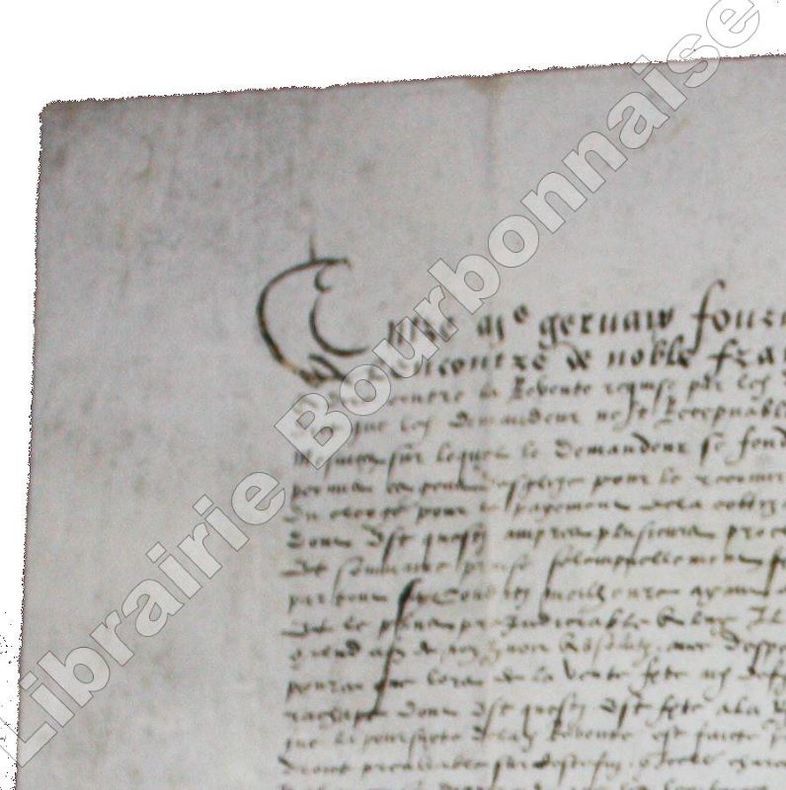
95131 pièce manuscrite sur vélin, 48 x 46 cm, datée du vendredi 30 mai 1567. Deux petits trous à un pli. Beau document.
1826223051826 un document Original Authentique de 4 pages (une grande pliée en deux), préimprimée [à l'en-tête de l'Armée du Rhin et les emblèmes de l'Empire Français (à l'aigle) gravés en noir] et manuscrite à l'encre brune sur papier crème, format : 34 centimètres de HAUT par 22 centimètres de LARGE, fait au Ban Saint Martin, le 13 Septembre 1870, signature autographe de BAZAINE (Maréchal de France, Commandant en Chef de l'Armée du Rhin), petites fentes de papier en marge et léger manque de papier en marge (moins de 1 cm2) sinon Bel Exemplaire....
165422518saint germain en laye 1654 une lettre, d'une page, sur papier vélin ligné, manuscrite à l'encre brune, format : 34,4 x 24 cm, lettre autographe manuscrite, Lettre signée '' Louis '' de la main du Roi LOUIS XIV (Agé alors de 16 Ans) + signature de MICHEL LE TELLIER,[ MARQUIS DE BARBEZIEUX, SEIGNEUR DE CHAVILLE, D'ETANG ET DE VIROFLAY (SECRETAIRE DE LA GUERRE DU ROI)], fait à REIMS LE 12 JUIN 1654,
596862Décharge pour messieurs d'Aubery mes petits-fils. Signé d'Oré [présidente Doré], Nancy, 27 décembre 1789. Une vingtaine de lignes de la main d'Hozier de Sérigny.
Folio (210 x 310 mm). German manuscript on paper. 698 written pages on 396 unnumbered ff. Contemporary calf; spine gilt. Collection of almost entirely German (Austrian) 16th century legal texts, but also comprising a few 15th century sources (and one in Latin), thus assembled in the late 17th century. The tax legislation for all five Lower Austrian countries and Gorizia from 1542 (copied from the printed book) is followed by the extensive Treatises of Bernhard Walther (the "father of Austrian law" who in the mid-16th century collected the Lower Austrian customary law). The present, very complete manuscript comprises 14 of the 15 treatises (all except that on bankruptcy), and it was used by Max Rintelen for his critical edition, published in 1937 (cf. reference below). The treatises are followed by decisions concerning the law of inheritance ("Von Erbschafften drey Fragen, dem Herrn Landtmarschalkh ... alhier anzuzaigen"; "Ob deß abgestorbnen Wittib, oder Glaubiger den Vorgang haben: Der Regierung Rathschlag" etc.), "Bericht wegen der Caution im Landtsrechten in Österreich Under der Enß", "General wegen der Verstorbenen Pfarrer in Steyer Verlassenschafft", "Tractatus de testibus, ex secundo tomo actionum forensium D. Joan. Oldendorffii"; "Königlicher Bevelch daß ain jede Sach vor dem ordentlichen Gericht erster Instanz clagt soll werden (4 March 1534); "Khay. May. Declaration und Spruch zwischen der Löblichen Universitet zu Wienn, und gemainer Statt daßelbst" (1571), "Gemaine Beschwerung der Erblande" (with detailed regulations on mining and minting, manslaughter, gypsies, Jews, etc.), confirmations of decrees issued by Frederick III in 1444, 1462 and 1470, etc. - Some waterstaining near end; occasional slight staining. Spine-ends professionally repaired. Provenance: Handwritten ownership of Baron Anton von Egger (d. 1727): "Ex lib. Ant. L. B. de Egker". Later in the collection of the Austrian legal historian and numismatist Arnold Luschin von Ebengreuth (1841-1932) with his etched bookplate to the front pastedown. After Luschin's death his heirs presented the volume to his student, the legal historian Max Rintelen (1880-1965); cf. his entry in blue ink: "Von Luschins Erben erhalten. Max Rintelen". M. Rintelen, Bernhard Walthers privatrechtliche Traktate (Leipzig 1937), Ms. LE (p. XVIII).