19 868 résultats
Second edition, [2 ads], [36]pp., with printed title-page and half-title, engraved headpiece, the advert leaf includes two editions of Beckford's Vathek and A Description of Fonthill Abbey. Small 4to (235 x 145 mm), 2 works in one, recent half calf to style, marbled boards, spine tooled in gilt. A survey of the principal public and private libraries in England, listing highlights of the collections and concluding with brief accounts of 30 important English book auctions from the 17th century onwards. William Beckford assisted in the compilation of this work, particularly in the description of his own library at Fonthill. The Dialogue in the Shades is a two-part pamphlet of satirical verse is a response to Dibdin's Lincolne Nosegay and the Bibliographical Decameron. The attribution varies from William Beckford to the Clarke brothers. This second edition is issued with an additional half-title, title-page with note from 'Mr. Wynkem' on the verso, and with the addition of The Diary of Roger Payne, a work in the same vein. A rare anti-Dibdinia item. Windle & Pippin, D9.
8vo. Italian manuscript on paper. 1 p. Together with another contemporary copy of the sonnet (8vo, ½ p.). This unpublished sonnet was written in honour of the deceased Pope Clement XIV, who had died on 22 September 1774, and probably circulated in Rome at that time: "Chi giace in questa Tomba? Il Corpo giace / Del Gran Clemente. E l'Alma or è salita? / In grembo al suo Fattor pronto e spedita, / E di sua luce ivi trionfa e tace. / Chi piange? Il Mondo. E chi duol si sface? / Roma. Ed al duolo qual cagion l'invita? / Perchè sparendo Lui, seco è sparita / E Giustizia, e Bontà, Letizia, e Pace. / Chi fà al Sepolcro suo fregio, e corona? / Religion. Chi serba [!] la memoria? / Colui, che alla Virtude applausi dona. / Dunque in van Morte rea si vanta, e gloria, / Se in Cielo, e qui frà noi vive, e risuona, / E chiaro andrà nella futura Istoria". - The poem is a close adaptation of an elegiac sonnet in Giacomo Bratteolo's collection "Rime di diversi elevati ingegni della Citta di Udine" published in 1597. - The most consequential and controversial decision of Pope Clement XIV was the suppression of the Society of Jesus in 1773. This political act led to a surge in propaganda for and against the Jesuits and the Pope. The sonnet at hand must be seen in this context, although it does not refer to the disgraced Jesuits, choosing rather to elevate the deceased Pope as a beacon of virtue whose grave is rightfully crowned by Religion. - With minor fire damage.
Folio. Italian manuscript on paper. 1½ pp. In the guise of a supplication by the city of Rome to Spanish King Charles III (1716-88) following the death of Pope Clement XIV in 1774, this poem with 34 verses of 6 lines is a fiercely caustic enumeration of anti-Jesuit tropes and slanders. Among the common accusations levied against the Jesuits was the fabrication of a link between the Society and Robert-François Damiens, who had attempted to assassinate Louis XV in 1757: "Tu sai che nella Francia / Un caro a lor si cangia / In Sicario ed assase, / Perfido disleale, / Il Monarca al cospetto / Del Popol tutto per uprirgli il pecto." In one of the final verses the poem calls for Charles III, who "will extinguish the stains on the forks", to take up his sword "in every street" against those who have insulted "the majesty of the kings and of the church". - The most consequential and controversial decision of Pope Clement XIV was the suppression of the Society of Jesus in 1773. This political act led to a surge in propaganda for and against the Jesuits and the Pope. Spain had already expelled the Jesuits in 1767. - Traces of folds and insignificant brownstaining.
4to. Italian manuscript on paper. ½ p. The premise of this unpublished eulogy for Clement XIV (1769-1774) is a comparison between the Pope and the hero Rinaldo in the enchanted forest, the most famous episode of Torquato Tasso's "La Gerusalemme liberata" with the Jesuits serving as his foe. Clement is "greater than Rinaldo and strong and brave / Inspired by heaven, supreme sheperd" who "smashed the Ignatian branch to the soil". - On 21 July 1773, Clement XIV issued the papal brief "Dominus ac Redemptor Noster" ordering the suppression of the Society of Jesus. This was probably the most controversial political decision of the 18th century, leading to a surge of propaganda for and against the Jesuits and the Pope that culminated after Clement's death on 22 September 1774. - On the verso are two quotations from Virgil's Aeneid, cautioning against hubris and blasphemy: "Discite iustitiam moniti et non temnere divos!" (VI, 620) and "Flectere si nequeo superos, Acheronta movebo" (VII, 312).
5846781er may 1751. 1 ff. in-4, 4pp. d'écritures lisibles, nombreuses corrections, signatures.
1217S. l. : s. d. (vers 1860). UN PANORAMA DE LA CHANSON POPULAIRE AU MILIEU DU XIXE SIÈCLE
4565Paris, Palais du Louvre et Bibliothèque Nationale, Avril 1904. Un volume in-8 demi chagrin rouge, dos à nerfs, titre doré, couvertures conservées, réunissant:- Oeuvres exposées au Palais du Louvre (Peintures - Dessins - Emaux - Tapisseries): XXXII pp. d'introduction + 160 pp. + VIII pp. de table - Oeuvres exposées à la Bibliothèque Nationale (Manuscrits à peintures): 78 pp. + VI pp. de table + 32 ff. d'illustrations. Accident à la coiffe supérieure. Exemplaire de Lucien Musset, comportant quelques notes de sa main.
19663[s.l, Paris], Presses du CNRS, [d.l. 1988] 1 volume 24,8 x 30,5cm Reliure éditeur pleine toile sous jaquette illustrée couleurs. 247p.; très nombreuses illustrations in texte, vignettes et pleines pages, en noir et en couleurs. Bon état (petites traces laissées par un ancien adhésif de couvrure sur la garde de fin).
Etudes, par une équipe de spécialistes sous la direction de l'archiviste-paléographe Jean GLENISSON (1921-2010), sur la fabrication (supports matériels de l'écriture, ateliers et copistes), l'usage (contenus, lecteurs et bibliothèques), les textes et leur transmission (langues, cultures, évolution de l'écriture, traductions), les enluminures et notations musicales autour du texte, et la survie et les connaissances du livre médiéval, de la Renaissance aux informaticiens; avant-propos de Louis HOLTZ; nombreuses reproductions en noir et en couleurs; carte; chronologie (IVè siècle - 1523); glossaire; bibliographie. Ouvrage publié par l'Institut de recherche et d'histoire des textes; exemplaire bien complet de sa jaquette. Français
1847ARC-114192Paris, Imprimerie Royale, 1847 in-4, viii et 285 pages demi chagrin rouge à coins dos à 5 nerfs orné
7759Paris, Bibliothèque nationale, 1958. In-8, broché, planches hors-texte.
71pp., one of 100 numbered copies, coloured frontis., 13 plates (some coloured), orig. printed wrappers. From the library of Bernard H. Breslauer.
4to (172 x 202 mm). German manuscript on paper by various hands. 298 written pp. on 180 ff. (including flyleaves). Contemporary half calf over marbled boards. An extensive German commonplace book, continuously expanded for nearly a century by a family of merchants, farmers, and mariners, one of whom sailed to Virginia on the HMS Lion to join the fleet of Admiral Cornwallis, probably in 1779 during the American Revolutionary War. - The first part (comprising some 40 ff.) offers an anthology of maxims, aphorisms, and anecdotes about the Vienna Court Theatre, about Garrick and Hogarth, King George III and Voltaire, etc., apparently mainly compiled in the 18th century, with a few later additions by other hands. The second part, begun by the same writer and considerably expanded by several later owners of the book, contains a vast miscellany of historical and historico-cultural themes. Items include a piece about verbal responses to sneezing, another about wigs and elaborate hairstyles throughout history, about the history of playing cards; and tables for housewives with which to calculate their annual expenses. Later entries focus more strongly on household remedies against illnesses (such as cholera and dropsy) and agricultural advice (how to get rid of weevils, how to increase the fertility of fruit trees). - Occasionally, the notes will provide a more immediate glimpse of the life of the writer: underneath a discussion of how to calculate the deadweight tonnage of a ship of 100 cannons with a crew of 1000 men, an early 19th century owner who signs his name "Bindseil" states that he himself "sailed on an English ship of the 2nd line, blue flag, of 64 cannons, named Lion, under Captain Fox, which was taking us to the English general Cornwallis in Virginia. On this ship were 1375 souls, 4 live oxen, 12 large pigs, the same number of rams, and 4 horses, which are not taken into account by the above calculation, as little as the minimum two anchors are, each of which weighs some 600 pounds and yet is quite indispensable [...]" (transl.). Not infrequently, an entry will cite the source from which it is drawn: newspapers and journals mentioned include the "Hamburgischer Correspondent", "Holzmindisches Wochenblatt", "Hannoverscher Anzeiger" and "Braunschweigische Zeitung", pointing to a Northern German origin. - Occasional light brownstaining; binding somewhat rubbed. A fine survival worthy of detailed study.
4to. French manuscript on paper. 68, 37 (but: 38) pp. Contemporary full cloth with blank spine-label. Extracts from the works of great philosophers, writers and historical personalities, jointly composed by several hands, probably bound together soon after completion. Includes passages from Seneca quoted by C. A. Demoustier in his "Cours de Morale" (1804), Esprit Flechier's "Oraison funèbre de Monsieur de Turenne" (1676), and Chateaubriand's "Martyrs" (1809), as well as an extract from the Gazette de France from 9 April 1808 about the writer Germaine de Stael (1766-1817). Other sources include Voltaire, Jean-Baptiste Massillon, Fréderic César de La Harpe, Marie Jeanne Riccoboni, Jacques Necker, François de Neufchâteau, Jean-François Marmontel, and the Marquis de Bonnay. With the transcript of a description of Prince Potemkin given by Catherine the Great in one of her letters edited by Madame de Stael, as well as a "Recette de faire une Tragédie moderne" by Monsieur Hayley. - Some corrections and deletions. Binding a little soiled. Paper occasionally browned and brownstained; a few marginal tears rebacked with paper. An uncommon survival reflecting the reading habits of what appears to have been a group of students.
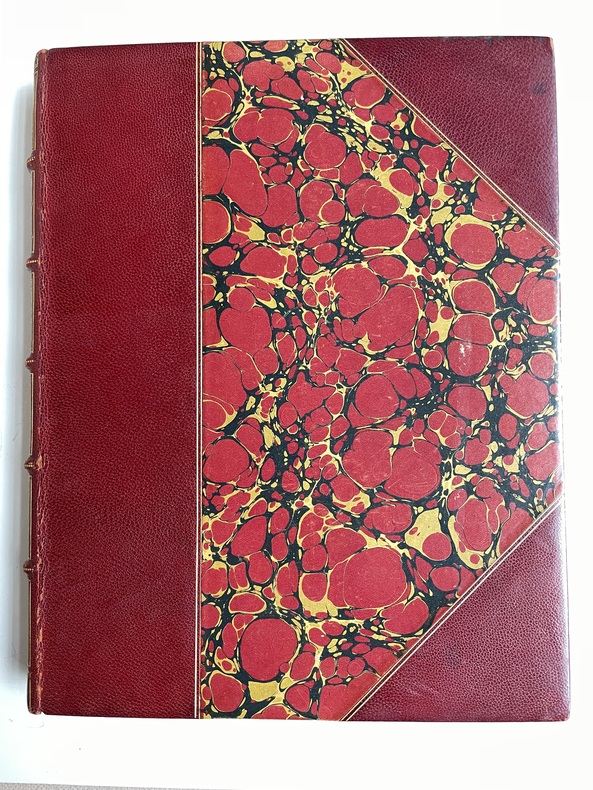
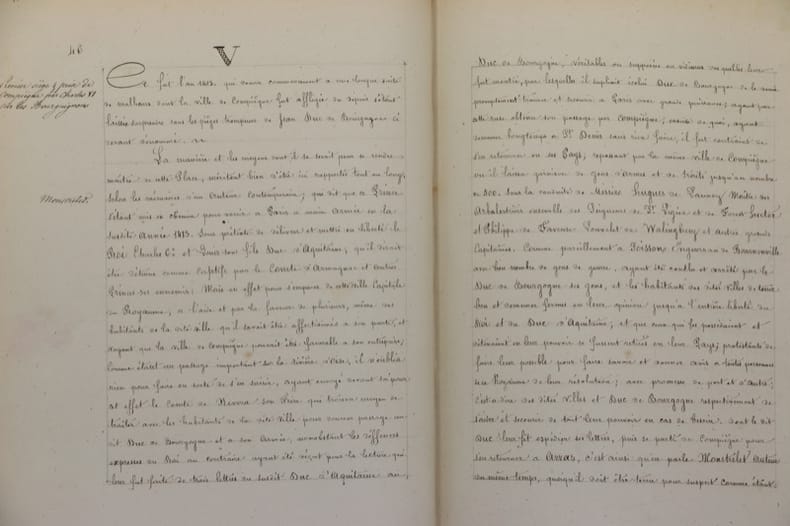
569017S.l., s.d. [milieu du XIXe]. In-4, reliure du XIXe demi-maroquin rouge (sign. C.P.), dos à 5 nerfs orné de caissons dorés, titre doré, tranches mouchetées de noir ; 277 pp. manuscrite. Ex-libris gravée aux armes de la famille de Bonnault.
GF15424Manuscrit sur papier (18,5 x 29 cm) avec cachet de cire rouge signé, situé et daté : "à Montechevou au Comté de Montbéliard le 20 février 1678"
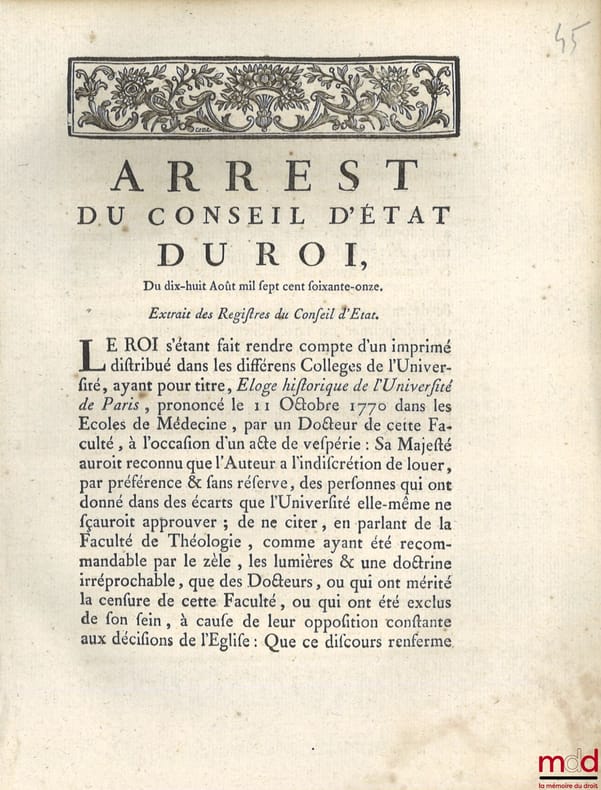
4193, Paris, Pierre-Guillaume Simon, imprimeur du parlement 1772, in-8, feuillet libre, (légt jauni), bon état, 1ff. [R°/V°].
4192[circa 1840], 34,50 mm [diam.]/ 17,10gr., Jeton octogonal en argent, (poisson partiellt effacé), tranche lisse, bon état.
57471, Paris, Dusillion ss date [1841], in-plano, 60x 45cm, cartonnage d’époque, dos lisse orné d’une frise dorée, 2 tableaux, 9 planches gravées, (rel. et plats usés, dos décollé avec des mq. de cuir, coupes frottées, mq. un coin, taches sur la p. de tit. et des mouillures sur le papier de protection), int. frais hormis qq. rousseurs sur les papiers de protection, gravures très bien conservées, 3p.[et] 9pl.
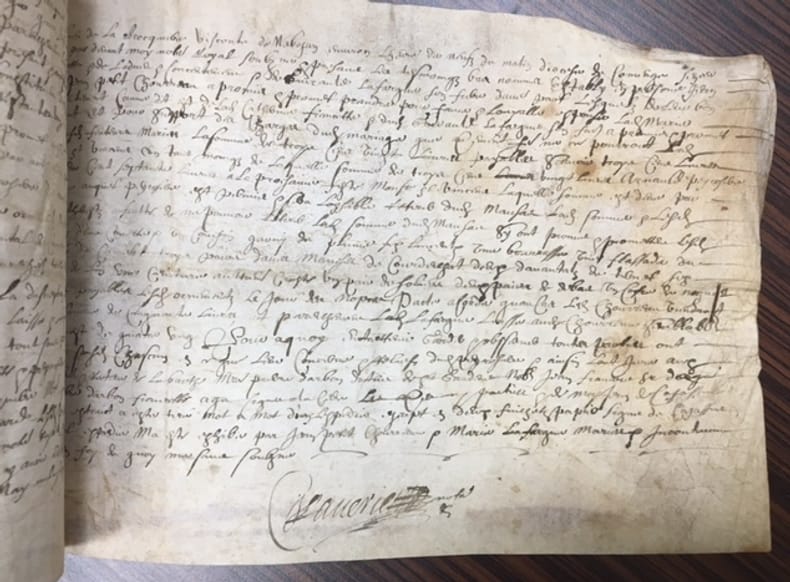
575791Belle pièce XVIIe, in-4 oblong, sur parch., 23 lignes, écriture bien lisible.
337001 page in4 - trés bon état -
337011 page 1/2 in4 - trés bon état - un peu poussièreuse - On joint une lettre à Joseph Fil, datée du 16 janvier 1890, en tant que consul d'Autriche à Ajaccio par ? -
42231898, (marque de pli, lég. taches, froissé en marge), [ce journal provient de la bibliothèque personnelle de Bernard Pacteau].
Folio (220 x 355 mm). German manuscript on paper. A sheaf of court documents containing records and correspondence (some as drafts or copies). 30 pp., folio und 4to, thread-stitched in grey wrappers with handwritten cover title as quoted above. Uncommon example of early modern court records relating to a case of sexual assault in the principality of Schwarzburg-Rudolstadt (now Thuringia). During the night of Sunday, 14 January 1821, the 19-year-old maidservant Johanna Christiane Pröschold from Piesau was brutally raped at Pfeiffer's inn in Ascherbach (now part of Lichte near Neuhaus am Rennweg) by Friedrich Scherf, Adolph Brödel, Markus Glaser, Christoph and Wilhelm Wächter, as well as Carl Kampf from Lichte. The documents include the records of the statements made by the maid as well as by the perpetrators, signed by the local sheriff Johann Christoph Horn; a certificate of good character for Pröschold's employer, the innkeeper, given by the priest Johann Jakob Korn; the copy of a letter to the Administrative Office in Schwarzburg; and the draft of a report to the general counsel, König, in which it is said that the maid "suffered through this most villainous, shameful behaviour the most horrible maltreatment, indeed insulting to humanity, which in fact endangers her very life". The culprits were sentenced to corporal punishments and prison terms of various severity, spent at the Schwarzburg gaol. - A few leaves loose; a few insignificant edge flaws, but on the whole in excellent state of preservation.
6418"Transcrite à Guéret", 1785 ; in-folio. 1er titre- XIVpp. (table sur feuillets bleus)- 2d titre- 644pp. Demi-veau brun, dos lisse orné, tranches rouges. Fottements au dos. Cachet humide de l'époque : "E.A. Berger avocat".