19 870 résultats
585373Paris, CNRS éditions, 2010. Fort in-4, cart. éd. ill., LXII-659 pp.; 24 pl. en n/b., appendice, index des auteurs et des titres in fine. Discret ex-libris au tampon.
1969LFA-126728938Un ouvrage de 132 pages, format 155 x 205 mm, illustré, broché couverture couleurs, publié en 1969, Impr. Tournon et Cie, bon état
200918882S.l., L'auteur, 1928 ; in-4, EN FEUILLET SOUS JAQUETTE. MAMUSCRIT - PLUS TEXTE MACHINE ORIGINAL avec correction manuscrite - joint -PRÉIMPRÉMATURE - (GASTON RIOU, journaliste positiviste combattant au front - 14-18, milite pour l'europe fédérale en 1920-29 "EUROPE MA PATRIE" existe une édition en Allemand par Marguerite Wolf avec préface de Renée Schickele Ed. Heitz strasbourg 1929 (il parle de l'historique de Charlemagne 1er Empereur franco germanique europeen -- Aristide Briand /Stresemann développe les thèses européennes avec 50 ans d'avance.
1949176501949 une carte-lettre autographe manuscrite écrite à l'encre bleue, format : 13,5 x 8,8 cm, signée BLAISE CENDRARS, et datée du Mercredi 23 Novembre 1949 et Adressée (au dos) à Jean Pierre Foucher, avenue Pierre Abélard, Nantes (timbres et cachet de la poste (23/11/49)
17452S.l.n.d. (ca 1780). 1 vol. in-12, cart. bradel, pièce de titre en long au dos. Reliure moderne. 57 pp., galerie de vers avec qq. atteintes au texte.
179943266Lampsaque, , 1799. 2 vol. in-4 manuscrits de (241) et (269) ff., becquets dans le texte et sur un contreplat, demi-basane blonde à petits coins de vélin, dos lisse orné, pièces de titre en maroquin rouge et noir (reliure de l'époque).
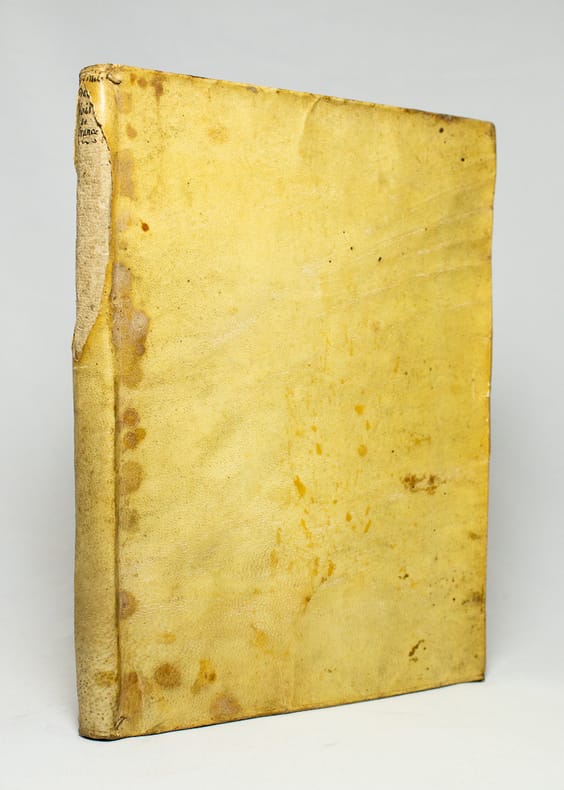
166017510Paris, Louis Boissevin, [1660]. In-4 de 66 feuillets, plein vélin ivoire.
87881785. Manuscrit de 68 pp., titre manuscrit encadré (quelques rousseurs).
8vo (190 x 133 mm). Latin manuscript (lettre batarde) on vellum. 2 columns, 25 lines. 70 (instead of 74) ff., with 2 ff. of flyleaves at beginning and end each. Floral borders in colours and gilt; ornamental initials; 10 (instead of 14?) illuminated pages. 16th century calf with gilt double cover rules and central oval stamps (upper cover: crucifixion; lower cover: annunciation). Splendidly illuminated Northern French Book of Hours on vellum. The nearly full-page miniatures (ca. 110 x 80 mm) show extended landscapes as well as interiors, comprising: fol. 14r, Annunciation (at the beginning of the matin of the Office of Mary); fol. 20r, Visitation (Lauds); fol. 26r, Crucifixion (Hours of the Cross); fol. 27r, Pentecost (Hours of the Holy Spirit); fol. 31r, Adoration (Sext), fol. 33r, Presentation at the Temple (None); fol. 35r, Flight into Egypt (Vespers); fol. 38, Coronation of Mary (Compline); fol. 41v, King David in prayer (Penitential Psalms); fol. 50v, Job (Office of the Dead). Wants 4 leaves: before fol. 7 (Gospel lections), before fols. 28 & 30 (Prime and Terce in the Office of Mary), and before fol. 65 (beginning of a prayer to the Blessed Virgin). The finely gilt accents on the figures' clothing are typical of the French book illumination of the period. The borders (on all sides of the first calendar page and surrounding the miniatures, otherwise only to the outside of the text) show characteristically elongated, light brown and blue tendril leaves as well as blossoms and fruits (mainly strawberries and oblong red blossoms) within light brown compartments. The various prayers and lections have small coloured initials; final paragraph lines are completed with red and blue bars bearing gilt decoration. - The localisation of this Book of Hours is conclusively demonstrated by the original note on fol. 13r: "Hore beate Marie virginis secundum usum Rothomagansem" (i.e., Rouen in Normandy). Liturgically of high importance is the calendar (fols. 1r-6v), written in French: the entries are alternately in red and blue, feasts are emphasized in gilt. Names include St Martialis, bishop of Limoges, celebrated in Rouen on 3 July and also prominently mentioned in the litany; St Romanus, bishop of Rouen (23 October); and other bishops of Rouen, such as Ansbertus (9 February), Hugo (9 April), Mellonus (22 October), and numerous saints typical for the region, some of which reappear in the litany (fols. 47v-50r). - The localisation is supported by the art-historical evidence: the tendril forms were developed in Rouen around 1460 by the "maître de l’échevinage", and his highly productive workshop continued the tradition until the 16th century. The compositions and their arched top borders further support this attribution. The date is suggested by the lack of bars in the borders, such as are typical of workshop's ornamentation as late as in the third quarter of the 15th century, and on the other hand by the unadulterated Gothic character of the illumination, which in Rouen tends to give way to Renaissance motifs even in the late 15th century. - Provenance: 16th century old French entries on fol. 70v, concerning the birth of several children of the book's owner. The first entry mentions a fourth son, Pierre, born on 13 May 1563; by 1570 he is followed by four more children who were apparently entered immediately after their birth. While the family's name is not stated, it might be identified from the names of the godparents. An added prayer entered on fol. 13v appears nearly contemporary with these notes. - Occasional very insignificant paint smudges and offsetting to opposite pages with a few very minor stains. Altogether in fine state of preservation.
187928628nantes 1879 une lettre autographe manuscrite à l'encre brune de 4 pages sur papier à en-tête imprimé en noir :" DOCTEUR GUEPIN , 13, Cours Tourny, BORDEAUX - CONSULTATIONS DE 1 HEURE A 3", format : 21,5 x 13,7 cm, signature manuscrite : Guépin ce 29 Avril 79,
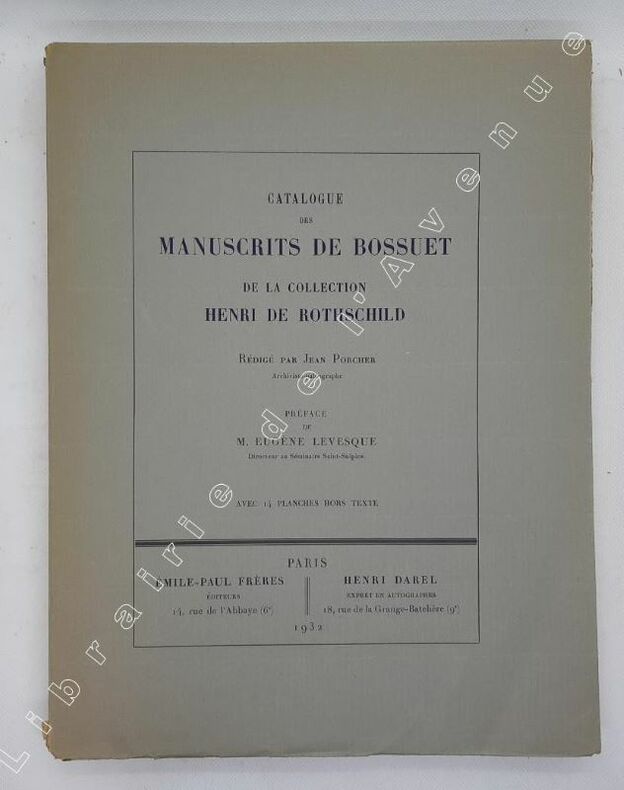
1932108728Paris, émile-Paul frères, Henri Darel 1932 In-4 33 x 25,5 cm. Broché, couverture grise rempliée, dos muet, titre en noir sur le premier plat, XXIV-109 pp., notes en bas de page, en frontispice, portait de Bossuet, par Robert Nanteuil, 13 fac-similés contrecollés sous serpentes, index, table des planches, table des matières. Exemplaire en bon état.
181543352, , 1815. Manuscrit in-12 de (1)-140 pp., titre orné, vélin souple bruni, dos lisse muet (reliure de l'époque).
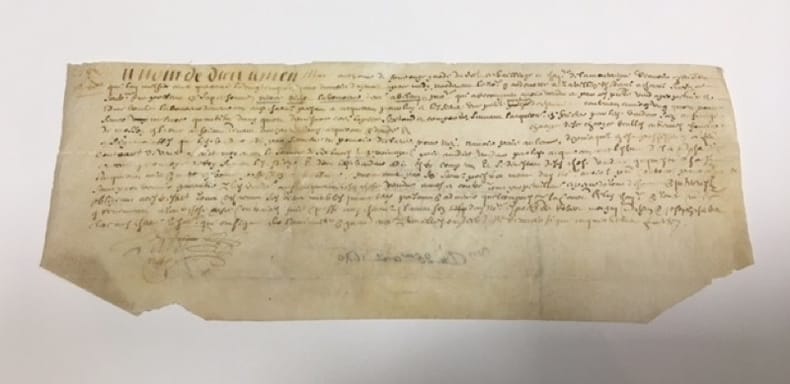
1004917 Février 1670. 6 feuillets in folio (angle extérieur du bas atteint par l’humidité).
- Paris dimanche 2 avril 1758, 13,4x19,2cm et 11,7x17,8cm, 2 feuillets. - Testament de Louise-Anne de Bourbon-Condé dite Mademoiselle de Charolais, recopié de la main de Jean-Baptiste-François-Joseph, comte de Sade (et père du Marquis), dans lequel cette dernière fait de son neveu, Louis-François Joseph de Bourbon, prince de Conti, son légataire universel. Une seconde partie concerne les legs aux gens de livrée, aux femmes et valets de chambre, à la femme de garde-robe, etc. Note de bas de page de la main du Marquis de Sade : « dite Mademoiselle de Charolais ». On y joint un billet de notes, rédigé de la main de Sade, en vue de la publication de la correspondance de son père. Ce testament a été rédigé cinq jours avant la mort de Mademoiselle de Charolais, dont le décès survint le vendredi 7 avril 1758 à la suite de trois mois de maladie. La seconde partie du testament est datée du dimanche 2 avril 1758, sur la première est mentionnée la date du dimanche 12 avril 1758 : il s'agit bien sûr d'une date fautive. La totalité de cette copie a été rédigée de la main du Comte de Sade qui vécut avec Mademoiselle de Charolais à son château d'Athis-Mons à partir de 1750 jusqu'à la mort de cette dernière. Le jeune Comte de Sade, envoyé par son père à Paris aux alentours de 1720, eut pour protecteur Louis-Henri de Bourbon, Prince de Condé, dit Monsieur le Duc. Dès son arrivée, le jeune homme apprécie la vie de cour et « Chose rare, il plaît aux femmes sans se faire haïr des hommes : d'où le nombre de ses amis, au moins aussi élevé que celui de ses maîtresses. [...] M. de Sade ne se contente pas de conquêtes faciles ; les bourgeoises l'indiffèrent. Celles qu'il recherche - et conquiert le plus souvent - sont des femmes de cour, non seulement pourvues d'esprit et de beauté, mais parées encore d'un nom illustre, de crédit, d'influence ou de fortune, capables en un mot de servir ses intérêts et de le mettre bien en cour. » (Lever, Sade). Parmi son tableau de chasse figure Mademoiselle de Charolais, de sept ans son aînée, soeur de son protecteur et alors maîtresse royale. Peu désireuse de se marier, elle préférera toute sa vie conserver le célibat et multipliera les aventures et les amants prestigieux. Elle fut notamment la favorite du Duc de Richelieu, mais aussi de Louis XV pour lequel elle recrutait de nombreuses maîtresses, écopant ainsi du sobriquet de « maquerelle royale ». La rencontre charnelle entre Mademoiselle de Charolais et le Comte de Sade eut lieu le 24 novembre 1725 alors que ce dernier était contraint de garder le lit à cause d'une entorse. Une lettre de Louise-Anne atteste de cette aventure naissante : « Le 24 novembre est le plus beau jour de ma vie si je suis rentrée en possession de mon royaume et de ma souveraineté, par les droits du lit où je vous ai prêté serment de fidélité. Je compte y avoir reçu le vôtre et je vis maintenant pour le plus joli roi du monde. » (Papiers de famille, p.20). La passion n'est pourtant pas réciproque et le volage Comte de Sade fait bientôt la rencontre de la Duchesse de la Trémoïlle. S'éloignant ainsi de Mademoiselle de Charolais, il lui écrit en guise de rupture : « J'ai regardé, Madame, les avances que vous m'avez faites, comme des agacements de votre esprit et point de votre coeur. Je n'avais point l'honneur de vous connaître, je ne vous devais rien, une entorse m'obligeait de garder ma chambre, j'y étais désoeuvré, vos lettres étaient jolies, elles m'amusaient, je me suis flatté s'il était vrai que j'eus fait votre conquête, que vous me guérissiez d'une passion malheureuse qui m'occupe uniquement. » (op. cit. p.23). En 1752, le Comte de Sade est ruiné par son train de vie, il a envoyé le jeune Donatien au collège Louis-le-Grand et loge chez sa bonne amie Mademoiselle de Charolais au château d'Athis-Mons : « Je me suis retiré chez Mademoiselle, quoiqu'il soit cruel à mon âge de dépendre de quelqu'un, pour diminuer ma dépense. » (Lettre du Comte de Sade à son oncle le prévôt
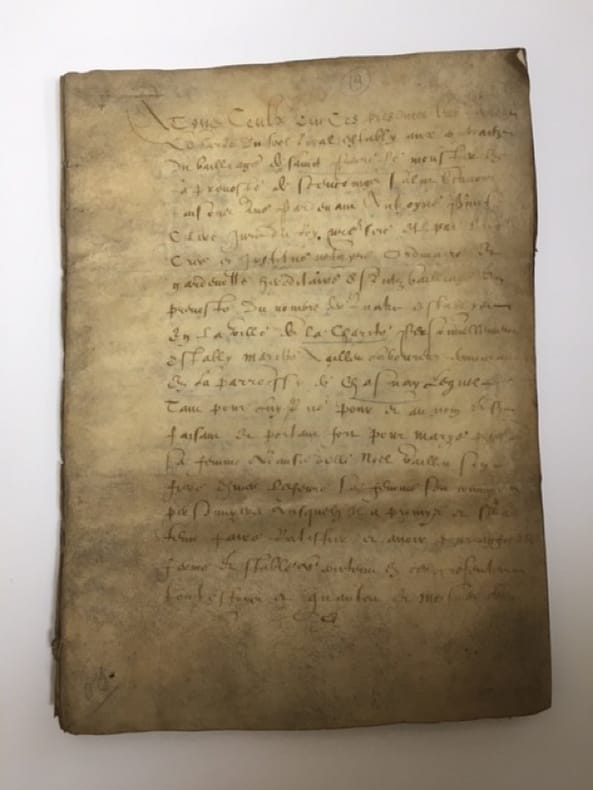
576696Cahier sur parchemin du XVIe siècle (1595), gr. in-4 de 20 pp. manuscrites.
192625617quimper FAÏENCERIE D'ART BRETON - JULES HENRIOT - LOC-MARIA QUIMPER 1926 une lettre autographe manuscrite écrite à l'encre bleue sur papier crème a en-tête illustré de 4 bois en bordeaux, avec noté en haut : FAÏENCERIE D'ART BRETON - JULES HENRIOT - LOC-MARIA QUIMPER, et en bas : GRAND PRIX - JURY INTERNATIONAL - EXPOSITION DES ARTS DÉCORATIFS - PARIS 1925, format : 21 x 27 cm, signée Henriot, et datée du 20 avril 1926,
191028658Nantes 1910 CARTE POSTALE ANCIENNE EN NOIR : PHOTO DU BARDE BRETON YVES BERTHOU - KALEDVOULC'H (1861-1933) AVEC ENVOI AUTOGRAPHE MANUSCRIT DU BARDE A L'ENCRE BRUNE : "A MONSIEUR CHARON "KEMWERZER" BARDE D'HONNEUR DU GORSEDD ... (signé) KALEDVOULC'H ...",
186023552Lille Alcan Lévy 1860 in-8 broché un volume, broché bleu in-octavo Editeur (paperback in-8 Editor) (20,2 x 13 cm), dos et couverture imprimés en noir (manque de papier au dos), toutes tranches non-rognées, envoi autographe manuscrit de l'auteur à l'encre brune en haut de la page de faux-titre : "...A ma Mère.....(signé) Comte de Kératry 1860....", sans illustrations, 91 pages, 1860 Lille : Alcan Lévy Editeur,
8vo. English manuscript on paper. (2), 34 (switching between foliation and pagination on the last 10 leaves), (1) ff. With a slip of paper attached to folio 11. Contemporary full red morocco with giltstamped border and spine. All edges gilt. Precisely drawn tables filled out in meticulous handwriting, listing forces in Britain and overseas including infantry, cavalry, general staff, garrisons in Gibraltar, Minorca, North America, and the West Indies, noting daily and annual salaries and other expenses. - After folio 22 the scribe occasionally switched to pagination, resulting in page numbers 23-24, 26-27, 29-30, and 32-33. - Spine slightly rubbed; interior crisp and clean. Contemporary ownership to flyleaf: "H. Leece | War Office | 1 Dec[embe]r 1777". Later in the collection of Thomas Fremantle, 3rd Baron Cottesloe (1862-1956), commander of the Territorial Army and president of the Society for Army History Research.
4to. English manuscript on paper. (2), 43, (1) ff. Contemporary full red morocco with giltstamped border and spine. Endpapers marbled. All edges gilt. Pre-printed table filled in by hand, detailing British military forces stationed in Britain and around the world, including the Caribbean, India, Africa, and Australia. Includes the names of regiments as well as the numbers of commissioned and non-commissioned officers, and the enlisted rank troops ("Rank & File"), distinguishing those fit for duty from those on the sick list, with a total of 238,978 regular forces and 91,586 militia. - Binding insignificantly rubbed at the hinges; interior crisp and clean. Heraldic bookplate incorporating a ducal coronet and Bentinck family crest to pastedown, a pencil note on the flyleaf ascribing it to the Duke of Portland's library. Later in the collection of Thomas Fremantle, 3rd Baron Cottesloe (1862-1956), commander of the Territorial Army and president of the Society for Army History Research.
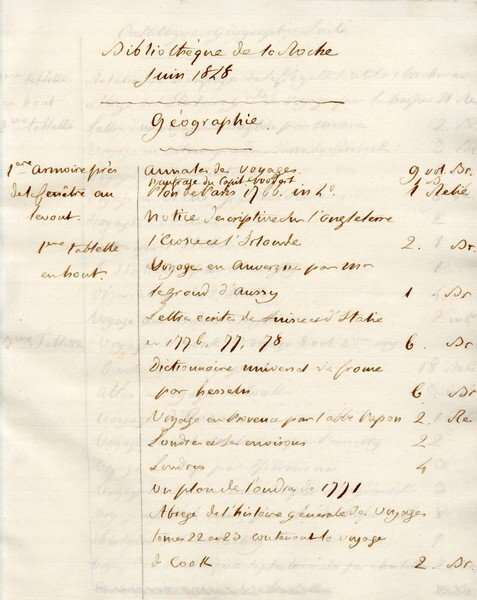
961[Couffé] : [1826-1868]. CATALOGUE MANUSCRIT DES BIBLIOTHÈQUES D'UNE ILLUSTRE FAMILLE NANTAISE
English manuscript on vellum. Approx. 620 x 555 mm (with folded plica). With two red seals. Stored in a custom-made half morocco case with gilt-stamped spine. Original deed of the first substantial purchase of land on the Brooklyn side of the East River ever made by the New York municipality, a purchase that was called by Henry E. Pierrepont (1808-88), director and historian of the Union Ferry Co., "the foundation of the claim of the City of New York to their land in Brooklyn" (23). After the capture of New Amsterdam from the Dutch in 1664, a municipal government had been formed, the Corporation of New York, while across the water, "Breuckelen" (as it was then called) long remained an independent, rival city on its own. - "As early as the 12th of October, 1694, the Corporation of New York purchased from William Morris, for no specific consideration, his hourse, barn and premises, situated at the 'Ferry', on Long Island. The house stood on the north side of the road, opposite the present Elizabeth Street, about one hundred feet from the then shore of the river" (Pierrepont, 16ff.). The site was then known as "Brookland Ferry", the place where George Washington escaped with his troops after the Battle of Long Island. It adopted its modern name, Fulton Ferry, when in 1814 Robert Fulton established the first steam ferry route connecting Manhattan and Brooklyn, which played such a major role in their shared history and evolution. - Incipit: "This Indenture, made the twelfth day of October, in the sixth year of the reigne of our Sovereigne Lord and Lady, William and Mary, by the grace of God, of England, Scotland, France, and Ireland, King and Queen, defenders of the faith etc., and in the yeare of our Lord one thousand six hundred ninty and four, between William Morris, now of the Ferry, in the bounds of the towne of Breuckle, in Kings county, on Long Island, gent., and Rebecca his wife, of the one part, and the Mayor, Aldermen and Commonalty, of the City of New York of the other part [...]". - Two copies of the deed would have been made, and this appears to be the deed retained by the Morris family and heirs, with an early note indicating that it was also "recorded in the Office of the Town of Clerk of City of New York in the Book of Grants". Pierrepont, writing in 1879, was still able to locate the City's copy at the Office of the Comptroller, where it may have remained until 1910, when such documents were transferred to the New York State Library; it probably perished in the notorious archive fire of 1911. - Drafted and signed by Ebenezer Wilson, later Mayor of New York City (1707-10). Verso signed additionally by William Pinhorne (d. 1720), the American colonial politician and jurist. Folded, few small tears to folds with negligible loss. Gabriel Furman, Notes, Geographical and Historical, Relating to the Town of Brooklyn, in Kings County on Long Island (Brooklyn, 1824), Appendix A, pp. 102f. (published in part). Henry Evelyn Pierrepont, Historical Sketch of the Fulton Ferry, And Its Associated Ferries (1879), pp. 16-23.
600 x 65 mm. 21 palm leaves between two painted wooden boards with cord. Burmese manuscript in Pali, most likely a register of Buddhist monastic rules. - Signs of age.
340 x 100 mm. Manuscript on ca. 240 palm leaves between two wooden boards. In the original wrapping cloth. Signs of age.