19 878 résultats
193826449Rennes imprimerie du Nouvelliste 1938 -in-8 broché un volume, broché (paperback) crème in-octavo Editeur, dos et couverture crèmes imprimés en marron foncé et vert (white spine and cover printed), 1ère de couverture illustrée d'un bois en vert et marron-foncé par R. HINGANT, tranches non rognées (edges no smooth), Signature Autographe manuscrite à l'encre noire du révérend Père YVON en bas de son portrait photographié donné en frontispice, orné de trés nombreuses illustrations photographiques in et hors-texte en noir, 310 pages, 1938 à Rennes Imprimerie du Nouvelliste de Bretagne Editeur, + le bandeau de librairie saumon imprimé en noir joint
GF29009Carte de correspondance recto-verso - En tête de la Rue Monsieur le Prince -
GF29011Carte de correspondance recto-verso - En tête de la Rue Monsieur le Prince -
GF290131 page in4 - En tête de la Rue Monsieur le Prince -
GF290151 page in8 - En tête de la Rue Monsieur le Prince -
GF290161 page in4 - En tête "Les Baux de Provence" -
GF29010Carte de correspondance recto-verso - En tête de la Rue Monsieur le Prince -
GF29012Carte de correspondance recto-verso -
GF290141 page in4 - En tête de la Rue Monsieur le Prince -
200283083S. n. | s. l. 2002 | 21 x 29.50 cm | une feuille
GF308041 page in8 et 4 pages in12 - bon état -
Very Good Turkish, Ottoman (1500-1928) Original manuscript autograph letter signed 'Ortaç' by Yusuf Ziya Ortaç to an unknown friend of him. 2 p. Full. In Ottoman script. 'Akbaba' satiric magazine's letterhead with its address in its period, Klodfarer (Claude Farer) Street, Istanbul. It's written with an interesting satiric style of Ortaç and it mentions 50's Turkey. It starts as 'Aziz kardesim, dostum, efendim'. He told that he received his friend's letter and upon this he wrote 'after I've read your letter, I felt like I've seen and heard you, it was like a "fondness feast!'". And he mentions 'Turkish nation' by criticizing as 'This nation knows only just forgiveness! They forgive superabundant; they forget fabrics, chimneys; but never forget some things!'. A rare and very collectible autograph.
Very Good Turkish, Ottoman (1500-1928) Original autograph document signed by Yusuf Râzî Giridî Bel. 23,5x15,5 cm. In Ottoman script. 1 p. Six lines. Script: "Yalniz elli aded lira-yi Osmanîdir. Defter-i Hakânî Nezâreti muavini Refik Beyefendi'nin nakden elli lira-yi Osmanî ... ahz ettigimi ve meblag-i mezbûru tarih-i senedden itibâren alti ay zarfinda iâde edecegimi mübeyyin isbû sened müsarileyhe ita kilindi. 17 Subay [1]329, Sûrâ-yi Devlet âzâsindan Yusuf Râzî Giridî.". Yusuf Razi, who was born in 1870, is the son of Sirri Pasha, known as Giritli, and Leyla Hanim, one of the well-known poets and composers of the time. After graduating from Galatasaray High School, Yusuf Razi, who studied engineering in Paris, was appointed as a member of the Ottoman Council of State after teaching at the Engineering School for a while. Yusuf Razi, who left all his duties in 1920, wrote articles in various magazines and newspapers and worked in (Resimli Kitap) and (Sehbal) magazines published after the Second Constitutional Monarchy in 1908. Meanwhile, Yusuf Razi was the Turkish correspondent for magazines published in Berlin and Paris titled 'Illustration' and 'Illustriert Berlin'. Later he translated and published his mother Leyla Hanim's memoirs under the title "Le Harem Impérial" in Paris. During his life, Yusuf Razi, who also worked as the General Directorate of Postal Telegraph and Istanbul City Hall, translated many books.
Very Good Turkish, Ottoman (1500-1928) Original autograph letter signed (ALS) by Ottoman prince (Sehzâde) Yusuf Izzeddin to his brother, probably Mehmed Seyfeddin Efendi, (1867-1899). 27x17 cm. In Ottoman script. 1 p. 11 lines. Used a pencil. Full. Written on a "Toneywood Linen" watermarked paper. Sehzâde Yusuf Izzeddin was an Ottoman prince, the son of Sultan Abdülaziz and his first wife Dürrünev Kadin. Sehzade Yusuf Izzeddin was born on 29 September 1857 in the Dolmabahçe Palace. His father was Sultan Abdülaziz, who was then a prince, and his mother was Dürrünev Kadin, eldest daughter of Prince Mahmud Dziaps-lpa and his wife Princess Halime Çikotua. He had a full sister, Saliha Sultan, five years younger than him. He was brought up concealed in the villa of Kadir Bey, molla of Mecca, located in Eyüp. His birth was kept a secret until his father ascended the throne in 1861. Izzeddin's early education took place in the Prince's School, Dolmabahçe Palace. His tutors were Miralay Süleyman Bey, Ömer Efendi, Tophane Müfti Ömer Lutfi Efendi, Gazi Ahmed Muhtar Pasha, and Gürcü Serif Efendi. He took his French lessons from the Sultan's head doctor Marko Pasha and Sakizli Ohannes Pasha's son-in-law Sarl. In 1871, at the age of fourteen, Izzeddin was commander of the Fourth Army (Anatolian Army) with the rank of Marshal, and soon after was appointed commander of the First Army, the Imperial Army. After his accession to the throne, Prince Murad (future Sultan Murad V), became heir to the throne. However, Abdülaziz began considering changing the rule of succession in favor of Izzeddin. For this purpose, Abdülaziz set out to mollify different pressure groups and have his son gain popularity among them. During the 1867 visit to Europe, rumors spread that contrary to the rules of protocol Abdülaziz arranged Izzeddin's reception in Paris and London before the official heir, Prince Murad. Izzeddin's father, Abdülaziz was deposed by his ministers on 30 May 1876, and his nephew Murad became the Sultan. He was transferred to Feriye Palace the next day. On 4 June 1876, Abdülaziz died under mysterious circumstances. As both of Emine Sultan, Izzeddin's half-sister, parents died in the summer of 1876, when she was not yet two years old, Izzeddin raised her in his household. Izzeddin's cousin Sultan Abdul Hamid II was suspicious of him, and for this reason, had a police station built opposite his country house. Izzeddin and Prince Vahideddin (future Mehmed VI) had a rivalry with each other. Though, coldly polite to each other, they refused to share the same carriage even for the ceremonies of the state. Vahideddin especially insisted on being considered the second heir apparent. Yusuf Izzeddin suffered from his role and lived his later years in a kind of paranoia, until he committed suicide (his cause of death is still under debate: murder or suicide?) on 1 February 1916 in his villa at Zincirlikuyu, Istanbul.
Very Good Turkish Original typed letter (TLS) with autograph signature by Yusuf Mardin. 13x21,5 cm. In Turkish. 1 p. Two puncher holes. He had written that politic condition and chaos of the youth and country in the late 70s, he prepared an article on Namik Kemal, and he requested to publish this in famous 'Hisar' (Turkish literary periodical) magazine, to an unnamed recipient. Yusuf Mardin was a graduate of Istanbul University Faculty of Law. In addition he was Istanbul Robert College Teacher, General Secretariat and Legal Advisor, Founding and Writing Yücel Magazine, Bogaziçi Magazine Editorial Directorate, Author, the Deputy of Mardin for the period of the TBMM VIII.
50366o.J. Blevio, 3. X. 1892, Qu.-Kl.-8°. 1 Seite.
64810, Brepols, 2022 Hardback, 525 pages, Size:240 x 340 mm, Illustrations:121 col., Language(s):French, Syriac, Arabic. *new. ISBN 9782503570426.
GF287841 page in4 - bon état -
GF252801 page in4 - On joint un portrait imprimé de Paul Fort par Jacques Yonnet (taches vertes en marges) -
THREE VOLUME SET IN HEBREW WITH ENGLISH INTRODUCTION. RARE FACSIMILE LIMITED EDITION OF 550 COPIES - COPY No.165. [CONTENTS]: 1)'Sefer Lekah Tov' - a Commentary on the Book of Esther by Yom Tov ben Moshe Tzahalon (Moses Zahalon), also known as the Maharitatz (c.1559-1638). 'Sefer Lekah Tov' was first printed in 1577 in Safed, thus the first Hebrew book printed in the Land of Israel. Contains a general introduction in English and Hebrew. 2) Kehillat Ya'acov - Commentary on the Book of Ecclesiastes, first printed in 1578 in Safed. This cabalistic commentary on Ecclesiastes was written by Moshe ben Mordechai Galante (d.1608), a 16th-century rabbi and a disciple of Joseph Caro. / 3) Sefer Sar Shalom - Commentary on the Book of Songs of Songs by Samuel ben Isaac Aripul (1540?-ca.1586), first printed in 1579 in Safed. 250x180mm. [35+X+167] + [192] + [206] pages (altogether 610 pages: 212+192+206). Dark-blue leather Hardcover with silver lettering on front cover and spine. Spine edges bumped. [SUMMARY]: These extremely rare three volumes of a limited facsimile edition of Jewish biblical commentaries, which were the first books printed in the Land of Israel, are in very good condition. PLEASE NOTE: This item is overweight. We may ask for extra shipping costs.
1960R320013715A COMPTE DE L'AUTEUR. VERS 1960. In-4. En feuillets. Etat d'usage, Couv. convenable, Dos satisfaisant, Intérieur acceptable. Environ 400 - 500 pages manuscrites - Quelques unes dactylographiées.. . . . Classification Dewey : 91-Manuscrits
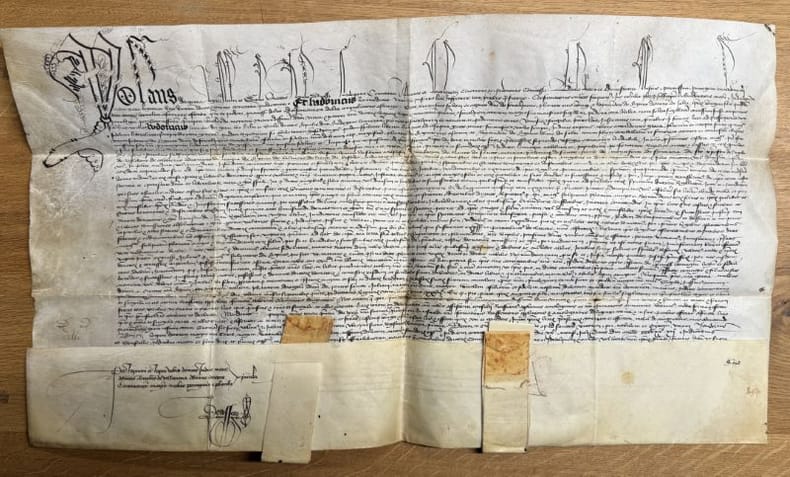
123772Marseille, près Saint-Victor 1420 1 vol. en feuilles 1 feuillet in-folio oblong remplié, languettes, format 63 x 45 cm, calligraphié sur parchemin. Daté du 20 juillet 1420 à Marseille, le document confirme le don des régales de Forcalquier, Sainte-Anastasie, Roquebaron, Rancio, Saint-Martin de Pallières, Saint-Paul de Montfort, Simiane, Saint-Christol, Roussillon, Artigues, Les Beaumettes, etc., ainsi que leurs dépendances et leurs châteaux forts, fait à Foulques d'Agoult (Fouquet d'Agoult, 1400-1492), baron de Sault, par le roi Louis II. Yolande d'Aragon (1380-1443), épouse de Louis II duc d'Anjou, reine de Jérusalem et de Sicile, duchesse d'Apulie et d'Anjou, fille du roi d'Aragon, régente de Provence et tutrice de son fils Louis III, joua un rôle politique dans l'Empire angevin et prît notamment parti pour les Armagnacs dans la guerre de Cent ans. Rare et beau document.
61193o.J. Zürich, Fretz & Wasmuth, 1950, 4°. Mit zahlreichen meist ganzseitigen Fotografien in S/W. 46 unpag. Blatt. OLn. mit illustriertem Original-Umschlag.