1 476 résultats
1773WRCLIT80156Birmingham: Da' Torchj di G. Baskerville Per P. Molini Librajo dell' Accademia Reale e G. Molini 1773. Four volumes. 6lviii362; 2450; 2446; 244626pp. plus engraved frontis and forty-six plates. Octavo. Full contemporary straight grain crimson morocco spines ruled in gilt a.e.g. gilt inner dentelles marbled endsheets. Spines a bit darkened with rubbing and a bit of shelfwear to extremities scattered medium to light foxing and tanning characteristic of the medium quality paper utilized for the octavo edition but a very good set. With the bookplate of William G. Roelker in each volume and at the base of the title and the end of text on the terminal leaf in each volume appears a small stamped crowned signet in blue ink; in the case of the title of the first volume a second stamp appears a crown above the initials 'L.O.'. First Baskerville edition this being the printing in octavo. Sets were also issued on better paper in quarto format. In this set only A8 and D2 are cancels in the fourth volume and the errata and the extensive subscribers list appear at the end of that volume. The frontis is a portrait of Ariosto and the forty-six other plates each appear before the opening of the canto to which it relates. The plates are after works by Cipriani Moreau le jeune Eisen Cochin fils Monnet J.B. Greuze and engraved by Bartolazzi Launay Longueil de Ghendt Prevost Henriquez Massard Simonet Ponce Duclos Martini Moreau le jeune Choffard and Helmon. The earliest sections of Ariosto's epic poem appeared in 1516 and the first complete edition appeared in 1532. Through following generations it exerted a significant influence on the literatures of several languages as well as on art music and popular media. GASKELL 48. COHEN-DE-RICCI 95. ESTC T133621. Ray ART OF THE FRENCH ILLUSTRATED BOOK 64. Da' Torchj di G. Baskerville, Per P. Molini Librajo dell' Accademia Reale, e G. Molini unknown books
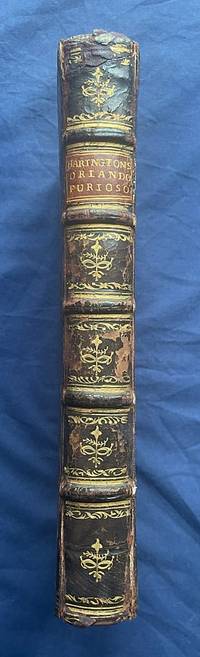
1634V64647London: Miller for Parker 1634. Very Good/None. copperplates 46 full-page said to be engraved under direction of Harrington & exalting legendary Roger d'Este. Sm.4to 278x185mm contemporary ruled calf with contrasting gilt lettered label and 5 raised bands compartment nicely gilt. Blindstamp initials H.H.to covers tips worn/ some splitting to foot of spine/some scuffed and scored and some leather surface laminating. All edges speckled red. 9423pgs9 Titlepage for Epigrams dated 1633 43pp SIGNATURES of Robert Kirk 1705 to margin of Titlepage & another very fancy but faint to foot of Titlepage in the margin. Third edition of Harington's 1591 translation. The engraved title with architectural border includes portraits of Ariosto and Harrington as well as a portrait of Harington's dog Bungy in the lower left corner. Strange EPS made of sheets from a bible with bookplate of James Marquis of Carnarvon and another coat of arms bookplate to rear EP. A fine wide margined copy with well printed well inked plates and unusually thick strong paper. Crisp and clean. Referenced by: STC 2nd ed. 748 and ESTC S106834. Miller for Parker hardcover
1787CLL-201Paris, Plassan, 1787 10 volumes petit in-12 de XII, 52pp., (2) ff., 401pp. - (4) ff., 475pp., (10)ff. - (4) ff., 503pp. - (4)ff., 527pp. - (4) ff., 452pp. - (2) ff., 34 pp., (1) f., 493 pp. - (4)ff., 493pp. - (4)ff., 507pp. - (4)ff., 465pp. - (4)ff., 595pp., maroquin vert, triple filet doré et dentelle dorée d'encadrement sur les plats, dos à nerfs ornés de caissons de fleurons dorés, coupes et bordures décorées, tranches dorées (Petit succ-r de Simier).
155619212In Lione, Apresso Bastiano di Bartholomeo Honorati, 1556. Grand in-8 de 508-[42] pages, plein veau brun, dos à nerfs orné de filets et fleurons dorés.
16171807030002In Genoua : Appresso Giuseppe Pauoni 1617. Hardcover. Good. 3 parts in one volume. Folio 31 cm. Bound in 18th century mottled calf. Gilt ruled gilt fleurons spines engraved in gilt. Front hinge cracked with chipping to joint. Internally clean and unmarked. 20 full-page engraved plates by Camillo Cungio after Bernardo Castello. Text printed in double columns. Woodcut head- and tail-pieces initials. Two portraits of Tasso and Carlo Emanuele I Duke of Savoy. Historiated initials. 16 255 1 71 1 36 4 p. The "third and grandest Tasso series". See Unglaub Poussin and the Poetics of Painting: Pictorial Narrative and the Legacy of Tasso p. 235. The illustrations differ significantly from Castello's in the Pavoni editions of 1590 and 1604. Brunet V.666; ABPC 1977; Cicognara 1:1113 In Genoua : Appresso Giuseppe Pauoni hardcover
1730046661Venice: Tefano Orlandini 1730. First Edition. Hardcover Vellum. Very Good Condition. Full contemporary vellum worn at corners soiled but sound. Scattered minor foxing and browning - mostly quite clean. Portrait of the author by Orsolini and 51 engraved plates. l 576; iv 400pp. The final section contains other works by Ariosto. Size: Folio. Quantity Available: 1. Shipped Weight: 2-3 kilos. Inventory No: 046661. Tefano Orlandini hardcover books
"In-4°, (12pp), 330, (29cc), legatura in piena pergamena coeva con titolo manoscritto al dorso. Ariosto usava l'allegoria con l'esplicito scopo di dare varietà alla sua opera, così come usava i miti classici, le narrazioni medievali, le storie pie o piccanti, e molto altro ancora. La prova di questa predilezione si trova nelle Bellezze del Furioso di Orazio Toscanella, pubblicate nel 1574. In questo commento canto per canto ai punti salienti stilistici del poema, Toscanella propone che uno dei notevoli attributi artistici di Ariosto fosse quello di ""molto variare"". La capacità del poeta di variare lo stesso argomento o situazione è ben illustrata nelle descrizioni dei duelli e, in diverse occasioni, analizza le tecniche di variazione che Ariosto usa nel raccontare questi incontri. La dilatazione e l'abbreviazione, vengono esaminati per primi. Ma ancor più impressionante, secondo Toscanella, è la capacità del poeta di variare gli elementi che costituiscono la descrizione di un combattimento cavalleresco per evitare la noia che potrebbe produrre la ripetizione di tali combattimenti. L'analisi di Toscanella è piuttosto specifica. Ad esempio, mentre commenta i colpi che Marfisa, Bradamante e Ruggiero infliggono agli uomini di Marganorre nel canto 37, Toscanella classifica i mezzi per realizzare tale diversificazione: distinguendo le cavalcature, le armature, le armi o gli usi delle armi; differenziando i tipi di colpi, ferite, cadute o morti subite; concentrandosi sui diversi arti colpiti dai colpi. E Toscanella illustra come l'Ariosto modifichi questi particolari. La sua attenta analisi rende consapevoli di quanto i lettori moderni siano diventati disattenti a queste sottili alterazioni. I loro occhi tendono ad appannarsi quando incontrano questo tipo di ripetizione, nonostante le notevoli variazioni individuate da Toscanella. Eppure la capacità illimitata di Ariosto di scoprire mezzi per alterare le componenti di azioni o eventi ricorrenti potrebbe essere stata il segno distintivo della sua arte per i suoi primi lettori. A parte i duelli, tali azioni ed eventi includevano giostre formali, combattimenti su larga scala, assedi, morti, funerali e gli altri avvenimenti che segnarono la vita dei cavalieri erranti: prove di abilità, salvataggi di sfortunate vittime, viaggi, prigioni. Si ripetono, inoltre, situazioni e motivi relativi alle 'donne e amori': descrizioni di bellezze femminili, di corteggiamenti, di amanti traditi; i lamenti degli innamorati abbandonati; e così via. Daniel Javitch, The poetics of Variatio in Orlando Furioso; Francesco Sberlati, Il genere e la disputa. La poetica tra Ariosto e Tasso. In-4°, (12pp), 330, (29cc), contemporary vellum binding, with manuscript title at the spine. Ariosto used allegory with the explicit aim of giving variety to his work, much in the same way as he used classical myths, medieval narrations, pious or spicy stories, and so much more. Evidence of this predilection is found in Orazio Toscanella’s Bellezze del Furioso, published in 1574. In this canto-by-canto commentary on the poem’s stylistic highlights, Toscanella proposes that one of Ariosto’s notable artistic attributes were to ‘far variare’. He finds that the poet’s capacity to vary the same subject or situation is well illustrated in the descriptions of duels, and on several occasion, he analyzes the techniques of variation that Ariosto uses when recounting these encounters. Dilation and abbreviation, other standard school exercises, are brought up first. But even more impressive, according to Toscanella, is the poet’s ability to vary the elements that constitute the description of a knightly combat so as to avoid the boredom that the repetition of such combats could produce. Toscanella’s analysis is quite specific. For example, while commenting on the blows that Marfisa, Bradamante, and Ruggiero inflict on Marganorre’s men in canto 37, Toscanella categorizes the means to achieve such diversification: by distinguishing the mounts, armors, weapons, or uses of the weapons; by differentiating the types of blows, wounds, falls, or deaths suffered; by focusing on the different limbs struck with blows. And Toscanella illustrates how Ariosto alters these particulars. His close analysis makes one aware how inattentive modern reader have become to these subtle alterations. Their eyes tend to glaze over when they encounter this kind of repetition, despite the remarkable variations Toscanella singles out. Yet Ariosto’s limitless ability to discover means of altering the components of recurring actions or events may well have been the hallmark of his artistry for his early readers. Aside from duels, such actions and events included formal jousts, large-scale combats, sieges, deaths, funerals, and the other happenings that marked the lives of knights errant: tests of prowess, rescues of hapless victims, voyages, imprisonments. Moreover, there were repeated situations and motifs relating to ‘donne e amori’: descriptions of feminine beauty, of courtships, of lovers betrayed; the laments of abandoned lovers; and so on. Daniel Javitch, The poetics of Variatio in Orlando Furioso; Francesco Sberlati, Il genere e la disputa. La poetica tra Ariosto e Tasso. "
In-8°; cc. (40) grande ritratto dell’autore inciso su legno al frontespizio. Legatura in cartonato moderno. Agnelli 2, pp. 119-120
In-8°; cc. (32), grande ritratto dell’autore inciso su legno al frontespizio. Legatura in cartonato moderno. Edizione originale. Agnelli 2, pp. 109-110.
alb81ff12cbc8715628Ariosto Ludovico. Furious Roland (in 3 books). In Russian (ask us if in doubt)/Ariosto Ludoviko. Neistovyy Roland (v 3-kh knigakh). Short description: In Russian (ask us if in doubt).Series: Family Library. Front Hall. St. Petersburg Vita Nova 2009. 624s. We have thousands of titles and often several copies of each title may be available. Please feel free to contact us for a detailed description of the copies available. SKUalb81ff12cbc8715628
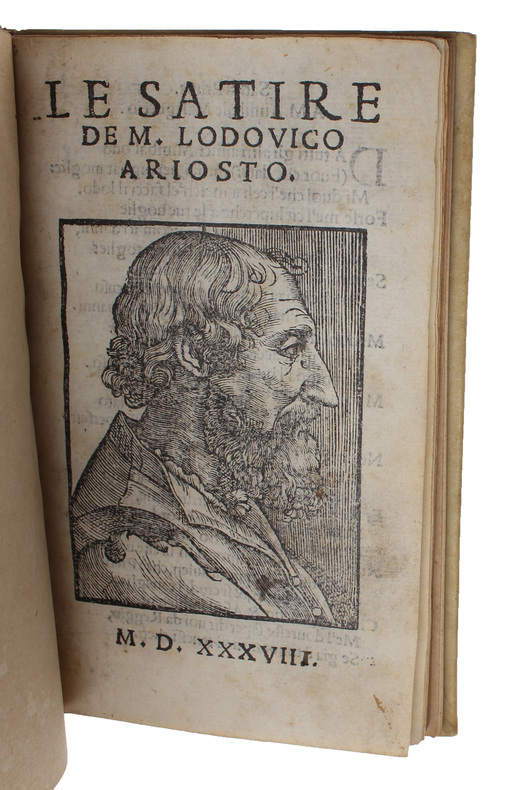
153833452(Vinegia), 1538. Colophon: In Vinegia Nicolo d'Aristotile detto Zoppino M.D.XXXVIII. Small8vo. Fine full vellum with handwritten title on back (ca. 1850). Woodcut portrait of Ariosto on title copied after the woodcut to the edition of ""Orlando Furioso"" from 1532, which was done after Tizian by F. de Nanto. Ff. 32 (=64 pp.). Good margins, fine and clean.
153833452Vinegia 1538. Colophon: In Vinegia Nicolo d'Aristotile detto Zoppino M.D.XXXVIII. Small8vo. Fine full vellum with handwritten title on back ca. 1850. Woodcut portrait of Ariosto on title copied after the woodcut to the edition of "Orlando Furioso" from 1532 which was done after Tizian by F. de Nanto. Ff. 32 =64 pp. Good margins fine and clean. <br/><br/><em>Extremely scarce early edition first published 1532 of the Seven Satires modeled after the Sermons satires of Horats by the "Divino Lodovico". - Not in Adams the earliest edition here is from 1545 . </em> hardcover
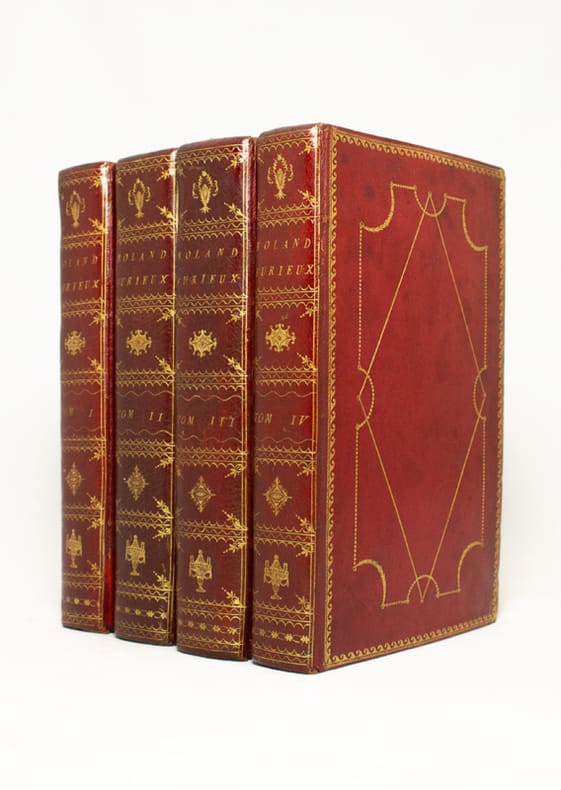
16605Paris, chez Brunet, 1775 - 1783. 4 volumes in-8 de [6]-321; [2]-391; [2]-407; 410 pages, plein maroquin rouge grenat, dos lisse orné de fleurons et dentelle dorée, plats au triple encadrement stylisé de roulettes dorées, roulettes dorées aux coupes et aux chasses, tranches dorées.
17731002816Birmingham: Baskerville 1773. First edition of the Baskerville Ariosto octavo issue with forty-six engraved plates. Set during the Saracen invasion of France Orlando Furioso 1516-1532 follows the adventures of Charlemagne's high-strung knight Orlando who goes mad for love. Ariosto's comic epic was hugely influential going on to inspire works as various as The Faerie Queene Much Ado About Nothing Don Quixote and Don Juan. Gaskell 48. Text in Italian. A very good set in handsome contemporary bindings. Four octavo volumes: 34 lviii 362 2; 2 450 2; 2 446 2; 2 446 2. Contemporary full tree calf Greek key border and floral cornerpieces in gilt to boards raised bands spine compartments ruled and patterned in gilt red and black morocco spine labels lettered in gilt gilt dentelles marbled endpapers. Copperplate frontispiece of Ariosto and forty-six engraved plates. Associati and Errata bound before Vita in Volume I all present. Bookplates of Francis Broderip and Irwin Laughlin to pastedowns. Light shelfwear to boards expert repair to joints and corners some foxing to text. Baskerville unknown books
In-8°; molto raro; pp. (64), al frontespizio grande ritratto di ariosto di prfofilo inciso su legno. Sette satire.Legatura in piena pelle moderna.
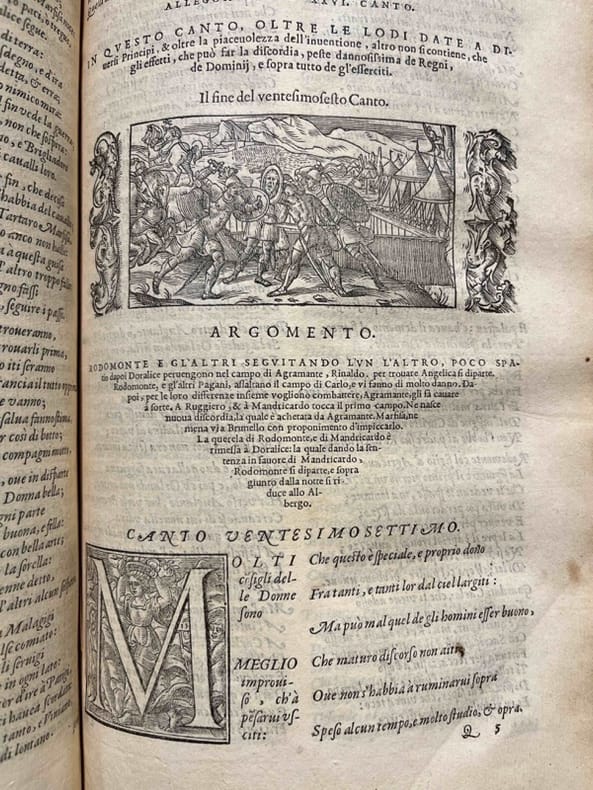
[Figurato Ariosto-Copia Unica] (cm.26) bella piena pergamena XVIII sec., titolo in oro al dorso. -- cc. 8 nn., pp. 654, cc. 16 nn. + ultima bianca non oroginale. frontis figurato e 51 magnifiche tavole xilografiche a piena pagina. Testatine, fregi vari e argomenti dei canti inquadrati da ricche cornici. Questa nostra edizione contiene, con frontis proprio, i 5 canti aggiunti che non erano presenti nell'edizione originale del 1556, ed è considerata una delle più belle per le incisioni di Gir. Porro da disegni di Dosso Dossi. Esemplare particolare con 2 carte aggiunte dopo il frontis, della fine del '500(?). Una con una tavola incisa in rame che rappresenta il "Deposito" di Ludovico Ariosto nella chiesa dei benedettini di Ferrara, l'altra contiene manoscritte notizie storiche e al verso la trascrizione dell'epigrafe. Copia appartenuta a Francesco Amici, il cui nome è manoscritto al frontis; per notizie di questo antico possessore vedi: Vecchietti "Biblioteca Picena" 1790-6 vol. I pag.105. Antico restauro a carta 49 con parziale rifacimento del testo e della bordura. Alcune macchiline e lievi aloni per lo più alle prime carte, qualche vecchio strappo restaurato altrimenti bell'esemplare con xilografie in ottima tiratura, fresco e nitido. *Agnelli-Ravegnani I 161; *Guidi 89; *Melzi p. 168 n°329; *Melzi-Tosi 67; *Bm.Stc. 40; *Index Aureliensis 107.570. Manca all'Adams e al Ferrazzi "Bibliografia Ariostesca". [f81] Libro
177244472Venice Presso Antonio Zatta 1772. Hardcover. The four volumes contain 56 full page copper engravings by Giuliano Zuliani Tommaso Baratti Ferdinando Fambrini Giacomo Malosso Giacomo Leonardis Pietro Antonio Novelli and an engraved frontispiece of Ariosto by Giuseppi Daniotto. The notes for the binder call for another copper engraving to precede that frontispiece but it is not present in this copy.<br /> <br /> Marbled endpapers and edges. Each volume contain a cloth marker ribbon.<br /> <br /> A large copy 289 x 204 cm with wide margins. Bound in full calf. Binder's label of "C. Meyer Bookseller and Bookbinder to the Queen and Princesses 2 Hemmings Row St. Martins Lane" - ie Charles Meyer a German emigre who was bookbinder to Britain's Queen Charlotte. Meyer was active in London from 1797 until his death in 1809 though the firm apparently continued until 1811 so the volumes were presumably bound during that 14 year period. The volumes were later rebacked see photos.<br /> <br /> Each volume contains on the verso of the front free endpaper an ink notation "L/ 4 E 3"; "L/4 E 4"; "L/4 E 5"; "L/4 E 6" - presumably the location marks for a substantial private library but the volumes contain no other indication of which of the several aristocratic collectors for whom Meyer worked was the original owner of these volumes.<br /> <br /> In parts of volumes three and four the upper and/or lower corners of the pages are very faintly dampstained not affecting the text and in fact barely visible. With that exception this is a very nice copy clean crisp and with wide margins of a very handsome and finely illustrated edition of one of the monuments of classic Italian literature. . Four volumes. The 46 cantos are followed by the 5 additional cantos and then by about 136 unnumbered pages of bibliographies summaries and indices. Venice, Presso Antonio Zatta hardcover
1834elala1621London: William Pickering 1834. 1834. 4 Volumes. 8vo. 1 p.l. vii-viii clxxvi 198 79; 2 p.l. 436; 2 p.l. 424; 2 p.l. 330. woodcut frontis. portrait. woodcut printers device on title. very handsome contemporary binding of full vellum over bds. by Hayday gilt tooled spines gilt inside dentelles all edges gilt covers bowed. First Panizzi Edition. Usually found with Panizzis edition of Bioardos Orlando Innamorato published by Pickering in 1830 in five volumes. Keynes p. 90. 1st Edition. Hardcover. London: William Pickering, 1834. Hardcover
51-1794Birmingham: Datorchi di G. Baskerville per P. Molini e G. Molini 1773. 4 vols. 8vo. Original Tree calf and Morocco with raised bands and gold leaf on spine and covers as well as all edges. Binding restored by Sasha Mosalov with imperfections showing. Pages clean. This copy with 48 engravings 2 of which are first states before lettering. 362 28 with 5 lines of errata; 450; 446; 446 pp. Provenance: from the collection of Charles Walker Andrews 1861-1946 an attorney in Syracuse whose father Charles Andrews 1827-1918 was the Chief Judge of the New York State Court of Appeals.Henry Cohen p. 31; Brunet I p. 488; Lowndes I p. 63Description from the Princeton Univ. Library: Late in his career John Baskerville printed an edition of Orlando Furioso for the Molini brothers an Italian printing firm based in Paris. This beautiful four-volume set of Ariosto’s 50000 line poem is illustrated with forty-six engraving plus a frontispiece designed by some of the most celebrated artists of that time. A new engraving begins each new episode of the author’s work and the artists appear to have been given much freedom in their designs. The twenty-one artists don’t often get credit and so here’s the complete list. Frontispiece portrait is after a painting by Titian ca. 1485/90-1576 drawn by Charles Dominique Joseph Eisen 1720-1778 and engraved by Etienne Ficquet 1719-1794.The plates were designed by Giovanni Battista Cipriani 1727-1785; Charles Nicolas Cochin II 1715-1790; Charles Dominique Joseph Eisen 1720-1778; Jean-Baptiste Greuze 1725-1805; Charles Monnet 1732-after 1808; Jean-Michel Moreau the Younger 1741-1814.The engravings were cut by Francesco Bartolozzi 1728-1815; Pierre Philippe Choffard 1730-1809; Antoine Jean Duclos 1742-1795; Emmanuel Jean de Ghendt 1738-1815; Isidore Stanislas Henri Helman 1743-1806/9; Benott Louis Henriquez 1732-1806; Nicolas de Launay 1739-1792; Joseph de Longueil 1730-1792; Pietro Antonio Martini 1738-1797; Jean Massard 1740-1822; Jean-Michel Moreau the Younger 1741-1814; Nicolas Ponce 1746-1831; Benoit Louis Prevost 1747-ca. 1804; and Jean-Baptiste-Blaise Simonet 1742-after 1813. Birmingham: Datorchi di G. Baskerville, per P. Molini e G. Molini, 1773 hardcover
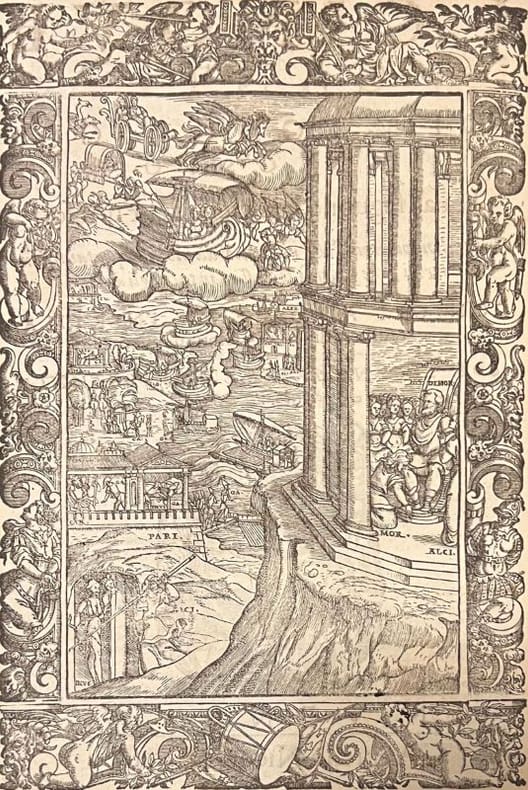
[Figurato Ariostea] (cm. 25) Bella solida pergamena XVII secolo.-- cc. 4 nn., cc. 256, cc. 4 nn., cc. 28. Bellissimo frontis architettonico figurato e 46 grandi silografie ai canti con figura entro ricca bordura. Seguono i cinque canti con gli argomenti dell' Anguillara con altrettante illustrazioni. Edizione poco comune e diversa da quella del 1566, con il discorso del Dolce sul furioso e l' esplicit in fine che manca nella edizione del 1566. Le belle illustrazioni sono a piena pagina diversamente da quelle della precedente edizione(Agnelli-Ravegnani). Vecchio rinforzo alla cerniera delle prime 3 carte con aloni e alcune ombreggiature, frontis foderato, in antico, con margine alto corto che intacca la xilografia. esclusi questi lievi difetti alle prime carte esemplare bello e fresco con xilografie in ottima tiratura. * Guidi p.76; * Agnelli-Ravegnani I 135/136; * Melzi 162 n°293; * Melzi-Tosi 65; * Mazzucchelli I 1072; * Graesse I 199; * Bm. Stc. 40; * manca a Brunet, Mortimer e Adams.[f68] Libro
1582CLL-364Venezia, appresso Domenico & Giovanni Battista Guerra, 1582 In-8 de (336) ff., maroquin vert, triple filet doré en encadrement sur les plats, dos à nerfs orné de caissons de fleurons dorés, pièce de titre de maroquin rouge, coupes et bordures décorées, tranches dorées sur marbrure (reliure française du XVIIIe siècle).
1603247181603 En Vénétie, Appresso Felice Valgrisi, 1603, in-4 (25 x 18 x 4 cm.), vélin, pièce de titre en maroquin rouge sur le dos, tranches mouchetées.
In-quarto (cm. 24,5), pp. (16) 654, 57 (33). Frontespizio interamente figurato, molti capolettera, cornice xilografica a contornare gli argomenti di ciascun canto e molte belle incisioni in legno nel testo. Legatura d'inizio Settecento in piena pelle, dorso a nervi con ricchi fregi e titoli in oro. Filetto in oro ad inquadrare i piatti. Sguardie marmorizzate. Un paio di ex libris. Mancanze reintegrate alle cuffie, margine alto a tratti un po' rifilato, due carte dell'indice finale fuori posto ed un difetto di un paio di cm. (dall'origine?) a p. 375. Esemplare peraltro ben conservato. Celebre edizione illutrata a proposito della quale Agnelli-Ravegnani così si esprime: "Edizione in-4, veramente pregiata, e ignota al Brunet, Per la disposizione del contenuto, può dirsi simile alle ultime impressioni del Valgrisi".
7584In Parigi: P. Lassan, 1795. Complet en 4 vol. grand in-8: 15 x 23.5 cm. I/ 1 front., lxxix pp. de titre, Vita di Lodovico ariosto par Giovanni Andrea Barotti et des Avvertimenti di Geronimo Ruscelli, 360 pp. de texte des Chants I à XII + 24 pl. grav. II/ 452 pp. de titre et texte des Chants XIII à XXIII + 22 pl. Grav.; III/ 448 pp. de titre et texte des Chants XXIV à XXXV + 24 pl. Grav. IV/ 452 pp. de titre, titre des Chants XXXVI à XLVI et Tables de noms + 22 pl. grav. Belle édition parisienne de ce Roland furieux en italien richement illustrée dun portrait de lArioste par Titien gravé en frontispice par Fiquet daprès Eisen et de 92 figures hors-texte par Cipriani, Cochin, Greuze, Eisen, Monnet, Moreau le Jeune et gravées par Ponce, Bartolozzi, Choffard, de Launay, A. J. Duclos, Lingée, De Ghendt, Martini, J. B. Moreau, Prevost et Henriquez. Il sagit dune nouvelle édition de lOrlando Furioso édité par Baskerville (1773) comprenant le portrait par Eisen ainsi que les 46 figures prévues pour cette édition à laquelle on a ajouté la suite de 46 figures de Charles-Nicolas Cochin gravées par De Launay, Lingé et Ponce pour lédition parisienne chez Brunet (1775-1783). (Cohen, 95-98).Très belles reliures de lépoque en basane mouchetée. Dos lisses avec pièces de titre en maroquin rouge et pièces de tomaison, également en maroquin rouge, en forme de losange, caissons ornés de filets, dentelles et fleurons dorés. Discrètes dentelles en encadrement des plats. Gardes et tranches marbrées. Ex-libris: «M. De Charnières / Officier de Marine» (Charles de Charnières, officier de marine, démissionnaire en 1792, maire deSaumuren 1828). Ex-libris: André Gutzwiller. Rares rousseurs. Bel ensemble. Décoratif et désirable pour sa double suite de gravures.
1730046661Venice: Tefano Orlandini 1730. Hardcover Vellum. Very Good Condition. Giuseppe Filosi and Giuliano Giampicoli. Full contemporary vellum worn through at corners tear to vellum at tail of spine soiled but sound. Scattered minor foxing and browning a few minor creases - mostly quite clean. Portrait of the author by Orsolini and 51 engraved plates. l 576; iv 400pp. The second book contains other works by Ariosto. Brunet I 437 <br /> <br /> An attractive and monumental edition with plates by Giuseppe Filosi and Giuliano Giampicoli<br /> <br /> Size: Folio. Illustrator: Giuseppe Filosi and Giuliano Giampicoli. Quantity Available: 1. Shipped Weight: 2-3 kilos. Inventory No: 046661. Tefano Orlandini hardcover