46 résultats
158233055-217Florence Filippo & Iacopo Giunti October 1582. Printer's woodcut device on title large historiated woodcut initials a different printer's device on last leaf. In Italics. 16 leaves 585 pp. 1 38 leaves. 4to c. 210 x 145 mm. 18th century half calf rep. Florence Filippo & Iacopo Giunti October 1582. An important edition of this classic of Italian literature by Giovanni Boccaccio 1331-1375. This literary ten-day odyssey became the emblem of creative expression in the Italian Renaissance about the human experience its nature and psyche. Boccaccio's epic is edited here by Leonardo Salviati 1540-1589 a Florentine nobleman who was a founder member of the Accademia della Crusca. Its avowed aim was to uphold the purity of the Tuscan language as it had been in the fourteenth century. The Accademia Florentina founded in 1540 was dedicated to the same purpose and Salviati was active in both bodies. In 1584 Salviati published his "Degli Avvertimenti della Lingua sopra il Decamerone" a detailed discussion about the language used by Boccaccio. In this edition of the Decameron Salviati returned to the old texts and dedicated the work to Jacopo Buoncompagni one of his patrons. The text includes many beautiful historiated initials. - A very well printed and rare edition. - Ind. Aur. 120.402; Adams B-2158; STC Italian 110; Brunet I 1002; Gamba Serie dei testi di lingua p. 59 no. 181. LITERATURE:ITALIAN ; EROTICA ; GRAPHIC ARTS:GIUNTA ; Florence, Filippo & Iacopo Giunti unknown
1573047703Florence: Giunti 1573. Early Edition. Hardcover. Very Good Condition. Later quarter calf front cover and free endpaper detached rear board just about detached. Mild dampstain over first 100 pages scattered foxing and browning but generally quite bright otherwise. Two small worm holes in gutter of final colophon leaf. Two portraits Boccaccio and an unidentified woman and lovely historiated initials throughout - a finely printed Giunti edition of Boccaccio's masterpiece. 32 580 1pp. Admas B2156 Brunet I 1002 note Pettas Giunti of Florence 496.<br /> <br /> The first of the famed Council of Trent editions - having been unable to ban a book as widespread and beloved as The Decameron it was censured in 1564 the council of Trent instead removed all mention of priests clergy and the Church from the work while leaving all the erotic bits that would have been too easily missed. Marketed as a "correction" of earlier supposedly erroneous editions. Provenance: Kimbolton Castle copy with case/shelf ticket inside front cover.<br /> <br /> Size: Quarto 4to. Quantity Available: 1. Shipped Weight: Under 1 kilo. Category: Poetry; Antiquarian & Rare. Inventory No: 047703. Giunti hardcover
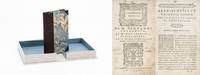
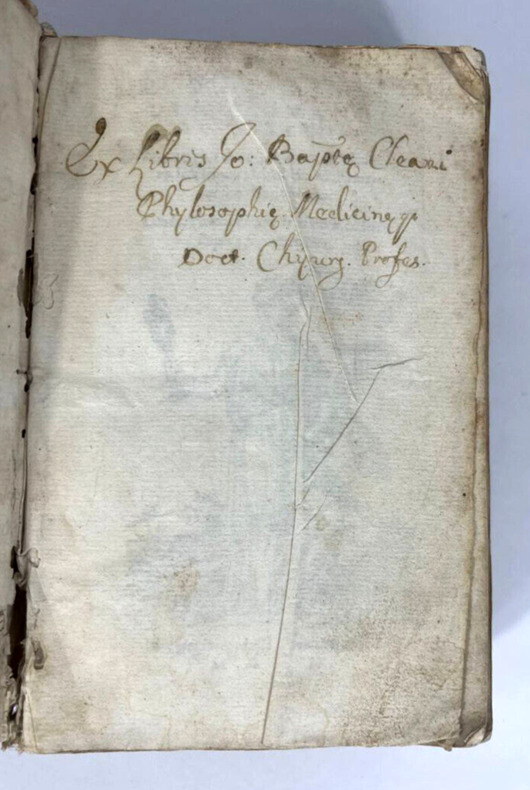
158431320AB1584. Venetia Appresso I Gioliti 1584. 9.5 cm x 15.4 cm. 107 1 pages including illustrated titlepage with Giolito's printer mark and Giolito's stunning colophon of Phoenix rising from the ashes and the Motto: "Semper eadem" "Always the same". Hardcover in custom - made solanderbox. Recently rebound in half-leather with marbled paper-covered-boards. The bookblock in very good condition with some minor contemporary inkstains. Name of preowner "Exlibris Bernard Rielliae "Bernard Reilly" in contemporary ink 16th or 17th century entry. Small lesion to titlepage and first three pages only. Very faint faded dampstain to the outer margins of a few pages. This is one of the rare Giolito editions of Boccaccio's "L'Elegia di Madonna Fiammetta" in which the important italian publisher Gabriel Giolito added a two-page-dedication to the women of Citta di Casale. His dedication reads: to the Gentili et Valorose donne della Città di Casale di Monferrato Gentle and Valorous women of the city of Casale Monferrato. This early dedication to women conveyed what later became the normative terms of Giolitos advertising techniques. According to Giolito Lamorosa Fiammetta was ideal feminine reading since it narrated a womans amorous experiences" Source: Androniki Dialeti - "The Publisher Gabriel Giolito de Ferrari Female Readers and the Debate about Women in Sixteenth-Century Italy" Elegia di Madonna Fiammetta or The Elegy of Lady Fiammetta in English is a novel by the Italian writer Giovanni Boccaccio probably written between 1343 and 1344. Written in the form of a first-person confessional monologue it describes the protagonist Fiammetta's passion for Panfilo a Florentine merchant and takes place in Naples. It has been characterised as the first psychological novel in Western literature. It consists of a prologue and nine chapters. Wikipedia Giovanni Boccaccio 16 June 1313 21 December 1375 was an Italian writer poet correspondent of Petrarch and an important Renaissance humanist. Boccaccio wrote a number of notable works including The Decameron and On Famous Women. He wrote his imaginative literature mostly in the Italian vernacular as well as other works in Latin and is particularly noted for his realistic dialogue which differed from that of his contemporaries medieval writers who usually followed formulaic models for character and plot. Boccaccio grew up in Florence. His father worked for the Compagnia dei Bardi and in the 1320s married Margherita dei Mardoli who was of a well-to-do family. Boccaccio may have been tutored by Giovanni Mazzuoli and received from him an early introduction to the works of Dante. In 1326 his father was appointed head of a bank and moved with his family to Naples. Boccaccio was an apprentice at the bank but disliked the banking profession. He persuaded his father to let him study law at the Studium the present-day University of Naples where he studied canon law for the next six years. He also pursued his interest in scientific and literary studies. His father introduced him to the Neapolitan nobility and the French-influenced court of Robert the Wise the king of Naples in the 1330s. At this time he fell in love with a married daughter of the king who is portrayed as "Fiammetta" in many of Boccaccio's prose romances including Il Filocolo 1338. Boccaccio became a friend of fellow Florentine Niccolò Acciaioli and benefited from his influence as the administrator and perhaps the lover of Catherine of Valois-Courtenay widow of Philip I of Taranto. Acciaioli later became counselor to Queen Joanna I of Naples and eventually her Grand Seneschal. It seems that Boccaccio enjoyed law no more than banking but his studies allowed him the opportunity to study widely and make good contacts with fellow scholars. His early influences included Paolo da Perugia a curator and author of a collection of myths called the Collectiones humanists Barbato da Sulmona and Giovanni Barrili and theologian Dionigi di Borgo San Sepolcro. Wikipedia hardcover
157321702Florenz, Giunti, 1573. 16 Bll., 578 S., 2 Bll. mit einigen einigen großen, figürlichen Holzschnitt-Initialen und Holzschnitt-Vignetten. 8°. Pgmt. der Zeit (knitterfaltig, etw. fleckig und gebräunt sowie etw. bestoßen, oberes Kapitell mit kl. Einriss). [5 Warenabbildungen]
152011556Jehan & Gourmont o. J. 1520 1520. priv. Einband . 4°.117s-. fachmännisch Restauriert einige Seiten mit geringem Textverlust sonst in gutem Zustand AZB7LS4 HC Jehan & Gourmont, o. J., (1520), unknown
1558181567In Vinegia : Appresso Gabriel Giolito de Ferrari 1558. New Edition. Hardback. Finely re-bound in modern 1/2 vellum over marble boards with a paper label to spine. Taped repairs to top left-hand corner of pages throughout. Minor scattered foxing. Corners sharp with an overall tight bright and clean impression. ; 8vo 8"" - 9"" tall; 107 pages; Description: 107p. 16cm. Subjects: Boccaccio Giovanni 1313-1375 --Italian drama --14th century. Publisher's device to title page. Decorative headings and historiated initials to dedication prologue and beginning of each act. Language: Italian. In Vinegia : Appresso Gabriel Giolito de Ferrari hardcover
1552184537Venetia: V. Valgrisio 1552. Leather bound. Fair heavy wear to leather boards with sections worn off. Expected age toning to pages but text is otherwise clear and binding is fairly tight. Bound in brown leather boards; five raised bands and gilt tooling on spine; all edge red tinted; red and blue marble illustrated end papers; bw illustrated title page; 10 487 10 pp. The rear of the book contains a separate section titled "Vocabolario Generale di Tutte le Voci Vsate dal Boccaccio." which is 67 pp. Text in Italian. "La vita di m. Giovan Boccaccio descritta da m. Francesco Sansovino": p. 1-6. V. Valgrisio hardcover
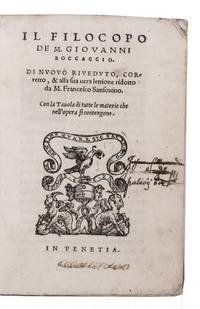
1554L1NFVE7U6EX8Venice: device of Domenico Giglio colophon: Francesco Rampazetto 1554. Contemporary limp vellum sewn on 3 alum-tawed supports laced through the joints with manuscript title down the spine in rotunda gothic lettering 6 mm x-height with decorated capitals: Filocopo del Boccaccio. Small 8vo 15 x 11 cm. With Giglios woodcut device a bird with a scorpion in its beak above a pot with DG above 2 winged sea-goats with motto non sine quare sic facio and N.S.C.C.F. on the title-page 6 woodcut decorated initials 3 series plus 2 repeats. Set in Aldine-style italic types with upright capitals with incidental roman. Second Sansovino edition of Boccaccio's first important work Il Filocolo here Filocopo a prose romance written ca. 1334-1336 about twenty years before the Decameron. Boccaccio reworked the 12th-century French love story of Floire Florio muslim Prince of Andalusia and Blancheflor Biancifiore the orphaned daughter of his mother's Roman Christian lady-in-waiting. They grow up together in the royal household but when they fall in love his parents try to break up the romance by selling her to merchants who will take her to Alexandria to join a harem. Florio under the pseudonym Filocopo rescues and marries her. He converts to Christianity and they return home where he ascends the throne and his people embrace Christianity. Boccaccio introduced many new elements into the story and told it with his usual flare for often risqué humour. It served as inspiration for writers around the world from Chaucer to Keats and Boccaccio himself further developed several episodes for stories in his Decameron.Francesco Sansovino 1521-1583 had produced the first variorum edition of the Decameron in 1546 and then turned his editorial scholarship to Il Filocolo beginning with Gaetano's text editions in 1527 and 1538. With 2 early owners' inscriptions on the title-page both struck through and part of one abraded. With a small hole in the title-page and the corners of a few leaves dog-eared but otherwise internally in very good condition. The binding is worn but the lovely manuscript title on the spine remains clear. Second edition of the best Renaissance redaction of Boccaccio's important influential and entertaining first major work.l EDIT 16 6334; Gay & Lemonnyer col. 726; USTC 814845; cf. Gamba Italiana letteratura 198 cr. other eds.; for the text: Kirkham et al. eds. Boccaccio: a critical guide pp. 87-93; Marrone Encyclopedia of Italian literary studies pp. 252-253. [device of Domenico Giglio] (colophon: Francesco Rampazetto, hardcover
15510006English description below. Venise, imprimé par Rapirio et Cesano, 1551. Rarissime première édition d'Il Filocopo de Boccace édité par Francesco Sansovino. En italien. Un épais in-12 de 160 x 110 mm pour 50 mm d'épaisseur et 390 pp. Relié plein vélin d'époque. Plats muets à l'exception d'une mention à la plume quasi effacée sur le plat avant. Dos à trois coutures plus tranchefiles, mention "Gio Boccaccio il Filicopo" (sic) ancienne, étiquette papier ancienne en coiffe avec inscriptions à la plume. Ex-libris au premier contreplat, extrémités des cordelettes de couture apparentes aux contreplats, mentions à la plume sur deux gardes blanches, page de titre, dédicace de F. Sansovino à Vitellozo Vitelli. Lettrines, indication du livre en haut de page. Table des matières en fin d'ouvrage. "Boccace a revisité l'histoire d'amour française du XIIe siècle de Floire (Florio), prince musulman d'Andalousie, et Blancheflor (Biancifiore), la fille orpheline de la dame d'honneur romaine chrétienne de sa mère. Ils grandissent ensemble dans la maison royale, mais lorsqu'ils tombent amoureux, les parents de la jeune femme tentent de mettre fin à leur romance en la vendant à des marchands qui l'emmèneront à Alexandrie pour la faire entrer dans un harem. Florio, sous le pseudonyme de Filocopo, la sauve et l'épouse. Il se convertit au christianisme et ils rentrent en Andalousie, où il monte sur le trône et convertit son peuple au christianisme. Boccace a introduit de nombreux éléments nouveaux dans l'histoire et l'a racontée avec son sens habituel de l'humour (souvent osé). Il a servi d'inspiration à des écrivains du monde entier, de Chaucer à Keats, et Boccace lui-même a développé plusieurs épisodes pour des histoires dans son Décaméron. Francesco Sansovino (1521-1583) avait produit la première édition variorum du Décaméron en 1546, puis avait tourné son érudition éditoriale vers Il Filocopo, en commençant par le texte de Gaetano (éditions en 1527 et 1538)." Provenance : bibliothèque de Caio de Mello Franco, ambassadeur du Brésil en France, dont l'ex-libris figure au contreplat. ********************** Venice, printed by Rapirio and Cesano, 1551. Extremely rare first edition of Boccaccio's Il Filocopo by Francesco Sansovino. In Italian. A thick duodecimo, 160 x 110 mm, 50 mm thick, and 390 pp. Bound in original full vellum. Blank covers except for a nearly erased pen-and-ink inscription on the front cover. Spine with three seams plus headbands, old inscription "Gio Boccaccio il Filicopo" (sic), old paper label at the end with pen-and-ink inscriptions. Bookplate on the front cover, ends of the stitching cords visible on the inside covers, pen-and-ink inscriptions on two blank endpapers, title page, dedication from F. Sansovino to Vitellozo Vitelli. Initials, book name at the top of the page. Table of contents at the end of the book. "Boccaccio revisited the 12th-century French love story of Floire (Florio), a Muslim prince of Andalusia, and Blancheflor (Biancifiore), the orphaned daughter of his mother's Christian Roman lady-in-waiting. They grow up together in the royal household, but when they fall in love, the young woman's parents try to end their romance by selling her to merchants who will take her to Alexandria to enter a harem. Florio, under the pseudonym Filocopo, rescues and marries her. He converts to Christianity, and they return to Andalusia, where he ascends the throne and converts its people to Christianity. He himself developed several episodes for stories in his Decameron. Francesco Sansovino (1521–1583) had produced the first variorum edition of the Decameron in 1546 and then turned his editorial scholarship to Il Filocopo, beginning with the text of Gaetano (editions in 1527 and 1538)." Provenance: personal library of Caio de Mello Franco, Brazilian ambassador to France, whose bookplate appears on the inside cover.
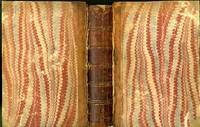
1552184537Venetia: V. Valgrisio 1552. Leather bound. Fair heavy wear to leather boards with sections worn off. Expected age toning to pages but text is otherwise clear and binding is fairly tight. Bound in brown leather boards; five raised bands and gilt tooling on spine; all edge red tinted; red and blue marble illustrated end papers; bw illustrated title page; 10 487 10 pp. The rear of the book contains a separate section titled "Vocabolario Generale di Tutte le Voci Vsate dal Boccaccio." which is 67 pp. Text in Italian. "La vita di m. Giovan Boccaccio descritta da m. Francesco Sansovino": p. 1-6. V. Valgrisio unknown books
1550CLL-615Venise, Giolito de' Ferrari, 1550 In-4 de (6)ff., 502pp., 1 f. bl., (30)ff., 1 f. bl., sign.: *6, A-HH8, II4, a4, b-d8, e4, veau raciné havane, filet à froid d'encadrement sur les plats, dos à nerfs orné de caissons de fleurons dorés, pièce de titre de maroquin rouge, roulette dorée sur les coupes, tranches rouges (reliure du XVIIIesiècle).
152011557J. Gourmont & J. Petit Paris 1520 1520. Opb 4° 109s. Fraktur. fachmännisch restauriert am Ende des Buches restaurierte Fehlstellen mit geringem Textverlust. sonst in gutem Zustand AZA8 SL2. HC J. Gourmont & J. Petit, Paris 1520 (?), unknown
1525L7UBM2B5YKM6Florence 1525. 8vo. heirs of Filippo Giunta the elder Contemporary sheepskin parchment with remains of a gold-tooled spine label dark blue edges. 72 ll. Second Giunta edition of the "Corbaccio" which first appeared in 1487 and was first and similarly anonymously printed by Filippo Giunta in 1516: "una materiale ristampa di questa edizione fatta pagina a pagina e riga a riga" Gamba; "ces deux editions sont assez rares" Brunet. This bawdy satire supposedly based on a Florentine widow who turned down Boccaccio was as popular as it remains controversial for its scurrilous and misogynistic elements. The text is prefixed by a letter from Filippo Giuntas son Bernardo "agli amatori della lingua Toscana"; leaves 57ff. contain Boccaccios letter to Pino di Rossi.With the engraved bookplate of Lord Robert Spencer 1747-1831 British Whig politician on the front paste-down. The youngest son of Charles Spencer 3rd Duke of Marlborough the hero of the Seven Years War Lord Robert was the nephew of the politician John Spencer 5th paternal great grandfather of Diana Princess of Wales and brother of George Spencer the great-great-great grandfather of Sir Winston Churchill. Occasional light brown stains and slight traces of worming to the foot margins of the first two leaves but altogether in very good condition. A charming example of a rare and desirable edition.l Adams B2182; Bandini Juntarum typographiae annales II 199; Brunet I 1016; Edit 16 CNCE 6267; Gamba 203 note; Panzer VII 40f 219; Renouard Supplément p. XLIX no. 79; WorldCat 612050557; cf. Hayn/Gotendorf I 398 citing later Italian eds.; not in BMC STC Italian. unknown
15382986Paris: Jean Réal for Philippe Le Noir Guillaume Le Bret and others 1538. 8vo 144 x 85 mm. 8 196 leaves. Title printed in red and black bâtarde type small typographic manicules pointing hands used throughout. Half-page woodcut of an author presenting his book to a seated dignitary with reserved space for letterpress name here "Jehan bocasse"; a variety of metalcut floriated initials final verso with woodcut device of Guillaume Le Bret Renouard 588. Title with old repair at top slightly affecting 2 letters a couple of tiny holes worming in or near gutters catching a few letters in quires R-T skillful discreet repairs in ff. CC3-6 small stain in quire M. Nineteenth-century French blue straight-grained morocco ca. 1820 covers with gilt rule border enclosing blind roll-tooled neoclassical frame and central blind-stamped lozenge spine gold-tooled and lettered board edges gold-tooled gilt edges green patterned pastepaper endleaves corners very lightly bumped else fine. A few old effaced inscriptions.An attractive copy of the second edition of De mulieribus claris in French using the text of Antoine Vérard's edition of 1493. Although Vérard had tried to pass the translation off as his own it was in fact a slightly revised version of an anonymous French translation made ca. 1401. Vérard's editions of Boccaccio in French had made the writer more accessible to a French public but it was not until the sixteenth century that his works became more widely known and frequently imitated. This was the "golden age" for Boccaccio in France which would draw to a close with the restrictions placed by the Church on the racier passages of the Decameron.On Famous Women was the first biographical survey devoted exclusively to women in Western literature. But in spite of the plethora of surviving Latin manuscripts of the text Boccaccio's survey of 106 women of distinction some for their vices drawn from the Bible mythology history and from amongst Boccaccio's contemporaries was of less interest to sixteenth-century French readers than Griseldis Fiametta or indeed the Decameron. Forty-five years had passed since the appearance of the first printed edition in French before a group of Paris publisher-booksellers decided to publish the work anew. In order either to blanket the market to obviate pirate editions or to spread the risk no fewer than thirteen booksellers shared this pocket-sized edition. The first and last quires containing the titles colophons and publishers' devices appear to have been reset for the various issues cf. Hortis's transcriptions. The present copy bears the imprint of Philippe Le Noir and the woodcut device of Guillaume Le Bret. The printer was recently identified as Jean Réal whose metalcut capital initials are used at the head of each chapter. This was the first book from his press. The typographic manicules in the text were added by the printer as a finding aid to signal the Latin articulating phrases left in by the translator the Latin phrases appear also in Vérard's edition but without any specific typographic mark highlighting them.Two US copies located at Princeton and Smith College. Moreau V 742; BM / STC p. 71; Brunet I 990-91; Bechtel B-224; Hortis Studi sulle Opere Latine del Boccaccio 1879 pp. 798-800. Cf. BnF Boccace en France 1975 123. [Jean Réal for] Philippe Le Noir, [Guillaume Le Bret, and others] unknown books
153965731Bern, Matthias Apiarius, 1539. Fol. Mit 2 versch. Holzschn.-Druckermarken (am Titel u. dem letzten Blatt, eine von Hans Holbein) u. 15 (dav. 2 wiederh.) fast halbseitigen Textholzschnitten (davon 9 monogrammiert J[akob] K[allenberg]). 6 nn., LXXXI num., 1 nn. Bll., Blauer Kleisterpapier-Bd. d. 18. Jhds. m. Farbschnitt in mod. blauer Maroquin-Kassette m. goldgepr. Rückentitel.
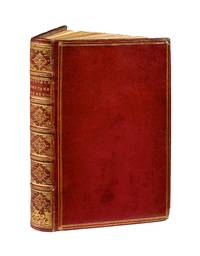
1551ABAA25-4<p>Lyon Guillaume Rouille 1551.</p><p>12mo 158 x 101 mm of 384 pp. 4 ll the last one doubled numerous ornamented initials two tiny holes in title small stain in lower margin of pp. 17-20. A fine copy.</p><p>Red morocco triple gold fillet around the covers spine ribbed richly decorated with the special crowned dolphin lace at the foot decorated edges inner gilt roulette gilt edges on marbling. <em>Bound in the 17th century.</em></p><p><strong>One of Boccaccio's most famous works the 'De claris mulieribus' written in Latin around 1360 is a book both erudite and amusing intended for a wide audience</strong>. Following the model of Petrarch's <em>Hommes illustres</em> Boccaccio recounts the lives of 104 famous women queens and courtesans virtuous and promiscuous from Eve to Pope Jeanne.</p><p><strong>First edition of this translation by Denis Sauvage. </strong>This is the first French translation after the Italian version due to Denis Sauvage; it replaced that which L.A. Ridolfi had given according to the Latin original.</p><p>Written in 1361-1362 Boccaccio's <em>De mulieribus claris</em> <em>The Illustrious Women</em> is the first collection of women's biographs in western history.</p><p>Inspired by Boccaccio's own admission by his friend Petrarch's <em>De viris illustribus </em><em>The Illustrious Men</em> this work offers a reasoned compilation of "stories" both pagan and Christian of remarkable women whose excellence in good or evil Boccaccio highlights even if it means drawing from this "evil" the appropriate moral lesson. We thus find the great figures traced by Titus Livius Pliny the Elder or Suetonius but also from Saint Jerome or the Bible the book begins with a "biography" of Eve. There is certainly no lack of the traditional depreciatory remarks inherited from the two antiquities on the weakness of women's character but in the praise of figures such as Nicostrata or Epicharis a certain evolution of mentalities is already apparent provoked by the prodromal stages of humanist reflection on female virtues.</p><p><strong>This book quickly translated into French</strong> Laurent de Premierfait or into German Heinrich Steinhöwel strongly marked its time since Chaucer drew on it for The Canterbury Tales and Christine de Pisan in 1405 for her Livre de la cité des dames.</p><p><strong>In this newly inspiring work Boccace therefore gives the modern reader an overview vast and often picturious of medieval attitudes to women</strong> at a time when the renascent elites were going to change their view of women's potential Jean-Yves Boriaud <em>Les Femmes illustres</em> / <em>De Mulieribus claris</em>.</p><p>"<em>The work written between 1360 and 1362 amplified and recast in later years contains the biography of 104 famous ladies of all times from Eve to Queen Joan of Naples; it is dedicated to the beautiful Andrée Acciaiuoli sister of the great seneschal Nicolas Acciaiuoli second wife of a Count of Altavilla.</em></p><p><em>The example of Petrarch and his treatise on illustrious men had a significant influence on Boccaccio as he himself acknowledged. The narrative vein expands with some freedom as in the pages devoted to the life of the papess Joan the voluptuous length on the love affairs of Thisbe and the story of the naive Paulina a Roman beloved of the God Anubis which is rather reminiscent of the tale of Lisette and the angel Gabriel in the Decameron. . Taken as a whole the volume is a compromise between historical scholarship and storytelling a pleasant book of scholarship intended not only for men but also for women - who says Boccaccio for his excuse being accustomed to hear stories have a greater need of them and are entertained by a copious exposition</em>." T. F. G. Rouville.</p><p>Beautiful italic printing by Philibert Rollet with nice initials and some ornaments. The title is set in a remarkable wood frame reproduced by Baudrier.</p><p><strong>Fine copy of exceptional elegance covered with a fine seventeenth century binding the spine of which bears the crowned dolphin lace.</strong></p><p>Label of the <em>Pierre Berès</em> bookshop on the first flyleaf it appeared under n°32 of its 1951 catalogue <em>Livres Français des quinzième & seizième siècles</em> at a price of 45 000 fr.</p><p>FR</p><p>Lyon Guillaume Rouille 1551.</p><p>In-12 de 384 pp. 4 ff. le dernier doublé nombreuses initiales ornées deux infimes trous ds. le titre pte. tache ds. la marge inf. des pp. 17 à 20. Exemplaire réglé.</p><p>Maroquin rouge triple filet or autour des plats dos à nerfs richement orné avec la dentelle spéciale au dauphin couronné en pied coupes décorées roulette intérieure dorée tranches dorées sur marbrures. <em>Reliure du XVIIe siècle</em>.</p><p>158 x 101 mm.</p><p><strong>Une des œuvres célèbres de Boccace le 'De claris mulieribus' composé en latin vers 1360 est un livre à la fois érudit et amusant destiné à un large public</strong>. Suivant le modèle des <em>Hommes illustres</em> de Pétrarque Boccace y raconte les vies de 104 femmes célèbres reines ou courtisanes vertueuses ou libertines d'Eve à la papesse Jeanne.</p><p><strong>Edition originale de cette traduction due à Denis Sauvage.</strong> Il s'agit de la première traduction française d'après la version italienne due à Denis Sauvage ; elle remplaçait celle que L.A. Ridolfi avait donnée d'après l'original latin.</p><p>Rédigé en 1361-1362 le <em>De mulieribus claris</em> <em>Les Femmes illustres</em> de Boccace constitue <strong>la première collection dans l'histoire occidentale de biographies féminines. </strong></p><p>Inspiré de l'aveu même de Boccace par la lecture du <em>De viris illustribus</em> <em>Les Hommes Illustres</em> de son ami Pétrarque cet ouvrage propose une compilation raisonnée des " histoires " païennes et chrétiennes de femmes remarquables dont Boccace met en exergue l'excellence dans le bien ou le mal quitte à tirer de ce " mal " la leçon de morale appropriée. On y retrouve donc de grandes silhouettes tracées par Tite-Live Pline lʼAncien ou Suétone mais venues aussi de saint Jérôme ou de la Bible le livre commence par une " biographie " d'Eve. Les propos dépréciatifs traditionnels hérités des deux antiquités sur la faiblesse de caractère des femmes nʼy manquent certes pas mais transparaît déjà dans la louange de figures comme celles de Nicostrata ou Epicharis une évolution certaine des mentalités provoquée par les prodromes de la réflexion humaniste sur les vertus féminines.</p><p><strong>Ce livre vite traduit en français</strong> Laurent de Premierfait ou en allemand Heinrich Steinhöwel <strong>marqua fortement son époque </strong>puisquʼy puisèrent aussi bien Chaucer pour <em>The Canterbury Tales</em> que Christine de Pisan en 1405 pour son <em>Livre de la cité des dames</em>.</p><p><strong>Dans cet ouvrage d'inspiration nouvelle Boccace donne donc au lecteur moderne un aperçu vaste et souvent piquant des attitudes médiévales à l'égard des femmes</strong><strong></strong> à un moment où les élites renaissantes vont changer leur regard sur les potentialités féminines. Jean-Yves Boriaud <em>Les Femmes illustres / De Mulieribus claris</em>.</p><p><em>" L'œuvre écrite entre 1360 et 1362 amplifiée et refondue dans les années postérieures contient la biographie de 104 dames de renom de tous les temps d'Ève à la reine Jeanne de Naples ; elle est dédiée à la très belle Andrée Acciaiuoli sœur du grand sénéchal Nicolas Acciaiuoli épouse en secondes noces d'un comte d'Altavilla.</em></p><p><em>L'exemple de Pétrarque et de son traité des </em>Hommes illustres<em> influença notablement Boccace ainsi qu'il l'a reconnu lui-même. La veine narrative s'y élargit avec quelque liberté comme dans les pages consacrées à la vie de la papesse Jeanne aux voluptueuses longueurs sur les amours de Thisbé à l'histoire de la naïve Paulina Romaine aimée du Dieu Anubis qui rappelle d'assez près le conte de Lisette et de l'ange Gabriel du Décaméron. … Dans son ensemble le volume est un compromis entre l'érudition historique et le conte un plaisant livre d'érudition destiné non seulement aux hommes mais aussi aux femmes - lesquelles déclare Boccace pour son excuse étant habituées à entendre des histoires en ont un besoin plus grand et se divertissent d'un copieux exposé. "</em> T. F. G. Rouville.</p><p>Jolie impression en italique de Philibert Rollet avec de jolies initiales et quelques ornements. Le titre est placé dans un remarquable encadrement sur bois reproduit par Baudrier.</p><p><strong>Exemplaire réglé d'une élégance exceptionnelle revêtu d'une fine reliure du dix-septième siècle dont le dos porte en pied la dentelle au dauphin couronné.</strong></p><p>Etiquette de la librairie <em>Pierre Berès</em> au premier contreplat il a figuré sous le n°32 de son catalogue <em>Livres Français des quinzième & seizième siècles</em> de 1951 au prix de 45 000 fr.</p> hardcover
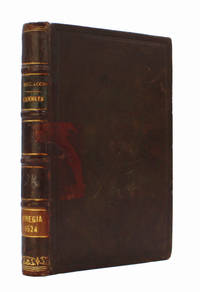
15248801Venetia: Bernardino di Vitale 1524. First Edition — Primera edición. Hardcover — Tapa dura. 156x104mm. 6¼x4". Venetia Bernardino di Vitale 1524. En 8º 156 x 104mm. 116 hojas sin foliar la última blanca. Signaturas <sup>4</sup> B-O<sup>8</sup> P-Q<sup>4</sup>. Marca del impresor en la última hoja de texto. Encuadernación del siglo diecinueve en piel tejuelo en marroquén cortes dorados de antiguo. Atractivo ejemplar de esta rarÃsima edición de <em>La Fiammetta</em> de Boccaccio desconocida a todos los repertorios bibliográficos consultados. Esta elegÃa de Madonna Fiammetta narra en primera persona sus desventuras y está considerada como la primera novela "psicológica". Escrita entre 1343 y 1344 la obra se presenta como una larga carta escrita en la que la protagonista Fiammetta relata su amor juvenil por Pánfilo en la ciudad de Nápoles. La relación entre ambos termina cuando Pánfilo debe partir a Florencia. Fiammetta sintiéndose abandonada por su amante intenta suicidarse. Al final de la obra la protagonista se siente de nuevo esperanzada cuando oye que Pánfilo ha regresado a la ciudad pero descubre con amargura que se trata de otra persona con el mismo nombre. La obra es dedicada por el autor «a las mujeres enamoradas». Obra con un importante componente autobiográfico. Giovanni Boccaccio 1313-1375 es uno de los padres de la literatura en italiano junto a Dante y Petrarca. Es recordado sobre todo como autor del <em>Decamerón</em> libro esencial para introducir en la literatura europea el género de la novela corta. Se trata de una edición desconocida a todos los repertorios consultados: no en Brunet ni Graesse ni Adams. OCLC no registra esta edición tampoco CCPB STL Italian Books ni BnF. Sólo lo registra el Catálogo del Servizio Bibliotecario Nazionale de Italia SBN código identificativo ITICCUCNCE006262. Aparece citada en <em>Mostra di manoscritti documenti e edizioni</em> Certaldo 1975 v. 2 n. 60. Contiene al fin la bella marca tipográfica de veneciano Bernardino di Vitale activo impresor italiano del que se conocen más de 150 impresiones entre los años 1493 a 1539. Triángulo con las iniciales TDG y seis estrellas en su interior. Buen jemplar generalmente limpio y de buenos márgenes muy ligera mancha en el margen exterior de los últimos folios por lo demás perfecto. Procedencia: Filiciano RamÃrez de Arellano Marqués de Fuensanta del Valle. Su ex-libris. Uno de los más importantes bibliófilos españoles del siglo diecinueve Bernardino di Vitale hardcover
153933106-1153Bern Mathias Apiarius 1539. With 15 near half-page woodcuts including 2 repeats of which 9 are signed Jakob Kallenberg 2 different printer's woodcut device on title and last leaf honey-licking bears one by H. Holbein. 6 LXXXI 1 ff. Small folio. 18th-century calf worn. From the library of G. Wüthrich with his engr. supralibros. Bern Mathias Apiarius 1539. Bound with: MAZZOCCHI Giacomo ed. Epigrammata antiquae urbis. With 21 woodcut illustrations of classical architecture and inscriptions including large depiction of the Pantheon on B2v more than 100 woodcut borders in text. Roman type. 10 CLXXXI leaves further 8 ff. with index and errate lacking at the end. Folio. Rome Jacobus Mazzocchi April 1521. Ad I: First edition of the earliest books from the press of the first printer of Bern and a beautifully illustrated edition of Boccaccio's encomium of famous women. It is notable as the first collection devoted exclusively to biographies of women in Western literature. The artist has been identified as Jakob Kallenberg a Bavarian painter and craftsman from Bern who worked there from 1535 until about 1565 and became a member of the city council. His style is reminiscent of Holbein whose pupil he probably was. Several of these cuts are also extant on broadside publications or loose sheets. The satirical cut of Pope Joan f. LXXIIIv giving birth during a procession surrounded by cardinals is here in perfect state whereas it is often either missing or mutilated.- 18th cent. ms. owner's entry on title-page otherwise a nice copy. Ad II: First edition of the first printed collection of classical inscriptions an anthology of ancient Roman epigraphs and the most beautiful book from the press of the famous Roman printer Mazzocchi active 1505- 1527. His work is import as one of the earliest humanist studies on epigraphy and valuable for its profuse woodcut illustrations. There are woodcuts of art and architecture of ancient Rome including the Pantheon triumphal arches the "Three Graces" and other reliefers and steles; about 80 cartouches of varying design frame the inscriptions and 7 full-page woodcut borders are on black ground. The work has been attributed to one of Mazzocchi's humanist friends Francesco Albertini the great scholar of Roman antiquities. This publication was a determining factor in the development of Roman studies in the 16th century and is the first collection of classical inscriptions from the city of Rome. - Last 8 ff. index and errata lacking 18th cent. ms. owner's entry on title-page otherwise fine. - Ad I: Fairfax Murray 78; VD 16 B 5814; Adams B 2141; Hollstein XVB p. 206 nos.1-15; ad II: Cicognara 3789; Sander 2554; Fumagalli p. 339-342 fig. 142; Coszena III 2251; Mortimer Italian 297; EDIT16 CNCE 18162; Adams E 236. GRAPHIC ARTS:ILLUSTRATED BOOKS ; SWITZERLAND ; ITALY ; Bern, Mathias Apiarius unknown
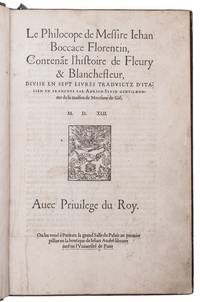
1542835Paris: Jean André bookseller to the University colophon: printed by Denis Janot 1542. French calf ca. 1760 sewn on 5 supports richly gold-tooled spine with a black morocco label in the 2nd of 6 compartments gold double-fillets on board edges blind triple fillets on boards gilt edges green silk ribbon marker curl-marbled endpapers similar to Wolfe 16 but with red blue orange green and white in that order. Folio 31.5 x 21.5 cm. With Jean Andrés woodcut flaming heart and caged bird device on the title-page and 15 woodcut illustrations plus 21 repeats in the text mostly 5.5 x 8 cm each in any of several 4-piece decorative borders including 8 foot pieces each with a different coat of arms; one illustration 13.5 x 8.5 cm with an 8-piece decorative border 5 woodcut decorated initials 2 series plus 1 repeat and many spaces with guide-letters for manuscript initials not filled in. Set in a roman type with shoulder notes and some verses in italic and a large roman for headings. Jean André issue of the extremely influential first French-language edition by Adrien Sevin of Boccaccio's first major work Il filocolo ca. 1336 a prose tale detailing the romantic love and adventures of Florio and Biancafiore based on the ca. 1160 French verse romance Floire et Blancheflor written at the request of Boccaccio's muse "Fiammetta". Boccaccio's version served as the model for Chaucer's more than fifty years later but it is a reworking rather than a translation so it was largely through the present printed translation that Il philocope a precursor of the better known Decameron became known north of the Alps. The fine woodcut illustrations first appeared in Janot's 1540 edition of Amadis de Gaula and after the Philocope also for several other romances. The borders used with them in these works are apparently older for two of the head borders are dated 1520. King François I of France who reigned from 1515 to 1547 greatly admired the Italian Renaissance and encouraged Italian influences in many aspects of French culture. The present book reflects that movement both as a model of French Renaissance prose under Italian influence and as an example of book production using new roman and italic types in the new style introduced under Italian influence in the 1530s.With the small letterpress bookplate and the armorial bookplate of Charles Bouchelet de Vendegies Comte d'Hust 1772- 1851 and a later bookplate of the Swiss collector Albert Natural. With a few mostly marginal defects and early repairs but with three repaired tears in the text one also in a woodcut but so skilfully repaired that it is barely visible in the woodcut. One of the repeated woodcuts has a small abrasion. Otherwise in good condition. The binding has restorations to the hinges and corners and the spine shows some superficial cracks and flaking but nearly all of the tooling remains clear. The very influential first French edition of Boccaccio's first major work with excellent woodcut illustrations.l BMC STC French p. 71 Janot issue; Brun Le livre français illustré p. 158; Mortimer French 105 Janot issue; Rawles Denis Janot . 1976 PhD thesis 164; Renouard Imprimeurs Parisiens 155; USTC 37796 & 92444 8 copies; see 37799 65503 & 92444 for the other issues; cf. Adams B2169-2171 Italian eds. Jean André, bookseller to the University (colophon: printed by Denis Janot), hardcover
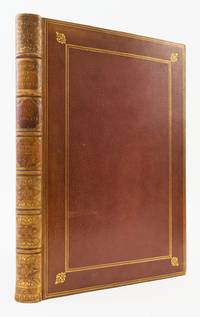
1554ST19091London: Iohn Wayland at the signe of the Sunne oueragainst the Conduite in Flete-strete. Cum priuilegio per septennium 1554 or 1555. Third or Fourth Edition of the First English Translation of "De Casibus Illustrium Virorum. 340 x 220 mm. 13 1/4 x 8 3/4". 9 p.l. clxiii xxxvi xxxv-xxxvii 1 leaves complete including "A Memorial of such Princes" leaf often lacking at the end; collates as ESTC. Translated from the French version of Laurent de Premierfait by John Lydgate. <br/> Attractive 19th century honey-brown morocco by Francis Bedford stamp-signed on front turn-in covers gilt with French fillet frame oblique bouquets at corners raised bands spine compartments with central fleuron framed by geometrical compartments filled with floral tooling gilt lettering gilt-rolled turn-ins marbled endpapers all edges gilt. Title page and Gg4 recto title page of a suppressed supplement dealing with English notables with woodcut title border the top compartment with the Royal Arms termini at sides the pedestal at base with a tablet showing one boy waking another with the motto "Arise for it is day" McKerrow & Ferguson 76a A4 recto with woodcut depicting the Creation of Eve flanked by terminal side-pieces woodcut historiated and floral initials throughout. Printed in black letter. Front pastedown with engraved bookplate of Christopher William Beaumont Pease; rear pastedown with bookplates of John William Pease and Lord Wardington. Chrzanowski 1555b; Pforzheimer 73; Luborsky & Ingram 3178; STC 3178; ESTC S107087. Spine somewhat sunned and dulled extremities very lightly rubbed boards with a couple of faint scratches but the once very handsome binding still attractive. Title leaf and final leaf extended at foot first few and last couple of leaves excluding title and final leaf with small minor repair at upper corner probably pressed and perhaps lightly washed at the time of binding isolated trivial stains but the text still surprisingly fresh remarkably clean and entirely smooth.<br/> <br/> This is a desirable copy of an important 16th century translation of Boccaccio's study of the vicissitudes of fortune prepared by John Lydgate a poet much influenced by Chaucer. Educated in the Benedictine monastery where he eventually served as prior Lydgate ca. 1370 - 1449/50 was a respected poet whose works DNB tells us "bear the mark of a pious and learned mind." And an indication of his importance is reflected in Chrzanowski's statement that "well into the 16th century the premier poets of England were considered to be Geoffrey Chaucer John Gower and Lydgate." Undertaken ca. 1431 at the request of the duke of Gloucester the 36365 lines here divided into nine books required a massive effort that took until 1438 or 1439 to complete. In the text a parade of notable historical figures pass before "Bochas" Boccaccio telling of the turns of fate that brought their careers and reputations crashing down from a pinnacle. According to DNB Lydgate's interpretation of the work "urges the traditional doctrines of moderation the avoidance of pride and the pursuit of virtue and demonstrates the horror of discord and strife between kinsfolk. This advice though couched in general terms was highly relevant to contemporary princes." This relevance led to popularity: more than 30 manuscripts of the work survive and it was printed previously in 1494 and in 1527. The final leaf here Gg4 contains the title page for "A Memorial of Such Princes as since the Tyme of King Richard the Seconde Haue Been Unfortunate in the Realme of England" intended for issue with "Fall of Princes" but suppressed by Queen Mary. It was finally published as the famous "Mirrour for the Magistrates" in 1559 after Elizabeth I had ascended the throne. The binding here is by the eminent West End bindery of Francis Bedford d. 1883 and was owned by three generations of the Wardington family who created one of the finest private libraries in England. It contains the bookplates of Northumberland banker John William Beaumont Pease 1869-1950 who began the collection; a grandson Christopher Henry Beaumont Pease 2nd Baron Wardington 1924-2005 who was successively Chairman Vice-President and then President of the Friends of the British Library; and a great-grandson the Hon. Christopher William Beaumont Pease b. 1970. The Wardington sales at Sotheby's in London were major bibliophilic events in 2005 and 2006. The very expert extension at the bottoms of the title leaf and the rare final leaf would seem to suggest that these come from another copy the leaves are not facsimiles. In any case every recent copy sold at auction according to RBH lacked one or both of these leaves or had other leaves supplied. This fact plus the fine state of preservation of our copy and its distinguished provenance surely are more than enough to compensate for the volume's one appreciable shortcoming. Iohn Wayland, at the signe of the Sunne oueragainst the Conduite in Flete-strete. Cum priuilegio per septennium unknown
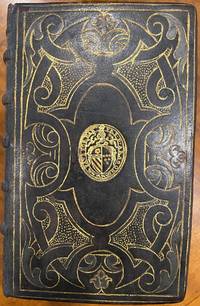
15384518Venice: Venice: Bernardino Bindoni 1538. Very good. 8vo 157 x 98 mm. Woodcut printer's device at end. Contemporary Parisian morocco by Wotton's Binder C: interlaced design some open tools painted gray others with pointille tooling central armorial device of Paolo Giordano Orsini with his arms impaling the Medici arms of his future wife motto Isabella and his motto "Pavl Iordan Vrs D. Aragon" spine in six compartments with floral design gilt and gauffered edges sympathetic restorations to spine ends and board edges. ONE OF A VERY SMALL GROUP OF ELABORATE RENAISSANCE BINDINGS EXECUTED IN PARIS FOR PAOLO GIORDANO I ORSINI BY THE THIRD OF WOTTON'S BINDERS "WOTTON BINDER C" AN ESTEEMED CRAFTSMAN WHOSE CLIENTELE INCLUDED MANY IMPORTANT BIBLIOPHILES SUCH AS JEAN GROLIER FRANCOIS I CARDINAL GRANVELLE CHARLES DE LORRAINE MARCUS FUGGER THE "GERMAN GROLIER" AND THOMAS WOTTON THE "ENGLISH GROLIER" AFTER WHOM THE WORKSHOP IS NAMED. <br /> <br /> It is almost certain that Orsini's bindings were made for him during his only known visit to France in 1556 when he was just fifteen. His was a diplomatic engagement accompanying the apostolic legate Cardinal Carafa to secure an alliance with Henri II against the Spanish.<br /> <br /> Only thirty of Orsini's Parisian bindings have so far come to light plus two remboite all bound by Wotton Binder C. The books are all printed before 1555 and with two exceptions are in Italian. The bindings either have a bold architectural strapwork decoration as here perhaps based on contemporary French patterns or a "center-and-corner" design. Concerning the armorial device: Orsini impaled his own arms with those of the Medici despite the fact that his marriage to Isabella de' Medici was not celebrated until 1558! This is the device that figures on our binding and all the other surviving examples. <br /> <br /> Paolo Giordano I Orsini 1541-1585 Duke of Bracciano infamous member of the famous Roman family and one of the most powerful men in Rome was affianced in 1553 to Isabella de'Medici daughter of Grand Duke Cosimo of Tuscany. After they married in 1558 Orsini already immensely wealthy became even richer with grand palaces in Rome Florence and Bracciano. He spent lavishly on paintings sculptures antiquities tapestries and furniture. <br /> <br /> Orsini is suspected of strangling Isabella in 1571 in reprisal for her infidelity apparently in broad daylight and in the presence of named servants. He is also suspected of ordering in 1581 the murder of Francesco Peretti wife of Vittoria Accoramboni with whom Orsini was himself having an affair. Unfortunately for Orsini Peretti was the nephew of the future Pope Sixtus V and soon found himself wanted not only by the Papal police but the Tuscan police. He took refuge in Venice and then in Abano and Salo with his mistress whom he married in 1585. He died in Salo later that year. <br /> <br /> Orsini's bindings are greatly prized but are very rare in private ownership indeed the great bibliophile Michael Wittock was unable to acquire one. In 2005 when the present binding came up for auction at Christie's New York we immediately recognized it as being from the Parisian workshop of Wotton Binder C despite the fact that Christie's described it as being "Italian." Happily we were able to secure it at the sale and it passed into the collection of one of our favorite clients; now after twenty years we are pleased to offer the present binding again. <br /> <br /> Despite the fact that books from Orisini's library almost never come on the open market T. Kimball Brooker was able to secure of them both of which commanded very high prices in the Brookeriana sales : <br /> <br /> 1. Sotheby's New York 10/11/23 lot 13. Bible in Italian. Venice 1547 Macchi no. 22. Est. $30000 - $40000 unsold. Offered again at Sotheby's Paris 12/17/25 lot 45. Sold for EUR 40640.<br /> <br /> 2. Sotheby's London 7/11/2025 lot 1709. Paolo Giovio Vita de Leon X Florence 1549 Macchi no. 24. Sold for GBP 25400 now in the Morgan Library.<br /> <br /> The first penetrating study of Orsini's bindings was made by G.D. Hobson 1931 who correctly assigned them to France not Italy. His work was continued by no less authorities than Tammaro de Marinis 1940 Anthony Hobson French and Italian Collectors 1953 Miriam Foot Henry Davis Gift I pp.152-154 and Appendix V: Bindings by Wotton's Binder III for Other Collectors Federico & Livio Macchi who compiled a list of 24 bindings for which see below. <br /> <br /> Robin Halwas's amazing self-published article on Orsini's bindings is essential reading "Parisian bindings for Paolo Giordano Orsini 1541-1585". Whereas the compilers of the Brookeriana sale catalogues state that only twenty-six such examples are known Halwas shows that there are thirty plus two remboitage. Our binding which had remained untraced after 2005 is listed his no. 9 and he gives a characteristically impressive provenance history and to him we are much obliged:<br /> <br /> 1. Paolo Giordano Orsini duca di Bracciano 1541-1585 armorial supralibros lettered "Pavl Iordan Vrs D. Aragon";<br /> 2. Librairie Damascène Morgand Paris;<br /> 4. Charles Fairfax Murray 1849-1919;<br /> 5. Sotheby's London 17-20 July 1922 lot 132;<br /> 6. Leo S. Olschki Florence;<br /> 7. Christie's New York 15 December 2005 lot 337 binding described as "contemporary Italian morocco";<br /> 8. Purchased by Michael Laird Rare Books<br /> 9. Private Collector USA;<br /> 10. Michael Laird Rare Books. <br /> <br /> THE BINDER: Thomas Wotton 1521-1587 wealthy English squire landowner and sheriff of Kent traveled to Paris with some frequency and there he patronized the leading binders of the day. Indeed on Wotton the posthumous title "the English Grolier" has been bestowed owing to his early adoption of Grolier's "Et Amicorum" formula on the covers of his books. About 140 bindings from Wotton's library have been identified. From the anonymous workshop known as "Wotton Binder C" which was active in the 1540s and 1550s and which was responsible for the present binding from Orsini's library Thomas Wotton commissioned as many as thirty bindings; most recognizable are those that bear the date "1552." <br /> <br /> § Adams B-2170. Macchi Federico & Livio Macchi "Le legature francesi di Paolo Giordano Orsini d'Aragona: Storia di un personaggio e di una legatura" in: Misinta 45 June 2016 pp.143-149 our binding is listed on p.147 as no. 21. Venice: Bernardino Bindoni unknown