Boccaccio, Giovanni (1313-1375)Biblio.com

46 résultats
1558181567In Vinegia : Appresso Gabriel Giolito de Ferrari 1558. New Edition. Hardback. Finely re-bound in modern 1/2 vellum over marble boards with a paper label to spine. Taped repairs to top left-hand corner of pages throughout. Minor scattered foxing. Corners sharp with an overall tight bright and clean impression. ; 8vo 8"" - 9"" tall; 107 pages; Description: 107p. 16cm. Subjects: Boccaccio Giovanni 1313-1375 --Italian drama --14th century. Publisher's device to title page. Decorative headings and historiated initials to dedication prologue and beginning of each act. Language: Italian. In Vinegia : Appresso Gabriel Giolito de Ferrari hardcover
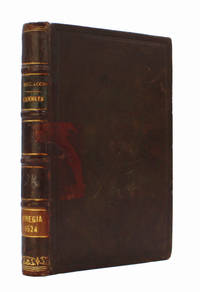
15248801Venetia: Bernardino di Vitale 1524. First Edition — Primera edición. Hardcover — Tapa dura. 156x104mm. 6¼x4". Venetia Bernardino di Vitale 1524. En 8º 156 x 104mm. 116 hojas sin foliar la última blanca. Signaturas <sup>4</sup> B-O<sup>8</sup> P-Q<sup>4</sup>. Marca del impresor en la última hoja de texto. Encuadernación del siglo diecinueve en piel tejuelo en marroquén cortes dorados de antiguo. Atractivo ejemplar de esta rarÃsima edición de <em>La Fiammetta</em> de Boccaccio desconocida a todos los repertorios bibliográficos consultados. Esta elegÃa de Madonna Fiammetta narra en primera persona sus desventuras y está considerada como la primera novela "psicológica". Escrita entre 1343 y 1344 la obra se presenta como una larga carta escrita en la que la protagonista Fiammetta relata su amor juvenil por Pánfilo en la ciudad de Nápoles. La relación entre ambos termina cuando Pánfilo debe partir a Florencia. Fiammetta sintiéndose abandonada por su amante intenta suicidarse. Al final de la obra la protagonista se siente de nuevo esperanzada cuando oye que Pánfilo ha regresado a la ciudad pero descubre con amargura que se trata de otra persona con el mismo nombre. La obra es dedicada por el autor «a las mujeres enamoradas». Obra con un importante componente autobiográfico. Giovanni Boccaccio 1313-1375 es uno de los padres de la literatura en italiano junto a Dante y Petrarca. Es recordado sobre todo como autor del <em>Decamerón</em> libro esencial para introducir en la literatura europea el género de la novela corta. Se trata de una edición desconocida a todos los repertorios consultados: no en Brunet ni Graesse ni Adams. OCLC no registra esta edición tampoco CCPB STL Italian Books ni BnF. Sólo lo registra el Catálogo del Servizio Bibliotecario Nazionale de Italia SBN código identificativo ITICCUCNCE006262. Aparece citada en <em>Mostra di manoscritti documenti e edizioni</em> Certaldo 1975 v. 2 n. 60. Contiene al fin la bella marca tipográfica de veneciano Bernardino di Vitale activo impresor italiano del que se conocen más de 150 impresiones entre los años 1493 a 1539. Triángulo con las iniciales TDG y seis estrellas en su interior. Buen jemplar generalmente limpio y de buenos márgenes muy ligera mancha en el margen exterior de los últimos folios por lo demás perfecto. Procedencia: Filiciano RamÃrez de Arellano Marqués de Fuensanta del Valle. Su ex-libris. Uno de los más importantes bibliófilos españoles del siglo diecinueve Bernardino di Vitale hardcover
1574D11148Venice: Giovanni Antonio Bertano 1574. Paperback. Very Good. 4to 204 x 148mm. 1 16 263pp. 2 leaves including final blank. Signatures: A-KK 8. Front flyleaf with likely 18th-century half-title added in manuscript calligraphic script over undulating ownership inscription on ribbon De Me Giovanni Agostino Panater and palm or quill on island in sea with ship signature repeated on title. Woodcut printers device of Bertano of young stork bring food to decrepid parent in the nest and motto on filial piety Pietas Homini Tutissima Virtus Compassion is the safest power. Few woodcut initials throughout. Italian translation by Giovanni Betussi. Dedicated to Count Collaltino di Collalto. Contemporary limp vellum ms. title to spine; spine darkened head cap chipped with loss text block loose in binding; intermittent browning title with old owners signatures cancelled minor marginal worming added half-title with ink oxidation. The whimsical added title complements this monumental Italian humanist work; a defense of poetry and a synthesis of ancient mythological sources which justified the study of pagan literature within a Christian context. <br/><br/>Betussis Italian translation of Boccaccios medieval work on progeny in classical times a veritable mythological encyclopedia that aimed to solve questions about lines of succession. Boccaccios Genealogia sought to preserve the past from oblivion by creating an almanac of inter-related families including the competing noble houses in order to organize lines of descent. With the Genealogia Boccaccio aimed to solve contradictory accounts of hereditary matters by assuming the existence of pagan gods and organizing their progeny - Jupiter I and Jupiter II for instance. Perhaps most contentious was Boccaccios identification of Demogorgon as the ultimate progenitor of all pagan divinities description starting on page 5 who was also associated with Satans netherworld conspirators. The Genealogia reputedly had been copied and transmitted before its completion apparently without the consent of Boccaccio. The earliest Latin editions all follow the first of 1472. This is a later edition of Giuseppe Betussis Italian translation of the Genealogia; Betussis first was printed in Venice by Comino da Trino di Monferrato in 1547. Nearly a dozen subsequent editions follow this date well into the seventeenth century. Betussi was a prominent man of letters in Paduas Accademia and was at the avant-garde of those promoting the substitution of Italian for Latin as the language of scholarly literature. To his edition Betussi added a ten-page biography of Boccaccio and alphabetical indices corresponding to page numbers not book or chapter. The Genealogia became a standard reference works for readers who wished to disentangle the complexities of Greco-Roman mythology. The work was enormous in scope covering approximately 950 individuals groups and beasts both named and unnamed in fifteen books and 723 chapters with over a thousand citations from Greek Roman medieval and Trecento authors. Near the end of the sixteenth century the Genealogia while mostly out of the public eye still provided source material for numerous authors including Edmund Spenser and his work on Christianized paganism. This edition rare OCLC lists one other in Toulouse. Giovanni Antonio Bertano paperback
159252248Venice: Bonfadino. Good. 1592. Softcover. Contemporary rustic paper binding. Partial bookplate. Some loss of paper to spine. No front or terminal blanks no frontis. Pp 144 10 1blank 70 Dialogo D'Amore misnumbered but all pages present. Occasional underlining in the text. ; 24mo 5" - 6" tall . Bonfadino paperback
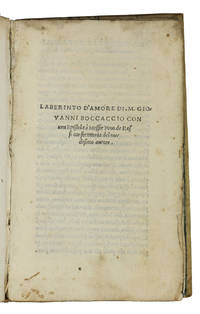
1545SE4<p>8° mm 147x92. Collation: A-G8 H4. 56 4 leaves. Woodcut printer's device on the title-page and larger on verso of the last leaf. Woodcut animated initials. Bookmark in blue silk. 20th-century half Morocco spine with four raised bands and title tolled in gold at the second compartment. A good copy pale stains one more visible on l. A3.<br /><br />The first Giolito edition of Bocaccio's Laberinto d'amore edited by Lodovico Domenichi 1515-1564.<br />The Labirinto d'amore was written in the mid-1350s; it is also known as Corbaccio an alternative title introduced in the Florentine editio princeps of 1487 although the word 'corbaccio' never actually occurs in the work. It certainly derives from the Italian 'corvo' i.e. crow possibly recalling the satire Ibis by Ovid one of Boccaccio's favourite sources.</p> Gabriele Giolito de Ferrari
1525L7UBM2B5YKM6Florence 1525. 8vo. heirs of Filippo Giunta the elder Contemporary sheepskin parchment with remains of a gold-tooled spine label dark blue edges. 72 ll. Second Giunta edition of the "Corbaccio" which first appeared in 1487 and was first and similarly anonymously printed by Filippo Giunta in 1516: "una materiale ristampa di questa edizione fatta pagina a pagina e riga a riga" Gamba; "ces deux editions sont assez rares" Brunet. This bawdy satire supposedly based on a Florentine widow who turned down Boccaccio was as popular as it remains controversial for its scurrilous and misogynistic elements. The text is prefixed by a letter from Filippo Giuntas son Bernardo "agli amatori della lingua Toscana"; leaves 57ff. contain Boccaccios letter to Pino di Rossi.With the engraved bookplate of Lord Robert Spencer 1747-1831 British Whig politician on the front paste-down. The youngest son of Charles Spencer 3rd Duke of Marlborough the hero of the Seven Years War Lord Robert was the nephew of the politician John Spencer 5th paternal great grandfather of Diana Princess of Wales and brother of George Spencer the great-great-great grandfather of Sir Winston Churchill. Occasional light brown stains and slight traces of worming to the foot margins of the first two leaves but altogether in very good condition. A charming example of a rare and desirable edition.l Adams B2182; Bandini Juntarum typographiae annales II 199; Brunet I 1016; Edit 16 CNCE 6267; Gamba 203 note; Panzer VII 40f 219; Renouard Supplément p. XLIX no. 79; WorldCat 612050557; cf. Hayn/Gotendorf I 398 citing later Italian eds.; not in BMC STC Italian. unknown
1597798Amsterdam: Cornille Claesz 1597. Early French edition. <br /> <br /> A rare late-16th century French edition of Boccaccio’s Decameron one of the foundational works of Western literature and a cornerstone of Renaissance humanist storytelling. First written in the 14th century the Decameron comprises one hundred novellas told by ten young Florentines sheltering outside the city during the Black Death. The tales range from romantic and tragic to humorous erotic moral and political forming one of the most influential narrative sequences in European literary history. This 1597 Amsterdam printing uses the celebrated French translation of Antoine Le Maçon court favorite of Francis I and is a corrected and illustrated edition compared to earlier printings making it an important early Continental witness to the French reception of Boccaccio.<br /> <br /> This volume would be an exceptional addition for collectors of Renaissance literature early printing French editions of classics plague-era narratives and works pivotal in shaping Chaucer Shakespeare Molière Balzac and countless authors thereafter. Internally the text remains highly readable with its original period typeface early pagination woodcut ornaments and decorative printer’s devices at title and colophon. The closing leaf states FIN with an ornamental tailpiece consistent with 16th-century printing conventions. Includes the full cycle of tales including stories of love cleverness vice clergy satire virtue rewarded and the social wit that earned Boccaccio both admiration and censorship for centuries.<br /> <br /> Condition & Binding: Period full leather binding with raised bands and gilt spine ornamentation well-worn with rubbing and losses spine cracking and some leather deterioration see photos. Both boards present but detached/separated. Overall- poor. Cornille Claesz unknown
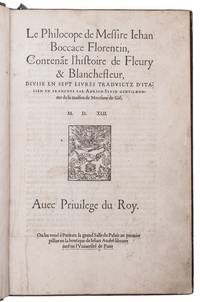
1542835Paris: Jean André bookseller to the University colophon: printed by Denis Janot 1542. French calf ca. 1760 sewn on 5 supports richly gold-tooled spine with a black morocco label in the 2nd of 6 compartments gold double-fillets on board edges blind triple fillets on boards gilt edges green silk ribbon marker curl-marbled endpapers similar to Wolfe 16 but with red blue orange green and white in that order. Folio 31.5 x 21.5 cm. With Jean Andrés woodcut flaming heart and caged bird device on the title-page and 15 woodcut illustrations plus 21 repeats in the text mostly 5.5 x 8 cm each in any of several 4-piece decorative borders including 8 foot pieces each with a different coat of arms; one illustration 13.5 x 8.5 cm with an 8-piece decorative border 5 woodcut decorated initials 2 series plus 1 repeat and many spaces with guide-letters for manuscript initials not filled in. Set in a roman type with shoulder notes and some verses in italic and a large roman for headings. Jean André issue of the extremely influential first French-language edition by Adrien Sevin of Boccaccio's first major work Il filocolo ca. 1336 a prose tale detailing the romantic love and adventures of Florio and Biancafiore based on the ca. 1160 French verse romance Floire et Blancheflor written at the request of Boccaccio's muse "Fiammetta". Boccaccio's version served as the model for Chaucer's more than fifty years later but it is a reworking rather than a translation so it was largely through the present printed translation that Il philocope a precursor of the better known Decameron became known north of the Alps. The fine woodcut illustrations first appeared in Janot's 1540 edition of Amadis de Gaula and after the Philocope also for several other romances. The borders used with them in these works are apparently older for two of the head borders are dated 1520. King François I of France who reigned from 1515 to 1547 greatly admired the Italian Renaissance and encouraged Italian influences in many aspects of French culture. The present book reflects that movement both as a model of French Renaissance prose under Italian influence and as an example of book production using new roman and italic types in the new style introduced under Italian influence in the 1530s.With the small letterpress bookplate and the armorial bookplate of Charles Bouchelet de Vendegies Comte d'Hust 1772- 1851 and a later bookplate of the Swiss collector Albert Natural. With a few mostly marginal defects and early repairs but with three repaired tears in the text one also in a woodcut but so skilfully repaired that it is barely visible in the woodcut. One of the repeated woodcuts has a small abrasion. Otherwise in good condition. The binding has restorations to the hinges and corners and the spine shows some superficial cracks and flaking but nearly all of the tooling remains clear. The very influential first French edition of Boccaccio's first major work with excellent woodcut illustrations.l BMC STC French p. 71 Janot issue; Brun Le livre français illustré p. 158; Mortimer French 105 Janot issue; Rawles Denis Janot . 1976 PhD thesis 164; Renouard Imprimeurs Parisiens 155; USTC 37796 & 92444 8 copies; see 37799 65503 & 92444 for the other issues; cf. Adams B2169-2171 Italian eds. Jean André, bookseller to the University (colophon: printed by Denis Janot), hardcover
15511110911551 In Vinegia al segno del Pozzo, 1551, per Pietro & Giovan Maria fratelli dei Nicolini da Sabbio, Nell'Anno del Signore MDLI. à tredici d'Agosto, 1 volume in-16 de 150x100 mm environ, 1f.blanc, titre avec large vignette à la devise et la marque de l'imprimeur (page de titre restaurée sur la marge supérieure), 264 ff. (un numéro pour 2 pages), 4ff. (all'illlustre S. Conte), 8ff. (table), 1f., demi-reliure en veau cognac à coins et cartonnage marbré, dos lisse portant titres et fers dorés. Cuir restauré et contregardes seules remplacées, marges un peu courtes par endroits, quelques rousseurs et petites mouillures dans les marges, fréquentes erreurs de numérotation et feuillets reliés dans le désordre p. 150à 154 (cahier T) et 222 à 235 (cahier FF) mais les signatures restent cohérentes, restauration sur un feuillet de la table. Le" Registro" se trouve avant la table et le colophon se trouve à la fin de la table. Version italienne "Des Cas vivants illustres", texte rédigé en latin par Boccace ("De casibus virorum illustrium").
1552184537Venetia: V. Valgrisio 1552. Leather bound. Fair heavy wear to leather boards with sections worn off. Expected age toning to pages but text is otherwise clear and binding is fairly tight. Bound in brown leather boards; five raised bands and gilt tooling on spine; all edge red tinted; red and blue marble illustrated end papers; bw illustrated title page; 10 487 10 pp. The rear of the book contains a separate section titled "Vocabolario Generale di Tutte le Voci Vsate dal Boccaccio." which is 67 pp. Text in Italian. "La vita di m. Giovan Boccaccio descritta da m. Francesco Sansovino": p. 1-6. V. Valgrisio unknown books
1574D11148Venice: Giovanni Antonio Bertano 1574. Paperback. Very Good. 4to 204 x 148mm. 1 16 263pp. 2 leaves including final blank. Signatures: A-KK 8. Front flyleaf with likely 18th-century half-title added in manuscript calligraphic script over undulating ownership inscription on ribbon De Me Giovanni Agostino Panater and palm or quill on island in sea with ship signature repeated on title. Woodcut printers device of Bertano of young stork bring food to decrepid parent in the nest and motto on filial piety Pietas Homini Tutissima Virtus Compassion is the safest power. Few woodcut initials throughout. Italian translation by Giovanni Betussi. Dedicated to Count Collaltino di Collalto. Contemporary limp vellum ms. title to spine; spine darkened head cap chipped with loss text block loose in binding; intermittent browning title with old owners signatures cancelled minor marginal worming added half-title with ink oxidation. The whimsical added title complements this monumental Italian humanist work; a defense of poetry and a synthesis of ancient mythological sources which justified the study of pagan literature within a Christian context. <br/><br/>Betussis Italian translation of Boccaccios medieval work on progeny in classical times a veritable mythological encyclopedia that aimed to solve questions about lines of succession. Boccaccios Genealogia sought to preserve the past from oblivion by creating an almanac of inter-related families including the competing noble houses in order to organize lines of descent. With the Genealogia Boccaccio aimed to solve contradictory accounts of hereditary matters by assuming the existence of pagan gods and organizing their progeny - Jupiter I and Jupiter II for instance. Perhaps most contentious was Boccaccios identification of Demogorgon as the ultimate progenitor of all pagan divinities description starting on page 5 who was also associated with Satans netherworld conspirators. The Genealogia reputedly had been copied and transmitted before its completion apparently without the consent of Boccaccio. The earliest Latin editions all follow the first of 1472. This is a later edition of Giuseppe Betussis Italian translation of the Genealogia; Betussis first was printed in Venice by Comino da Trino di Monferrato in 1547. Nearly a dozen subsequent editions follow this date well into the seventeenth century. Betussi was a prominent man of letters in Paduas Accademia and was at the avant-garde of those promoting the substitution of Italian for Latin as the language of scholarly literature. To his edition Betussi added a ten-page biography of Boccaccio and alphabetical indices corresponding to page numbers not book or chapter. The Genealogia became a standard reference works for readers who wished to disentangle the complexities of Greco-Roman mythology. The work was enormous in scope covering approximately 950 individuals groups and beasts both named and unnamed in fifteen books and 723 chapters with over a thousand citations from Greek Roman medieval and Trecento authors. Near the end of the sixteenth century the Genealogia while mostly out of the public eye still provided source material for numerous authors including Edmund Spenser and his work on Christianized paganism. This edition rare OCLC lists one other in Toulouse. Giovanni Antonio Bertano paperback books
1590D6205Venice: appresso Fabio e Agostino Zoppini fratelli e Onofrio Farri compagni 1590. Hardcover. Very Good. 4to 210 x154mm. 8 544pp 92 index epithets glossary by Ruscelli. Collation: ast. 4; A-2M 8; 2N 2; 2O-2R 8; 2S 4. Woodcut printers device to title. Oval woodcut portrait of Luigi Groto Cieco dAdria 1541-1585 facing first text page 10 woodcut illustrations numerous woodcut initials most historiated with griffins putti other figures or foliage and decorative chapter head- and tailpieces. Text in italic type; headlines chapter headings and marginalia in Roman. Printed marginalia. Early vellum; title with upper margin stained cancelled inscription and small tear some wear mostly on preliminaries; joints starting. Collection inscription in abbreviated Italian on front pastedown dated 1841 possibly from a Jesuit Society. Early booksellers stamp C. Simms of Manchester. <br/><br/>Good large quarto copy of Giovanni Boccaccios Decameron redacted by Luigi Groto 1541-1582 from the edition edited by Girolamo Ruscelli 1500s-1556 and first published two years previously. Groto a minor Venetian writer reworked Boccaccios famous tale; retaining parts of the original parable but also creating his own tangents. Groto for instance created a predicament concerning a young man who finds himself confronted by three different ladies he has been secretly courting. When his deceit is discovered he must answer as to which of them is his true love. The lengthy narration of the amoroso imbroglio is Grotos own literary stamp and he hoped with these revisions he would gain literary fame stating I will give life and light to Boccaccio and he will do likewise for me . I will rescue him from darkness and burial and he in turn will rescue me from obscurity Ironically Grotos retelling of the Decameron remains known for it deformations of the tale rather than its celebration. Each of the ten sections are preceded by an overview written by Ruscelli the well-known editor of Ptolemys Geographia of 1754 and a large woodcut illustration depicting narrative scenes of the Decameron tale. Brunet I 1002; STC Italy I: p.256. appresso Fabio e Agostino Zoppini fratelli e Onofrio Farri compagni hardcover books
1571289674Venetias.: Giorgio Angeliieri. 1571. Contemporary plain parchment. Good text detached from covers “Boccaccio†inked out on title page old ownership stamp to title page some mostly marginal dampstains old ink notes to pastedowns. . 12 mo. 13x8 cm. . Italian text. An uncommon edition of this prose romance. weight: 0.2 lb. Woodcut initials. Giorgio Angeliieri. unknown books
15382986Paris: Jean Réal for Philippe Le Noir Guillaume Le Bret and others 1538. 8vo 144 x 85 mm. 8 196 leaves. Title printed in red and black bâtarde type small typographic manicules pointing hands used throughout. Half-page woodcut of an author presenting his book to a seated dignitary with reserved space for letterpress name here "Jehan bocasse"; a variety of metalcut floriated initials final verso with woodcut device of Guillaume Le Bret Renouard 588. Title with old repair at top slightly affecting 2 letters a couple of tiny holes worming in or near gutters catching a few letters in quires R-T skillful discreet repairs in ff. CC3-6 small stain in quire M. Nineteenth-century French blue straight-grained morocco ca. 1820 covers with gilt rule border enclosing blind roll-tooled neoclassical frame and central blind-stamped lozenge spine gold-tooled and lettered board edges gold-tooled gilt edges green patterned pastepaper endleaves corners very lightly bumped else fine. A few old effaced inscriptions.An attractive copy of the second edition of De mulieribus claris in French using the text of Antoine Vérard's edition of 1493. Although Vérard had tried to pass the translation off as his own it was in fact a slightly revised version of an anonymous French translation made ca. 1401. Vérard's editions of Boccaccio in French had made the writer more accessible to a French public but it was not until the sixteenth century that his works became more widely known and frequently imitated. This was the "golden age" for Boccaccio in France which would draw to a close with the restrictions placed by the Church on the racier passages of the Decameron.On Famous Women was the first biographical survey devoted exclusively to women in Western literature. But in spite of the plethora of surviving Latin manuscripts of the text Boccaccio's survey of 106 women of distinction some for their vices drawn from the Bible mythology history and from amongst Boccaccio's contemporaries was of less interest to sixteenth-century French readers than Griseldis Fiametta or indeed the Decameron. Forty-five years had passed since the appearance of the first printed edition in French before a group of Paris publisher-booksellers decided to publish the work anew. In order either to blanket the market to obviate pirate editions or to spread the risk no fewer than thirteen booksellers shared this pocket-sized edition. The first and last quires containing the titles colophons and publishers' devices appear to have been reset for the various issues cf. Hortis's transcriptions. The present copy bears the imprint of Philippe Le Noir and the woodcut device of Guillaume Le Bret. The printer was recently identified as Jean Réal whose metalcut capital initials are used at the head of each chapter. This was the first book from his press. The typographic manicules in the text were added by the printer as a finding aid to signal the Latin articulating phrases left in by the translator the Latin phrases appear also in Vérard's edition but without any specific typographic mark highlighting them.Two US copies located at Princeton and Smith College. Moreau V 742; BM / STC p. 71; Brunet I 990-91; Bechtel B-224; Hortis Studi sulle Opere Latine del Boccaccio 1879 pp. 798-800. Cf. BnF Boccace en France 1975 123. [Jean Réal for] Philippe Le Noir, [Guillaume Le Bret, and others] unknown books
157417322AB1574. Fiorenza Giunti 1574. 20 : 145 cm. 20 leaves 142 pages 8 leaves with 2 woddcut portraits and two woodcut initials. Contemporary vellum First edition rare. - From the library of M. Landau with his Exlibris. - The first pages at the edges a bit rubbed occasionally some foxing the last pages with some waterstains at the edges not affecting the text; binding a bit wrinkled edgas a bit damaged. hardcover
152770195senza luogo Londra senza note editoriali Tommaso Edlin 1527 ma 1725. In 4° piena pelle coeva con bei fregi nervi e titolo al dorso qualche minima traccia di consunzione d'uso ma comunque molto buona. Bella antiporta incisa B. Baron con leone unicorno e allegoria della Musa che accompagna il Poeta piccolo angelo indica il cielo frontespizio dell'originale del 1527 con piccola marca tipografica segue una carta con la dedicatoria di Paolo Rolli tavola con ritratto inciso del Boccaccio cc. 6 n.n. con la vita dell'A. scritta da Filippo Di Matteo Villani altra carta con la riproposta del frontespizio originale che al retro propone i dati editoriali effettivi cc. 284. In fine sono poste 7 cc. non numerate con i "Nomi dè Signori sottoscriventi" e "Tavola sopra il libro chiamato Decameron cognominato Principe Galeotto ." seguono ancora 49 cc. con le Osservazioni dell'editore che provocarono aspre censure del Buonamici. Esemplare in ottimo stato di conservazione ad ampi margini tagli rossi; curiosa etichetta coeva in carta posiziona questo volume fra quelli "Proibiti". Gamba 186. Bacchi della Lega pag 49 senza luogo (Londra), senza note editoriali (Tommaso Edlin) unknown
152011556Jehan & Gourmont o. J. 1520 1520. priv. Einband . 4°.117s-. fachmännisch Restauriert einige Seiten mit geringem Textverlust sonst in gutem Zustand AZB7LS4 HC Jehan & Gourmont, o. J., (1520), unknown
1547008609Venetia: Venice: Pietro dei Nicolini da Sabbio 1547. This is an original edition published in the year 1547.Collation 264216 i.e 4321pp woodcut decorative capital's throughout. Recently bound in full antiquarian calf blind flat bands leather title label ruled blind lines on boards. Slight crease line along edge of spine. Binding in very good clean firm condition with strong hinge joints. Internally no loose pages title page slightly dusty very small nick on margin first few pages with light stain to extreme margin otherwise text in remarkably clean condition throughout. A very nice copy in a very good attractive binding.F. Full Calf. Very Good. Small 8vo. Venice: Pietro dei Nicolini da Sabbio, Hardcover
1569746Paris: Morel 1569. Hardcover. Fair. The last Italian novel that Boccaccio prepared Il Corbaccio The Crow; around this time 1354-55 a.d. and after Boccaccio primarily focused on Latin works. This copy is a 1569 edition in the original Italian but printed in France by Morel but Morel Italianized his name to appeal to Italians on the title page. This novel finds some disfavor with modern readers. In this work a man is being rebutted by a widow but upon falling asleep her dead husband visits him and confides in him all the ways she's best left alone. In concert the sleeping man and the dead man decide to write this work warning young men of the deceits of some women. The work has since been dubbed ""misogynistic"" despite at almost the same time Boccaccio preparing his Latin work recording a selection of noble women De Claris Mulieribus. Other's claim that surely Boccaccio must have been jilted by a widow to write such a scathing work. About Boccaccio - Giovanni Boccaccio 1313 1375 was an Italian writer poet correspondent of Petrarch and an important Renaissance humanist. Born in the town of Certaldo he became so well known as a writer that he was sometimes simply known as ""the Certaldese"" and one of the most important figures in the European literary panorama of the fourteenth century. Some scholars including Vittore Branca define him as the greatest European prose writer of his time a versatile writer who amalgamated different literary trends and genres making them converge in original works thanks to a creative activity exercised under the banner of experimentalism. His most notable work is The Decameron. About the Printer from the website Printing in France - ""In 1549 Morel decided like many before him to get involved in the book trade. He became a proof-reader for Charlotte Guillard d. 1557 one of the famous woman printers of sixteenth-century Paris. In 1557 Morel decided to become a printer himself following the death of Charlotte Guillard in the same year. By 1570 Fédéric I Morel was one of the most prestigious printers in Paris. It is thus not surprising to see him being appointed royal printer on 4 March 1571 following the move by his wifes cousin Robert II Estienne to Geneva."" Provenance - Ex-libris plate of George Benson Weston a Harvard and Columbia graduate who edited a work on Italian literature. Also his inscription stating that he bought the book in Naples in 1904. Also the ticket of the Naples bookseller F. Casella established 1852. Bibliographic Details - Universal Short Title Catalogue USTC number 130039 found in many of the world's best libraries. Pettegree Walsby and Wilkinson - 58272 Physical Attributes - Measures approx. 11 x 17 x 1.75 cm. Signed in 8 octavo. Hardcover. Marbled paper covering pasteboards and a leather spine. Spine broken into six compartments by five gilt fillet lines title in gilt in one compartment five compartments with a blind tool roll of circles and palm fronds making the top and bottom border. Edges sprinkled brown. Pages - xvi 174 all numbered pages present but missing one blank leaf. Collation - A-G8 H7 I-L8 missing H8 a blank leaf that went between two sections and was not included in the numbering which is perhaps why it was removed Condition - This copy missing one blank leaf which would be the 8th leaf in the H gathering between two sections. Binding with some wear at edges corners and spine. Bookseller ticket and ex libris of George Beson Weston on pastedown. Blank unnumbered endpapers stating Gamba 205 and that Weston purchased the book Naples July 5 1904. Some toning and foxing throughout. Occasional thumb. Title page with an old manuscript provenance inscription under the title. A manuscript note in the fore-edge margin of page 111. Morel
1554ST19091London: Iohn Wayland at the signe of the Sunne oueragainst the Conduite in Flete-strete. Cum priuilegio per septennium 1554 or 1555. Third or Fourth Edition of the First English Translation of "De Casibus Illustrium Virorum. 340 x 220 mm. 13 1/4 x 8 3/4". 9 p.l. clxiii xxxvi xxxv-xxxvii 1 leaves complete including "A Memorial of such Princes" leaf often lacking at the end; collates as ESTC. Translated from the French version of Laurent de Premierfait by John Lydgate. <br/> Attractive 19th century honey-brown morocco by Francis Bedford stamp-signed on front turn-in covers gilt with French fillet frame oblique bouquets at corners raised bands spine compartments with central fleuron framed by geometrical compartments filled with floral tooling gilt lettering gilt-rolled turn-ins marbled endpapers all edges gilt. Title page and Gg4 recto title page of a suppressed supplement dealing with English notables with woodcut title border the top compartment with the Royal Arms termini at sides the pedestal at base with a tablet showing one boy waking another with the motto "Arise for it is day" McKerrow & Ferguson 76a A4 recto with woodcut depicting the Creation of Eve flanked by terminal side-pieces woodcut historiated and floral initials throughout. Printed in black letter. Front pastedown with engraved bookplate of Christopher William Beaumont Pease; rear pastedown with bookplates of John William Pease and Lord Wardington. Chrzanowski 1555b; Pforzheimer 73; Luborsky & Ingram 3178; STC 3178; ESTC S107087. Spine somewhat sunned and dulled extremities very lightly rubbed boards with a couple of faint scratches but the once very handsome binding still attractive. Title leaf and final leaf extended at foot first few and last couple of leaves excluding title and final leaf with small minor repair at upper corner probably pressed and perhaps lightly washed at the time of binding isolated trivial stains but the text still surprisingly fresh remarkably clean and entirely smooth.<br/> <br/> This is a desirable copy of an important 16th century translation of Boccaccio's study of the vicissitudes of fortune prepared by John Lydgate a poet much influenced by Chaucer. Educated in the Benedictine monastery where he eventually served as prior Lydgate ca. 1370 - 1449/50 was a respected poet whose works DNB tells us "bear the mark of a pious and learned mind." And an indication of his importance is reflected in Chrzanowski's statement that "well into the 16th century the premier poets of England were considered to be Geoffrey Chaucer John Gower and Lydgate." Undertaken ca. 1431 at the request of the duke of Gloucester the 36365 lines here divided into nine books required a massive effort that took until 1438 or 1439 to complete. In the text a parade of notable historical figures pass before "Bochas" Boccaccio telling of the turns of fate that brought their careers and reputations crashing down from a pinnacle. According to DNB Lydgate's interpretation of the work "urges the traditional doctrines of moderation the avoidance of pride and the pursuit of virtue and demonstrates the horror of discord and strife between kinsfolk. This advice though couched in general terms was highly relevant to contemporary princes." This relevance led to popularity: more than 30 manuscripts of the work survive and it was printed previously in 1494 and in 1527. The final leaf here Gg4 contains the title page for "A Memorial of Such Princes as since the Tyme of King Richard the Seconde Haue Been Unfortunate in the Realme of England" intended for issue with "Fall of Princes" but suppressed by Queen Mary. It was finally published as the famous "Mirrour for the Magistrates" in 1559 after Elizabeth I had ascended the throne. The binding here is by the eminent West End bindery of Francis Bedford d. 1883 and was owned by three generations of the Wardington family who created one of the finest private libraries in England. It contains the bookplates of Northumberland banker John William Beaumont Pease 1869-1950 who began the collection; a grandson Christopher Henry Beaumont Pease 2nd Baron Wardington 1924-2005 who was successively Chairman Vice-President and then President of the Friends of the British Library; and a great-grandson the Hon. Christopher William Beaumont Pease b. 1970. The Wardington sales at Sotheby's in London were major bibliophilic events in 2005 and 2006. The very expert extension at the bottoms of the title leaf and the rare final leaf would seem to suggest that these come from another copy the leaves are not facsimiles. In any case every recent copy sold at auction according to RBH lacked one or both of these leaves or had other leaves supplied. This fact plus the fine state of preservation of our copy and its distinguished provenance surely are more than enough to compensate for the volume's one appreciable shortcoming. Iohn Wayland, at the signe of the Sunne oueragainst the Conduite in Flete-strete. Cum priuilegio per septennium unknown
1550CLL-615Venise, Giolito de' Ferrari, 1550 In-4 de (6)ff., 502pp., 1 f. bl., (30)ff., 1 f. bl., sign.: *6, A-HH8, II4, a4, b-d8, e4, veau raciné havane, filet à froid d'encadrement sur les plats, dos à nerfs orné de caissons de fleurons dorés, pièce de titre de maroquin rouge, roulette dorée sur les coupes, tranches rouges (reliure du XVIIIesiècle).