18 344 résultats
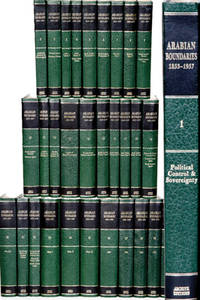
1988Arabian-Boundaries-30Archive Editions Ltd 1988-12-01. Hardcover. Very Good. 23x15x11. In fine clean condition 30 volume set including all maps some volumes have DENTED corners clean pages no missing pages Archive Editions Ltd hardcover
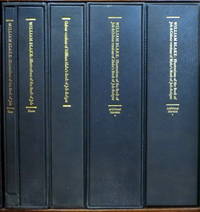
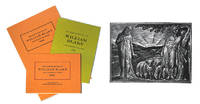
42250London: The William Blake Trust 1987. Limited edition one of five special sets from a total edition of 387 copies. Four parts each containing subdivisions of text volumes and/or portfolios of illustrations. Dark blue half morocco the text volumes and solander boxes over marbled boards with gilt labels the portfolios and slipcases over grey cloth. Part Ia - text volume titled as above 147 1 pp.; Part Ib - "The Plates with an Introduction and Plate-by-Plate Commentary by Bo Lindberg" the introduction and 22 plates Blake's title design plus 21 in different states presented in individual fascicles; Part IIa - text volume titled "Colour Versions of William Blake's Book of Job Designs from the Circle of John Linnell. Facsimiles of the New Zealand and Collins Sets and the Fitzwilliam Plates. With an Essay by Bo Lindberg. Edited by David Bindman" 27 1 pp.; Parts IIb-d - Three portfolios containing 22 22 and 4 plates from the respective sets plus a further two images loosely inserted in the case; Parts IIIa-e - The first collection of "Additional Materials" comprising five portfolios holding numerous plates titled thus: "Label printed for original publication March 1826" "Guides and Stencils for Coloured Version of Page from 'Riches' Sketchbook not used." "Colour Versions. Collins & New Zealand Sets & Fitzwilliam Plates" ".Illustrations of the Book of Job Alternative Printing Without Plate Mark" and ".Hand coloured Maquettes and First Proofs from Pochoirs with Comments"; Parts IVa-d - The second collection of "Additional Materials" comprising four portfolios with numerous plates thus: "Proofs Guides and Stencils for Colour Plates from Colour Versions. Trianon Press Paris c.1974" ".First Proofs from the Collotype Plates with Notes by Arnold Fawcus" "Pages from the 'Riches' Sketchbook with Colour Washes not published" "Facsimiles of Subjects from the Butts Version Watercolours Printed Collotype by Emery Walker for the Pierpoint Morgan Library Edition 1935". Slight rubbing to the head of the spine of one of the solander boxes occasional slight dustiness to the slipcases excellent condition overall. John Commander's set with his name inscribed on the limitation leaf being one of five "containing extra material. specially made up for those most closely concerned with bringing the publication to completion". Commander spent his life in publishing and for many years headed the Scolar Press. An expert on Blake he was heavily involved in the refounding of the William Blake Trust and was appointed as secretary and executive director of the organisation. A scarce work to begin with this is a highly desirable set of this expanded and very limited issue given to an esteemed authority on Blake who had did much to promote the study and enjoyment of the artist's work over many decades. London: The William Blake Trust unknown
194135790London 1941. Engraving printed on Rives wove paper watermarked "France". A rich impression in excellent condition. Fifth state of five. Image size: 11 3/4 x 37 inches. Final state of the largest Blake engraving.<br/> <br/>"Every age is a Canterbury Pilgrimage" wrote William Blake 1757-1827 poet and probably the most imaginative and original artist in the history of British art. "We all pass on each sustaining one or other of these characters nor can a child be born who is not one or other of these characters of Chaucer." Working in an archaic style intended to evoke the engravings of Chaucer's time Blake presents us with the cast of Chaucer's Tales as they begin their pilgrimage. Since Blake understood his subject so well and wrote with such elegance we can do no better than to use as a guide his own description of the engraving: "The time chosen is the early morning before sunrise when the jolly company are leaving the Tabarde Inn. The Knight and Squire with the Squire's Yeoman lead the Procession; next follow the youthful Abbess her nun and three priests; her greyhounds attend her. Next follow the Friar and Monk and then the Tapiser the Pardoner and the Sompnour and Manciple. After this 'Our Host' who occupies the centre of the cavalcade and directs them to the Knight as the person who would be likely to commence their task of each telling a tale in their order. After the Host follows the Shipman the Haberdasher the Dyer the Franklin the Physician the Ploughman the Lawyer the Poor Parson the Merchant the Wife of Bath the Miller the Cook the Oxford Scholar Chaucer himself; and the Reev comes as Chaucer has described:- And ever he rode hindermost of the rout." The view is eastward from the Tabard in Southwark across the Bridge from London as Blake conceived it to have been in Chaucer's day. He based his costumes on ancient monuments and other records. "As a literary piece" it has been noted Blake's engraving "has hardly an equal in the whole field of art." The engraving was begun late in 1809 and issued by the artist in October the following year. In his Prospectus for the issue Blake declared that the English nation would 'flourish or decay' according to the recognition they gave him for his year's labor. The printing plate survived and passed after Blake's death through the estate of Blake's wife finding its way to the collection of John Giles. Sold at auction with Giles collection in 1881 the printing plate was purchased by Colnaghi who issued restrikes on laid India paper. By 1940 the plate was in the possession of a New York art dealer who sold it to the wife of noted collector A. Edward Newton for her to present to her husband as a fiftieth anniversary present. After Newton's death the plate was sold with his famed library at auction on 16 April 1941 for the princely sum of $2300 to Charles J. Rosenbloom via his agent at the Parke Bernet sale Philadelphia bookseller Charles Sessler. Before delivering the printing plate to Rosenbloom Sessler had a small number of prints pulled on French hand-made paper. Although Rosenbloom only authorized 35 prints Essick and Young identified at least ninety-one impressions. "Whereas most of the identifiable Colnaghi restrikes were flatly printed the Sessler prints were heavily inked and printed. The plate shows minimal wear and the Sessler prints are generally preferable to Colnaghi's earlier printings -- probably because of better cleaning of the copper and superior presswork" Essick and Young. Rosenbloom donated the plate to Yale University in 1973.<br/> <br/>Robert Essick and Michael Young "Blake's Canterbury Print: The Posthumous Pilgrimage of the Copperplate" in Blake: An Illustrated Quarterly Vol. 15 No. 2 Fall 1981 pp. 78-82; Essick Separate Plates of William Blake XVI. unknown books
106538London: W. Pickering Chancery Lane and W. Newbery 6 Chenies Street Bedford Square 1839. Small 8vo xxi 3 74 pp. Original pebbled plum cloth upper cover lettered in gilt partly worn away as often a very good copy in a variant original binding slightly worn around the edges upper hinge a touch weak internally bright and very attractive. Enclosed in a modern protective box. § First Typographical Issue the issue with the poem “The Little Vagabond†not present - this has long been held to be the first issue see Keynes although others have claimed that it was present but cancelled due to content and thus this is the second issue. Either case is plausible; copies of each issue turn up with about the same frequency which is to say rarely. The preface by J.J. Garth Wilkinson gives a mostly favorable account of Blake’s life in the context of his work and concludes stirringly: “If the volume gives one impulse to the New Spiritualism which is now dawning on the world;-if it leads one reader to think that all Reality for him in the long run lies out of the limits of space and time; and that spirits and not bodies and still less garments are men; if it gives one blow even the faintest to those term-shifting juggleries which usurp the name of “Philosophical Systems†and all the energies of all the forms of genuine Truth must be henceforth expended on these effects it will have done its work in its little day.†Keynes Blake 135 issue without “The Little Vagabond". Bentley Blake Books 171 this issue said by Bentley to have two leaves canceled by the editor out of prudishness. W. Pickering hardcover books
19871106893 huge black slipcases. Paris: Trianon Press for the Blake Trust 1987. 3 huge black slipcases with contents in various formats see below. In perfect condition as issued. § Edition limited to 365 copies in three different formats and a super de luxe edition limited to 22 sets of which this is #D. The super de luxe issue includes David Bindman ed. William Blake’s Illustrations of the Book of Job: The Engravings and Related Material with Essays Catalogue of States and Printings Commentary on the Plates and Documentary Record by David Bindman Barbara Bryant Robert Essick Geoffrey Keynes and Bo Lindberg. London: The William Blake Trust 1987. The work is housed in four cloth slipcases trimmed in morocco as follows:1. Text volume with the title page and colophon. Contents:Stephen Keynes “Acknowledgments.â€Charles Ryskamp “Foreword.â€David Bindman and John Commander “Preface.â€Geoffrey Keynes “The Development of the Job Designs.â€David Bindman “The Book of Job Designs from Butts Series to Final Engravings.â€Robert Essick “Blake’s Engravings to the Book of Job: An Essay on Their Graphic Form and Catalogue of States and Printings.â€Barbara Bryant “The Job Designs; a Documentary and Bibliographical Record.â€Quarter morocco and cover label. In the same slipcase: William Blake’s Illustrations of the Book of Job: The Plates with related designs and with an Introduction and Plate-by-Plate Commentary by Bo Lindberg. Loose in fascicles in a quarter morocco folder quarter morocco clamshell box with cover label.2. Colour Versions of William Blake’s Book of Job Designs from the Circle of John Linnell. With an essay by Bo Lindberg. Text volume quarter morocco with cover label. Quarter-morocco clamshell box with cover label with the following quarter-morocco folders with cover labels as quoted below contents loose:a. “The New Zealand setâ€b. “The Collins setâ€c. “The Fitzwilliam platesâ€3. “Additional Material 1.†Quarter-morocco clamshell box with cover label with the following quarter-morocco folders with cover labels as quoted below contents loose:a. “Pages from the ‘Riches’ sketchbook with colour washes not publishedâ€b. “William Blake Illustrations of the Book of Job Alternative printing of the engravings without plate markâ€c. “Facsimiles of subjects from the Butts version watercolours printed collotype by Emery Walker for the Pierpont Morgan Library edition 1935â€. Two mounted color reproductions.d. “Proofs guides and stencils for colour plates from Colour versions of Blake’s Book of Job designs Trianon Press Paris c. 1974â€4. “Additional Material 2.†Quarter-morocco clamshell box with cover label with the following quarter-morocco folders with cover labels as quoted below contents loose:a. “Label printed for original publication March 1826â€b. “Colour versions of William Blake’s Book of Job designs from the circle of John Linnell Collins & New Zealand sets & Fitzwilliam plates.†Housed in three paper folders. The same reproductions as those in box 2 above.Bentley BBS pages 198-99. Trianon Press for the Blake Trust hardcover books
179748706London.: R. Noble. 1797. Scarlet morocco-backed contemporary moiré cloth boards gilt titles to front cover and spine. Folio. 415 x 325 mm. Leaf with 'Explanation of the Engravings' recto and verso printed title advertisement pp. iii - viii and 43 leaves with engravings by William Blake surrounding the text; 21 of the leaves retain the publisher's imprints. First edition of Blake's illustrations for Edward Young's Night Thoughts.Night Thoughts is a key work in the Blake canon executed at a crucial point in his career. Sometime in 1795 or 1796 Blake was comissioned by the publisher Richard Edwards to undertake the illustration of each page of Young's bestseller 'Night Thoughts'. It was intended to publish the whole poem of nine nights in installments accompanied by engravings based on Blake's drawings but Edwards went out of business after the first volume consisting of 4 Nights and the project was never completed. 'Blake has undertaken to make designs to encircle the letter press of each page of Young's Night Thoughts Edwards the Bookseller of Bond Street employed him and has had the letter press of each page laid down on a large half sheet of paper. There are about 900 pages - Blake asked 100 guineas for the whole. Edwards said he could not afford to give more than 20 guineas for which Blake agreed. Fuseli understands that Edwards proposes to select about 200 from the whole to have that number engraved by Blake as decorations for a new edition.' Blake Records. R. Noble. hardcover
20930<p><b>BLAKE EUBIE</b>. 1883-1983. American ragtime pianist and composer of "I'm Just Wild about Harry" "Love Will Find a Way" "Charleston Rag" "Memories of You" and other hits. AMusMsS. <i>"Eubie Blake"</i>. 8pp. Small folio roughly 9½" x 12½". N.p.; after 1959. An autograph piano vocal score in pencil of his most famous song "I'm Just Wild about Harry" with notable differences from the original 1921 sheet music version. Seven pages of music and lyrics on four sheets of "King Brand" lined music paper totaling 90 triple measures in E-flat Major set to ¾ time; each page bearing Blake's 1959 Local 802 union stamp. Blake has written on the cover in blue ink "<i>I think Harry would be better for Waltz if Key of C. Sorry about this number in Lead Pencle</i>sic." He has added his initials "<i>E.B.</i>" in red ink to each of these two lines. The first page of music is headed "'<i>I'm Just Wild about Harry' The New Arrangement for Miss Swann Words by Noble Sissle Music by Eubie Blake</i>."</p><p>Blake the son of former slaves who nurtured their child's musical talent began composing while playing in clubs bordellos medicine shows and on the vaudeville circuit where he met composer Noble Sissle and formed the Dixie Duo. Together they composed the groundbreaking musical revue <i>Shuffle Along</i> with playwrights Flournoy Miller and Aubrey Lyles whom they had met at an NAACP benefit. </p><p>After touring New Jersey and Pennsylvania <i>Shuffle Along </i>premiered on Broadway in 1921 and was an instant hit running for an unprecedented 504 performances and defying conventional wisdom that a show written by and starring African-Americans could be commercially successful. <i>Shuffle Along</i>launched the careers of Josephine Baker and Paul Robeson and was the first Broadway show to feature an all-black cast. Additionally its hit song "I'm Just Wild about Harry" broke the taboo against onstage romantic love between African-American characters.</p><p>One of only three songs written specifically for the show "I'm Just Wild about Harry" was originally composed by Blake as a Viennese waltz but "Lottie Gee the veteran performer who introduced it said for her to make it work it would have to be an up-temp one step. 'That cut me to the quick' Blake remembered. 'She was going to destroy my beautiful melody. I loved that waltz. Then Sissle went along with her… 'All right' I said 'we'll make it a one step'" <i>America's Songs: The Stories Behind the Songs of Broadway Hollywood and Tin Pan Alley</i> Furia and Lasser. Blake's handwritten notes on our manuscript's cover indicates that he still preferred a waltz tempo for his most famous song nearly 40 years after its debut. </p><p>The popularity of "I'm Just Wild about Harry" was revived in 1948 when President Harry S Truman used it during his reelection campaign. Detractors joked "I'm just mild about Harry." In recognition of its use Blake sent a manuscript excerpt of the song to Truman in 1967 erroneously reported on the internet as the original manuscript with a letter that stated "The interesting thing about 'Harry' was that it actually was written as an election song in the show whose plot was almost a parallel occurrence to the 1948 Presidential Campaign. The story was about the race for Mayor in a small Southern town. Our hero Harry Walton was the underdog in his race just as you were in the Election of 1948. Although we did not have a <u>Chicago Tribune</u>telling the people that his rival had been elected it first appeared that one of the candidates opposing Harry in our Race had won." </p><p>Among Blake's papers at the Maryland Historical Society are manuscripts of the song including one from 1959. However ours differs in both scoring and lyrics. Although Blake agreed to write out quotations from his best-known work this is the only full manuscript version of the song ever to be offered for sale. It belonged to Jazz musician Jim Hession Blake's friend and protégé. </p><p>Some scattered staining and wear with reinforced file holes in the left margin. In very good condition. One of America's most popular and enduring melodies with a long and fascinating history.</p> books
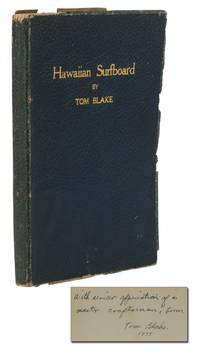
1935140945466Honolulu: Paradise of the Pacific Press 1935. First Edition. Very Good. First edition first printing. Signed by Tom Blake and inscribed in the year of publication "with sincere appreciation of a master craftsman from Tom Blake 1935". <p> In 200 Years of Surfing Literature an Annotated Bibliography by Timothy DeLaVega the author states "There is one known soft bound cover blue with text only." It is not certain that this is the specific copy known to DeLaVega but it would appear that this binding is in the very least identical to the one he described and nonetheless a true rarity. <p>Very Good with wear to yapped edges light lean to binding. Toning and light soiling to pages with several light marginal tidemarks several hinges slightly exposed and the page Blake has signed on is partially detached at the top inch; but on the whole very well preserved given the production and materials used for the binding. <p>Tom Blake is often considered to be one of the most influential surfers in the history of the sport. He is largely credited with transforming surfing from a regional Hawaiian sport to one with national popularity as well as establishing California surf culture. Paradise of the Pacific Press unknown
1797123299Large 4to. London: R. Noble 1797. Large 4to viii 1 95 2 pages; with 43 full-page engravings by Blake after his own designs surrounding the letterpress text. “Explanation†leaf bound in at the back. Half brown morocco backstrip gilt gilt top by Riviere; a very large copy measuring 16 1/2 x 13 inches thus preserving almost all the imprints. § First edition with Blake’s illustrations complete with the leaf of “Explanationsâ€. Essick and LaBelle explain in their commentary how Blake virtually in a frenzy completed 537 watercolor designs when he was commissioned by the publisher Edwards to illustrate Young’s masterpiece. Edwards issued only the first four “Nights†or sections and had Blake etch and engrave 43 plates to test the market. The response must have been poor since no further engravings were requested of Blake and Edwards ceased business shortly thereafter. Ironically today the poet Young once compared with Shakespeare and Milton is largely forgotten save for this edition. Colored copies are known in two palettes the earlier of which may have been colored under Blake’s direction. Bentley Blake Books 515. Easson and Essick William Blake Book Illustrator vol. 1 IV. Essick and LaBelle Night Thoughts Dover 1975. Bindman Complete Graphic Works of Blake 357-379. Ray The Illustrator and the Book in England 3. R. Noble unknown books
179737372London: R. Noble for Richard Edwards 1797. Large quarto. 16 5/8 x 12 3/4 inches. 4 engraved section titles and 39 pages with engraved border illustrations by William Blake with the letterpress Explanation of the Engravings leaf. Uncut on the fore-edge and lower edge. Minor offsetting as usual. Later half dark green morocco and green moire cloth boards by Riviere & Son spine with raised bands in seven compartments lettered in the second and fourth the others with a repeat decoration in gilt burgundy glazed endpapers top edge gilt.<br/> <br/>A spectacular work illustrated by Blake.<br/> <br/>"Of the merit of Mr. Blake . the editor conceives it to be unnecessary to speak. To the eyes of the discerning it need not be pointed out; and while the taste for the arts of design shall continue to exist the original conception and the bold and masterly execution of this artist cannot be unnoticed or unadmired" advertisement p.viii. Blake originally intended the present work to be the first installment of a much larger illustrated edition of Young's best selling poem. He chose 43 images to engrave from the 537 drawings in watercolour he had made around pages of the first edition of Young's poem inlaid in album sheets. Perhaps baffled by the novelty of Blake's interpretations the public remained unreceptive and the book remains what is essentially a remarkable fragment: a tantalising hint of what might have been. A large copy. Bentley notes that "the paper was only marginally larger than the copperplate and even in untrimmed copies . parts of the platemark may not appear." With the explanation leaf often wanting.<br/> <br/>Bentley Blake Books 515; Bindman Complete Graphic Works of Blake 337-379; Dover 1975; Easson and Essick William Blake Illustrator Vol. I IV; Essick and LaBelle Night Thoughts; Ray The Illustrator and the Book in England 3. R. Noble for Richard Edwards unknown books
18851228882 vols. Edmonton: William Muir 1885. 2 vols. 4to 34; 30 leaves hand-colored with the original blue-gray wrappers as issued enclosed in a modern quarter-blue morocco folding box lettered in gilt. § Limited to around 50 copies of each "Innocence" inscribed "No. 0 Pearson's copy" and "Experience" inscribed "for The Times". These are amongst the most alluring and successful of Muir’s facsimiles. Songs of Innocence was taken from the Pearson copy and he is recorded at the end as the Publisher in London in 1884 but his death caused Muir to take the project to Quaritch who distributed the whole series. Songs of Experience is taken from the Beckford copy. The general title to both works is found at the end of Experience. Bentley BB 249 a and 249 d. Loosely inserted in the box is a prospectus from John Pearson for a series of facsimiles after Blake and a 4-pp ALS from Muir to the editor of The Times. Last sold by Heritage Bookshop in 1998. William Muir unknown books
18851223852 vols. Edmonton: William Muir 1885. 2 vols. in one. 4to 34; 30 leaves hand-colored with the original blue-gray wrappers as issued; copies No. 24 Innocence and 11 Experience. Full dark red morocco gilt top gilt-lettered backstrip with gilt device at foot bookplates of Thomas William Waller and Willis Vickery. Very good with tissue guards as issued. § Limited to around 50 copies of each. These are amongst the most alluring and successful of Muir’s facsimiles. Songs of Innocence was taken from the Pearson copy and he is recorded at the end as the publisher in London in 1884 but his death caused Muir to take the project to Quaritch who distributed the whole series. Songs of Experience is taken from the Beckford copy. The general title to both works is found at the end of Experience. Bentley BB 249 a and 249 d. William Muir unknown books
1884303028Edmonton: John Pearson for Bernard Quaritch 1884. Each title one of 50 copies. With 8 26 11 and 21 plates in the four works 66 total. 1 vols. 4to. Contemporary full white vellum gilt spine and upper cover titled in gilt t.e.g. others untrimmed. Fine copy. Cloth slipcase. Each title one of 50 copies. With 8 26 11 and 21 plates in the four works 66 total. 1 vols. 4to. Four Muir Facsimiles in Special Binding. The Muir facsimiles were produced in editions of 50 copies; a few copies would have been bound up by Quaritch the distributor in white vellum as here. The wrappers are not preserved but the books are complete. Bentley 249 bce & g John Pearson for Bernard Quaritch unknown books
108280Sheet 10.2 x 12.8 cm. image and plate mark as per Essick 3.1 x 7.8 cm. and 3.3 x 8.1 cm. respectively. Printed in pale brown on a small 8vo sheet. Delicately printed with three tiny ink spots within the margins in very fine condition. § Blake’s last engraving executed for one of his closest friends. The images invoke one of Blake’s greatest themes—the relationships between time and eternity. Opinions vary on the purpose of this plate but it should be noted that at the time 1827 it was not uncommon to paste a calling card into a book as proof of ownership. However no book once owned by Cumberland has been located with his card pasted in. It has also been suggested that the name of Cumberland in the center was executed by a writing engraver and Blake added his borders later. 39 examples of this print are known to Essick not including examples now untraced all but three on laid paper printed later and three on card but it is quite rare in commerce. Essick The Separate Plates of William Blake XXI. Bindman Complete Graphic Works of Blake 654. unknown books
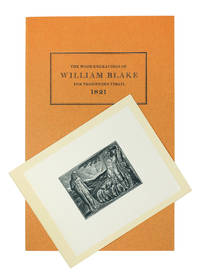
19771105008vo. London: BM Publications Ltd. 1977. 8vo introductory pamphlet and 17 woodcuts on special paper each in an individual folder all contained in a brown cloth folding box with black leather gilt-lettered labels on upper cover and backstrip. As issued in the original BM-issued numbered cardboard box; a few prints and mounts are slightly foxed a little musty from storage a couple of spots on the cloth box. § Limited to 150 sets this superb reprinting of Blake’s only woodcuts from the original blocks was executed by Iain Bain the Bewick authority and sold out immediately. Very few sets have since come to market as most were purchased by institutions. The accompanying commentary volume includes an introduction by Lord Clark a technical account of the printing of the blocks by Bain and David Chambers an essay on the engravings by Andrew Wilton and the text of Ambrose Phillip's "Imitation of Virgil's First Eclogue" which the illustrations were made to accompany. Bentley BBS p.262. BM Publications Ltd hardcover books
1887109160Folio. Edmonton: William Muir 1887. Folio 17 plates richly hand colored. Original printed wrappers dated September 1887 backstrip renewed gilt top fine. § Limited to fewer than 50 copies this copy numbered #11 signed priced and numbered by Muir. Based on three different copies see below. With the frontispiece “The Ancient of Days†which is perhaps Blake’s most famous image. Bentley BB 249k1: "plates 1 and 4 are from originals in Mr. Muir's possession copy c plates 2 5-6 and 8 are from copy D and plate 7 9-18 from copy A." See also Bentley Blake Books Supplement pp.66-69. William Muir unknown books
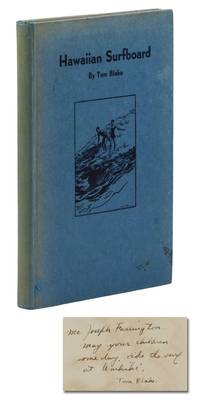
1935140944080Honolulu: Paradise of the Pacific Press 1935. First Edition. Near Fine. First edition first printing. Signed by Tom Blake and inscribed on the front free endpaper "Mr. Joseph Farrington - may your children some day ride the waves at Waikiki." Farrington was a journalist who later served as the delegate to the U.S. House of Representatives from Hawaii Territory's At-large district serving in office from 1943 until his sudden death in 1954; he followed in the footsteps of his father Wallace Rider Farrington who also was a journalist before turning to politics and serving as the Territorial Governor of Hawaii from 1921-1929. <p>Bound in original blue paper-covered boards stamped in black. Near Fine with light uneven sunning to spine and edges light wear and soiling to covers pages toned. Now lacking the dust jacket but with evidence of removal to the front and rear paste downs where jacket flaps were adhered as issued. <p>Tom Blake is often considered to be one of the most influential surfers in the history of the sport. He is largely credited with transforming surfing from a regional Hawaiian sport to one with national popularity as well as founding California surf culture. <p>"The most important publication in the surfing canon." - Timothy DeLaVega 200 Years of Surfing Literature. Paradise of the Pacific Press unknown
1884303028Edmonton: John Pearson for Bernard Quaritch 1884. Each title one of 50 copies. With 8 26 11 and 21 plates in the four works 66 total. 1 vols. 4to. Contemporary full white vellum gilt spine and upper cover titled in gilt t.e.g. others untrimmed. Fine copy. Cloth slipcase. Each title one of 50 copies. With 8 26 11 and 21 plates in the four works 66 total. 1 vols. 4to. The Muir facsimiles were produced in editions of 50 copies; a few copies would have been bound up by Quaritch the distributor in white vellum as here. The wrappers are not preserved but the books are complete. Bentley 249 bce & g John Pearson for Bernard Quaritch unknown
1245991977. London: BM Publications Ltd. 1977. <br /> <br /> 8vo introductory pamphlet and 17 woodcuts on special paper each in an individual folder all contained in a brown cloth folding box with black leather gilt-lettered labels on upper cover and backstrip. As issued.<br /> <br /> § Limited to 150 sets this copy unnumbered this superb reprinting of Blake's only woodcuts from the original blocks was executed by Iain Bain the Bewick authority and sold out immediately. Very few sets have since come to market as most were purchased by institutions. The accompanying commentary volume includes an introduction by Lord Clark a technical account of the printing of the blocks by Bain and David Chambers an essay on the engravings by Andrew Wilton and the text of Ambrose Phillip's "Imitation of Virgil's First Eclogue" which the illustrations were made to accompany. Bentley BBS p.262. unknown
1246331977. London: BM Publications Ltd. 1977. <br /> <br /> 8vo introductory pamphlet and 17 woodcuts on special paper each in an individual folder all contained in a brown cloth folding box with black leather gilt-lettered labels on upper cover and backstrip. As issued.<br /> <br /> § Limited to 150 sets this superb reprinting of Blake's only woodcuts from the original blocks was executed by Iain Bain the Bewick authority and sold out immediately. Very few sets have since come to market as most were purchased by institutions. Bentley BBS p.262. unknown
1797007894London: R. Noble for R. Edwards 1797. First Edition. Full Morocco. Very Good. Elephantine folio 44 by 34 cm. viii 2 95 2 pp. 43 of the pages have Blake's expansive charismatic illustrations surrounding the text. Four of these are section heads the balance being border ornamentation but even the latter are far more than merely decorative. The distinctive Blake artwork fires the imagination regardless. In fact the text which is framed with ruled lines seems to cover some of the illustration. Last two pages are the Explanation of the Engravings which are often not present. The full navy blue morocco is fairly heavily rubbed along the edges a bit less so by the joints. Some scattered soiling within but the pages are generally quite clean. There are a few closed tears not of great length and one repaired close tear which was somewhat longer. The Explanation of Engravings leaf has two repaired tears. Notwithstanding these flaws this is an attractive appealing copy. R. Noble for R. Edwards unknown
1959219868Spartan Productions 1959 1959. First Edition. Hardback. A large format publication in fair to good condition. It is spiral-bound in elaborately blind-tooled full leather. There is some wear to the top of the spiral spine. In a portfolio leather folder with imitation cowhide on the front cover. The portfolio folder is somewhat edge-worn. The pages are impressively produced on colour-illustrated stiff card with slight dulling around the edges. Some of the introductory and credit pages have separated from the binding and have become brittle and edge-worn. Remains particularly well-preserved overall. Futher images and additional bibliographic information available on request. ; 8vo 8"" - 9"" tall; 0 pages; Pre-production or proposal portfolio for a western TV series entitled 'Rango' featuring the script for a presumed pilot episode 'Posse from Hell' with a selection of proposed storylines for future episodes. Three pages of production credits indicate that this item was published in 1959 by Spartan Productions with Blake Edwards credited as director. Gordon Oliver is credited in the leading role of Rango. Clair Huffaker is credited as writer indicating that the script is based on his 1958 novel 'Posse from Hell'. This novel was eventually adapted into a Universal film in 1961 starring Audie Murphy and directed by Herbert Coleman. Also included is the album cover for the original theme music written by Hank Mancini. Unfortunately the LP is lacking. Hank Henry Mancini was involved in a dispute regarding the 1961 film with Universal's music director Joseph Gershenson who reused the music scores from This Island Earth 1955 and It Came from Outer Space 1953 rather that the original music. Therefore it appears that Rango: Posse from Hell was the pilot for a proposed TV series that was eventually adapted into a film produced by Gordon Kay and Edward Muhl for Universal. In the film version Rango's name is changed to Banner Cole. There was also a 1967 Western/Comedy TV series called Rango. Other than the title of the main character there does not appear to be any link to between these productions although is is possible some elements may have been adapted. Subjects: Film -- Westerns -- TV series -- Scripts -- 1950s -- 1960s -- Television -- History -- United States. Physical description: Unpaginated. Impressively colour illustrated throughout. 38 x 54cm. [Spartan Productions, 1959] hardcover
1887109161Folio. Edmonton: William Muir 1887. Folio 18 plates printed in blue. Original wrappers rebacbacked top edge gilt fine. § Uncolored Muir facsimile limited to around 50 copies of which according to Keynes in 1921 only 6 were hand-colored. This is copy #3 signed priced and numbered by Muir. "In the first of his "Continental Prophecies" see also Europe and The Song of Los Blake explores the radical paradigms of political repression and revolt through a highly imaginative treatment of the American Revolution. While historical figures such as Washington and Paine appear much of the symbolic and thematic weight is placed on Blake's own invented mythological figures including "Albions Angel" and "Londons Guardian" forces of the British government Urizen the god of restrictive reason and the origin of political repression and fiery Orc the spirit of revolt. The American Revolution is viewed as a harbinger of universal revolution epistemological as much as political." The Blake Archive. Eighteen copies of the original are known to exist. William Muir's facsimiles of Blake's works were the most ambitious and in many cases the first of their kind until the Trianon Press began work for the Blake Trust in 1951. Upon establishing the Blake Press at Edmonton his goals were clear: "My desire and intention is to reproduce ALL the important works by Wm Blake that exist in book form and also some of his finest designs and this by methods of working as nearly the same as Blake himself used as the need of maintaining fidelity to his results will allow. I will not use either photography or chromolithography. All outlines are drawn and all the colouring is by hand. I produce fifty copies only of each book and each of them is numbered".Keri Davies writes "‘Muir’s facsimiles not only made Blake’s works in “Illuminated Printing†accessible for the first time in reliable copies and helped establish Blake’s reputation as visual artist alongside his reputation as poet but I feel must also have contributed to the most advanced ideas in English art of the 1880s." Bentley Blake Books 249j. William Muir unknown books
1859472016. The excited retelling of great stories An alternative version of the illustration published within Morpurgo's picture book on page 8 showing an excited group of children talking with animation in a classroom. The story concerns a class of children from an inner-city school who spend a week living as farmers at Nethercott Farm in Devon. Morpurgo's text reads "Every year after our week in Devon we come back to school and the whole place is buzzing with excitement. Everyone wants to hear about it. In the playground and in the staff room all the stories of our time down on the farm. are told again and again. Some are true some are not so true maybe a bit exaggerated but they all make great stories". For many decades Quentin Blake has created different versions of the same illustration prior to publication. The one finally reproduced in a book is retained in the artist's archive and the alternative versions have generally been sold. These alternatives offer an insight into Blake's process of changing small details in his work. The present illustration for example includes a bright sunlit window and more wall decoration than in the published version. Ink and watercolour drawing 84 x 160 mm on single sheet of wove paper 198 x 280 mm signed "Quentin Blake" lower left. Mounted framed and glazed framed size 250 x 330 mm. Light rippling to paper some finger marks: fine and unfaded. unknown
109358London: Jonathan Cape 1982. First edition of this Dahl classic which has sold over 20 million copies. Octavo original cloth illustrated by Quentin Blake. Presentation copy inscribed by the author on the front pastedown "Nicola Love Roald Dahl." Additionally inscribed by the illustrator Quentin Blake opposite Dahl's inscription. Fine in a near fine dust jacket. Uncommon signed by both Dahl and Blake. Roald Dahl is now considered one of the most beloved storytellers of the twentieth century. Dahl's ability to twist words into a clever and creative new language is fascinating to children and is evident in BFG. The gruesome descriptions of the horrid giants and the subtle allusions to other stories will entertain children young and old. An animated adaptation was released in theatres in 1987 with David Jason providing the voice of the BFG and Amanda Root as the voice of Sophie. It was also the basis for the 2016 film directed and co-produced by Steven Spielberg written by Melissa Mathison and starring Mark Rylance Ruby Barnhill Penelope Wilton Jemaine Clement Rebecca Hall Rafe Spall and Bill Hader. Jonathan Cape hardcover