Philippe de LA HIREBiblio.com
155 résultats
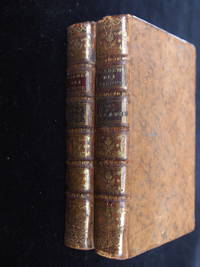
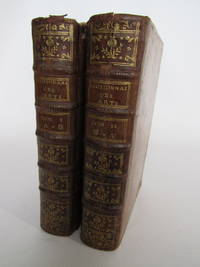
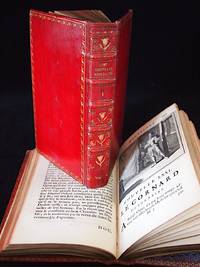
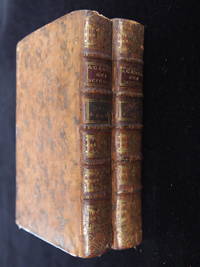
177753029à Paris: Chez Panckoucke 1777. Fine. Chez Panckoucke à Paris 1777 10 x 17 cm 2 tomes en 2 volumes reliés Edition illustrated with 16 folding plates 8 per volume. Contemporary full marbled brown calf bindings. Spines with raised bands decorated. Red morocco title labels and black wax volume labels. Head of volume I with headcap partly missing. One hole along the upper joint of volume I. 2 corners slightly bumped. Worming throughout the first volume in the lower margin the holes progressively becoming galleries then reverting to holes. Good set overall. Notable articles to be retained in each of the mentioned sections include: Remarks on the construction of geometric loci & equations by M. de La Hire; General construction of magic squares by M. Sauveur; Use of a given integral by M. le Marquis de L'hôpital by M. Varignon; On breaking points of figures by M. Parent; General method for the construction of circular arcs by M. de La Hire; Observations on bezoar by M. Geoffroy; Remarks on the movement of planets by M. de la Hire. Numerous astronomical observations by Cassini Maraldi. Chez Panckoucke hardcover
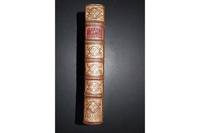
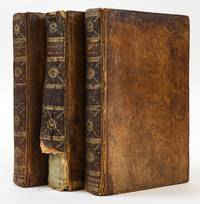
175053039à Amsterdam: Chez Pierre Mortier 1750. Fine. Chez Pierre Mortier à Amsterdam 1750 10 x 17 cm 2 tomes en 2 volumes reliés Illustrated edition with 16 folding plates 8 per volume. Contemporary full marbled brown calf bindings. Raised band spines with gilt ornaments. Red morocco title-labels and black wax volume labels. Small lack to head of volume I. One corner slightly bumped. Rubbing. Last errata leaf frayed at margin. Good copies. Notable articles to be retained in each of the mentioned sections include the following: On beam resistance by M. Parent. On conchoids in general by M. de La Hire. Observations on coral analysis by M. Geoffroy. Reflections on magnetic variations by M. Houssaye. General method for finding an infinity of new curved lines by M. Réaumur. Physical explanation of the vertical and natural direction of plants by M. de La Hire. Method for describing large arcs of conic sections by M. de La Hire. Conjectures on the position of the island of Meroë by M. Delisle. Numerous astronomical observations by Cassini Maraldi. Chez Pierre Mortier unknown
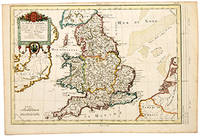
178757382Cosmographie Universale. 1787. Detailed map of England with ornamental title cartouche and coats of arms. Copper engraving. Fine condition. Light foxing to the margins not affecting the image. Later colour. Size: 41 x 28 cm. 16 x 11 inches unknown
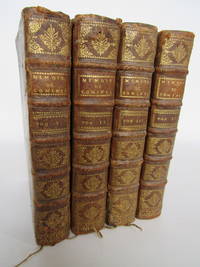
171458508à Brusselle Brussels Bruxelles Brussels: Chez François Foppens 1714. Fine. Chez François Foppens à Brusselle Brussels Bruxelles Brussels 1714 12.9 x 19.7 cm 4 volumes reliés New edition produced by Denys Godefroy the first dating from 1649. One folding genealogical table and 6 portraits re-engraved by Audran. Title pages in red and black. Volume III bears a specific title: Divers traittez contracts testamens et autres actes et observations . Volume IV: Supplement aux memoires. Bindings in full speckled brown sheep. Spine with raised bands decorated. Fawn morocco title labels. Gilt volume numbering. Lacks at head of volume I. One wormhole at foot of volume IV. 4 corners very bumped. Bindings rubbed and worn. An essential work engendering modern history Commynes' work which moreover establishes a rule of political conduct for the Great ones of the kingdom forms the greatest source for this period. From 1472 to 1483 after having been counselor to the Duke of Burgundy Charles the Bold Commynes entered the service of Louis XI then of Charles VIII and Louis XII. He distinguished himself there through his diplomatic talents notably in Italy; consequently the Memoirs are also a history of Europe. Too often forgotten is that his exemplary career experienced an interlude of disgrace: opposing the young Charles VIII through his liberal ideas he rallied to the cause of the future Louis XII plot aimed at abducting Charles VIII. He was consequently arrested and locked in an iron cage at Loches for five months in 1488. To this day the work still being studied Commynes' Memoirs have never failed in success and interest. Denys Godefroy's critical edition replaced the one that had served as reference until then Savage's version. This edition contains La chronique scandaleuse the proofs and observations Addition à l'histoire de Louis XI by Charles Naudé Le cabinet du roi Louis XI by Tristan L'Hermite L'éloge du roi Charles VIII by Brantôme Comparaison du règne du roi Louis XII à celui du roi Louis XI by Claude de Seissel Chronicles of the Dukes of Burgundy Remarks on the history of King Louis XI by Varillas. Chez François Foppens hardcover
1760M7182Paris: Desnos c. 1760. Very Good. Notes: These maps was originally designed by de la Hire 1640-1718 in 1705. Size : 461x461 mm 18.15x18.15 Inches Coloring: Hand Colored Reference: Tooley III:72 Category: Maps Celestial; Desnos unknown
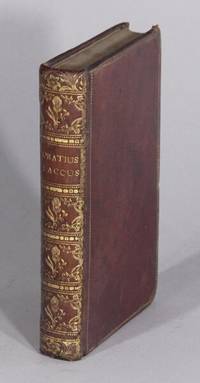
174670635Lutetiae Parisiorum: sumptibus Ant. Urb. Coustelier 1746. 12mo pp. xxiv 299 1; text in Latin; engraved frontispiece by Duflos after Picart; printer's woodcut device on title page engraved headpieces woodcut initials and ornaments; contemporary full calf triple gilt-ruled border on covers smooth gilt spine laid out in 6 compartments gilt-lettered direct in 1 a.e.g.; rebacked with spine laid down spine worn and with small loss at the extremities upper joint cracked dampstains in the foremargin of A7 and A8 and C7 and C8; a good sound and clean copy. This copy with the bookplate of Adolphe Périès and with 2 signed manuscript translations of his inserted dated 1853 and 1856 on 3 small pages in ink on blue paper: Ode 1-22 at p. 23; and Ode 4-1 at p. 100. A manuscript note tipped to the front pastedown possibly by H. H. Furness notes: "Mr. A. Périès seems to have been the owner of this book as evidenced by the two manuscript translations inserted and by the bookplate on whose motto his name appears "aperies". He was a fine classical scholar with a dainty gift of versification as shown by a little volume of translations published "by himself for himself" at Philadelphia in 1861. The author's name is not given the work is "by an idler" but has been ascertained from a copy containing his photograph and an autograph inscription to his friend John T. Montgomery." Mills College Check List 616; Riedel-Horatiana A-177. sumptibus Ant. Urb. Coustelier unknown
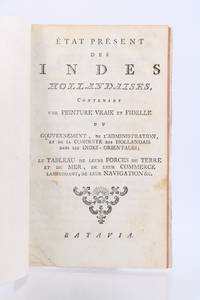
178090166Batavia Jakarta Jakarta Amsterdam: s. n. 1780. Fine. s. n. Batavia Jakarta Jakarta Amsterdam s. d. 1780 12.5 x 18.7 cm Broché This critical survey of the Dutch possessions in Indonesia survives in three versions English French and Dutch without it being possible to determine with certainty which constitutes the original edition.Only three copies are recorded in the CCF. Written at the outset of the Fourth Anglo-Dutch War 17801784 triggered by the early recognition of American independence by the United Provinces this pamphlet seeks to highlight the weaknesses of the administration of the Dutch East India Company and the vulnerability of its possessions to a French or British attack.In fact hostilities quickly turned to the disadvantage of the Dutch who in 1784 were compelled to make numerous colonial concessions following the Treaty of Paris. Philippe Fermin or Firmin 17201790 was a colonial physician who spent most of his life in Suriname which he famously described but he also published on various other colonial subjects.A disbound copy presented in a modern temporary marbled paper wrapper; page 13 has been slightly trimmed resulting in the loss of a letter at the end of certain words; a few light spots of foxing. s. n. unknown
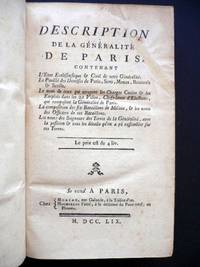
175925944Se vend à Paris: Chez MoreauHochereau 1759. Fine. Chez Moreau Hochereau Se vend à Paris 1759 12.50 x 20.50 cm relié First edition and the only rare edition complete with all 22 elections and the table. Half red sheep binding ca 1850. Smooth spine with fillets. Rubbing to headcaps. Fairly good copy. The work proceeds in the manner of a dictionary listing boroughs and villages for each election with their descriptions. Each election begins with the description and state of the town. Chez MoreauHochereau unknown
1800745823Damiani 1800-01-01. Hardcover. Acceptable. 0x0x0. Binding tight.Hardcover.Dust Jacket Included and in Poor condition. Minor marking to text. Damiani hardcover
1792C3160<p>166 pages Small octavo 7 1/2" x 4 3/4" bound in full leather with gilt decorations to spine and cover with red spine label lettered in gilt. Linden - N. 559; van der Linde I 417f Second printing.</p><p>Van Zuylen van Nijevelt wrote a well-known treatise on the game of chess <em>La Supériorité aux Échecs </em>1792. The book's full title was<em> La Supériorité aux Échecs mise à la portée de tout le monde et particulierement des dames qui aiment cet amusement</em>. It was reprinted several times and translated into several languages.</p><p>The Dutch chess theorist Philippe Jules van Zuylen van Nyevelt was a civil servant general and published "<em>La supériorité aux échecs .</em>." <em>The Great Game of Chess.</em> in 1792. "The 'Volume de Planche' mentioned on the title page forms the second game for no other exists." van der Linde For a detailed discussion of the distinction between the first and second printings see van der Linde I 417 f. This edition is valued for its instructive examples on the management of pawns in the endgame. He was the first Dutchman to write a book on chess and probably also the first person to come up with the idea of random chess also known as shuffle chess a chess variant whereby the starting position of the main pieces is chosen at random. He wrote that he hated openings "with all those annoying constantly repeating patterns" and therefore thought of randomizing the starting positions of the chess pieces. "This produces a huge number of different situations so that no one can study them beforehand" according to Van Zuylen van Nijevelt</p><p><strong>Condition: T</strong>he plates and errata page are missing. The interior is toned occasionally stained with a few notes in an old hand. A few pages are marginal. Cover slightly bumped and scratched else about very good.</p> Chez J A de Chalmont hardcover
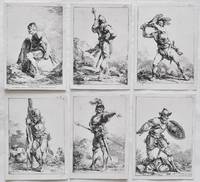
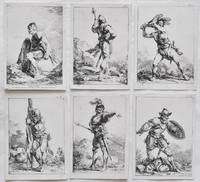
175525093<p>A work from Loutherbourg`s early career when he was in Paris 1755 – 1770. This series is outstandingly rare. Ca. 11.9 x 8.5 cm; plate mark not visible; in fine condition.</p><p>Literature: Le Blanc.</p><p>Loutherbourg an Alsatian painter who studied etching in Johann Georg Wille's academy clearly admired the prints of the seventeenth-century Neapolitan painter Salvator Rosa as did many other French printmakers of the time. In the set entitled "First suite of Soldiers"Loutherbourg took up a format associated with Rosa in order to showcase his own inventiveness and fluency.</p><p><strong>Philip James de Loutherbourg</strong> RA 31 October 1740 – 11 March 1812 whose name is sometimes given in the French form of <strong>Philippe-Jacques</strong> the German form of <strong>Philipp Jakob</strong> or with the English-language epithet of <strong>the Younger</strong> was a French-born British painter who became known for his large naval works his elaborate set designs for London theatres and his invention of a mechanical theatre called the "Eidophusikon". He also had an interest in faith-healing and the occult and was a companion of the confidence-trickster Alessandro Cagliostro</p><p><input type="checkbox"></p></p><p>Loutherbourg was born in Strasbourg in 1740 the son of an expatriate Polish miniature painter.1 Intended for the Lutheran ministry he was educated at the University of Strasbourg.2</p><p>Rejecting a religious calling Loutherbourg decided to become a painter and in 1755 placed himself under >Charles-André van Loo in Paris and later under Francesco Giuseppe Casanova. His talent developed rapidly and he became a figure in the fashionable society of the day. In 1767 he was elected to the French Academy although below the age required by the rules of the institution and painted landscapes sea storms and battles all of which work had a celebrity above those of the specialists then working in Paris. He made his debut with the exhibition of twelve pictures including <em>Storm at Sunset</em> <em>Night</em> and <em>Morning after Rain</em>.2</p><p>Loutherbourg then travelled through Switzerland Germany and Italy distinguishing himself as much by his mechanical inventions as by his painting. One of these showing new effects produced in a model theatre was the wonder of the day with its use of lights behind canvas representing the moon and stars and the illusory appearance of running water produced by clear blue sheets of metal and gauze with loose threads of silver.2</p><p>In 1771 he settled in London where David Garrick paid him £500 a year to design scenery and costumes and oversee the stage machinery at the Drury Lane Theatre.3 His stage effects attracted the admiration not just of the general public but also of artists including Joshua Reynolds. He devised scenic effects in which for instance green trees gradually became russet and the moon rose and lit the edges of passing clouds:2 illusions achieved through the use of coloured lantern-slides and the ingenious lighting of transparencies.4 He continued to work at the theatre until 1785.3</p><p>He achieved an even greater success with an entertainment called the <em>Eidophusikon</em> meaning "image of nature". This was a miniature mechanical theatre measuring six by eight feet and described as displaying "Various Imitations of Natural Phenomena represented by Moving Pictures". It was presented at Loutherbourg's home from March 1781 in an auditorium seating about 130 people. He used Argand lamps to light the stage and stained glass to change colours.</p><p>At Christmas 1781 Loutherbourg mounted a spectacle at a party in the Egyptian Hall at Fonthill for William Beckford promising according to Beckford to "present a mysterious something that the eye has not seen or heart of man conceived".4 Following this he attempted rather more fantastical subjects for the Eidophusikon presenting a scene from <em>Paradise Lost</em> with "Satan arraying his troops on the banks of the Fiery Lake and the rising of the Palace of Pandemonium".4 The Eidophusikon soon closed however as the income did not cover the costs and the audience demanded new productions faster than Loutherbourg could create them. He has been called the inventor of the panorama but although it first appeared about the same time as the Eidophusikon the first panorama was painted and exhibited by the Scottish painter Robert Barker.</p><p>Despite these other projects Loutherbourg still found time for painting. <em>Lord Howe's action or the Glorious First of June</em> exhibited 1795 and other large naval pictures were commissioned to commemorate British naval victories many of them ending up soon afterwards in the Greenwich Hospital Gallery in whose successor the National Maritime Museum they still remain. His finest work was the <em>Destruction of the Armada</em>. He also painted the <em>Great Fire of London</em> and several historical works including the <em>Attack of the Combined Armies on Valenciennes</em> 1793.2 He was interested in the industrial revolution and his 1801 painting <em>Coalbrookdale by Night</em> shows iron foundries at work.</p><p>Seven of his paintings including <em>Lodore Waterfall</em> and <em>Skating in Hyde Park</em> are in the Government Art Collection.5</p><p>He was made a member of the Royal Academy in 1781.</p><p>Two sets of drawings by de Loutherbourg were published reproduced in aquatint under the title <em>Picturesque English Scenery</em> in 1801 and 1805. He also contributed illustrations to a Bible published by Thomas Macklin in 1800.3 After his death Cadell and Davies published a volume of the Apocrypha. All 110 of his drawings for the vignettes but not the Apocrypha are pasted in the Bowyer Bible in Bolton Museum in Greater Manchester.</p><p>Esoteric interests</p><p>In 1789 Loutherbourg temporarily gave up painting in order to pursue an interest in alchemy and the supernatural.3 He met Alessandro di Cagliostro who instructed him in the occult.3 He travelled about with Cagliostro leaving him however before his condemnation to death.2 He and his wife also took up faith-healing. A pamphlet called <em>A List of a Few Cures performed by Mr and Mrs De Loutherbourg of Hammersmith Terrace without Medicine</em> was published in 1789. Written by a follower named Mary Pratt it claimed that the Loutherbourgs had cured two thousand people between Christmas 1788 and the following July "having been made proper recipients to receive divine manuductions".6</p><p>Death</p><p>Loutherbourg died in Chiswick in 1812.</p><p>There are paintings by him in the collections of many British institutions including Tate Britain The Victoria and Albert Museum The National Portrait Gallery The Royal Academy of Art Leicester Farnham and Derby Art Gallery.7</p><p>Loutherbourg was buried in Chiswick Old Cemetery adjoining the graveyard of St Nicholas Church Chiswick. Buried nearby are the artists William Hogarth and James Abbott McNeill Whistler.</p>
176022093<p>A work from Loutherbourg`s early career when he was in Paris 1755 - 1770. This series is outstandingly rare. Ca. 11.9 x 8.5 cm; plate mark not visible; in fine condition.</p><p>Literature: Le Blanc.</p><p>Loutherbourg an Alsatian painter who studied etching in Johann Georg Wille's academy clearly admired the prints of the seventeenth-century Neapolitan painter Salvator Rosa as did many other French printmakers of the time. In the set entitled "First suite of Soldiers"Loutherbourg took up a format associated with Rosa in order to showcase his own inventiveness and fluency.</p>
17761204110039Paris Chez Moutard 1776. Hardcover. Very Good. 3 Volumes. xv 421 p ; 364 p ; 414 p. fronts. plates. 16 cm. 8vo. Bound in contemporary leather. Good bindings and covers to each volume. Ornate gilt design on spine. Gilt lettering on red spine label. Minimal wear to extremities. Chipping and loss to head and spine to Volume I and III; only to head of Volume II. Splitting starting on Volume I and III at head of spine. French. Clean unmarked pages with minimal toning. Please feel free to view our photographs. <br><br> Paris, Chez Moutard hardcover
176658304à Paris: Chez Lacombe 1766. Fine. Chez Lacombe à Paris 1766 10 x 17 cm In-12 2 volumes reliés First edition. Full mottled brown calf bindings. Spines with raised bands gilt-tooled. Title and volume labels in Havana morocco. Losses at the head of volume I. Upper border of volume I partly trimmed. Abrasions to the boards with a loss on the lower board of volume I. Overall a good copy. In the preface the author pays tribute to the undertaking of Diderot and D'Alembert; the Encyclopédie des arts et métiers began in 1751 but only two volumes had appeared. Several contributors took part in writing the entries including Baumé and Rigaud. Many articles are noteworthy in particular those on bookbinding and numerous forgotten trades: ceinturier belt maker coffretier-malletier coffer- and trunk-maker. Certain remarks refer to the dictionary of chemistry by the authors brother Pierre-Joseph Macquer as well as to the dictionary of natural history. Chez Lacombe hardcover
179867059Parisiis Paris: Apud Molini 1798. Fine. Apud Molini Parisiis Paris 1798 An VI 13 x 20.50 cm relié First edition rare. An allegorical frontispiece signed Clément. Printed on laid paper. Contemporary binding in full glazed long-grain red morocco in the sober manner of Bozérian. Smooth spine decorated with 7 fillets gilt title and date. Double blind fillet border on boards with small angular tools. Roll on edges and turn-ins. All edges gilt. Superb copy very fine with particularly fresh paper. F. M. Caye bookplate. Surgeon and man of letters Petit-Radel is responsible for several books on eroticism notably Érotopsie ou coup d'il sur la poésie érotique. A publisher's preface introduces the author. Latin poetry inspired by Latin authors of a gentle and sentimental eroticism. Apud Molini hardcover
173649994à Cologne: Chez Pierre Gaillard 1736. Fine. Chez Pierre Gaillard à Cologne 1736 9.50 x 15.50 cm relié Reprint by the same publisher of the first edition of 1701 illustrated with a frontispiece and 100 half-page figures by Romain de Hooghe and retouched by Picart le Romain. Rare. Late 18th century binding possibly later in full red Russia leather. Foreign binding perhaps Russian. Spine with raised bands decorated with compartmented tulip tools. Gilt title and volume label. Head and foot rolls. Decorative border on covers. All edges gilt. Headcap of volume 2 partly worn. Corners slightly bumped. A tear to the lower joint of volume 2. Despite minor defects handsome and uncommon binding the set in good condition and well-printed. Les Cent Nouvelles nouvelles is the first collection of French novellas commissioned by the Duke of Burgundy Philip the Good to whom it is dedicated and who received it in 1462. It brings together one hundred very free tales by authors from the Burgundian court satirical and ribald in spirit particularly targeting women and the clergy. Pierre Champion attributes its authorship to Philippe Pot although 36 different storytellers can be identified. Their model of inspiration is clearly Boccaccio's Decameron. Along with La Fontaine's Contes this represents Romain de Hooghe's finest work who captured the spirit of each tale in a lively manner full of fantasy and humor. Chez Pierre Gaillard hardcover
172437118à Paris: par La Compagnie des libraires 1724. Fine. par La Compagnie des libraires à Paris 1724 18.50 x 25.50 cm relié New edition after the original published in 1699. The second part is announced by a half-title. Contemporary speckled brown calf binding. Richly decorated spine with raised bands. Red morocco title label. Various rubbing. Good copy. Renusson devoted several works to family law including this treatise on dower rights which concerns the property that a husband will leave to his wife in case of death. We distinguish customary law thus fixed by custom and contractual law that is to say fixed by contract. Dower is a fundamental element of marriage law under the Ancien Régime. par La Compagnie des libraires hardcover
175470386Lutetiæ Parisiorum: typis Josephi Barbou 1754. Small 8vo pp. xxiv 299 1; engraved frontispiece printer's woodcut device on title page woodcut initials and ornaments engraved head- and tailpieces throughout; contemporary full maroon goat dotted gilt rule on covers smooth gilt-decorated spine laid out in 5 compartments gilt-lettered direct in 1; a very good sound and clean copy. Owner's inscription on flyleaf dated 30-1-99. Mills College Check List 658; not in Riedel-Horatiana. typis Josephi Barbou unknown
1798665L10Paris: Chez L'Auteur 1798/VII. First edition. Leather. Very Good Indeed. 8" by 5". None. A scarce two volume work on the principals of chemistry. Written by Pierre Philippe Alyon a French medical botanist and prolific author on scientific subjects. A smart set bound in contemporary quarter calf bindings. A scarce edition of this work. To the preface Alyon notes that he first composed this guide to chemistry for the children of the former Duke of Orleans to whom he was responsible for teaching chemistry. His original textbook was written in 1786. To this edition he has made some alterations and has updated certain parts in accordance with the development of science. To the title page it is noted that this work was published in year VII of the French Republican Calendar. The Republican Calendar began in year 1789 of the Gregorian Calendar. Year VII loosely translates to the Gregorian year 1798. In French. With the half-titles to each volume and errata to the rear of volume II. A smartly bound two volume set by this noted French scientist of the eighteenth century. In quarter calf bindings with paper covered boards. Externally very smart with just some minor shelfwear to the head and tail of spine and to the extremities. Internally firmly bound. Pages are very bright. Occasional light spots to pages. Very Good Indeed Chez L'Auteur hardcover
174753054à Amsterdam: Chez Pierre Mortier 1747. Fine. Chez Pierre Mortier à Amsterdam 1747 10 x 17 cm 2 tomes en 2 volumes reliés Second edition statement illustrated with 26 plates most of them folding including a frontispiece. Title pages in red and black. Contemporary full marbled brown calf bindings. Decorated raised band spines. Red morocco title labels and black wax volume labels. One lack at head of volume I. One corner bumped. Rubbing. Good copies. Among the remarkable articles mentioned in each section we note the following: Reflections on spaces more than infinite by M. Wallis by M. Varignon. Observations on the methods of Maximis & Minimis where the identity & difference of that of the analysis of the infinitely small with those of M. Fermat and Hudde is shown by M. Guisnée. Continuation of the establishment of some new genera of plants by M. Tournefort. Reflections on the appearances of the body of the moon by M. de La Hire. Discovery of a new star by M. Maraldi. Supplement to the memoir on voice and tones by M. Dodart. Observations on iron under burning glass by M. Homberg. Solution to the problem proposed by Bernouilli by M. Bernouilli his brother. On honey and its chemical analysis by M. Lemeri. Treatise on roulettes by M. de La Hire. Different ways of finding the osculating radii of all sorts of curves by M. Varignon. Various astronomical and meteorological observations for the year 1706. Chez Pierre Mortier unknown
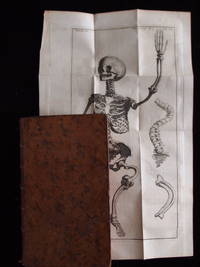
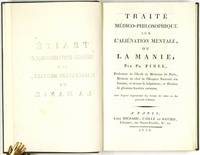
1800315841800. Paris Chez Richard Caile et Ravier Libraires rue Haute-Feuille No. 11 An IX 1800-01 8° I-V VI-LVI 318 pp. 1 Tabelle. 2 Taf. feiner Pappband mit Rvg.; ungewöhnlich breites und frisches Exemplar. First Edition of one of the most important medical classics and one of the most valuable texts in the history of psychiatry written in the opening year of the new century. It is both a postcript to the eighteenth and a preface to the nineteenth century. Pinel wrote this treatise on the basis of his experience in the Bicêtre. His medical theories and classifications are very methodical and clear and they contain some original ideas but their importance pales in comparison with his work of hospital reform and reorganization by which a new tradition was established and a new perspective opened for practical and research psychiatry; it is this achievement which always come to mind when the name of Philippe Pinel is mentioned. On May 24 1798 at the risk of his own life and liberty he struck off the chains of the insane at the Bicêtre placing them in hospitals under lenient physicians and doing away with the abuses of drugging and blood-letting to which they were subjected. Garrison & Morton No. 4922; Heirs of Hippocrates 1070 Grolier/Medicine 54; Lilly Notable Medical Books 155; Norman 1701 unknown
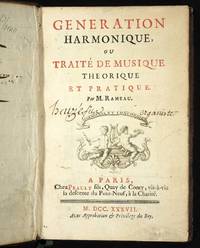
17372674DB1737. Paris Prault 1737. 4°. 16 201 13 S. Mit 12 Kupfertafeln. Grässe VI 20. - MGG dtv X 1904. - Eitner VIII 120. - Fétis VII 175. - Erste Ausgabe. - "Hatte Rameau im Traité Zarlinos 'duale' Theorie mit der nach unten gehenden Reihe zur Erklärung der Mollharmonie scharf zurückgewiesen und dafür den schwachen Versuch unternommen die Lage der Terz zwischen den beiden bestimmenden Eckpfeilern von Grundton und Quinte willkürlich zu vertauschen so greift er in der 'Génération' zum Zwecke einer befriedigenderen Abteilung der Mollharmonie auf die sympathetische Vibration von Saiten und eine sich daraus ergebende arithmetische Proportion zurück was praktisch eine Anerkennung von Zarlinos ursprünglicher Erklärung bedeutet" MGG. - Gioseffo Zarlino 1517-1590 ital. Musiktheoretiker und Komponist. - Papier zu Beginn etwas gebräunt und stockfleckig. Mit alten Besitzereinträgen auf dem Vorsatz. Einband berieben. unknown
17801394642Argentorati Strasbourg: Bauer et Treuttel 1780. Quarto xiv 243 pages. In Good minus condition. Bound in full leather with gilt tooling to banded spine spine label worn away. Boards show moderate plus wear to edges moderate plus bumping and wear to corners significant wear to head and tail of spine and significant cracking along joint of front board front board loose but attached. Text block has moderate plus age toning to speckled edges and some light smudging to front free end paper. Ex libris of former owner on front paste down. Marbled end papers. 1394642. Special Collections - Downstairs. Bauer et Treuttel unknown
17881396093Argentorati Strasbourg: n.p. volume I and II; excudit Jon. Henricus Heitz volume III 1788. Hardcover. Octavo three volumes. Volumes 1 and 3 in Good minus condition Volume 2 in Fair condition. Bound in full tree calf with gilt ornamentation to spine and edges. Spines have gilt lettering cracking to joints tears and chipping. Volume 2 spine is partially detached with the tail end torn away. Boards have mild rubbing wear and peeling chipping and moderate wear to extremities. Mild to moderate bumping to corners in some cases exposing the boards. Textblocks have marbled endpapers light age toning light stains scattered throughout and speckling to edges. Some of the end papers appears to have a line of adhesive near the spine which partially attaches the free end pages to the marbled pages. Volume 1 front marbled endpapers are partially attached has a pen inscription on the front free end page and light to moderate adhesive stains on the edges of pages 429-432. Volume 2 has light to moderate adhesive stains on the edges of the title page and pages 547-549. Volume 3 has light to moderate adhesive stains on the edges of the title page and pages 531-533. Text appears complete however volumes 2 and 3 contain half-title pages which volume 1 lacks. Text in Greek and Latin. Shelved in Room G.<br /> <br> <br /> <br> <br /> CONTENTS: VOL I: xii 432 pages;-- VOL II: 2 549;-- VOL III: 2 533. 1396093. Special Collections. [n.p.] [volume I and II]; excudit Jon. Henricus Heitz [volume III] hardcover