DERENUSSON, Philippe ; [ DE RENUSSON, Philippe ]Livre Rare Book
314 résultats
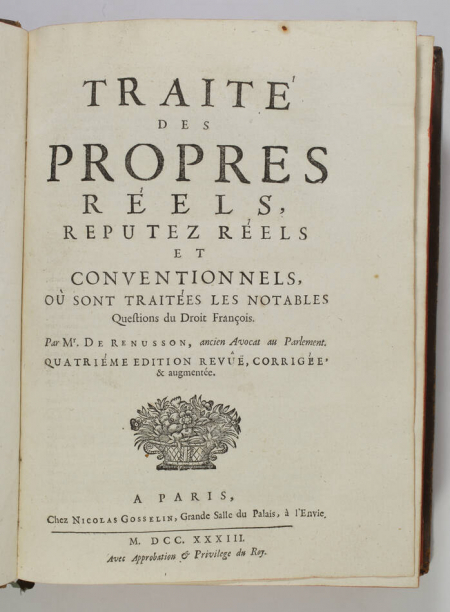
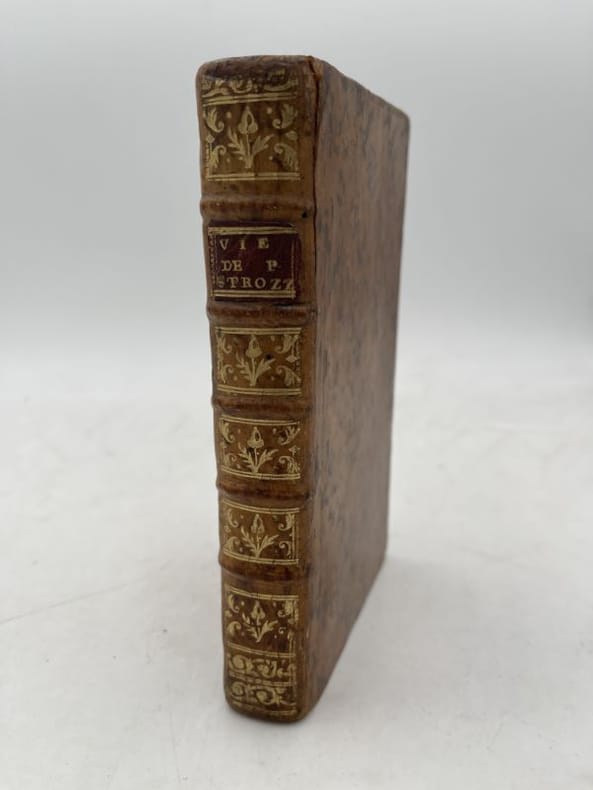
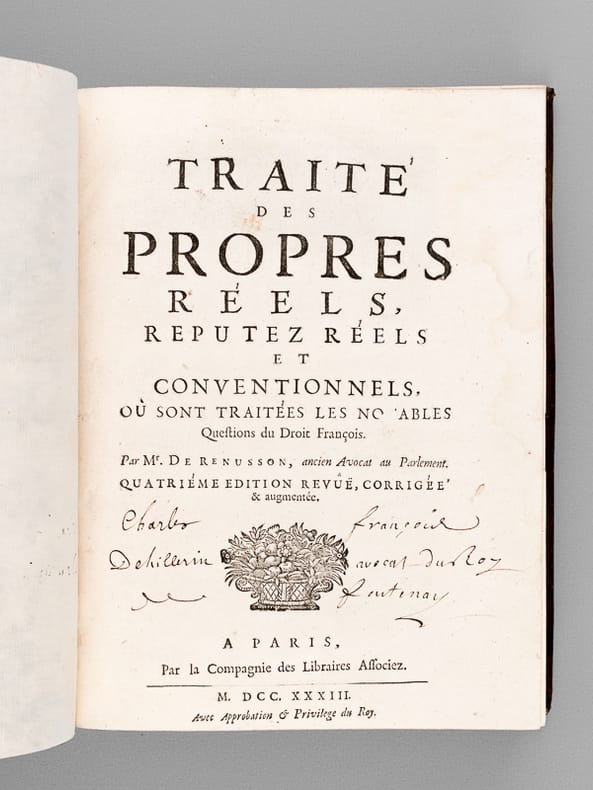
173363719Quatrième édition revüë, corrigée & augmentée, 1 vol. in-4 reliure de l'époque plein veau brun, dos à 5 nerfs orné, Par la Compagnie des Libraires Associés, Paris, 1733, 6 ff., 665 pp. et 13 ff. n. ch. (tables) et 1 f. blanc.
1714168031714 basane mouchetée, dos à nerfs. in-4, (7ff.), 665pp., (12ff.) P. Nicolas Gosselin 1714
17339923Paris, Nicolas Gosselin, 1733. 1330 g In-4, pleine basane, dos orné à nerfs, [6] ff. 665-[27] pp.. Quelques annotations marginales anciennes. Frottements et usures, petit travail de vers dans la marge inférieure des derniers feuillets. . (Catégories : Droit, )
17142059Paris, Nicolas Gosselin, 1714. 1 vol. in-4, (25,5 x 20 cm) ; titre, [14] pp. (discours, table des chapitres et approbation), 665 pp. et [27] pp. (table des matières et privilège du roi). Reliure d'époque en plein veau moucheté, dos à nerfs orné, pièce de titre de maroquin rouge, tranches rouges. Exemplaire agréable. Rares piqûres.
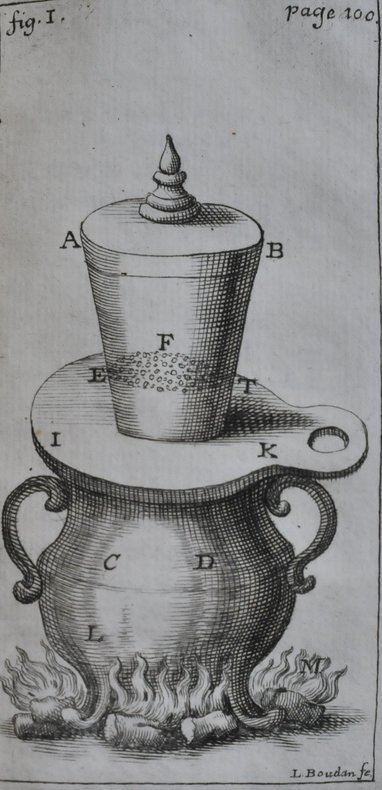
172346405349Paris, Laurent d’Houry, 1723 ; in-12, veau brun, dos orné. (Reliure de l’époque) 6 ff., 206 pp., 1 f. errata - 4 planches gravées hors-texte.ÉDITION ORIGINALE de cette traduction de l’italien du P. Buonanni, un jésuite, par A. J. DEZALLIER D’ARGENVILLE ou par DUFAY (du Jardin des Plantes) Barbier IV 790 qui signale deux rééditions de ce traité en 1780 et 1802.Philippe BUONANNI est né à Rome en 1638 et mort dasn la même ville en 1725. Il est l’auteur de plusieurs ouvrages d’histoire naturelle. On lui doit aussi la description du cabinet de curiosités du célèbre Père Kircher. L’édition originale italienne du traité sur les vernis a paru à Rome en 1720. Sommervogel I, 383 cite d’autres réimpressions de ce traité, rapidement devenu un classique. La laque de Chine est évoquée dès 1655 dans l’Atlas Chinois publié par le missionnaire Martino Martini. Le traité de Buonanni donne toutes les recettes de laques et vernis transparents ou en couleurs de Chine, du Japon et autres, la manière de les cuire, de les orner. Cette première édition est rare.
172891789Paris, Chez François Montalant, Imprimeur-Libraire 1728 In-16. Reliure de l’époque veau havane marbré, dos à nerfs encadrés de fers dorés, 12-212-8-4 pp., figures & diagrammes dans le texte. Reliure légèrement frottée, Sans les 3 planches d'instruments. En l’état.
178956943Strasbourg Levrault 1789. 2 contemp. marbled boards. Spines faded. Gilt lettering and paperlabels pasted on lower part of spines. Stamp on title-pages. 2262274138;3662 pp. and 28 folded engraved plates. A few faint marginal brownspots. Printed on thick fine paper. <br/><br/><em>Klaus Jordan 2049. - Sloos 8192. </em> hardcover
178956943Strasbourg, Levrault, (1789). 2 contemp. marbled boards. Spines faded. Gilt lettering and paperlabels pasted on lower part of spines. Stamp on title-pages. (2),262,(2),74,138366,(2) pp. and 28 folded engraved plates. A few faint marginal brownspots. Printed on thick fine paper.
1777001671Utrecht: G.T. van Paddenburg and J. Visch 1777. Hardcover. Very Good/No Jacket. Folio. Etc. en Andere Voornaame Gebouwen van dit Hertogdom. Four volumes in one Vols. 2-4 dated 1770. Second Edition. Four volumes in one. Separate title pages and pagination. Full vellum binding with decorative blind tooling on front and rear boards. Raised bands and red leather spine label. In tan custom slipcase. Vol. 1: 3 39 p.p. 1 9 leaves of engravings showing castles and countrysides 1 folding; Vol. 2: 43 p.p. with 40 leaves of engravings 3 folding. Vol. 3: 30 p.p. 1 35 engravings 3 folding. Vol. 4: 24 p.p. errors to pagination 13 engravings 2 folding. A historical and genealogical description of the villages cities and prominent buildings in the province of Brabant Netherlands. Illustrations of castles architectural buildings countrysides and coats of arms. Upper front joint cracked and rear joint starting. Some scuffs and black smudges to boards and spine. Light soiling to upper rear board. Pages and endpapers lightly foxed. Otherwise a very good copy with nicely detailed engravings. G.T. van Paddenburg and J. Visch hardcover
1781176431781 PARIS, Imp. de la Valleyre - 1781 - Grand in-8 - Broché - Tiré à part - Frontispice - 64 pages - Propre
1762176884Chez Lambert Paris, Chez Lambert, Brocas, Dessain, 1762. In-12 relié plein veau blond de l'époque, dos à 5 nerfs orné à motifs dorés, pièce de titre de maroquin rouge. Tranches marbrées. 1 feuillet blanc, faux titre, titre, XVI + 171 pages 1 feuillet blanc. Edition originale. Un mors supérieur légèrement fragilsé sinon bel exemplaire.
176327733PARIS Chéreau 1763 une vue d'optique en couleurs, GRAVÉE A L'EAU-FORTE ET AQUARELLE SUR PAPIER DE FORMAT: 43,5 x 30,5 cm., 1763 PARIS Chéreau Editeur,
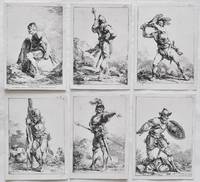
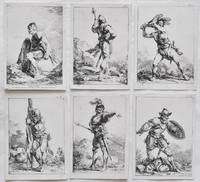
175525093<p>A work from Loutherbourg`s early career when he was in Paris 1755 – 1770. This series is outstandingly rare. Ca. 11.9 x 8.5 cm; plate mark not visible; in fine condition.</p><p>Literature: Le Blanc.</p><p>Loutherbourg an Alsatian painter who studied etching in Johann Georg Wille's academy clearly admired the prints of the seventeenth-century Neapolitan painter Salvator Rosa as did many other French printmakers of the time. In the set entitled "First suite of Soldiers"Loutherbourg took up a format associated with Rosa in order to showcase his own inventiveness and fluency.</p><p><strong>Philip James de Loutherbourg</strong> RA 31 October 1740 – 11 March 1812 whose name is sometimes given in the French form of <strong>Philippe-Jacques</strong> the German form of <strong>Philipp Jakob</strong> or with the English-language epithet of <strong>the Younger</strong> was a French-born British painter who became known for his large naval works his elaborate set designs for London theatres and his invention of a mechanical theatre called the "Eidophusikon". He also had an interest in faith-healing and the occult and was a companion of the confidence-trickster Alessandro Cagliostro</p><p><input type="checkbox"></p></p><p>Loutherbourg was born in Strasbourg in 1740 the son of an expatriate Polish miniature painter.1 Intended for the Lutheran ministry he was educated at the University of Strasbourg.2</p><p>Rejecting a religious calling Loutherbourg decided to become a painter and in 1755 placed himself under >Charles-André van Loo in Paris and later under Francesco Giuseppe Casanova. His talent developed rapidly and he became a figure in the fashionable society of the day. In 1767 he was elected to the French Academy although below the age required by the rules of the institution and painted landscapes sea storms and battles all of which work had a celebrity above those of the specialists then working in Paris. He made his debut with the exhibition of twelve pictures including <em>Storm at Sunset</em> <em>Night</em> and <em>Morning after Rain</em>.2</p><p>Loutherbourg then travelled through Switzerland Germany and Italy distinguishing himself as much by his mechanical inventions as by his painting. One of these showing new effects produced in a model theatre was the wonder of the day with its use of lights behind canvas representing the moon and stars and the illusory appearance of running water produced by clear blue sheets of metal and gauze with loose threads of silver.2</p><p>In 1771 he settled in London where David Garrick paid him £500 a year to design scenery and costumes and oversee the stage machinery at the Drury Lane Theatre.3 His stage effects attracted the admiration not just of the general public but also of artists including Joshua Reynolds. He devised scenic effects in which for instance green trees gradually became russet and the moon rose and lit the edges of passing clouds:2 illusions achieved through the use of coloured lantern-slides and the ingenious lighting of transparencies.4 He continued to work at the theatre until 1785.3</p><p>He achieved an even greater success with an entertainment called the <em>Eidophusikon</em> meaning "image of nature". This was a miniature mechanical theatre measuring six by eight feet and described as displaying "Various Imitations of Natural Phenomena represented by Moving Pictures". It was presented at Loutherbourg's home from March 1781 in an auditorium seating about 130 people. He used Argand lamps to light the stage and stained glass to change colours.</p><p>At Christmas 1781 Loutherbourg mounted a spectacle at a party in the Egyptian Hall at Fonthill for William Beckford promising according to Beckford to "present a mysterious something that the eye has not seen or heart of man conceived".4 Following this he attempted rather more fantastical subjects for the Eidophusikon presenting a scene from <em>Paradise Lost</em> with "Satan arraying his troops on the banks of the Fiery Lake and the rising of the Palace of Pandemonium".4 The Eidophusikon soon closed however as the income did not cover the costs and the audience demanded new productions faster than Loutherbourg could create them. He has been called the inventor of the panorama but although it first appeared about the same time as the Eidophusikon the first panorama was painted and exhibited by the Scottish painter Robert Barker.</p><p>Despite these other projects Loutherbourg still found time for painting. <em>Lord Howe's action or the Glorious First of June</em> exhibited 1795 and other large naval pictures were commissioned to commemorate British naval victories many of them ending up soon afterwards in the Greenwich Hospital Gallery in whose successor the National Maritime Museum they still remain. His finest work was the <em>Destruction of the Armada</em>. He also painted the <em>Great Fire of London</em> and several historical works including the <em>Attack of the Combined Armies on Valenciennes</em> 1793.2 He was interested in the industrial revolution and his 1801 painting <em>Coalbrookdale by Night</em> shows iron foundries at work.</p><p>Seven of his paintings including <em>Lodore Waterfall</em> and <em>Skating in Hyde Park</em> are in the Government Art Collection.5</p><p>He was made a member of the Royal Academy in 1781.</p><p>Two sets of drawings by de Loutherbourg were published reproduced in aquatint under the title <em>Picturesque English Scenery</em> in 1801 and 1805. He also contributed illustrations to a Bible published by Thomas Macklin in 1800.3 After his death Cadell and Davies published a volume of the Apocrypha. All 110 of his drawings for the vignettes but not the Apocrypha are pasted in the Bowyer Bible in Bolton Museum in Greater Manchester.</p><p>Esoteric interests</p><p>In 1789 Loutherbourg temporarily gave up painting in order to pursue an interest in alchemy and the supernatural.3 He met Alessandro di Cagliostro who instructed him in the occult.3 He travelled about with Cagliostro leaving him however before his condemnation to death.2 He and his wife also took up faith-healing. A pamphlet called <em>A List of a Few Cures performed by Mr and Mrs De Loutherbourg of Hammersmith Terrace without Medicine</em> was published in 1789. Written by a follower named Mary Pratt it claimed that the Loutherbourgs had cured two thousand people between Christmas 1788 and the following July "having been made proper recipients to receive divine manuductions".6</p><p>Death</p><p>Loutherbourg died in Chiswick in 1812.</p><p>There are paintings by him in the collections of many British institutions including Tate Britain The Victoria and Albert Museum The National Portrait Gallery The Royal Academy of Art Leicester Farnham and Derby Art Gallery.7</p><p>Loutherbourg was buried in Chiswick Old Cemetery adjoining the graveyard of St Nicholas Church Chiswick. Buried nearby are the artists William Hogarth and James Abbott McNeill Whistler.</p>
176022093<p>A work from Loutherbourg`s early career when he was in Paris 1755 - 1770. This series is outstandingly rare. Ca. 11.9 x 8.5 cm; plate mark not visible; in fine condition.</p><p>Literature: Le Blanc.</p><p>Loutherbourg an Alsatian painter who studied etching in Johann Georg Wille's academy clearly admired the prints of the seventeenth-century Neapolitan painter Salvator Rosa as did many other French printmakers of the time. In the set entitled "First suite of Soldiers"Loutherbourg took up a format associated with Rosa in order to showcase his own inventiveness and fluency.</p>