Rene LEYNAUD - Albert CAMUS (Pref)Biblio.com
3 904 résultats
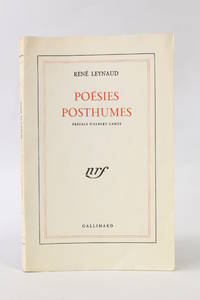
194764501Paris: Gallimard 1947. Fine. Gallimard Paris 1947 12 x 18.50 cm broché First edition one of 13 numbered copies on pur fil paper this copy one of 3 lettered hors commerce the only grand papier deluxe copies. Preface by Albert Camus. Endpapers slightly and partially shaded. Rare and nice copy with a photographic portrait of the author as frontispiece. Gallimard unknown
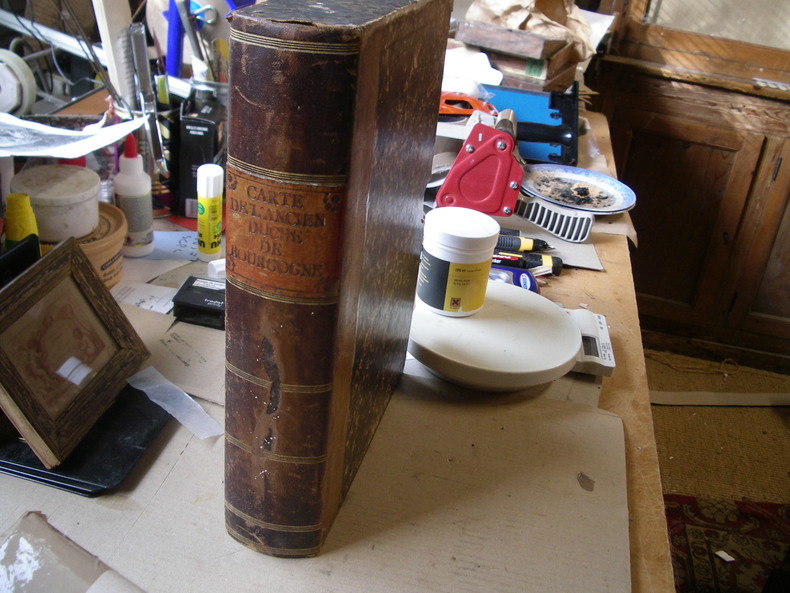
1763177041763 toile, dans un emboitage 35 x 25 x 7 cm (XIXe sur laquelle on a placé l'étiquette XVIIIe). carte composée de 9 feuilles, 290 x 246 cms, 1763
195473748Sous étui bordé et sous chemise en demi-maroquin rouge signés Patrice Goy et C. Vilaine. Couverture souple piquée. Rousseurs éparses. En partie non coupé.
195852286Gallimard | Paris 1958 | 13 x 20 cm | relié
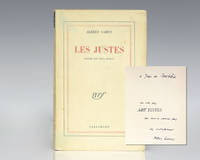
1950137191Paris: Gallimard 1950. First edition early printing of Camus' classic examination of the moral issues associated with murder and terrorism. Octavo original wrappers. Presentation copy inscribed by the author on the half-title page "A Jean de Bosschère crossing through "Les" an nom des que vous no sommes sens tes cordialement Albert Camus." The recipient Jean de Bosschère lived for most of the 20th century between London and France and illustrated his own works as well as the works of Oscar Wilde Charles Baudelaire and the classical works of Aristophanes Ovid Strato and Apuleius. He published his own works of poetry and in 1952 was awarded the Prix de la Méditerranée and in November the Mandat des Poètes. In near fine condition. Camus separated his work into three cycles. Each cycle consisted of a novel an essay and a play. The first was the cycle of the absurd consisting of L'Étranger Le Mythe de Sysiphe and Caligula. The second was the cycle of the revolt which included La Peste The Plague L'Homme révolté The Rebel and Les Justes The Just Assassins. The third the cycle of the love consisted of Nemesis. Each cycle was an examination of a theme with the use of a pagan myth and including biblical motifs. Camus began his work on the second cycle while he was in Algeria in the last months of 1942 just as the Germans were reaching North Africa. Based on the true story of a group of Russian Socialist-Revolutionaries who assassinated the Grand Duke Sergei Alexandrovich The Just Assassins explores the moral issues associated with murder and terrorism. Gallimard unknown
1946150923New York: Alfred A. Knopf 1946. First American edition of Camus' first novel and masterpiece. Octavo original beige cloth. Fine in a fine dust jacket with a single closed tear. Jacket design by Warren Chappell. Translated by Stuart Gilbert. The nicest example we have ever seen. Through the story of an ordinary man unwittingly drawn into a senseless murder on an Algerian beach Camus explored what he termed "the nakedness of man faced with the absurd." With the publication of this first novel L’Etranger The Stranger Camus introduced his lifelong attempt to reconcile a philosophy of heroic nihilism with “the ideal of human fraternity†Encyclopedia of Philosophy. It remains one of the classic works of the twentieth century. Alfred A. Knopf hardcover
196244658Paris: Gallimard 1962. Fine. Gallimard Paris 1962 12.50 x 19.50 cm relié First edition one of 90 numbered copies on Hollande paper the tirage de tête. Elegant half red morocco binding over marbled paper boards by P. Goy & C. Vilaine spine in six compartments marbled endpapers and pastedowns covers and spine preserved top edge gilt. A very good well-margined copy in a handsome binding. Gallimard hardcover
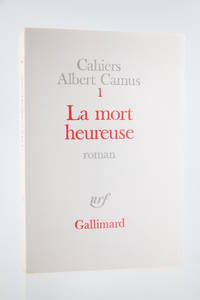
197178115Paris: Gallimard 1971. Fine. Gallimard Paris 1971 14.50 x 21.50 cm broché First edition one of 106 numbered copies on Holland the tirage de tête. A beautiful copy of this important text in the work of Albert Camus: although published posthumously it is indeed his first novel which is considered a first draft of L'Etranger. Gallimard unknown
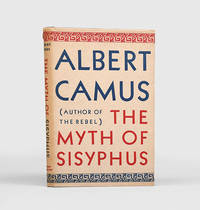
1955192704London: Hamish Hamilton 1955. One must imagine Sisyphus happy First edition in English including a new preface by Camus and collecting the title essay alongside "Summer in Algiers" "The Minotaur or The Stop in Oran" "Helen's Exile" "Return to Tipasa" and "The Artist and His Time". Camus's absurdist treatise on the philosophical problem of suicide was first published as Le Mythe de Sisyphe in 1942. Addressing his English readers Camus comments that "written fifteen years ago in 1940 amidst the French and European disaster this book declares that even within the limits of nihilism it is possible to find the means to proceed beyond nihilism. This book is in a certain sense the most personal of those I have published in English". It acts as a non-fictional companion to his novel L'Étranger 1942. The translator Justin O'Brien 1906-1968 was a professor of French at Columbia University who translated many works by Camus and certain works by Jean-Paul Sartre and André Gide including Gide's collected journals. Octavo. Original blue boards spine lettered in silver. With dust jacket. Spine ends bumped a few spots to edges; jacket unclipped spine lightly toned closed tear to spine head couple of nicks and creases: a very good copy in like jacket. hardcover
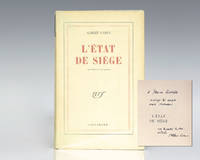
1948137545Paris: Gallimard 1948. First edition early printing of Camus' fourth play a political allegory about resistance to the plague of authoritarian rule. Octavo original wrappers. Presentation copy inscribed by the author on the half-title page "A Jean de Bosschère assiege sure anso mars insoumais L'Etat de Siege are Esperes a plus cordials Albert Camus." The recipient Jean de Bosschère lived for most of the 20th century between London and France and illustrated his own works as well as the works of Oscar Wilde Charles Baudelaire and the classical works of Aristophanes Ovid Strato and Apuleius. He published his own works of poetry and in 1952 was awarded the Prix de la Méditerranée and in November the Mandat des Poètes. In near fine condition. Written in 1948 The State of Siege—the original sense is closer to state of emergency—is a play in three acts presenting the arrival of plague personified by a young opportunist in sleepy Cadiz and the subsequent creation of a totalitarian regime through the manipulation of fear. In a piece written in 1948 in reply to criticisms from Gabriel Marcel Camus defended his decision to set the play in Spain and not in Eastern Europe citing the ongoing oppression in Spain France's collusion in it and the Catholic Church's abandonment of Spanish Christians. The piece was first performed in October 1948 and was initially received poorly by critics and public who had eagerly awaited the work but expected a dramatization of Camus's novel The Plague. While the two share a common background the treatments are entirely different in tone. The work has remained almost constantly in print in French and since 1958 in an English translation by Stuart Gilbert—in Caligula and Three Other Plays—with a foreword by Camus. Gallimard unknown
1955122226London: Hamish Hamilton Pub.;.TRINITY PRESS. Very Good in Very Good dust jacket. 1955 VERSO. first editionUK. HARDCOVER. 6x8". VERY GOOD CONDITION IN VERY GOOD UNCLIPT15s. ne t DUST JACKET. Includes old newspaper page 778 from "THE TIMES LITERARY SUPPLEMENT FRIDAY DECEMBER 23 1955" review by Translator for this edition.JUSTIN O'BRIENstated pr ice was 15s. confirms this is first ed DUST JACKET .Has left light tan area on inner ep from being laid in since purchase.now in its own plastic protector. book look new I do not describe any book above VG/VG.but it has no defects beside effect oof newspaper review. ; BOOK APPEARS WITH SILVER SPINE TITLES ON DARK BLUE TEXTURED HARD COVERS.Tan paper dust jacket has black & red titles. with red and black border designs. Back pane describes revies for THE PLAGUE. ; 169pgg pages; Hamish Hamilton. States "First published Year" or "First published in Great Britain in Year" on copyright page; notes subsequent printings.this copy meets that standard no subs. printing noted to proper statement verso. . Hamish Hamilton Pub.;.TRINITY PRESS hardcover
1955212314Hamish Hamilton 1955. First English Translation first printing. Hardcover in dust jacket. Inked in ownership along inside edge of ffep light rippling to inside edge of front paste down from binding some acid browning from laid in Times supplement now in mylar sleeve. Text block is extremely clean crisp and tight very near fine in near fine to fine dust jacket with a shade of toning to spine and just a touch of wear to spine head NOT price-clipped in mylar cover. It's difficult to find a more beautiful copy of this monumental absurdist text. <br /> <br /> Originally written in 1942 The Myth of Sisyphus is in many ways the literary companion to The Stranger––published that same year. <br /> <br /> As an introduction to his absurdist philosophy this work addresses what is in Camus' estimation the only truly serious philosophical problem"––suicide. In Camus' own words: "This book declares that even within the limits of nihilism it is possible to find the means to proceed beyond nihilism. The Myth of Sisyphus sums itself up for me as a lucid invitation to live and to create in the very midst of the desert." <br /> <br /> Translated from the French by Justin O'Brien. <br /> <br /> Includes the Times literary supplement from Friday Jan. 8 1960 discussing Camus' influence. Hamish Hamilton hardcover
19508993ROWOHLT ERNST 11/1950. 1. softcover. ROWOHLT, ERNST paperback
19918991ROWOHLT ERNST 05/1991. 1226.-1245. Tsd. softcover. ROWOHLT, ERNST paperback
195347737Gallimard | Paris 1953 | 12 x 19 cm | broché
195363678Gallimard | Paris 1953 | 12 x 19 cm | relié
195482990Gallimard | Paris 1954 | 12 x 18.50 cm | broché
195354039Gallimard | Paris 1953 | 10.50 x 16.50 cm | relié
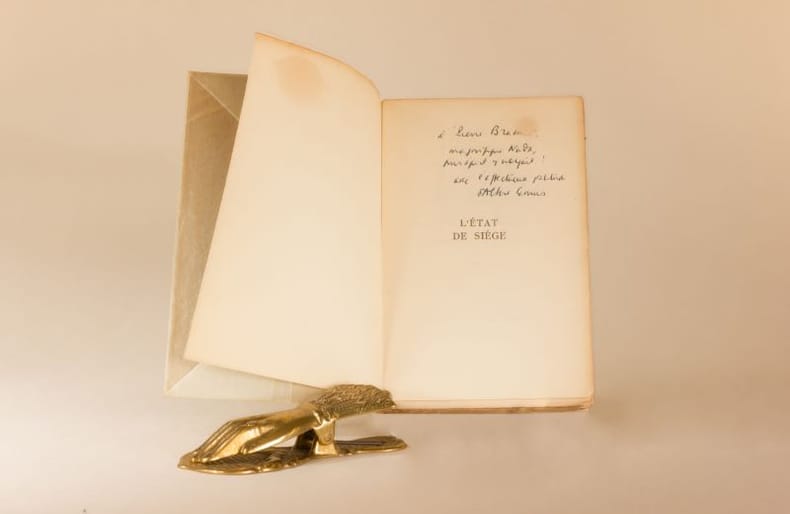
1948116393Paris Gallimard 1948 1 vol. Broché in-12, broché, 233 pp. Edition originale. Un des 235 exemplaires numérotés sur alfa Navarre, celui-ci hors commerce (n°XLI), comprenant un bel envoi autographe signé de l'auteur : "à Pierre Brasseur, magnifique Nada puisqu'il y croyait ! avec l'affectueuse gratitude d'Albert Camus". On relève des notes à l'encre pour la mise en scène sur les quatre dernières pages du texte, groupes de mots soulignés ou placés entre parenthèses, dialogue barré et mot ajouté. Petite tache sur le premier feuillet affectant légèrement l'envoi, sinon bonne condition.
1948116393Paris Gallimard 1948 1 vol. Broché in-12, broché, 233 pp. Edition originale. Un des 235 exemplaires numérotés sur alfa Navarre, celui-ci hors commerce (n°XLI), comprenant un bel envoi autographe signé de l'auteur : "à Pierre Brasseur, magnifique Nada puisqu'il y croyait ! avec l'affectueuse gratitude d'Albert Camus". On relève des notes à l'encre pour la mise en scène sur les quatre dernières pages du texte, groupes de mots soulignés ou placés entre parenthèses, dialogue barré et mot ajouté. Petite tache sur le premier feuillet affectant légèrement l'envoi, sinon bonne condition.
19509405Paris, Gallimard, [1950]. In-12 (186 x 118 mm), 92 pp., 2 ff. n. ch. Broché, papier bruni.
194764501Gallimard | Paris 1947 | 12 x 18.50 cm | broché
195458313Paris, Gallimard, 1954. Uncut in the original printed wrappers. A very nice copy housed in a beautiful brown half morocco box with gilt lettering to spine and gilt super ex-libris to front board.
195458313Paris Gallimard 1954. Uncut in the original printed wrappers. A very nice copy housed in a beautiful brown half morocco box with gilt lettering to spine and gilt super ex-libris to front board. <br/><br/><em>First edition Service de presse-copy i.e. review-copy "S.P" to bottom of title-page and to verso of back wrapper of Camus' magnificent and highly influential collection of essays entitled "Summer" inscribed to the famous critic of literature and drama the writer Guy Dumur 1921-1991: "à Guy Dumur/ l'une des/ ÉTÉs ÉTÉ being printed an L' crossed out in front with s added in Camus' hand/ son vieil et fidele ami/ Albert Camus" on half-title.The younger Guy Dumur was a close friend of Camus who hired him to work on "Combat" with him. It is reported that he had a great talent for discovering new talent. Since childhood he was extremely passionate about the theatre and came to work with all the great dramatic figures in Paris at the time. He is also famous for a number of well respected novels. The essays in "L'été" are devoted to Algiers and represent a very personal side of Camus who provides a marvelous poetic and humorous picture of the provincial simplicities of Oran and Algiers. For many Camus-devotees "L'Été" constitutes one of the most beloved works as it gives the feel of a certain intimacy with the author that few of his other works does. "In "Return to Tipasa" perhaps the most confessional essay in "Summer" which dates from a long trip to Algeria in December 1952 Camus issues his now famous testimony of survival - "In the depths of winter I finally learned that within me lay an invincible summer" Hawes: Camus A Romance 2009 pp. 181-82. </em> unknown
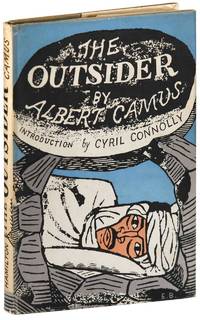
19467282London: Hamish Hamilton 1946. First UK Edition. First Impression. Octavo 19cm; gray-green textured cloth with titles stamped in gilt on the spine; ii104pp. Hint of sunning to spine scattered foxing to upper and right edge of textblock; Near Fine. Dustjacket is unclipped priced 6s. net gently spine-sunned and lightly edgeworn with a few tiny nicks and tears to extremities and some faint foxing to rear panel; Very Good.<br /> <br /> Camus's first novel and the first to be published in English preceding the American edition published by Knopf and with an introduction by Cyril Connolly not present in the American edition. Since it was first published by Gallimard as L'Etranger in 1942 Camus's first-person narrative of solitude and disaffection has become a classic of existential literature and the basis for the 1967 Luchino Visconti film starring Marcello Mastroianni and Anna Karina. Connolly 100. Hamish Hamilton unknown