432 résultats
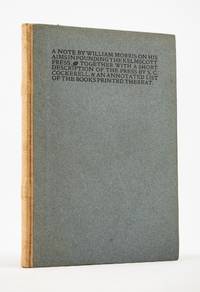
1898ST20842Hammersmith: Kelmscott Press 1898. ONE OF 525 COPIES on paper and 12 on vellum. 210 x 150 mm. 8 1/4 x 5 3/4". 4 p.l. including two blanks 70 pp. 1 leaf colophon. <br/> Original holland-backed blue paper boards. WOODCUT ILLUSTRATION BY EDWARD BURNE-JONES of "Pysche Borne off by Zephyrus" ENGRAVED BY WILLIAM MORRIS elaborate borders around this and first page of text designed and cut by Morris large decorative woodcut initials device on last page of text and one full-page woodcut of ornaments used in the Kelmscott edition of "Love is Enough." Printed in red and black in Golden Troy and Chaucer types. With errata slip laid in at title page. Front pastedown with Arts & Crafts-style bookplate of Edmund Bulkley dated 1893; a list of the Kelmscott books in E. W. Buckley's collection listed by the number assigned to them in this book recorded in pencil on a translucent piece of paper laid in here. Morris & Cockerell 53; Peterson A-53; Ransom 53; Tomkinson p. 121. Some wear to lower corners just a hint of soil to covers otherwise a very fine copy--exceptionally fresh clean and bright internally.<br/> <br/> Owned by two collectors with a special interest in Morris this is a very pleasing copy of one of the key Kelmscott Press books and the last one to be issued by the press. Morris tells us here about his admiration for 15th century printed books saying that "they were always beautiful by force of the mere typography even without the added ornament with which many of them are so lavishly supplied." And he says that "it was the essence of his undertaking to produce books which it would be a pleasure to look upon as pieces of printing and arrangement of type." This is the most important contemporaneous source of comment on the founding operation and publications of the Kelmscott Press. Peterson quotes Newdigate who says that this is "one of the three books that every student of English book-production ought to read." The original owner here was American private press collector Edmund Bulkley who according to the list laid in at the rear of this volume owned 42 Kelmscott books. Evidently prepared after Bulkley's death the list also marks with a "0" the books sold before 1950 and notes at the end the books including this volume that remained in the possession of "M A B B." this might refer to a relation possibly art collector M. A. B. Bulkley who bequeathed a Pre-Raphaelite-style painting to the Fitzwilliam Museum in 1996. Bulkley's distinctive bookplate perhaps created by one of the private presses is found in a number of press books which when listed at auction are in notably fine condition. In 1883 Morris & Company took out a full-page ad in the Official Catalogue of the Boston Foreign Exhibition announcing the appointment of Elliott & Bulkley of 42 East 14th Street New York City as U.S. agents for the sale of Morris & Co. "Decorative Manufactures" including wallpaper fabrics and "the celebrated Hammersmith carpets made only by Morris & Company." It is tempting to speculate that Edmund Bulkley was associated with this firm and became aware of the Kelmscott Press via this connection with Morris & Company. Although without additional signs of ownership our book was later sold as part of the library of Clive Wilmer 1945-2025 English poet and scholar of John Ruskin and William Morris. He wrote and lectured extensively on both men and from 2009 to 2019 served as Master of The Guild of St. George a charity for arts crafts and the rural economy founded by Ruskin in 1871. The Ruskin Society of North America presented him with a Lifetime Achievement Award in 2023. Copies of this work appear with some regularity in the marketplace but specimens in attractive condition are becoming increasingly difficult to find. Kelmscott Press unknown
1837219681London: James Fraser 1837. First edition. 8vos. Red crushed morocco. teg marbled endpapers french fillet border front panels raised bands spine gilt in compartments with floral centerpieces inside floral spray borders lavish inner dentelles. A Club Bindery production and stamped by them on the inside lower front dentelle. A few surface nicks to boards some marginal foxing a uniformly fine set. Red morocco ex libris bookplate of important American collector and founder of the Grolier Club Robert Hoe 1839-1911 front pastedown of each volume. A handsome set in custom cut mylar covers. James Fraser unknown
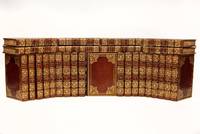
1880135178London: Chapman and Hall 1880. hardcover. very good. 34 volumes 30 original 1 volume Index 3 volumes of Carlyle's Translations from the German. Frontispiece illustrations in some volumes. 8vo handsomely bound in 3/4 tan polished calf; ornately gilt-decorated spines with raised bands; burgundy and black leather labels marbled edges. London: Chapman and Hall no date circa 1880. A very good set. The Library Edition.<br/><br/> Chapman and Hall unknown books
1880135178London: Chapman and Hall 1880. hardcover. very good. 34 volumes 30 original 1 volume Index 3 volumes of Carlyle's Translations from the German. Frontispiece illustrations in some volumes. 8vo handsomely bound in 3/4 tan polished calf; ornately gilt-decorated spines with raised bands; burgundy and black leather labels marbled edges. London: Chapman and Hall no date circa 1880. A very good set. The Library Edition.<br/> <br/> Chapman and Hall unknown
18963445London: Chapman and Hall Limited 1896. The Centenary Edition Large Paper Edition Limited Edition. Leather Bound. Very Good. The Centenary Edition Large Paper Edition Limited Edition. Leather Bound. 30 vol. Thomas Carlyle The Works of Thomas Carlyle. <br /> The Centenary Edition Large Paper Edition Limited Edition limited to 300 sets of which this is no. 274. Illustrated frontispiece of Louis XVI of France. Illustrated throughout. Top edges gilt raised bands on spine. Bound in full brown Morocco leather with elaborate gilt floral embellishments on front and back covers and beautiful gilt floral embellishments on spine panels. Beautiful leather and silk doublures on inner covers. Published London: Chapman and Hall Limited 1896.<br /> H: 8 7/8" W: 6 1/4" D: 1 1/2 Chapman and Hall Limited unknown
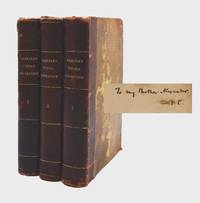
1837372411London: James Fraser 1837. First Edition with half-titles. vii 1 404; vii 1 422 2; vii 1 448pp. 3 vols. 8vo. Contemporay three-quarters morocco with gilt bands and title to spine and marbled paper boards. General edgewear and rubbing to boards spine and corners generally sound; tear to half-title and bump to contents pages in vol. 3 overall occasional spotting and foxing to endpapers. Letters with old folds staining some loss both silked. In matching custom clamshell box and folder. First Edition with half-titles. vii 1 404; vii 1 422 2; vii 1 448pp. 3 vols. 8vo. Inscribed in the first volume: "To my brother Alexander. T.C." With 2 ALS laid in from Thomas to his brother Alex as well as a note laid-in in pencil: "Published 1837 / autographed to Grandfather / HCJ 1950." <br /> <br /> Carlyle and his brother Alexander were the eldest of nine children and their correspondence goes from when Carlyle was in Edinburgh trying to get his footing as a writer until Alexander died on his farm in Canada in 1876. They were "remarkably close" and Thomas wrote to Alexander with "an open and copious expression of feeling and in this regard are distinguished from the letters Carlyle wrote to Goethe Emerson Mill Sterling and Browing.He showed his love for Alexander in many of the letters he wrote either to or about him by the frequency with which he wrote and the moral and financial support he gave to him by accepting support from him in return and by graphically bringing to him the sophisticated worlds from which Alexander was isolated" Marrs p. viii.<br /> <br /> One of Carlyle's dreams was to live on a self-sustaining farm where he could work in peace. He moved to such a farm in Hoddam Hill in May 1825 which his father leased for him and Alexander moved away from the family farm to work the land with a helper. The plans for the farm are discussed in the second letter sent February 1825. Disagreements with the landlord caused them to give up the plot but Carlyle would remember it fondly the rest of his life. Alexander eventually moved to Canada to live on his own farm.<br /> <br /> The first letter of 24th of May 1823 tells an animated and detail rich story about traveling to Kinnaird the Buller house near Dunkeld where he was to work as tutor to the two adolescent sons. He talks sitting next to a Dr. Fyfe one of Jane Welsh's "more ardent and enterprising suitors" Marrs p. 146 as well as his impressions of first arriving in Dunkeld "among people of such a fashionable turn" and the house where he was to stay. At the time he was deeply involved in his Life of Schiller articles for Taylor's London Magazine completing the first of three articles in April and had begun translating Goethe's Apprenticeship of Wilhelm Meister for Edinburgh publisher Boyd: "The family received me hospitly and shewed me into my quarters where I spent two hours in unpacking and arranging my goods. I have not dined and having all put to rights I am scribbling to Alick.I shall be quite comfortable here.I shall be as quiet as in the middle of Sahara; shall bolt my door and study and read and smoke according to my own pleasure." <br /> <br /> The second letter dated February 14 1824 sic. but postmarked February 17 1825 discusses his plans: "I must settle some place of abode for myself some scheme of existing in conformity to my medical prescriptions and also of proceeding with my literary employments. The farm is still my favourite or rather only steady project. A reasonable house is all that I want; with land that would pay you for working it." He talks also of learning Spanish and describes his dreams of accomplishment and reputation: "Literary fame is a thing which I covet little; but I desire to be working honestly in my day and generation in this business which has now become my trade. I make no grain of doubt that in time I shall penetrate the fence that keeps me back and find the place which is due to me among my fellow men. Some hundreds of stupider people are at this very time doing duty with acceptance in the literature of the time. We shall see; I am not at all in a hurry; the time will come."<br /> <br /> It was this book written a decade later that established Carlyle's reputation as an important intellectual: "a prose epic teeming with colourful scenes of dramatic events and imaginative portraits of the leading revolutionaries. The book at once captured the English-speaking world and has outside France moulded popular conception of the French Revolution down to the present day" PMM In his letter to Alexander in Canada written 23 April 1837 he references the completion of "The Book" "it is all in type my share of it finished.I suppose it will be out as a Book in not many days. You shall have a Copy of it by the earliest chance after that; and good appetite I shall wish you with it. It is I think the most radical Book that has been written in these late centuries.and will give pleasure and displeasure one may expect to almost all classes of persons. Let it take its fate: the great indisputable blessin is that I have done with it forever and a day" Marrs p. 421. PMM 304; Marrs ed. The Letters of Thomas Carlyle to his Brother Alexander p. 142-147 p. 191-195 James Fraser unknown
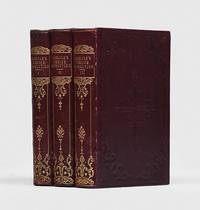
1837174294London: James Fraser 1837. Moulding "popular conceptions of the French Revolution down to the present day" First edition bound for presentation and inscribed by the author to his mother-in-law on the title page of the first volume: "To Mrs. John Welsh. Liverpool. T.C. London June 1837". A leaf of the original manuscript closely written across two sides is bound in facing the title. Presentation copies of Carlyle's magnum opus are extremely scarce. The History was published in May 1837. Grace Welsh 1782-1842 the mother of Jane Welsh Carlyle 1801-1866 is recorded as visiting the couple in London at the end of May whereupon Thomas removed himself to rural Scotland. Grace had not approved of her daughter's choice to marry Carlyle in October 1826. In Jane's own words writing to him without her mother's knowledge made her "as nervous as if I were committing a murder" ODNB. Grace leased the pair a modest home in Edinburgh shortly after their marriage but relations between mother and daughter remained fraught throughout their lives. While writing the History Carlyle observed of one maternal visit that "Jane and her mother cannot live together" quoted in Ireland p. 151. The manuscript leaf preserves the text for pages 58-62 of Volume III discussing the aftermath of the September Massacres of 1792. It runs to 45 lines and contains several corrections and crossed-through sections including some two and a half lines not printed on page 59. The final manuscript of the History was largely destroyed after publication only fragments remaining. This copy remained in the Welsh family until 1938 when it was sold at Sotheby's after the death of Mary Chrystal the granddaughter of Jane Welsh's uncle. Carlyle's History remains one of the most authoritative accounts of the early Revolution. The work established his reputation as an intellectual and influenced many of his contemporaries - including Dickens whose Tale of Two Cities drew heavily from it. "The book at once captured the English-speaking world and has outside France moulded popular conceptions of the French Revolution down to the present day" PMM. 3 vols octavo 182 x 115 mm. All vols bound without half-titles vol. II bound without leaf of publisher's advertisements at rear. Bound for presentation in contemporary full purple morocco spines lettered and decorated in gilt covers with decorative border and central ornament in blind turn-ins in gilt light yellow coated endpapers edges gilt. Housed in custom red morocco book-form case. Neat contemporary note to p. 318 of vol. III "see 328". Margins of manuscript leaf slightly trimmed vol. III sig. P4 bound after P8. Aside from light rubbing to extremities and very minor sunning to spines bindings bright and fresh slight superficial split to front inner hinge of vol. I and in a few places to the text block but all holding firm scattered light foxing. A highly attractive copy. Dyer p. 85; Printing and the Mind of Man 304; Tarr A8.1. Annie Elizabeth Ireland Life of Jane Welsh Carlyle 1891. unknown