Jean COCTEAUBiblio.com
829 résultats
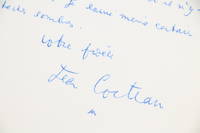
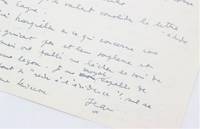
195083936s. l. 1950. Fine. s. l. 4 février 1950 21 x 27 cm une page sur un feuillet Autograph letter signed ""Jean"" and with a small star addressed to his English translator Marie Hoeck one page in blue ink on a sheet of fine white paper. Transverse folds inherent to posting. On the verso notes by the translator in ballpoint pen. Jean Cocteau is overworked by several projects: ""I have finished the mixtures of sounds and music for Orphée. I will probably finish the images for Les Enfants Terribles next week. . I do not speak to you of Léone because I look at her feel her steep myself in her - but alas my English allows me nothing more than to breathe in her light ink."" He shares with his translator his great fatigue: ""Then relaxation and fatigue - for fatigue only manifests itself in rest. . I am quite at ease concerning your springs. They do not creak and their flexibility is perfect. Mine nearly gave way on me the evening in Brussels. It is a lesson. I thought myself capable of the impossible. One must ""face the facts"" no one can do it."" unknown
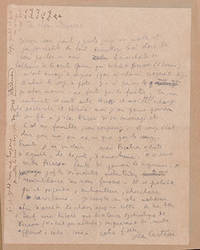
195287645Saint-Jean-Cap-Ferrat 1952. Fine. Saint-Jean-Cap-Ferrat 8 Novembre 1952 21 x 27 cm une page Autograph letter dated and signed by Jean Cocteau 15 lines in blue ink addressed to a friend from Saint-Jean-Cap-Ferrat about a painting he is about to complete. Fold marks inherent to postal delivery. Jean Cocteau questions his correspondent about the shipping arrangements for his work which he plans to finish the day after writing this letter: ""Should I bring it back to Paris or send it elsewhere if that suits you The best would be to remove the canvas from its frame and roll it. Please be so kind as to reply quickly so that I can prepare the packaging."" ; he briefly describes the work: "". will be 92 cm in height and 1 m 26 wide. It appears as if it were in flat tints and there is not a single flat surface. I even leave some sunken areas that form dark patches."" unknown
195366053Monaco: Editions du Rocher 1953. Fine. Editions du Rocher Monaco 1953 14.50 x 19 cm broché First edition one of 100 numbered copies on pur fil paper the tirage de tête. A nice copy despite tiny spots not serious on the first free endpaper. Illustrated as frontispiece a portrait of the author by Modigliani and a drawing hors-texte by Hans Bellmer. Editions du Rocher unknown
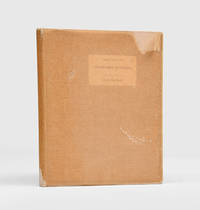
aly655Paris: Flammarion 1948. First Edition Limited to 1000 Copies this being 826. folio. pp. 13. 5 watercolour & 7 drawing reproductions. bds corners rubbed & upper corner bumped. cloth slip-case worn with chips 2 sides detatched & missing Paris: Flammarion, [1948] hardcover
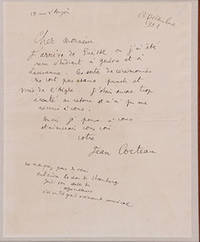
51-3555Paris: 1921. 4to. ALS from Cocteau dated 13 décembre 1921 from 10 rue d'Anjou his mother's apartment on his return from Switzerland. Cocteau tells his frecipient not to miss the performance of the chore by Schoenberg in Paris at the salle des Agriculteurs.Mme Cocteau s'installe au 10 rue d'Anjou en 1910 et elle y habitera jusqu'à la guerre de . Jean Cocteau Lettre-plainte Roland Saucier éditeur Paris 1926. Arnold Schoenberg Paris : Fayard 1993 p. 172-173. . partielle le 15 decembre 1921 a la salle des Agriculteurs Provenance:José Chaidron 1913-1997Comme l’avait dit Jean-Pierre Lambot lors du décès de José Chaidron en juillet 1997 : « La Glycine était plus encore qu’un hôtel devenu galerie d’art. Elle était l’expression des passions de José et Dieu sait s’il en avait. On peut dire que chaque vitrine du rez-de-chaussée abritait une collection qui était chaque fois une passion : Jean Marais Jean Cocteau la numismatique la géologie les statuettes religieuses et puis aussi cette extraordinaire série de miniatures consacrées au pont Saint Lambert. Chacune de ces collections était en définitive une facette de l’esprit envieux mais aussi imaginatif de José Chaidron » Au fil des années la Glycine est devenu un véritable temple de l’Art. Les premiers à y exposer seront deux ecclésiastiques : Bonaventure Feuillin et Cornerotte. Des centaines d’autres suivront. Parmi eux on peut citer Maringer Schuddeboom Marie Howet Albert Raty Benjamin Gourmet etc. Tous y laisseront des souvenirs inoubliables et contribueront à la renommée de l’établissement. Lithographie en couleurs sur ArchesSignée dans la plancheNumérotée 196/700 au dosFrançois Wahl Editeur Nice166 x 12 cmProvenance:José Chaidron 1913-1997Comme l’avait dit Jean-Pierre Lambot lors du décès de José Chaidron en juillet 1997 : « La Glycine était plus encore qu’un hôtel devenu galerie d’art. Elle était l’expression des passions de José et Dieu sait s’il en avait. On peut dire que chaque vitrine du rez-de-chaussée abritait une collection qui était chaque fois une passion : Jean Marais Jean Cocteau la numismatique la géologie les statuettes religieuses et puis aussi cette extraordinaire série de miniatures consacrées au pont Saint Lambert. Chacune de ces collections était en définitive une facette de l’esprit envieux mais aussi imaginatif de José Chaidron » Au fil des années la Glycine est devenu un véritable temple de l’Art. Les premiers à y exposer seront deux ecclésiastiques : Bonaventure Feuillin et Cornerotte. Des centaines d’autres suivront. Parmi eux on peut citer Maringer Schuddeboom Marie Howet Albert Raty Benjamin Gourmet etc. Tous y laisseront des souvenirs inoubliables et contribueront à la renommée de l’établissement. Lithographie en couleurs sur ArchesSignée dans la plancheNumérotée 196/700 au dosFrançois Wahl Editeur Nice166 x 12 cmecembre 1951 on his return ot 10 rue d'Ajour from Switzerland.Provenance:José Chaidron 1913-1997Comme l’avait dit Jean-Pierre Lambot lors du décès de José Chaidron en juillet 1997 : « La Glycine était plus encore qu’un hôtel devenu galerie d’art. Elle était l’expression des passions de José et Dieu sait s’il en avait. On peut dire que chaque vitrine du rez-de-chaussée abritait une collection qui était chaque fois une passion : Jean Marais Jean Cocteau la numismatique la géologie les statuettes religieuses et puis aussi cette extraordinaire série de miniatures consacrées au pont Saint Lambert. Chacune de ces collections était en définitive une facette de l’esprit envieux mais aussi imaginatif de José Chaidron » Au fil des années la Glycine est devenu un véritable temple de l’Art. Les premiers à y exposer seront deux ecclésiastiques : Bonaventure Feuillin et Cornerotte. Des centaines d’autres suivront. Parmi eux on peut citer Maringer Schuddeboom Marie Howet Albert Raty Benjamin Gourmet etc. Tous y laisseront des souvenirs inoubliables et contribueront à la renommée de l’établissement. Lithographie en couleurs sur ArchesSignée dans la plancheNumérotée 196/700 au dosFrançois Wahl Editeur Nice166 x 12 cm Paris: 1921 unknown
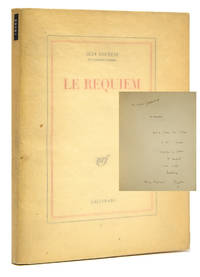
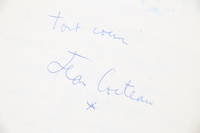
1962311626Paris: Gallimard 1962. First trade edition. 171 3pp. 4to. Printed wrappers. Fine. First trade edition. 171 3pp. 4to. This collection of poems Cocteau's final book published just a year before his death. This copy warmly inscribed at length by Cocteau and signed by him with his characteristic star flourish to his good friend Maurice Goudeket who was married to Cocteau's dear friend Colette until her death in 1954. Gallimard unknown
1926D1873Paris: Editions Briant-Robert 1926. Limited Edition. Paperback. Near Fine. Number 383 from a limited edition of 200 copies "sur velin 180 sur arches 20 sur rives" signed by Cocteau on the limitation page. Total limitation 500 copies. <br/><br/> Editions Briant-Robert paperback
dola808Paris: Éditions des Quatre Chemins 1929. First Edition: Hors-Commerce copy on vélin de Rives printed for M. Berthold Held total edition: 605. Lani a Polish Jew arrived in Paris in 1928 proclaiming to be a silent film star from Berlin. She quickly managed to enlist an impressive group of contemporary artists to produce portraits of her that were to be used on the set of a projected film. Picasso refused to collaborate. The film was never made but an exhibition of the portraits travelled to galleries and art centres in New York Chicago London Berlin Paris and Rotterdam. 4to. pp. 24. frontis. portrait by Lipnitzky & 51 reproductions of portraits of Lani by Bonnard Braque Chagall De Chirico Derain Foujita Matisse Man Ray Dufy Rouault & others. contemporary calf light wear to extremities Paris: Éditions des Quatre Chemins, [1929] unknown
1948140937499Paris: Gallimard 1948. Eleventh Edition. Very Good. Eleventh edition onzieme edition. Signed by Jean Cocteau inscribed to a former owner on the half-title page. Very Good with toning light reading creases to spine and previous owner bookplate to verso of front cover. Revised price-over label on spine is lifted on one edge. Signed by the French writer poet playwright designer and filmmaker. Gallimard unknown
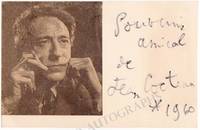
M6847-H3D<p>French poet 1889-1963 and also writer designer playwright artist and filmmaker.</p><p>Signed card with a short sentiment attached with a half-tone photograph of him dated by him in 1960. Size is 5 x 3.25 inches in excellent condition.</p><p>Interested in more autographs and memorabilia of Literature Personalities please visit us following this link https://www.taminoautographs.com/collections/literature-autographs</p>
190939420Maisons-Laffitte / Arnaga 1909-1910. A SIGNED AUTOGRAPH POEM BY JEAN COCTEAU about a prematurely aged female drinker. Four verses in ink in an extremely legible cursive hand on a single leaf of light card measuring 25 x 25 cm. SIGNED with Cocteau's monogram. EARLY AUTOGRAPH POEMS BY COCTEAU ARE VERY RARE; SIGNED ONES ARE OF THE GREATEST RARITY. A tiny bit of wear but in overall excellent condition. <br/><br/> unknown
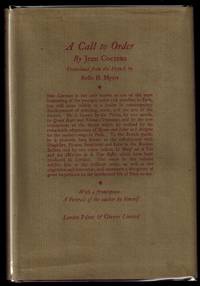
1926007604London: Faber and Gwyer 1926. Book. Near Fine. Cloth. First Edition. 8vo - over 7¾" - 9¾" tall. RARE in dust wrapper and this one quite nice Near Fine a hint of toning to end pages prior owner name front end page in a Near Fine dust wrapper tiny chips at head of spine small old tape mends internally at fold edges. Written between the years 1918 and 1926 and including "Cock and Harlequin" "Professional Secrets" and other critical essays. With a frontispiece titled "A portrait of the artist by himself". Faber and Gwyer Hardcover
1946213325Paris: Editions de Clermont 1946. Softcover. VG. Wear around the edges of the wraps with a little more bumping at the head/tail of spine. Interior has some toning but plates a bright and clear. Quarto. Softcover. Blue paper wraps with white titles. 144 pages plates some color portraits 28 cm. Presentation copy to Herbert Bayer with a long personal inscription from Vienot dated 1951. Editions de Clermont paperback
1928184934Paris: Edward W. Titus 1928. First edition limited issue number 5 of 250 copies on large paper. Imaginary Letters is a fictional tale of gay heartbreak in 1920s Paris comprised of eight letters written to the mother of a young Russian by one of his infatuated friends. It was the first book Cocteau illustrated aside from his own publications. Cocteau and Butts met at the Hotel Welcome in the French Riviera. Butts writes of her first impression "aged & suffering Latin quicksilver quality. I like him not at all afraid of him. 'Touches nothing that he does not adorn'. I think that's the phrase. Yes France's Brightest Boy." Square octavo. Copper-engraved frontispiece and 3 plates all after original drawings by Jean Cocteau. Original tan cloth paper labels printed in red on spine and front board edges uncut a few gatherings unopened. With glassine jacket. Edges and outer leaves a little foxed; a little loss to glassine jacket: a very good copy. Mary Butts The Journals 2002. hardcover
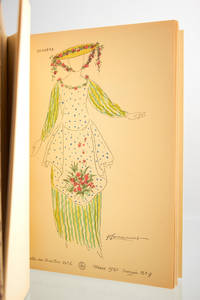
192073134Paris: Lucien Vogel éditeur 1920. Fine. Lucien Vogel éditeur Paris 1920 18 x 24 cm relié Set of eight original color engravings printed on laid paper and signed at the lower right and left of the plates. The plates are introduced by a text signed by Jean Cocteau and depict costumes for Shakespeares play two Shepherdesses Paulina and Time. Bradel binding in full decorative paper smooth spine brown shagreen title-piece binding signed by Goy & Vilaine. Original engravings created for the illustration of La Gazette du bon ton one of the most beautiful and influential fashion magazines of the twentieth century celebrating the talent of French designers and artists at the height of the Art Deco movement. A celebrated fashion periodical founded in 1912 by Lucien Vogel La Gazette du bon ton appeared until 1925 with an interruption between 1915 and 1920 due to the mobilization of its editor-in-chief. It comprises 69 issues printed in only 2000 copies and is illustrated with 573 color plates and 148 sketches depicting designs by leading couturiers. From the outset these luxurious publications were addressed to bibliophiles and worldly aesthetes Françoise Tétart-Vittu La Gazette du bon ton in Dictionnaire de la mode 2016. Printed on fine laid paper they employed a typeface specially created for the review by Georges Peignot the Cochin type later revived by Christian Dior in 1946. The engravings were produced using the pochoir technique hand-colored and in some cases heightened with gold or palladium. The venture began in 1912 when Lucien Vogel a man of fashion and societyalready involved with the magazine Feminadecided with his wife Cosette de Brunhoff sister of Jean the father of Babar to establish La Gazette du bon ton subtitled Art modes et frivolités. Georges Charensol reports the words of the editor-in-chief: In 1910 he observed there was no fashion magazine truly artistic and representative of the spirit of its time. I therefore thought of creating a luxury magazine with genuinely modern artists . I was certain of success for in matters of fashion no country can rival France. Un grand éditeur dart. Lucien Vogel in Les Nouvelles littéraires no.133 May 1925. The success of the review was immediate not only in France but also in the United States and South America. At the outset Vogel brought together a group of seven artists: André-Édouard Marty and Pierre Brissaud soon joined by Georges Lepape and Dammicourt; and finally his friends from the École des Beaux-Arts George Barbier Bernard Boutet de Monvel and Charles Martin. Other talents quickly joined: Guy Arnoux Léon Bakst Benito Umberto Brunelleschi Chas Laborde Jean-Gabriel Domergue Raoul Dufy Édouard Halouze Alexandre Iacovleff Jean Émile Laboureur Charles Loupot Maggie Salcedo. Most of these artists were unknown when Vogel first engaged them yet they would later become emblematic and highly sought-after figures in the art world. These same illustrators also created the advertisements for the Gazette. The plates highlighted and exalted the creations of seven designers of the period: Lanvin Doeuillet Paquin Poiret Worth Vionnet and Doucet. For each issue the couturiers provided exclusive designs. Nevertheless some illustrations did not reproduce actual models but rather conveyed the illustrators vision of contemporary fashion. La Gazette du bon ton represents a decisive stage in the history of fashion. Combining aesthetic refinement with visual unity it brought together for the first time the leading talents of art literature and couture imposing through this alchemy an entirely new image of womanhoodslender independent and boldfurther embodied by the new generation of designers such as Coco Chanel Jean Patou and Marcel Rochas. Taken over in 1920 by Condé Montrose Nast La Gazette du bon ton greatly influenced the new composition and aesthetic choices of the little dying magazine Nast had acquired a few years earlier: V Lucien Vogel éditeur unknown
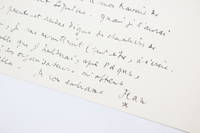
196386003Fréjus 1963. Fine. Fréjus 17 Avril 1963 21.50 x 27.50 cm une page Autograph letter dated and signed by Jean Cocteau 20 lines in black ink on letterhead of the committee for the edification of the chapel of Notre-Dame de Jérusalem de Fréjus. Fold marks inherent to postal dispatch one tear in left margin of the letter at the level of the fold. Jean Cocteau offers profuse apologies while acknowledging mitigating circumstances regarding the emotional burden overwhelming him: ""J'accepte vos reproches avec beaucoup de honte. Mais si je pouvais vous raconter la période que je traverse votre coeur me comprendrait et m'absoudrait."" ""I accept your reproaches with great shame. But if I could tell you about the period I am going through your heart would understand and absolve me."" due to a recently deceased friendship about which he does not wish to reveal more: ""N'en parlons plus et priez pour moi."" ""Let us speak no more of it and pray for me."" Jean Cocteau prefers to discuss his projects: ""Actuellement je me consacre à mon travail de la chapelle du Saint-Sépulcre. Quand je l'aurai construite peinte et rendue digne des chevaliers de Jérusalem je me remettrait sic peut-être à écrire."" ""Currently I am devoting myself to my work on the chapel of the Holy Sepulchre. When I have built it painted it and made it worthy of the knights of Jerusalem I will perhaps start writing again."" and the prospects that delight him: ""Il est probable que je resterais après Pâques à Fréjus où les organisateurs m'offrent une petite villa."" ""It is likely that I will remain after Easter in Fréjus where the organizers are offering me a small villa."" unknown
195885233Saint-Jean-Cap-Ferrat 1958. Fine. Saint-Jean-Cap-Ferrat 4 N ovembre 1958 13.50 x 21 cm trois pages et demi sur deux feuillets Autograph letter signed by Jean Cocteau 52 lines in blue ink to Olivier Quéant sent from the Villa Santo-Sospir in Saint Jean Cap-Ferrat which he decorated. Fold marks inherent to the mailing. Jean Cocteau waxes bucolically enthusiastic about the place where he resides and works: "". chaque jour je travaille à flanc de colline dans une sorte de ferme exquise où ne fleurisse que les grains qui tombent d'ailleurs."" "". each day I work on the hillside in a sort of exquisite farm where only the seeds that fall from elsewhere flourish."" and rhapsodizes about the local craftsmanship: "". des artisans véritables. travailler chez eux c'est le contraire de lire un journal. On aime voir ce miracle de l'équilibre entre le coeur et la main."" "". true artisans. working with them is the opposite of reading a newspaper. One loves to see this miracle of balance between heart and hand."" He informs Olivier Quéant of his upcoming exhibition: ""J'expose le 15 13 pour la première 6 rue Bonaparte. je ne te demande pas de venir voir mes oeuvres mais leur besogne ils le méritent."" ""I'm exhibiting on the 15th 13th for the opening 6 rue Bonaparte. I'm not asking you to come see my works but their labor they deserve it."" and also explains the aesthetic causes he intends to defend henceforth: "". nous menons la même croisade : celle de soutenir ces braves types qu'on dédaigne comme des aristocrates du milieu ouvrier. Le drame c'est que l'artiste qui tournait amoureusement un pied de fauteuil Louis 15 apporte la même application mais froide à forger la pièce d'une machine qui fabriquera le fauteuil."" "". we wage the same crusade: that of supporting these good fellows who are disdained as aristocrats of the working class. The tragedy is that the artist who lovingly turned a Louis XV chair leg applies the same care but cold to forging the part of a machine that will manufacture the chair."" while lamenting that artisanal traditions and know-how are sinking into oblivion: "". les jeunes refusent d'apprendre le métier par exemple des femmes de soixante ans qui firent ce prodige : ma tapisserie de Judith et Holopherne. disaient : c'est la dernière."" "". young people refuse to learn the trade for example women of sixty who performed this miracle: my tapestry of Judith and Holofernes. said: it's the last one."" He hopes to see his friend Olivier Quéant soon: ""Tu en verras une chez les Weill si tu me fais la grâce de venir et si le déluge parisien cesse et si tu ne dois pas atteindre la rue Bonaparte en arche ou gondole."" ""You'll see one at the Weills' if you do me the grace of coming and if the Parisian deluge ceases and if you don't have to reach rue Bonaparte by ark or gondola."" unknown
24564Paris Gallimard juin 1941. 1 vol. 120 x 190 mm de 89 p. et 1 f. Broché. . Édition originale. Un des 75 exemplaires sur alfax Navarre celui-ci parmi les 10 hors commerce n° XVIII. Envoi signé : « à mon très cher André Gide Jean ». . Les rapports entre les deux hommes s’étaient envenimés au moment de la parution de Potomak en 1919 lorsque Gide s’en était pris aux poèmes du Cap de Bonne Espérance : « Il m’appela comme un élève en faute chez le maître d’école et me lut une lettre ouverte qu’il me destinait. On m’adresse pas mal de lettres ouvertes. Dans celle de Gide je figurais en écureuil et Gide en ours au pied de l’arbre. Je sautais des marches et de branche en branche. Bref je recevais une semonce et je devais la recevoir en public. Je lui déclarai qu’à cette lettre ouverte je comptais répondre. Il renifla opina du bonnet me dit que rien n’était plus riche ni plus instructif que ces échanges. On se doute que Jacques Rivière refusa de publier ma réponse dans la N.R.F. où Gide avait publié sa lettre. Elle était assez rude je l’avoue. J’y constatais que la maison de Gide villa Montmorency ne regardait pas en face que ses fenêtres donnaient toutes de l’autre côté ». À cette « Lettre ouverte à Jean Cocteau » parue dans La NRF en juin 1919 Cocteau répliqua dans Les Écrits nouveaux de juin-juillet : « Il y a en vous du pasteur et de la bacchante ». Nouvelle riposte de Gide dans la même revue en octobre lui reprochant « non point tant de suivre que de feindre de précéder ». La rivalité intellectuelle et l’estime distanciée durera tout au long de la vie respective des deux hommes au cours de laquelle ils se croisent aux éditions Gallimard et dans les dîners en ville notamment chez les de Noailles. Cocteau y reviendra dans son Journal d’un inconnu : « J’aimais Gide et il m’agaçait. Je l’agaçais et il m’aimait. Nous sommes quittes. … Au terme de sa vie il vint dans ma maison de campagne avec Herbart. Il souhaitait que je fisse la mise en scène d’un film qu’il tirait d’Isabelle. À l’œil d’Herbart je devinai qu’il pataugeait. Le film était médiocre. Je le lui expliquai dans une note écrite et qu’on attendait plutôt de lui un film des Faux-Monnayeurs ou des Caves. Il jubilait de m’entendre lire une note. Il empocha cette note. Il est possible qu’on la retrouve dans quelque tiroir. Nos contacts furent agréables jusqu’à sa fin jusqu’à la lettre où Jean Paulhan me le décrivait comme pétrifié sur son lit de mort. » Gide dès août 1914 avait marqué ses distances : « Jean Cocteau m’avait donné rendez-vous à un ‘thé anglais’ au coin de la rue de Ponthieu et de l’avenue d’Antin. Je n’ai pas eu de plaisir à le revoir malgré son extrême gentillesse ; mais il est incapable de gravité et toutes ses pensées ses mots d’esprits ses sensations tout cet extraordinaire brio de son parler habituel me choquait comme un article de luxe étalé en temps de famine et de deuil …. Il y a chez lui l’insouciance du Gavroche ; c’est près de lui que je me sens le plus maladroit le plus lourd le plus morose ». Paris, Gallimard, (juin) 1941. 1 vol. (120 x 190 mm) de 89 p. et [1] f. Broché. unknown
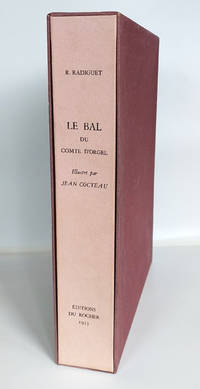
1953003111Monaco: Editions du Rocher 1953. Book. Fine. Soft cover. Loose sheets in wrappers cardboard chemise and slipcase. This 1953 edition is illustrated with 34 original etchings by Jean Cocteau all protected by tissue guards with printed text. Copy number 171 of a total edition of 277 copies. One of 220 copies printed on Velin pur fil. Light offsetting to wrappers and lightest wear to slipcase. 184 pp. 33 x 26 cm. A very fine collectible copy. . Editions du Rocher Paperback
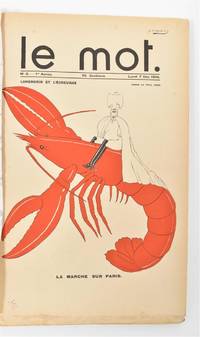
1915191415SSParis: MOT 1915. First Edition. all issues bound in one volume. Very Good. LE MOT hedomadaire illustre published and printed by MOT gerant: Paul Iribe Paris.<br /> Vols. 1-20 Nov. 1914 - July 1915 all published. Contemporary private half leather. Folio. 17.5" x 11.5" Untrimmed. With various invitation-leaflets for subscription bound in. Each title page has a very small stamp "J de Sainte Foy" on top<br /> <br /> Complete set of famous satirical bi-monthly by Jean Cocteau marked by its pacifist and anti-militaristic stance with pronounced anti-German sentiment. Contributors incl. a.o.: Raoul Dufy Sem Gleizes Iribe André Lhote Léon Bakst and Cocteau some contributions signed under his pseudonym Jim after his dog's name. MOT unknown
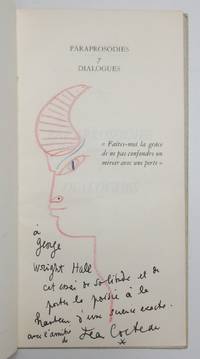
1958202433Editions du Rocher 1958. 1st Edition. Hardcover. 11.2 x 22 cm grey paper wraps with red decoration and black titles to the front 37 1pp with erratum tipped in. The half title contains a red and blue profile portrait drawn by the artist with a personal inscription reading. ' à George/ Wright Hall /cet essai de solitude et de/ porter le poise à la/ hauteur d'une sucrie exacte./ avec l'amitie/ de Jean Cocteau'. The pamphlet also comes with its original mailing envelope written by Cocteau with his return address in Saint Jean Cap Ferrat France. There is a light horizontal mark just up from the end of the "S" of "DIALOGUES" and across onto the spine and a round mark immediately below the bottom triangle slightly right of centre on the front cover. Otherwise it is in at least near fine condition. The envelope is addressed by Cocteau to his friend George Wright Hall 1895-1974 who had studied in Edinburgh in the early 1920s and was a member of the 1922 Group. It bears its original stamps and Cocteau's return address. The envelope has been opened along the top and both side are now open too. The two sides of it remain partially joined along the bottom edge but this has been conserved by the application of Japanese paper. In all a lovely inscribed item complete with the envelope Cocteau used to send it and which has helped to keep the book so well preserved. Rainford & Parris Books welcomes enquiries so please do not hesitate to ask if you require further images or have any questions. All books are packaged with great care. Editions du Rocher hardcover
130921952-1961. Circa 20 items two printed others typescript and manuscript various formats including: a. Autograph Letter en francais Signed "Jean Cocteau" 19 Dec. 1952 one page c.20 x 30cm to Edward O. Marsh translator and adapter presumably a response to e. below partly about translation and translators; b. Agreement one page folio signed on behalf of Cocteau on 7 November 1952 on share of revenue between Marsh and Cocteau on adaptation SIGNED by Marsh and by a representative of the Union Financière Artistique on behalf of Cocteau see scan on website appointing Dr Jan van Loewen as exclusive agent; c. Memorandum of Agreementcarbon 4pp. folio UNSIGNED 21 Oct. 1952 between Jean Cocteau and Edward O. Marsh and London Arts Theatre Committee Ltd lightly annotated and corrected in unknown hand terms of production etc; d. draft letter heavily worked manuscript in French using version of an unrelated TLS his text spilling onto the second page Edward Marsh to Cocteau recalling their first meeting on the subject of "Les Monstres Sacres" and discussing changes for English audiences and hoping for success; e. carbon copy of this draft letter dated 5 Nov. 1952 d.; f. other related correspondence some carbons involving Marsh's agent Dr Jan van Loewen Associated Rediffusion discussing TV version one saying the play wasn't suitable not being "vintage Cocteau"; g. two theatre programmes. 1952-1961. unknown
51-3556Paris: circa 1930s. 4to. ALS from Cocteau to Fernand DivoireAdressée à Divoire sans doute Fernand Divoire et traitant de sa relation avec Picasso : … je suis presque parrain de son fils - j’étais témoin de son mariage etc. Ainsi que de son rapport à Picabia.Fernand Divoire né le 10 mars 1883 à Bruxelles et mort le 18 juillet 1951 à Vaucresson est un écrivain d'origine belge et naturalisé français en 1912.Provenance:José Chaidron 1913-1997Comme l’avait dit Jean-Pierre Lambot lors du décès de José Chaidron en juillet 1997 : « La Glycine était plus encore qu’un hôtel devenu galerie d’art. Elle était l’expression des passions de José et Dieu sait s’il en avait. On peut dire que chaque vitrine du rez-de-chaussée abritait une collection qui était chaque fois une passion : Jean Marais Jean Cocteau la numismatique la géologie les statuettes religieuses et puis aussi cette extraordinaire série de miniatures consacrées au pont Saint Lambert. Chacune de ces collections était en définitive une facette de l’esprit envieux mais aussi imaginatif de José Chaidron » Au fil des années la Glycine est devenu un véritable temple de l’Art. Les premiers à y exposer seront deux ecclésiastiques : Bonaventure Feuillin et Cornerotte. Des centaines d’autres suivront. Parmi eux on peut citer Maringer Schuddeboom Marie Howet Albert Raty Benjamin Gourmet etc. Tous y laisseront des souvenirs inoubliables et contribueront à la renommée de l’établissement. Paris: circa 1930s. unknown
19554801France: Grasset 1955 120 pp.; Exemplar 313 out of 455; The book is inscribed on front page "Salut bien amical de jean cocteau 1958" with the star signature and contains a drawing by him - all in blue pen. Uncut; minor wear to cover; else in good condition. Size: 22 cm Tall Grasset paperback
19644807Paris: Galerie Jean Giraudoux 1964. Quarto unpaginated. Twenty original illustrations in red on ivory cloth pages. FIRST EDITION limited to 800 copies with this being number 64 of 770 unsigned copies. A collection of recipes by the chef of Le Grand Vefour the first really magnificent restaurant of Paris which originally opened in 1784. The restaurant was revived with Oliver in charge in 1948 having been closed in 1905. It was awarded a third Michelin star in 1953. In this book Oliver shares dishes he makes for his friends. A touch of very light foxing to edges of text block otherwise fine in ivory cloth in very lightly soiled slipcase with chemise. With an additional suite of twelve lithographs on B.F.K. Rives labelled in pencil "Avantages Réservés aux membres de Tradition et Qualité" Galerie Jean Giraudoux hardcover