3 896 résultats
19644807Paris: Galerie Jean Giraudoux 1964. Quarto unpaginated. Twenty original illustrations in red on ivory cloth pages. FIRST EDITION limited to 800 copies with this being number 64 of 770 unsigned copies. A collection of recipes by the chef of Le Grand Vefour the first really magnificent restaurant of Paris which originally opened in 1784. The restaurant was revived with Oliver in charge in 1948 having been closed in 1905. It was awarded a third Michelin star in 1953. In this book Oliver shares dishes he makes for his friends. A touch of very light foxing to edges of text block otherwise fine in ivory cloth in very lightly soiled slipcase with chemise. With an additional suite of twelve lithographs on B.F.K. Rives labelled in pencil "Avantages Réservés aux membres de Tradition et Qualité" Galerie Jean Giraudoux hardcover
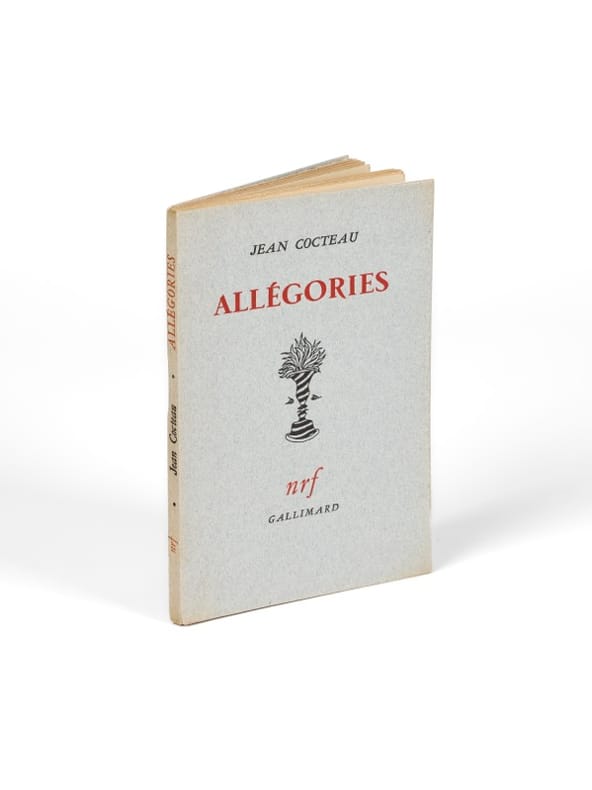
194074207Paris Gallimard 1940 1 vol. broché in-12, broché, couverture à rabats, 211 pp. Édition originale. Un des 10 exemplaires numérotés sur Madagascar réservés à l'auteur. En parfait état.
196261421962 Robert Léger, Paris, 1962. Grand in-4 en feuilles sous chemise et emboîtage, 163 pages dont 25 aquarelles de Jean-Pierre Rémon sous serpentes, portfolio contenant 11 aquarelles supplémenataires (dt 1 double), suite en noir des 25 dans portfolio. Sans le tableau encadré mentionné dans la justification. L'un des 25 exemplaires sur japon nacré, celui-ci le n°25. Très bel exemplaire.
195687010Saint-Jean-Cap-Ferrat 31 Décembre 1956 | 21 x 27 cm | une page + une enveloppe
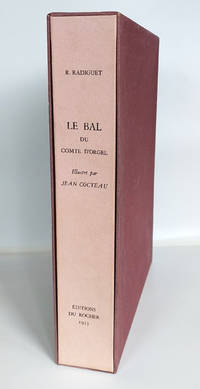
195746197Editions du Rocher | Monaco 1957 | 14 x 19.50 cm | broché
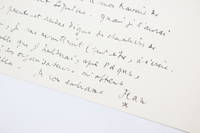
008457Jean Cocteau (1889-1963), poète, artiste. L.A.S., 25 avril 1954, 1p in-8. A l'acteur dramatique Hubert Rouchon, appelé Cher Capitaine, qui était alors en tournée pour La Machine Infernale (1953-1954) avec notamment Jean Marais et Louise Conte (1923-1995) qui deviendra sa compagne. "Très cher capitaine, J'ai reçu des lettres de Jeannot bien triste. Je n'arrive pas à comprendre qu'un type de ton génie - comme dirait Stendhal - descendes à de petites brouilles. Souviens-toi de tes lettres si belles sur la noblesse du caractère de Jeannot. Mille fois, lorsque je tournais un film, j'ai été victime de certaines boutades de sa fatigue, mais que sont-elles à côté de son cour d'or. Mon capitaine, va dans la loge de Jeannot avec sa [...] et embrasse-le. Ne ressemblons jamais à ces imbéciles du festival de Cannes - Claude Mauriac et autres. Je te connais, je suis sûr que tu te ronges. Si tu m'aimes encore un peu. Ecoute moi. Ton Jean Cocteau." Notons que Cocteau vient d'être président du festival de Cannes du 25 mars au 9 avril 1954. Il l'avait été déjà en 1953. Il sera président d'honneur en 1957 et 1959. Contrecollée sur un papier blanc. Magnifique lettre. [277]
GF29314Il ne demande pas mieux que de l'aider dans son entreprise et lui envoie quelques lignes: "Tout art est abstrait lorsque l'artiste arrive à dominer le prétexte de son oeuvre. Et s'il le supprime, il ne nous livre plus que son âme" - [Cette phrase sera reproduite en fac-similé sur des cartons d'invitation à une présentation en avant première à Monte-Carlo, villa Belgica, de la prochaine exposition à New-York des Artistes de France Associés les 10 et 24 juillet 1959] - Il lui recommande en plus de prendre contact "avec un jeune peintre abstait de premier ordre et vierge de galeries, Martial Raysse"
192382698Couverture souple verte. Ouvrage dédié à Erik Satie, illustré de 16 reproductions hors-texte dont un portrait-photo de Picasso par Man Ray, in-fine.
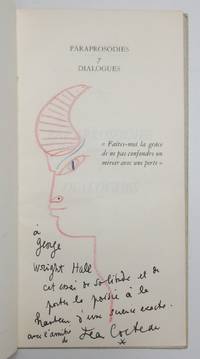
1958202433Editions du Rocher 1958. 1st Edition. Hardcover. 11.2 x 22 cm grey paper wraps with red decoration and black titles to the front 37 1pp with erratum tipped in. The half title contains a red and blue profile portrait drawn by the artist with a personal inscription reading. ' à George/ Wright Hall /cet essai de solitude et de/ porter le poise à la/ hauteur d'une sucrie exacte./ avec l'amitie/ de Jean Cocteau'. The pamphlet also comes with its original mailing envelope written by Cocteau with his return address in Saint Jean Cap Ferrat France. There is a light horizontal mark just up from the end of the "S" of "DIALOGUES" and across onto the spine and a round mark immediately below the bottom triangle slightly right of centre on the front cover. Otherwise it is in at least near fine condition. The envelope is addressed by Cocteau to his friend George Wright Hall 1895-1974 who had studied in Edinburgh in the early 1920s and was a member of the 1922 Group. It bears its original stamps and Cocteau's return address. The envelope has been opened along the top and both side are now open too. The two sides of it remain partially joined along the bottom edge but this has been conserved by the application of Japanese paper. In all a lovely inscribed item complete with the envelope Cocteau used to send it and which has helped to keep the book so well preserved. Rainford & Parris Books welcomes enquiries so please do not hesitate to ask if you require further images or have any questions. All books are packaged with great care. Editions du Rocher hardcover
130921952-1961. Circa 20 items two printed others typescript and manuscript various formats including: a. Autograph Letter en francais Signed "Jean Cocteau" 19 Dec. 1952 one page c.20 x 30cm to Edward O. Marsh translator and adapter presumably a response to e. below partly about translation and translators; b. Agreement one page folio signed on behalf of Cocteau on 7 November 1952 on share of revenue between Marsh and Cocteau on adaptation SIGNED by Marsh and by a representative of the Union Financière Artistique on behalf of Cocteau see scan on website appointing Dr Jan van Loewen as exclusive agent; c. Memorandum of Agreementcarbon 4pp. folio UNSIGNED 21 Oct. 1952 between Jean Cocteau and Edward O. Marsh and London Arts Theatre Committee Ltd lightly annotated and corrected in unknown hand terms of production etc; d. draft letter heavily worked manuscript in French using version of an unrelated TLS his text spilling onto the second page Edward Marsh to Cocteau recalling their first meeting on the subject of "Les Monstres Sacres" and discussing changes for English audiences and hoping for success; e. carbon copy of this draft letter dated 5 Nov. 1952 d.; f. other related correspondence some carbons involving Marsh's agent Dr Jan van Loewen Associated Rediffusion discussing TV version one saying the play wasn't suitable not being "vintage Cocteau"; g. two theatre programmes. 1952-1961. unknown
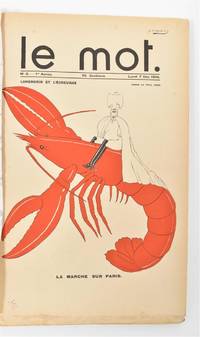
1915191415SSParis: MOT 1915. First Edition. all issues bound in one volume. Very Good. LE MOT hedomadaire illustre published and printed by MOT gerant: Paul Iribe Paris.<br /> Vols. 1-20 Nov. 1914 - July 1915 all published. Contemporary private half leather. Folio. 17.5" x 11.5" Untrimmed. With various invitation-leaflets for subscription bound in. Each title page has a very small stamp "J de Sainte Foy" on top<br /> <br /> Complete set of famous satirical bi-monthly by Jean Cocteau marked by its pacifist and anti-militaristic stance with pronounced anti-German sentiment. Contributors incl. a.o.: Raoul Dufy Sem Gleizes Iribe André Lhote Léon Bakst and Cocteau some contributions signed under his pseudonym Jim after his dog's name. MOT unknown
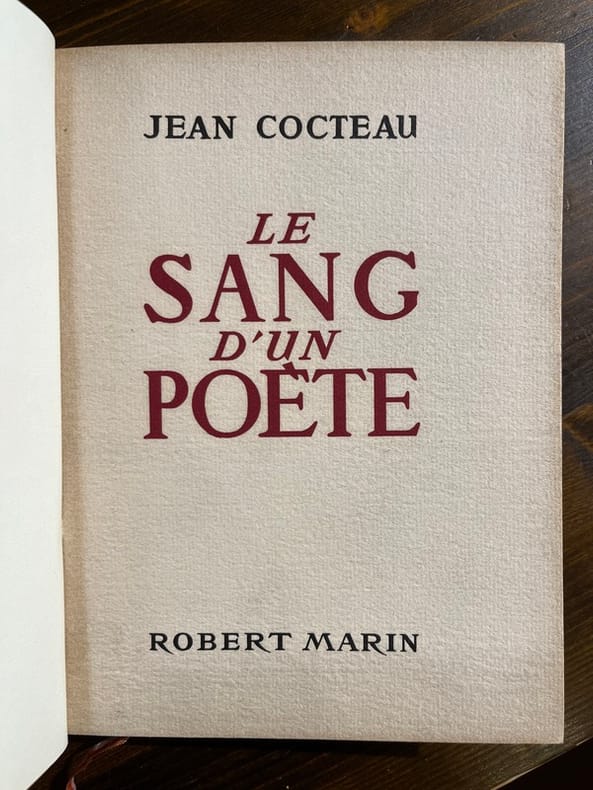
194820172sans lieu, Robert Marin, 1948. 1 vol. in-8 br. de 106-[4] pages, plein maroquin rouge (sang), dos à nerfs, couvertures conservées, tête dorée.
194124564Paris, Gallimard, (juin) 1941. 1 vol. (120 x 190 mm) de 89 p. et [1]f. Broché. Édition originale. Un des 75 exemplaires sur alfax Navarre, celui-ci parmi les 10 hors commerce (n° XVIII). Envoi signé : «à mon très cher André Gide, Jean».
194842155Sans lieu (Paris) Robert Marin 1948 In-8, broch, couverture imprime.Edition originale, illustre de photographies de Sacha Mansour extraites du film mis en scne par Jean Cocteau. Tirage limit 1.940 exemplaires numrots. Un des 95 exemplaires sur vlin d'Isre, second papier aprs 45 exemplaires sur vlin d'Arches. Exemplaire enrichi d'une carte grave indiquant le changement d'adresse de l'auteur (H.8 x L.10,7 cm, papier fort crme).
24564Paris Gallimard juin 1941. 1 vol. 120 x 190 mm de 89 p. et 1 f. Broché. . Édition originale. Un des 75 exemplaires sur alfax Navarre celui-ci parmi les 10 hors commerce n° XVIII. Envoi signé : « à mon très cher André Gide Jean ». . Les rapports entre les deux hommes s’étaient envenimés au moment de la parution de Potomak en 1919 lorsque Gide s’en était pris aux poèmes du Cap de Bonne Espérance : « Il m’appela comme un élève en faute chez le maître d’école et me lut une lettre ouverte qu’il me destinait. On m’adresse pas mal de lettres ouvertes. Dans celle de Gide je figurais en écureuil et Gide en ours au pied de l’arbre. Je sautais des marches et de branche en branche. Bref je recevais une semonce et je devais la recevoir en public. Je lui déclarai qu’à cette lettre ouverte je comptais répondre. Il renifla opina du bonnet me dit que rien n’était plus riche ni plus instructif que ces échanges. On se doute que Jacques Rivière refusa de publier ma réponse dans la N.R.F. où Gide avait publié sa lettre. Elle était assez rude je l’avoue. J’y constatais que la maison de Gide villa Montmorency ne regardait pas en face que ses fenêtres donnaient toutes de l’autre côté ». À cette « Lettre ouverte à Jean Cocteau » parue dans La NRF en juin 1919 Cocteau répliqua dans Les Écrits nouveaux de juin-juillet : « Il y a en vous du pasteur et de la bacchante ». Nouvelle riposte de Gide dans la même revue en octobre lui reprochant « non point tant de suivre que de feindre de précéder ». La rivalité intellectuelle et l’estime distanciée durera tout au long de la vie respective des deux hommes au cours de laquelle ils se croisent aux éditions Gallimard et dans les dîners en ville notamment chez les de Noailles. Cocteau y reviendra dans son Journal d’un inconnu : « J’aimais Gide et il m’agaçait. Je l’agaçais et il m’aimait. Nous sommes quittes. … Au terme de sa vie il vint dans ma maison de campagne avec Herbart. Il souhaitait que je fisse la mise en scène d’un film qu’il tirait d’Isabelle. À l’œil d’Herbart je devinai qu’il pataugeait. Le film était médiocre. Je le lui expliquai dans une note écrite et qu’on attendait plutôt de lui un film des Faux-Monnayeurs ou des Caves. Il jubilait de m’entendre lire une note. Il empocha cette note. Il est possible qu’on la retrouve dans quelque tiroir. Nos contacts furent agréables jusqu’à sa fin jusqu’à la lettre où Jean Paulhan me le décrivait comme pétrifié sur son lit de mort. » Gide dès août 1914 avait marqué ses distances : « Jean Cocteau m’avait donné rendez-vous à un ‘thé anglais’ au coin de la rue de Ponthieu et de l’avenue d’Antin. Je n’ai pas eu de plaisir à le revoir malgré son extrême gentillesse ; mais il est incapable de gravité et toutes ses pensées ses mots d’esprits ses sensations tout cet extraordinaire brio de son parler habituel me choquait comme un article de luxe étalé en temps de famine et de deuil …. Il y a chez lui l’insouciance du Gavroche ; c’est près de lui que je me sens le plus maladroit le plus lourd le plus morose ». Paris, Gallimard, (juin) 1941. 1 vol. (120 x 190 mm) de 89 p. et [1] f. Broché. unknown
192082662Sous double couverture souple bleue et verte. Non rogné.
190987875S. n. | s. l. s.d. (ca 1909) | 20 x 25.50 cm | une page
190988017s. n. | s. l. s.d. (ca 1909) | 24.50 x 25 cm | une page
190988018s. n. | s. l. s.d. (ca 1909) | 24.50 x 25 cm | une page
190988070s. n. | s. l. s.d. (ca 1909) | 24.50 x 25 cm | une page
190988081s. n. | s. l. s.d. (ca 1909) | 24.50 x 25 cm | une page
1953003111Monaco: Editions du Rocher 1953. Book. Fine. Soft cover. Loose sheets in wrappers cardboard chemise and slipcase. This 1953 edition is illustrated with 34 original etchings by Jean Cocteau all protected by tissue guards with printed text. Copy number 171 of a total edition of 277 copies. One of 220 copies printed on Velin pur fil. Light offsetting to wrappers and lightest wear to slipcase. 184 pp. 33 x 26 cm. A very fine collectible copy. . Editions du Rocher Paperback
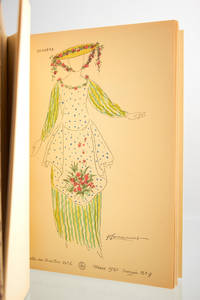
192073134Paris: Lucien Vogel éditeur 1920. Fine. Lucien Vogel éditeur Paris 1920 18 x 24 cm relié Set of eight original color engravings printed on laid paper and signed at the lower right and left of the plates. The plates are introduced by a text signed by Jean Cocteau and depict costumes for Shakespeares play two Shepherdesses Paulina and Time. Bradel binding in full decorative paper smooth spine brown shagreen title-piece binding signed by Goy & Vilaine. Original engravings created for the illustration of La Gazette du bon ton one of the most beautiful and influential fashion magazines of the twentieth century celebrating the talent of French designers and artists at the height of the Art Deco movement. A celebrated fashion periodical founded in 1912 by Lucien Vogel La Gazette du bon ton appeared until 1925 with an interruption between 1915 and 1920 due to the mobilization of its editor-in-chief. It comprises 69 issues printed in only 2000 copies and is illustrated with 573 color plates and 148 sketches depicting designs by leading couturiers. From the outset these luxurious publications were addressed to bibliophiles and worldly aesthetes Françoise Tétart-Vittu La Gazette du bon ton in Dictionnaire de la mode 2016. Printed on fine laid paper they employed a typeface specially created for the review by Georges Peignot the Cochin type later revived by Christian Dior in 1946. The engravings were produced using the pochoir technique hand-colored and in some cases heightened with gold or palladium. The venture began in 1912 when Lucien Vogel a man of fashion and societyalready involved with the magazine Feminadecided with his wife Cosette de Brunhoff sister of Jean the father of Babar to establish La Gazette du bon ton subtitled Art modes et frivolités. Georges Charensol reports the words of the editor-in-chief: In 1910 he observed there was no fashion magazine truly artistic and representative of the spirit of its time. I therefore thought of creating a luxury magazine with genuinely modern artists . I was certain of success for in matters of fashion no country can rival France. Un grand éditeur dart. Lucien Vogel in Les Nouvelles littéraires no.133 May 1925. The success of the review was immediate not only in France but also in the United States and South America. At the outset Vogel brought together a group of seven artists: André-Édouard Marty and Pierre Brissaud soon joined by Georges Lepape and Dammicourt; and finally his friends from the École des Beaux-Arts George Barbier Bernard Boutet de Monvel and Charles Martin. Other talents quickly joined: Guy Arnoux Léon Bakst Benito Umberto Brunelleschi Chas Laborde Jean-Gabriel Domergue Raoul Dufy Édouard Halouze Alexandre Iacovleff Jean Émile Laboureur Charles Loupot Maggie Salcedo. Most of these artists were unknown when Vogel first engaged them yet they would later become emblematic and highly sought-after figures in the art world. These same illustrators also created the advertisements for the Gazette. The plates highlighted and exalted the creations of seven designers of the period: Lanvin Doeuillet Paquin Poiret Worth Vionnet and Doucet. For each issue the couturiers provided exclusive designs. Nevertheless some illustrations did not reproduce actual models but rather conveyed the illustrators vision of contemporary fashion. La Gazette du bon ton represents a decisive stage in the history of fashion. Combining aesthetic refinement with visual unity it brought together for the first time the leading talents of art literature and couture imposing through this alchemy an entirely new image of womanhoodslender independent and boldfurther embodied by the new generation of designers such as Coco Chanel Jean Patou and Marcel Rochas. Taken over in 1920 by Condé Montrose Nast La Gazette du bon ton greatly influenced the new composition and aesthetic choices of the little dying magazine Nast had acquired a few years earlier: V Lucien Vogel éditeur unknown
196386003Fréjus 1963. Fine. Fréjus 17 Avril 1963 21.50 x 27.50 cm une page Autograph letter dated and signed by Jean Cocteau 20 lines in black ink on letterhead of the committee for the edification of the chapel of Notre-Dame de Jérusalem de Fréjus. Fold marks inherent to postal dispatch one tear in left margin of the letter at the level of the fold. Jean Cocteau offers profuse apologies while acknowledging mitigating circumstances regarding the emotional burden overwhelming him: ""J'accepte vos reproches avec beaucoup de honte. Mais si je pouvais vous raconter la période que je traverse votre coeur me comprendrait et m'absoudrait."" ""I accept your reproaches with great shame. But if I could tell you about the period I am going through your heart would understand and absolve me."" due to a recently deceased friendship about which he does not wish to reveal more: ""N'en parlons plus et priez pour moi."" ""Let us speak no more of it and pray for me."" Jean Cocteau prefers to discuss his projects: ""Actuellement je me consacre à mon travail de la chapelle du Saint-Sépulcre. Quand je l'aurai construite peinte et rendue digne des chevaliers de Jérusalem je me remettrait sic peut-être à écrire."" ""Currently I am devoting myself to my work on the chapel of the Holy Sepulchre. When I have built it painted it and made it worthy of the knights of Jerusalem I will perhaps start writing again."" and the prospects that delight him: ""Il est probable que je resterais après Pâques à Fréjus où les organisateurs m'offrent une petite villa."" ""It is likely that I will remain after Easter in Fréjus where the organizers are offering me a small villa."" unknown